Monday, July 18, 2005

Immortality

December 1999, J-F and I vacationed in Paris. The brink of a new millennium, amid apocalyptic prophecies, and just before devastating storms swept the city and the rest of Europe.

All travels, I think, are marked by a theme or concept, often identified only retrospectively. Our trip wore an air of chaos, a sign of the times; we were gasping for breath and raging out of control. We celebrated a fierce love, as if enjoying a last hurrah on the eve of the world's end, though I realize now it signified the transition from the wildness of youth to adulthood and commitment.

Our trip had a soundtrack. And J-F purchased Enki Bilal's La trilogie Nikopol. He'd been a fan for years. The images were new to me.


© Enki Bilal.
 Posted by Picasa

The work is now available in English, and the first two parts of the trilogy have been translated to film (with many identical frames).

Immortel ad vitam ("Immortal" in English), directed by Enki Bilal, is a stunning blue-grey dystopia with a brooding soundscape.

The acting is atrocious. We'd assumed (wrongly) the film was in French and set it to play with English subtitles (for my benefit). We were lucky on this point — the French voice-acting carried far more pathos (and being the language of the original better evoked the scripts of J-F's adolescence). In particular, English is foreign to the actors playing Nikopol and Horus, and it shows.

The story is weak. Elements of it are full of promise, but none is ever explored.

The year is 2095. Aliens (the ancient Egyptian Gods) hover over the city. Horus has been condemned to death (we don't know why) but he returns to Earth in his final days, searching for a human host (Nikopol) by which to mate to continue his legacy.

In 2095, humans modify and upgrade body parts. Corporate and political interests involve the eugenics laboratories. Human society seems to be sharply stratified.

The film version has changed Nikopol's backstory. Now he's a revolutionary whose spirit has infected the masses. An interesting angle, but one that's not exploited.

The locale has been changed to New York City. The futuristic vision is striking, yet I feel the city itself was not as much a character as it could've been. Bilal would've wandered the streets of his own city, Paris, the story's original setting, more lovingly and to much greater effect.

The movie is still beautiful, with a visual and spiritual poetry. At times, I was reminded of Wings of Desire in the texture of the city, the home they're passing through, and, not least, thematically, as the blue-haired woman, an alien and destined to be Horus's "vessel," forgets her past and learns to be human. We catch occasional glimpses of her own perspective swimming through our world.

Nikopol is struck against a wall and seen to be "crucified." Horus mentions those very few special women — no one knows when or where they will appear — who are able to carry the seed of a god. None of the imagery or allusions is carried far enough to call any of it an allegory, which is a shame, because these are pretty cool notions and it seems to me the Earth of 2095 may need salvation.

This film is terribly flawed, but outstanding in evincing a strange and unique vision of our future. Others will argue it's not so original, pointing to Bladerunner and The Fifth Element, or any number of sci-fi movies featuring corporate city-states or genetic manipulation. Immortel is all these with a twist, just a little weirder, a little richer, stretching the ideas so they are part of the fabric, without condescending to explain them.

It is one of the first movies to use an entirely digital backlot and uses only three human actors. I am mystified by some of the animation choices: why so obviously crude in places? why not real people? However, the Egyptian gods were rendered beautifully and naturally, I thought (though many people disagree).

All this is to say: I really liked this movie, but I don't know why.

Trailer and extracts available on the movie's official site (in French, but it's better that way).

Brief bio.
Interview.
Article.
Review.

Friday, July 15, 2005

Bad books

Parents Against Bad Books in Schools lists books with questionable material along with a review form to help objectively identify them. (Via MobyLives.)

I can't imagine teenagers really enjoying Umberto Eco's The Name of the Rose, but they may pick it up now to be titillated by such tasty bits as this:

"He pointed to the Virgin’s slender bust, held high and tight by a cross-laced bodice, which the (Christ) Child’s tiny hands fondled.... Beautiful also are the breasts, which protrude slightly, only faintly tumescent, and do not swell licentiously, suppressed but not depressed... What do you feel before this sweetest of visions?"


Also noted are many controversial sentiments:
"A dream is a scripture, and many scriptures are nothing but dreams."
"...the female is a vessel of the devil..."

The book is riddled with homosexual monks, and there's witchcraft (never mind, that the "witch" is to be burned at the stake for it).

PABBIS, curriculum Inquisitors, are on the job. I just knew The Name of the Rose was a corrupting force.

Wednesday, July 13, 2005

Pottering

"It is good that you explain the facts of Harry Potter, because this is a subtle seduction, which has deeply unnoticed and direct effects in undermining the soul of Christianity before it can really grow properly."

Do you know the facts?

Should I cave to the great marketing machine and just go ahead and order the damn book?

Tuesday, July 12, 2005

Art by any other name

Easels were always liberally sprinkled throughout my Sims' houses. I was always making my Sims paint.

It's no surprise then that I had to have one for my little girl (Ikea, half price!). I've never forced it on her, but I'm ecstatic when she goes looking for it. It becomes her sole plaything for days at a time. It remained "packed" after our move, stored at the back of a closet, but the other week she asked after it.

As much as I delight in hearing of other people's artistic endeavours, I don't feel quite at ease in practicing my own. However, when I do sit down with Helena for colouring and when she invites me to her easel, I often stay with it long after her attention has passed to something else. I find it immensely calming.


J-F has been mocking our (my) "art" — as having a decidely Paleolithic influence reminiscent of the cave of Lascaux and other Magdalenian sites.

But what were these deliberately engineered and carefully contrived experiences designed to convey? What was the purpose of Magdalenian art? The answer is: we do not know, and we may never know. The earliest explanation was that they were the evening doodles of hunters, with no systematic purpose, spiritual, religious, utilitarian, totemic or even aesthetic. Then, throughout the twentieth century, eminent scholars the Abbé Henri Breuil, Max Raphael, Annette Laming Emperaire, Andre Leroi Gourhan, Reynaldo González Garcia and others devoted many years to formulating, elaborating and proving theories of use. These are contradictory and often mutually exclusive, and all have been eventually invalidated by fresh discoveries which do not fit. The utilitarian theory has been most generally held. But if the art was designed to teach the science of hunting, why did it include creatures already extinct or others that were never hunted? Why did it not include specific hunting scenes? In any case, anyone who has actually hunted knows that its skills are acquired not by studying pictures but by practise, something in which primitive peoples engaged from earliest youth, indeed childhood. Non utilitarian theories see the art as shamanistic, or magical or religious. But none of these fits all, or most or even many of the facts. There are no sacrifices depicted. Humans, almost always the central point of early religious art systems, scarcely figure at all. With one possible exception, the art shows no priest or sorcerer or witch doctor. There is nothing which could be termed a ceremony. An immense amount of classification and taxonomy has been performed on the caves and their contents, and elaborate timeschemes have been worked out. But these chronologies provide the appearance of knowledge rather than its reality. The earliest explanation seems as likely to be true, or untrue, as the later ones. We are a huge distance from Magdalenian society and its mentality, and finding answers to its mysterious actions requires an effort of imagination which may be beyond us.


According to Wikipedia, "the commonest themes in cave paintings are large wild animals, such as bison, horses, aurochs, and deer, and tracings of human hands." According to me, that last one is a dead giveaway as to the nature and intent of these artworks.

Saturday

Such prosperity, whole emporia dedicated to cheeses, ribbons, Shaker furniture, is protection of a sort. This commercial wellbeing is robust and will defend itself to the last. It isn't rationalism that will overcome the religious zealots, but ordinary shopping and all that it entails — jobs for a start, and peace, and some commitment to realisable pleasures, the promise of appetites sated in this world, not the next. Rather shop than pray.


Saturday I rose early after a restless night, feeling a little drunk still, and started to read about Henry, who was just getting up from a very restless night.

Saturday, by Ian McEwan.

On the cover, an alarm clock, or a time bomb.

(Helena had gone to her grandmother's house Friday night. J-F and I had been looking forward to a day of some final unpacking — installing ourselves, towel racks, and curtains. The rain inspired instead a lazy day, drinking coffee, lounging, reading. Such days are so rare now. I love them.

Saturday had arrived in my mailbox by accident. I'd heard wonderful things about it, and, while I hadn't been sufficiently motivated to procure myself a copy, its immediate presence demanded I take a closer look.

I meant to skim it, for a slightly fuller taste than what the reviews had offered. Then I'd pack it back in its box and return it. But I feel, now, that would stealing. The book is a keeper, even if it's eating up a budget I'd intended for other books.)

I had trouble settling into the novel at first. I was highly distractible — my surrounding, cats, world events were invading my focus. I'm not used to having the luxury of reading for a whole morning at a stretch. Even so, I could recognize the book had merit.

Wonderful descriptions.
The surgeon's fingers: "the tips of which are flat and broad, like the suckers on a a salamander."

A turn of phrase:
"The sea of neural misery is wide and deep."

Poignant observations, expressed with economy:
"The square's public aspect grants privacy to these intimate dramas."

Later:
"...the babel of various gods..."

The novel follows a day in the life of neurosurgeon Henry Perowne on a day off — February 15, 2003, a day of antiwar demonstrations in London.

(A day in the life — a difficult conceit to pull off. For example, Don DeLillo comes to mind, but by contrast, Cosmopolis feels contrived. McEwan's Henry is ordinary, if educated and of a certain class. The characters are psychologically consistent, believable.)

The story is punctuated by new reports and casual conversations with family about current events, primarily the impending war with Iraq.
And how luxurious, to work it all out at home in the kitchen, the geopolitical moves and military strategy, and not be held to account, by voters, newspapers, friends, history. When there are no consequences, being wrong is simply an interesting diversion.


Saturday morning Henry has an altercation with a thug (whom Henry perceives to be afflicted by Huntington’s disease), the effects of which follow him throughout his day.

The encounter is a metaphor. It's an act of terrorism against Henry and, later, his family. The perpetrator is volatile.
Until now, Henry suddenly sees, he’s been in a fog. Astonished, even cautious, but not properly, usefully frightened. . . . The truth, now demonstrated, is that Baxter is a special case — a man who believe he has no future and is therefore free of consequences. . . . It is written. No amount of love, drugs, Bible classes or prison sentencing can cure Baxter or shift him from his course. It's spelled out in fragile proteins, but it could be carved in stone, or tempered steel.
But for all the reductive argument, Perowne can't convince himself that molecules and faulty genes alone are terrorising his family. . . Perowne himself is also responsible. He humiliated Baxter.


McEwan meditates on art. Henry doesn't read much, doesn't have time for literature, doesn't see the sense in imagining a world other than our own, but he is confronted with literature — Henry the scientist spawned a poet daughter.
So far, Daisy's reading lists have persuaded him that fiction is too humanly flawed, too sprawling and hit-and-miss to inspire uncomplicated wonder at the magnificence of human ingenuity, of the impossible dazzlingly achieved. Perhaps only music has such purity.


Science and art are, of course, windows to the same soul.
There is much in human affairs that can be accounted for at the level of the complex molecule. Who could ever reckon up the damage done to love and friendship and all hopes of happiness by a surfeit or depletion of this or that neurotransmitter? And who will ever find a morality, an ethics down among the enzymes and amino acids when the general taste is for looking in the other direction?


Schrodinger is invoked early on. Henry can't make any sense of parallel universes, but he demonstrates a sympathetic, fatalist streak: "Whatever the score, it is already chalked up."

For all his rational, clinical detachment — "He doesn't have the lyric gift to see beyond it [traffic] — he's a realist, and can never escape." — Henry commends the poet's gift of compression while grappling with the impossibility of describing the slow-motion perception of a split-second event. He's thrown off his game when "everything that's happened to him recently occurs to him at once. He's no longer in the present." He's the cat, while trying to run the experiment.

Henry recalls the biography of Darwin he's reading: "There is grandeur in this view of life."
Kindly, driven, infirm Charles in all his humility, bringing on the earthworms and planetary cycles to assist him with a farewell bow. To soften the message, he also summoned up the Creator, but his heart wasn't in it and he ditched Him in later editions. Those five hundred pages deserved only one conclusion: endless and beautiful forms of life, such as you see in a common hedgerow, including exalted beings like ourselves, arose from physical laws, from war of nature, famine and death. This is the grandeur. And a bracing kind of consolation in the brief privilege of consciousness.


Optimism.

Because music's been on my mind lately:
There are these rare moments when musicians together touch something sweeter than they've ever found before in rehearsals or performance, beyond the merely collaborative or technically proficient, when their expression becomes as easy and graceful as friendship or love. This is when they give us a glimpse of what we might be, of our best selves, and of an impossible world in which you give everything you have to others, but lose nothing of yourself. Out in the real world there exist detailed plans, visionary projects for peaceable realms, all conflicts resolved, happiness for everyone, for ever — mirages for which people are prepared to die and kill. Christ's kingdom on earth, the workers' paradise, the ideal Islamic state. But only in music, and only on rare occasions, does the curtain actually lift on this dream of community, and it's tantalisingly conjured, before fading away with the last notes.


In the end, it's poetry that disarms the villain.

Henry dares not imagine. We dare not imagine, but we must. In literature, and in life.

Just passing through

I neglected to alert a few people of my change of address. This is how I came to fail to know of and to decline the Book-of-the-Month club's recent selections. After much delay they came to be delivered to my current address, the rerouting for parcels of which I had to pay extra postage.

I always have to open the box, just in case...

The Mermaid Chair, Sue Monk Kidd.
Yuk. Flat. Boring. Stupid.

Had I come acoss it in a bookstore, I might've read the blurbs and the flaps, decided the plot held little of interest to me, and returned it to the stack. More likely, I'd've judged it by its cover and not picked it up at all.

But as it was sitting in my house, I had to turn the pages. Even if very quickly. Now I know it's not for me.

I haven't decided if I'm grateful for the certain knowledge that this book is not worth any investment or more angry that I wasted even a little time with it.

Friday, July 08, 2005

The world is quiet here

The other week Mental Multivitamin had a few things to say about atonality and Alban Berg, with reference to a recent article excerpted as follows:

Music is both a balm for loneliness and a powerful, renewable source of meaning — meaning in time and meaning for time. The first thing music does is banish silence. Silence is at once a metaphor for loneliness and the thing itself: It's a loneliness of the senses. Music overcomes silence, replaces it. It provides us with a companion by occupying our senses — and, through our senses, our minds, our thoughts. It has, quite literally, a presence. We know that sound and touch are the only sensual stimuli that literally move us, that make parts of us move: Sound waves make the tiny hairs in our inner ears vibrate, and, if sound waves are strong enough, they can make our whole bodies vibrate. We might even say, therefore, that sound is a form of touch, and that in its own way music is able to reach out and put an arm around us.


(Does smell literally move us? Does everyone have nose hairs? Is their movement an essential component of the physiological processing of smells? Smell is powerfully evocative, but the case could be made for sound and taste. In each case, a step is taken outside of our predominantly visual world. It's a question of what you notice, what you're allowed to notice, what you're made to notice.)

A response noted that:
We have relegated music to simply an exercise in listening, and then intellectually verbalizing (for expression) what we hear.

What many of the twentieth century modernists do is to force us to go beyond intellectualizing about what we hear, to force our hearing to blend with those physical vibrations that are happening, to tap into something deeper from within our very center that we can't articulate. We can only express by moving. Or by creating something else in a physical or visceral way.


I've only skimmed the original article and the commentary it generated. I'm not currently interested in a discussion of the virtues, or lack thereof, of atonality and dissonance. It's the excerpted passage that my mind keeps returning to.

The music moves you.
"Can you feel the music?"

Is it because music is so physical that it is so emotional? That we ascribe the qualities of sound to certain experiences to convey their intensity?

An idea resonates.
It strikes a chord.
"How does that sound?"
A face or a name rings a bell.
Memories echo.

Voices, when soft music dies
Vibrate in the memory

— Shelley

I'm struck by how little music is in my life these days.

With some exceptions, I turned the stereo off and shut "music" out, rather unconsciously and I believe temporarily.

It started with the exhaustion of new motherhood. I needed to regain my ability to focus amid... everything — the spatial-visual clutter, the disorganization, the interrupted sleep. The noise of that time in my life (though all my senses were assulted). I wanted peace and quiet. (Even here, I think the "quiet" is metaphorical.)

Perhaps turning the music off was an attempt to disassociate, to stop up emotional leaks.

Of course, my world is not silent at all. I hear the whir of air conditioners, snippets of conversation passing beneath my window, hammers and saws in the distance, planes overhead. Birds. Cats.

I feel I am in tune (in tune) with my space. Tuned into it. This is something that much pop music actually prevents us from doing (opposite from what musicians of formal training aspire to).

(I wanted to research "expressions of sound as metaphor," but this wasn't a very fruitful avenue. However, here are some of the really amazing subjects to the study of which people devote their lives:
The effects of culture, environment, age, and musical training on choices of visual metaphors for sound
Modeling the effects of irrelevant speech on memory
Cross-language word segmentation by 9-month-olds
Modulating semantic feedback in visual word recognition
Foreign language knowledge can influence native language performance in exclusively native contexts

I note that I listed many topics related to language, because I studied linguistics, because a fascination with these things drew me to the study of linguistics. For a while I'd wanted to pursue Cognitive Science, but I'm too lazy, and probably not smart enough. I read Steven Pinker when I can.)

I'm discovering the music again.

Thursday, July 07, 2005

My sixth self

Words without Borders this month offers an extract from Final Stories, by Olga Tokarczuk, in which "she remembers the war, when the Soviet army occupied the eastern Polish-Ukrainian borderlands, where she and Petro lived, and deported many Poles to Siberia."

The blurb immediately catches my attention, because:
1. Out of Poland and from the Polish language, it is part of my heritage.
2. I've actually read a handful or two of representative examples of twentieth century Polish literature (both in Polish and in translation), and I like it.
3. The time and the place — it sounds like it could be my mother's story. No, not the story that this story in fact turns out to be, but in the generalness of borderlands, war, and deportation.

(Why do I search out my mother's story in cultural echoes? I don't even know the whole story, and I won't ask her. I think it pains her to tell it. It pains her that she doesn't remember it, those experiences when whe was 7, 10 years old. And it would pain her for me to ask, that I don't already know the story. Though on some level, I do. I find other stories to reinforce the family mythology I've created.)

It starts:
Every seven years you should have a repeat wedding ceremony because—so Aunt Marynka used to say — every seven years you become a different person. So you should renew every sort of contract, commitment, mortgage agreement, recorded data, and personal identification. Every kind of document.

I am already my eleventh self. Petro is his thirteenth.
I love this idea. A seven-year itch to be relieved only by shedding the skin. (I've heard of this seven-year cycle before; in fact, I take it for granted. Is it a universally held belief; is there something of a distinct Polish ethos about it; does it have mythical origins?)

By this measure, I am in the first year of my sixth self. Perhaps this is why I feel such turmoil these days, trying to come into my new self. The other transitions were natural and relatively seamless, if not entirely easy — I note them now only in retrospect, I didn't notice them at the time at all. Perhaps it is age — experience, and dare I say wisdom — that not only allows me to be conscious of the current mutation but has also granted me the capacity and the desire to control it.

"The new me." Reinventing myself? Rediscovering myself. Releasing myself.

Wednesday, July 06, 2005

How I will die


How Will You Die??
created with QuizFarm.com

I will disappear and be found with my throat cut. Appropriate, somehow.
Via Geistweg.

W and Virgil

The Onion:
President Bush delighted an intimate gathering of White House dinner guests Monday, regaling the coterie of dignitaries, artists, and friends with a spirited, off-the-cuff discussion of the Roman poet Virgil's lesser-known works.


A world leader ought to know his classics, don't you think?

Tuesday, July 05, 2005

New heights will emerge

Interview with China Miéville, sexiest writer alive, about revolution, monsters ("The thing is that we love the monsters"), and Jane Eyre:

Jane Eyre is the greatest book in English. It exists at an intersection of Gothic, psychological realism and ideology-critique. It features the most searingly flawless powerful-though-disempowered protagonist I know, whose intelligence and self-possession are so extreme as to make her almost autistic in her separation from the world around her. The book contains the most important 'minor detail' in literature since the knocking at the gate in Macbeth that De Quincey wrote about, namely the scene where the baker will not let her buy a bun with her gloves, despite the gloves being worth far more than the cost of the buns, and the baker would rather *let her die* than have commodity economies so destabilised. And then it completely fucks with your expectations by ending *not* with Jane, *not* with Mr Rochester, but with fucking St John, and what's more with the *death scene* of St John, the visionary christian, thereby i) utterly destabilising the supposed 'happy ending', and ii) injecting into that ending a more ecstatic vision by far, the vision of unmediated relations with the godhead, which is the revolutionary vision, and the flipside to Jane's astonishing and gender-radical poise, making her proto-feminism a desperately poignant triumph. And other things too.


And other things too.

(Did you click the link? Is that not the sexiest interview you've ever read? He is so hot.)

The value of good writing

"It's impossible to calculate the ultimate cost of lost productivity because people have to read things two and three times."

When writing is sloppy, reading is tedious, our thinking is muddled, and communications are ineffective. The vicious circle is set in motion: sloppy writing, sloppy thinking, sloppy writing.

In public office, "I read things that were absolutely incomprehensible," Kerrey said. He shudders to think how Thomas Jefferson's Declaration of Independence, published 229 years ago Monday, would have read in standard, government-worker bureaucrat-speak.

"It would be 10 times as long, one-tenth as comprehensive, and would have lacked all inspiration," Kerrey said.


Not only have I read reams of bureacrat-speak in my lifetime, in the seven years I spent in the government's employ I was encouraged to write it too. I left to pursue a career in editing.

(Even Jefferson's work was edited.)

Sunday, July 03, 2005

Her mother's daughter

Storytime
Helena spreads her beach towel out on the floor in the hallway and invites me to — nay, insists that I — sit on one of the many towel fish. She sits at the head of the towel and announces that she will tell us (for I sit among her invisible "amis") a story. She draws a book from the shelf, holding it up carefully so we can all see the picture. She is going to tell us the story of "Bootsie Bootsie. The little girl a peur parce qu'il y a dinosaur. Rawr."

Small talk
J-F (to me): What's this book about? Any good?
Helena (to J-F): C'est pas ton livre. That's Mama's book!
J-F: I was just asking about it... I wasn't going to take it.
Helena: C'est le livre a Mama. Pour la salle de bain.

(For those of you who don't speak French, essentially, "That's mom's bathroom reading.")

Bathtime
Helena scurries about, notes that she "forgot" her book, picks one seemingly at random off the shelf, and is reluctant to part with it throughout bath preparations. Finally, she sets it very carefully on the counter, away from the bath, telling me she does so because she doesn't want it to fall in the water.

Bedtime
Helena requests a reading of Brown Bear, Brown Bear, What Do You See? (The book of last summer.) I oblige. I usually drop the book on the bedside table when we finish; she won't let me — she wants to hang on to it and hugs it tight. Lights out. Good night. Minutes later, I hear her little voice booming out from her room. She recites the book in its entirety. Accurately. Twice.

My worries were unfounded. All in her own time, in her own space.

Friday, July 01, 2005

Because it's Friday

and I've only just gotten 'round to uploading photos of recent weeks, and I love this picture.

Christmas in June

(Yes, I know it's July already, but I'm talking about yesterday.)

The job that's been keeping me crazy the last few weeks is still not done.

And with commitments outstanding, it certainly wouldn't do to be seen having fun. Or blogging.

I feel like a school-girl, avoiding the teacher, ducking out of class early, because she hasn't completed the assignment. Not that I'd know too much about that, but I know a little, having always thought: better perfect and a little late than just plain substandard. (Similarly, if it's worth doing at all, it's worth doing right, which makes so many tasks so overwhelmingly ominous, it's no wonder so few things around the house ever get started.) Of course, this philosophy has not served me particularly well, and it really shouldn't be encouraged among people who work in a deadline-driven industry.

Where was I? Ah, yes. Crazy.

Yesterday, Helena's daycare headed out to Santa's summer residence for the day. J-F and I had signed on board to accompany the hordes.

(To the annoyance of many women, Svelte Mommy strips down to a bikini moments after stepping into the grounds. It is a small consolation that Svelte Mommy goes home with Problem Child.)

I find the Christmas concept a little strange, but much fun was had by all the toddlers, particularly in the bouncy tent (we have got to find ourselves one of those in town).

Helena with daycare buddy Xavier.

Helena had been talking about Père Noel all day though, and it didn't seem right to have come all that way (maybe an hour out of town) and not pay him a visit. So we joined the line that trailed up to his cabin. As we neared the door, Helena admitted she didn't like Santa Claus — he scares her. Which is not an altogether unhealthy attitude for a two-year-old to take toward a big, smelly, overly friendly old man. We did have an audience with the guy, and he did his best to assuage her fears, Helena clinging to my neck the whole time. But she graciously accepted and genuinely appreciated the notebook he gave her, was polite, even friendly, with her "merci"s and "buh-bye"s.

We rounded out the day with ice cream cones around the corner from home. Helena decided she liked my strawberry cone better than her vanilla, and so a vast world of ice cream flavours has opened up to her that she is eager to explore.

Merry Christmas to all, and to all a good night.

Wednesday, June 29, 2005

Tucking Helena in the other night, I offer her a teddybear. She pushes it away, "Non, je veux toi Mama."

Monday, June 27, 2005

A public, fictional life

Umberto Eco:

I have the virtue of not listening when people are talking to me, and to muse by myself. One day, a friend of mine — by the way, an antiquarian book dealer, which is probably why my character became a book dealer — was talking with me while we were sipping martinis. He used a word... I don’t know if it was memory, or maybe he said, "I forgot," but something clicked in my brain, and I started musing. My friend said, "You are not listening to me," and I said, "Sorry, I was writing my new novel," and he bought me a second martini.


Just imagine the martinis consumed if Eco had a blog to feed.

Yet,

People right now are encouraged to live a more public, fictional life than their own and you realize that when they are alone, they are compelled to talk on their cell phone to be in contact with somebody else, because they are unable to appreciate silence and solitude. I think it’s a dangerous risk of our time.


I see his point, but how is this worse than not listening to your drinking buddy?

Sunday, June 26, 2005

Not Constantinople

Alberto Manguel reviews Orhan Pamuk's Istanbul: Memories and the City.

All happy cities resemble one another, to paraphrase what Tolstoy famously observed of families, but each melancholy city is melancholy in its own way. The saudade of Lisbon, the tristeza of Burgos, the mufa of Buenos Aires, the mestizia of Turin, the Traurigkeit of Vienna, the ennui of Alexandria, the ghostliness of Prague, the glumness of Glasgow, the dispiritedness of Boston share only on the surface a common sense of melancholy.

Not every city has this spirit, but I've visited a few that do for long enough to recognize it. Lisbon, Prague, Krakow.

Someday, I will go to Istanbul.

[Pamuk suggests] Istanbul is haunted by another Istanbul, a shadowy presence in the shadows. He sees the city in black and white, mirrored in the ancient engravings and old photographs that illustrate the book — a city in which ruined buildings conjure up the ghosts of their former selves and stately monuments insinuate their future collapse. Through the descriptions of other writers — several Turkish masters, various traveling foreigners — Pamuk parades yet more double-images of the Istanbul he knows. As seen by the poet Yahya Kemal or the historian and encyclopedist Resat Ekrem Kocu, by Gerard de Nerval or Gustave Flaubert, Pamuk's Istanbul keeps unfolding like a series of Rorschach tests, multiplying its ink-stained ghosts and tempting the reader with potentially infinite interpretations.

Consider the paving stones beneath your feet.

This was only a test

Had I actually died, posting would have continued as usual, for a short while anyway, in accordance with instructions I'm leaving to be followed in the event of my demise. The idea's been planted that I must prepare a few drafts so that I can continue to blog from beyond. Feel free to offer your topic suggestions.

What's been going on:
Work.

A surprise (to me) fundraising barbecue at Helena's daycare Thursday.

A surprise holiday Friday. Not really a surprise — it's been going on for years. But it slipped my mind. How dare the world stop and have fun while I have so much work to do?! Of course, I couldn't do any of that work, because it being a holiday, the daycare was closed.

So, much less work than originally scheduled.

And people came to visit yesterday — real people! — not like all you imaginary folk.

Does anyone even visit my virtual space anymore? Why bother? I don't blame you.

The week ahead:
More work. All the work I should've finished by now.

On my mind:
What ever happened to laser discs? Did anyone actually own one of those players?

Why are videogames so crappy? Why isn't there a DaVinci Code videogame yet? I'd play that. What's Jane Jensen doing?

A ton of things to say about The Golden Notebook. I'm at about the quarter mark and hope to say some of these things soon, before I forget them.

The Management thanks you for your patience and continued patronage.
Stay tuned.

Wednesday, June 22, 2005

This week

Work, work, work, work, work, yuk, work. Yuk. Work.

Blog?

Sleep?

Work. Work, work, work. Die.

Monday, June 20, 2005

Summer reading

Everyone has a different idea of what makes for good summer reading. Personally, I've always believed the season to read is winter, curling up on cold days and nights with a blanket, a cat, a book. Summer is for... I don't know exactly what it's for, but reading is not the first thing that springs to my mind.

I've never cared much for other people's lists, that is, the recommended reading lists published in newspapers and magazines. Better to trust a friend.

Among my friends, then, I've come to count AS Byatt and Elinor Lipman, whose taste in books have proven a match for my own (though Antonia and I will have to agree to disagree on Harry Potter).

Of course, I read all the lists, not paying them much attention, but hoping to find new friends.

So what's Doris Lessing reading?
Patrick Hamilton's Twenty Thousand Streets Under the Sky.

Aliens and angels

Margaret Atwood on why we need science fiction:
Literature is an uttering, or outering, of the human imagination. It lets the shadowy forms of thought and feeling - heaven, hell, monsters, angels and all - out into the light, where we can take a good look at them and perhaps come to a better understanding of who we are and what we want, and what the limits to those wants may be.

Friday, June 17, 2005

Green sheep

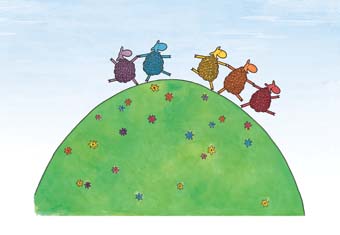
Where Is the Green Sheep?, written by Mem Fox and illustrated by Judy Horacek.

I'm not familiar with any of Mem Fox's other children's books, but her interest in teaching and promoting literacy (as expressed on her website) is in full evidence in the fine crafting of this sheepish little tale.

We love this book!


Illustrations © 2004 Judy Horacek. Posted by Hello

(Compare the covers of the US and Australian editions.)

Helena received this book as a gift about a month ago. While it would've entertained and captivated her from birth, I'm certain it will be a staple to be read in various ways and on different levels for years still to come.

[Warning: spoilers ahead.]

Helena is developing a fine sense of intertextuality. At 32 pages, the simplicity of this book, and the assumed brief time it takes to read it, is deceptive.

Blue sheep and red sheep recall both black sheep (Have you any wool?) and brown bear (What do you see?). We follow the tangents.

Just a few pages in, bed sheep provides a Borgesian touch to our reading experience. Aside from the fact that bed sheep is a sheep and Helena is a little girl, our bedroom scenes are near identical. What book is bed sheep reading?

A host of varied creatures peers from the windows of train sheep's train, not so exotic or endangered as Burningham's menagerie, but each on his own journey to an unknown destination.

Moon sheep never fails to inspire a few bars of Au clair de la lune. It is striking that moon sheep is on the moon, in contrast to the many of our other books featuring a cow over the moon. Different still from kitten's moon, which is full, whereas this is a crescent — a partial moon, but one that is "owned," not merely aspired to.

Similarly star sheep gives us pause. Helena sings a little Mozart, but is well aware that star sheep's star is not so little and with no worlds in sight of it. Could this star possibly be caught?

Eventually we find green sheep, asleep. I expect a straight reading of this book has a deliberately sleep-inducing lilt; it asks us to turn the page quietly, intoning the subliminal suggestion, "Sleeeep, little one. Sleep." We should find both green sheep and tot asleep at the end.

Not so in this household. Helena is invigorated, and with a resounding blast of a pop-cultural reference invokes Joe, singing "Wake up, Green Sheep, wake up!"

Now that we know how the book ends, Helena insists we begin each reading in hushed tones, so as not to disturb Green Sheep until it's time.

Helena "reads" the book back to me, in French, a remarkably fluid and accurate translation. (Perhaps we could get a contract for publication?)

Each reading provides fresh insight into the backstory of the minor characters such as train escargot and hillside-picknicker sheep.

Review.

The book has already been successfully adapted for the stage.

Where Is the Green Sheep? is getting constant play these days, resting only for very short bits of time on the shelf. "Ssshhhh! Green Sheep fait do-do..."

Wednesday, June 15, 2005

Over the past few days, and in the future

In my sci-fi future, you will walk into the office and plug yourself — your brain — into a control panel. A technician will quickly survey your neural circuitry and temporarily deactivate the pain receptors associated with today's dental procedure. With a flick of a switch.

No needles, no time wasted waiting for the freezing to take hold, no realizing it didn't take.

In my sci-fi future, the technician will also adjust your speakers, so to speak — you can listen internally to, say, Erik Satie, instead of the grind of metal on tooth that no external input can drown out.

I assume though that if we were capable of this technology, we would also have nanotechnology keeping one's teeth forever healthy and white.

(J-F is extremely bothered by sci-fi movies that feature people wearing glasses. Laser surgery, anyone? Never mind that he would fight to the death anyone attempting to laser, let alone clamp, pierce, poke, or discuss in any detail, his own eyeball. Me, I like wearing glasses: I think they're cool, and I like having the option to remove them, to move through life as if in a haze.)

Today's extraction was unpleasant. Had the procedure lasted 23 hours, I might put it on par with childbirth. I tried distracting myself, thinking about the novel I've been reading, considering how to manage my workload. Not really strong enough ideas to hold my attention for long. I tried visualization, imagining I was being probed by aliens, but only until I realized this perceptual shift was in fact making my experience all the more horrific.

Walking to the dentist, I hadn't though much about pain or discomfort — it was nothing compared with the extraction of my life savings to pay for the procedure. Hah! The physical extraction was hell.

On the up side, walking to the dentist, on the other side of street than last time, I discovered a chocolatière. I will have to investigate further.

I'm so glad to have run away this weekend, if only for 12 hours. The sense of freedom achieved was just large enough to outweigh the enormous guilt. But I'm still paying for it.

I'm deeply resentful of the fact that just after J-F and Helena dropped me off at the bus station before 3pm, Helena fell asleep, and stayed asleep, till about 10 minutes before I returned home. That it was my job to stay with her, soothe her. That the guilt for having left them was telling me I had to make up for it now.

(By the way, photos are available of Saramago and others in Ottawa. Now you have something by which to judge my sketching abilities.)

For reading material for the bus ride, I left behind the hardcover novel I'd started and chose instead the relatively lightweight The Golden Notebook. It's not what I'd expected. The dialogue, and tone overall, is almost gossipy. I'd expected to be intimidated, to have to weigh every sentence carefully to glean its Importance. But it's enjoyable in a very easy way. I'd had it in my head that I would be diligent in providing a running commentary with profound insight here, but it doesn't feel conducive to that sort of reflection. Not yet.

Work this week is not progressing as I'd hoped.

Tuesday, June 14, 2005

She flits


Cookie in hand, Helena makes a break for it. Posted by Hello

(Yesterday, when it was still sunny and hot.)

Monday, June 13, 2005

Saramago speaks, part 3 of 3

The interview
Saramago describes himself as a child as melancholic, and further explains that this is not a bad thing. Where is the virtue in being happy? "C'est bien la tristesse." For the soul. A typically Portuguese sentiment (to which I relate).

You are sad, you are happy, you write, you don't write.

Adrienne Clarkson suggests he was a late-bloomer, to which he agrees maybe he bloomed differently. You bloom in one way when the time is right, and then again. He seems to be saying that in order to write, one must live first and bear witness.

He fears the specialist, the "What do you do for a living?" askers.

"One writes well under liberty. But under a dictatorhip, the writer is more intelligent." One learns to overcome, to fool, to be vigilant. One masters language as a cryptic device.

(Saramago assures the Governor General, and the audience, that he is not suggesting she instate a dictatorship — Canadians are already sufficiently intelligent.)

Clarkson raises the theme of bureaucratic walls his protagonists keep running up against. Saramago, to my surprise, segués to the subject of women. Are the women also walls?

[His female characters are weakly drawn, but they are often catalysts, driving forces (for better or worse) and inspiration. I don't think he actively dismisses them so much as he doesn't consider them at all. There's something of a saint–whore complex to them. Saramago is an old man, from the Old Country, so for this I forgive him.]

"For men, women are opaque. Men for women are transparent."

He admits women are a mystery, with a "force intérieure." It is evident he loves women. He gazes lovingly and respectfully at his current wife, seated in the audience. There is tenderness and awe.

Clarkson turns to The Cave, a vision of the near future, and in this context asks Saramago for his impression of West Edmonton Mall (which he recently visited).

Saramago has much to say about the shopping centre. (I'm reminded of my visit to Portugal — a man I'd met wanted to show me around the city, so we took the subway out to one the city's more recently contructed landmarks and a point of pride. A suburban mall.)

Shopping centres are clean, well-lit, calm, secure. There is never a lack of people offering to help you. There are women whose happiest moments in life have been realized in a mall.

The mall is not much different from the traditional market or main street in concept, but there is a difference of spirit.

The conversation turns a little political. A citizen's duties. The duty to vote. We must choose; also we must have choice.

Saramago is tearful "What's happened to the human species?" "Is God an assassin?" Why do we accept to live in a world like this?

Each of us in in our own hearts knows that we have responsibility for the future, and knows what that responsibility is.

Disclaimer
I have a hard time believing I understood all that was said (in French!), even if I feel as if I did. Perhaps my comprehension was better than usual because of the "level" playing field — all participants were not native speakers of French. More likely, I've made a lot of this up. Recognized a few words and filled in the blanks to match the expressions and gesticulations. Still, that's not to say I didn't gain anything from the evening — I engaged with my own self for some fresh insight into Saramago's character and work, whether or not he actually said any of these things.

What Saramago is currently reading:
Flaubert's Parrot, Julian Barnes.
(Actually, rereading, if I understood correctly.)

His favourites and influences:
Gogol, Kafka, Montaigne, Cervantes.
He comments also on the impact on him personally of the lesser known (internationally, relatively) Portueguese canon, highlighting Anton Vieira, a 17th century Jesuit, as having great personal significance in addition to his importance in forming the literary tradition in which Saramago was raised.

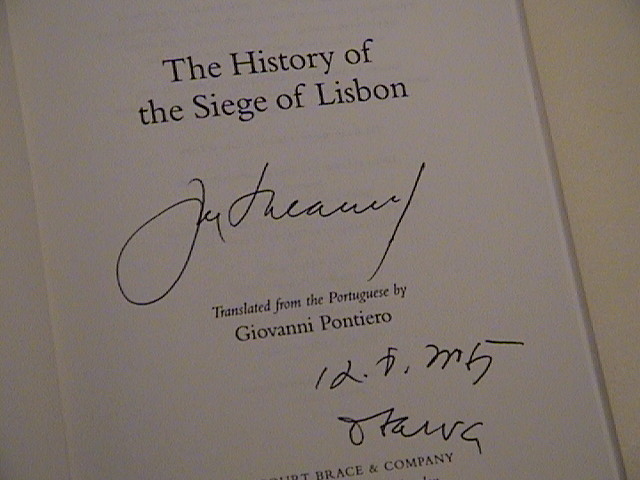
A signature
Gracing the book of his that has the most personal significance to me.


Illegibly signed. Posted by Hello

Blindness on screen
Jonathan Safran Foer gets his wish.

The mood in reference to the planned movie adapation of Blindness was celebratory, it being a point of pride that the much-sought after rights (more than 30 serious requests, Saramago says) were granted to a Canadian.

In March 1999, Saramago
explained that in his own novel, Ensaio sobre a Cegueira (Blindness), he had striven to express his own perception of that dehumanised modern reality which Kafka's work foreshadows: his main purpose in this novel was 'to denounce the perversion of human relations'. He had been asked by numerous film directors for permission to film this novel, but the answer was no: he felt that a film of his book would reduce it to a mere spectacle of sex and violence and — as had happened with Umberto Eco's The Name of the Rose — deprive it of its entire intellectual content.


Verdict
Saramago: man of greatness. Unquestionably Nobel-worthy. Clever, down to earth, funny, sincere. He gives a lot of thought to what he says; he's not afraid to say what he thinks. He's shy, but poised, exuding some vast inner reserve of calm and wisdom. He stands in awe of the world, and shouts about it from the rooftops of his novels.

From Saramago's Nobel lecture:
The apprentice thought, "we are blind", and he sat down and wrote Blindness to remind those who might read it that we pervert reason when we humiliate life, that human dignity is insulted every day by the powerful of our world, that the universal lie has replaced the plural truths, that man stopped respecting himself when he lost the respect due to his fellow-creatures.

Saramago speaks, part 2 of 3

The stage set is flanked by two identical signs, startling red on the earthy palette. Lettered in white:
KNOWLEDGE IS HERE
ICI LE SAVOIR

The event is sold out. (I'd purchased a ticket by phone a day beforehand.) They are prepared to accommodate a limited overflow crowd, with video and audio available in an adjoining room.

(For all the years I lived in Ottawa, I recognize no one, except for that guy who used to ride my bus when I had that one contract, and a woman I think I was introduced to at a bar as a friend of a friend of a friend.)

More than 30 minutes late to get started, the emcee dives into a long and boring list of obligatory acknowledgements of volunteers and sponsors.

The format of the evening is revealed. Also, Saramago will speak in French. (I should've guessed. A test of my linguistic abilities now too.) There's been much confusion regarding the language and nature of the events in the local press. (Saramago is due to speak also at the University of Ottawa later today.)

Some welcoming comments by Ian Wilson (Librarian and Archivist of Canada). Something vaguely elitist in him recognizing that this is an audience who appreciates the power of language, literature, and the written word. As if not enough people do.

Also a word from Governor General Adrienne Clarkson — who will as the highlight of the evening be interviewing Saramago on stage — and then some other guy. Support for the arts, blah, blah, blah.

I didn't bring the cumbersome, less-than-handy Handycam with me, but I did snap a couple analog photos. It'll be months, I'm sure, before I get them developed. But here's a rendering of the man to lend some immediacy to my retelling of the event.


José Saramago. Posted by Hello

Saramago takes the stage. Standing ovation. He looks genuinely humbled.

He speaks (in French) for maybe 10 minutes: For all our advanced studies — discussion, analysis, expostion — he says what is missing from universities today, what is missing from the study of literature is communication, between the reader and writer. Saramago speaks also of "la reception" — by which I understand a kind of opening up of the reader to receive and welcome, and engage in, the literature at hand.

Saramago has recieved thousands of letters from readers around the world. He wonders why — they are not seriously intended to engage with the author, they are a one-way communication. But he understands that in the letter-writing the reader engages with his own self, and perhaps this is what literature is meant to do after all.

Saramago reads the opening pages of Blindness in Portuguese. It's beautiful.

Don McKellar reads the same segment, and then some, in English. Decidedly less beautiful. He stumbles a lot, but his theatricality manages to charm us.

(He'd "joked" about forgetting his own copy of the book at home and having to borrow Her Excellency's, afraid to mark its unscored pages. His reading sounded unpracticed. While the tone of the evening was casual, this struck me as less than professional and sadly disrespectful.)

Saramago speaks, part 1 of 3

In a long, drawn-out fit of spontaneity, I hopped on a bus for Ottawa yesterday to hear for myself what Nobel laureate José Saramago had to say.

His publisher's publicity department did in fact respond to my email last week, informing me that at this time Saramago has no plans to appear in Montreal.

Though the news disappointed me, I was relieved that I could blame time and distance for missing him, missing him because he was hundreds of kilometres away. I'd dreaded that I might hear from the publisher that Saramago had lectured in Montreal just around the corner from here last week: to miss him because of negligence — ignorance of local literary events on my part or delay in the publisher responding — would've been unbearable.

I couldn't get it off my mind though. Ottawa isn't that far away. How much work would I really get done at home this weekend? The real test (of anything): if I didn't do this, how much would I regret it later?

I figured that hearing, in person, José Saramago was worth at least the price of a bus ticket, worth foisting all toddler-minding duties on J-F, worth cramming in extra work hours elsewhere to make up for lost time. How often does one have the opportunity to bask in the presence of genius (a Nobel Prize winner at least)?

(I have met a Nobel winner before, and he failed to impress me. Czeslaw Milosz emanated no aura of greatness.)

Literature of course is not a science. A Nobel prize in the field then cannot be a quantitative indicator of genius. In judging writers, their writing and its impact, the Nobel committee is often as flawed as the rest of us.

It's clear that over the years, some of the awards have been political, if not necessarily politically correct.

How does Saramago measure up?

Remarkably, I'd heard of Saramago before he scored the big prize. I work as a copyeditor. It was in some industry publication or other that a review of The History of the Siege of Lisbon caught my eye. I hunted it down immediately, and fell in love with the rhythm of his words, flattered by his reverence for my profession. (I think it was the following year that the international Nobel spotlight fell on him.) Years later the book again was highlighted to my colleagues.

The proof-reader say, Yes, this symbol is called deleatur, we use it when we need to suppress and erase, the word speaks for itself, and serves both for separate letters and complete words, it reminds me of a snake that changes its mind just as it is about to bite its tail, . . . I must remind you that proof-readers are serious people, much experienced in literature and life, My book, don't forget, deals with history. However, since I have no intention of pointing out other contradictions, in my modest opinion, Sir, everything that is not literature is life, History as well, Especially history, without wishing to give offence, And painting and music, Music has resisted since birth, it comes and goes, tries to free itself from the word, I suppose out of envy, only to submit in the end, And painting, Well now, painting is nothing more than literature achieved with paintbrushes, I trust you haven't forgotten that mankind began to paint long before it knew how to write, Are you familiar with the proverb, If you don't have a dog, go hunting with a cat, in other words, the man who cannot write, paints or draws, as if he were a child, What you are trying to say, in other words, is that literature already existed before it was born, Yes, Sir, just like man who, in a manner of speaking, existed before he came into being, It strikes me that you have missed your vocation, you should have become a philosopher, or historian, you have the flair and temperament needed for these disciplines, I lack the necessary training, Sir, and what can a simple man achieve without training, I was more than fortunate to come into the world with my genes in order, but in a raw state as it were, and then no education beyond primary school, You could have presented yourself as being self-taught, the product of your own worthy efforts, there's nothing to be ashamed of, society in the past took pride in its autodidacts, No longer, progress has come along and put an end to all of that, now the self-taught are frowned upon, only those who write entertaining verses and stories are entitled to be and go on being autodidacts, lucky for them, but as for me, I must confess that I never had any talent for literary creation, Become a philosopher, man, You have a keen sense of humour, Sir, with a distinct flair for irony, and I ask myself how you ever came to devote yourself to history, serious and profound science as it is, I'm only ironic in real life, It has always struck me that history is not real life, literature, yes, and nothing else, But history was real life at the time when it could not yet be called history, So you believe, Sir, that history is real life, Of course, I do, I meant to say that history was real life, No doubt at all, What would become of us if the deleatur did not exist, sighed the proof-reader.


Saramago's biography has also comforted me. He worked as a clerk, a civil servant, before getting into the publishing business. Though he'd published some poems in his 20s, decades passed before he would become a novelist. He's a late bloomer.

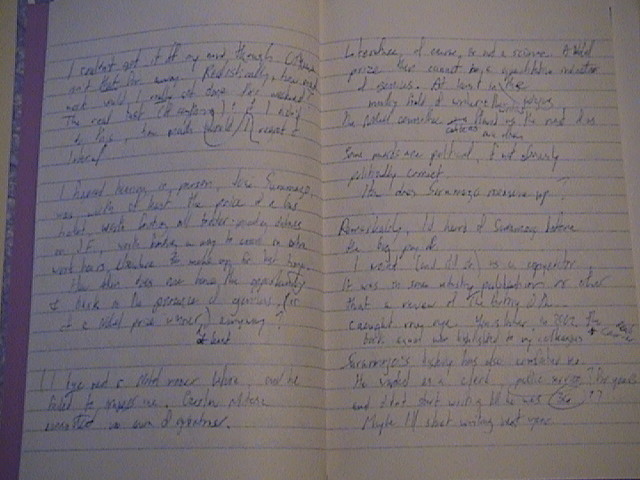
Notes. Posted by Hello

Thursday, June 09, 2005

Confronting oneself

I commented on a review of José Saramago's The Double shortly after its release in the UK.

Now that I've read the novel for myself, my comments stand.

The reviewer found that:
The difference between the spareness of the idea and the bulk of the finished book is made up by the contributions of an intrusive narrator. There are elusive truths which must be approached round three corners, but there is also such a thing as going all round the houses for no good reason.


Saramago goes "round the houses" because they are there. It's as good a reason as any. This is not a plot-driven book — deal with it.

The New York Times:
To judge "The Double" by the tenor of plot and theme would be to miss it. The countertenors are at least as important and, if there were such a thing, the countersopranos and -altos as well. Also the counterdog. (When Tertuliano stays overnight at his mother's, her Tomarctus comes sniffing at his bedroom door. "For what dogs most want in life is for no one to go away.") What Tertuliano and Antonio make and mangle of their situation would provide a one-dimensional fable, stunningly conceived and played out. Greek tragedy without the chorus would be a thin thing; the chastening humanity in "The Double" comes from those who witness and warn.


The Washington Post:
Throughout The Double there is an obvious archness, an authorial sneer at the fantastical subject matter that quickly distances the reader from any emotional involvement with either the character or his situation. As a result, we don't care what happens to Afonso or how he ends up.

What's more, if the subject of a novel is a dull man, there must be something at least a little interesting in his everyday existence to keep us interested. Unfortunately, in The Double it takes close to half of the novel's 300 pages for the protagonist to even get up the nerve to send a letter to the film company asking about this mysterious actor. Until then, we hear only about Afonso's dry-as-a-bone daily inner and outer life, his tepid love affair with a woman, and repeatedly about the inner conflict he has trying to decide whether to eat out or stay home and rummage in the refrigerator for a meal.


Not all reviews of The Double were favourable, as you can see.

Why not write about boring people? Tedium is a powerful tool, and in the hands of a skilled writer, can lure a voyeur into the intricacies of a mundane life just as well as the usual stock of character quirks and plot twists.

Is the narrator intrusive? He is as much a character with reflections and opinions as those people named in his story. The voice of Common Sense converses with Tertuliano; perhaps he is the narrator, inserting himself directly into our hero's life.

Some reviews hint that the novel should be read as a commentary on the implications of cloning. The "twins" do briefly entertain the notion of DNA testing to determine the extent of similarity between them, but the book is about neither science nor society (much). It's a novel about interior spaces — obviously, the sense of identity and where it comes from.

I admit I was slow to like this novel. I didn't care about the protagonist and didn't understand what motivated him to act as he did. I realize now that it is on the suggestion of his colleague, a math teacher, that the entire plot is set in motion. The plot is almost a mathematical exercise, following each action to its logical conclusion. It is not what he wants to do, but what he must. Tertuliano is purposely dull, without the strength of character to resist the course laid out before him.

They say you can hate someone only if you hate yourself, but the worst of all hatreds must be the hatred that cannot bear another person to be the same, worse still if that sameness should ever become total.


Had this sentence begun the novel, a proclamation in the style of an older literary tradition, rather than appearing near the end, I suspect the work would be better received.

It's a truth, in my experience, that we criticize in others those flaws we recognize (and fear, and deny) in ourselves. Saramago explores this phenomenon in the extreme.

Reviews.
Reading group guide.
Excerpt, but not a very good one. (It's from the opening pages, which failed to make an impression on me. In fact, the first 100 pages left me indifferent. In truth, I'd be hard pressed to find an enticing excerpt — there's little but to swallow the book whole for the desired effect.)

José Saramago appears this Sunday evening in Ottawa courtesy of The Ottawa International Writers Festival. (I'm still waiting for the publisher's publicity department to tell me whether an appearance is scheduled for Montreal.) To all of you in Ottawa: can I crash on your couch? If I can't make it: can you go in my stead? (You'd have to take careful notes — heck, videotape the proceedings — and get one of my books signed for me though. I'll pay for your ticket.)

It's said everyone has a double somewhere in the world. One assumes that double in on the other side of the world, not next door. When I first moved to Ottawa, I was several times stopped in the street by people expecting me to acknowledge them. "Mary?" No. (Maybe Mary will show up at Writersfest Sunday night.)

J-F encountered his double many years ago, before we'd met, when he was working in retail. An uncanny resemblance, he says. Though he reports feeling unsettled by the experience, it was business as usual.

Most people take it as obvious that our sense of self is derived from environmental factors and experience more so than genetics.

I'm reminded of an idea articulated by David Byrne that has obsessed me since I first brought Music for the Knee Plays home with me in the late 1980s (vinyl!).

Social Studies [Knee Play 4]

I thought that if I ate the food of the area I was visiting.
That I might assimilate the point of view of the people there.
As if the point of view was somehow in the food.
So I would make no choices myself regarding what food I ate.
I would simply follow the examples of those around me.
I would study menus very carefully,
Making note of important differences and similarities.
When shopping at the supermarket
I felt a great desire to walk off with someone else's groceries
So that I could study them at length
And study their effects on me.
As though if I ate their groceries I would become that person; until I finished their groceries.
And we might find ourselves going to the same places.
Running into one another at the movies
Or in a shopping mall.
Reading the same books.
Watching the same TV programmes.
Wearing the same clothes.
Travelling to the same places.
And taking the same pictures.
Getting sick at the same time.
And getting well again simultaneously.
Finding ourselves attracted to the same people.
Working at the same job.
And making the same amount of money.
Living identical lives — as long as the groceries lasted.


I play this game every time I do groceries (every time!): I form a character profile of the person in front of me at the checkout, based on the items they lay out on the conveyor belt. The time of day and the manner in which they arrange their purchases are also factors I consider. Whether they have families or live alone, are health-obsessed and indulge in guilty pleasures; what they do for a living, the hours they keep, the extent and quality of their social life.

I fear, too, what others might make of my basket.

Where's the harm?

Eye Weekly produces its own list of harmful books, and actually defines "harm," in response to a recent list compiled by conservative scholars.

One dangerous book that might not occur to many people:
The Pet Goat, Siegfried Engelmann and Elaine Bruner: This heartwarming story of a boy and his goat is so insidiously mesmerizing that it kept George W. Bush transfixed for a full seven minutes after learning that the first plane had hit the twin towers on Sept. 11, 2001.


(Link via Bookninja.)

Wednesday, June 08, 2005

Misbehavin' Elmo

You wouldn't know it to look at him, but Dancing Elmo has a mean streak. (Maybe as a result of my wanting him not to dance quite so much, preferring him to sit quietly?)

No less than twice this week, Helena has had to console one of her dolls, telling me the doll was mad because Elmo hit her. Helena scolded Elmo, "Non, c'est non," and carried him (kicking and screaming?) under her arm out of her bedroom to sit in the hall.

She checks on him a few minutes later, asks if he's better, and then invites him back into her room.

(We've never formalized a "time-out" method in this household — certainly there's no "Go stand in the corner" or "I want you to sit here and think about what you've done." If Helena's being particularly ornery, we may walk away for a minute till she calms down. I can only imagine she's mimicking a rare disciplinary measure in force at her daycare.)

Elmo may be annoying, but toddlers are weird.

Tuesday, June 07, 2005

A meme, by which I procrastinate

The lovely Kimberly recently tagged me with a book meme. I'm terrible at getting around to doing these things, and I doubt anyone (except maybe Kimberly) really wants to know my answers to these questions, but hey, it's more fun (for me) than working.

Actually, I answered some of these questions in brief elsewhere, but in the interest of wasting time I will refine my responses here.

Total number of books I've owned
My rough estimate of books currently occupying shelves and waiting patiently in unpacked boxes is about 2000. (So I exaggerated a little previously.) The number of books I've ever owned would be easily double that number, having seriously culled my shelves in a move about 8 years ago (finally liberating myself from required university reading as well as the literary trash that had helped pass the time) and including boxes that remain in my mother's basement (favourites from my childhood and teenage years).

The last book I bought
I imposed a moratorium on book-buying a few months ago. Knowing that we'd be moving soon it didn't make sense to me to add to the piles needing packing, particularly when there is sufficient as yet unread material on hand to get me through this stressful period. Even though I've been frequenting bookstores lately, it's more in a pursuit of calm and centredeness than to satisfy any urge for acquisitions. Likely the last book I bought was Walter Mosley's The Man in My Basement (in April), discounted, and no, I haven't read it yet. Too, I rather like deluding myself that I don't have a book-buying compulsion, so I may have conveniently forgotten one or two purchases since.

The last book I read
I am 28 pages from the end (does that count?) of José Saramago's The Double, and I'm dying to know how it turns out. (I must set my priorities straight.) Although the opening chapters didn't impress me, the meat of it is more than satisfactory. Before this book was Iain Pears' The Dream of Scipio.

I recommend both of these to people whose taste in books is highly similar to my own (practically no one). I would recommend neither to casual acquaintances looking to me for a suggestion for light summer reading.

[In a twist of fate, my computer froze while composing this post. The clock on the computer also froze, and so I gained, or lost, half an hour. Amid waiting and rebooting and waiting and scrambling to recover files, I managed to finish reading The Double, on which I will have something to say later.]

Five books that mean a lot to me
These change over time. Few books are truly life-changing. Some books I'm sentimental about because of the time in my life when I read them or because they were gifts from lovers. Today I choose the following, some of which I've written about previously:

1. A Little Princess, Frances Hodgson Burnett.
"Not because it introduced me to the world of books — I was already immersed in it. I read it when I was 8 or 9 — it couldn't've been long after my father died. I felt something like empathy with poor orphaned Sara (our princess), and so a whole new level of reading was opened up to me, some place Nancy Drew could not take me. I learned something about mastery of one's inner life even when completely at odds with one's surroundings."

2. The Razor's Edge, W Somerset Maugham.

3. The Unbearable Lightness of Being, Milan Kundera.

4. The New York Trilogy, Paul Auster.
"Changed my life. There. I knew I would find one. Thing is, I can't quite pinpoint how. Something to do with that time in my life, fumbling about at university, identity, my obsession with the myth of the Tower of Babel, why I finally chose to study linguistics, and my generally roundabout approach to life."

5. The First Century after Beatrice, Amin Maalouf.
Apart from the fact that it has a great premise and is told by a master storyteller, I don't know why I rave about this book, to everyone. Honestly I don't know what it means to me, but it feels Important.

Tag 5 people
This is where it all falls apart. Memes tend to stop with me. I don't think I even know 5 people, let alone 5 who would be happy to take up the challenge and post responses on their own blogs. So with absolutely no expectations, I tag:
1. Liam (Silly Daddy), because I want to encourage his blogging efforts by obligating him to comply.
2. Suzanne (Miscellanea & Ephemera), because she also needs to blog more, and I think she likes being tagged.
3. Russell (All My Shoes and Glasses), even though he's on a blog vacation, because he's taken an interest in memes lately, going so far as to create his own (though I've not felt adequate to undertake it).
4. Diana (Seeking Clarity), because she reads a lot, and this may provide some clarity.
5. Anonymous, even though you don't visit much anymore, because I want to know more about you.

Sunday, June 05, 2005

Bookstore observations

Mass market paperback editions of The DaVinci Code are recently available everywhere in French, but there is no scheduled date for such an English edition. Meanwhile, Umberto Eco's latest is marked down 30% in French, not so in English. What does this say about the difference between French and English consumer markets? (Note that first issues in French are usually a kind of trade paperback, and relatively expensive — as much as or more than an English hardcover.)

(Yes, I'm spending more time in bookstores these days than I ought. With all the other things needing doing, they're so conveniently on the way.)

I'm setting off alarms in stores. The culprit is finally identified as the book I've been lugging around for dentist chairs and metro rides. Of course, it's in the bookstores that security guards question me about the contents of my bag. One uniform turns the book over, checking the spine and corners. He thumbs through it, presumably looking for smudged fingerprints, coffee spills, chocolate smears, other signs of wear.

The thing is: I tend to take care of my books. While this one is not pristine, it isn't any worse off than many that are regularly handled and perused in the bookstore stacks. The only evidence in my favour is the tattered bookmark about halfway through. I brace myself for a pop quiz on the book's contents, but it does not come to pass. He hands the novel back to me, resignedly.

Surely they realize that people who carry books around with them are likely to frequent bookshops, that they who linger there might be the type to have reading material at the ready.

I wonder do they ever confiscate such books, do they have training to recognize that a book has had travels and experiences beyond the store, or are they specialized in reading people.

Do people steal books? What kind of people? Do security guards hand the goods over to the criminals and let them walk away?

Friday, June 03, 2005

The notebook

Confession: As much I profess an admiration of Doris Lessing, and I've read handfuls of her books, I have not read what many consider to be her most important work, The Golden Notebook.

I bought a copy for myself ages ago. I often weigh it in my hands, with a sense that it has a secret to tell me which I'm not yet equipped to handle. It will reveal mysteries to me. I've never glanced inside. I didn't feel ready.

It's been increasingly on my mind in recent months. My eyes rest on it more frequently. Now — soon, this summer — is the time.


The Golden Notebook, by Doris Lessing. Posted by Hello

There's a couple books I'd like to get through before I tackle this one, but I sat down to read the Doris Lessing's 1971 preface to this 1962 novel the other night.

"This novel was not a trumpet for Women's Liberation." Its theme, breakdown as a means of self-healing, was, she claims, barely noticed.

To be honest, I know nothing about this book, its plot or themes. I thought it was a kind of feminist manifesto. Hmmm.

Lessing addresses some of the decisions that went into creating The Golden Notebook: the ideological "feel" of the midcentury, why her main character must be an artist, the shape of the book.

The problem of subjectivity:
At last I understood that the way over, or through this dilemma, the unease at writing about 'petty personal problems' was to recognize that nothing is personal, in the sense that it is uniquely one's own. [The tiny individual is a microcosm.] Growing up is after all only the understanding that one's unique and incredible experience is what everyone shares.


Perhaps, then, I am a grown-up.

Lessing lambastes literary critics, but also the education system; more broadly, she explores the problem of parochialism in our culture, institutionalization and indoctrination. Just as a preface.

The other thing taught from the start is to distrust one's own judgement. Children are taught submission to authority, how to search for other people's opinions and decisions, and how to quote and comply.


(This is what I hated about university. I was not being encouraged to think; it was important only that I knew what other people had thought.)

Lessing writes also of the multiplicity, and validity, of perceptions and interpretations:
It is not only childish of a writer to want readers to see what he sees, to understand the shape and aim of a novel as he sees it — his wanting this means that he has not understood a most fundamental point. Which is that the book is alive and potent and fructifying and able to promote thought and discussion only when its plan and shape and intention are not understood, because that moment of seeing the shape and plan and intention is also the moment when there isn't anything more to be got out of it.


There is much more that is quotable, but you'd do better to go find a copy of the preface and read it for yourself. I agree with most of what Lessing has to say; she is sensible; her writing on these subjects engages me.

The preface bodes well for the book.

There is only one way to read, which is to browse in libraries and bookshops, picking up books that attract you, reading only those, dropping them when they bore you, skipping the parts that drag — and never, never reading anything because you feel you ought, or because it is part of a trend or a movement. Remember that the book that bores you when you are twenty or thirty will open doors for you when you are forty or fifty — and vice-versa. Don't read a book out its right time for you. . . . Everywhere, if you keep your mind open, you will find the truth in words not written down. So never let the printed page be your master. . . . [Y]ou should have been taught to read your way from one sympathy to another, you should be learning to follow your intuitive feeling about what you need: that is what you should have been developing, not the way to quote from other people.


I am ready.

Thursday, June 02, 2005

Behind the fairy tales

Directing you to your Mental Multivitamin of Hans Christian Andersen:

Harold Bloom sees Andersen's project as "how to remain a child in an ostensibly adult world."

Simon Tait investigates the relationship between Andersen and Dickens.

(For the record, we love the movie, too.)

Leaps and bounds

J-F is away for a few days for work. That leaves me and Helena with intense quality time together, not the least being the metro ride for drop-off and pick-up at daycare.

Leave house this morning at 8.25. Arrive at daycare shortly thereafter as building is being evacuated — fire drill? bomb threat? Regardless, once I'm in the daycare courtyard with Helena, I'm not allowed to leave, as the only legitimate way of doing so is through the building, which we're not allowed to re-enter (apparently hopping the fence sets a bad example for the children). So I stick around with half a dozen other parents, their own children clinging to them. I help out with impromptu snacks (someone did sneak back inside for cheerios and juice [why doesn't Helena eat cheerios at home?]), wiping up other people's children. I watch grown men, suited up and tied, sing about the wheels of the bus.

Helena's group is going for a walk; the key for the gate in the fence makes a rare appearance. Neither their day nor mine is going according to plan, but they seem grateful for my help. I bring up the rear of the rope, corraling the herd, while one of the educatrices communicates with the other groups for updates. They will serve an early lunch, outdoors, and phone parents to pick up their children by 1:00.

Helena and I leave the pack at about 11:00; we have to go the long way 'round to get to the metro. She falls asleep on my lap before our stop.

It seems I won't be getting any work done today (you know, work, the kind they pay me for).

We finally made it to the new neighbourhood park, featuring a half-million dollar playground, a sign proudly proclaims.

While the old neighbourhood park was across the street, its vastness ensured a healthy trek before reaching the playground. Though the new park is down the street, it's about the same distance to what matters — the slide.


New slide. Posted by Hello

In fact, the new park is superior on this count: 2 pieces of equipment that feature 5 slides in total.

Helena likes swings too. At her size, the baby swings are a bit awkward, and I feel some trepidation about regular swings. But Helena insists. She holds on tight. I sit on the swing next to her and demonstrate how to pump one's legs to make the swing move. Helena is thrilled. She slips off her swing because she wants to help push me.


New duck. Posted by Hello

Other cool stuff about the kid:

An obsession with microbes — as in wash your hands, wipe the table, and don't eat that, parce qu'il y a des microbes.

Helena has entered the pourquoi, ad infinitum, phase. It seems "il y a des microbes" is the only answer able to cut the chain.

I hold the door open for Helena to pass through. She sings out, "Merci Madame Mama."

The big bed. She fell out once, her second night. She has not exploited the freedom the bed allows. I'd left to retrieve something or other and returned to find her scurrying back into bed — she knows she's not to leave its confines. She doesn't get of bed herself in the morning, but rather waits for someone to come get her.

Bedtime is tedious. Everything about it drags on forever. (I have yet to see an episode of Doctor Who in its entirety.) I'm hoping the ritual will normalize over the next couple weeks as we impose more order on our space and our time.

When she tells me about her day, I understand her. For example, she told me that she and J-F the other day had stopped for coffee on the way to daycare, Papa had coffee but she didn't have any coffee, she ate a blueberry muffin, and J-F rested her backpack and her hat on the chair beside her. And it was all intelligible and true.

She can count to 11 in both official languages.

Is that enough?

Toothless

I've lost a tooth.

I'm embarrassed to tell the world of this. It implies self-neglect in one so young (?!); alternatively, it speaks of age, of physical decay. It stuns me actually, because I've always had pretty nice teeth.

While having a perfectly ordinary lunch yesterday, I felt something hard and unusual rolling about in my mouth and extracted a large piece of tooth.

Fortune would have it that this is the same tooth for which I had a root canal last year, so at least it doesn't hurt. Am a little pissed off about all the time and money spent on the root canal.

I blame Helena. I'm certain it was her swift kick to my face that precipitated the root canal. I'm equally certain it was her sudden standing up as I leaned over her, the slamming into my chin that clanked my jaw together and threw my head back, that cracked the already weakened tooth. Accidents, of course.

Up: Had a lovely walk to the dentist this morning. For the first time walked more or less in a straight line from current address to immediate vicinity of old address.

Down: Dentist previously 3 blocks away, now a 20- to 25-minute walk away.

Up: Discovered that there's a patisserie around the corner from here, not yet having walked around that particular corner.

Up: Found a fantastic second-hand bookshop featuring in its window the likes of Calvino, Gombrowicz (!), Kundera, Pirandello — for all your used 20th century European (and other) literature needs.

Down: All the books were in French translation.

Up: Two and a half hours with my feet up, sinking into a very comfortable chair, and because of the circumstances not feeling a shred of guilt for not working.

Down: Actually not getting any work done.

Up: Most of the two and a half hours was spent waiting. I read. Am about halfway through Saramago's The Double.

Down: It's not one of his stronger works.

Up: Have been meaning to get 'round to scheduling a cleaning. Done.

Down: The noise! Oh, the unbearable noise noise noise noise of dental instruments! It's never really bothered me before today.

Down: There's a cut at the corner of my mouth, courtesy of noisy dental instruments.

Down: The tooth in question is not salvageable.

Down: Dental work is expensive.

Up: On my way home purchased a small jasmine tree to lift my spirits. I've wanted one for years. I'd let all houseplants die a miserable death this winter, and this tree with its evocative scent feels appropriately inaugural in our new home.

Wednesday, June 01, 2005

Mara and Dann again

I've been meaning to say some things about Doris Lessing, but they will have to wait — they're still brewing, or steeping, or simmering, not ready yet. Just this morning I was wondering to myself: "It's been ages since I had news from the Doris Lessing mailing list. I hope she doesn't die this summer, it's too soon." (Morbid, I know. And selfish. That's me, morbid and selfish.)

By a startling coincidence I received word via the mailing list today that:
"Doris Lessing's new book The Story of General Dann, Mara's Daughter, Griot and the snow dog has just been published in the U.K. It is the sequel to Mara and Dann and is one of her most emotional and moving books."

(Mara and Dann was one of the most powerful books I've read in recent years.)