Helena hasn't quite got the hang of letter names yet, though she readily associates letters with words they initialize. For example, for "d" she produces "dinosaur," "dragon," "Dora," etc.
This morning, playing with letter magnets:
Me: What's that letter? [I'm pointing at "u," expecting "umbrella."]
Helena: [No response. Looks at me expectantly.]
Me: That's the letter "u."
Helena: Moi? [Her eyes linger on "h," compare with "u," and question me.]
Me: No, "u."
Helena: Toi?
Sunday, September 11, 2005

Saturday, September 10, 2005
Typewriter notes
The Story of My Typewriter, by Paul Auster and Sam Messer, is both a love story and a ghost story. Bittersweet because we know eventually the ribbons will run out, the ink will run dry.
This slim volume is disappointing because Auster's spare text is so very short. The relationship between the artist and his machine is complicated, their lives intertwined, yet Auster admits he'd never really given it much thought.
(What does it say about me that I've wanted to fetishize objects — pens, notebooks, and, yes, even typewriters — and these particular objects, instruments of writing, instruments of writers, but I could never really get into it. When I realized, as did Auster, that typewriters were fast becoming dinosaurs, I thought it'd be cool to collect them. I bought a few in junk shops, a couple dollars apiece, thought one would serve nicely as a planter, a couple others as bookends or shelf supports. When I moved to the next apartment, they ended up on the curb. Perhaps because I hadn't actually written anything with these machines. But even if I had? Would I see them as anything other than a tool? I've thrown out pencils, ripped up notebooks that had written or contained some brilliant jottings. None ever became a talisman. I've blogged on more than one keyboard, monitor, computer. I prefer some over others as aesthetic objects, and still others as utilitarian ones, but none has ever evoked object lust.
[The only collection of mine that has taken on a life of its own is the bookmarks. But then, I'm a reader, after all.])
The typewriter, as a thing in itself, if it is a muse or catalyst for anyone, inspires Sam Messer. He paints the Olympia both as a ghostly presence and as a visceral monster.
Most interesting are the paintings depicting Auster and Olympia together, the weird hold they have on each other (the kind of relationship only the outsider can identify), how they intrude on and expand each other.
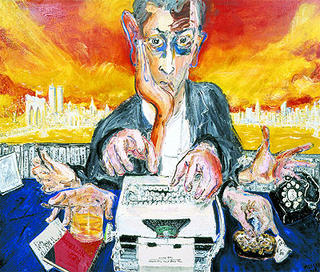
On Sam Messer (with particular attention to "The Wizard of Brooklyn"):
Exhibition.
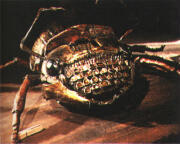 I can't help but be reminded of David Cronenberg's Naked Lunch and all it had to say about the creative process (and the utter shit most writers produce).
The paintings are brilliantly done, and I am proud of my typewriter for proving itself to be such a worthy subject, but at the same time Messer has forced me to look at my old companion in a new way. I am still in the process of adjustment, but whenever I look at one these paintings now (there are two of them hanging on my living room wall), I have trouble thinking of my typewriter as an it. Slowly but surely, the it has turned into a him.
This slim volume is disappointing because Auster's spare text is so very short. The relationship between the artist and his machine is complicated, their lives intertwined, yet Auster admits he'd never really given it much thought.
(What does it say about me that I've wanted to fetishize objects — pens, notebooks, and, yes, even typewriters — and these particular objects, instruments of writing, instruments of writers, but I could never really get into it. When I realized, as did Auster, that typewriters were fast becoming dinosaurs, I thought it'd be cool to collect them. I bought a few in junk shops, a couple dollars apiece, thought one would serve nicely as a planter, a couple others as bookends or shelf supports. When I moved to the next apartment, they ended up on the curb. Perhaps because I hadn't actually written anything with these machines. But even if I had? Would I see them as anything other than a tool? I've thrown out pencils, ripped up notebooks that had written or contained some brilliant jottings. None ever became a talisman. I've blogged on more than one keyboard, monitor, computer. I prefer some over others as aesthetic objects, and still others as utilitarian ones, but none has ever evoked object lust.
[The only collection of mine that has taken on a life of its own is the bookmarks. But then, I'm a reader, after all.])
The typewriter, as a thing in itself, if it is a muse or catalyst for anyone, inspires Sam Messer. He paints the Olympia both as a ghostly presence and as a visceral monster.
Most interesting are the paintings depicting Auster and Olympia together, the weird hold they have on each other (the kind of relationship only the outsider can identify), how they intrude on and expand each other.

On Sam Messer (with particular attention to "The Wizard of Brooklyn"):
As Messer depicts him, Auster looks like a more robust Kafka — Kafka as a private eye — all dark circles and angst, with a cocked ear the size of a small satellite dish. The head (figuratively speaking) is in one place and the body (which consists of a withered trunk and seven separate hands) in another. One hand, expressionistically elongated, supports his chin, but the others, which are as grasping and acquisitive as claws, lead lives of their own. One stubs out a cigarette while another dials a number on a rotary phone (that other mechanical dinosaur); others type, take notes and smoke; one prepares to lift a glass of whiskey. The page in the typewriter is blank except for the words "The Story of My Typewriter by Paul Auster."
Exhibition.
 I can't help but be reminded of David Cronenberg's Naked Lunch and all it had to say about the creative process (and the utter shit most writers produce).
Friday, September 09, 2005
Poetry without borders
Words without Borders this month is all poetry, of all shapes and sizes.
In the "Polish corner," work never before seen in English:
In the "Polish corner," work never before seen in English:
Look
The blue winter sky like a stone on which angels
sublime and quite unearthly sharpen their wings
moving on rungs of radiance on crags of shadow
they gradually sink into the imaginary heavens
but in another moment they emerge even paler
on the other side of the sky the eye's other side
Don't say that it's not true there aren't any angels
you immersed in the pool of your indolent body
you who see everything through your eye's color
and stand sated with world — at your lashes' edge
— Zbigniew Herbert
(translated from the Polish by Alissa Valles)
Cottage notes
Our 2-day adventure in the deepest, darkest wilderness of Quebec was a success,
despite it taking us about 7 hours to reach our destination, which is a mere 3-hour drive north of Montreal if one has accurate directions;
despite travelling down what couldn't possibly be a road, but by all indications (ie, the written directions) was the right way, though it was later proved to be an inaccuracy, and, in fact, an ATV trail;
despite severely putting the 4-wheel drive to the test, though no one can now accuse us that our vehicle never goes off road;
despite killing a rabbit;
despite copious swearing and teetering on the brink of deciding to just head back to town and order a pizza;
despite Helena throwing up in the car within a handful of kilometres of our destination, thereby further delaying our arrival due to clothes change and car clean-up and almost not making it before it was completely dark;
despite the pouring rain, on both nights, slightly inhibiting the access between the two cottages;
despite Helena staying up late (and I can never fully unwind until I know Morpheus keeps watch over her) and still getting up early;
despite someone thinking that chicken curry is appropriate cottage fare (what? no steak on the barbecue?!);
despite having to toast marshmallows over the flames of the wood stove indoors;
depite not having a moment's peace, and not having time to read;
despite not getting the carseat fully clean or remotely dry in time for the return journey.
Despite all the bloody oxygen, we drank like fish and smoked like chimneys.
Helena loved the lake, the boat, the fish. She went "fishing" twice (I went only once), and there in the boat on the lake slept the deepest naps of her lifetime. On shore, she built sandcakes to feed the fish, scooping them up when ready and tossing them off the pier.
Helena rode on the back of the all-terrain vehicle, the thrill in her face of which will be topped only when she someday mounts a Harley.
We gazed at stars, rather uninformedly, but in awe.
Helena is not yet jaded by family gatherings, the dynamics, the expectations, the stresses. The in-laws.
But home. How I love that word.
Tuesday, September 06, 2005
My stupid weekend, and then some
By which I mean more than a week of trivial things, both annoying and delighting me, including:
Gashing my palm on the lid of an open tin, which may as well have been a circular saw, such that I started to bleed again every time I tried to bend my thumb (it's fine now, thanks).
Ruining my favourite dress of the summer, after handwashing it and preparing to hang it to dry, by dropping it in the shower stall, which I'd failed to rinse properly of the bleach I'd used to clean the potty.
Have I mentioned how much the themesong to CSI: NY bothers me? Great song, but as a themesong? Inappropriate. "Who Are You?" (Vegas), opening a show about forensics — makes sense. "We Won't Get Fooled Again" (Miami) — a crime lab determined to get it right, sure, whatever, even if David Caruso sucks. But "I don't need to be forgiven" (of Teenage Wasteland) as the lingering verse (NY) makes absolutely no sense. I note this only because CSI: NY seemed to be the only thing on television last week, and this themesong business really, really bothers me.
Helena spent a few days trying to lick me. My face, my throat, my elbow. She thinks this is very funny. I think it's annoying, and gross, but it also tickles far more than when she's actually trying to tickle me.
Oh, and, at the risk of jinxing the order of things as they've held to be over the last couple weeks, I think it's safe to say Helena is completely toilet-trained.
I received a spectacular bouquet of flowers (because we celebrated an anniversary)! And my jasmine tree is in full bloom! The key to a happy garden, I've discovered, is watering it regularly between rainfalls.
We ordered in some Chinese food, as is our wont on special, romantic occasions. We picked a restaurant at random from those for which flyers have been deposited in our mailbox, and it was gawdawful.
Gangs of New York was on TV the other night, and we've always kinda wanted to see it but never got around to renting it, so watch it J-F and I did. Only I fell asleep. I asked J-F about the ending in the morning. He tells me Leonardo DiCaprio and Daniel Day Lewis met for what was to be a final showdown, but before the fatal blow was struck, a bright light appeared in the sky, bringing everyone to standtill. The spacehip landed and the territory was overtaken, leaving the audience with an ambiguous conclusion from which one might draw that since that time, "native" New Yorkers are in fact descended from those very aliens. I totally did not see that coming.
Avenue Mont-Royal was closed to traffic this weekend, so Helena and I walked down to peruse the sales, soak up the festive atmosphere. There was a stand where kids could get their face painted — Helena was enthralled by this and decided she wanted a ladybug on her cheek. After waiting about 20 minutes, it was our turn, at which point Helena decided she was too scared to have a stranger paint her face and would rather have a balloon animal, for which we waited another eternity but were rewarded with a fish.
And I treated myself to the purchase of the prettiest nightlight I've ever seen.
We made a special trip to the park in our old neighbourhood to feed the ducks, which we did, but the playground was closed and is seemingly under (re)construction, which is a good thing but also a painful reminder that summer is over. We spent many, many hours at our local playground instead. And we ate far too much ice cream.
We're off to J-F's mom's cottage sometime tomorrow for a couple days. We don't really want to go, but 3 years since our last visit, we've run out of excuses.
Around le bloguemonde:
Discussion of Paul Auster's New York Trilogy at Reading Matters.
Am eagerly awaiting hockey season, for no other reason than that the television will lure J-F away from the computer, to the benefit of us all.
The Name of the Toad
Rachel has a new comic! "The Name of the Toad"! (I do believe Rachel's been reading Eco...) See the ad here!
 © Rachel Hartman.
Fridays at GirlAMatic, starting in October. Subscribe so Rachel can make some money.
(A little bit about some of Rachel's previous work, Amy Unbounded: Belondweg Blossoming, here. Buy it, so Rachel can make some money, and because it's sweet and smart.)
 © Rachel Hartman.
Fridays at GirlAMatic, starting in October. Subscribe so Rachel can make some money.
(A little bit about some of Rachel's previous work, Amy Unbounded: Belondweg Blossoming, here. Buy it, so Rachel can make some money, and because it's sweet and smart.)
Friday, September 02, 2005
Space poetry
The UK's Poetry Society is sending a poem into outer space. You can vote for your favourite from a shortlist or submit your own suggestion. (There's one I rather like. At the moment, all the possibly future/space-exploration/wonders-of-human-accomplishment-related poems that come to mind are a little cynical for the epic task of contact with alien civilization.)
The winning poem will be announced October 6, National Poetry Day 2005, the theme of which is The Future.
The Guardian reports:
What poem would you send to outer space?
The winning poem will be announced October 6, National Poetry Day 2005, the theme of which is The Future.
The Guardian reports:
Simon Singh, the science writer, suggested the opening lines of Auguries of Innocence by William Blake: "To see a world in a grain of sand, And a heaven in a wild flower, Hold infinity in the palm of your hand, And eternity in an hour."
He said: "Blake captures the essence of science in his first few lines. In fact, it almost seems like the very first line should have been engraved on the side of Nasa's Stardust probe, which tried to capture grains of sand from a comet ..."
What poem would you send to outer space?
Thursday, September 01, 2005
Fabulous notes
(Because they're about fables, not because they're in any way spectacular.)
Two months ago, I stole this link from someone (thanks and apologies, whoever you are) and squirreled it away until such time as I might have related material and clever commentary to share.
However, I need to purge some brainspace — finish or destroy all drafted thoughts — and I've decided to store up all my cleverness for winter. So with no further ado, I present to you Aesop's Fables, as rendered in the Uncyclopedia (which is full of misinformation and utter lies).
Although I'm withholding clever commentary, I do have related material to offer:
I recently read Squids Will Be Squids: Fresh Morals for Beastly Fables, by Jon Scieszka and Lane Smith, who assert "If you can't say something nice about someone, change the guy's name to Donkey or Squid." It's recommended for ages 4 to 8 (or for the 4- to 8-year-old within us all).
It made me smile, but I'm not sure kids would find it funny. But hey, I know nothing about kids, and apparently a lot of them like stories about farting dogs. These fables present practical concerns regarding socially appropriate behaviours and good advice, like always call home.
Two months ago, I stole this link from someone (thanks and apologies, whoever you are) and squirreled it away until such time as I might have related material and clever commentary to share.
However, I need to purge some brainspace — finish or destroy all drafted thoughts — and I've decided to store up all my cleverness for winter. So with no further ado, I present to you Aesop's Fables, as rendered in the Uncyclopedia (which is full of misinformation and utter lies).
The Lion and the Mouse
Once a lion was awakened from his sleep by a mouse. The lion raised his paw to crush the mouse, but the mouse begged for mercy. 'If you let me live,' he said, 'I will one day repay your kindness.' The lion scoffed at the idea that a humble mouse could ever help a mighty lion, but nonetheless he let the mouse go. The mouse promptly sued the lion for an estimated five hundred thousand dollars, citing assault and mental anguish. The lion took to the bottle, and died a penniless wino.
Moral: No good deed ever goes unpunished.
The Lion, the Witch and the Wardrobe
Story unavailable at present time due to impending court case concerning blatant copyright infringment.
Moral: Cheaters never prosper
Although I'm withholding clever commentary, I do have related material to offer:
I recently read Squids Will Be Squids: Fresh Morals for Beastly Fables, by Jon Scieszka and Lane Smith, who assert "If you can't say something nice about someone, change the guy's name to Donkey or Squid." It's recommended for ages 4 to 8 (or for the 4- to 8-year-old within us all).
It made me smile, but I'm not sure kids would find it funny. But hey, I know nothing about kids, and apparently a lot of them like stories about farting dogs. These fables present practical concerns regarding socially appropriate behaviours and good advice, like always call home.
Tuesday, August 30, 2005
Places I've lived
In the 18 years (almost exactly) since I was almost 18 years old, I've had 12 addresses.
1. University residence. The 9th floor, or maybe the 10th. My roommate arrived in the middle of the night. After depositing her stuff, she and her mom sat on the floor and drank beer. Heather negotiated a trade a few weeks later, scoring a much cooler roommate than myself. And so Nikki moved in. Nikki slept with her oboe.
Some floormates were good as friends for a couple years, some longer, as study buddies or clubbing partners. But for 8 months we were sucked into each others lives and, ultimately, looked out for each other.
2. The other, apartment-style residence on campus, for the summer. These were real roommates, real people who didn't go "home" for the summer, working at real jobs to support themselves, maybe taking a course. Desperate to be one of those people, I took a job at a bakery, and brought home bags of bread and croissants at the end of the day, thereby gaining acceptance into the household.
3. The rooming house. A huge, old stone mansion, housing about 20 people, mostly students. Ed Broadbent lived on the corner — we'd see him mowing his lawn.
Every morning Mark's stereo down the hall would blare Depeche Mode — my cue to put the kettle on for tea. We talked, and talked, and talked. I miss him.
Al, was the oldest in the house, pushing 50, living next door to me. He was a fixture, a big tough guy — don't get on the wrong side of Al — and on welfare. He borrowed money from time to time. Al still owes me a 100 bucks.
This is the house I lived in when I first fell in love. I mean truly, deeply in love. He flicked pebbles at my second-story window to announce himself. This is also where my heart was broken.
4. My first bachelor apartment. In the basement of a family home of old-world Italians who grew tomatoes and grapes in their frontyard — a fairly striking feature in this part of town (not Little Italy). Bags of fresh tomatoes. Near Christmas, a couple bottles of potent "wine," which seemed decent compensation for the stench I'd endured post-harvest.
Conveniently between campus and the market, around the corner from the cinema and old Zaphod's. Windows at toe-tapping height. This is the place where people came at all hours to pour out there hearts, bare their souls, listen to Ella and Billie.
5. A real apartment, shared with a good friend, even though everybody told us it wasn't such a hot idea moving in with a friend. It wasn't such a hot idea. But we're grown-ups now, and better for it. She had furniture and a cat.
That summer I worked nights at an animation studio, loving my walks to and fro through Chinatown.
6. Another bachelor apartment, but one that was designed as such, not simply someone's extra, converted space. A dead-end street.
Small. Two guests at a time was crowded. Small. There was no other way but to sit on the toilet sidesaddle.
The light fixture pulled away from the closet ceiling and sparked, resulting in the largest ever gathering of guests (all firemen) between these walls at one time. The hole in the closet ceiling was never fixed. Through this hole, the bat made its entry. The first time, he scared me silly. I eventually named him (Clive).
I lived here for years. This is where I lived when I went to Paris the first time, for a weekend. This is where the travel bug infected me. From this apartment, I saw wondrous pieces of the world.
7. I gave up that apartment because I was going away for the summer. It seemed silly to pay rent for months I wouldn't be there. I moved all my crap to my sister's place, where I stayed for a little more than half a year, causing her a lot of inconvenience, if not grief, misery, and embarrassment. I was a little lost.
8. A one-bedroom apartment on another dead-end street.
The one with the pink and purple kitchen. On Perkins. Provoking p-based pleasantries with pals in pubs, prior to Princess Prunella's publication (permit us to put Peggy's proboscis in its place).
Got a cat. I was daunted by the responsibility of being a pet-owner, but a friend thrust him upon me. I'm glad he did. Calvino walked me to the busstop when I left for work and met me halfway down the street when I came home. Little children asked if the big black panther belonged to me. Calvino was king of that street. He brought mice and sparrows to my doorstep.
Eventually got a boyfriend (almost exactly 9 years ago) who moved in after a couple months.
9. Our first apartment together, which ironically was smaller than the previous place. The "coachhouse" — the old barn out back. Winding staircase, mezzanine. A bathroom too small for a tub.
This is where I said goodbye to my career as a civil servant, found the strength and courage to start to know and follow my heart's desire. This is where I learned to love, really love.
10. Conceivably an apartment of the kind grown-ups live in. Dishwasher! A balcony that inspired great conversation and secrets (to forget the view, perhaps). Got another cat.
Joseph the mailman lived on the third floor, but spent an inordinate amount of time in the laundry room. Joseph knew everything about everyone. Directly upstairs from us lived Stompy. Stompy liked sex, a lot.
This is where our respective families met each other. This is where Helena was conceived, tho' we didn't know it till after we'd left.
11. Montreal. Known from the start to be the transition apartment, easing our way into a new city, a new life. Centrally located. Across from the park. With the great windows: fabulous light and infernal heat. A drug-dealer downstairs; he always held the door for me. The building owned by two now-warring Portuguese families.
The pregnancy test. The home Helena was born into. So many of her firsts.
12. Current address. Owners.

As much as I hate moving, and for all the promises that this would be it — a place we own, we would never have to move again — I know this is not the case, I know this is not our forever house. Still, there are pictures on the walls now, curtains. It's good to be home.
Monday, August 29, 2005
On freelancing
Chris Rodell on the palatial prison he has constructed around himself, at MobyLives:
(Yes, I should be working right now. Or paying some bills.)
I never have an okay day. My professional elevator only stops at two floors: despair and euphoria. An editor will call me for a 2,500–word assignment that pays $1.50 a word. I am overjoyed. It's a big job. Then I am instantly crestfallen because I realize I'll have to write it.
I type the first $1.50 word and pause to stare at it. It's "The." I realize I've just typed a draft beer. I calculate a sentence equals a steak dinner, a party a paragraph. You see, besides being lazy, I'm easily distracted, another career killer for duties that require discipline.
(Yes, I should be working right now. Or paying some bills.)
Clearing the slate
I'm feeling blocked. I have a lot to say, to share, to vent, to dump, but this mass of tangled extension cords isn't showing any viable ends to pull at.
There are tens of things I've started to write and never finished. I've collected links, quotations, commentaries, skeletons of ideas. In an effort to shake the debris out of my head, this week (and maybe next) I'm culling, purging, editing, if not entirely finishing, some of my drafted thoughts.
In February I read something somewhere about The DaVinci Code, leading me on an Internet trail about Templars, noting how stories about Templars bring out the lunatics (or maybe the lunatic in all of us). I promised myself to reread (and, this time, to understand) Foucault's Pendulum (not yet attempted).
Umberto Eco on cultural anthropology.
Umberto Eco on science:
Modern science does not hold that what is new is always right. On the contrary, it is based on the principle of "fallibilism" (enunciated by the American philosopher Charles Peirce, elaborated upon by Popper and many other theorists, and put into practice by scientists.
According to this principle, science progresses by continually correcting itself, falsifying its hypotheses by trial and error, admitting its own mistakes — and by considering that an experiment that doesn't work out is not a failure but is worth as much as a successful one, because it proves that a certain line of research was mistaken and it is necessary either to change direction or even to start over from scratch.
Armchair historian
The other night we watched the 20/20 report on "Summer of the Vampire," although I think that's a pretty bold claim to make on the basis of only one, if bestselling, novel. The report gave an overview of the vampire legend and its appearance in books and film, framed by snippets of interview with Elizabeth Kostova, author of The Historian (excerpt).
I've been intrigued by this novel, but am much less so now. The book has been praised for its meticulous research, yet Kostova never made it to the site of Vlad Tepes' grave (till now). The derision of the Romanian guides when they call her an "armchair historian" is marked.
She may have a genius for evoking places, but she does so through words based in and more authentically evoked by history, legend, image, not experience.
(I can't imagine writing about someplace I'd never been, unless it were wholly imaginary.)
Dystopias
Robert Collins lists his top 10 dystopias in The Guardian: "re-inventing the present is sometimes the only way to see how bad things already are."
I've read 6 of them (yes, Auster is on the list), and am familiar with a 7th (Planet of the Apes) via its film incarnations.
In university, my very favourite course was the one on utopian but primarily dystopian literature. Our reading list (with wikipedia links for overviews):
Utopia, Thomas More (1516) (text available online)
Erewhon, Samuel Butler (1872) (text)
Looking Backward: 2000-1887, Edward Bellamy (1887) (text)
News from Nowhere, William Morris (1891) (text)
Herland, Charlotte Perkins Gilman (1915) (text)
We, Eugene Zamiatin (1920)
Brave New World, Aldous Huxley (1932)
1984, George Orwell (1949) (text)
The Dispossesed, Ursula K LeGuin (1974) (I never made it through this one; in truth, I barely got started.)
Woman on the Edge of Time, Marge Piercy (1976)
The Marriages between Zones Three, Four, and Five, Doris Lessing (1980)
The Handmaid's Tale, Margaret Atwood (1985)
Of these, We was my favourite, for doing what I'd been unable to do at university, combine math and literature. Bellamy interested me for the detail of his vision (communal umbrellas deployed over sidewalks at the first hint of rain). The course also introduced me to the work of Doris Lessing, which inspired... something.
Why do I love a good dystopia, book or film, so much? I've always been prone to catastrophizing, imagining worst cases. I need to know all possible consequences.
Wednesday, August 24, 2005
Kidnotes
Reading
More often than not over the last month, when Helena is tucked into bed she tells me, "Pas une histoire, Mama. Bonne nuit." I may have to establish storytime at some other time of day.
Counting
Some fascinating research is discussed at Collision Detection, and it happens to be remarkably relevant to weird stuff Helena does.
The experiments started after witnessing behaviour I've seen for myself, and puzzled over, in Helena: exploring and attempting to interact with pictures of objects as if they were the objects themselves.
(Helena has done this with less-than-realistic pictoral representations — perhaps a more intensive exploration of the relationship between it and the referent. Huge philosophical implications are likely also being considered: when does the cat picture, in all its petting-worthiness, stop representing a cat? when it's not furry? when it's purple? when it has no legs? when it's a stick cat? when it's stretched unbelievably long? Humour starts here too — to delight in the unusual, one must know what is normal and expected first. She continues to "play" with pictures, to enter into them, but with a wink and a smile — she's in on the secret now.)
A subsequent experiment is summarized nicely at Collision Detection:
A girl who used the blocks offered some advice to the researchers after the study: "Have you ever thought of teaching kids to do these with paper and pencil? It's a lot easier."
Helena is definitely better at counting off the top of her head than at counting objects. This has improved significantly over recent weeks, but counting with objects is considerably slower.
Puzzling
Last week, my sister gave Helena a couple of amazing jigsaw puzzles she's brought back from Bishkek recently, and we're proud to note they're made in Poland.

This one has 20 pieces. The pieces are bigger than my hand. I love that the edges aren't straight, but follow the line of the treetop. (The other puzzle has a few hundred pieces and will have to wait a while.)
Helena's 12-piece puzzle was no longer a challenge for her, so just before we went away I got her a 24-piece puzzle featuring Dora the Explorer. I've seen her complete it on her own, but she still still struggles with it, as well as with the above "Bambi" picture.
We're still working on figuring out clues as to what piece goes where. What doesn't work: suggesting to Helena that she look at the picture on the box. Just as the above-mentioned research would indicate, Helena has trouble mapping.
More often than not over the last month, when Helena is tucked into bed she tells me, "Pas une histoire, Mama. Bonne nuit." I may have to establish storytime at some other time of day.
Counting
Some fascinating research is discussed at Collision Detection, and it happens to be remarkably relevant to weird stuff Helena does.
The experiments started after witnessing behaviour I've seen for myself, and puzzled over, in Helena: exploring and attempting to interact with pictures of objects as if they were the objects themselves.
The confusion seems to be conceptual, not perceptual. Infants can perfectly well perceive the difference between objects and pictures. Given a choice between the two, infants choose the real thing. But they do not yet fully understand what pictures are and how they differ from the things depicted (the "referents") and so they explore: some actually lean over and put their lips on the nipple in a photograph of a bottle, for instance. They only do so, however, when the depicted object is highly similar to the object it represents, as in color photographs.
(Helena has done this with less-than-realistic pictoral representations — perhaps a more intensive exploration of the relationship between it and the referent. Huge philosophical implications are likely also being considered: when does the cat picture, in all its petting-worthiness, stop representing a cat? when it's not furry? when it's purple? when it has no legs? when it's a stick cat? when it's stretched unbelievably long? Humour starts here too — to delight in the unusual, one must know what is normal and expected first. She continues to "play" with pictures, to enter into them, but with a wink and a smile — she's in on the secret now.)
A subsequent experiment is summarized nicely at Collision Detection:
When teachers try to show kids subtraction or addition, they typically use objects — like coins, sticks, whatever — to represent quantities. But DeLoache suspects many children cannot easily yet separate the symbolic nature of numbers — the "threeness" of a trio of apples, for example — from the actual objects themselves. In an even more mindblowing experiment, she taught two groups of six-and-seven-year-old kids to do subtraction problems that involve borrowing, a rather sophisticated concept. One group of kids was taught using pencil and paper; the other was taught using blocks. Both groups learned the concept, but the kids with blocks took three times longer. Why? Because learning the concept with pencil and paper requires the kids to immediately interact with abstract symbolic concepts. The kids working with blocks, paradoxically, had to do more mental work — since they had to separate the concept of numbers from the blocks they were working with.
A girl who used the blocks offered some advice to the researchers after the study: "Have you ever thought of teaching kids to do these with paper and pencil? It's a lot easier."
Helena is definitely better at counting off the top of her head than at counting objects. This has improved significantly over recent weeks, but counting with objects is considerably slower.
Puzzling
Last week, my sister gave Helena a couple of amazing jigsaw puzzles she's brought back from Bishkek recently, and we're proud to note they're made in Poland.

This one has 20 pieces. The pieces are bigger than my hand. I love that the edges aren't straight, but follow the line of the treetop. (The other puzzle has a few hundred pieces and will have to wait a while.)
Helena's 12-piece puzzle was no longer a challenge for her, so just before we went away I got her a 24-piece puzzle featuring Dora the Explorer. I've seen her complete it on her own, but she still still struggles with it, as well as with the above "Bambi" picture.
We're still working on figuring out clues as to what piece goes where. What doesn't work: suggesting to Helena that she look at the picture on the box. Just as the above-mentioned research would indicate, Helena has trouble mapping.
Tuesday, August 23, 2005
Balancing the essential and the superfluous
Opening line:
The telephone rang, and she knew she was going to die.
It ends for our heroine in a gunfight, a mad dash, and a craving for a cigarette.
I admit that, though I've been enjoying Arturo Pérez-Reverte's "literary mysteries" (whatever that means) for over a decade now, I had little interest in picking up The Queen of the South. I received the hardcover as a gift many, many months ago, but simply didn't care to read a fictional biography of a drug smuggler. Then I opened it.
Of course, it takes a long time to die. "It takes time to lose a life"; "So you die little by little for hours, and days, and years. A long death... But the more you think and the more you live, the more you die"; "Dying takes time" — we are reminded often.
The many years of Teresa Mendoza's (metaphorical) dying are being investigated by a journalist. He meets with her just once, at the beginning of the novel but at the end of the story, to establish and understand the facts of The Situation that set her adventure in motion, for the purpose of his writing a book or a film. The woman he met would never be real — sitting before him was the legend of her, in part created by him.
One review dwells on a structural problem — how can the narrator journalist know the heroine's intimate moments and innermost thoughts? Though I noticed this dissonance early on, I easily forgave it, chalking it up to the journalist's sense of romance, his fictionalization of events and admitted creative reconstruction — this is how we make legends, after all.
After being one drug smuggler's girl, then that of another, Teresa ends up in prison and makes an influential friend. She's never read a book in her life, till now. The Count of Monte Cristo.
Naturally, after prison, Teresa and Patricia seek out a secret treasure, and Teresa's life begins anew. This time, she's in charge.
(Pérez-Reverte loves books. In particular, he loves Dumas. The homage paid him in The Club Dumas is obvious, and I'm told his Alatriste series of books in unabashedly, swashbucklingly musketeer-like. It's no accident either that after finishing this novel, I moved on to Dumas myself.)
Romance, adventure, honour, revenge. Dying.
Teresa's motivation? "More than cold-blooded calculation, ambition, or thirst for revenge" — Alvarez nodded... — "I think it was a sense of symmetry."
Amid his reconstruction of the queen's life, in one of many interludes, our narrator journalist meets up with an old friend, a gossip columnist, who reminds us: "Then there's the mystery, right?.... What happened with all of them?" So this is a mystery book after all. There is also the mystery (though I'd forgotten about it by now) of precisely what happened in the hours after that death-announcing phone call.
(I've never been satisfied with how Pérez-Reverte resolves his traditional mysteries. This book delivers in part because, not being a traditional mystery, it avoids the problem of wrapping things up too neatly (or vaguely, or unfairly), while exercising what he's mastered — the pacing, "clue"-dropping, suspense-building of the genre.)
Teresa is an incredibly sympathetic and believable woman. The way she works, the way she loves. The way she is raped. The way she dresses. The way she dissociates from herself, watching herself — checking herself — in disagreeable situations. The way she calculates. She evolves and transforms.
"She had discovered that all the books in the world were about her."
Teresa's favourite book: Pedro Paramo.
The phrase (from an unnamed book) that impressed her most: The only salvation of the conquered is to expect no salvation.
Reviews
This brief review is right on the mark:
The Guardian:
If you like adventure stories, read this book.
The telephone rang, and she knew she was going to die.
It ends for our heroine in a gunfight, a mad dash, and a craving for a cigarette.
I admit that, though I've been enjoying Arturo Pérez-Reverte's "literary mysteries" (whatever that means) for over a decade now, I had little interest in picking up The Queen of the South. I received the hardcover as a gift many, many months ago, but simply didn't care to read a fictional biography of a drug smuggler. Then I opened it.
Of course, it takes a long time to die. "It takes time to lose a life"; "So you die little by little for hours, and days, and years. A long death... But the more you think and the more you live, the more you die"; "Dying takes time" — we are reminded often.
The many years of Teresa Mendoza's (metaphorical) dying are being investigated by a journalist. He meets with her just once, at the beginning of the novel but at the end of the story, to establish and understand the facts of The Situation that set her adventure in motion, for the purpose of his writing a book or a film. The woman he met would never be real — sitting before him was the legend of her, in part created by him.
One review dwells on a structural problem — how can the narrator journalist know the heroine's intimate moments and innermost thoughts? Though I noticed this dissonance early on, I easily forgave it, chalking it up to the journalist's sense of romance, his fictionalization of events and admitted creative reconstruction — this is how we make legends, after all.
After being one drug smuggler's girl, then that of another, Teresa ends up in prison and makes an influential friend. She's never read a book in her life, till now. The Count of Monte Cristo.
"Books are doors that lead out into the street," Patricia would tell her. "You learn from them, educate yourself, travel, dream, imagine, live other lives, multiply your own life a thousand times. Where can you get more for you money, Mexicanita? And they also keep all sorts of bad things at bay: ghosts, loneliness, shit like that. Sometimes I wonder how you people that don't read figure out how to live your lives."
Naturally, after prison, Teresa and Patricia seek out a secret treasure, and Teresa's life begins anew. This time, she's in charge.
(Pérez-Reverte loves books. In particular, he loves Dumas. The homage paid him in The Club Dumas is obvious, and I'm told his Alatriste series of books in unabashedly, swashbucklingly musketeer-like. It's no accident either that after finishing this novel, I moved on to Dumas myself.)
Romance, adventure, honour, revenge. Dying.
How long do you last and what do you achieve while you last? Which is why everything that helps you survive is essential. The rest is superfluous. Disposable, Tesa. In my work, as in yours, you have to move within the simple margins of those two words. Essential. Superfluous. Understand?... And the second of those words includes the lives of other people.
Teresa's motivation? "More than cold-blooded calculation, ambition, or thirst for revenge" — Alvarez nodded... — "I think it was a sense of symmetry."
Amid his reconstruction of the queen's life, in one of many interludes, our narrator journalist meets up with an old friend, a gossip columnist, who reminds us: "Then there's the mystery, right?.... What happened with all of them?" So this is a mystery book after all. There is also the mystery (though I'd forgotten about it by now) of precisely what happened in the hours after that death-announcing phone call.
(I've never been satisfied with how Pérez-Reverte resolves his traditional mysteries. This book delivers in part because, not being a traditional mystery, it avoids the problem of wrapping things up too neatly (or vaguely, or unfairly), while exercising what he's mastered — the pacing, "clue"-dropping, suspense-building of the genre.)
Teresa is an incredibly sympathetic and believable woman. The way she works, the way she loves. The way she is raped. The way she dresses. The way she dissociates from herself, watching herself — checking herself — in disagreeable situations. The way she calculates. She evolves and transforms.
Reading, she'd learned in prison, especially novels, allowed her to inhabit her mind in a new way — as though by blurring the boundaries between reality and fiction, she might witness her own life as if it were happening to somebody else. Besides, teaching her things, reading helped her think differently, or think better.
"She had discovered that all the books in the world were about her."
Teresa's favourite book: Pedro Paramo.
The phrase (from an unnamed book) that impressed her most: The only salvation of the conquered is to expect no salvation.
Reviews
This brief review is right on the mark:
Pérez-Reverte understands that the glamour of the narcosmuggler is rooted in the codes of revenge and honor that the futureless poor of all countries hold dear. He has Teresa clinging to that code as she returns to Mexico to face the killers of her first love in an unforgettable showdown that cements the Queen's legend in a country whose corridos — musical poems glorifying the underdog — have long championed lawless rebels.
The Queen of the South is audacious, and its heroine uncommon, but it is Pérez-Reverte's pace, unhurried and unforced, and his superb attention to detail, that makes the Spanish novelist's sixth book so mesmerizing. The Queen of the South is that rare blessing — a book by a mature writer at the top of his game, unwilling to settle for less than his best.
The Guardian:
The only force that prevents all this hard-nosed machismo from collapsing into psychopathic anarchy is its own internal honour code. "When you live crooked," a Mexican hitman soberly informs the narrator at a barbecue, "you've gotta work straight." Break your word to your fellow narcos, like Teresa's deceased pilot boyfriend, and you'll be eating lead for lunch. Although their argot is pure hispanic tough-guy talk, and their scores are settled with guns rather than swords, Mexican and Spanish narcomafiosi are ruled by a sense of obligation and loyalty every bit as powerful as that which governs the Three Musketeers. Pérez-Reverte can run from the 17th century, it seems, but he can't hide.
If you like adventure stories, read this book.
Monday, August 22, 2005
Backnotes
We're back. Tired, but mostly happy.
Helena had 1 bout of motion sickness at about the 4-hour mark the way there, entailing an unscheduled stop in the middle of nowhere to clean up and change clothes. This seems to happen regularly on long car trips. Helena doesn't seem to mind much — in fact, she seems quite relieved after vomiting — it's the mess of it that troubles her. She was telling the story of it for days afterward.
Number of times Helena asked "Ou est la maison a Babcia?" (a kind of "are we there yet?") on the way there: irritatingly high.
Carousel rides: 1, but it was spectacular. (More on this to come.)
Haircuts: 2
1 for my mom, and 1 for the kid. My mom sat still and didn't cry or kick anyone, but somehow the kid got 2 lollipops (mom didn't get any). And her bangs are still crooked.
Pedicures: 2
1 for my sister, and 1 for me, courtesy of my sister (bringing my lifetime pedicure count to 3, or maybe 4). (Thanks, Ivonna!)
Number of times Helena stomped on my toes within seconds of my emerging from pedicure: 2, even though the polish was completely smudged after the first try.
1 daytrip to Toronto to visit an aunt and a cousin.
1 mother throwing up in the car on the way home.
Diapers changed by my mother in the middle of the night, necessitated by Helena's disrupted food and sleep routine and the ensuing copious milk consumption at bedtime: 1 (bringing the grand total over Helena's lifetime to 2).
Bedtime diapers applied by my sister: half (will she make it on the board before Helena is completely toilet-trained?).
Accidents of a peeing nature (by Helena): just 1, but in a mall and while in my arms, thus completely soaking the left side of my shirt and pants and my left shoe.
Number of times Helena sings out "Mama!" in a day: at least 100, by my mother's count.
Noteworthy consumption (by me):
Dozens of pierogi.
Suicide-hot Buffalo wings. Honestly, the closer you are to Buffalo, the better they are.
5 cigarettes, after very long days.
Purchases for me:
1 pair of sandals.
3 books (discount outlet).
1 pyjama.
Purchases for the kid, notably in the shoe category:
1 pair cheap sandals (cuz her other cheap sandals broke), which turned out to be too big.
1 pair cheap sparkly, spangly slippers, cuz she liked the ones my mom gave me so much I figured she should have some in a size she can kind of wear without breaking her neck in them.
1 pair incredibly expensive (well, relatively) but fashionable running shoes, cleverly displayed instore among several more reasonably sale-priced but far less attractive (to Helena) and apparently less comfortable options.
Other purchases and gifts for Helena: countless.
Pages read: about 100.
Movies watched in their entirety: 1, even though I thought it was stupid and boring (by which I mean it had nothing inspired or the least bit original to say about the concept of honour, nor was it told in an original way, and I'm disappointed because I wanted to like it but couldn't), but everyone else really liked it.
Frustrations: many.
Maybe for me to express in days to come, or perhaps just to roll into a ball to bury deep in a pit in my stomach.
It seems every trip "home" sees me struggling with family dynamics, roles, traditions. The realization that you can never go home again.
It highlights to me how different things are — the times, but also individual styles — between my raising Helena and my mom's raising me (let alone her raising my brother and sister some dozen years before I came along). How I feel judged exteriorly, and feel interiorly inadequate.
Saddest of all is that the integration of J-F and my family has not improved over the years, yet is doesn't feel complete.
It's good to be home.
Saturday, August 13, 2005
Gone a-visiting
Back on or about August 23.
Don't expect to hear from me before then, cuz where I'm going, I don't think they have the Internet.
Any spare time I have I'll be spending reading The Man in the Iron Mask. I love musketeers!
Don't expect to hear from me before then, cuz where I'm going, I don't think they have the Internet.
Any spare time I have I'll be spending reading The Man in the Iron Mask. I love musketeers!
Friday, August 12, 2005
Ugh
I am so bored! Not at this very minute, actually, as I've just had the better (read: bigger) part of a bottle of wine (oh, maybe a whole bottle) and scintillating conversation on the terrace. I mean generally, in life, or at least this week.
Mostly, I'm working hard, and procrastinating harder, and denying myself all worldly and blogly pleasures because I should be punished for not working hard enough.
Saturday we leave to visit my mom for a week or so.
Until then, I'm feeling the pressure of work! and bills to pay! and laundry! and the novel I have to finish reading cuz I'll be damned if I have to carry it with me for hundreds of miles for just the final 20 pages! and sandals I need to buy cuz my old ones are broken and they hurt! and some new diversion for Helena to reward her for sitting quietly in a moving vehicle for 7 or 8 hours (which will also showcase her brilliance in front of family)! and maybe I should get a belated birthday present for my mom! and I have to send my resume out for that perfect job!
And the pressure of blogging! How uninspired I feel. And just look at the drafts of brilliant things I have, just sitting there, waiting 'til the time is ripe! And all those notes on The Golden Notebook — as scared as I was to read the damn thing, I'm even more scared of committing to saying anything about it. Though it will happen someday, cuz it needs to come out. Really. Just not before Saturday, probably.
Fuck this. I'm going to go finish that novel.
I hope I have important things to tell you before I go. Or at least on my return.
That is, apart from about how Helena elaborates her plans for the day and then grips my face between her hands, "Tu as compris, Mama?"
How we're trying to establish the habit of a walk after supper before bedtime. How yesterday it was just me and Helena, in the rain, and she kept insisting "hode ma han" and we traded umbrellas so I had a tiny ladybug over my head while a vast expanse of shadow loomed over hers, and I am completely head over heels for her.
And how do I explain to my mom that no, I don't speak much Polish to the child — she barely speaks English as it is.
Where'd my wine go? Right. As you were.
Wednesday, August 10, 2005
My future self when she travels back in time will not disrupt the path of my present self
Apparently, the laws of physics do permit time travel. There's a lot of paradoxes to grapple with, but a recent paper proposes a model in which they "may be ruled out by the weirdness inherent in laws of quantum physics," as summarized at NewScientist.com:
"If you travel into the past quantum mechanically, you would only see those alternatives consistent with the world you left behind you."
Aha!
(But wait. Will I be able to act at all, or simply observe? If I'm travelling back to where the quantum waves recombine, will there be two of me, or will I be my past self? I need a nap.)
Sunday, August 07, 2005
Things that astound me
That, when we were browsing in a nearby French chain bookstore, there should be a prominent display table featuring the latest releases in philosophy.
That the local fruiterie offers free delivery, and I wonder what kind of people take advantage of this service, wanting a crate of mango and a case of olive oil delivered up to their fourth floor walk-up. In addition to fruits and vegetables, they have a small selection of coffee and gourmet cheeses (and the aforementioned olive oil). I imagine there is a little old lady who lives around the corner from me who every day phones them up for an apple and a potato, with maybe a bit of Emmenthal on Fridays.
That well over 100 people in the last 48 hours have arrived here via internet search results for "What Russian literary figure do some people believe to be almost as unfortunate as the Baudelaire orphans?" How many unfortunate Russian literary figures are there to choose from? They must be very disappointed that I don't tell them it's Anna Karenina, that slut, but who could blame her, and really the whole incident with the train was very tragic. But Violet, Klaus, and Sunny really have it hard.
That somebody needs to know "where book nerds hang out," though I'm actually rather flattered that this little blog might appear as an answer to them.
Editors: ghosts in the machine
Blake Morrison writes about the value of editors in The Guardian:
It's a wonderful essay, replete with examples from DH Lawrence, TS Eliot, and F Scott Fitzgerald. These are the reasons why I wanted to be an editor, to shape literature but also writers and readers. There is an editor's life perhaps a little more meaningful than the one where I ease the dissemination of research on the latest radiographic technology. (Important, sure, but not very Romantic.)
Writers, editors, readers: take heed.
There are, of course, many different kinds of editor — from fact-checkers and OKers (as they're known at the New Yorker), to line-editors and copy editors, to editors who grasp the big picture but skip the detail. But in popular mythology they're lumped together as bullyboys, bouncers or, to quote Nabokov again, "pompous avuncular brutes".
It's a wonderful essay, replete with examples from DH Lawrence, TS Eliot, and F Scott Fitzgerald. These are the reasons why I wanted to be an editor, to shape literature but also writers and readers. There is an editor's life perhaps a little more meaningful than the one where I ease the dissemination of research on the latest radiographic technology. (Important, sure, but not very Romantic.)
When people speak of writer's block, they think of the writer stalled over a blank page, or of throwing scrunched-up bits of paper — false starts — into a wastebin. But there's another kind of block, which is structural, when you've written tens of thousands of words, but can't figure out which are superfluous and what goes where. Something's wrong, but you don't know what it is, and that can make you pretty desperate, so that if some new acquaintance rashly expresses an interest in what you've written, as happens to the Californian wine buff and would-be published author Miles in Alexander Payne's recent film Sideways, you foist your typescript on them, which in Miles's case means retrieving from the back seat of his car not one whacking heap of pages but two, and even though you know this will a) place the recipient in an awkward situation b) sprain his or her back and/or c) ruin a beautiful friendship, still, you do it anyway, because you're desperate.
And that's why editors matter, not as butchers and barbers, but because what's wrong with a book can be something the author has repressed all knowledge of, something glaringly obvious which, the moment an editor or other reader identifies it, you think yes, of course, Eureka, and then you go back and fix it. Editing might be a bloody trade. But knives aren't the exclusive property of butchers. Surgeons use them too.
Writers, editors, readers: take heed.
But think for a moment of another kind of culture, where nothing is edited. A culture where we're all so logorrheaic we haven't time for each other's words or books or blogs, where everything goes into the ether — and there's no sign that anyone reads it all. A culture that doesn't care about editing is a culture that doesn't care about writing. And that has to be bad.
Friday, August 05, 2005
Memos from various departments
Department of Isabella
For some time now I have been indexing the books I read, mostly because it makes it easier for me to count, and I derive a great deal of satisfaction from knowing that I'm averaging about 2, or whatever, books a month, and it helps put into perspective the occasional hellish midnight-oil deadline crunchers and the needy and exhausting demands the toddler, the toddler's father, and the cats put on me, reassuring me that yes in fact I do achieve some sort of balance in my life. And because I'm kind of anal that way. So anal that I thought I'd extend that sort of catalogue to the children's books in our life.
However.
I think of these blog sites as lists, handy index-like link repositories, nothing like the "traditional" journal or newsy styles I've come to associate with blogs. But this week for the first time, I wrote something there that I didn't mention here. I expressed an opinion on a book. And that opinion is pretty unimportant, in the grand scheme of things but also to me personally. I don't care. About the book, or about the opinion I have of it. It's just some book I read.
So why mention it at all, anywhere? So I read books I don't talk about here. It's not often that happens, admittedly. Usually a book will have some impact on my life, even if only of the sort that it meant I stayed up late so it made for a grumpy-tired next day or I feel I wasted my time, which makes for a grumpy-angry next day.
What has me bothered is the idea of compartmentalizing. And that I feel the urge to compartmentalize at this point in time. Ironic, that this urge should develop after having read The Golden Notebook, in which the compartmentalizing of events and histories and ideas into different coloured notebooks is shown to be symptomatic of breakdown. It is the golden notebook that unifies, integrates the aspects into the whole, becomes something greater than the sum of its parts. Odd, too, because I've always considered myself a pretty "together" person.
How does one categorize things? At what level of detail? Too specific and you wind up with so many categories as to render them useless. Too general and contents tend to get misfiled and lost, change shape over time.
As for blogging philosophy, I figure it's all me. How could I possibly separate the kid from the books from the walk in the park from remembering that time in that bistro 11 years ago from that news item sticking in my head. (The exception, maybe, is the love, the relationship, discussion of which in anything but the broadest of terms is simply off limits. Because it's none of your business.)
Umm, ya. I have no idea where this train of thought is going.
I've read a couple books recently that did nothing for me but help pleasantly while away a few hours.
Television
I've been wanting to say how little television I've been watching since we moved. How this home has a great reading spot, and another great reading spot, and another, and the television is not in the middle of everything. But I must give some credit to the fact that summertime TV programming is crap and the other fact that I've been busy working.
And then I must confess that I am compelled to watch Rockstar: INXS, even though the thought of it turns my stomach. The premise, to audition wannabes for an existing, if washed up, rock band would be fine, if it weren't for the fact they're to replace a guy who hanged himself. I just think it's in poor taste. But I watch it anyway.
J-F and I have considered some ways to improve Rockstar: INXS.
1. All contestants must undergo psychiatric analysis to ensure a rockstar mentality.
2. Supply a fresh album title and cover concept.
3. Provide a list of backstage demands (a la cheesburgers with Dom Perignon).
4. A general knowledge and history of rock and roll component.
5. Essay: the greatest rock song ever.
6. Hotel-room-trashing competition.
7. Insult-hurling competition.
8. Drinking games!
Books
"Both the title of upcoming Book the Twelfth in A Series of Unfortunate Events and Mr. Snicket himself have been reported missing, unknown, or both." Official investigation is underway.
Oh, and also, she's back!: "Bridget Jones returns tomorrow, indomitable, wise, yearning, optimistic, poised and just a teeny bit sloshed."
Conclusion
See? That was all pretty disjointed.
Wednesday, August 03, 2005
The things she says and does
Because I don't want ever to forget any of Helena's two-and-a-half-year-old charms.
(Excuse my French. I'm trying to replicate her toddler speak, in addition to which I make my own grammatical mistakes. When she addresses me in French, I often find that even just moments later I'm unable to recall her precise words, as I've already translated them in my head.)
When counting or listing things, Helena asks me "Tu veux en français or in English?"
Last week, out of the blue, she says to me, "Tu s'appeles Mommy," saying "Mommy" with big lazy English vowels. She's never called me "Mommy."
She's learning our actual names: "Ja-Fwafwa Fourmi" and "Zabibella Kratiskititi." Eh, close enough.
I thought she should know her surname, in case — God forbid — she gets lost or something. The poor thing is hyphenated, but she's been choosing to identify herself as a "Kratiskititi," "comme toi, Mama!"
To me: "Apres vous madame Mama."
To J-F: "Apres vous madame Papa."
Sitting by the pool this weekend, "1, 2, 3, enleve ton chandail, Mama." ("Take off your shirt.")
The way she cups her face in her hands, when she stops to remember something. My mom does that. I do that too.
"Tous mes choses," as she gathers her things about her, blanket, pillow, teddybear, book. There's delight and pride in her face.
"Touches pas!" Not because she doesn't want to share, but because she's in the middle of executing a very complicated plan that cannot be interrupted.
She runs out of imaginary food when she's hosting a tea party. (How can you run out of imaginary food?) She accuses me of swiping imaginary food off her plate.
She favours vanilla and strawberry ice cream over chocolate.
I've coached her in solving jigsaw puzzles: "What about if we try this other piece on the edge — look, the colours are similar." The way she puzzles through on her own now: "What about... ici!"
Yesterday morning was the first morning I've been woken by the pitter-patter of little feet approaching my bed, looking to climb in. She still prefers to be retrieved from her bed in the morning.
The way she says "oui, oui" and "non, non" so sweetly, to emphasize my silliness in questioning the obvious.
The way she thinks really, really, really hard about choosing one of the outfits I offer for her to wear.
How, when we go to the park, she wants me to sit in the swing, she wants to push.
She has an imaginary horse (the size of a small dog) in her bedroom. There's an imaginary photo of her imaginary horse hanging on the wall.
The way everything must stop when she hears church bells in the distance. ("Ecoute! Les ding-dongs!") Or when they're close by (just down the street) and she must out-peal them: "Ding-dong! Ding-dong!" at the top of her lungs. I love bells.
Playing hide and seek with the sun: "Le soleil cache dans les nuages! Kookoo, soleil!"
Tuesday, August 02, 2005
Last things
I've been wanting to read In the Country of Last Things, by Paul Auster, for a long time because:
1. I've liked (loved!) everything I've read of Auster's work, and it seems to me I haven't read nearly enough.
2. I have a crush on Paul Auster.
3. This book is his favourite, I learned last year, though by "favourite" it is not clear whether he means most personal, most ambitious or challenging, of which he's most proud or sentimental.
The country is a dystopia, reported on in a traditional manner. The book takes the form of Anna Blume's letter to home. She left for this place when she 19 years old to look for her older brother (she never finds him). We do not know if her notebook ever reached the hands it was intended for or how (if) it came to be found.
The prose is spare, at times perhaps even immature, but it lends some authenticity to the young narrator and how she views this world.
J-F has read the opening pages and says it's a rip-off of Soylent Green. I'm more familiar with Soylent Green through its reputation than I have memory of actual first-hand knowledge of it, so let's just trust J-F on this and counter, "So what?"
Runners, leapers, assassination clubs. Euthanasia clinics. Transformation centres, converting dead bodies into fuel, and later we encounter one of the human slaughterhouses rumored to exist.
To start, Anna describes this place and its conditions — the climate, the people and their occupations, thebureaucraticc processes — before recounting her personal journey, which ultimately doesn't cover much physical ground. The people are generally bound, economically and by governmental controls, to the zones of the city — undoubtedly New York.
It seems to me that it's not that the gulf between the rich and the poor has widened so much as the numbers comprising these populations have been redistributed — almost everyone is impoverished, if not homeless. Many live in subway terminals. She describes the underground "societies," the scavenging. She finds Quinn's passport (lost in City of Glass).
Things (people?) in themselves apart from their function or purpose:
The story as a dystopia was a little disappointing (but having had a few days to think about it now I rather respect Auster's commentary on economics and sustainability, though I still don't think that's what the book's about) — we never learn how this place came to be so bleak ("it takes a long time for a world to vanish"), suspicious because the narrator's own reference point is a life that sounds much like ours. We know only that the government changes often enough to prevent anything from being accomplished. We hear about "the rich," but we do not know where or how they live, if they exist at all.
Anna near the beginning refers to herself as a squeamish little rich girl. Some of the citizens "turn themselves into grotesque parodies of the prosperous and well-fed." And there is a pastry shop. Some people among the vast dispossessed population must still recognize that there is (or was) another way to live.
"In order to live, you must make yourself die."
Under one government's policy of tolerance, scholars and writers, then religious groups and journalists, were housed in public buildings such as, fittingly, libraries. But the systematization of the library has been disrupted. "When you consider that there were seven floors of stacks, to say that a book was in the wrong place was as much to say that it had ceased to exist." The subsidy cuts academics off from the world while skewing their perception of reality. (Later we hear that the Library burned to the ground.)
Anna's story, her personal relationships and attachments, is slim and inconsequential. The novel is another of Auster's games, a reflection on memory and its impermanence and "the language of ghosts."
Mr Frick:
Boris, on the other hand, uses empty words to create dream worlds:
The words are the last things.
I love Paul Auster.
Anna promises to try to write again when they get to where they're going. Dare I hope?
Reviews:
New York Times
Conversational Reading.
"The Definitive Website."
Part of a dissertation.
(Also, a review I read this weekend of a book that may share some themes with this one: "We Indians have this sublime ability to see the pain and misery around us and yet remain unaffected by it. So . . . close your eyes, close your ears, close your mouth, and you will be happy like me.")
1. I've liked (loved!) everything I've read of Auster's work, and it seems to me I haven't read nearly enough.
2. I have a crush on Paul Auster.
3. This book is his favourite, I learned last year, though by "favourite" it is not clear whether he means most personal, most ambitious or challenging, of which he's most proud or sentimental.
The country is a dystopia, reported on in a traditional manner. The book takes the form of Anna Blume's letter to home. She left for this place when she 19 years old to look for her older brother (she never finds him). We do not know if her notebook ever reached the hands it was intended for or how (if) it came to be found.
The prose is spare, at times perhaps even immature, but it lends some authenticity to the young narrator and how she views this world.
J-F has read the opening pages and says it's a rip-off of Soylent Green. I'm more familiar with Soylent Green through its reputation than I have memory of actual first-hand knowledge of it, so let's just trust J-F on this and counter, "So what?"
Runners, leapers, assassination clubs. Euthanasia clinics. Transformation centres, converting dead bodies into fuel, and later we encounter one of the human slaughterhouses rumored to exist.
To start, Anna describes this place and its conditions — the climate, the people and their occupations, thebureaucraticc processes — before recounting her personal journey, which ultimately doesn't cover much physical ground. The people are generally bound, economically and by governmental controls, to the zones of the city — undoubtedly New York.
It seems to me that it's not that the gulf between the rich and the poor has widened so much as the numbers comprising these populations have been redistributed — almost everyone is impoverished, if not homeless. Many live in subway terminals. She describes the underground "societies," the scavenging. She finds Quinn's passport (lost in City of Glass).
Things (people?) in themselves apart from their function or purpose:
It is an odd thing, I believe, to be constantly looking down at the ground, always searching for broken and discarded things. After a while, it must surely affect the brain. For nothing is really itself anymore. There are pieces of this and pieces of that, but none of it fits together. And yet, very strangely, at the limit of all this chaos, everything begins to fuse again.
The story as a dystopia was a little disappointing (but having had a few days to think about it now I rather respect Auster's commentary on economics and sustainability, though I still don't think that's what the book's about) — we never learn how this place came to be so bleak ("it takes a long time for a world to vanish"), suspicious because the narrator's own reference point is a life that sounds much like ours. We know only that the government changes often enough to prevent anything from being accomplished. We hear about "the rich," but we do not know where or how they live, if they exist at all.
Anna near the beginning refers to herself as a squeamish little rich girl. Some of the citizens "turn themselves into grotesque parodies of the prosperous and well-fed." And there is a pastry shop. Some people among the vast dispossessed population must still recognize that there is (or was) another way to live.
"In order to live, you must make yourself die."
Under one government's policy of tolerance, scholars and writers, then religious groups and journalists, were housed in public buildings such as, fittingly, libraries. But the systematization of the library has been disrupted. "When you consider that there were seven floors of stacks, to say that a book was in the wrong place was as much to say that it had ceased to exist." The subsidy cuts academics off from the world while skewing their perception of reality. (Later we hear that the Library burned to the ground.)
Anna's story, her personal relationships and attachments, is slim and inconsequential. The novel is another of Auster's games, a reflection on memory and its impermanence and "the language of ghosts."
What about an airplane? I said. What's an airplane? he asked, smiling at me in a puzzled sort of way, as though I had just told a joke he didn't understand. An airplane, I said. A machine that flies through the air and carries people from one place to another. That's ridiculous, he said, giving me a suspicious kind of look. There's no such thing. It's impossible. Don't you remember? I asked. I don't know what you're talking about, he said. You could get into trouble for spreading that kind of nonsense. The government doesn't like it when people make up stories. It's bad for morale.
You see what you are up against here. It's not just that things vanish — but once they vanish, the memory of them vanishes as well. Dark areas form in the brain, and unless you make a constant effort to summon up the things that are gone, they will quickly be lost to you forever. . . . Memory is not an act of will, after all. It is something that happens in spite of oneself, and when too much is changing all the time, the brain is bound to falter, things are bound to slip through it.
. . .
In the end, the problem is not so much that people forget, but that they do not always forget the same thing. What still exists as a memory for one person can be irretrievably lost for another, and this creates difficulties, insuperable barriers against understanding. How can you talk to someone about airplanes, for example, if that person doesn't know what an airplane is. It is a slow but ineluctable process of erasure. Words tend to last a bit longer than things, but eventually they fade too, along with the pictures they once evoked. Entire categories of objects disappear — flowerpots, for example, or cigarette filters, or rubber bands — and for a time you will be able to recognize those words, even if you cannot recall what they mean. But then, little by little, the words become only sounds, a random collection of glottals and fricatives, a storm of whirling phonemes, and finally the whole thing just collapses into gibberish. The word "flowerpot" will make no more sense to you than the word "splandigo." Your mind will hear it, but it will register as something incomprehensible, a word from a language you cannot speak. As more and more of these foreign-sounding words crop up around you, conversations become rather strenuous. In effect, each person is speaking his own private language...
Mr Frick:
Mr Frick had an odd, ungrammatical way of speaking, and he often made a hash of his ideas when trying to express them. I don't think this had anything to do with the quality of his mind — it was simply that words gave him trouble. He had difficulty maneuvering them around his tongue, and he would sometimes stumble over them as though they were physical objects, literal stones cluttering his mouth. Because of this, he seemed especially sensitive to the internal properties of words themselves: their sounds as divorced from their meanings, their symmetries and contradictions. "Words be what tells me how to know," he once explained to me. "That's why I got to be such an old man. My name is Otto. It go back and forth the same. It don't end nowhere but begin again. I get to live twice that way, twice as long as no one else. You too, miss. You be named the same as me. A-n-n-a. Back and forth the same, just like Otto myself. That's why you got to be born again..."
Boris, on the other hand, uses empty words to create dream worlds:
Boris had an aversion to being pinned down, and he used language as an instrument of locomotion — constantly on the move, darting and feinting, circling, disappearing, suddenly appearing again in a different spot.
The words are the last things.
I love Paul Auster.
Anna promises to try to write again when they get to where they're going. Dare I hope?
Reviews:
New York Times
Conversational Reading.
"The Definitive Website."
Part of a dissertation.
(Also, a review I read this weekend of a book that may share some themes with this one: "We Indians have this sublime ability to see the pain and misery around us and yet remain unaffected by it. So . . . close your eyes, close your ears, close your mouth, and you will be happy like me.")
Saturday, July 30, 2005
Burst bubbles
I miss bubblebaths.
There was a time, in my pre-committed-relationship days, where I enjoyed a weekly date with myself. It wasn't something I scheduled — it just naturally etched its own space into my life. Me time. Away from work, an evening without family or friends, not thinking about who's out at the pub, no boys. Something I obviously needed and loved.
Some shopping, usually a trip to the market, a nice meal at home with wine, a bubblebath, a book or a movie. More wine, and chocolate or potato chips, depending which best complemented the supper.
(I would only ever venture to indulge in such a special evening if the apartment was spotless. Otherwise I wouldn't enjoy it. A reward of sorts for having spent the morning cleaning.)
I always had a healthy supply of bath additives. Nothing too fancy. Just a step up from regular soap was enough to make me feel special. I think I treated myself well.
(I remember a coworker, mother of a small child, once telling me she wished she had time for such luxuries as bubblebaths. I didn't understand.)
When J-F and I shacked up, I simply fell out of the habit. It didn't seem right to not be spending every waking moment with each other. Now we shared trips to market, romantic dinners, and cuddling and chatting while watching a movie or listening to music.
The tub was too small and uncomfortable for sharing baths. They weren't essential, after all. Besides, now the bathroom was rarely even clean or tidy enough for me to want to spend so much time there. Soon after, we moved to an apartment that had no bathtub. Showers only. Bubblebaths dropped out of my life.
In our new home, the bathtub is wide and deep, comfortable. The bathroom is spacious, well-lit. It's a calm space. Clean like only new homes can be — how beautiful the knowledge that no stranger has sat in this tub or vomited in that toilet, ours are the first steps across this floor.
Yesterday afternoon, I had my first bath, for my own personal enjoyment. Not because a toddler persuaded me to join her and I was already drenched from all her splashing I may as well, or because the shower stall drain was clogged or the hot water tank was disconnected and a cold shower would be too devastating. Because I was tired, resltess, sore, and wanted to read a magazine.
It was all right.
No candles this time, though there are plenty of nooks and ledges. No glass of champagne within reach. But an adequate if slightly stale assortment of salts and oils.
I'm going to try again next week.
Friday, July 29, 2005
Busy
Busy working. No, not really. Busy procrastinating.
Busy mulling over Doris Lessing's The Golden Notebook, trying to decide what it is I want to say about it.
Busy reading Paul Auster's In the Country of Last Things.
Busy wondering where should I hang those pictures and where are the damn curtain rod brackets.
Busy noting the recent crop of weird and wonderful expressions Helena has adopted.
Busy sleeping. I love sleep.
Busy checking out other people's blogs.
Notably:
Scribbling Woman on (old) age as represented in literature.
Mental Multivitamin on how the text should stand alone.
Collision Detection on both minimizing and enhancing jargon.
Also:
The Economist on the glass ceiling.
Nothing much going on. Nothing much to say.
Tuesday, July 26, 2005
Potter digested
Courtesy of the Guardian:
I read the whole thing over the weekend and enjoyed it immensely. There's nothing I can say that hasn't been said elsewhere. I liked it far better than the last two books. And I choose to believe Snape is on the side of good.
I love Harry Potter and I have no doubt he'll be loved generations from now, but I've always hesitated to call this series Good Writing. But after reading the above and various other adult discussions about this latest instalment, I have a much greater respect for the story's structure, the detail, the clues. Rowling could still use some editing though.
Dumbledore appeared at the door. "I've come to take you to the Weasleys," he said kindly. "And when you return to Hogwarts, you will be having some one-to-one tuition with me. You have so much back story to catch up on that you won't be ready for your final adventure unless you do a lot of cramming."
I read the whole thing over the weekend and enjoyed it immensely. There's nothing I can say that hasn't been said elsewhere. I liked it far better than the last two books. And I choose to believe Snape is on the side of good.
I love Harry Potter and I have no doubt he'll be loved generations from now, but I've always hesitated to call this series Good Writing. But after reading the above and various other adult discussions about this latest instalment, I have a much greater respect for the story's structure, the detail, the clues. Rowling could still use some editing though.
Helena and relativity
Helena received this doll for Christmas:
 Certainly, the idea of him is funny — a perfect counterpoint to our Barbie culture — and he's funny-looking, but there was something a little creepy in the thought of my daughter taking this effigy of an eccentric (if brilliant) old man to bed with her.
I didn't dwell on him though, because Helena didn't. Her interest passed onto the next shiny package.
Until a couple of weeks ago. She rediscovered Einstein. She takes him everywhere. She asks for him by name. She takes his sweater off because it's too hot. She shares meals with him.
She takes him to the park. Dressed in some of her finest — clothes received as gifts, clothes too "pretty" for rambunctious toddlers engaged in daycare play activities, outfits with sailor collars, as J-F says, of another era — Helena sits in the sand with Einstein, engrossed in her physics experiments.
Other parents smile at Helena. Some ask about her doll. "Is that Einstein?" Some of them get the joke, comment on his wild hair or erratic behaviour, and start talking science, to Helena or their own kids. Some of them give me a funny look.
I wonder sometimes what other people — strangers — must think of the sort of mother I am. (Mostly I don't care, but I wonder.) Though I believe there's some worth in "educational" toys, most such toys are imbued with value by insecure parents and ever-at-the-ready marketing departments rather than quantifiable effects on a child's development.
I've never gone in for Baby Einstein or Baby Mozart products — we have books, blocks, and real Mozart (et al). I will not condescend to Helena, nor drive her down some educational fast-track. I wasn't too sure about this doll's message.
But what with all Helena's love for and joy with him, it turns out that Einstein is a pretty sensible toy. (I may have to pick up Gandhi or Jane Austen for next Christmas.)

Monday, July 25, 2005
Bleep
This weekend we watched What the Bleep Do We Know!?
It promised to ask some interesting questions about quantum physics and reality, and it did. But they're essentially the same questions I've been asking myself for years.
[I don't really know how this relates — a quantum-parallel consciousness? — but the film kept reminding me: when I was teenager, I dreamed I was dead. I did not see myself die, or observe the world affected by my death. I dreamed the experience of being dead, that everything was simultaneously dark and light, heavy and weightless. I wish I could dream it again.]
Synopsis (from the official website):
While I enjoyed the concept of the movie and the ideas presented, the "story" on which all the documentary soundbites hang I thought was incredibly weak. Better to present a straight doumentary.
Specifically, three character traits were obvious but unexplored, so rendering them pointless.
1. She is deaf. How does this affect her powers of perception?
2. She is a photographer. Is she a keener observer for this? The "chorus" comments on how the brain registers scenes in our environment, but doesn't necessarily process them. [I'm reminded of the game Mara plays, to hone her skills of observation, and understanding.] But her character detail is wasted, her occupation merely serving as a reason to attend a wedding of strangers and observe human behaviours.
3. She takes antianxiolytics. Commentary touched on addiction (to various behaviours in general), how synapses fire and neural networks are built (and detroyed), and how to fool the brain (what is the difference, biochemically, between actually seeing or experiencing something and believing it?) One "expert" tells us a nervous breakdown is the destruction of a model of perception we had wired into our brain. [More thoughts on breakdowns to come as I wrap up The Golden Notebook.]
It bothered me that the credentials of the experts were not presented till the final credits were rolling. I suspect that had I known them up front, I would've viewed their commentary with a lot more skepticism.
While I was interested in hearing viewpoints on where science and God overlap and intersect, early on, the chorus turned more mystic than scientist and the movie took on a power-of-positive-thinking flavour (not my cup of tea).
One expert relates the anecdote (hypothesis?) that the Native Indians didn't see Christopher Columbus's ships approaching, because such an occurrence was beyond their wildest imagination. But they witnessed the effects of the ships — waved rolling on the shore — and exercised their reasoning to learn to be able to see them. (Doesn't most science witness merely the effects?) This little tidbit had us searching the backyard for aliens.
[Some time ago I'd noted an article regarding a new paper suggesting that SETI is looking in the wrong places. "Any long-lasting intelligent civilizations will have intensive information-processing needs, and indeed may "be" information, having hit the Singularity and uploaded their consciousnesses into the aether. In that case, the authors suggest, alien civilizations would head out to the frozen outer regions of the Milky Way — where information-processing would be easier for thermodynamic reasons." I think I understand it, but only because I'd been watching Doctor Who, and am reminded of Robert J Sawyer's Calculating God — the idea that an alien lifeform could be outside the existing paradigm we hold of "lifeform."]
The more I think about it, the less I like this movie, but it generated more interesting conversations than many recent films.
It promised to ask some interesting questions about quantum physics and reality, and it did. But they're essentially the same questions I've been asking myself for years.
[I don't really know how this relates — a quantum-parallel consciousness? — but the film kept reminding me: when I was teenager, I dreamed I was dead. I did not see myself die, or observe the world affected by my death. I dreamed the experience of being dead, that everything was simultaneously dark and light, heavy and weightless. I wish I could dream it again.]
Synopsis (from the official website):
It is part documentary, part story, and part elaborate and inspiring visual effects and animations. The protagonist, Amanda, played by Marlee Matlin, finds herself in a fantastic Alice in Wonderland experience when her daily, uninspired life literally begins to unravel, revealing the uncertain world of the quantum field hidden behind what we consider to be our normal, waking reality.
...
The fourteen top scientists and mystics interviewed in documentary style serve as a modern day Greek Chorus. In an artful filmic dance, their ideas are woven together as a tapestry of truth. The thoughts and words of one member of the chorus blend into those of the next, adding further emphasis to the film’s underlying concept of the interconnectedness of all things.
The chorus members act as hosts who live outside of the story, and from this Olympian view, comment on the actions of the characters below. They are also there to introduce the Great Questions framed by both science and religion, which divides the film into a series of acts. Through the course of the film, the distinction between science and religion becomes increasingly blurred, since we realize that, in essence, both science and religion describe the same phenomena.
While I enjoyed the concept of the movie and the ideas presented, the "story" on which all the documentary soundbites hang I thought was incredibly weak. Better to present a straight doumentary.
Specifically, three character traits were obvious but unexplored, so rendering them pointless.
1. She is deaf. How does this affect her powers of perception?
2. She is a photographer. Is she a keener observer for this? The "chorus" comments on how the brain registers scenes in our environment, but doesn't necessarily process them. [I'm reminded of the game Mara plays, to hone her skills of observation, and understanding.] But her character detail is wasted, her occupation merely serving as a reason to attend a wedding of strangers and observe human behaviours.
3. She takes antianxiolytics. Commentary touched on addiction (to various behaviours in general), how synapses fire and neural networks are built (and detroyed), and how to fool the brain (what is the difference, biochemically, between actually seeing or experiencing something and believing it?) One "expert" tells us a nervous breakdown is the destruction of a model of perception we had wired into our brain. [More thoughts on breakdowns to come as I wrap up The Golden Notebook.]
It bothered me that the credentials of the experts were not presented till the final credits were rolling. I suspect that had I known them up front, I would've viewed their commentary with a lot more skepticism.
While I was interested in hearing viewpoints on where science and God overlap and intersect, early on, the chorus turned more mystic than scientist and the movie took on a power-of-positive-thinking flavour (not my cup of tea).
One expert relates the anecdote (hypothesis?) that the Native Indians didn't see Christopher Columbus's ships approaching, because such an occurrence was beyond their wildest imagination. But they witnessed the effects of the ships — waved rolling on the shore — and exercised their reasoning to learn to be able to see them. (Doesn't most science witness merely the effects?) This little tidbit had us searching the backyard for aliens.
[Some time ago I'd noted an article regarding a new paper suggesting that SETI is looking in the wrong places. "Any long-lasting intelligent civilizations will have intensive information-processing needs, and indeed may "be" information, having hit the Singularity and uploaded their consciousnesses into the aether. In that case, the authors suggest, alien civilizations would head out to the frozen outer regions of the Milky Way — where information-processing would be easier for thermodynamic reasons." I think I understand it, but only because I'd been watching Doctor Who, and am reminded of Robert J Sawyer's Calculating God — the idea that an alien lifeform could be outside the existing paradigm we hold of "lifeform."]
The more I think about it, the less I like this movie, but it generated more interesting conversations than many recent films.
Friday, July 22, 2005
On my list
New books from a couple of my favourite authors! I'm looking forward to Christmas...
Margaret Atwood
The Penelopiad: The Myth of Penelope and Odysseus
November 2005
From Atwood's introduction to the book:
(Crap. Now I have to read The Odyssey.)
Paul Auster
Brooklyn Follies
December 2005
From an early review (via Rake's Progress):
Margaret Atwood
The Penelopiad: The Myth of Penelope and Odysseus
November 2005
From Atwood's introduction to the book:
Homer’s Odyssey is not the only version of the story. Mythic material was originally oral, and also local — a myth would be told one way in one place and quite differently in another. I have drawn on material other than The Odyssey, especially for the details of Penelope’s parentage, her early life and marriage, and the scandalous rumours circulating about her.I’ve chosen to give the telling of the story to Penelope and to her twelve hanged maids. The Maids form a chanting and singing Chorus which focuses on two questions that must pose themselves after any close reading of The Odyssey: what led to the hanging of the maids, and what was Penelope really up to? The story as told in The Odyssey doesn’t hold water: there are too many inconsistencies. I’ve always been haunted by the hanged maids; and, in The Penelopiad, so is Penelope herself.

(Crap. Now I have to read The Odyssey.)
Paul Auster
Brooklyn Follies
December 2005
From an early review (via Rake's Progress):
Brooklyn Follies is a big box filled to the brim with little boxes — and reading upends the big box over your head. Each box has a story and — there are hundreds of them, competing for your attention and ... it can get a little bewildering. And in the midst of the tumbling boxes, you have [main character] Nathan saying oh hang on, let me tell you this first, let me tell you that, we'll talk about her later, forget about them for now etc etc etc. There's a deliberate clumsiness to proceedings which (you feel) is Auster trying on clothes for size (writing a warm book, a la Ian McEwan with Saturday) that don't quite fit or suit.
Thursday, July 21, 2005
Language attitude
I've been learning to speak franglais. For the most part, it's been a fairly unconscious process, but some aspects are deliberate.
We live in a predominantly French-speaking neighbourhood. Many well-rehearsed phrases from high school classes have come in handy, for example, when buying stamps. I learned early on, however, in retail and service counter situations, to play up my accent to ensure that I wasn't mistaken for bilingual. My "effort" to speak French would be acknowledged, and the other half of the conversation would slow down a little, use a simpler vocabulary, sometimes even slip into English.
Then I had a French baby. Bilingual, really. But French is Helena's language of choice, the easy one, the one that sees her through the business of daily life — French is the language she speaks. I speak to her in English, and I choose to believe she fully comprehends what I say.
Inevitably, I've taken on plenty of her utterances (and rudimentary grammar), incorporating her words into my speech. Voila: franglais.
One of the difficulties in language switching is accent switching. The words tumble out, but the mouth has trouble shaping itself accurately around the now doubled number of subtle sounds required.
While J-F revels in mocking the accents of English speakers, he knows better in my presence and won't risk my never uttering a French word again.
I show Helena the new pyjamas I bought for her, remarking how soft the fabric is, what lovely pantalons with all the pink fleurs. I heard myself saying it, tired, lips and tongue unable to move in French.
"C'est des fleurs, Mama. Pas flewhaah." There's a glint in her eye. She's mocking me.
How did I come to give birth to a French perfectionist?
(Oh, yeah: J-F[French] + me[perfectionist])
Scribbling in the margins
The Mysterious Flame of Queen Loana Annotation Project (via Splinters).
If only my marginalia were so smart.
Why have I not read this book yet? What is wrong with me?
(I haven't read it because I must first finish The Golden Notebook — I'm in the final pages. Also, Harry Potter arrived a couple days ago, weeks ahead of schedule, in fact, sent on ahead of the rest of my order.)
Wednesday, July 20, 2005
Hot water
The hot water tank is in our bedroom closet.
When moving boxes and bags around recently, we saw the tank was encircled by a sticky black patch. Wet. Grimy. Likely moldy. New wood floors if not already then soon rotting.
Friday
Plumber #1 arrives. Confirms the tank has a leak. Can't see it. Must be on the bottom.
Borrows my pen — one of my favourites, cuz it was handy — and fails to return it.
Monday
Unanswered phonecalls. We learn that the annual 2-week construction worker holiday has begun, and the offices are closed. Phonecalls to building contractor.
Tuesday
Plumber #2 arrives. Looks at the tank. Hmmm.
After 10 minutes, asks if we have a garden hose. No. Checks his truck. Takes the neighbour's garden hose (adjoining building but separate condo corporation) to drain the tank.
Asks if there's a man around to help him carry the tank. His partner is at the dentist. No. Mother-in-law, here to watch Helena, tells him J-F will be home soon.
Plumber assaults J-F at the door for assistance in wiggling the tank inside, before even Helena is deposited or I get a kiss hello.
It's only at the top of the stairs that J-F realizes he's expected to help carry the tank downstairs. We're running late for our evening out.
Plumber fiddles with old tank. Catches the skin of his thumb on an edge and bleeds all over our bathroom. Announces he's going to the clinic.
The door buzzes at 11:23, 10 minutes after we've turned out the lights and gone to bed. Plumber. To collect his tools. At 11 fucking 23.
We're scantily clad. I don't want him in my bedroom at that hour. He's oblivious to my indications that he should remain by the front door while J-F collects his tools for him. He barges past. I hold my breath, in anger, and also expecting Helena to wake up.
Plumber waves his bandaged thumb about, a bit dramatically. "Did you get stitches?" "Oh, no. It's not serious."
Plumber #2 is stupid (but fast).
Wednesday
J-F has a cold spongebath before setting off for work.
Plumber #1 returns and installs new tank. Advises that old tank will be removed on Friday, when plumber #2's thumb is better.
Old tank sits in the middle of our bedroom, on cardboard and towels, now very wet, still leaking.
I have a garden hose to return.
How do you count oatmeal?
Originally compiled as a resource for missionaries, Ethnologue currently counts 6912 languages in the world.
New York Times:
New York Times:
"We tend to see languages as basically marbles, and we're trying to get all the marbles in our bag and count how many marbles we have," said M. Paul Lewis, a linguist who manages the Ethnologue database (www.ethnologue.com) and will edit the 16th edition. "Language is a lot more like oatmeal, where there are some clearly defined units but it's very fuzzy around the edges."
Risque
Yesterday evening we enjoyed cocktails with a couple hundred other people in celebration of the return of Michel Risque, "l'un des héros mythique de la bande dessinée québécoise."
The book launch of the reissue of Les Aventures de Michel Risque: Le Savon maléfique, by Réal Godbout and Pierre Fournier (J-F's uncle), from Les Éditions de la Pastèque, was part of BD Montreal, the first ever comic strip component of the Just for Laughs festival, in association with L’Association Bande Dessinée and the Salon du Livre de Montréal.

We have our autographed copy, and I'll be making my best efforts to read the damn thing — it's in the family, after all — though the colloquial language will prove a challenge for me.
Here's a quiz by which I can gauge my comprehension. Wish me luck.
Tuesday, July 19, 2005
About the girl
I've been wanting to write about Helena — a progress report, a summary of recent developments — for some time now, but I haven't really known where to start. Nor did I want my words to radiate too much negativity, which is hard, because, honestly, she's been a horrid little creature of late.
Umpteen tantrums a day, for no discernible reason.
Maybe it's the heat, though I'm pretty sure I remember her wailing in the cool of the rain.
Maybe she's teething. She had all her teeth ahead of schedule, except for the last four molars. Her mouth has been open wide enough and long enough for me to ascertain that the top back molars are present and accounted for. I'm scared to check for the bottom ones. But maybe that's the root of her tetchiness.
Maybe she's testing us, crying out for us to delimit her world, wanting someone to take control.
Maybe she's two, and this is just a phase. Maybe it's an existential spleen.
But the balance is shifting now. Since about Friday, the house is full with giggles.
She plays differently now. More narrative, more structured. Different.
She's excellent at jigsaw puzzles.
She adores D.W., Arthur's little sister, articulating her name with exactitude. We have one Arthur book (Marc Brown) from the book club we joined to start up Helena's library. It's at a higher reading level, but she takes joy in studying the more complicated illustrations, pointing out details and devising her own story. She watches for D.W. on tv.
We've been watching Hans Christian Andersen. She sings along and dances. She's in awe of the "princess" (ballerina).
(I am starting to miss Mary Poppins, though, and Helena's vigorous performance of "Step in Time.")
(Where does the princess fixation in little girls come from?)
There are kites in both Hans Christian Andersen and Mary Poppins. Helena loves the kites. I must see about getting a kite. I don't think she's ever seen a kite in real life.
We miss the ducks a little. The local park has no ducks. We occasionally wander down to the park in the old neighbourhood (le parc rouge — the park nearby is le parc jaune — because of the colour of the slide, I finally determined) to feed the ducks, but more often we just reminisce about them.
I've always left her bedroom door open a crack at night. As of a week ago, she insists on keeping a light on in her room. At my prompting, she admitted she was afraid, but I don't know of what.
She's almost, but not quite, toilet-trained. In the morning she asks to wear underwear, like a big girl, and to preempt my lecture very seriously declares that she will go pee-pee on the toilet.
She's "graduating," advancing to an older group, at daycare.
She counts "correctly," ascribing one number per object, without skipping numbers or counting the same object a gazillion times.
She says "please" and "thank you" (well, s'il vous plait and merci), almost always.
She notices things — when I hang blinds or pictures, or if I'm wearing a new skirt — little things. She has opinions.
She loves ice cream, preferring strawberry and vanilla over chocolate.
She's pretty amazing really.
Subscribe to:
Posts (Atom)
