The ever charming and irreverent Ella (Box of Books) has been vacationing for the last couple weeks, but she left behind for us a series she's recently collected of interviews with her fellow bloggers. She even invited me to participate and I did: I discuss a number of uninteresting things at length. (Shut up, already, Isabella!)
Ella's one control question put to all her subjects: “Who is your favorite underappreciated author, and what makes them great?”
These are the suggestions elicited:
Suggested by Kate (Kate's Book Blog):
Anna Kavan — "She’s extraordinary. Powerful, disturbing, unconventional tales. One critic referred to her as "Kafka’s sister" and she’s worthy of the comparison."
Adele Wiseman — "She took on topics thought at the time to be decidedly unsavoury for a woman writer... She is a daring, uncompromising, accomplished writer."
Suggested by Bud Parr (Chekhov's Mistress):
Mesa Selimovic — "It's something of a feat to pull off nearly five hundred pages of a man thinking, without a great deal of action. So, I would say that it's subtlety and nuance that Selimovic is great for." Death and the Dervish.
Suggested by Iliana (BookGirl's Nightstand):
Denise Chavez — "Her stories are always filled with eccentric characters."
Suggested by Dorothy (Of Books and Bicycles):
Mary McCarthy — "She has this very honest, forthright voice that is devastatingly intelligent." Memoirs of a Catholic Girlhood.
Also, great underappreciated book: U and I, by Nicholson Baker.
Suggested by Rachel (Milkbreath and Me):
Mark Alan Stamaty — "Full of fastidious, eccentric, hilarious, creepy, obsessive, possibly drug-addled detail, these books are surrealist classics." Who Needs Donuts? and Small in the Saddle.
Suggested by Susan (Paged Turned):
Rebecca West — "She's smart, versatile, and writes like a dream."
Suggested by yours truly:
Amin Maalouf — "Exotic locales, spiritual quests, stories within stories."
Suggested by Stefanie (So Many Books):
Ursula K LeGuin — "She tends to approach many of her novels and stories from an anthropological viewpoint, dissecting and commenting on the societies and cultures she creates but that are ultimately reflections of our own in some way."
Suggested by Danielle (A Work in Progress):
Mary Wesley — "Wikipedia says it nicely: "Her take on life reveals a sharp and critical eye which neatly dissects the idiosyncrasies of middle-class England with humour, compassion and irony, detailing in particular sexual and emotional values.""
Sebastien Japrisot — "He wrote a series of atmospheric noir thrillers."
Suggested by Phil Wade (Brandywine Books):
Lars Walker — "He is a good writer and I believe he has strong stories... It's good historical fantasy."
Suggested by Julia (Bookworm) — "It's pretty obvious (to me) what makes both of these authors great; what's sad is that I believe they're underappreciated only because they write genre fiction":
Patrick O'Brian
Ray Bradbury
Suggested by Jeff (Necessary Acts of Devotion):
Christopher Morley — "He has a keen eye for detail, a profound respect for books, and a wonderful sense of humor."
Suggested by Diana (Diaphanous):
John Banville
Also, great underappreciated book: We Need to Talk About Kevin, by Lionel Shriver.
And Ella answers the question (among others) herself — "All three have that mix of tension and dreaminess I find particularly nice in a novel":
WH Hudson
Mary Webb
George du Maurier
Also, great underappreciated book: The Enormous Room, by ee cummings.
I've heard of some of these authors,in passing, mainly on the blogs of those people who put the names forth, but on the whole they are new to me and wonderful discoveries. Other names I know quite well, but are typically circumscribed by some genre or other label: "underappreciated" is a subjective judgement.
I'm determined to hunt down some work by Anna Kavan (particularly Ice), since earlier this year I read a short essay (by Doris Lessing, in Time Bites) summing up three of her books.
The Underrated Writers Project thread is still open at MetaxuCafé — nominate your own favourite underappreciated writer. See the Introduction and the list of 55 writers compiled at Syntax of Things.
Tuesday, July 04, 2006

Jazz cat in training
On a relatively quiet holiday Monday, we headed out to pursue our jazz education.
La Petite Ecole du Jazz was specifically geared toward youngsters, most of whom were likely the less than willing accompaniments to afficionado parents, out-of-towners on jazz-vacation weekends.
It was that vaguely pleasant time of morning when the kids are starting to tucker from hours of play and the parents are just beginning to reap the benefits of copious pots of coffee. The crowd was remarkably well-behaved, I'd even say mellow.
Audience members sang out nursery rhymes and other childhood favourites; the band echoed them jazz-style, swing or latin or blues. Lessons included cool vs not-cool as exemplified through syncopated hand-clapping rhythms, what is jazz vs not-jazz, counting (Take Five!). The band did some fun tricks like playing blindfolded and playing (piano) upside down. And of course, the jazz festival mascot, Ste-Cat, was a big hit.
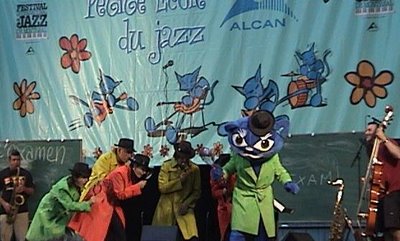
Helena was tired, but she impressed me with spontaneous bursts of head-bopping, hip-swaying, foot-tapping. She passed with flying colours, and we have the certificate to prove it.
La Petite Ecole du Jazz was specifically geared toward youngsters, most of whom were likely the less than willing accompaniments to afficionado parents, out-of-towners on jazz-vacation weekends.
It was that vaguely pleasant time of morning when the kids are starting to tucker from hours of play and the parents are just beginning to reap the benefits of copious pots of coffee. The crowd was remarkably well-behaved, I'd even say mellow.
Audience members sang out nursery rhymes and other childhood favourites; the band echoed them jazz-style, swing or latin or blues. Lessons included cool vs not-cool as exemplified through syncopated hand-clapping rhythms, what is jazz vs not-jazz, counting (Take Five!). The band did some fun tricks like playing blindfolded and playing (piano) upside down. And of course, the jazz festival mascot, Ste-Cat, was a big hit.

Helena was tired, but she impressed me with spontaneous bursts of head-bopping, hip-swaying, foot-tapping. She passed with flying colours, and we have the certificate to prove it.
Saturday, July 01, 2006
Jazz virgins
I don't know much about jazz, much less how to write about it, but I remembered having read something, so I went looking for it, and found just one sentence...
No one seemed disposed to contradict him because Wong had quietly appeared with the coffee and Ronald, shrugging his shoulders, had turned loose Fred Waring and his Pennsylvanians and after a terrible scratching they reached the theme that fascinated Oliveira, an anonymous trumpet followed by the piano, all wrapped up in the smoke of an old phonograph and a bad recording, of a corny prejazz band, all in all like those old records, showboats, Storyville nights, where the old only really universal music of the century had come from, something that brought people closer together and in a better way than Esperanto, UNESCO, or airlines, a music which was primitive enough to have gained such universality and good enough to make its own history, with schisms, abdications, and heresies, its Charleston, its Black Bottom, its Shimmy, its Fox Trot, its Stomp, its Blues, to label its forms, this style and the other one, swing, bebop, cool, a counterpoint of romanticism and classicism, hot and intellectual jazz, human music, music with a history in contrast to stupid animal dance music, the polka, the waltz, the zamba, a music that could be known and liked in Copenhagen as well as in Mendoza or Capetown, a music that brings adolescents together, with records under their arms, that gives them names and melodies to use as passwords so they can know each other and become intimate and feel less lonely surrounded by bosses, families, and bitter love affairs, a music that accepts all imagination and tastes, a collection of instrumental 78's with Freddie Keppard or Bunk Johnson, the reactionary cult of Dixieland, and academic specialization in Bix Beiderbecke, or in the adventures of Thelonious Monk, Horace Silver, or Thad Jones, the vulgarities of Erroll Garner or Art Tatum, repentance and rejection, a preference for small groups, mysterious recordings with false names and strange titles and labels made up on the spur of the moment, and that whole freemasonry of Saturday nights in a student's room or in some basement café with girls who would rather dance to Stardust or When Your Man Is Going to Put You Down, and have a sweet slow smell of perfume and skin and heat, and let themselves be kissed when the hour is late and somebody has put on The Blues with a Feeling and hardly anybody is really dancing, just standing up together, swaying back and forth, and everything is hazy and dirty and lowdown and every man is in a mood to tear off those warm girdles as his hands go stroking shoulders and the girls have their mouths half-opened and turn themselves over to delightful fear and the night, while a trumpet comes on to possess them in the name of all men, taking them with a single hot phrase that drops them like a cut flower into the arms of their partners, and there comes a motionless race, a jump up into the night air, over the city, until a miniature piano brings them to again, exhausted, reconciled, and still virgins until next Saturday, all of this from a kind of music that horrifies solid citizens who think that nothing is true unless there are programs and ushers, and that's the way things are and jazz is like a bird who migrates or emigrates or immigrates or transmigrates, roadblock jumper, smuggler, something that runs and mixes in and tonight in Vienna Ella Fitzgerald is singing while in Paris Kenny Clarke is helping open a new cave and in Perpignan Oscar Peterson's fingers are dancing around and Satchmo, everywhere, with that gift of omnipresence given him by the Lord, in Birmingham, in Warsaw, in Milan, in Buenos Aires, in Geneva, in the whole world, is inevitable, is rain and bread and salt, something completely beyond national ritual, sacred traditions, language and folklore: a cloud without frontiers, a spy of air and water, an archetypal form, something from before, from below, that brings Mexicans together with Norwegians and Russians and Spaniards, brings them back into that obscure and forgotten central flame, clumsily and badly and precariously he delivers them back to a betrayed origin, he shows them that perhaps there have been other paths and that the one they took was maybe not the only one or the best one, or that perhaps there have been other paths and that the one they took was the best, but that perhaps there were other paths that made for softer walking and that they had not taken those, or that they only took them in a halfway sort of way, and that a man is always more than a man and always less than a man, more than a man because he has in himself all that jazz suggests and lies in wait for and even anticipates, and less than a man because he has made an aesthetic and sterile game out this liberty, a chessboard where one must be bishop or knight, a definition of liberty which is taught in school, in the very schools where the pupils are never taught ragtime rhythm or the first notes of the blues, and so forth and so on.
– From Hopscotch, Julio Cortazar, 1963.
Friday, June 30, 2006
The Zorn zone
The Festival International de Jazz de Montreal is on!
Last night we took in John Zorn's Acoustic Masada, an event I'd been looking forward to for half a year.
Phenomenal. I don't know how to begin to describe this music. It's deeply familiar, even while it's strange and I encounter parts of Zorn's project for the first time.
It reminds me of... everything.
His sax sounds like ducks and sick cows, and street traffic, hordes of forgotten people, there's a noise he sustains that sounds like a violin when you draw the bow across the strings on the wrong side of the bridge. I sat with my mouth open, watching a trumpet play percussion, and a bass sound like a piano, and drums like an intricate tap dance transforming into butter-leather butterflies and dipping into gritty 1950s movies set in New York. All the while, nostalgic melodies hover.
All this noise so clean and precise, each of the musicians completely in control, creating this energy, stealing it from everyone in the room, a palpable tension that suddenly breathed a collective breath, felt peace and calm, before again the collective soul filled with anger and melancholia and the adrenaline of building something wholly new out of something so very old.
From Wikipedia:
As for those historical associations, the Romans breached the wall of the fortress Masada in 73 CE:
I'm not sure what any of it means, and frankly for the timebeing I'd rather not consider its political implications — I don't think I'm mature enough to not let it spoil the music for me. The words, the titles are sufficiently vague, and Zorn is silent on any intent other than musical, that I'm comfortable with what meaning this music has for me.
One recommendation for this show recognizes that:
They're tight as a group, with Zorn obviously directing them, raising a leg (camouflage cargo pants) or jerking his head to adust their volumes, shift their tempos. The setting, at Place des Arts, was a bit formal for my liking, but I'm almost scared to consider what energy might be drawn and released elsewhere.
Two encores, refusing a third only, I think, out of sheer exhaustion.
The performance was recorded for Radio-Canada and will be broadcast July 16, 20:00 EST.
Last night we took in John Zorn's Acoustic Masada, an event I'd been looking forward to for half a year.
Phenomenal. I don't know how to begin to describe this music. It's deeply familiar, even while it's strange and I encounter parts of Zorn's project for the first time.
It reminds me of... everything.
His sax sounds like ducks and sick cows, and street traffic, hordes of forgotten people, there's a noise he sustains that sounds like a violin when you draw the bow across the strings on the wrong side of the bridge. I sat with my mouth open, watching a trumpet play percussion, and a bass sound like a piano, and drums like an intricate tap dance transforming into butter-leather butterflies and dipping into gritty 1950s movies set in New York. All the while, nostalgic melodies hover.
All this noise so clean and precise, each of the musicians completely in control, creating this energy, stealing it from everyone in the room, a palpable tension that suddenly breathed a collective breath, felt peace and calm, before again the collective soul filled with anger and melancholia and the adrenaline of building something wholly new out of something so very old.
From Wikipedia:
Masada is not so much a band as a musical project that John Zorn embarked upon in the early '90s. It is a collection of more than 200 short tunes that have been written in accordance with a number of rules. These include the maximum number of staves, the modes or scales that are used and the fact that they must be playable by any small group of instruments. Given the historical associations of the project's name (see Masada), the Hebrew titles of the compositions, and the Jewish imagery on the covers of the associated albums, Zorn was clearly exploring his Jewish roots. "The idea with Masada is to produce a sort of radical Jewish music, a new Jewish music which is not the traditional one in a different arrangement, but music for the Jews of today. The idea is to put Ornette Coleman and the Jewish scales together."
As for those historical associations, the Romans breached the wall of the fortress Masada in 73 CE:
When they entered the fortress, however, the Romans discovered that its approximately 1000 defenders had set all the buildings but the food storerooms ablaze and committed mass suicide rather than face certain capture or defeat by their enemies (which would probably have led to slavery or execution). Because the Judaism strongly discourages suicide, however, the defenders were reported to have drawn lots and slain each other in turn, down to the last man, who would be the only one to actually take his own life. The storerooms were apparently left standing to show that the defenders retained the ability to live and chose the time of their death.
I'm not sure what any of it means, and frankly for the timebeing I'd rather not consider its political implications — I don't think I'm mature enough to not let it spoil the music for me. The words, the titles are sufficiently vague, and Zorn is silent on any intent other than musical, that I'm comfortable with what meaning this music has for me.
One recommendation for this show recognizes that:
It recalls the collective suicide of the Masada community in biblical Israel, but is more about music that gets to your gut. Zorn's original Masada quartet combines individual prowess in a collective spirit of creative renewal: trumpeter Dave Douglas, drummer Joey Baron and bassist Greg Cohen.
They're tight as a group, with Zorn obviously directing them, raising a leg (camouflage cargo pants) or jerking his head to adust their volumes, shift their tempos. The setting, at Place des Arts, was a bit formal for my liking, but I'm almost scared to consider what energy might be drawn and released elsewhere.
Two encores, refusing a third only, I think, out of sheer exhaustion.
The performance was recorded for Radio-Canada and will be broadcast July 16, 20:00 EST.
Wednesday, June 28, 2006
Left-brained literature
As defined by Waggish: "books that fall into the category of my having empirically observed them being read by a multitude of engineers with a literary bent." No conclusions drawn, but I think it's an interesting exercise.
The list of authors includes some of my favourites: Umberto Eco, Italo Calvino, Milorad Pavic, Neal Stephenson. Also, Borges, Perec, DeLillo. (Maybe I'm an engineer at heart after all.)
Not surprisingly, there is some overlap with Alex Kasman's list of mathematical fiction, though I like the Waggish ambition to focus on "literary" fiction.
No women writers are noted. I think AS Byatt might appeal to left-brained readers, but I can't say I've ever seen an engineer reading her books.
Tuesday, June 27, 2006
Trains and things
Every morning Helena pitter patters to my bedside. Sometimes she gently shakes me awake, usually it takes only her whispered "Mama." There are mornings I'm woken by her presence, her standing there and gazing at me; I'm awake but don't open my eyes, wondering how much longer before she whispers or reaches out her hand, wondering how long has she has been there already, wondering if she stands there all those other mornings too, perhaps her presence alone is not enough to rouse me as often as I think.
She asks if we can go upstairs, is it time. She assembles her things — usually her pillow and a chosen bear — for me to carry for her. From my own bedside I grab my glasses (to put them on in this half-sleep haze would be too rude an awakening) and the novel du jour.
In recent days, Helena wants to carry my book for me. She has created this job for herself; she holds the book as if it were a holy relic, presenting it to me proudly at the top of the stairs. It is important, and it is something she does for me.
This weekend was a holiday weekend, St-Jean Baptiste day. A visit from Helena's grandmother. A trip to the bookstore. A trip to the playground (le parc jaune, for its yellow slide), a walk through the park to see if we could score balloons or flags. Coming upon an assembled crowd, staying late to watch flamenco dancers. Neighbours having a party; being sung to sleep by their drunken crooning in the wee hours. A trip to another park (le parc boum-boum, for its bumpy slide). Tending the flowers on our balcony. A walk to the video store, another shop. Stopping at the playground on the way home. A tricycle ride to the schoolyard after supper. Back to the park after breakfast. A little drive. Later, a walk to yet a different park, with a wading pool. Splash. A tricycle ride to return a movie. Crepes for breakfast. A visit to our old park, the one we used to live across the street from, to feed the ducks and, of course, enjoy the playground (le parc rouge, for its red slide). A walk to the store for a bottle of wine and cookies. Finally, the rain.
I steal away to read a few pages. Helena finds me on the bench in the courtyard. She asks to look at my book. The only picture is the one on the dustjacket. I make the mistake of telling her the book is about a train. She is too eager now. The bookmark flutters to the ground. Helena opens Iron Council to page one. She's facing me; she props the book up on her knee so as to display all that lies within to her audience. She describes the illustration that only she can see, a bright blue engine; and she "reads" to me about a train called Thomas and the schoolchildren who come to visit him.
(China Miéville's Iron Council is not a light read. Review. The language is rich, heavy; the politics, slow to digest. The making of myth and messiahs. "The uncovering of the 'truth' informs the achievement, but does not destroy it: actions gain their own momentum." Debate.)
Sunday, June 25, 2006
Lessing's mothers
I didn't mean to read The Grandmothers this week. It's been on my nightstand for ages; other books are queued up to be read first. But in that moment between books I found my hand resting on it, then picking it up and opening it.
I didn't mean to write about it here, either. But.
These aren't nice stories. All 4 stories in this volume by Doris Lessing leave me sad and uncomfortable. Too, the writing isn't... tight. Trails tangential to the main path are followed at whim, then dropped. It sounds at times likes the ramblings and commentary of an old woman. Still interesting and usually relevant, but not always obviously purposeful. Perhaps she's always written this way and I never noticed. Perhaps it's from recently reading her essays with their casual rhythms, and having listened to her that I'm more aware of her pauses and asides, how she strays before coming back.
These stories are about mothers. I didn't figure that out till I was finishing up the third story. You'd think the title of the book would've served me as a clue to the fact that family relationships would figure strongly.
There are fathers too, but they are barely there. They are emotionally then physically absent, absent then intrusive, tyrranical and dead; while the fourth story is told from the father's perspective, he never meets his child.
The mothers. The mothers try so hard to do right by their children, and they fail, often spectacularly. They mean well, they do their best, and sometimes I think I would've done much the same, but they still don't get it exactly right. You can't win; mothers can't win.
The third story, The Reason for It, is my favourite of this lot. It reads like a report from another time and place, though it could be an allegory for some of our current times and places.
I wonder what kind of mother Doris Lessing was (is). I don't know how much her autobiography will tell me about this; I suspect, not much.
It's Doris Lessing who articulated some of my deepest fears regarding motherhood, years before I even considered entering that state. How much control does a mother have? What if my child is evil? What if my child is stupid? What is my child's nature? How will that nature reveal itself to me, and will it guide me like I need to be guided?
(Doris Lessing is now on MySpace.)
I didn't mean to write about it here, either. But.
These aren't nice stories. All 4 stories in this volume by Doris Lessing leave me sad and uncomfortable. Too, the writing isn't... tight. Trails tangential to the main path are followed at whim, then dropped. It sounds at times likes the ramblings and commentary of an old woman. Still interesting and usually relevant, but not always obviously purposeful. Perhaps she's always written this way and I never noticed. Perhaps it's from recently reading her essays with their casual rhythms, and having listened to her that I'm more aware of her pauses and asides, how she strays before coming back.
These stories are about mothers. I didn't figure that out till I was finishing up the third story. You'd think the title of the book would've served me as a clue to the fact that family relationships would figure strongly.
There are fathers too, but they are barely there. They are emotionally then physically absent, absent then intrusive, tyrranical and dead; while the fourth story is told from the father's perspective, he never meets his child.
The mothers. The mothers try so hard to do right by their children, and they fail, often spectacularly. They mean well, they do their best, and sometimes I think I would've done much the same, but they still don't get it exactly right. You can't win; mothers can't win.
The third story, The Reason for It, is my favourite of this lot. It reads like a report from another time and place, though it could be an allegory for some of our current times and places.
And that was the moment I understood. Oh, all kinds of enlightenment came flooding, rather late, but there it was, right in front of me. It was not that he had forgotten. Not that he had deliberately destroyed what was good. He had never known it was good. He had never understood. He had seemed to be part of it all, but he, Destra's son, the graceful and charming and delightgul DeRod, whom we had all admired, had been a blind person among us. From some spirit of emulation he had gone along with it all, as children do, but he had unsderstood nothing at all.
Oh, yes, the scales were indeed falling from my eyes.
I sat there looking back over my long life, and thinking how we, The Twelve, had not seen the first most obvious thing. We had deluded ourselves with all kinds of imaginings and resentments and suspicions: we had seen this man here, DeRod, as a villain, a scheming, ambitious, unscrupulous scoundrel. The truth, had been — he was stupid. That's all. We had never seen it. But clearly, his mother had . . . and that was something I had to think out.
I wonder what kind of mother Doris Lessing was (is). I don't know how much her autobiography will tell me about this; I suspect, not much.
It's Doris Lessing who articulated some of my deepest fears regarding motherhood, years before I even considered entering that state. How much control does a mother have? What if my child is evil? What if my child is stupid? What is my child's nature? How will that nature reveal itself to me, and will it guide me like I need to be guided?
(Doris Lessing is now on MySpace.)
Thursday, June 22, 2006
The box in my mother's basement
Every time I visit my mother, I make my way to the crawlspace in the basement to retrieve childhood treasures — books, naturally. What was once a 5-box storehouse has now dwindled to 2 cartons, each only half full. Over the years, I've winnowed the contents, releasing some to charity, some to their rightful owners, some to the dump. Quite a few have made their way to my home, finally I have my own home, but I've resisted the logical course of action: packing the boxes into the trunk of the car, moving them in one fell swoop. My trips to the basement are adventures I'm not ready to end.
One of the remaining boxes keeps my Nancy Drew collection. Those books will come home with me someday, but I have no inclination to reread them myself, and my daughter is still too young for them.
The other box still holds mysteries. Old friends wait there too, but there are books I barely recognize. Their illustrations are vaguely familiar, titles ring distant bells — I know them from a past life. Indeed, after some 20 years of weeding and sorting, I know that every book there is there for a reason. But what reason?
 On my last visit, I plucked out The City Beyond the Gates, by N Roy Clifton. It's copyrighted 1972, but my edition was printed in 1977. Likely I read it when I was 8 years old.
I read it again. It's a dystopia and an allegory. And it leaves a very bad taste in my mouth.
It is probably the very first dystopian fiction I read, something I did develop a taste for. My 8-year-old self was looking for a perfect world, knowing it would never be found. My 8-year-old self did not find this book simplistic, naive, obvious; she thought it was cool. My 8-year-old self learned that other people were looking too, and that some things can be found only in literature.
I cannot confirm the identity of the author. Perhaps he is this man: Quaker and vegetarian, remembered by RH Thompson.

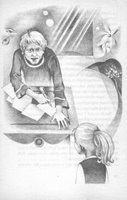 The most unsettling aspect of the book is, in my view, its illustrations, by Tibor Kovalik. I think they speak for themselves.
Indeed, I have found a great treasure in the box in my mother's basement.
One of the remaining boxes keeps my Nancy Drew collection. Those books will come home with me someday, but I have no inclination to reread them myself, and my daughter is still too young for them.
The other box still holds mysteries. Old friends wait there too, but there are books I barely recognize. Their illustrations are vaguely familiar, titles ring distant bells — I know them from a past life. Indeed, after some 20 years of weeding and sorting, I know that every book there is there for a reason. But what reason?
 On my last visit, I plucked out The City Beyond the Gates, by N Roy Clifton. It's copyrighted 1972, but my edition was printed in 1977. Likely I read it when I was 8 years old.
I read it again. It's a dystopia and an allegory. And it leaves a very bad taste in my mouth.
It is probably the very first dystopian fiction I read, something I did develop a taste for. My 8-year-old self was looking for a perfect world, knowing it would never be found. My 8-year-old self did not find this book simplistic, naive, obvious; she thought it was cool. My 8-year-old self learned that other people were looking too, and that some things can be found only in literature.
"No one tells me what to do."
"What you mean is," said the Kemarch, gently, "that you are not aware of anyone's telling you."
I cannot confirm the identity of the author. Perhaps he is this man: Quaker and vegetarian, remembered by RH Thompson.

 The most unsettling aspect of the book is, in my view, its illustrations, by Tibor Kovalik. I think they speak for themselves.
Indeed, I have found a great treasure in the box in my mother's basement.
The editor's brain
On Ellen Seligman, publisher of fiction and vice-president of McClelland & Stewart, or "Canada's top fiction editor":
(Via GoodReports.net)
When she talks, two brains are at work.
There's her First Response Brain, the one that listens to questions and offers an immediate answer. And then there's her Editor's Brain, the one that considers how the first brain responded and then scrawls in some marginalia.
(Via GoodReports.net)
Wednesday, June 21, 2006
The books are talking to each other again
Utopian society! Cult?! Cognitive science! Visions?!
When Annette Gilson contacted me about sending me a copy of her novel, New Light, I jumped at the chance to read it. It's a pretty breezy, quick read I consumed in spare moments over about 3 days last week.
Gilson's website gives this synopsis:
New Light was reviewed favourably by Alan Cheuse, though I take issue with his calling it a romance.
I don't really know where to start in talking about this book — I seem unable to maintain, let alone articulate, any coherent thought lately. But the book certainly had me thinking about a great deal of very interesting ideas — a good thing.
I wasn't enthralled by the tone of the first chapter (I'm not a fan of first-person narrative; I think it's really hard to pull off well), but the ideas were compelling enough; it did the job of making me want to read on. One review discusses the writing style (among all else). The rhythm does in fact suit the narrator rather well as we come to know her.
The dialogue I found to be natural and completely believable, reminding me of parties I went to in my university days; the interesting parties, anyway. So I find myself remembering: people I had brief but intense connections with, conversations about the nature of perception.
The book tells the story of one week in Beth's life. A lot can happen in a week. And I remember: one group of people I fell in with, or another, for a few days, or a summer; I remember the feeling that all eternity, and the meaning of everything, if coded, was contained in a handful of moments — intimate friendships with strangers. The briefest of exchanges were immensely meaningful.
While not exactly a trip down memory lane (I've never lived on a commune; I've never had visions), the novel awakened lingering questions: how have I processed my reality? what happened to the others? what happened to all our big ideas? do they remember things the way I do? how can such little moments have such profound effects? what the fuck happened?
I'm not trying to be cryptic, but I don't want to tell all my little stories either. But I'm trying to explain those moments — I think we all have them, don't we? It doesn't happen often anymore (is biological age, or lifestyle, a factor?). How to explain those moments: when there's a connection, intellectual, spiritual, or, yes, sexual; with a stranger, an old friend in a new light, the universe; that defies sense or definition. Is it a kind of altered state? I don't mean odd events. I mean those otherwise very ordinary days: Those 3 "ordinary" days of shopping, ice cream, and gin & tonics with my girlfriends, days rife with spontaneity and coincidence, but somehow they were different than all the other times, somehow for that one span of time everything was in tune, in sync, magical, and I was in the moment and imbued with a sense of omnipotence. A confluence of circumstance over a chunk (small, dense) of time that taps an essence.
And while a week on a commune is bit of an extreme example of a social situation, I think Gilson has tapped into a common "problem" of experience.
Anyway.
New Light is having conversations with other books on my shelves. With Beyond Black, about the idea of a stage persona taken on by a "mystic." With Labyrinth, about the nature of visions — genetic? biochemical? mystical? With War and Peace (which, no, I haven't started reading, but I've been reading a bit about it), about the nature of history.
New Light's neuroscientist posits that spiritual movements throughout history, and the effects on social and political radicals, are a manifestation of chaotic patterning. "It's the chaotic effect. It doesn't matter if spiritualism itself is a sham, just like it doesn't matter that you solve for the chaos pattern in imaginary space. Both map out patterns in the real world." Meanwhile, Tolstoy:
The loudest conversation in the room, nearly drowning out all the others, is with A.S. Byatt's A Whistling Woman. They're still talking. I thought I was quite done with Byatt, but it seems I'm only now beginning to hear some of what that book had to say. Spiritual communities figure in both, as does investigation into the cognitive processes in play. A heroine grappling with identity issues and romantic difficulties. The imagery of bird-women. Byatt cuts across a much broader swath of life, but remains coldly, academically detached; Gilson's world is smaller but warmer. My, they have a lot to say to each other.
When Annette Gilson contacted me about sending me a copy of her novel, New Light, I jumped at the chance to read it. It's a pretty breezy, quick read I consumed in spare moments over about 3 days last week.
Gilson's website gives this synopsis:
Beth Martin wakes up one day feeling that she has wasted her life. She goes to Saint Louis to visit her college roommate and take some time to get her bearings. But at a party she experiences what she can only call a vision, which she finds isconcerting, but also strangely compelling. Also compelling is her seeming chance meeting with a neuroscientist who is researching vision phenomena. Beth accompanies him to New Light, a visionary commune in the Missouri Mountains where she meets its charismatic leader and is befriended by some of its members. Their conception of American life challenges the mainstream in a number of ways, most notably in their openness to sexual and emotional experimentation. Beth is intrigued by the sense of possibility she finds at New Light, but is also disturbed by the enormous power its leader wields over the members' lives. In the end she must address questions of faith and responsibility, loyalty and desire, jealousy and tolerance.
New Light was reviewed favourably by Alan Cheuse, though I take issue with his calling it a romance.
I don't really know where to start in talking about this book — I seem unable to maintain, let alone articulate, any coherent thought lately. But the book certainly had me thinking about a great deal of very interesting ideas — a good thing.
I wasn't enthralled by the tone of the first chapter (I'm not a fan of first-person narrative; I think it's really hard to pull off well), but the ideas were compelling enough; it did the job of making me want to read on. One review discusses the writing style (among all else). The rhythm does in fact suit the narrator rather well as we come to know her.
The dialogue I found to be natural and completely believable, reminding me of parties I went to in my university days; the interesting parties, anyway. So I find myself remembering: people I had brief but intense connections with, conversations about the nature of perception.
The book tells the story of one week in Beth's life. A lot can happen in a week. And I remember: one group of people I fell in with, or another, for a few days, or a summer; I remember the feeling that all eternity, and the meaning of everything, if coded, was contained in a handful of moments — intimate friendships with strangers. The briefest of exchanges were immensely meaningful.
While not exactly a trip down memory lane (I've never lived on a commune; I've never had visions), the novel awakened lingering questions: how have I processed my reality? what happened to the others? what happened to all our big ideas? do they remember things the way I do? how can such little moments have such profound effects? what the fuck happened?
I'm not trying to be cryptic, but I don't want to tell all my little stories either. But I'm trying to explain those moments — I think we all have them, don't we? It doesn't happen often anymore (is biological age, or lifestyle, a factor?). How to explain those moments: when there's a connection, intellectual, spiritual, or, yes, sexual; with a stranger, an old friend in a new light, the universe; that defies sense or definition. Is it a kind of altered state? I don't mean odd events. I mean those otherwise very ordinary days: Those 3 "ordinary" days of shopping, ice cream, and gin & tonics with my girlfriends, days rife with spontaneity and coincidence, but somehow they were different than all the other times, somehow for that one span of time everything was in tune, in sync, magical, and I was in the moment and imbued with a sense of omnipotence. A confluence of circumstance over a chunk (small, dense) of time that taps an essence.
And while a week on a commune is bit of an extreme example of a social situation, I think Gilson has tapped into a common "problem" of experience.
Anyway.
New Light is having conversations with other books on my shelves. With Beyond Black, about the idea of a stage persona taken on by a "mystic." With Labyrinth, about the nature of visions — genetic? biochemical? mystical? With War and Peace (which, no, I haven't started reading, but I've been reading a bit about it), about the nature of history.
New Light's neuroscientist posits that spiritual movements throughout history, and the effects on social and political radicals, are a manifestation of chaotic patterning. "It's the chaotic effect. It doesn't matter if spiritualism itself is a sham, just like it doesn't matter that you solve for the chaos pattern in imaginary space. Both map out patterns in the real world." Meanwhile, Tolstoy:
And if history has for its object the study of the movement of the nations and of humanity and not the narration of episodes in the lives of individuals, it too, setting aside the conception of cause, should seek the laws common to all the inseparably interconnected infinitesimal elements of free will.
The loudest conversation in the room, nearly drowning out all the others, is with A.S. Byatt's A Whistling Woman. They're still talking. I thought I was quite done with Byatt, but it seems I'm only now beginning to hear some of what that book had to say. Spiritual communities figure in both, as does investigation into the cognitive processes in play. A heroine grappling with identity issues and romantic difficulties. The imagery of bird-women. Byatt cuts across a much broader swath of life, but remains coldly, academically detached; Gilson's world is smaller but warmer. My, they have a lot to say to each other.
Summer reading
Slate celebrates the beginning of summer reading season in pictures, and I mention it only because it makes me angry: the photo series is called "Hitting the Books," yet books are featured in only half the photos (the rest show newspapers and magazines), and some of those books aren't even being hit. No, Slate, your titles are not very clever at all.
Monday, June 19, 2006

Friday, June 16, 2006
Thursday, June 15, 2006
Le rouge et le noir
 Acquired today, because I happened to be passing by a bookstore, and it was there. This edition chosen for its striking cover (yes, Picasso) and slightly atypical dimensions. It includes a brief biography, introductory notes, a historical timeline. The text itself is interspersed with articles concerning the major themes and suggested thesis topics. In French.
The section I quoted previously reads as follows:
Mais, cent pas plus haut, si celui-ci continue sa promenade, il aperçoit une maison d'assez belle apparence, et à travers une grille de fer attenante à la maison, des jardins magnifiques. Au-delà, c'est une ligne d'horizon formée par les collines de la Bourgogne; et qui semble faite à souhait pour le plaisir des yeux. Cette vue fait oublier au voyageur l'atmosphère empestée des petits intérêts d'argent dont il commence à être asphyxié.
What the hell have I gotten myself into?
Has anyone had any success in reading, for pleasure, in a language other than their native one?
Wednesday, June 14, 2006
How can we bear the weight of the world without robots?
I open the door and Helena collapses against my leg. I look up at J-F; he shrugs. Must've been a rough day at daycare.
She makes no move to make herself at home. Her shoes and sweater stay on. She stays put. I crouch beside her.
Her little body leans into mine, heavy with the weight of the world.
We stay like this for more than 10 minutes. I've dropped to my knees by now, my fingertips still on the doorframe for balance. She isn't exactly hugging me, more like trying to sink back inside me.
Do you want to talk about it? She shakes her head. A deep sigh escapes her, and I think to myself, My god, what have they done to you, what cruelties has the world shown you to age you like this, for you to know already the dark truths of our life, you, so young, is this how it happens, at age 3, you've stared into the abyss.
I'm not sure how the spell was broken, but soon after, we're sitting on the sofa side by side eating raisins. Almost normal.
There's still some sadness in her voice. She tells me — and I don't know if this is the reason for her existential spleen or simply something that happened earlier in the day — A. keeps telling C. that she's not my friend anymore. A.'s not my friend anymore. Because of our house, the things at our house. A. won't be my friend anymore because we don't have any robots.
Monday, June 12, 2006
What I've been reading
Beyond Black
by Hilary Mantel
It starts off kind of odd; toward the end it gets weird. I did not love this book.
After hearing Mantel in interview some years ago and deciding I really didn't like her (tho' I'd quite enjoyed The Giant, O'Brien) — the self-absorption, the self-aggrandizement, the flakiness — this story sounded just too interesting to pass up. It had great reviews and Maud Newton's endorsement as one of the top books she'd read in 2005.
(What do you do when a friend loves a book you hate, or vice versa? Or a blog acquaintance, or someone you respect. I turns my world upside down. That Maud Newton liked Beyond Black I can accept, respect, appreciate. That Mimi Smartypants is loving Percival Everett's Glyph, a book I abhorred, is driving me fucking insane. Every time I click over, I'm reminded of this, and all her words are then filtered through this tiny piece of my consciousness and the pleasure is lost. Another piece of my consciousness is meanwhile reconsidering my assessment of the book: did my book-reading capacity fail me? what am I missing? is it me, it must be me? Or else, Mimi Smartypants is full of shit, and then, where does that leave me?)
While the characters of Beyond Black are wholly believable, they're not likeable. Which is fine.
It turns out that the themes I expected to be explored weren't so much. Which is fine. Seeing the psychics at first through Colette's eyes, I expected more of a struggle between her skepticism and her desire to believe. Maybe the ending speaks to this a little bit — the tie between the "real" ghosts and the ghosts of Alison's past. I can't decide if it's too ambiguous or not ambiguous enough to satisfy me. Either way, this isn't a major theme, which is a problem for no one but me and my readerly expectations.
So I didn't love it. Yet, more than any book I've read in recent memory, I'm dying to know how it came about — which part of the story came first, what was the kernel. The novel didn't speak to me, but I have a lot of appreciation for the way the characters were unfolded and how the story was told.
Labyrinth
by Kate Mosse
I was only mildly interested in reading this one, but knowing it was the next Reading Matters book club book and coming across a copy bearing a $5 sticker on a fine day conducive to impulse purchases, I started in.
The blurb on the cover ("Eat your heart out, Dan Brown, this is the real thing.") is just plain crass. Although it's clear from the historical detail that research for this book must've been well underway before Brown's Code ever hit the shelves, Labyrinth was obviously rushed through its final stages so as to cash in as early as possible. (I stumbled across a lot of errors that should've been caught at proofreading.)
The writing's bad. The mechanism tying present to past is clunky. There's a fantasy element — our modern-day heroine "remembers" the past in her blood (an idea that bears a certain amount of poetry, I think) — that comes across as quite stupid; the book can't decide between being a fantasy or historical novel, and the attempt to blend these elements fails. It lacks focus and finesse.
Still, I read through to the end. My brain needed a little rest and certainly couldn't handle the decision to abandon it and choose to pick up something else. I can't recommend it to anyone though. I liked The DaVinci Code better.
The Gambler
by Fyodor Dostoevsky
This is the book I've had in my purse the last few months. Reading opportunities away from the house are few, but I'd been riding public transportation a lot last week (because), so I finally got past the introductory scenes and finished it. It stands out from the other reading for its passion. It's short, witty, full of astute observations, just passionate, about women, gambling, everything. Any old idea spouted from any character's mouth is so alive.
Beautiful (although I prefer the Garnett translation I have in hand)! Takes my breath away! Read it!
Also, it leads perfectly to my next reads, via the roulette wheel (red and black) and Russian sensibilities (war and peace).
The Red and the Black
by Stendhal
Why, why, why am I so desperate to read this book? I've read the introduction, historical notes, essays, etc. I've read only the first few pages, and I am in love. I've deliberately held back though, hoping it might be chosen as the next book for discussion at Reading Middlemarch. Alas, it did not seem likely.
Quite stupidly as I was falling in love with the first 4 pages, I mused aloud that I ought to try reading it in French, it's so good, it must be so much better in French, and really I ought to challenge myself more. It's as good as a vow, as I said it out loud and someone heard me. So I need to get myself a copy in French before proceeding.
Also, it strikes me as a lovely companion piece to the actual Reading Middlemarch selection. My Napoleonic summer!
War and Peace
by Leo Tolstoy
The people have spoken! War and Peace is the next book under discussion by the Reading Middlemarch reading group. (Stupid short-sighted blog name!) I'm less enthusiastic about this choice than I was about some of the other options (having a taste of both Dostoyevsky and Stendhal in my mouth), but hey, "greatest novel ever written" and all that, so whatever.
I don't have a copy yet. I spent a couple hours in bookstores yesterday afternoon comparing translations. I'm leaning toward the 1968 Dunnigan, which apart from satisfying my readability criterion is declared superior by various internet authorities, although an argument is made for Briggs. What do I know?
Promises
by me
To read Stendhal in French.
To post here more regularly in more manageable bite-sized chunks, to prevent staleness and bloating. I keep forgetting lately that blogging is good for me. I feel so unexercised (and unexorcised).
That is all for now.
by Hilary Mantel
It starts off kind of odd; toward the end it gets weird. I did not love this book.
After hearing Mantel in interview some years ago and deciding I really didn't like her (tho' I'd quite enjoyed The Giant, O'Brien) — the self-absorption, the self-aggrandizement, the flakiness — this story sounded just too interesting to pass up. It had great reviews and Maud Newton's endorsement as one of the top books she'd read in 2005.
(What do you do when a friend loves a book you hate, or vice versa? Or a blog acquaintance, or someone you respect. I turns my world upside down. That Maud Newton liked Beyond Black I can accept, respect, appreciate. That Mimi Smartypants is loving Percival Everett's Glyph, a book I abhorred, is driving me fucking insane. Every time I click over, I'm reminded of this, and all her words are then filtered through this tiny piece of my consciousness and the pleasure is lost. Another piece of my consciousness is meanwhile reconsidering my assessment of the book: did my book-reading capacity fail me? what am I missing? is it me, it must be me? Or else, Mimi Smartypants is full of shit, and then, where does that leave me?)
While the characters of Beyond Black are wholly believable, they're not likeable. Which is fine.
It turns out that the themes I expected to be explored weren't so much. Which is fine. Seeing the psychics at first through Colette's eyes, I expected more of a struggle between her skepticism and her desire to believe. Maybe the ending speaks to this a little bit — the tie between the "real" ghosts and the ghosts of Alison's past. I can't decide if it's too ambiguous or not ambiguous enough to satisfy me. Either way, this isn't a major theme, which is a problem for no one but me and my readerly expectations.
So I didn't love it. Yet, more than any book I've read in recent memory, I'm dying to know how it came about — which part of the story came first, what was the kernel. The novel didn't speak to me, but I have a lot of appreciation for the way the characters were unfolded and how the story was told.
Labyrinth
by Kate Mosse
I was only mildly interested in reading this one, but knowing it was the next Reading Matters book club book and coming across a copy bearing a $5 sticker on a fine day conducive to impulse purchases, I started in.
The blurb on the cover ("Eat your heart out, Dan Brown, this is the real thing.") is just plain crass. Although it's clear from the historical detail that research for this book must've been well underway before Brown's Code ever hit the shelves, Labyrinth was obviously rushed through its final stages so as to cash in as early as possible. (I stumbled across a lot of errors that should've been caught at proofreading.)
The writing's bad. The mechanism tying present to past is clunky. There's a fantasy element — our modern-day heroine "remembers" the past in her blood (an idea that bears a certain amount of poetry, I think) — that comes across as quite stupid; the book can't decide between being a fantasy or historical novel, and the attempt to blend these elements fails. It lacks focus and finesse.
Still, I read through to the end. My brain needed a little rest and certainly couldn't handle the decision to abandon it and choose to pick up something else. I can't recommend it to anyone though. I liked The DaVinci Code better.
The Gambler
by Fyodor Dostoevsky
This is the book I've had in my purse the last few months. Reading opportunities away from the house are few, but I'd been riding public transportation a lot last week (because), so I finally got past the introductory scenes and finished it. It stands out from the other reading for its passion. It's short, witty, full of astute observations, just passionate, about women, gambling, everything. Any old idea spouted from any character's mouth is so alive.
"If," replied Astley, "you do not care to hear their names coupled together, may I ask you what you mean by the expressions 'this Frenchman,' 'this Russian lady,' and 'there being anything between them'? Why do you call them so particularly a 'Frenchman' and a 'Russian lady'?"
"Ah, I see you are interested, Mr. Astley. But it is a long, long story, and calls for a lengthy preface. At the same time, the question is an important one, however ridiculous it may seem at the first glance. A Frenchman, Mr. Astley, is merely a fine figure of a man. With this you, as a Britisher, may not agree. With it I also, as a Russian, may not agree — out of envy. Yet possibly our good ladies are of another opinion. For instance, one may look upon Racine as a broken-down, hobbledehoy, perfumed individual — one may even be unable to read him; and I too may think him the same, as well as, in some respects, a subject for ridicule. Yet about him, Mr. Astley, there is a certain charm, and, above all things, he is a great poet — though one might like to deny it. Yes, the Frenchman, the Parisian, as a national figure, was in process of developing into a figure of elegance before we Russians had even ceased to be bears. The Revolution bequeathed to the French nobility its heritage, and now every whippersnapper of a Parisian may possess manners, methods of expression, and even thoughts that are above reproach in form, while all the time he himself may share in that form neither in initiative nor in intellect nor in soul — his manners, and the rest, having come to him through inheritance. Yes, taken by himself, the Frenchman is frequently a fool of fools and a villain of villains. Per contra, there is no one in the world more worthy of confidence and respect than this young Russian lady. De Griers might so mask his face and play a part as easily to overcome her heart, for he has an imposing figure, Mr. Astley, and this young lady might easily take that figure for his real self — for the natural form of his heart and soul — instead of the mere cloak with which heredity has dowered him. And even though it may offend you, I feel bound to say that the majority also of English people are uncouth and unrefined, whereas we Russian folk can recognise beauty wherever we see it, and are always eager to cultivate the same. But to distinguish beauty of soul and personal originality there is needed far more independence and freedom than is possessed by our women, especially by our younger ladies. At all events, they need more EXPERIENCE.
Beautiful (although I prefer the Garnett translation I have in hand)! Takes my breath away! Read it!
Also, it leads perfectly to my next reads, via the roulette wheel (red and black) and Russian sensibilities (war and peace).
The Red and the Black
by Stendhal
Why, why, why am I so desperate to read this book? I've read the introduction, historical notes, essays, etc. I've read only the first few pages, and I am in love. I've deliberately held back though, hoping it might be chosen as the next book for discussion at Reading Middlemarch. Alas, it did not seem likely.
But if the traveler keeps on walking, no more than another hundred paces up the hill he will see a distinguished-looking house and, if he looks through an adjoining wrought-iron gate, a very fine garden. Beyond that, he will see a horizon shaped by Burgundian hills, which seems to have been put there expressly for the purpose of pleasing the eye. This view will help the traveler forget the foul smell of petty financial transactions, which had begun to asphyxiate him.
Quite stupidly as I was falling in love with the first 4 pages, I mused aloud that I ought to try reading it in French, it's so good, it must be so much better in French, and really I ought to challenge myself more. It's as good as a vow, as I said it out loud and someone heard me. So I need to get myself a copy in French before proceeding.
Also, it strikes me as a lovely companion piece to the actual Reading Middlemarch selection. My Napoleonic summer!
War and Peace
by Leo Tolstoy
The people have spoken! War and Peace is the next book under discussion by the Reading Middlemarch reading group. (Stupid short-sighted blog name!) I'm less enthusiastic about this choice than I was about some of the other options (having a taste of both Dostoyevsky and Stendhal in my mouth), but hey, "greatest novel ever written" and all that, so whatever.
I don't have a copy yet. I spent a couple hours in bookstores yesterday afternoon comparing translations. I'm leaning toward the 1968 Dunnigan, which apart from satisfying my readability criterion is declared superior by various internet authorities, although an argument is made for Briggs. What do I know?
Promises
by me
To read Stendhal in French.
To post here more regularly in more manageable bite-sized chunks, to prevent staleness and bloating. I keep forgetting lately that blogging is good for me. I feel so unexercised (and unexorcised).
That is all for now.
Thursday, June 08, 2006
Today I bought art from a cigarette machine
(or: "Is this blog entry worth $2.00?")

I was reading about Conundrum Press last week, and as one link led to another I discovered their Distroboto imprint:
Well, it happens that we were passing by Casa del Popolo this morning. I'd taken Helena to the doctor to see about her leaky eye. Our day was pretty much free, so we dropped in on our walk home. A handful of student types were having coffee. It seems to be a comfortable space. I noticed a box in the corner collecting books for prisoners. Cool tunes. If I'd been on my own I would've lingered, but Helena had some other ideas about how to be spending our time. So I conducted my business with the machine as efficiently as possible.
I deposited my coins and made my selection. I slipped the cellophane-wrapped cigarette-sized package into my bag with barely a glance. I would examine it closely later.

I'd chosen How I Loved the Broken Things of Rome, based on title, a thumbnail graphic, and, hoping for something booklike, elimination of those things labelled as CDs, photos (I think there was something labelled photos), etc. Inside the packing material, a business-card-sized envelope contained my prize.


JR Carpenter, who has a number of works available in various machines around the city (well, neighbourhood), explains Broken Things; it's not clear to me but I assume that this pamphlet is a byproduct of the web project.


I love this idea. I'm imagining it as the perfect spontaneous romantic gesture: your date comes back to the table with your drinks and drops a small package in your lap, "Thought you might like some art."
I wouldn't mind clearer labelling regarding the form my art might take, but I suppose, at $2, "vending machine surprise" is enough of an attraction to enough people.
From the Distroboto website:
The Art-o-mat has been around since 1997. Find one near you.

I was reading about Conundrum Press last week, and as one link led to another I discovered their Distroboto imprint:
Conundrum Press was invited to contribute mini-books to an artist's distribution project. Distroboto is a converted cigarette machine, located in the trendy bar/café Casa del Popolo, which dispenses art and chapbooks. It was featured in The New York Times Magazine's "Ideas" issue. Everything in the machine sells for $2 and must fit into a cigarette case.
Well, it happens that we were passing by Casa del Popolo this morning. I'd taken Helena to the doctor to see about her leaky eye. Our day was pretty much free, so we dropped in on our walk home. A handful of student types were having coffee. It seems to be a comfortable space. I noticed a box in the corner collecting books for prisoners. Cool tunes. If I'd been on my own I would've lingered, but Helena had some other ideas about how to be spending our time. So I conducted my business with the machine as efficiently as possible.
I deposited my coins and made my selection. I slipped the cellophane-wrapped cigarette-sized package into my bag with barely a glance. I would examine it closely later.

I'd chosen How I Loved the Broken Things of Rome, based on title, a thumbnail graphic, and, hoping for something booklike, elimination of those things labelled as CDs, photos (I think there was something labelled photos), etc. Inside the packing material, a business-card-sized envelope contained my prize.


JR Carpenter, who has a number of works available in various machines around the city (well, neighbourhood), explains Broken Things; it's not clear to me but I assume that this pamphlet is a byproduct of the web project.


I love this idea. I'm imagining it as the perfect spontaneous romantic gesture: your date comes back to the table with your drinks and drops a small package in your lap, "Thought you might like some art."
I wouldn't mind clearer labelling regarding the form my art might take, but I suppose, at $2, "vending machine surprise" is enough of an attraction to enough people.
From the Distroboto website:
The mandate of the Distroboto project is to provide an opportunity to emerging artists of all disciplines — visual arts, film, animation, music, literature and poetry, crafts etc. — to gain wider exposure by making examples of their work easily accessible to the public.
The low price of the work sold through the Distroboto machines, currently set at two dollars, as well as the original way in which it is sold, encourages the public to discover a whole world of local art that they might not have otherwise encountered.
The fact that the project is administered by a non-profit arts organization allows nearly all sales revenues to go directly to the artists, who are responsible for the cost of producing the work sold.
Since the first Distroboto machine was launched in January, 2001, more than 300 local artists have sold more than 20 000 items through these machines. A major expansion of the project is currently being planned for fall 2006.
The Art-o-mat has been around since 1997. Find one near you.
Tuesday, June 06, 2006
The neighbourhood bar
(by which I mean crawling distance)
The other residents of this condominium do not like having a bar next door, though it predates this building by decades. It did not stop them from purchasing a unit, but condo meetings often devolve into plotting how to have it closed down. We must protect our investment, after all — think of the resale value! They call the fire department about "cracks" in the wall. They call the police on the grounds of noise disturbance if two people should leave the establishment and head down the street in our direction.
It doesn't bother me. The bar patrons are mostly old farts who keep to themselves. Our street doesn't really go anywhere; few people have reason to pass our home.
We've been inside twice, shortly after we moved here. The only thing offensive about it is the hush that falls over the room when an outsider crosses the threshold. Of course, it wouldn't do now to be seen by the neighbours to be giving the bar our custom.
La Presse yesterday paid tribute to some of the independant bars in the area that are not swayed by trends, that hum of a bygone era.
I think it's fitting that of our own little watering hole it's said:
En plein quartier résidentiel . . . cette remise transformée en bar semble tout droit sortie d'un film de David Lynch.
Monday, June 05, 2006
All crêped out
It started about 3 weeks ago. At first it was a procrastinating ploy, more appealing than work. Then as a window of pleasure between freelance jobs, then a reward. Over the last week, I've engaged in much household drudgery, determined to set our home straight after a couple weeks' neglect, but still I've channelled more energy into this task than to all the chores combined.
I've been making a lot of crêpes. In a handful of separate sessions, I've produced dozens. At first I rolled them up with jam, served some up plain to be topped with syrup (of which I myself am not a fan). Then Polish-style, folded up with cinnamon cottage cheese. As my experimentation drew out toward lunch, bacon and cheese, and ham and asparagus.
Not so much because I, or anyone else in this household, wants to eat the final product, but because I feel an overwhelming need — need — to perfect the recipe and technique. The fact that Helena devours my mom's crêpes and seems to care not at all for mine is something of a driving force.
To be clear: not pancakes. I've always thought them too... cakey. Doughy. I want paper-thin, plate-sized crêpes. Like the ones you buy on street corners in Paris for a quick, cheap lunch or an evening snack. Yes, we have them in Montreal, too. Some little stands appear during festival season, and a few permanent food counter windows offer them up, but I find they lack that Parisian je ne sais quoi.
My mother's recipe always served its purpose for quick breakfasts, but it never fully satisfied. Years ago she'd instructed me over the phone. My notes indicate "some" flour, about a tablespoon for every crêpe, which is even less precise than you might think, given that my mother has never owned or used measuring cups or spoons; I know the tablespoons in her kitchen drawer — they all seem so much less substantial than the ones I have, but heaped they're sure to hold more than my accurate half-sphere measure. Just add more water till you have the right consistency. Alas, my concept of "right" has never been quite right.
I came to a turning point this weekend when I looked up recipes in the cookbooks on my shelf. Actual recipes, at my fingertips, which I'd ignored.
They're not perfect yet, but getting there. Perhaps I'll invest in a dedicated crêpe pan, see what other kitchen tools are available to assist me. But I'm full for now, and grateful that festival season is underway and crêpe stands are popping up along the city routes I'm likely to travel this summer.
Wednesday, May 31, 2006
Bites
Flora
I.
One evening last week, Helena announced she didn't want any meat for supper, which was a little odd — the girl loves her red meat. Just broccoli. And, after she scanned the contents of the refrigerator, mango. In no mood to argue, I obliged her. There are worse meals in the world. A whole mango as an appetizer, then three helpings of steamed broccoli. After which, she was pretty set on heading straight to bed. Then she threw up.
The next time Helena wants broccoli and mango for supper, I'll probably think twice before conceding. Probably.
Days later, we're out for a walk and hear sirens. Helena cranes her neck, anticipating a glimpse of a camion pompier. She was a little disappointed to see an ambulance. What's an ambulance? I explain that perhaps there was an accident or someone is very sick and called for help. She runs with the idea: "Peut-etre c'est un monsieur qui a mangé trop du mango."
II.
We did some planting last weekend, which with Helena's help was easily three times the work, time, and mess I'd counted on. We have a nice little container garden now, with a sturdy tomato plant, herbs, and a few flowers.
We've planted some morning glory too. We don't know if it'll thrive in this container environment, but thus far it's been particularly gratifying: opening the packet and counting out the seeds, germinating them in wet paper towel, transferring the seedlings to soil — visible growth, daily, even hourly.
Helena imagines them growing tall, tall, taller than the roof. We must install buttons on them that we can push in order to tell them to stop.
Fauna
(or things Helena cannot believe)
I.
Helena asks what's for supper. Barbecued porkchops, I say. J-F tells her we're having pig. Helena find this to be ridiculous, quite a joke.
Obviously, we've not watched Charlotte's Web often or carefully enough.
II.
There's a mosquito perched on the balcony railing, evidently waiting for the rain to subside. Helena checks on it every few minutes. She asks me where it lives, do I think it's lost, where are its mama and papa. I tell her I don't know. All I know is that when it gets hungry it'll sit on her, poke its "leg" inside her like a needle and drink her blood.
This story yielded wide-eyed amazement, then laughter. Days later Helena has settled into gentle mockery of Mama's crazy story. So crazy, it couldn't possibly be true.
I.
One evening last week, Helena announced she didn't want any meat for supper, which was a little odd — the girl loves her red meat. Just broccoli. And, after she scanned the contents of the refrigerator, mango. In no mood to argue, I obliged her. There are worse meals in the world. A whole mango as an appetizer, then three helpings of steamed broccoli. After which, she was pretty set on heading straight to bed. Then she threw up.
The next time Helena wants broccoli and mango for supper, I'll probably think twice before conceding. Probably.
Days later, we're out for a walk and hear sirens. Helena cranes her neck, anticipating a glimpse of a camion pompier. She was a little disappointed to see an ambulance. What's an ambulance? I explain that perhaps there was an accident or someone is very sick and called for help. She runs with the idea: "Peut-etre c'est un monsieur qui a mangé trop du mango."
II.
We did some planting last weekend, which with Helena's help was easily three times the work, time, and mess I'd counted on. We have a nice little container garden now, with a sturdy tomato plant, herbs, and a few flowers.
We've planted some morning glory too. We don't know if it'll thrive in this container environment, but thus far it's been particularly gratifying: opening the packet and counting out the seeds, germinating them in wet paper towel, transferring the seedlings to soil — visible growth, daily, even hourly.
Helena imagines them growing tall, tall, taller than the roof. We must install buttons on them that we can push in order to tell them to stop.
Fauna
(or things Helena cannot believe)
I.
Helena asks what's for supper. Barbecued porkchops, I say. J-F tells her we're having pig. Helena find this to be ridiculous, quite a joke.
Obviously, we've not watched Charlotte's Web often or carefully enough.
II.
There's a mosquito perched on the balcony railing, evidently waiting for the rain to subside. Helena checks on it every few minutes. She asks me where it lives, do I think it's lost, where are its mama and papa. I tell her I don't know. All I know is that when it gets hungry it'll sit on her, poke its "leg" inside her like a needle and drink her blood.
This story yielded wide-eyed amazement, then laughter. Days later Helena has settled into gentle mockery of Mama's crazy story. So crazy, it couldn't possibly be true.
Monday, May 29, 2006
The reading hell into which I descended
So I finally got through the other ingenious and erudite book. I'll give it "erudite." "Ingenious" is perhaps too generous — maybe I'm too stingy? would I call any book ingenious? A blurb from me would say "pretty clever" and "way cool." (But what do I know? Neither do I review books for the New York Times nor am I Doris Lessing — if I met either of these conditions I might be ready and confident to call a work "ingenious.")
The Dante Club, by Matthew Pearl, is what I've been reading the last couple weeks, along with a couple old kids' books I'd dug up. I've been consumed with work — a good thing in the grand scheme of my life, but sheer hell for the now. There is an irony to the fact that the editing project that caused me so much anxiety was in fact about anxiety disorders. One panic attack, another, 782 references to verify, trouble sleeping, yes, I must have panic disorder, I'm sure of it, letting the house go hell in the meantime, no, it's generalized anxiety disorder, job performance anxiety, checking, double-checking, triple-checking, it's obsessive—compulsive (Copyediting! Turn your OCD into a career!), but it's over now, I did a damn good job, and I'm pretty sure any remaining anxiety symptoms I have are subsyndromal.
(This has nothing to do with anything: Did you know only 60% of OCD sufferers are women? That's a significantly lower proportion of women than for any other anxiety disorder. And OCD is the only anxiety disorder for which neurosurgical treatment is actually occasionally considered to be a viable option. Do you think those facts might be connected? A lot of men have OCD, so it must have a biological basis, we can't just keep them drugged up... No, I'm not a psychiatrist or otherwise qualified to draw any conclusions from arbitrarily juxtaposing those two facts. It's just something I noticed and thought odd.)
Oh, right, The Dante Club. In 1865, Henry Wadsworth Longfellow, was working on a translation of Dante's Divine Comedy and met regularly with Oliver Wendell Holmes, James Russell Lowell, and publisher JT Fields to work through some difficulties. This much is historical fact. They grapple with Board politics at Harvard. Meanwhile, some apparently Dante-inspired murders terrorize the city. The victims are sinners representative of those Dante encountered in Hell and are punished accordingly. Boston's brains are on the case. Premise: way cool.
I really hated the first 60 pages. None of the characters were at all differentiated from each other. This muddle was made somewhat muddier by the fact that I know absolutely nothing about Longfellow, Holmes, or Lowell, let alone Dante. But very suddenly, I couldn't put the book down, in part because these characters were finally given back stories and I could finally distinguish between them (a little late perhaps for the average lay reader — I seriously considered giving up on this book, something I never do but am with age considering the merits of), but I think mostly because my work project was wrapping up and I could finally allow myself to give myself over to the story.
The resolution of the murder mystery was somewhat disappointing, but I say that about every single mystery I read, so this criticism of mine really doesn't mean anything. I don't like most endings to most books. Maybe I just don't like them to end. The thrill of the journey and all that.
So, what does this give us? A tedious beginning, a lame ending. And I loved it. Really. Go figure. Plus, I'm dying to check out Dante now.
Excerpt.
Check out the gallery of covers. I have a UK edition (I don't know why) — the flies are in glossy relief on an otherwise smooth matte cover and are realistically unsettling.
In related news, Matthew Pearl has a new book out, The Poe Shadow, featured during Slate's pulp fiction week (the recent boom in historical fiction is briefly discussed). Pearl lists his top 10 books inspired by Poe.
Wednesday, May 24, 2006
Wacky Wednesday
One of the very first things I did when Helena was born was sign her up for the Beginning Readers’ Program book club. As a first-time mother who had done absolutely no research about parenting, didn't consort much with other parents, and basically had no idea what she had gotten herself into, it was obvious to me that a steady supply of children's books for the preverbal infant was the utmost priority.
Needless to say, in only a few short months my ideas about parenting were turned upside-down. However, three and a half years later, those few dozen book-club books have found a comfortable place in our lives, though the spines of a couple of them have yet to be cracked.
About once a week (though only rarely on Wednesdays) for the last few months, with a certain mischievous twinkle Helena pulls out Wacky Wednesday, by Theo LeSieg (yes, the good doctor), illustrated by George Booth.
She loves pointing out all the crazy things going on in these pictures — shoes on walls, trees growing out of chimneys, people without heads (she can't yet identify the spelling mistakes in the signage). But this:
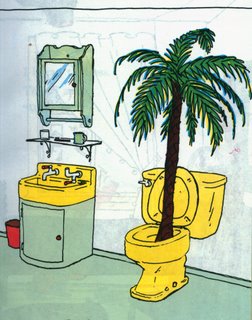 — this is the funniest thing Helena has ever seen. This is the page she keeps coming back to. This is the page that prompts hysterical, sometimes maniacal, laughter.
As we go about our daily business, this is the page that keeps coming to her mind. She'll suddenly remember, "Il y a un arbre dans la toilette." Wait, she says, she'll show me, and she rushes off to retrieve the book. Book in hand, she makes a great show of it, are you ready?, because this is the funniest thing you'll ever see. She laughs and laughs, and I laugh, and eventually we settle into exploring the relative subwackiness of the rest of the book.
Every week. She still thinks it's funny.
Needless to say, in only a few short months my ideas about parenting were turned upside-down. However, three and a half years later, those few dozen book-club books have found a comfortable place in our lives, though the spines of a couple of them have yet to be cracked.
About once a week (though only rarely on Wednesdays) for the last few months, with a certain mischievous twinkle Helena pulls out Wacky Wednesday, by Theo LeSieg (yes, the good doctor), illustrated by George Booth.
She loves pointing out all the crazy things going on in these pictures — shoes on walls, trees growing out of chimneys, people without heads (she can't yet identify the spelling mistakes in the signage). But this:
 — this is the funniest thing Helena has ever seen. This is the page she keeps coming back to. This is the page that prompts hysterical, sometimes maniacal, laughter.
As we go about our daily business, this is the page that keeps coming to her mind. She'll suddenly remember, "Il y a un arbre dans la toilette." Wait, she says, she'll show me, and she rushes off to retrieve the book. Book in hand, she makes a great show of it, are you ready?, because this is the funniest thing you'll ever see. She laughs and laughs, and I laugh, and eventually we settle into exploring the relative subwackiness of the rest of the book.
Every week. She still thinks it's funny.
Tuesday, May 23, 2006
Clit lit
The 25 sexiest novels ever written. Some decidedly literary.
What does is say that I've read significantly more of the books on this list than of the best American fiction of the last 25 years?
The sexy list is by far the sexier, not least because it spans many sexy decades (centuries, really) and sexy cultures. (Really, there's not much sexy about either the 80s or America.)
What does it say that Philip Roth is on both lists (although for different titles)?
What does it say that I'd actually be willing to waste time on arguing that Quiet Days in Clichy is by far sexier than Tropic of Cancer?
What does it say that I'm dying to lay my hands on a copy of George Bataille's Story of the Eye?
See also behind the The Story of O:
What's the sexiest novel you've ever read (whatever sexy means to you)?
What does is say that I've read significantly more of the books on this list than of the best American fiction of the last 25 years?
The sexy list is by far the sexier, not least because it spans many sexy decades (centuries, really) and sexy cultures. (Really, there's not much sexy about either the 80s or America.)
What does it say that Philip Roth is on both lists (although for different titles)?
What does it say that I'd actually be willing to waste time on arguing that Quiet Days in Clichy is by far sexier than Tropic of Cancer?
What does it say that I'm dying to lay my hands on a copy of George Bataille's Story of the Eye?
See also behind the The Story of O:
Histoire d'O (Story of O) is an erotic parable about more achieving less. It has far more in common with the travails of medieval saints than with the beleaguered female of modern-day pornography. The book tells the profound, and disturbing, story of a woman who wishes to exist without existing: "She lost herself in a delirious absence from herself."
What's the sexiest novel you've ever read (whatever sexy means to you)?
Saturday, May 20, 2006
Waiting for Beckett
Ian Brown amends his resolution to read the complete works of Samuel Beckett and then write about them, deciding instead to read them all in a single day. "But having done it, I can tell you this: It doesn't make any difference. I imagined Beckett would approve."
By the sounds of it, Brown could've saved himself the better part of a day and spent an hour or so banging his head against the wall to similar effect.
I've never read Beckett apart from that little Godot thing, but this essay makes me want to wallow in the whole mess of it.
By the sounds of it, Brown could've saved himself the better part of a day and spent an hour or so banging his head against the wall to similar effect.
...by the time he gets to The Unnamable, Beckett is content to simply slam your head repeatedly into the thick planks of linguistic hopelessness, proving again and again how meaningless meaning can be.
I've never read Beckett apart from that little Godot thing, but this essay makes me want to wallow in the whole mess of it.
Friday, May 19, 2006
Colouring
 This morning when Helena woke me up, I installed her at the kitchen table with crayons and colouring book. I sneaked back to bed to steal a few more minutes' rest, kicking J-F out to take care of child and coffee.
Some minutes later, J-F brought me latte and Helena brought me this picture.
It's the first picture of hers I've seen that looks coloured. That is, somehow ordered, controlled.
Till recently, it seemed our colouring books would just as well have been filled with blank pages. While Helena might take a second to remark on whatever animal or flower was outlined, the crayoning that ensued was a chaotic tangle of colour scribbles with seemingly no correlation to the underlying image. Lately I'd noticed a more careful approach: a proclamation that a particular object should be a certain shade and then a token wisp of wax to make it so.
But this is colouring.
Monday, May 15, 2006
The most beautiful flowers in the world

I never thought Mother's Day was a big deal. I was always extra nice to my mother on that day. We'd prepare a crafty card or some such thing in school, and I remember stealing lilacs off the bush that poked through the fence in a nearby parking lot to give to her all the years we lived in that spot. But I always considered it one of those made-up, commercialized excuses of a holiday, not a cause for real celebration.
Of course, that all changed when I became a mother.
I can't put my finger on it. I'm tempted to say that every day — at least, all those good days, when my girl laughs, when we're in sync, when we're full of love and joy — is Mother's Day. But this weekend was something special.
I was treated to a Saturday without the child, which I spent lazily, puttering and listening to the CBC. (I never thought such a simple pleasure might be thwarted by the presence of a little one, but games, questions, little attentions, and meal preparations are enough to distract me from the point of a story, to miss a punchline. Lazy Saturday mornings is a habit we're only just now being able to slowly, gradually reinstate as she's better able to amuse herself.) We braved torrents of rain to enjoy lunch out. On the drive to retrieve Helena, we hear a recording of an interview with Salman Rushdie, the one I'd ultimately opted not to attend back in the fall but I was glad to hear it now. (I'm unable to find links to audio files or transcripts, though I did find a couple write-ups, one of which I'm certain misquoted Rushdie and neither of which managed to synthesize all the interesting things he had to say. I'm not able to do that either, but he did say wonderfully inspiring things about the purpose of literature to help readers view the world — the real world — a little differently, to incite discussion, to shake things up. It almost makes me want to read The Satanic Verses.)
Sunday was simply lovely, brimming with thoughtful little attentions I won't enumerate here. I did receive as a gift a copy of Stendhal's The Red and the Black, which I'm certain Helena's father had a hand in choosing (if you ask Helena what Mommy's reading, she's still likely to say Don Quixote). (I'm torn whether I want to read it along with a group or savour it all for myself. I cannot explain why I suddenly have so much enthusiasm for this book.)
Et cetera.
Somehow, all weekend, I managed to suppress all work-related stress. Panic erupted this morning and is sure to have a tangible presence all the coming week. I will remind myself to stop and smell the flowers.
Thursday, May 11, 2006
The reading goup project
I've posted a shortlist of possible titles for the next reading group project.
Discussion of Middlemarch is still ongoing. Some are still reading. I for one still have things to say about it (but I've been swamped with work), including my impressions of the 1994 BBC adaptation, which I'm halfway through watching.
But I'd like to start another reading project in a few weeks' time.
The shortlist:
War and Peace, Leo Tolstoy
The Brothers Karamazov, Fyodor Dostoevsky
Ulysses, James Joyce
The Red and the Black, Stendhal
Fathers and Sons, Ivan Turgenev
I'd narrowed it down to the first 4 titles some weeks ago. I added Turgenev only because of the references to it I encountered in Snow.
By coincidence, I was reading an essay, "A book that changed me," by Doris Lessing just this morning:
I'm struck by the overlap in our lists, what it might indicate about where my mind is at.
If you read Middlemarch with us, or if you didn't, and if you want to read one of the above titles, leave a comment at Reading Middlemarch indicating your preference. Reading will likely begin mid-June and carry on through August.
Discussion of Middlemarch is still ongoing. Some are still reading. I for one still have things to say about it (but I've been swamped with work), including my impressions of the 1994 BBC adaptation, which I'm halfway through watching.
But I'd like to start another reading project in a few weeks' time.
The shortlist:
War and Peace, Leo Tolstoy
The Brothers Karamazov, Fyodor Dostoevsky
Ulysses, James Joyce
The Red and the Black, Stendhal
Fathers and Sons, Ivan Turgenev
I'd narrowed it down to the first 4 titles some weeks ago. I added Turgenev only because of the references to it I encountered in Snow.
By coincidence, I was reading an essay, "A book that changed me," by Doris Lessing just this morning:
I do not believe that one can be changed by a book (or by a person) unless there is already something present, latent or in embryo, ready to be changed. Books have influenced me all my life. I could say as an autodidact — a condition that has advantages and disadvantages — that books have made me what I am. But it is hard to say of this book or that one: it changed me. How about War and Peace? Fathers and Sons? The Idiot? The Scarlet and the Black? Remembrance of Things Past? But now they all seem dazzling stages in a long voyage of discovery, which continues.
I'm struck by the overlap in our lists, what it might indicate about where my mind is at.
If you read Middlemarch with us, or if you didn't, and if you want to read one of the above titles, leave a comment at Reading Middlemarch indicating your preference. Reading will likely begin mid-June and carry on through August.
A complication, of sorts
As it turns out, The Grand Complication, by Allen Kurzweil, is neither ingenious nor particularly erudite, as Doris Lessing claimed it to be, and for this, Lessing has fallen a little in my estimation, though I console myself a little, thinking that were I to confront her on this shameless blurbing, she'd wave it off, "Business, you know, and besides, that was years ago; maybe I exaggerated, but still, it was quite fun."
I shouldn't gripe. I hadn't wanted ingenious or erudite; I'd wanted something light, and that's what I got. A nice little diversion, about library cataloguing and research.
(I'd enjoyed A Case of Curiosities a couple years ago.)
The resolution is clumsy, the villain's motivations never made clear (I love a bit of ambiguity, but this just lacked sense), the love story not quite credible. There are some annoying shifts in tone, for which I'm sure I could muster up a logical rationale if I set my mind to it, but I can't be bothered.
The Literary Saloon has a review, along with a comprehensive list of others.
It's a little bit clever, but there's really not much else to it. Which is fine.
Wednesday, May 10, 2006
Literary "gentlemen"
A while ago (Is it already a month? Ack!) I attended a reading as part of Montreal's Blue Metropolis Literary Festival. The event was to feature 3 "literary gentlemen."
As should be obvious from the amount of time I allowed to lapse before filing this report, I felt no pressing need to tell the world about what I'd seen and heard. Still, it was nice to get out.
Tim Parks
I wondered why the name was so familiar. Of course, I'd seen the name splashed across his novels but was never tempted to pick one up. It turns out that I know his name because he has translated the work of Italo Calvino.
Tim Parks is an odd little man. He seemed friendly enough, cracking jokes about the coffee and chocolates some of the audience carried in with them. After about 50 of us have taken our places, he is introduced. In response to the host's remarks, he mutters audibly and with a wink that there's "no such thing as an important literary prize."
He chats briefly about the book tour circuit (something to the effect of: People read! They come to these things!), and manages to disparage the quality of Harry Potter and The DaVinci Code while implying he is more worthy of their rankings.
Parks will read from Rapids. He provides some context, warns about the use of kayaking terminology, for example "stopper" — "not a word you're familiar with, but we'll see." He reads from a paperback, well-worn and dog-eared. I can see he has marked passages, scribbled notes in the margins.
He's nervous. His eyes dart. His hands are shaking. I'm sitting quite close and am distracted by the rustling of the cloth over the authors' table; I realize he's kicking.
The reading is animated, expressive. He does voices, accents. The story is boring.
There's time for only 2 questions: One had something to do with age or experience and elucidated the audience as to how the questioner spent his morning and his delayed reaction to an art exhibition he saw last week. The other question, posed by the moderator, pointed out that Tim Parks, living in Italy, is essentially cut off from the evolving Enlgish language. He responds vaguely but wisely that when you know something is going to be one way, you'd better decided early on it was an advantage.
Later, as I'm leaving, I overhear someone asking Parks about translating Calvino. Parks seems modest, clarifies that he's only translated a couple works (interestingly, I find these to be among the very least engrossing of Calvino's oeuvre); then, looking over his shoulder as if to ensure he's overheard by only the right people, "Most of them are translated by William Weaver, and not very well."
Gentleman? Not so much.
José Carlos Somoza
Somoza looks serious and suspicious. There's no doubt he is taking in everything.
This is only the second time, he says, that he's given a reading in English. He mispronounces (for example, "you-nexpected" for "unexpected" — quite charming really after the initial moment of deciphering), stammers and repeats, but he is very composed. The story speaks for itself.
From the book jacket of The Art of Murder:
Excerpt.
Somoza pauses to give us some context for the various snippets he reads. He clarifies that artists work not only on the canvas bodies, but on their minds, to prepare them to be art.
It's worth noting that Somoza gave up a career in psychiatry to pursue writing. His training is put to obvious use in developing symbols, themes, character psychologies — attics hold the secrets of childhood, the attraction of the forbidden. Some of the writing comes off as cliché, but it's gripping nonetheless.
I will be reading this novel.
Gentleman? I think yes.
David Bezmozgis
The reason for which I purchased a ticket. Cancelled. His father ill.
Perhaps he's too young to be seriously considered a gentleman. His writing: decidedly ungentlemanly, if at times gentle.
Ironically, Bezmozgis's casual style, his material, family stories, short stories — the idea of his writing — appeals to me least (compared with the other authors at this event). But his book was undeniably touching and entertaining, and it's what drew me there. Parks is the self-proclaimed literary one, boring in his book and a bit of an asshole in person. Somoza strikes me as a happy medium, his novel like literary pulp (maybe a little like Arturo Perez-Reverte), and I'm glad to have discovered him.
(More readings should be multiauthor events! How better to be introduced to work that is vaguely similar to that by an admired author but new!)
Bonus gentleman: José Saramago
No, I did not see him that weekend. However, while wondering around the festival venue and perusing various flyers it came to my attention that, at long last, the transcript of his conversation with Adrienne Clarkson, to which I was witness last summer in Ottawa, is allegedly now available in English (though I am unable to find it among the archives).
His latest novel, Seeing, is recently released. (No, I haven't read it yet.)
Ursula K LeGuin: "It's hard not to gallop through prose that uses commas instead of full stops, but once I learned to slow down, the rewards piled up: his sound, sweet humour, his startling imagination, his admirable dogs and lovers, the subtle, honest workings of his mind. Here indeed was a novelist worthy of a reader's trust."
As should be obvious from the amount of time I allowed to lapse before filing this report, I felt no pressing need to tell the world about what I'd seen and heard. Still, it was nice to get out.
Tim Parks
I wondered why the name was so familiar. Of course, I'd seen the name splashed across his novels but was never tempted to pick one up. It turns out that I know his name because he has translated the work of Italo Calvino.
Tim Parks is an odd little man. He seemed friendly enough, cracking jokes about the coffee and chocolates some of the audience carried in with them. After about 50 of us have taken our places, he is introduced. In response to the host's remarks, he mutters audibly and with a wink that there's "no such thing as an important literary prize."
He chats briefly about the book tour circuit (something to the effect of: People read! They come to these things!), and manages to disparage the quality of Harry Potter and The DaVinci Code while implying he is more worthy of their rankings.
Parks will read from Rapids. He provides some context, warns about the use of kayaking terminology, for example "stopper" — "not a word you're familiar with, but we'll see." He reads from a paperback, well-worn and dog-eared. I can see he has marked passages, scribbled notes in the margins.
He's nervous. His eyes dart. His hands are shaking. I'm sitting quite close and am distracted by the rustling of the cloth over the authors' table; I realize he's kicking.
The reading is animated, expressive. He does voices, accents. The story is boring.
There's time for only 2 questions: One had something to do with age or experience and elucidated the audience as to how the questioner spent his morning and his delayed reaction to an art exhibition he saw last week. The other question, posed by the moderator, pointed out that Tim Parks, living in Italy, is essentially cut off from the evolving Enlgish language. He responds vaguely but wisely that when you know something is going to be one way, you'd better decided early on it was an advantage.
Later, as I'm leaving, I overhear someone asking Parks about translating Calvino. Parks seems modest, clarifies that he's only translated a couple works (interestingly, I find these to be among the very least engrossing of Calvino's oeuvre); then, looking over his shoulder as if to ensure he's overheard by only the right people, "Most of them are translated by William Weaver, and not very well."
Gentleman? Not so much.
José Carlos Somoza
Somoza looks serious and suspicious. There's no doubt he is taking in everything.
This is only the second time, he says, that he's given a reading in English. He mispronounces (for example, "you-nexpected" for "unexpected" — quite charming really after the initial moment of deciphering), stammers and repeats, but he is very composed. The story speaks for itself.
From the book jacket of The Art of Murder:
In 2006, the art world has moved far beyond sheep in formaldehyde and the most avant-garde movement is to use living people as artwork. Undergoing weeks of preparation to become 'canvases', the models are required to stay in their pose for ten to twelve hours a day and, as art pieces, they are also for sale. After being exhibited, the 'canvases' can be bought and taken to the purchaser's home, where they are rented for weeks or months.
Many beautiful young men and women long to become a 'canvas' — knowing they are a masterpiece and worth millions seems to make all the sacrifices worthwhile...
Excerpt.
Somoza pauses to give us some context for the various snippets he reads. He clarifies that artists work not only on the canvas bodies, but on their minds, to prepare them to be art.
It's worth noting that Somoza gave up a career in psychiatry to pursue writing. His training is put to obvious use in developing symbols, themes, character psychologies — attics hold the secrets of childhood, the attraction of the forbidden. Some of the writing comes off as cliché, but it's gripping nonetheless.
I will be reading this novel.
Gentleman? I think yes.
David Bezmozgis
The reason for which I purchased a ticket. Cancelled. His father ill.
Perhaps he's too young to be seriously considered a gentleman. His writing: decidedly ungentlemanly, if at times gentle.
Ironically, Bezmozgis's casual style, his material, family stories, short stories — the idea of his writing — appeals to me least (compared with the other authors at this event). But his book was undeniably touching and entertaining, and it's what drew me there. Parks is the self-proclaimed literary one, boring in his book and a bit of an asshole in person. Somoza strikes me as a happy medium, his novel like literary pulp (maybe a little like Arturo Perez-Reverte), and I'm glad to have discovered him.
(More readings should be multiauthor events! How better to be introduced to work that is vaguely similar to that by an admired author but new!)
Bonus gentleman: José Saramago
No, I did not see him that weekend. However, while wondering around the festival venue and perusing various flyers it came to my attention that, at long last, the transcript of his conversation with Adrienne Clarkson, to which I was witness last summer in Ottawa, is allegedly now available in English (though I am unable to find it among the archives).
His latest novel, Seeing, is recently released. (No, I haven't read it yet.)
Ursula K LeGuin: "It's hard not to gallop through prose that uses commas instead of full stops, but once I learned to slow down, the rewards piled up: his sound, sweet humour, his startling imagination, his admirable dogs and lovers, the subtle, honest workings of his mind. Here indeed was a novelist worthy of a reader's trust."
Monday, May 08, 2006
On my television
Edward R Murrow, speech to the Radio-Television News Directors Association, 1958:
Forty-eight years later...
Good night, and good luck.
Our history will be what we make it. And if there are any historians about fifty or a hundred years from now, and there should be preserved the kinescopes for one week of all three networks, they will there find recorded in black and white, or color, evidence of decadence, escapism and insulation from the realities of the world in which we live.
*****
This instrument can teach, it can illuminate; yes, and it can even inspire. But it can do so only to the extent that humans are determined to use it to those ends. Otherwise it is merely wires and lights in a box. There is a great and perhaps decisive battle to be fought against ignorance, intolerance and indifference.
Forty-eight years later...
Good night, and good luck.
Friday, May 05, 2006
The new Number 6
It's a girl!
 I remember the horrid experience of the ultrasound. I was overwhelmed, scared, tense. Alone (J-F couldn't make the appointment), in an unfamiliar setting (having just moved to a new city), grappling poorly in a second language for any hope of communication with the staff, waiting with an overfull bladder, and generally worried, confused, emotional. Everything was OK, normal, no reason not to be, just fine; but a little voice niggled: Are you sure? How can they be sure? I won't let my guard down. I have every reason to be concerned, tense.
Then she told me, It's a girl, and for the first time in days, I smiled. That smile imprinted itself on my heart, I think — my heart melted a little and I could no longer control the muscles in my face.
Of course, I'm pretty sure I'd've had the exact same reaction if she'd told me I was having a boy. Pretty sure.
I'd never envisioned a baby girl in pink or daydreamed about doing mother–daughter stuff. But then I'd never been dreamy-eyed over motherhood at all or had any vision of that future except as a vague, blurry Someday. I was relieved to have a girl, because I know nothing about boys. But it turns out it's not so simple.
It's a Girl: Women Writers on Raising Daughters is the latest anthology edited by Andrea J Buchanan. As it's so succintly and accurately stated at Parent Hacks, "Andi's books are a central part of the growing conversation (in print and online) about the realities of middle-class, American motherhood." (The review there has sparked a great discussion on gender identity.)
Read the Introduction.
Mothering a girl, according to these writers, makes a woman face herself anew, reliving her own experiences growing up as a girl. The mother of a girl must plumb the depths of the girlhood she'd thought she had safely escaped — but this time through the eyes of her daughter, whose experience is necessarily different. The pain and joy of this reliving, the merging of mother and daughter experience, and the bittersweet, inevitable separation between the two, is at the core of mothering a girl — and at the heart of the essays that make up this book.
That's it, really. This collection is less about daughters than it is about mothers coming to terms with themselves, their own sense of girlness and womanhood, the awareness of how that sense grew out their relationships with their mothers. Emulate our mothers, or distance ourselves from their legacy?
I'm sure many readers will find it reassuring, but I find it troubling that so many (were there really that many, or did my reaction to them exaggerate their number in my mind?) of these essays centred on body-image. (Maybe I'm too much in denial, my vehemence in eschewing the latest fashion trends and resistance to dieting betrays an overcompensation, an armour of words I've built up around a less-than-perfect body.) I'd hoped we were past that.
No essay reflects my experience closely, but every one of them has a little something I relate to.
See Mothershock this week for Andi's take on specific essays.
Follow the blog book tour:
Arch Words
Left-handed Trees and Other Lies: Keeping It All Honest
Mom Brain
The Mommy Blog
Mommy Needs Coffee
Mom Writes
MUBAR
Parent Hacks
Phantom Scribbler
Scribbling Woman
Wet Feet
Woulda Coulda Shoulda
Related books also edited by Andi:
Literary Mama: Reading for the Maternally Inclined, my review of.
It's A Boy: Women Writers on Raising Sons, a few words about.
When I first wrote to Andi to express my interest in It's A Girl, I mentioned some of the issues I'd been grappling with.
The way J-F rolls his eyes and mutters "Women..." when Helena has a tantrum. Even little girls are emotionally complex, he says. When a boy has a tantrum you know exactly why. Is it because I'm female that I'm quicker to figure her tantrums out, because I'm her mother, because I spend more time with her — which of these is behind my knowing her better? Is it true that boys are simpler, easier?
His surprise at my sister's choice of a trainset as a birthday gift for a little girl.
That Helena for a while seemed to be far more girly than I thought possible as the daughter of someone who's never cared for clothes, makeup, etc. Where does she get it from? And what do I do about it (nurture, suppress, ignore)? (The girliness has waned somewhat in recent months, or maybe I don't notice anymore.)
As a counterbalance to the girliness, Helena's bossy and even bully-ish, decidedly "unfeminine," in her daycare group (she's physically larger than most of them).
Just yesterday Helena asked for a new toothbrush, her Winnie-the-Pooh brush at daycare is getting old. She wants a Power Rangers toothbrush, or maybe Batman. J-F is uncomfortable with the un-girliness of it all, and I'm uncomfortable with the fact that he's uncomfortable about it.
How much control do I really have over any of this? Does any of it matter?
The essays in It's A Girl don't have any answers. But they're honest about it.
Pamuk, PEN World Voices
Orhan Pamuk on April 25 delivered the inaugural Arthur Miller Freedom to Write Memorial Lecture at the PEN World Voices festival:
I don't know that it's a peculiarly modern condition, but it's one Pamuk explores superbly in Snow.
I always have difficulty expressing my political judgments in a clear, emphatic, and strong way — I feel pretentious, as if I'm saying things that are not quite true. This is because I know I cannot reduce my thoughts about life to the music of a single voice and a single point of view — I am, after all, a novelist, the kind of novelist who makes it his business to identify with all of his characters, especially the bad ones. Living as I do in a world where, in a very short time, someone who has been a victim of tyranny and oppression can suddenly become one of the oppressors, I know also that holding strong beliefs about the nature of things and people is itself a difficult enterprise. I do also believe that most of us entertain these contradictory thoughts simultaneously, in a spirit of good will and with the best of intentions. The pleasure of writing novels comes from exploring this peculiarly modern condition whereby people are forever contradicting their own minds. It is because our modern minds are so slippery that freedom of expression becomes so important: we need it to understand ourselves, our shady, contradictory, inner thoughts, and the pride and shame that I mentioned earlier.
I don't know that it's a peculiarly modern condition, but it's one Pamuk explores superbly in Snow.
Thursday, May 04, 2006
Choosing a book
Trying to decide what to read next.
I want something light, something without politics. I read a chapter of China Miéville's Iron Council and decide the language is too rich for me to digest right now, and it is far too political, even if this revolution brews in a wholly imagined world.
I go through the stack (there's another stack downstairs, but that's far too far away to be relevant) and methodically eliminate the possiblities. I'm left with two books for closer inspection and begin to compare blurbs.
One book:
"Ingenious... Sparkling with erudition."
The other book:
"I admire this ingenious, erudite book."
What kind of choice is that? Who wants erudition?
Snow
Snow, by Orhan Pamuk, is wonderfully evocative and extremely complex.
Snow is the most recent selection of the Reading Matters book group. I'd previously read Pamuk's My Name is Red (set in 16th-century Istanbul) — I particularly enjoyed the philosophical discussion of the nature of art and how Eastern and Western attitudes toward art differ, although the novel's structure felt contrived. Snow, set in modern times, touches on similar themes but goes well beyond them, to touch on pretty much everything.
Snow is quite obviously the prevailing motif of Snow. It works to isolate the city of Kars (roads are closed), while something dark metaphorically falls over it. Snow makes it picturesque, temporarily obliterating its squalor (which makes itself felt otherwise). Our hero in snow recaptures childhood, innocence, God, peace. Snow's crystalline structure is the inspiration for a series of poems Ka writes; the novel has its own geometry. While the snow falls Kars is suspended from reality; the first half of the novel itself freezes time, relating events that occur over about a day. Then the thaw, the ugliness, the hidden workings; time becomes fluid again.
Excerpt.
For a plot summary, see the reviews:
Margaret Atwood's review.
(Some comments on that review.)
The Literary Saloon has its own review along with a comprehensive list of others.
For my thoughts on more specific aspects of the book, see Reading Matters.
I particularly like the characterizations of Snow's minor players. They're complicated products of circumstance and ideals, sometimes weird, riddled with contradictions and failures, larger than life, but all still sympathetic and believable.
Turgenev's Father and Sons is mentioned a few times in Snow. I think I actually read it for school but remember nothing of it. I suspect these two novels have a closer relationship than anyone has yet discussed: the struggle with tradition and national identity, revolution in the air.
See also:
Discussion at Bookninja Magazine.
The NY Times Reading Group discussion includes some informative points (and links to other sources) on the following:
-Turkish history, Turkey's relationship to Europe and specifically Germany.
-The issue of headscarves, both in relation to Turkey and to Islam.
-The metafictional aspects of the novel, how the narrator's intrusion works to complement the tensions of the novel and underscore the theme of the significance, impact, and place of art.
What all these reviews and discussions highlight for me is just how big Snow is. While they raise fascinating points on Turkish history, Islam, religious state vs secularism, tradition vs modernity, East vs West, the nature art, art & politics, women in Islam, women vs men (in how both events and emotions are processed), love, God, betrayal, revolution, national identity, memory, failure, shame, metafiction, and purity, I still come away with the feeling the surface of this novel has been barely scratched.
Wednesday, May 03, 2006
What I've been up to
My eyeballs!
In tax crap. The paperwork is mostly over now, with some more organizing and filing away still to do. I don't even mind the number-crunching and paperwork so much. It's the stinging slap of reality that lingers and weighs on me. Sigh.
In work. A new project I desperately want to not fuck up. Must not procrastinate. Must discipline myself.
In rain. I love rain. But I could do without the fuzzy sinuses and migraines.
In Snow. Discussion ongoing, if lacking in participants. Read it! It's... important. Somehow.
In the sunshine of my life:
I have the distinct impression Helena is practicing her English. Since she started daycare, she's favoured speaking French. I've asked her about this in the past and she's shrugged her shoulders — I speak to her primarily in English, there's no doubt she understands everything I say, and her exposure to books and television is also generally via English; but French is easier for her, it's the language of her daily activities and her peers. From Dora she hears Spanish. From my mother, Polish. We also have books in Polish, songs, and I sprinkle phrases here and there. Suddenly this weekend, she is aware of different languages. After one motherly admonition in Polish slips out, she asks, "Pourquoi tu parles comme Babcia?" She knows there are multilingual seeds planted in her. For now, she practices English, looking to me for confirmation, even asking me about particular words.
We took Helena for a haircut on the weekend. While awaiting our turn, we stop into the pet store next door. The resident big blue parrot says "buh-bye" while lifting one foot and flexing his talons in a makeshift wave. Helena hasn't stopped talking about this amazing bird.
Tuesday, May 02, 2006
Family portrait

That's me in red. Helena's green. The yellow is sometimes the cat (who is in real life black as night), but usually the light is such that it's not visible at all. The blue folk keep changing identities, but include J-F, all the grandparents, and others.
Subscribe to:
Posts (Atom)
