Friday, December 01, 2006

Books for drunks

Five novels for your inner drunk, among which is Hangover Square, by my latest passion, Patrick Hamilton:

Hamilton — who, until a recent revival in which his vicious streak of black humor and sometimes-astonishing gift for disturbing imagery was discovered by a new generation of critics, was best known for providing Alfred Hitchcock with the raw material for Rope — tells the story of the perfectly named George Harvey Bone, a schizophrenic good-for-nothing who drowns out the “dead moods” inside his skull by constant drinking. Bone doesn’t have a job; he has a career that largely consists of talking about all the things he could do if he wasn’t drunk. He doesn’t have friends; he has, like most alcoholics, a bunch of people he drinks with and who can’t stand him the minute they sober up. And he doesn’t have a girlfriend; he has an actress he’s obsessed with and who loathes him, and who will meet a grisly but unforgettable fate, burning up among Hamilton’s beloved London lowlifes in an eerie foreshadowing of the nightmarish days to come (Hangover Square was begun in 1939 and completed in 1941). The descriptions of Bone and his contemptible ’friends’ careering aimlessly from pub to pub are among the truest in all of drunk fiction.


Doesn't that just sound like the best?

I haven't acquired this book yet, but, having read two and a half Hamilton books and with two and a half more on my shelf ready to go, I consider myself something of an expert, and I can tell you that in Hamilton's books, people go to bars, or round to the pub, and it's never a happy experience, though it may sometimes be vaguely satisfying, and you watch the drinks perform their transformations, loosening people's tongues or quickening their tempers or dulling their good sense, and it is an achingly real reading experience. Thank you, Mr Hamilton, for being the observant drunk you were.

Also on the list, Crime and Punishment. Missing from the list, Under the Volcano, although frankly, I don't really remember what it's about, just the feeling of having drunk too much and going about in a stupor. (Link via Ed.)

This be the end

While away, I treated myself to The End, the last in A Series of Unfortunate Events, by Lemony Snicket. (Excerpt.)

I love this series. It's not particularly meaty; both the characters and their adventures are rather like sketches that hint at depths never fully realized. It's fun (in a grim way) and easy, with more mood and attitude than substance. And that's fine. Like an Edward Gorey drawing: charming, witty, morbid. It's also deceptively mature and well crafted, with simple but meaningful metaphors (the story is like an onion) and life lessons ("It depends on how you look at it."). It has all the elements of classic children's literature — orphans, boarding school, eccentrics, treasure, circus freaks, a quest — pared down to their barest, ugliest essence.

I love the wordplay and the literary allusions. I only regret that I cannot read these books as a 10-year-old. (I look forward to Helena's experience of them.)

What I love about The End is that very little is solved or resolved. The reader is warned:

But it cannot be said that The End contains the end of the Baudelaires' story, any more than The Bad Beginning contained its beginning. The children's story began long before that terrible day on Briny Beach, but there would have to be another volume to chronicle when the Baudelaires were born, and when their parents married, and who was playing the violin in the candlelit restaurant when the Baudelaire parents first laid eyes on one another, and what was hidden inside that violin, and the childhood of the man who orphaned the girl who put it there, and even then it could not said that the Baudelaires' story had not begun, because you would still need to know about a certain tea party held in a penthouse suite, and the baker who made the scones served at the tea party, and the baker's assistant who smuggled the secret ingredient into the scone batter through a very narrow drainpipe, and how a crafty volunteer created the illusion of a fire in the kitchen simply by wearing a certain dress and jumping around, and even then the beginning of the story would be as far away as the shipwreck that left the Baudelaire parents as castaways on the coastal shelf is far away from the outrigger on which the islanders would depart. One could say, in fact, that no story really has a beginning, and that no story really has an end, as all of the world's stories are as jumbled as the items in the arboretum, with their details and secrets all heaped together so that the whole story, from beginning to end, depends on how you look at it. We might even say the world is always in medias res — a Latin phrase which means "in the midst of things" or "in the middle of a narrative" — and that it is impossible to solve any mystery, or find the root of any trouble, and so The End is really the middle of the story, as many people in this history will live long past the close of Chapter Thirteen, or even the beginning of the story, as a new child arrives in the world at the chapter's close. But one cannot sit in the midst of things forever.


And this, I think, is an excellent introduction for 10-year-olds to both literature and life. Interconnectedness and continuity.

Most of the allusions throughout the series are superficially appropriate to the characters and situations but don't run very deep. They provide a chuckle to those in the know, perhaps make the reading of juvenile fiction more tolerable for parents. In youngsters they may inspire questions, but perhaps more important is the mere forming of an acquaintanceship — that years later they will not shy away from, say, Prufrock or Ishmael for finding something familiar in them.

Count Olaf in a climactic scene, which takes place on a coastal shelf, quotes Philip Larkin. "Man hands on misery to man. It deepens like a coastal shelf. Get out as early as you can, and don't have any kids yourself." And this, my friends, is the theme of the Baudelaires' story, perhaps life itself: They fuck you up, your mum and dad.

Cat


That's the nose in the middle, with the whiskers to either side and the eyes just above them. Less obvious, you will find the paws in the corners.

Thursday, November 30, 2006

Home

Over the last week I've missed my blogging home tremendously, but now that I'm back I don't know what to say. Much like when meeting up with old friends, it takes the time to consume a bottle of wine before you reestablish your old rhythms. I feel like I should be brimming with fresh insight and self-realizations. I have a fog in my head. I'm in the dark, fairly familiar with my surroundings by now for all this groping about but I haven't found the light switch yet. I mean, you know, life and stuff. Oh, what the hell am I talking about, sounding so maudlin.

Being away from home was lovely, in fact very much like going "home," as far as hanging out with my sister means "home," which it does quite a lot.

Helena was exceptionally charming, with only very few and minor outbursts.

We did nothing that could be called sightseeing, wandered aimlessly around Dupont Circle (several times), bought shoes in Georgetown, went to the zoo, stopped by the World Bank (for which adventure Helena has a wonderfully official visitor's pass) where we lunched (Helena chooses salad bar over pizza).

The highlight of Helena's trip was the nearby playground.

The highlight of my trip was sharing far too many bottles of wine with my sister. And the shoes. And the used Patrick Hamilton book I found.

We watched Mary Poppins. I asked Helena what she would do with her tuppence: put it in the bank or feed the birds. Without hesitation she opts for banking it. What about the birds? Who's going to feed the birds then? She tells me Michael wants to feed the birds, he can feed the birds.

That's it. I should go reflect more carefully on my week before reporting anything further.

Tuesday, November 21, 2006

Up and down, and up and away

1. Does anyone have a job for me? I do mostly medical copyediting, but I'd do just about anything (though preferably something vaguely editorial, and slightly more literary, at an outrageous salary please). I make a decent cup of coffee even. And I can write too, kind of. My bread-and-butter contract upped and went (I'm assured that the quality of my work was not in question, simply they have the resources to produce the journal fully in house now), which has me thinking, at age 37, (ack,) what the hell do I want to do with my life.

2. Curses on Ana Maria, and on that accursed Popword, on which I've spent more time in the last few days than pretty much everything else.

3. I feel the assault of Christmas. The commercial Christmas crap ought not to start till December 1. Leave my birthday a Christmas-carol-and-tacky-decorations-free zone.

4. I haven't packed yet, but I feel confident about getting it done in the morning. The laundry at least is laundered.

5. I've spent far too much time carefully considering what reading material to bring with me. I'm bringing The Red and the Black (Stendhal) and The Art of Murder (José Carlos Somoza). (Also Harold and the Purple Crayon and Harold's Circus.)

6. I've been reading — in an effort to delay the forthcoming pleasures of Patrick Hamilton, and to leave my vacation book alone, and to enforce some schedule discipline on myself for the group reading project book (and I'm really not liking having so many books "open" at the same time — it's a pervasive uncomfortableness, I'm at loose ends) — The Shadow of the Wind, which a third of the way in, underwhelms me. A pleasant enough comfort read, but I don't think the blurb comparisons with Umberto Eco (my recent realizations notwithstanding) or Arturo Pérez-Reverte (though I can see the Dumas-style romance adventure connection) are deserved. An example of word-of-blog run amok? To me it reads like a young adult novel (and that's not meant as an insult). — More on this when I finish it.

7. I spent a lot of time with my cat today. He's very cool.

8. I'm still thinking about War and Peace. Last week I finished watching Bondarchuk's epic film adaptation, but I haven't had the mental space to sort out all my thoughts. I liked it very much. Stay tuned.

9. I leave tomorrow for a week. Blogging will be intermittent, perhaps nonexistent or quite possibly better than you've seen it in months. I expect to have time enough once at my destination to post a bit on The Red and the Black (to chapter 21).

10. I dread travelling with small children. Every time, I dread it.

Isabella was 4 (once)!

Today is Isabella's 4-plus-30-something-th birthday. Helena crammed a muffin full of candles for me this morning. Later there will be book browsing and Chinese food and champagne, and laundry and packing for a weeklong visit with my sister in Washington, D.C., with 4-year-old Helena in tow.


(Isabella remembers that after her 4th birthday party, she wasn't feeling very well, and had to lie down on the couch.)

Monday, November 20, 2006

Helena is 4!

Today is Helena's 4th birthday. Yesterday was full of giggles and family and pizza and cake and presents and antics.


Friday, November 17, 2006

Tito and Rose

Helena attended a teddybear workshop today.

When I come to pick her up, she introduces me to her new best friend bear, Tito, who wants to sleep with her tonight. She advises me that Tito is afraid of cars and of Christmas trees.

Helena tells me that Rose told her to ask me to write her name both on Tito's tag and on the tag of his shirt. "Rose est presque une educatrice," Helena says. I confirm that she means Rose — Rose whose 4th birthday party we attended a couple weeks ago. Yes, because "Rose nous dit qu'est-ce qu'on doit faire."

Wednesday, November 15, 2006

Various charms

1. Today was picture day a la garderie, without the drama and hysterics of last year. According to Helena it went very well; she did not make faces, she blessed the photographer with nice smiles and willingly took various poses with flowers. According to the note left by her éducateur, they somehow managed to coax a smile out of her in the end. I'm just glad there were no tears.

2. I had some errands to run this morning, and very conveniently I polished off the last bite of my croissant aux amandes just outside of one of my now-favoured used book stores, so I went in. I came out with The Charmer, by Patrick Hamilton. The cover illustration is perfectly charming, and the back cover tells me it was dramatized for Masterpiece Theatre. Inside the cover I learn it was originally titled Mr Stimpson and Mr Gorse (1953). The disclaimer says, "All the characters in this book are entirely imaginary. So also are Mr Stimpson's Crossword Puzzles, the clues to which the reader is advised not to be beguiled into attempting to solve." I am beguiled.

3. I said I'd take a little break from Mr Hamilton, but I don't think I want to after all. I had started eyeing another book — well, erm, reading it actually — I ordered it, it arrived, I had to sample the goods — but I'd been meaning to save that one for my vacation next week. So now I'm all in a tizzy — what do I read now, and what do I read then?

4. I've temporarily abandoned my French reading of The Red and the Black. I've been trying so hard to stay on pace, not to get ahead, that all of a sudden there was no time for it or I'd be falling behind. But this is temporary. Stendhal and I will just have to get along in English for a little while. Besides, my French edition is away on business this week with my personal translator.

5. Helena wants a Dora birthday cake. I haven't got a clue where to find one. I'd had the idea to order an "edible image" I could plaster onto a cake of my own devising, but that idea didn't occur to me till after the shipping time window had closed. I could not find Dora candles. I did find a marzipan Dora, but she looked kind of creepy, and Helena doesn't like marzipan (yet). (I remember getting marzipan "fruits" in my Christmas stocking when I was 4 and thinking them horrid.) For all the lovely bakeries in my neighbourhood, their cakes are elegant and for those of discriminating taste, like myself, but sadly not for the likes of my almost-4-year-old daughter. Her birthday is Monday; family will gather to celebrate on Sunday. I am so screwed.

6. We've attended 3 birthday parties in the last 2 months. Helena hadn't expressed any interest in a party of her own, but when invitations to the most recent fête were distributed, she asked if she also could give out cards for her birthday. My understanding is that this is not about a party per se, but that she wants to give something to her friends by way of celebration. (I've been thinking to bring helium balloons to the daycare that her classmates can take home. Maybe.) However, when I picked Helena up yesterday, little Mathilde approached to show me the billet Helena had given her — a half-centimetre square paper with a green scribble dot — to fêter sa fête. I am so screwed.

7. Just the other day I read about Adèle and Simon, by Barbara McClintock. Today I had the opportunity to turn its pages. Utterly charming! I must have this for my little girl. (But it'll hold till Christmas, I think.)

8. On my way home, I missed my metro stop, kind of; that is, I forgot I had to change to another line. I wasn't even reading, or engaged in serious daydreaming; I was simply mistaken and confused, convinced this train would take me to my doorstep. I have often imagined this scenario, but it's never happened before today.

Tuesday, November 14, 2006

About Doris Lessing

The Adventures of Doris Lessing, including her condescension and contradictions, ostensibly a review of two of her books but referring to very many and with some biographical detail, as told by John Leonard in The New York Review of Books, who sums up:

Except that so often she is the only grownup in the room. For a dervish, Lessing's not exactly light on her feet. Lofty and heavy, dogged and relentless, stubborn and punitive, she wears you down. It's as if she knows so much, and so much better, that we have to carry her around — as Dann carried the snow dog to safety — all the way to Stockholm for a Nobel Prize long overdue. She has written tens of thousands of pages, many of them slapdash, millions of words, none of them mushy, one masterwork, The Golden Notebook, and may be the twentieth century's least ingratiating great novelist, whose fatalism is often difficult to distinguish from complacency, and who is harder on women than on men: there is "a basic female ruthlessness," she has said, "female unregenerate, and it comes from a much older time than Christianity or any other softener of savage moralities. It is my right."


Much to think about in this essay, and many, many more books by Doris Lessing for me to read....

Craven

Have I mentioned? I love Patrick Hamilton.

I finished Craven House this weekend. What Mr Hamilton says makes me laugh; what goes unsaid makes me cry.

Whereas the first signs of a failing brain in the average human are believed to manifest themselves in the form of odd straws, or irrelevant flowers sticking out from their persons; and whereas this in in actual fact a mainly false belief, there is no doubt whatever that, when suspicions of this sort come to centre round an old lady, the trouble first sets in around the Hat. A cherry too much, a rose too dangling, an apple too great, a bunch of grapes to the bad, and before you know where you are, you have a thick-veiled, white-booted, painted, muttering nodder, charging along the streets, mixing with the crowd, and waiting with eternal nods at street corners, to the bewildered horror of the public at large.

The concern of Craven House, then, can well be apppreciated, when Mrs. Hoare came down to lunch one Saturday afternoon, in a picture hat belonging to an unknown era, and adorned with a bright blending of large water grapes and pink ribbons, guaranteed to cause the Not All There school of nephews and nieces to toss their caps into the the air at the final and crushing defeat of their opponents.

Immediately she had taken her place, which she did with a mixture of slight coyness and a slight consciousness of being brazen, Bertha began to wheeze. This she continued to do before receiving a sharp glance from Miss Hatt, when she shook unsteadily, and remembered herself.

"Oh, Mrs. Hoare?" said Miss Hatt, agreeably, and in general.

"I sometimes wear it, you know," said Mrs. Hoare, and the company turned very pale. . . .

"Oh, yes," said Master Wildman.

"Yes. My Solicitor, you know," said Mrs. Hoare, with a winning smile.

"Oh, yes," said Master Wildman. "I see."


There was little else about the hat. In fact, most of the book is made up of such little windows on the inhabitants of Craven House.

Craven House was Patrick Hamilton's first novel, and it shows. It takes a while for the language and the characters to settle into each other. The early chapters are overwritten. It lacks polish and the precision that I felt sculpted The Slaves of Solitude, but brims with real and pathetic people and is no less devastating.

Twenty Thousand Streets Under the Sky arrived on my doorstep last week, but I'm going to take a little break from Mr Hamilton before I start in again. It's just too emotionally bleak to read so much of him all at once.

Friday, November 10, 2006

Bedtime story

It's a treat for Helena some evenings to curl up on the sofa, already pyjama-ed, with blanket and favoured plush toy du jour, and watch the hockey game with her father.

This particular evening* she shows as much interest in the game as I do (ie, none) and clambers onto my lap with a "so, whatcha reading" expression on her face.

She gingerly extricates my book from my hands, searching my face for a reaction, to make sure it's ok. She identifies all the "H"'s on the cover — front, side, and back. (It's Craven House, by Patrick Hamilton.) She riffles the pages, confirming there are no pictures within. She mischievously suggests we read it together.

"Ca c'est toi," she points at the dumpy old woman drawing back curtains from a window pictured on the cover. This is not flattering — I'm almost insulted — but "on fait semblant."**

She turns to page 1, appropriately flipping past the author info and title pages, and begins.

"Il était une fois une petite fille, s'appelle Mommy Isabella."***

Helena offers me a sentence per page. There's a witch, and she wants the little girl's magic shoes. There's also a little boy imprisoned somewhere. He wants candy. The little girl marches up the steps to her house. "Hurry, hurry, I want coffee."

Helena tells me I have to calm down, stop laughing, or she won't read any more to me this evening. I bite my lip.

Fortunately, Helena has begun to turn pages 10 at a time. The witch makes occasional appearances to thwart some action or other but she is beaten off. The little boy doesn't want to take a bath.

At page 223 Helena yawns. She promises she'll finish reading to me another night. She wants to go to bed.

*That would be Tuesday, for those of you fact-checking against team schedules.
**"It's pretend."
***"Once upon a time, there was a little girl, called Mommy Isabella."

Wednesday, November 08, 2006

The mysterious flame, and other crap

I like Umberto Eco, I really do. He's smart and funny. I've always enjoyed him in interview, and I've made a point of getting out to his readings and lectures when the opportunity arose. I read quite a bit of his work in the course of my studies, on semantics and the philosophy of language (I have a particular fondness for The Search for the Perfect Language).

So I like Eco. (I even wrote him a clever (I thought) letter once, regarding my copy of Misreadings, which was misbound, with some signatures missing and others repeating. He never replied.)

Then there's his novels.

I loved The Name of the Rose. Frankly, though, it's the movie I remember more clearly than the book. Different beasts, both wonderful. Full of wonder.

Foucault's Pendulum I raved about, without really understanding it, having read it when I was young and pretentious. I'd like to read it again someday.

The Island of the Day Before has languished on my to-read shelf for many years, bookmark stuck on page 55. I've tried a few times, but I can't seem to get past page 55.

Baudolino I received as a birthday present the day after Helena was born. I read it while breastfeeding. I enjoyed it well enough, but without ever feeling fully engaged. Reading while breastfeeding can do that, but some authors can do that all on their own. It occurred to me that maybe I didn't really like Umberto Eco's novels after all.

The Mysterious Flame of Queen Loana was painfully boring, and, as far as I can tell, pointless.

The premise is this: Yambo, a rare-books dealer, suffered a stroke and lost his memory. He retains implicit memory, automatic things like how to brush his teeth and drive a car. Explicit memory is twofold: Yambo's semantic or public memory is intact — it's scholastic, general knowledge; but his episodic, autobiographical memory is gone. So he goes in search of it amid the objects in the attics and secret rooms of his old family home.

I like this idea. What am I without my memories? What do my belongings say about the sort of person I am? Yambo learns very little from his wife, family, friends, emphasizing the limits on how well anyone can possibly know him.

So the novel starts pleasantly enough, in Yambo's haze of fog. Eco quotes TS Eliot, Edgar Allen Poe, Dante, Dickens; he makes reference to all manner of classic literature, poetry, and fairy tales. I know many of these. This starts me on my own sentimental journey, wondering why I remember some things, why they resonate, and not others.

But the more references Yambo has, the less they mean anything, to him or to me. The novel quickly degenerates into a beautifully illustrated but dry catalogue of experience without significance.

Yambo has lost his emotional sense of being. Would he necessarily then be unable to react emotionally to his present? Yambo is detached from himself, and so are we. This makes for a plausible and intellectually consistent point to the story, but it doesn't make for very good fiction.

The storytelling, those loose threads strung between cultural objets, is never personal enough for me to buy into this character, to engage in his quest, to feel for him. And it's not general enough to be the cultural odyssey of everyman. It leaves me cold. It seems to leave Yambo mostly cold too.

Some stimuli do manage to spark something:
"It's not that," I said. "It's that I felt something inside. Like a tremor. No, not like a tremor. As if . . . You know Flatland, you read it too. Well, those triangles and those squares live in two dimensions, they don't know what thickness is. Now imagine that one of us, who lives in three dimensions, were to touch them from above. They would feel something they'd never felt before, and they wouldn't be able to say what it was. As if someone were to come here from the fourth dimension and touch us from the inside — say on the pylorus — gently. What does it feel like when someone tickles you pylorus? I would say . . . a mysterious flame."


Hence the title. I happen to have read Flatland, so this actually means something to me.

(Queen Loana does not make an appearance till quite far along in the book. Her image is inextricably linked to Yambo's sexual awakening and his first love, unrequited, he now believes to be the love of his life.)

Previously I mentioned that I had the distinct impression that Eco is shitting on his readers. My words were chosen carefully.

Two particular scenes made me scrunch up my face — and I'm not a squeamish person. First, shortly after arriving at his childhood home, Yambo goes out to take a shit in nature, in the vineyard, "enjoying a pleasure that went back to Neanderthal man" even while "Shit is the most personal and private think we have." Second, Yambo learns the story of his grandfather's revenge on the Fascists who detroyed his newspaper office and forced him to drink castor oil, a little lesson about talking politics. His grandfather tracked the one man for more than 20 years; revenge involved a bottle of aged essence of shit.

It's not the events per se that disturb me, it's that they seem so out of place. I don't feel like they have shock value exactly, it just feels uncomfortable, like here's a man (I mean Eco here, not the Yambo character) indulging himself, finding it somehow satisfying, maybe even liberating to be so frank, but at the expense of others.

A sixty-year-old man (Yambo, but Eco in a way too) trying to recapture his youth (granted, Fascist Italy and war stole a good portion of it from him), possibly having spent his whole life doing so, reliving his vaguely sexual, adolescent longings. After a brush with death, is that really what a 60-year-old man will devote his brainpower to thinking about — copulation and evacuation?

(It's all much clearer to me now as I write about it. The book is making some kind of sense. But it wasn't any fun for me.)

In The Name of the Rose, Jorge condemns Aristotle's Poetics, Book II, on Comedy. He disapproves of laughter. There's no doubt the man couldn't take a joke.

Anthony Burgess in his review of Foucault's Pendulum wrote, "For while it is not a novel in the strict sense of the word, it is a truly formidable gathering of information delivered playfully by a master manipulating his own invention — in effect, a long, erudite joke."

In interview, on writing such epic novels as Flame Eco says, "The real challenge is to make the writing process last as long as possible, always delaying the moment of the end. It is so beautiful to live for many years with your story, while nobody else is knowing what are you doing, and in every moment you can pick up an idea or an image from your everyday experiences… I cannot understand these authors who concoct a new novel every year. Where is the fun, then?"

Eco then is having fun. Writing novels is his hobby, his secret pleasure, all for himself, like a private joke. He plays, and he jokes, on paper and in person (I've heard him). He must live well. He's a Bondologist. I suspect he likes his women. Like Yambo, I'm sure he occasionally revels in his bodily functions, this dirty thing called life.

I'd really like to think he's putting one over on us. The Mysterious Flame sits better with me if I think of it as an old man's joke (even if I don't find it very funny).

Interestingly, the only review of Flame on Eco's official website is a negative one: gimmicky, clumsy, boring, static. This gives me hope that Eco acknowledges it as such, perhaps even wants the public to know it.

Apparently Eco has stated that The Mysterious Flame will be his last novel. I'm kind of relieved.

Related
(Really.)

A clip from The Pervert's Guide to Cinema (via Maud Newton), in which the depiction of bathrooms and toilets is psychoanalysed and it is postulated that waiting for a film to begin is like staring at a toilet bowl waiting for the return of excremental remainders.

An examination of the social contract of male restroom etiquette, breach of which places the very fabric of our civilization in peril.

Monday, November 06, 2006

A red and black reminder

Go read the first 6 chapters of The Red and the Black. Then go talk about it.

Utterly and magnificently ... useless

Paul Auster on reading and writing, his acceptance speech for the Prince of Asturias Prize for Letters:
In other words, art is useless, at least when compared, say, to the work of a plumber, or a doctor, or a railroad engineer. But is uselessness a bad thing? Does a lack of practical purpose mean that books and paintings and string quartets are simply a waste of our time? Many people think so. But I would argue that it is the very uselessness of art that gives it its value and that the making of art is what distinguishes us from all other creatures who inhabit this planet, that it is, essentially, what defines us as human beings.

To do something for the pure pleasure and beauty of doing it. Think of the effort involved, the long hours of practice and discipline required to become an accomplished pianist or dancer. All the suffering and hard work, all the sacrifices in order to achieve something that is utterly and magnificently ... useless.


I am desperately hoping to find Travels in the Scriptorium under my birthday tree. Even though it won't be released on this continent for months. Even though the verdict on it appears to be "slim" and "disappointing."

One review, and some others.
Digested read.

Sunday, November 05, 2006

After midnight

The drinking's easy. Le bloguemonde is uninspiring. Better to watch Monty Python instead.

Saturday, November 04, 2006

It's a screwcap

I announced to J-F that I was off to the grocery, and gentleman that he is he offered to go in my stead. You could tell though, the offer was insincere. It's unsafe, he argued feebly. I can see the back of the grocery from our front window. Oh, I have an idea, let's both go, it'll be romantic — which just goes to show that I am in fact drunk enough to forget for a moment that there is a child asleep in the house.

So I went, and picked out a bigger bottle of even cheaper red wine. For 5 minutes I stared at the snack foods, picked up a bag of peanuts, put back the bag of peanuts, picked it up again, left it behind. Then the cashier tried to tell me my coupon didn't apply to this particular wine. (Is there anyplace else in the world where flyers are delivered to one's door that include coupons for wine?) But it did, and I'm glad we got that sorted out.

Interestingly, I noted 3 individuals wandering about the grocery store aimlessly, each with an unlit cigarette dangling from his lips.

The moon, hours away from full, is amazing.

The wine, it turns out, is near undrinkable, but drink it I shall.

I should've bought the peanuts.

So

Perhaps some clarification is in order. Ya, I wanna write the Great Canadian Novel, only not too Canadian, cuz that could be downright boring, not great at all, they only get interesting when they stop obsessing about their Canadianness, or the wilderness, and I know very little about Canadianness or wilderness, so let's just say a Great Novel. Thank you, for all the encouragement and kind words. My mentioning it was not in fact a desperate plea for attention and validation (well, not more so than blogging in general is); nor was it jumping on the NaNoWriMo bandwagon, cuz that kind of thing just isn't for me; it's just something that's come up a lot lately, as something I've always thought about doing someday, and some people advising that I may as well exert my energies on that sort of thing as on anything else, whether scaring up more freelance work or looking for a regular job or intensive language training and possibly translation studies (as, this town is bent on having bilingual editors, and I could spend hours telling you and potential employers why this is wrong, wrong, wrong, but it won't change their hiring practices, and they'll be content with bilingual publications that are "good enough" (and my French is not, though it might be for some jobs in a field that didn't actually depend on one's use of the language); English-only jobs are few and far between,) or deciding I want to do something altogether different with my life and starting over.

Plus, I heard a wonderful real-life anecdote the other day, which is just the perfect frame to hang a novel on.

Only, I started putting some things to (figurative) paper the other day, and it was hard, and it was crap.

But now I feel the pressure. Cuz about 17 people read it right here that I'm going to do this. So now I have to.

Also, I have to run to the grocery store for a bottle of wine.

Now what?

So it's National Drunken Writing Night. I don't know which nation, but it is night. I bought a bottle of wine among groceries today, but how is it that that's the only alcohol in the house? I opened it with dinner, about 3 hours ago, and had to share, and there's just a dribble left. I've had about 3 glasses, then, of crappy grocery store wine. I don't feel drunk. The kid was late getting to bed, and, oh, shh, I think she's actually asleep now. J-F's watching hockey. So that leaves me here, in front of the computer, writing, but with nothing to write about. And damn, I think the game's over. Maybe he can run out for wine or something. And damn, the kid's calling me now.

Thursday, November 02, 2006

What are you doing this Saturday night?

It's NaDruWriNi!

Reading, etc

1. I finished reading Patrick Hamilton's The Slaves of Solitude. I don't have any more to say than what I've already said. I recommend it highly, if you don't mind bleak and claustrophobic. The writing is exquisite and the observations sharp.

2. I ducked into a used books shop earlier this week, and there was Patrick Hamilton's Craven House, just waiting for me. It's his first novel, published when he was 21 years old(!). Like Slaves it centres on a boarding house and its motley inhabitants, but it's evident from the first few pages that Hamilton did not yet have the mastery of language and character that showed itself some 20 years later in Slaves. In the introduction to the 1940-something reissue of Craven House, Hamilton admits to it being flawed, unpolished: sentimental, wordy, and perhaps needlessly dating itself; but also that "if it can still find readers, I should still like it to be read." So read it I shall.

3. I'm about to place an order for books: something for Helena for her birthday, some Christmas considerations for others, and a little birthday treat for myself. I'm treating myself to Patrick Hamilton's Twenty Thousand Streets Under the Sky. Do you detect a new obsession?

4. I've been slogging through Umberto Eco's The Mysterious Flame of Queen Loana, when I'm not being distracted. It started off promising enough; I'm nearing the end and I do want to know how things are resolved; but the middle? The middle 200 pages were mostly boring and gratuitous, and I have the distinct impression Eco is shitting on his readers, but more on this later, when I've actually finished reading it.

5. We've been watching Sergei Bondarchuk's War and Peace. This of course has me going back to the novel, checking the scenes and checking over characters' words, but more importantly going over it again in my mind. Reading the book I picked bits of it apart; watching the movie is helping me put it back together again, reintegrate all the pieces. The movie's war bits are spectacular, the peace bits are rather harder to decipher (which is opposite to my reading experience). It's all very beautiful. We're about halfway; I'll say more when we finish.

6. I've been poking around the internet looking for some background material on Stendhal and the writing of The Red and the Black, and coming up short. Its plot is based on a real-life incident, and to share any details of it seems to give away the book's ending. So I've got nothing — I'll have to wait until Monday to talk about the actual text.

7. Do you think I should write a novel? I've been thinking about writing a novel. I suppose actually I've thought about it for many years, but never said it out loud, because that would signify some sort of commitment on my part. So I guess this is me saying it out loud. I'm ready.

Wednesday, November 01, 2006

The ghost in the crowd

My sweet little ghost in the end looked a rather scary little ghost. It was confirmed, rather late in the game, that masks were not in fact allowed, so my hooded mask masterpiece was set aside and a little last-minute improvisation was called for. Helena insisted on doing her own makeup.

But oh, she was happy, and into the spirit of the thing. I took her to daycare in the morning. She costumed up in the vestibule and made an entrance on her already assembled group with all sorts of arm-waving and oooohh noises.

I left her to meet up with J-F; with other parents we watched our disguised monsters parade about and gave them treats, and saw them off on their tour of the office building.

Helena came home beaming and with a backpack full of candy. I still don't know whether our neighbourhood embraces the trick-or-treat tradition. I'd intended that we stroll about in the evening — candy not being the objective of it, but simply to spread a little ghostly cheer — but as it was cold and rainy, and Helena'd already had hours of excitement, we simply called it a day.

I'm insanely proud of my little ghost, for her spirit, for following through on her slightly off-beat vision, for not following the store-bought princess crowd.

Monday, October 30, 2006

How to watch The Wizard of Oz with a not-quite-4-year-old

I undertook the watching of The Wizard of Oz with my not-quite-4-year-old spontaneously, as it happened to be on television just when television-viewing seemed like an appropriate thing to be doing, but I recommend against it; indeed, this activity calls for careful preparation, and to that end, I give you a sort of study guide, a list of questions you may wish to consider and devise potential answers for before embarking on the experience. This list is by no means exhaustive, but a little preparation may enhance your viewing pleasure. Be sure to be fully rested when you do choose to engage in this activity; it can be exhausting.

Why is it so windy?
Where does wind come from?
Is she dead?
Where's the farm?
Why does the house fall on the witch?
Where's the witch? You said there'd be a witch?
Why are you singing, Mommy?
Where's the witch?
Is that the witch?
Is that the witch there?
Is she a witch?
Why does the witch look like a princess?
Why is the (other) witch's face green?
Where'd the witch go?
Why are you singing again, Mommy?
Is that a witch?
What's a scarecrow?
Where's the witch?
(Note that talking trees do not elicit any questions from your not-quite-4-year-old.)
Is that a robot?
Do robots have hearts?
Why don't robots have hearts?
Why is the lion walking on two legs?
Where's the witch?
Why are they falling asleep?
C'est quoi "poppy" en français?
Why isn't the scarecrow falling asleep?
Are they dead?
How does the princess make it snow?
Why is everything green?
What's a wizard? Is that the wizard?
Why is there so much fire in the wizard's room?
Is Dorothy going home? Why can't she go home?
Why does she want to go home?
Where's the witch?
Why do the monkeys have wings?
Why does the witch have monkeys? Can we have a monkey?
Can I have a monkey if I'm a witch?
Why are the monkey's taking the little dog?
Where are they taking Dorothy?
Where's the witch?
Why don't the monkeys take the lion? Don't monkeys like lions?
Why is the witch mean?
Why does she want the shoes?
Where'd the witch go?
Why does the witch set the scarecrow on fire?
Why did Dorothy throw water on the witch?
Why is the witch melting?
Why does water make the witch melt?
Will I melt if you throw water on me? Why not?
Do I have to take a bath?

The climactic witch-melting scene will be essentially the end of your viewing experience, as the television-watching activity must now be replaced with scene reenactment.

The scene can be reenacted with two people (Dorothy and the witch), but ideally a third will play the scarecrow. Imagination is ok, but props are better: something to serve as a broom (like a broom) and something to serve as a water receptacle (we used a hat, but a pail will do nicely). It's important to take turns so that your not-quite-4-year-old can experience the thrill of each of these important elements: 1. being set on fire, 2. throwing water, 3. melting. Repeatedly.

Be prepared for follow-up questions and clarifications in the ensuing days.

All usual pretend-play scenarios will be suspended indefinitely as witch-melting scene reenactment is perfected. Scene reenactment can be incorporated into bathtime, but script improvisations should be avoided till their (psycho)logical implications have been tested in a dry and nonvolatile environment.

Saturday, October 28, 2006

The crouching monster

Yesterday being a most miserable day, a mix of uncooperative people and failing technologies (of many kinds and in multiple physical locations), I was looking forward to stopping by the library (Sergei Bondarchuk's film adaptation of War & Peace finally came in!), but alas, my journey by public transportation was marked by shortcomings both human and mechanical.

I arrived remarkably without having sworn at anyone (out loud), stepped on anyone's feet (deliberately), or pushed anyone down. What better place to compose oneself than in a library, I thought. So rather than simply pick up my film, I thought I'd see what Dumas offerings there were to be had (in English, though the French section turned out to fare little better), and there were scant three offerings: two I'd read, and the third I don't feel a pressing urge for. And at this, my spirits sank, further. So I reached deep into the recesses of my mind for the list I store there of books and/or authors I'm continually on the lookout for; one author name found therein is Patrick Hamilton. Have you heard of Patrick Hamilton? Have you read him?

It's been well over a year that Patrick Hamilton was added to that list (for Doris Lessing's mention of him), the particular title to watch for being Twenty Thousand Streets Under the Sky, which in my book is one of the best titles ever (and I say that still, without having read it, knowing barely anything about it). I'd never heard of him, for some reason assumed he was contemporary, and only very recently discovered that he wrote in the interwar period and is dead. Knowing this aided my search technique a little, the name rising to the top of the list in my browsing of certain shops and falling off the list entirely when in others, but I haven't yet come across a book of his.

And so it was that I scanned the library shelves for his name, and felt like I'd found treasure when amid Janes and Ruths and others I espied two volumes by Patrick, though the bindings were ratty with titles difficult to make out. I passed over, for now, Hangover Square (his masterpiece, bigger, darker, and sounding more political than I'd expected) and alighted on the slimmer The Slaves of Solitude.

It begins thus:

London, the crouching monster, like every other monster has to breathe, and breathe it does in its own obscure, malignant way. Its vital oxygen is composed of suburban working men and women of all kinds, who every morning are sucked up through an infinitely complicated respiratory apparatus of trains and termini into the mighty congested lungs, held there for a number of hours, and then, in the evening, exhaled violently through the same channels.

The men and women imagine they are going into London and coming out again more or less of their own free will, but the crouching monster sees all and knows better.


Reading this helped my own soul to breathe, lifting it a little above the jostling crowds of my Friday gone wrong.

So this was the treasure I took home with me, and I am wowed like I do not remember having ever been previously wowed, every page being quotable, and clever almost funny (in a dark way); I'm finding it achingly bleak and beautiful, somehow true. But achingly. So sad, these slaves.

(The Slaves of Solitude is set in 1943. It was published in 1947. My library copy was borrowed once in each of 1959, 1977, and 1993, according to the stamps. I expect I'm the only borrower since. And that's a crying shame.)

I'm not quite a third of the way through the novel. To this point the story focuses on Miss Roach, a 39-year-old secretary who lives in a boarding house in Thames Lockdon, having been bombed out of London.

Here, for two hours or more every evening, the guests of the Rosamund Tea Rooms sat in each other's company until they were giddy — giddy with the heat, the stillness, the desultory conversation, the silent noises — the rattling of re-read newpapers, the page-turning of the book-reader, the clicking of the knitter, the puffing of the pipe-smoker, the indefatigable scratching of the letter-writer, the sounds of breathing, of restless shifting, of yawning — as the chromium-plated clock ticked out the tardy minutes. Finally they went to their bedrooms in a state of almost complete stupefaction, of gas-fire drunkenness — reeling, as it were, after an orgy of ennui.


Hamilton is a keen observer of human behaviour: the dialogue is spare and often interrupted — character interactions are very brief — but heavily laden with petty power games, ambitions, motivations, and second-guessing. It's a very rich picture of empty lives.

(I learn this evening that Patrick Hamilton wrote the plays Rope and Gaslight, the film adaptations of which I am familiar with (the former being one of my very favourite of Hitchcock's).)

I'm off to bed, to spend my extra clock hour with Mr Hamilton's Miss Roach (sympathetic, yet perhaps no better than any other character we may pass), her American lieutenant (a love interest, if she decides to think about love, and he stops behaving as if everything were inconsequent), her vulgar German friend (potentially a rival? "Her English accent was curiously in keeping with her cigarette smoking — a little too excellently polished, a little too much at ease, and conscious of being so. Her skill here, however, was remarkable, and could only have been acquired by one who had spent, as she had, the greater part of her adult years in England. It was, when first meeting her, only in the consciousness that she was speaking English extraordinarily well that the listener realised that she was not English."), and her rooming-house nemesis, Mr Thwaites.

(I think I'm in love with Mr. Hamilton.)

This is the part I'm at now:

Gloomy as both these enforced excursions were, Mrs. Barratt's soul was saddened less by the cemetery than by the Park. The Park, in fact, was the cemetery — the burial-ground, to those elderly ones who came slowly limping along its asphalt paths to sit down and stare, of hope, vivacity, enthusiasm, animation — of life, in the positive sense of the word, itself. Where the cemetery spoke greenly and gracefully of death and antiquity, the Park spoke leaflessly and hideously of life-in-death, or death-in-life, amidst immature municipal surroundings. Though of small, almost miniature dimensions, and bearing the singular characteristic of running by the side of a river, Thames Lockdon Park closely resembled other parks of its kind all over the country. Dominated by a small red-brick building, which was seemingly deserted all the year save by the gardener, and devoid of all furniture save the gardener's brooms, machines, and tools, Thames Lockdon Park, within its small acreage, contained and enclosed with neat hedges a green bowling-green, a green putting-green, a brown hard tennis-court, a sandy enclosure with swings for children, and a small recreation-ground for games of all sorts.

Threaded through these were the asphalt paths, bordered in places with grass verges and flower-beds, and ornamented here and there with brand-new trees about ten feet in height. Though much was thus offered to the public, little, even in the summer, was taken advantage of, and more was forbidden — Cycling, Spitting, walking on the grass, picking flowers, defacing the Corporation's property, removing its chairs, using the bowling-green, putting-green, or tennis-court without asking its permission, etc., etc. — these ordinances being proclaimed in white lettering on green boards here, there, and everywhere, and a reward of forty shillings being in some cases offered to amateur detectives of culprits.

Backed and tolerably comfortable seats, each accommodating five or six persons, were placed at intervals facing the river, and to these Mrs. Barratt — oblivious of putting, bowls, and tennis, or of the temptation to Cycle, remove or deface — went to sit. Nor was Mrs. Barratt, this morning, alone in the pursuit of this object, the unexpectedly fine and warm day having brought out several other people of a similar mind, age, and constitution from the boarding-houses of Thames Lockdon, of which there were many.

Nor was this weak, semi-tottering parade of death-in-life in the winter sun taking place in Thames Lockdon alone. Though happening so quietly, and as it were clandestinely: though utterly unknown to and unsuspected by the busy world of train-takers, office-goers, and workers, it was as much a feature of the English social scene generally as train-taking, office-going, and working. At eleven o'clock each morning, far and wide over the land — in Parks, in Gardens, on Sea-fronts — in shelters, on seats, in crazy-paved nooks; beneath walls, behind hedges, facing flower-beds, these inert and silent sessions were in progress, out of the wind and forgotten by the world.

Thursday, October 26, 2006

Red and black notes

Yes, as a matter of fact I am reading The Red and the Black, and so are a lot of other people. If you are one of those people, or want to be one of those people, and you haven't bothered to look over there, assuming nothing would be going on over there, I did indeed post a schedule last week (take a look). Discussion on the first section opens November 6.

So get reading!

(What follows is not about the book — it's about reading the book in French; ie, there are no spoilers here.)

I have already read chapters 1 through 6 (those up for discussion first), and have shown admirable restraint in not reading further (really, if you could see me, you'd admire my restraint) and am exercising a great deal of discipline (and it really needs the exercise) to stick to the schedule, intending to read no more than the required reading for the week, even as I'm dying to know what happens next, because: 1. if I get too far ahead with reading, it's much harder to discuss what happened that many more pages beforehand; 2. a lot of people seem to be pretty good at, and enjoy, reading more than one thing at a time, and I think there must be some kind of trick to it that I haven't yet figured out and maybe it's time I did, even if it doesn't feel natural to me (if only for the sake of being able to hold a proper discussion on a book with people who don't read the way I do).

I did get an early start. Helena is to blame, having asked me one recent night for a French bedtime story. I had such a very hard time moving my mouth around the words — I sounded like one of those people who don't know how to read aloud! — and was struggling to figure out what was going on, and even though on some level I know my French to be better than was evidenced that evening (an unlucky performance — tired, distracted, simply not "on"), I shuddered to think I'd committed to reading Stendhal in French (No, there's no going back on this, dammit. Because I say so.).

So, with heavy heart and low expectations I picked up the French text. Maybe I could manage a page a day. I'd need a headstart if I wanted to participate in the discussion I'd scheduled. (Or maybe I'd have to revise the schedule.)

And I started reading. Aloud. Mistake, I soon realized. Not only were people (and the cat) retreating from me (the look in their eyes triangulating the intersection of utter boredom, disbelief, and fear), I wasn't understanding a thing, spending more time on making the sounds than deciphering their meaning.

So eventually I shut up. And I read silently to myself. I thought about hauling myself out of my comfy spot to grab the English edition and/or a dictionary or two, but inertia prevailed. So I skipped a bunch of words. But all of a sudden it started making sense.

I read all 6 chapters in French, and had some sense of the story. Then I read them in English, and my sense was somewhat fleshed out. While scholars turn to the original language for nuance of character in dialogue and descriptions, subtleties of intended meaning, I'm, for the meantime, the opposite, relying on the translator to alert me to those distinctions.

So, I'm finding my bilingual rhythm. I'm afraid if I read the English first, the French reading will be an afterthought, the mere scanning and flipping of pages. By reading the French first, I'm actually challenging myself to understand, and maybe learn something about the language along the way. I thought I might read a chapter at a time, but, in this portion of the book anyway, the chapters are too short for this to be viable; it takes at least the length of a chapter for me to feel the flow, and once the flow is felt, I want to know what happens next, without breaking from and "rereading" the story.

So far, so good. I can do this! I may have to set aside — schedule! — Stendhal nights, as this will take blocks of time; my usual method of cramming-in-whatever-reading-I-can-at-any-spare-moment is not going to work.

But I can read in French! Yay me!

Tuesday, October 24, 2006

Ghost

Helena by mid-August had announced she wanted to be a ghost for Halloween. How lame, I thought — what's more cliché than a ghost at Halloween. We offered her some alternative, more exciting suggestions: pirate, dragon, spider. Silly, she says. Two months later, she has not wavered from her initial choice. Ghost it is.

Partly, I was relieved. Easy, I thought. Just throw a white sheet over her.

But I've given it some more careful consideration. I realize that throwing a sheet over a small child, no matter how effective as a costume, if it wouldn't actually cause some serious mishap due to impaired vision, tripping, or snagging, would nevertheless be frowned upon, not necessarily on our trick-or-treating stroll through the neighbourhood, but certainly by daycare administrators, for the aforementioned reasons of safety, and by the parents of her daycare peers, my efforts likely eliciting a string of criticisms regarding parental laziness in the creative costuming department.

Besides, I don't have any white sheets. Well, one set, but they're textured in a subtle stripey fashion, a 300 thread count, and they were expensive.

Easy. I'll buy a ghost costume, I thought. I searched high, and I searched low, but nary a ghost costume to be found. And really, why would manufacturers bother producing such a cliché thing when it's as simple as throwing a sheet over one's head?

Well, I was prepared to buy a costume, I may as well spend the money on a white sheet instead. Easy! Alas, not so. I searched the same and other places, high and low. And I found white sheets all right — very expensive high-thread-count white sheets. (Will "cheap" always mean "ugly floral"? Are ghosts really white?)

(Why? Why? couldn't she want to be something actually easy, like princess or WWI flying ace?)

So, I went to the fabric store and bought some fabric. Cheap. Then I went to the dollar store, to see about a mask, or make-up, or something. I now have the materials of most-excellent-ghost-costume-ever at the ready. I even have an idea of how to go about it. And I have less than a week to do it.

I have on hand also one very excited little ghost girl. (Excitement in part owing to excessive sugar intake in effort to deplete last year's Halloween candy stash before a new one is generated. My rationing calculations were a little off.)

And it seems ghost is a pretty unique Halloween costume concept after all.

Monday, October 23, 2006

Got her tongue

Supper finished, the table not yet cleared, Helena starts making faces. We all start making faces. She sticks out her tongue and I reach over to grab it, graze it with my fingertips. She accuses me of taking her tongue. I confess and flash her the side of my thumb. Helena comes round to get a closer look. J-F asks me to pass him the imaginary piece of tongue. I do, and he carries it away. Helena follows him. She follows him into the bathroom. J-F flushes the imaginary piece of tongue down the toilet. Helena is in hysterics, sobbing and screaming at her father.

I'm crying of laughter. (Shame on me.)

It takes a long time to console Helena. She won't speak to her father. She comes running to me for a hug. I confess that I hadn't really passed her tongue to J-F. I reach into my pocket, raise my closed, empty hand, and gently part her lips. Helena sighs with relief.

Friday, October 20, 2006

Drama unleashed

Because I won't give her any candy. Because she didn't finish her soup, as we'd agreed this condition must be satisfied. "Mais, maman! Tu m'a brisé le coeur!" ("But, mom! You're breaking my heart!")

Helena's been home most of the week with cough and fever. She misses her friends.

If I didn't catch cold from Helena, I caught one out in the rain today, my umbrella pretty useless against sprays of water the wind propels at me on an angle, and useless against unavoidable puddles I step into up to my ankles. The massive raindrops turn white and flat, then melt back again. Today is heavy and wet.

Wednesday, October 18, 2006

The Dodecahedron, in brief

It's been months since I read The Dodecahedron, or A Frame for Frames: A Novel of Sorts, by Paul Glennon. I've started writing about it a number of times, but I've had a heck of a time of it (obviously). However, seeing as it's been nominated for a Governor General's award for fiction, I feel compelled now to tell you how awesome it is.

Most years I'd be calling this book "the best book I've read this year," certainly the most interesting and most ambitious. It just so happens that I read it this spring, sandwiched between Eliot's Middlemarch and Pamuk's Snow, and it's a little small by comparison. But still rather beautiful.

I have a sick little girl on my hands today, so you'll have to check back later for more coherent thoughts and links, to see what I've made of my months'-old notes. In the meantime, I give you an excerpt:

I chose the second book, because it looked difficult and father always told me to never put off doing what's difficult. Its cover is soft brown suede and it doesn't have a title anywhere. It is not a regular book, set and printed with even letters. It looks hand-written, but very neatly with thick black ink, and there were lots of drawings. The author doesn't even write out his whole name, just his initials, A.T. and the words vere adeptus which I know means 'very clever'. I suppose A.T. is very clever because I don't really understand anything in his book. Sometimes I think that it is about the planets, because it talks about Mercury and Venus and Mars and Jupiter, but these are also the names of the old gods and sometimes it does sound like the book is talking about people. The pictures don't even help. There are just lots of circles with arrows and lines. Sometimes I skip ahead to other sections. There are four sections, and they are called 'Panacea', 'The Philosopher's Stone', 'Alkahest' and 'The Elixir of Life'. These don't make me think of planets or old mythology. I must work harder at understanding this tonight.

It has taken many hours in the library with the funny brown book, but I think I understand something about it now, not all of it, just a little bit. I stayed up late in the library and reread the sections that were especially mysterious. It came to me in my sleep. I dreamed that all the little diagrams in the book came to life. Rows of circles moved across the page towards other circles, or triangles or whatever other shapes, and then they fought. When one side won, they swallowed up the other shapes and changed their own shape just a little, like when a king conquers a country and adds that country's coat of arms to his own. When I woke up I knew that the diagrams were battle maps, and then I looked through for the names of generals and kings. I found lots of people called Magus, which means great, which is a thing a lot of kings have after their names, and there is somebody called Bombastus, who seems to be a great general, so that must be it. It is a book about a great war.

The brown book gave me a new idea about my father's mission. I don't know if these generals are from the coutries here in the known world or from the land beyond the wetern sea. Maybe there is going to be a war about this land. Maybe we are going to be invaded. I don't know who is fighting whom, but I know that my father is on the good side. Maybe he is a spy working for the good army and we live in a country ruled by an evil tyrant or usurper. This wouldn't surprise me at all, now that I have see the captain and his two guards.

I didn't eat this book right away. There is something about it that makes me not want to destroy it. Mabye it is because it is written by hand. It might be the only copy of the book in the world. I can imagine a person writing it out. It must have take a very long time to do. I feel awful about destroying it, even thought I know that it isn't truly gone as long as I eat the words rather than burning them, but it is still all very mysterious, these symbols and king's names. You shouldn't eat a book until you really understand it. I have put this book back in the locked cabinet. If I have to, I will eat it last.


12 reasons to read The Dodecahedron:
1. Support Canadian small press.
2. It's as much a puzzle as it is book (yes, that's a good thing).
3. One word: bibliophagia.
4. Vatican conspiracies.
5. Messages in bottles.
6. Polygamists.
7. Genies.
8. Golem myths.
9. Electronic plot device.
10. A scriptorium (on an island in the middle of nowhere).
11. The paper quality is thick, creamy, lightly rippled — good enough to eat.
12. You can read it more than once and hear it tell a different story each time.

Tuesday, October 17, 2006

My Gorey death


What horrible Edward Gorey Death will you die?


You will swallow some tacks. You are a little weird, maybe not so much in a good way. Buy a yellow tie and wear it on your head.


Take this quiz!

The horrors of Dumas, and others

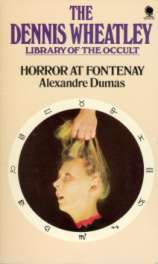
Horror at Fontenay, by Alexandre Dumas.

Let me start with the double horror of the cover — the grotesquerie it depicts and then the travesty of design (let's just say it belongs to another era).

Then there's the horror of the smell of my second-hand (quite probably eighth- or twenty-third-hand) copy, ferociously tickling my sinuses every time I opened it.

The horror of the translation: it's translated and adapted by Alan Hull Watson (who has also translated De Sade and Huysmans). In his introductory notes he states that "considerable revision and re-writing, some elimination and some expansion were essential, together with paraphrase rather than translation, more or less throughout," on the assumption that Dumas dashed off these pieces, for whatever reason, without careful thought. Watson took it upon himself to add details to "improve characterization" and "heighten atmosphere," while eliminating unnecessarily wordy descriptions. Hmmm.

The horror of the ending: well, it's not Dumas's ending, it's Watson's. Whatever cuts and additions Watson made throughout the story, as much as the idea of them makes me cringe, they aren't noticeable. The ending, however, is both a little far-fetched and too neat, needlessly. From what little else I've read of Dumas, I don't think he was troubled by having to have all the little loose ends tied up; seemingly important events or objects might remain forgotten, and some characters' secrets remain secret. So Watson's end didn't feel genuine.

But the horrors within this slim volume are delightful. The book starts with a man presenting himself at the mayor's house, confessing to the murder of his wife. He claims the severed head of his wife spoke to him and bit him. After the scene of the crime is investigated and testimony taken, the mayor invites many of the witnesses (of the confession) to his home for dinner, the main topic of conversation being the events of the day and whether the murderer's tale is to be believed.

Dumas himself is a guest at the mayor's dinner party (as is an allegedly almost 300-year-old man), so the stories have a stamp of validity, as if to say these things really happened to a friend of a friend of mine... (a fairly standard technique these days, but effectively engaging nontheless).

All the stories bear the mark of Dumas. A bit melodramatic perhaps, but heart-wrenching:
Words cannot describe my feelings during the next few moments, for hardly had my hand reached down to grab a head than I felt my fingers being pressed by lips which still retained something of the warmth of life in them.

The only way I can express it is by saying that I experienced such an access of terror that the sheer intensity of my fear somehow restored my courage. I removed my fingers from their proximity to the lips, seized the head by the hair, and going back to my chair, stood it on the table in front of me.

As I looked I was petrified as a man turned to stone. The lips seemed still warm and living, the eyes were half open, and the head — the head was that of Solange!

I thought I must be insane, and I remember, shouting over and over again: "Solange! Solange! Solange!" Then the eyes opened wide, and, looking at me, seemed to light up for an infinitesimal part of a second, while two large tears trickled slowly down the cheeks. Then they closed once more, never to open again in this life.


Love and honour, and revenge and justice on these counts, are not terminated by mere death. The sense of chivalric duty is strong. Guillotined heads, hanged men, the desecration of the Royal Tombs. There's even a vampire story (which predates Dracula).

The stories were published in 1849. While there's nothing startlingly horrific here, nothing new, it's interesting to note that the conventions of the genre were only just being established.

These stories were intended as the introduction to a much larger collection, for which Dumas supplied the general title of "Les mille et un fantômes," but it seems he abandoned the project. Too bad, cuz this book's a gem.

Some reviews and background.
French text of Les mille et un fantômes.

Dumas was keenly interested in the question of whether a guillotined person suffered pain after being beheaded. It seems a number of his characters are interested in "the occult sciences." Alchemy and mesmerism figure in his tales. He wrote a play about a vampire and is credited with having written one of the first modern werewolf stories.

Must. Read. More. Dumas.

The horrors of Friday the 13th
- J-F's mom wants Helena's company for the weekend. On announcing the plans to Helena, she has a fit of hysterics. (After a couple hours, she does come round to the idea.)
- I do not procure a copy of Lemony Snicket's The End.
- Traffic en route to J-F's mom's place is hellish. (Not really an effect of the curse of the day, but the first time I've experienced it since a bridge collapsed along our usual route.)
- J-F tries to buy cigarettes, but the dépanneur has had its license suspended. (Not a bad thing in the grand scheme of things, but the minutes between J-F deciding he wants a cigarette and eventually actually having one are decidedly unpleasant.)
- Upon deciding tonight's the night we're going to try the pizza from the place down the street (four and a half years in this city, and we've yet to find a pizza joint we're willing to call our regular), we arrive to the news that their oven is broken. (We settle for the sub-par pizza from across the street.)
- Arriving home, we crack open a 12-pack to find it contains only 11 beers. (I haven't gotten over this yet.)
- Inexplicably, we have no trouble finding a copy of Art School Confidential to rent. (Not a bad thing — a very good thing, in fact — but surely a supernatural intervention, even if benevolent compensation for all the other horrors of the day.)

Things that went right this weekend: child-free evening, with pizza, beer and cigarettes, and a movie.

Helena returns home from her grandmother's with a nasty cough and fever and stays home from daycare yesterday. Her sweetness in her vulnerable state is overwhelming, even if fever does cause her to be a bit (more) temperamental (than usual). Again this week she insists on cuddling on my lap to watch Doctor Who, and again I worry what trauma watching the program may inflict on her. First thing on waking she tells me what fun it was watching Doctor Who with me, how the wolf became moonlight. She insists on going to daycare this morning, but explains that if she's coughing a lot she'll ask the éducateur to phone us to pick her up. She's being very together.

Friday, October 13, 2006

Manguel's library

"In any of the pages of any of my books may lie a perfect account of my own secret experience of the world."

The Library at Night, by Alberto Manguel.

Review:
At its heart, it is a meditation on knowledge and memory, on the links between the two, on the limits of each. For Manguel, the library is the "emblem of man's power to act through thought." More even than that, it is a "monument intended to defeat death, which, as poets tell us, puts an end to memory."

[...]

As in The History [of Reading], the narrative is deftly leavened with literary anecdotes. There is the Czech librarian who runs after the retreating German army, insisting that they return the books they have borrowed. There are the secret libraries of the inmates of Auschwitz and Bergen-Belsen. There are the Colombian peasants who refuse to return their copy of The Iliad: "They explained that Homer's story exactly reflected their own: It told of a war-torn country in which mad gods willfully decide the fate of humans who never know exactly what the fighting is about, or when they will be killed." There is the librarian Mrs. Calloway, the terror of Eudora Welty's childhood. "You could take out two books at a time and two books only," Welty remembered. "This applied as long as you were a child and also for the rest of your life."


October 15–21, 2006, is Semaine des bibliothèques publiques, coinciding with library week in several other provinces, all part of Canadian Library Month.

Thursday, October 12, 2006

My father's moustache

Speaking of moustaches...

My father wore a moustache all his life, certainly I never knew him without one.

Legend has it that he lost it once in a poker game. It's the only time my mother saw him without one, and it didn't take long for his look to be reestablished. (I don't know if my siblings existed yet, but I imagine they'd have been too young to remember.)

I have one photo of him sans moustache, age 17, but I don't see the resemblance. It was taken by an army buddy, inscribed and dated on the back so I know it to be him, but he looks a stranger. Indeed, it troubles me to look at it.

There are a few other pictures from his youth — but he was sufficiently angled, the photos grainy and shadowed... The effect is such as if the moustache were there.

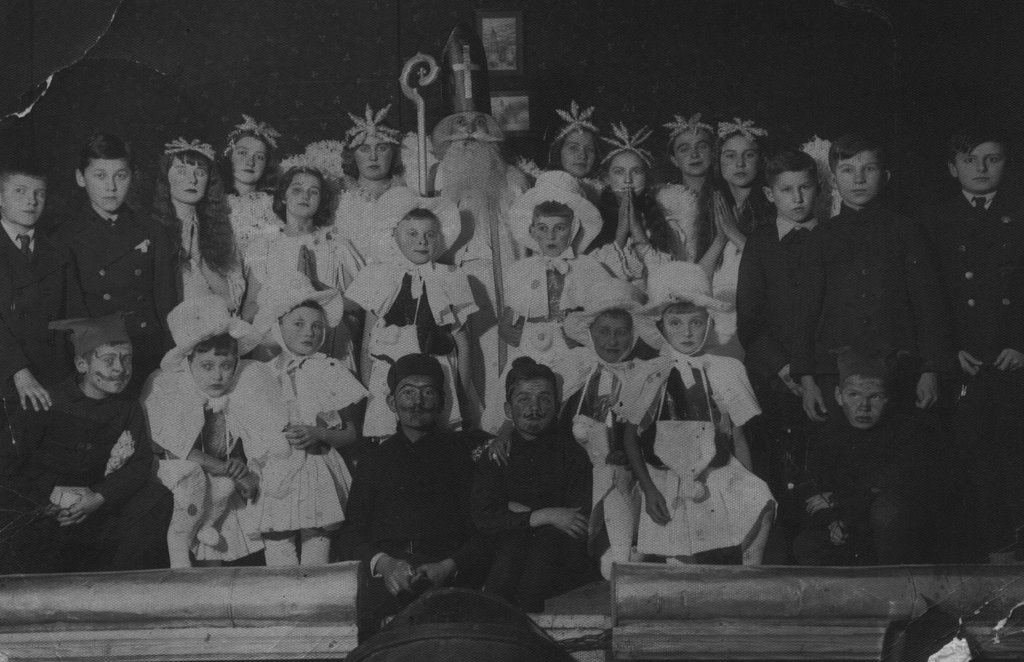
Here's a school photo from childhood (circa early 1930s, Poland now Lithuania). That's my dad at the very front, the one on the left, looking very much like the man he grew up to be. He's, well, moustached.

Wednesday, October 11, 2006

Nobel games

The Lord of the Flies.

A book and a movie

Not to imply that there is any connection between them other than my experiencing them in tandem, but they both have me thinking about what exactly is this thing we call reality.

There are spaces in between the material substance of our world, and sometimes you can see them, but no one else will see what you see, and it will form you, become a part of you. Wherever you go, there you are. You cannot get out of your own head.

The book
I finished reading M John Harrison's Light — has anyone else read it? I'm still not quite sure what to make of it. It's unlike anything I've ever read before, which is a fairly meaningless statement given that I haven't read very much SF, even if I read somewhat more than do people who don't read SF at all. I'm told it's both hard science fiction and space opera.

There's Michael in our present day, doing research in quantum physics. And he's a serial killer, which fact is revealed on page 3, so I don't think I'm spoiling anything for you, and besides, it has next to nothing to do with the plot. (Except for hinting at that he may be insane, or schizophrenic. I did find myself wondering about his brain chemistry, how he sees fractals everywhere, and feeling that he had episodes (alternately of sanity, genius, and murderous rampage, all inextricably linked and triggered by I know not what (though this "imaginary" ghost/demon Shrander connective tissue/god(?) is somehow a factor)), kind of like how epileptic seizures can be brought on by video games, strobe lights, etc.) Four hundred years in the future, there's Ed, who seems to be living his present in a tank, having his reality piped in to him, as a means of escape from reality as well as from the people to whom he owes large sums of money; and Seria Mau, running missions as a disembodied pilot who interfaces directly with the mathematics — she is the ship. Their plots are connected and have interesting parallels and intersections.

Weirdly, they're all rather sympathetic, haunted by the question of being. Ironically, it's Seria Mau who's the most sympathetic of the lot, though arguably she's the least human, having given up her physicality to technology, or maybe her humanness has been distilled to its essence, or maybe I find her so because she's female. They do all find "redemption," whatever that means.

It's a very uncomfortable read, partly because it's so unfamiliar (in its world setting, but also in my reading experience), partly because of the violence — not because it's graphic, though it sometimes is, but because it's so casually dismissed. But mostly for its attitude toward women, I think — I can't quite put my finger on it. They indulge in pleasure-seeking behaviour as much as the males, but it feels like they're being victimized — I can't tell if this is deliberate and essential to the novel's workings or if it's something else, or if it's even there. It just feels uncomfortable.

Iain Banks says "Harrison is the only writer on Earth equally attuned to the essential strangeness both of quantum physics and the attritional banalities of modern urban life." I don't know that Harrison's the only such writer, but the basic assessment of his ability is valid. (If you can call senseless murder a banality of urban life.)

If anyone has read it, I would love to hear what you make of it and where you think it fits within the genre and within its canon.

Excerpt.
The Literary Saloon review, with links to others.
M John Harrison's top 10 "books which link the inside to the outside, the scientific to the personal, the individual to the universal."

The movie
Last week I came across a mention of a novel, La Moustache, the premise of which greatly intrigued me (so I looked it up!), amid refections on the uncanny. Naturally, everywhere I turned in the ensuing days the author's name, Emmanuel Carrère, popped out at me — in my internet reading, in my real-life bookstore browsing, and at the videostore.

While I didn't find a copy of the novel La Moustache, I had to rent the (freshly released on DVD) film adaptation (directed by the author himself).

The plot: man shaves off his trademark mustache and nobody notices.

It's quite funny to start with, in an it's so absurd you chuckle out loud kind of way. Then it gets a bit weird.

When he confronts his wife she insists he's never had a mustache the whole time she's known him, and over the next few days the status of things — varying in significance from restaurant menus and wardrobe contents to her denying the existence of friends they dined with last week to whether his father is alive — slips into uncertainty and beyond.

When he first shaves, he hides it from her, waiting for the right moment to spring the surprise. He couldn't answer the door for her in time, he lies, because his shoelace broke. About halfway through the movie, his shoelace really breaks, as if the little white lie started him on the road to total breakdown. Maybe.

It's deliberately ambiguous, from beginning to end: we never know what really happened, is this all in his head, is it an elaborate joke cum conspiracy against him, is he insane, or maybe his wife is insane, or is it a splicing of universes, one where he's always had a mustache and one where he never did. Did he ever have a mustache and did he really shave it off?

(There are a few scenes of evidence being washed away or erased, maybe just forgotten, a reminder of how tenuous, and individual, our grasp on identity can be. For example, I've misplaced my jump log, the only physical evidence I have of the fact that I ever parachuted out of a plane. I'm no longer in contact with those people who witnessed it. The older I get, the less likely, I feel, I am to be believed. Does it matter? Not really. Except for that I feel this act is somehow essential to my identity, at least to the person I once was, and it would be weird and I would be sad if it unhappened. For another example, my mother in the last few years has "invented" an Easter ritual that she claims has been forever a family tradition. Her insistence has led me to doubt my own memory, once unwavering in the belief that this tradition was not part of my childhood, to the point that I'm not comfortable to proclaim I'm 100% certain on this anymore. And rather than dwell on it (which I still do in my head) and upset her, it seemed easier, and kinder, to let it go, because it doesn't really matter. Or does it?)

In my opinion the acting is superb; there's not a lot of anything you could call action, and no superfluous dialogue. Mostly there's the lead character, Marc, looking at people, waiting for a reaction, and people looking at Marc, wondering what the hell he's looking at or waiting for, and Marc looking at his wife, thinking she must be thinking what he thinks she's thinking, and then knowing she must think he's crazy, and her watching him, knowing he knows she thinks he's crazy, and no one ever actually knowing what anyone is thinking, which is kind of the point.

(I rarely bother with foreign movies anymore — the price of compromise in my cohabitating condition. Which is a shame. I miss them. Their pace. Their ambiguity. The leaving of things unsaid. The not always happy endings. The naturalness of bodies and of living spaces (with bookshelves, and books strewn about!))

From a review:
At first "La Moustache" seems to be a darkly witty commentary on what we notice or don't notice about one another; we're so lulled by the predictable and the commonplace, it implies, that we fail to recognize change. Then it widens into a reflection on marriage and the notion that two people, no matter how intimately connected, inhabit separate worlds. An illusion of oneness requires each partner to overlook or deny the other's unknowable qualities.


Maybe.

Official website.
Trailer.

Tuesday, October 10, 2006

Be good and behave

I try to lay down some ground rules for Helena, giving in to her insistence that she accompany me on what was supposed to be a super quick nip out to the grocery store. She must behave, and very solemnly she nods her head to my instructions, then trots off to put on her shoes. She's back in a minute, looking timid and puzzled.

"Qu-est-ce que veut dire "have" [pronounced /heiv/]? Tu m'as dis qu'il faut que je sois une good girl, être "have"?"

She will be good, she will be-have. I'm glad she asked.

Monday, October 09, 2006

Giving thanks

Today was Thanksgiving in Canada. I like to think that most days I give appropriate thanks where thanks are due — my friends and family, my lucky stars. Every day I count my blessings.

But today was a special day. Today I give especial thanks for the return of the Doctor (Finally!, she says with feigned exasperation that cannot disguise her glee)!

Thursday, October 05, 2006

Reading group project the next

Goodbye, Tolstoy; hello, Stendhal!

The Red and the Black.

Discussion to begin in November and carry into the new year. Pace will be relatively slow, to accommodate my late-November vacation, Christmas preparations and festivities, and the fact that I will be attempting to read it in French.

Register your interest here, or there, or by email. I'll be setting up contributers and updating the group blog with Stendhal-appropriate links and resources over the coming weeks.

Wednesday, October 04, 2006

Fractious

Main Entry: frac·tious
Pronunciation: 'frak-sh&s
Function: adjective
Etymology: fraction (discord) + -ous
1 : tending to be troublesome : UNRULY [a fractious crowd]
2 : QUARRELSOME, IRRITABLE
- frac·tious·ly adverb
- frac·tious·ness noun

The book I'm reading: I wasn't sure what to make of it, didn't think I liked it, and wondered what review had made me take note of it and buy it (almost a year ago, according to the receipt tucked inside the cover). It's Light, by M John Harrison, and it's anything, and everything, but light. I really liked the first chapter, read in-store, and appreciated how the fact that the guy's a serial killer is treated pretty much as an aside, though it is a bit offputting, but the subsequent chapters, introducing the two other main story threads, just confused me. Although, these are both set in 2400, like they must have a closer relation to each other than with the mathematician-who-happens-to-be-a-serial-killer story; maybe it's this imbalance that's setting me off kilter. Mostly, I'm hugely disappointed to have finished my Dumas book and to have no more Dumas at the ready (oh, if I had a copy of Queen Margot [I liked that movie, wasn't aware of the Dumas connection]). No book quite felt right, none would, and what with work obligations and some meaty reading planned ahead I thought some light reading would be in order, and the title tricked me, so now I'm reading Light, and after 40 some pages and a few days, I'm finding my rhythm with it and wanting to know what happens next.

Maybe it's the fact that in 40 some pages, the word "fractious" has appeared a handful of times, and Anna says it's like they're in a Tom Waits song. Anna's fractious, the book is fractious. I'm fractious, Helena, J-F, work, my sleep, my reading behaviour, my nasty blog habit — all fractious.

Today I took a breather from work to shop for winter accoutrements for the girl: boots, coat. I carry her footprints with me, their outline, to slip them into footwear to size it properly. Because shopping with Helena, especially with a specific task at hand, is usually not fun (but oh how I love pointless wandering with her). So this is how I usually buy footwear for her. And I always end up hesitating between the "perfect fit" and the slightly larger ones, because the difference seems almost negligible. And I always buy the bigger ones, because it's better to have a little extra toe-wiggle room. And they're always too big. But she's always grown into them eventually. Today's lovely boots: too big. Allowing her to grow into them doesn't seem practical, as our still only potential snow will likely have melted by then.

And I've been wanting to buy Snakes and Ladders, but I've found only fancy gigantic snakes and ladders, or tiny magnetic snakes and ladders, or over-priced cartoon-character-themed snakes and ladders, and I want classic snakes with classic ladders. Because I am oh so tired of playing Cache-Cache Grenouilles with her every morning and every evening. And the novelty of some card games has already worn off, and the difficulty of others seems insurmountable at this point. So when Rachel mentioned dominos, I obsessively latched on to this idea — the perfect game! (for 3-year-olds) — and the thought of acquiring some has been all-consuming, for days. Again, I eschewed the cartoon-character-themed ones, and the farm-animal-themed ones, and the colour-coded geometric-shape-themed ones, and I found some! plain ol' white dots on black! for a dollar! We gave it a go this evening, but it's too early to tell if it'll take. Helena was more keen on serving them up as biscuits at her tea party (oh I am so tired of tea parties).

After my little shopping expedition I was to pick up Helena from daycare (J-F's out of town), so I descended the stairs to the metro station to find access barred and hordes of students just standing there, waiting (don't you have better things to do?), and I still have no idea why the station was closed. I did find a bus, but I was late, and it was generally hellish. Did I mention it was raining?

However. En route from pseudo-mall to metro station are bookstores, used. One, a bust, today. Another has changed hands and sells only new books now, and literary ones (note to self: return for pretty editions of Paul Bowles collections as birthday gift to self). Yet another, one I've never before set foot in as it keeps unpredictable hours, is filled with odd-smelling, mostly genre, very definitely used-many-time-over paperbacks. There I found Alexandre Dumas's Horror at Fontenay, his "immortal occult novel," in which it is wondered how long does life persist after the head is severed. I love you, Madame la Guillotine, for the inspiration you've served this master storyteller.

Fractious.

Oh, I really should be working right now...