Saturday, February 24, 2007

Resonance

res·o·nance
n.
1. The quality or condition of being resonant: words that had resonance throughout his life.
2. Richness or significance, especially in evoking an association or strong emotion: "It is home and family that give resonance . . . to life" George Gilder. "Israel, gateway to Mecca, is of course a land of religious resonance and geopolitical significance" James Wolcott.
3. Physics The increase in amplitude of oscillation of an electric or mechanical system exposed to a periodic force whose frequency is equal or very close to the natural undamped frequency of the system.
4. Physics A subatomic particle lasting too short a time to be observed directly. The existence of such particles is usually inferred from a peak in the energy distribution of its decay products.
5. Acoustics Intensification and prolongation of sound, especially of a musical tone, produced by sympathetic vibration.
6. Linguistics Intensification of vocal tones during articulation, as by the air cavities of the mouth and nasal passages.
7. Medicine The sound produced by diagnostic percussion of the normal chest.
8. Chemistry The property of a compound having simultaneously the characteristics of two or more structural forms that differ only in the distribution of electrons. Such compounds are highly stable and cannot be properly represented by a single structural formula.

I'm reading something... important.

It happens occasionally that a book comes along. A book comes along at the right time in the right place. It seems to be happening more frequently these days. Maybe I'm reading better books. Maybe I've become a better reader. Maybe I'm simply paying better attention. Some books come with personal baggage before I ever open them, an overwhelming sense of having a specific import to me as an individual (Middlemarch); some books are a suitcase of global, historical significance, though the world may not know it yet and I can only guess (Snow).

I'm reading Richard Powers' The Gold Bug Variations and I am in love.

It feels important.

From the very first pages I knew I was reading something big. Every page resonates with me, on different levels, for sometimes trivial reasons, essential ones too. It's clear at this point (a couple hundred pages in) that it is important to me personally, but I sense that it's bigger than that.

"And I learn again, in my nerve endings, that information is never the same as knowledge."

"...when I still believed in the potential of democratically available facts..."

"Recognition, learning a thing by heart: life will be nothing after these go."

Even this insignificant scene:
Tooney Blake, dark, mid-height, a youthful forty, is at the piano doing a terrifyingly down-tempo version of "Let's Call the Whole Thing Off." Only he's missed the point of the song: "Potato, potato, tomato, tomato," all pronounced exactly the same.


It resonates, as I recall the very funniest Saturday Night Live bit, with Christopher Walken, that I've ever seen. (Why do I think it's so funny? It's hilarious, missing the point is.)

A coincidence: I turned on the radio last weekend and, for my benefit alone, there was Francis Collins, who headed the Human Genome Project, in interview.

There is a message in this book for me.

Half of what I made out about the twenty-five-year-old scientist was pure projection. I began to feel I had not lived up to my own intellect, that I'd been born too late, had taken a wrong turn, had lost my own chance to turn up the edge of the real, discover something, something hard. This child scientist, desperate with ability, somehow reduced to full-scale adult withdrawal, night shift labor, by something not explained in the literature: here was my own irreversible missed hour.

[...]

But something else motivates the euphoric articles, something more than self-aggrandizement, more than the desire to cap the ancient monument and book passage to Stockholm, that freezing, pristine Valhalla. The compulsion to find the pattern of living translation — the way a simple, self-duplicating string of four letters inscribes an entire living being — is built into every infant who has ever learned a word, put a phrase together, discovered that phonemes might speak.

As the journal evidence accumulated, it sucked me into the craze of crosswords, pull of punch lines, addiction to anagrams, nudge of numerology, suspense of magic squares. I felt the fresh PhD's suspicion that beneath the congenital complexity of human affairs runs a generating formula so simple and elegant that redemption depended on uncovering it. Once lifting the veil and glimpsing the underlying plan, Ressler would never again surrender its attempted recovery. The desire surpassed that for food, sex, even bedtime stories, worth pursuing with convert's zeal, with the singleness of a monastic, a lost substance abuser, a true habitué: the siege of concealed meaning.


Then a reference to the Pythagoreans: "They say that things themselves are Numbers." I've always had a certain fondness for the Pythagoreans.

The search for a starting point begins to resemble that painful process of elimination from freshman year, spent in the university clinic, a knot across my abdomen from having to choose which million disciplines I would exclude myself from forever.


I feel my own knot tighten again.

I remember Mr Veenstra with the crazy accent, grade 9 science, who made you do push-ups if you broke the rules of the lab. He sent me to the principal's office when I refused my sentence, on principle, after I'd baited him, deliberately dawdling while leaving my safety goggles on my desk. I remember the frustration of skipping from chemistry to biology when I still felt gaps in my understanding, and I stayed after class to puzzle out the difference between molecules in animate and inanimate object. "That, Ms Kratynski," — his eyes were on fire, mine were all water — "is the $64,000 question."

On page 88 I find the joke I always used to make, that we need a map, ideally scaled 1:1, only to discover Lewis Carroll had cracked it before me.

Everything resonates.

Science is not about control. That is technology, another urge altogether. The pursuit of living pattern that possessed Ressler has nothing to do with this year's apotheosis of bioengineering. He once remarked that mistaking science for technology deprived the nonscientist of one of the greatest sources of awe, replacing it with diet as filling as Tantalus's fruit. I had only to hear the man talk for fifteen minutes to realize that science had no purpose. The purpose of science, if one must, was the purpose of being alive: not efficiency or mastery, but the revival of appropriate surprise.


There is awe on every page, reminding me of the awe I feel, on good days, in real life, regarding those two most awe-inspiring things: science and music. (There is love, too, but it a mechanism, not the message — the grammar through which all awe is known.) And when I close the book before closing my eyes at night, I am in awe of the pages I've just read.

I find my theory of everything in these pages: "Motion is not forward but concentric."

Ressler asks, "Can you look at a score and tell . . . simply by the pattern of notes, whether the composer has uncovered something correct?"

In the back of my mind hovers the question, is there a novel that is "something correct," mathematically necessary, or obvious.

Coincidentally I'd been listening to Glenn Gould's 1955 Goldberg Variations — the same recording referred to in the text. Maybe it was a subconscious preparation for immersion in this novel. I've been listening to it ever since. Nonstop for weeks now. It's breathtaking.

There is nothing to do except release side one, track one. He touches the needle down on the Goldberg aria. The first sound of the octave, the simplicity of unfolding triad initiates a process that will mutate his insides for life. The transparent tones, surprising his mind in precisely the right state of confusion and readiness, suggest a concealed message of immense importance. But he comes no closer to naming the finger-scrape across the keys. The pleasure of harmony — subtle, statistical sequence of expectation and release — he can as yet only dimly feel. But the first measure announces a plan of heartbreaking proportions. What he fails to learn from these notes tonight will lodge in his lungs until they stop pumping.


I need to know how it all ends.

"You've worked in a lab, you've scribbled in enough notebooks to know better. I tell you, the world in not modulations and desire. It is stuff, pure and simple."

Thursday, February 22, 2007

Make 'em laugh

The grown-ups' birthdays in this household tend to go without much celebration in recent years — mine is the day after Helena's, J-F's just a few days before Christmas.

This year for J-F's birthday I bought a DVD. The movie as a whole was not intended as the gift; rather just one specific scene. Helena led him into the living room where a cappuccino and becandled day-old muffin were awaiting him. The movie already cued up, I pressed play, and we watched Donald O'Connor make 'em laugh, make us laugh.

I'd never seen Singin' in the Rain when I was growing up. My mother didn't care for Gene Kelly. If ever the movie was on TV during my childhood, it was passed over, for Bing Crosby or for the news. Of course, I knew the song — everyone knows that song. But it didn't mean anything to me.

It was a few years ago that we stumbled on some television program featuring classic movie moments or dance sequences or some such, and amid the hilarity, J-F made the bold pronouncement (shh, don't tell anyone) that Singin' in the Rain was one of the best movies, and O'Connors' Make 'Em Laugh one of the best scenes, ever. Now that I've seen it for myself, I agree. Even in my dourest moods, the finale of this number never fails to elicit deep and sincere spasms from my belly.

It seemed right this birthday to give the gift of laughter, start the new year on a laughing foot.

What I didn't foresee was the impact of this movie, this scene, on Helena.

From that first viewing on J-F's birthday morning Helena was fascinated. Interestingly, the title number resonates least of all (though it gives her some context, a cultural reference, for the Gene Kelly Muppet Show episode).

But when the mood here is musical she will take a jazz stance and proclaim "gotta dance!"

She sings Good Morning, loudly and clearly when we take the metro, putting smiles on other people's face. I cringe a little at the now less-than-innocent connotations, but I smile too, for reasons they cannot know, for the joy this film and this little girl bring to my household.

She exercises her booming low voice and squeaky high voice. "No, no, no," as she nods, and "yes, yes, yes," shaking her head emphatically. It's a bit she's found good for bringing levity to the yes/no questions I may ask her at trying times.

But it's Make 'Em Laugh that captivates her, that she requests repeatedly. She is perfecting her pinwheel, running circles round her shoulder on the floor. She is learning to rubberize her face. She is examining the possibility of running up the wall.

She's studying the humour, mining it for material.

Make 'em laugh, little girl.

(I started writing this post exactly 2 months ago today when I first noticed a little phenomenon that has since ballooned. I've been struggling all week with getting much of anything done, and for some reason this has been the biggest stumbling block of all. Though it's waited this long already, it's the thing I have to put to paper, to finish. It poses the problem of articulating very particular kinds of ineffable joy — that of one insignificant (in the grand scheme of things) movie scene, how it seems to punctuate the 3 lives intertwined in this household (and did so enthusiastically this last weekend), and that of the child, both in what she experiences and in what she brings to others. How does one write seriously about laughter without the writing itself being comedic, or slapstick? How do you capture laughter without being laughter? This is neither here nor there, really. Simply: I'm blocked. Writer's block, blogger's block. Fortunately, not laugher's block. I've never been one known to make 'em laugh, but beyond my expectations and contrary even to my own inclinations (and to any evidence in the tone you may hear here) this week I'm laughing with the best of 'em.)

The slaves of Patrick Hamilton

David Lodge sings the praises of The Slaves of Solitude, by Patrick Hamilton, calling it one of the very best English novels written about the second world war. (Link via Tom Roper). It's a great introduction to a book I now pronounce (I'm a little slow to commit to such bold statements) as one of my all-time greatest reads.

The book has just been reissued by NYRB Classics. I don't have a copy yet, but Susan does (maybe she can tell us whether this article and Lodge's print introduction to the reissue are one and the same).

The Slaves of Solitude was the first Patrick Hamilton book I read — a serendipitous library find — and it hooked me. You'll be hearing even more about him from me as I work through his two big ones over the next couple months. I intend to read everything of his I can get my hands on.

I'm pleased to learn also that The Gorse Trilogy is set to be reissued in June 2007 (Black Spring Press). Having read the first two parts and being unable to find the third, I'm, well, really excited! I can't wait!

Wednesday, February 21, 2007

In which my sister attends a reading at my insistence and then tells me about it

That is: author appearance, a report by proxy.

China Miéville wasn't appearing at a bookstore near me, but he was appearing at one (very many miles away from where I live) that my sister frequents (well, has been to), so I told her to go, and for some inexplicable reason she listened to me (she hasn't read any Miéville) and even braved pouring rain to go hear him read from Un Lun Dun and ask on my behalf my now trademark question (although I'm sure nobody but me knows it, about it being my trademark I mean), "So, whatcha readin'?" (although I'm fairly certain my sister ad libbed it), it being at once casual, unpretentious, and sincere and having the potential for if not great insight then at least some pleasant alternatively warm-up or wind-down discussion.

He read chapter 5, and his reading was strong, sensible, and entertaining enough that 1) my sister was actually sucked into buying a copy of the book, even after I'd told her she shouldn't bother cuz it's not very good — (I don't really mean that, China. It's good, I liked it; I just didn't love it, it's like you were holding back, it could've been so much better. Be political! Be scary! The kids can take it!) — which has now been personally inscribed to my daughter, "for when she's ready to turn the iron wheel," and 2) she (my sister) is inspired to finally get 'round to reading something he's written, Perdido Street Station having sat unread on her shelf for a few years already.

He fielded questions for about an hour from a fairly geeky-looking (so says my sister) audience, a lesser turnout than for other DC-area readings my sister has attended, and would not be goaded into trashing either Tolkien (his views are on the record) or Star Trek. While he mocked the accuracy of Amazon and Wikipedia regarding future publications and speculated on the life cycle of rumour, he did not unequivocally deny that he was at work on a novel called Kraken.

Also, apparently Miéville has a sexy laugh.

What China Miéville is currently reading:
The Ideology of the Aesthetic, by Terry Eagleton
Suttree, by Cormac McCarthy
Fire Sale, by Sara Paretsky

Any errors regarding what transpired at China Miéville's reading yesterday evening are likely my own, as my multitasking has on occasion proven to be deficient (and I was trying to load the dishwasher while listening on the phone) and sometimes I infer and extrapolate in accordance with my own subconscious desires and assumptions and am later unable to distinguish this from actual fact; or quite possibly my sister's, in either sloppy note-taking or her inability to read her own writing; or China Miéville's deliberate misinformation.

Friday, February 16, 2007

Un-China

I so wanted to love this book. And I so wish I were 12 — maybe then it'd be a little easier. As it is, I found it very easy to walk away from this book for hours, even days, at a time.

China Miéville wrote Un Lun Dun for young adults. The title comes from the name of a city in an alternate reality, which a couple kids slip into. Un Lun Dun. Un-London.

Miéville in a recent interview describes the book thusly:

It's a classic story of children from our world who find their way into another, odder place. The place is sort of a twisted city. It's a homage to that tradition of books like the Alice books, the Narnia books — cross-fertilised with the urban tradition of books like Michael de Larrabeiti's Borribles.


Un Lun Dun has a decidedly urban feel. The dialogue is modern and slangy (there's a glossary for the benefit of American readers); as an adult reader I find this off-putting — the story loses the sense of fabular timelessness I associate with YA lit — but the tone at least is even and consistent throughout the whole of the novel. The world is littered with clever ideas of characters, but none are fleshed out. The plot is nothing new: youngster trapped in another world in accordance with prophecy must battle a villain before finding her way home.

Miéville talks a lot about breaking the conventions of the fantasy genre, but for some reason didn't see fit to do it here. It is a classic story. The prophecies are flawed, but this is a mere joke, not an overturning of the narrative formula.

(One character spouts out Humpty Dumpty's old line, that words mean whatever he wants them to mean. I love that Deeba argues back.)

The villain is a sentient gaseous cloud: Smog. Smog was apparently previously battled and beaten in London by the Klinneract. Deeba does some research and digs up the Clean Air Act. I half hoped, half dreaded that Miéville might get political, impart on young readers some lesson regarding the environment. But no, just a little joke.

Everything about this book feels like a missed opportunity, a thin sketch. I'm not well versed in young adult literature, so I can't fairly gauge how it measures up against what the kids are reading these days (although I can with certainty say this no Narnia or Hogwarts). I'd been hoping for a scaled-down version of Bas-Lag (I really wouldn't want to take a child there, even if I do let my 4-year-old watch Doctor Who with me), something less monstrous but as richly peopled. This isn't it.

There are moments when the darker, more adult Miéville shines through, with evidence of things for which I love the Bas-Lag books, when describing, for example, architecture:

They were swaying before a huge building. It was like nothing she had ever seen.

It had no straight edges, was all long curving planes stretched like cloth or rubber. In several places it poked into steep cones, and pillars and jags like tree branches jutted from beneath its shimmering, moving surface. It looked like a load of giant tents, all stitched together at crazy random, as big as a stadium. Its entire surface was white, or gray-white, or yellow-white, and it rippled.

"Oh my gosh," whispered Deeba again. "It's a cobweb."

Tons of spider silk had been draped over an enormous irregular framework. It coated it completely, in layers, totally opaque. At its edges, strands of webbing jutted out at angles and anchored to the pavement and surrounding buildings like guyropes.

In one or two places, Deeba could see dark, immobile things smothered in the silk. It was wound around them in shrouds, suspending them in the building's substance.

"That'll be Webminster Abbey, then," said Hemi.


or monsters:

Through the Diss & Rosa's windshield, Deeba saw fingers of weed rise from the murk and stroke the underside of the metal. Deeba put her face close to the glass to watch them, then sat hurriedly back.

"It moved," she said.

The stuff floated around them. If drifted by in little islands. As Deeba watched it, one quivered, and reached out a tendril to grab a passing piece of rubbish. It hauled it in — it was a mouldy fish carcass — and the slimy clot of weed quivered more.

"That's shudderwrack," said Lectern. "Keep you hands out of the water."


But these atmospheric gems are few and far between.

Interestingly, of all the books I've handled recently, Helena is particularly attracted to this one. She loves the jacket design. She found the illustrations within, Miéville's own, to be very funny. So there's something to it, the book having an appeal to a younger crowd. (Helena insisted I start at the beginning with her, not to read, but to count the chapters.)

See Edward Champion's review.

Excerpt.

Tuesday, February 13, 2007

The rat

I love this book — Firmin: Adventures of a Metropolitan Lowlife, by Sam Savage, from Coffee House Press.

It's charming. A rat who reads and eats books. Love and reverence for books. The comfort books provide both body and mind. While I'm drawn to books about books, booklovers' books, they often disappoint me — too much sentiment or too much sermon, often just meaningless name-dropping. In Firmin, the book-love is just enough in evidence without ever feeling like a cheap trick. Firmin the rat is hopelessly romantic; Firmin the novel is not.

From a very simple premise, we have a window onto humanity and despair through the cracks in the margins of existence. It's seedy, and brimming with life. And surprisingly gentle.

Firmin begins his life in a used books store; he is far too busy absorbing and being absorbed by books to know a real rat's life. It's a while before Firmin is able to distinguish fiction from nonfiction, and though he consumes plenty of it, it's questionable whether he ever fully digests it. Apart from books, Firmin's pleasure is to scurry out among the lowlifes to take in late-night pornographic movies at the local theatre, which carries a different kind of romance altogether. His world is turned upside down when he discovers all is not as he imagines it to be, people are not what they seem — the proprietor tries to kill him. Firmin sets out to make contact with humans; his effort is disastrous, but it brings him into a relationship, complicated and beautiful in its way, with the science fiction writer who lives upstairs from the shop. This time, Firmin has a greater understanding of the dynamic he has entered into:

Jerry talked and I listened. Gradually I learned more and more about his life, while he, one can safely say, learned less and less about mine. Due to my natural reticence, he had a free hand with my personality. He could pretty much make me into whomever he wanted, and it was soon painfully clear that when he looked at me what he mainly saw was a cute animal, clownish and a little stupid, something like a very small dog with buckteeth. He had no inkling of my true character, that I was in fact grossly cynical, moderately vicious, and a melancholy genius, or that I had read more books than he had. I love Jerry, but I feared that what he loved in return was not me but a figment of his imagination. I knew all about being in love with figments. And in my heart I always knew, although I liked to pretend otherwise, that during our evening together, when he would drink and talk, he was really just talking to himself.


The thing. Two things.

One: The novel opens with a couple epigrams, one being that old teaching "...he did not know whether he was a man dreaming that he was a butterfly or a butterfly dreaming that he was a man." In Firmin, there's a kind of metamorphosis, from rat to human, from fiction to life, and both back again.

Two: Jerry's novel is about an alien race that mistakes rats as the dominant species of Earth. (Which is maybe why Firmin likes Jerry.) It merits a little consideration, that there is something — no, not dominant, but — meaningful in the human rats, the marginalized, the forgotten, the drunks and the whores. What it is to be human. To be the protagonist of one's own narrative.

I began to spend most of every day on my back, all four feet in the air, dreaming and remembering, or else playing the piano, remembering and dreaming. I could see that my dreams were changing. They were getting soft and nostalgic, with a kind of crepuscular flare around the edges, and I didn't have many exciting adventures anymore. I missed the past terribly, even the awful parts. I never forget anything that has happened to me and scarcely anything that I have read, so by that time I had stored up an awful lot of memories. My brain was like a gigantic warehouse — you could get lost in it, lose track of time, peeking into boxes and cases, wandering knee-deep in dust, and not find your way our for days. Sometime shortly after I moved in with Jerry I had begun to play with the past, tweaking it this way and that to make it more like a real story, and I had begun mixing my memories with my dreams. This was probably a mistake, since the more I played with them the more they came to resemble each other, and it was harder and harder for me to tell the things I remembered from the things I invented. I was now, for example, unsure which of the figures was really Mama, the fat greedy one or the thin, worn sweet one, and whether her name was Flo of Deedee of Gwendolyn. All the archives existed only in my mind. I had no external check, no diary, no old family friend. How could I verify? All I could do was compare one mental image with another image, equally suspect, and in the end they all got tangled together. My mind was a labyrinth, enticing or terrifying according to my mood. I was losing my footing, and the odd thing was that I didn't care.


See the discussion at the LitBlog Co-op (a couple posts aren't properly tagged, including the comments by Sam Savage himself, so check the November archives to get all the good bits).

Really, an excellent read.

Monday, February 12, 2007

Counting the days

Helena was flipping through the pages of her calendar, and before I could think up an excuse to be elsewhere, she had me listening (feigned attentively) to her count every single effing day of every single effing month of the whole effing year. She knows how many days till her uncle's birthday (a handful), and how many to her own (very many). (My brain had glazed over and I'm unable to recall the exact numbers.)

Yesterday we played in the snow. Here Helena ceremoniously presents an emissary with a symbolic chunk of snow to appease the gods of winter, that the winds will not make ice statues of us, that the polar bears will not take us for popsicles.

Friday, February 09, 2007

Bits

What I'm thinking about:
Margaret Atwood's take on arts funding. If you haven't read it already, do. And check out the dirty little debate over it at Bookninja, where, if one must take sides, I'd be trumpeting merit over financial need. Not that any of this affects me personally, apart from my being a citizen-consumer of "art."

Atwood starts her piece hinting at a kind of art-brain-drain, a problem that might indeed be helped by having money thrown at it. But she doesn't go anywhere with that grain for an argument, and no one else is pecking at it, which has me thinking, more than anything, that my comprehension skills are defective and deficient.

What I'm puzzling over:
How to translate "twunt."

What I'm dreaming about:
Sex in space.

What made me sad:
Solveig Dommartin died.

What I'm reading:
I'm in the final stretch of China Miéville's Un Lun Dun. At some point this evening I'll retrieve from my go-everywhere bag Firmin, by Sam Savage, the opening pages of which had me laughing out loud on the metro earlier this week.

A week into February and I haven't cracked a chunkster — I'm leaning toward Powers' Goldbug Variations, it being the shortest of my options and thus seemingly perfectly suited to this shortest of months for my one-a-month plan. But I just don't know yet.

I never figured I was susceptible to the February blahs, but the last few years would give evidence to the contrary. This year, so far, so blah. Reading, blah. Blogging, blah. Cat puking all over my bed, blah. Helena home sick, blah.

What I'm listening to:
Thelonious Monk.

What I'm going to do next:
Nap. Me and Monk and Miéville, with the kid and the cat.

Thursday, February 08, 2007

The Doctor and us

One of the things, of very many, that makes me a bad mommy (or, arguably, just feel like one) is that I watch Doctor Who with my 4-year-old daughter. (Is that hipster parenting, or what?)

Whether or not it's too narratively sophisticated for the 4-year-old mind, many parents would find it objectionable for its scary monsters, frightening situations, and violence.

(Helena's educateur had overheard her reminding her father that she'd be watching Doctor Who that evening, so he made a point of catching an episode himself. His only comment afterward to J-F: "weird." That sounds judgmental to me.)

None of these concerns outweighs my deep-seated need for a peaceful Monday evening watching my television program of choice. (Sure, I watch other programs, but none regularly.) We tried to get her to bed swiftly so that I'd be sitting comfortably and undisturbed by 8 o'clock, but she knew something was up — she dawdled, she resisted. And I was not willing to sacrifice this selfish pleasure for the sake of my daughter's well-being. So I walked away, and she followed me, and a monster of a habit was born.

I rationalize it. It's bonding time. It's not breastfeeding, or storytime, or a bath. It's something so completely outside ourselves, beyond the bonds dictated by family. It's a shared pop cultural experience.

I like that we've planted a seed of open-mindedness in her. A respect for science fiction. For space exploration. I like that she's introduced to idea of alien life and time travel, regardless of whether they're a real possibility, for the philosophical implications that must then be considered.

Helena loves monsters. And robots. Sometimes they scare her, but mostly they thrill her. Occasionally she whimpers a quiet "I'm scared" and burrows her face into my arm.

I'm not too worried about the "monsters," particularly when many of them are not essentially malevolent — they're just misunderstood, trying to survive.

The best part is, Helena asks questions.

(Possible spoilers ahead.)

This week's episode I was wary of. Children were disappearing off the streets. Creepy kids' drawings were coming to life, or trapping life. I feared Helena might take it a little more personally, relate it more directly her experience of life. But it was not so alarming as previews had suggested (episode guide).

An alien life form had essentially possessed the body of child. Its spaceship was broken. It was lost and lonely for its brothers and sisters. So it literally drew the London children into its energy field. But it wasn't a mean creature; itself it was a child, and doing what it could to survive, if a little selfishly and at the expense of others. The Doctor helped it go home.

We talked. Just because you're sad or lonely doesn't give you the right to do whatever you want. Just because you're young doesn't mean you can't be helped to understand and to do right.

We talked about drawing. How drawing can help you express your feelings. How it can make you feel better if you're sad or lonely. The difference between a drawing and reality. (One drawing depicted the girl's father as he appears in her nightmares, an emotionally twisted, dream version of reality.)

There are issues. Moral dilemmas. Logistical problems. Ongoing narrative developments. Things that are more sophisticated than contained in a half-hour Dora episode or a Kevin Henkes book. Things Helena's mind has the potential to grapple with, and some of that capacity is already afire.

The thing is, Helena likes Rose. (Not Barbie! Rose!) She asks where the Doctor is and cheers when he comes on screen, but she worries about Rose. And the thing about her liking Rose is, well, Rose is going to die.

Scenes from next week's episode reference a previous story in which the Beast said Rose would die in battle.

It's inevitable now. I know it's coming, if not next week, then soon. But I don't know how to brace Helena for it.

Tuesday, February 06, 2007

Magic

Helena closes her eyes, tight, tight, tight, stretches out her arms, and wiggles her fingers. (Sometimes she uses a magic wand, but one isn't always on hand when you need it.) Slowly, loudly, she intones:

"Par la magie de mes doigts, [chose x] disparru!"

(Actually, "disparrait," would be the grammatically correct way about it, but she says what she says.)

The chant was inspired by her theatre class — they would bring the teacher's puppet to life, later returning it to its enchanted sleep.

Helena knows the power of magic.

The first thing she wanted to disappear was a tea towel. She was "helping" me fold laundry. Quick thinker that I am, with her eyes closed so tight, I swiped it away from in front of her and tucked it under the bed.

A glint in her eye, a gasp, and a smile. She proceeded to disappear the rest of the towels.

It's when she tried to use her skills in the bath — I was precariously perched, the props she chose were fragile or unwieldy, and hiding places were awkward — that it occurred to me I may have unwittingly enabled her to believe that she really had magical powers. Or perhaps it was just a test of my complicity.

She makes me disappear. And Papa. She magics us back into existence in odd places. For some reason, the magic doesn't work very well on the cat.

She asks us to make her disappear. She reminds us we have to close our eyes tight for the magic to work. We here her pitter-patter down the hall. We trace her by her giggles. Her act is complete with "where am I?" and "how did I get here?"

Sometimes she casts a spell with no warning and the magic doesn't take. I suggest she didn't have the right stance or a magical enough tone. Slower and louder gives me more time to work my magic.

Still, there are times I'm caught off guard, not fast enough, and she catches me in the act. I catch a quick scolding (no, mama, let the magic do it) and the glint in her eye: there are things of which we must not speak.

Monday, February 05, 2007

Listen to the radio

I've by chance tuned in to Wire Tap a few times, and after stumbling into it again yesterday, I'm convinced that it's the funniest, most wonderfully scripted and performed entertainment out there.

Show highlights are online.

In particular: Howard enlists Goldstein's help, Cyrano de Bergerac style, to pitch some poetry to the editor of the Regina Quarterly — "45 seconds, a very valuable commodity in the poetry world."

"The Canadian Broadcasting Corporation is not a metaphor; it's a broadcasting corporation."

Drunroll, please...

Contest: Un Lun Dun-inspired place names.
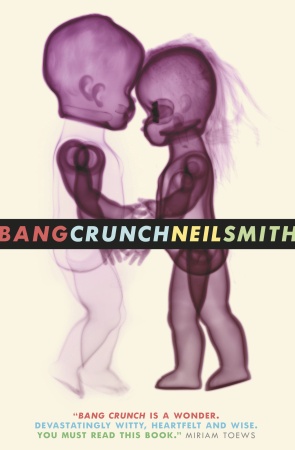
Prize: Bang Crunch, by Neil Smith, signed by the author.
Winner: Danielle, of A Work in Progress, for Nomaha, which is beautiful in its simplicity. (Please email me, Danielle, with your postal address.)

Thanks, everyone, for playing. (I may have to do this again — it's an entertaining way to get rid of some of the excess books stacking up around here, as well as to discover some otherwise silent readers and their blogs.)

(I grew up in Sans Catharines (near Niagara Fell, or, in the opposite direction, Shamilton), Untario. I lived for many years in Nottawa. Oh, I could do this all day. I have been doing this, for far too many days, with random place names around the globe. Please get me outside of my own head.)

Thursday, February 01, 2007

Un-place: contest! with prize!

(Originally posted January 30, 8:07 pm. I'll be keeping this post up top for a bit, cuz it's fun! you should play! even if you don't want the prize.)

One of the books I've been most looking forward to this winter is the new novel by China Miéville, this time writing for young adults. Un Lun Dun is set to hit store shelves February 13, but I'll be tucking into my review copy tonight.

The title comes from the name of a city in an alternate reality, which a couple kids slip into. Un Lun Dun. Un-London. Get it?

The world has other alternacities, of course. Parisn't, No York, Helsunki, Hong Gone.

The contest:
So, what's the name of your alternaplace, of the city you live in, or your neighbourhood, or your hometown, or where you went to school, or where you are right now (it must be a place you have a personal connection with)?

The prize:
The commenter with the cleverest (or silliest, or weirdest) response (as judged by me, probably) will receive my review copy (previously read by me; like new!) of Bang Crunch (really, it's worth reading), by Neil Smith, signed by the author earlier this evening (secondary contest: guess how many glasses of wine I had at the book launch). (International responses are both welcome and eligible. Contest closes February 3, midnight EST.)

Me? I live in Montsurreal.

Wednesday, January 31, 2007

Cinnamon crocodiles


I am drowning in colour.

The Street of Crocodiles, by Bruno Schulz, is under discussion at MetaxuCafé by the Slaves of Golconda.

The novel, or collection of stories, was originally called Cinnamon Shops, after one of the stories therein. "I used to call them cinnamon shops because of the dark paneling of their walls."

Since I first started my hunt for a copy in Polish, I've been rather obsessed with the matter of the title. Whereas Cinnamon Shops is breathtakingly fantastic, the Street of Crocodiles is bleak, bordering on grotesque. The two stories are so opposite in tone; to give the title of one over the other to the collection seems to me to impose a mood on the reader. I'm genuinely puzzled by the title switch.

Cinnamon Shops is truly full of wonder:
These truly noble shops, open late at night, have always been the objects of my ardent interest. Dimly lit, their dark and solemn interiors were redolent of the smell of paint, varnish, and incense; of the aroma of distant countries an rare commodities. You could find in them Bengal lights, magic boxes, the stamps of long-forgotten countries, Chinese decals, indigo, calaphony from Malabar, the eggs of exotic insects, parrots, toucans, live salamanders and basilisks, mandrake roots, mechanical toys from Nuremberg, homunculi in jars, microscopes, binoculars, and, most especially, strange and rare books, old folio volumes full of astonishing engravings and amazing stories.

I remember those old dignified merchants who served their customers with downcast eyes, in discreet silence, and who were full of wisdom and tolerance for their customers' most secret whims. But most of all, I remember a bookshop in which I once glanced at some rare and forbidden pamphlets, the publications of secret societies lifting the veil on tantalizing and unknown mysteries.

I spent much of the last week trying to establish the right mood by which to read this. Dipping into my collection of Polish folk songs, and old Polish crooners. Skimming through early 20th century poetry, the program notes from some of the plays I'd seen, my course notes on Młoda Polska and modernism.

(I discovered the existence of what might be the perfect mood music, but it won't be in my possession for weeks yet (I tell myself it's better suited to Schulz's other book anyway). Sanatorium Under the Sign of the Hourglass: A Tribute to Bruno Schulz, the Cracow Klezmer Band plays the music of John Zorn. John freakin' Zorn!)

I circled around Schulz and 1934, listened to multiple renditions of the suicide tango, never quite getting the book-reading ambience exactly right. I have a sense of what came before Schulz (Witkacy), what came after (Gombrowicz), and what happened alongside, but Schulz himself is unique.

There's little information available on Schultz, biographical or critical. (Also, I am mystified to discover that volume 3 of Witold Gombrowicz's Diary, the volume that details his friendship with Schulz, is missing from my shelves.)

In the end, there was nothing for it but for Bruno Schulz to create his own mood.


My response — uninformed, the one from my gut — to this book: I am drowning in colour, and light, with shadows. It is overwhelmingly visual.

From the first page alone: "the blinding white heat," "dizzy with light," "blazing with sunshine," "golden pears,"luminous mornings," "the flames of day," "the colorful beauty of the sun," "shiny pink cherries," "transparent skins," "mysterious black morellos," "golden pulp." And it goes on. Everything bathed in melting gold, drenched with honey. It's an assault of light and heat. As I become acclimatized to the mid-summer, the colours begin to appear darker, richer: velvet bruises, amber, heavy black sleep. Then the birds: splashes of crimson, strips of sapphire, verdigris, silver; thick flakes of azure, of peacock and parrot green, of metallic sparkle. The yellow-white light, the bright night of winter offers up cinnamon and violets.

The stories have little plot, but they are full-colour sketches. They are connected by time, place, character. They feel like a grown-up reaching back in time to his childhood, for a memory grounded in his visual sense but which keeps shape-shifting.

Schulz himself states that:
"It is an autobiography — or rather, a genealogy — of the spirit . . . since it reveals the spirit's pedigree back to those depths where it merges with mythology, where it becomes lost in mythological ravings. I have always felt that the roots of the individual mind, if followed far enough down, would lose themselves in some mythic lair. This is the final depth beyond which one can no longer go."
I find Schulz in his stories puts into words what I've seen in the quintessentially Polish visual art that preceded him. (Ironically, I find that his own artwork is of a very different school, a little bit grotesque, cartoonish. I am unable to reconcile his own drawings to his words.)

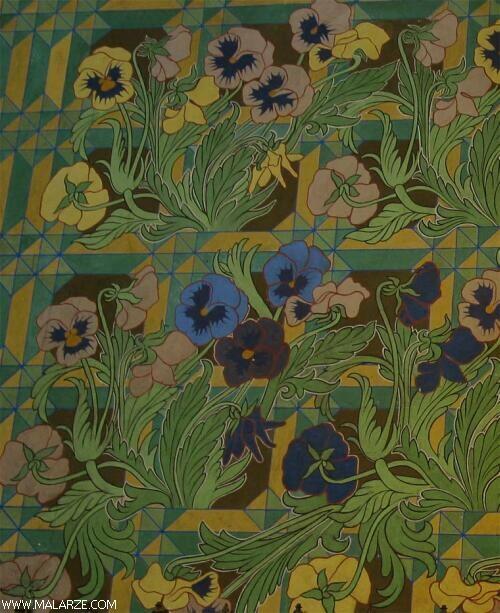
The first visual reference I made was to Wyspianski (1869–1907), likely most recognized as a playwright, whose murals and stained glass flood the Franciscan church in Krakow. It's positively hallucinogenic, enormous flowering vines crawling the pews and walls. I'd hate to attend mass on drugs — it smells of violets everywhere — for fear the sunflowers would bite my head off.

Schulz would not have met Wyspianski, but there's no doubt that he would've been familiar with his work.

Witkacy (1885–1939), an artist of many talents, also perhaps best known as a playwright, promoted Bruno Schulz, befriended him, corresponded with him.

All these artworks preceded the publication of Cinnamon Shops by some dozen or more years, but I see them as part of the same tradition.

Monday, January 29, 2007

Different children

My weekend centred on children: us depositing our child with her grandmother, me lounging in bed Saturday morning to finish reading The Children of Men (PD James), us wandering out later in the day to the cinema to see the film adaptation (and I felt like such a terrorist smuggling in a shawarma and a bottle of water).

I have a fondness for dystopian literature, so even while some call James's novel mediocre, or substandard to her usual genre output, my instinct is to defend the effort.

The premise here: the human race is infertile. (Fertility issues are also central to Margaret Atwood's The Handmaid's Tale, my copy of which inexplicably is nowhere to be found.)

Dystopian novels are not generally revered for their sublime prose. They often come in the form of a travel report from a distant place. They are above all novels of ideas. While some feature wonderfully developed characters, they generally offer us types (the docile, unquestioning citizen; a totalitarian ruler; a heroic, rebel element) fleshed out only enough to make the point and advance the moral of the story.

James's novel is about half and half traditional 3rd-person narration and diary entries, presumably to give us a glimpse into Theo's inner workings. Theo's not exactly likable, but he doesn't have the complexity of character I suspect James intended.

He'd had a child, once, but accidentally ran her over. In the movie, much more sensibly, his boy was victim to a flu pandemic — Theo has a normal, personal, emotional investment in the fate of the planet, not driven by the guilt of extreme and unusual circumstances.

Book: Theo's cousin is omnipotent Warden of England.
Movie: His relation has some not clearly defined position of power in the government (he also has a child).

Book: Theo is drawn into the intrigue by a relative stranger he's attracted to (roll your eyes here).
Movie: Theo's drawn in, much more credibly, by his ex-wife, who has a history of political activism, and the promise of monetary compensation.

Book: Theo needs to be convinced by an inept group of 5 that there are problems under the existing system.
Movie: There is chaos in the streets and known rebel factions. The system is obviously not working very well.

Book: Theo witnesses one of the state-organized mass suicides — some participants seem less than willing. Theo hears of the inhumane conditions of the penal colony form the sister of an escaped (allegedly wrongly convicted) inmate. The group of Five Fishes also demands a general election, rights for the immigrant workers brought to England to combat the labour shortage, and a stop to mandatory fertility testing (because it's degrading and pointless).
Movie: The Fishes are protesting the treatment of immigrants, who are denied full rights, routinely rounded up into refugee camps and deported. It is implied that the rest of the world has gone to hell, possibly the result of war.

Book: As the group travels, they are attacked by an extremely violent gang. The incident is an unfair surprise, the existence of such gangs having been mentioned casually just once.
Movie: The group is attacked, but it makes sense in the context of the unrest everywhere in evidence.

I won't tell you the respective endings.

Wikipedia summarizes the book and the movie.

The novel is flawed but enjoyable. Read it if, like me, you have a fascination with dystopian literature.

The film is astounding. The mood is perfect. The script improves on characters and back stories in ways I hadn't thought possible while reading the book. You don't need a stupid love story. You don't need for Theo to be an Oxford historian, or to have killed his child. You don't need for him personally to take control of the government for resolution.

We did question the logic of the depicted future, but only after we'd left the theatre and thought about it.

Theo's friend Jasper in the book points out some of the pluses of a world without children:

"It doesn't worry me particularly. I'm not saying I hadn't a moment of regret when I first knew Hilda was barren; the genes asserting their atavistic imperatives, I suppose. On the whole I'm glad; you can't mourn for unborn grandchildren when there never was a hope of them. This planet is doomed anyway. Eventually the sun will explode or cool and one small insignificant particle of the universe will disappear with only a tremble. If man is doomed to perish, then universal infertility is as painless a way as any. And there are, after all, personal compensation. For the last sixty years we have sycophantically pandered to the most ignorant, the most criminal and the most selfish section of society. Now for the rest of our lives we're going to be spared the intrusive barbarism of the young, their noise, the pounding, repetitive, computer-produced so-called music, their violence, their egotism disguised as idealism. My God, we might even succeed in getting rid of Christmas, that annual celebration of parental guilt and juvenile greed. I intend that my life shall be comfortable, and, when it no longer is, then I shall wash down my final pill with a bottle of claret."


Problems that stem from the premise, which neither book nor movie adequately addresses:

Is it long enough (book: 25 years; movie: 18) to feel the effects of a labour shortage? The youngest citizens are only just entering the work force; the lack of replacement workers shouldn't be felt for another few years. (The disappearance of child-centred industries would first result in massive unemployment.) If there is indeed a labour shortage (and since people continue to die without being replaced), shouldn't immigrants be welcomed? Any strain on resources by immigrants should just about equal the resources freed up by the unborn numbers. While it's natural to want to protect and preserve resources, given the infertility scenario, it's for a finite period.

I'd have thought one of the biggest and most immediate effects of mass infertility would be sexual violence, combining a lack of fear of consequence with a sense of desperation. The book addresses this: the instinct loses out to disinterest, a sense of pointlessness and depression.

Would the effects be quiet and hidden (book) or massive and obvious (film)?

The book covers some of the side effects of the crisis: for example, how pets are treated like children. It's typical of dystopian novels to include details of fairly mundane goings-on. This is rightly kept out of the film.

Book: Excerpt.
Movie: Official site.

J-F says, not that his opinion counts for anything, that it's one of the best movies he's ever seen, to which I raise my eyebrows. He says, "Yes, better than Pulp Fiction."

Friday, January 26, 2007

Literary boozer

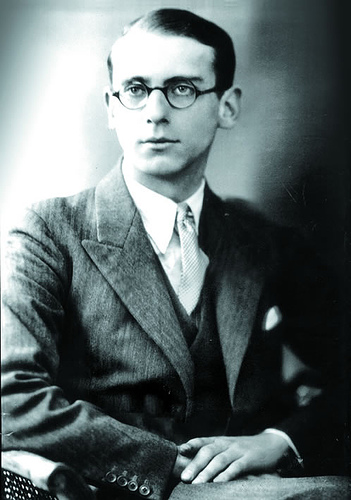
Patrick Hamilton, looking somewhat more proper than I'd imagined, but quite possibly very drunk (from Through a Glass Darkly). His suit's all rumpled, and he's probably just splashed water on his face and freshly slicked his hair and he thinks we can't tell.

Also, there may or may not be an event celebrating Patrick Hamilton on his birthday, March 17.

I've read 4 of his novels now, and must read them all. I've been saving up Twenty Thousand Streets Under the Sky for some of kind of drunken midwinter reading binge I feel coming on (though I've wet my whistle on its opening chapters already); Hangover Square arrived on my doorstep just the other week and should get me through the reading binge hangover. The obsession continues.

Thursday, January 25, 2007

All for one

Helena went to the movies yesterday. With her daycare group. Without me.

She's a little sketchy on the actual story, but was immensely impressed with the theatre itself. "La télé, it's big as the wall. It's big like me! Bigger!"

It'd slipped my mind that this was something of a new experience for her. Previously, she's seen only Chicago on the big screen — she was barely 2 months old and slept through most of it (but I wonder if this has anything to do with her fondness for musicals).

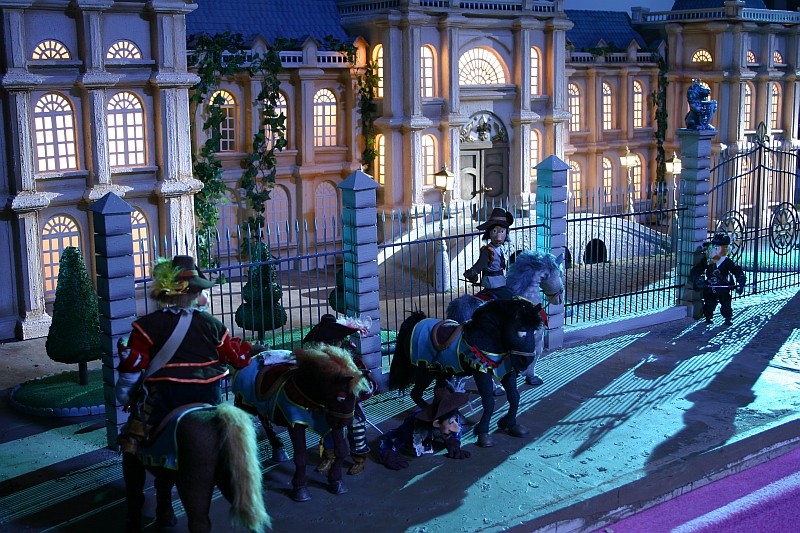
Yesterday's feature was a stop-motion animation of one of my favourites. You're never too young for the classics.


Wednesday, January 24, 2007

Excellent snow

The other evening, I'm sitting by the window, watching the snow fall. I jump up, to find the song, put it on the stereo.

Helena, often witness to my bursts of musical inspiration, doesn't always appreciate my taste. But she perks up at the opening tones. "Wait, Mama."

She comes back with her saxoflute. "Listen. It's the same." She insists I play the song from the beginning. "Wait, Mama."

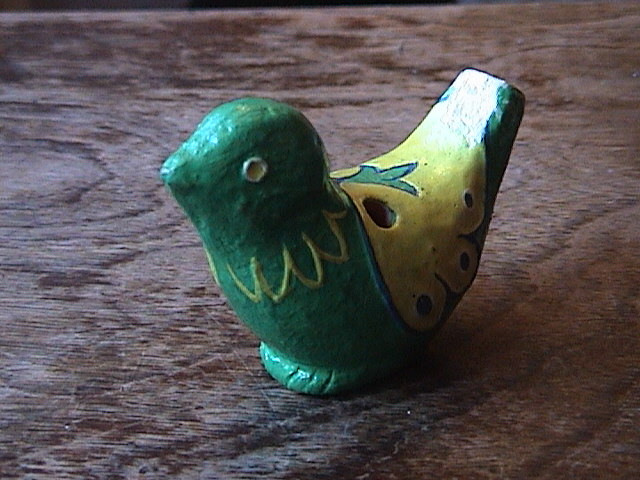
She comes back with her Kyrgyz clay bird ocarina. "This one too — it's the same." She hands it over for me to play.

We start the song from the beginning again. "Wait, Mama."

She rummages through the kitchen cupboards. The old coffee tin with rice grains.

Now we're ready. From the beginning again. We jam.

Excellent birds.

Literature by foot

Ryszard Kapuscinski, died yesterday in Warsaw, age 74.

"There is, I admit, a certain egoism, in what I write," he once said, "always complaining about the heat or the hunger or the pain I feel. But it is terribly important to have what I write authenticated by its being lived. You could call it, I suppose, personal reportage, because the author is always present. I sometimes call it literature by foot."


It's sad that it takes a death to inspire me to finally get around to an author I've been meaning to read for ages.

Monday, January 22, 2007

Thoughts on David Copperfield

(...the novel, by Charles Dickens, not the magician, whom I keep picturing as the protagonist.)

1. It's so optimistic, which is maybe an odd thing to say about a novel in which unpleasant things happen and so many people (in a couple cases perhaps needlessly) die. It was declared when David Copperfield was born by sage women in the neighbourhood that he was destined to be unlucky. This turns out to be not true. Which is maybe the optimistic point: we are makers of our own destiny no matter what circumstance we are born into.

2. Why, why, why does Daisy persist in seeing Steerforth in the most favourable light? When they first meet at school, Steerforth takes advantage of him, and David acquiesces to him. Steerforth has this charismatic hold on people, which we learn about more through the reactions of others than directly. (Dicken is much better at describing ugly than good.) David does tend to see the good in people and their potential and give them the benefit of the doubt, but this goes too far.

3. The women seem so much all the same. Even when they're silly, they're kind and good. And when they've been led astray, they're at heart kind and good. Through crusty exteriors, kind and good. Or they're just kind and good (Agnes is too good to be true; I kept confusing Annie with her). The kvetchy Mrs Gummidge is maintaining a facade; she is, of course, kind and good. Even the mothers of those despicable characters are guided by love for their sons. They are all unwavering constancy and devotion, to something or other. (Miss Dartle is loyal to the object of her love, to her own detriment; Miss Murdstone is loyal to her brother and their principles.) Kind and good, or at least devoted, is not a bad thing for women to be presented as being, but it's a bit boring, even if they are sometimes slightly disguised. Julia is perhaps the only exception, coming back from India shallow and passionless, but her fate is an afterthought and never examined. Betsy Trotwood has more dimensions than the other women, having a mysterious past, a strong will, and seeming independence, but she is, undeniably, kind and good.

4. Uriah Heep is one of the most delicious villains I've ever had the pleasure to encounter — not so much for what he does (plenty others have done far worse), or how he does it, but for his gloriously uncomfortable, writhing physicality. I couldn't turn the pages fast enough to be rid of him.

5. Yes, I'd like some more Dickens, please. I read Tale of Two Cities in high school. I remember having turned all the pages of Bleak House shortly thereafter, but did not retain any of the story. There are other books by other writers I like better. But some people think Dickens is the best. I'm prepared to read more, to better understand why he's considered a master, before pronouncing a verdict.

That's 1 down (750 pages), 5 to go.

Friday, January 19, 2007

Who's worried?

Months ago I came across a trio of Kevin Henkes books, remaindered, cheap. I couldn't decide between them, so I bought them all. Helena was a big fan of Kitten's First Full Moon so I thought she might like Henkes at the next reading level. I worried that she might not, that it might've been smarter to try one out before committing to all 3, but then rationalized that if it came to that, I could easily find them a happy home.

Lilly's Purple Plastic Purse I was certain would be a hit (and this eventually proved to be true).

I worried a little about Lilly's Big Day — how to explain the concept of flower girl, of wedding, of marriage (none of which J-F and I ever have had or will have, excepting, of course, our marriage of minds and goals to build a life together, blah, blah, blah). Helena hasn't questioned these yet, either as pertains to the story or to our life.

I worried mostly about Wemberly Worried. Because, you see, Wemberly worries a lot, about everything, and Helena doesn't seem to worry about anything at all. I worried that the book might instill worry rather than assuage it.

I worried about when to give her the book. When I bought it, Halloween was just around the corner, and Wemberly worries about her costume being just right, about there being too many butterflies, about being the only butterfly. I was worried enough about Helena liking her costume, and that she might actually care what other people think. I worried for nothing, it turns out, but I thought it better to hold the book for her birthday.

But Wemberly worries about her birthday too, that no one would come to her party, that there wouldn't be enough cake.

So finally Helena received all 3 books for Christmas. It doesn't surprise me that Helena prefers Lilly over Wemberly, and pores over Wemberly's illustrations hoping to catch a glimpse of Lilly (she's there). She finds humour in Wemberly's situations, but seems a bit puzzled by her worried condition.

I ask Helena if she ever worries, what she worries about. She sighs deeply. "Yes. I worry about my dolls. And my stickers."

I don't mean to undervalue the worries of Helena's big little life. Worry for her dolls to means motherly worry, her loving, doting care of them, that they're fed, washed, dressed, blanketed. But her stickers? We don't use stickers for rewards here; they're just plain fun.

Now I worry about putting words in her mouth, but she needs prompting. "Do you worry about losing them?" "Yes. I worry about losing my stickers." I suppose this to mean they must be accounted for, affixed as she finds fit.

No worries.

Thursday, January 18, 2007

With a bang and a crunch

That's what a short story's supposed to do, I think. Bang. Crunch.

And short stories are poignant — at least the one's that register on my radar.

Neil Smith is a Random House New Face of Fiction for 2007 (the honour last year was bestowed on Ami McKay, The Birth House). His debut volume, Bang Crunch, collects 9 stories, all of them poignant — not wipe-a-tear,-aww poignant, but hollow punched-gut poignant.

My bias: I'm generally not a big fan of short stories. I like them well enough when I come across them in magazines, but I don't often search out volumes of them of my own accord. What jumped out at me about this book's description was the originality of the scenarios and that several of them seemed to touch on science and medical conditions, so I accepted a review copy.

Here are stories about the aftermath of a school shooting, a store detective and a pair of gloves, a support group for people with benign tumours, a young man who's a model for his artist father, an experimental play in a mentored drama group. They are "an exploration of the human need for connection, however tenuous or absurd, and at whatever cost."

The title story is about a girl with Fred Hoyle syndrome (a fictitious condition, to the best that I can determine), in which the aging process is speeded up and then reverses:

After your guests blow their noses into the hankies that your mum embroiders with the show's name, Through the Ages, they usually apologize for their tears and the blue lady, her skin a denim colour from ingesting colloidal silver, wonders how she can cry when you, Eepie Carpetrod, won't live much beyond your tenth birthday. Your mum argues you're eternal, that your mind and soul will expand forever like the universe, an allusion to the Big Bang theory, which you explained to her over lunch, tomato soup and saltines, but you know what your death will be, your brain collapsing under its own weight, the Big Crunch.


The pace is frenetic, to match Eepie's experience of life, and the second-person narration is weirdly effective in its matter-of-factness (you know, you live, you die).

Of the 9 stories, one I didn't like much at all (too many characters, too fast) and another I thought weak for its first-person narration. On of my favourites ("Jaybird") is also the longest, by a long-shot, at 66 pages, playing to my preference for the meatiness of character you find in novels.

From what I can tell — several of the stories having been previously published in various venues and Smith himself talking about some of them being written after the volume was contracted for publication — the stories were not conceived as a collection. They are not tied together by place or character (though a couple are) or theme.

There are a few common traits though: I'd guess that Smith's interest in science and medicine is a little stronger than your average Joe's, and that Freud might have something to say about his relationship with his mother (mothers are embarrassing, overbearing, absent, or useless — the attitude balances out over the volume, but there were enough negative references for me to notice and wonder).

What they do all have in common is that they're quite depressing. They don't offer much hope beyond a sense of "it's all right," which is, well, all right. Probably better not to devour them in one sitting though, but one at a time, slow but sure, for their full bang crunch.

I look forward to seeing what Smith can do in a novel.

Excerpt: "Isolettes."

Also: "Scrapbook," in Maisonneuve (September 2004) (full access for print subscribers only).

Interview.

Neil Smith will be reading from Bang Crunch on January 30 at Paragraphe Books in Montreal. (I'm going to try to be there.)

Wednesday, January 17, 2007

Open your notebooks

The Guardian book club this month discusses Doris Lessing's The Golden Notebook.

The first column about the novel outlines its structure, the multiple narratives told in separate notebooks.

She finally writes the golden notebook, where she is reconciled to her different stories of herself. "It's been necessary to split myself up, but from now on I shall be using one only."


(This novel affected me deeply, yet I've been unable to write about it. I recognize in myself multiple paths, tangled. They initially seem to veer off in opposite directions, but I can't follow all of them to their logical conclusion, so they come to overlay each other and fold back in. Over the years, I've lost the ability to compartmentalize — I no longer switch hats with ease, but wear them all at the same time. In some ways I think of this blog as my golden notebook, the integration of my fragmentary self.)

John Mullan is discussing The Golden Notebook with Doris Lessing today — how badly do I wish I could be there! — and will be podcast.

Everyone is invited to discuss the novel online. Maybe I'll finally piece together some of my thoughts.

Tuesday, January 16, 2007

Fickle

As an infant, the giraffe (Ginger) was Helena's constant companion. The elephant (Fred) would occasionally substitute. Perhaps she herself now identifies them with her babyhood. Whatever the reason, they've been left behind.

She entered into a string of relationships, a serial monogamist, with occasional one-night stands. One dog, another, a litter of kittens, then the little pink bear.

At age 2 and a half she found Nyo-Nyo, a bigger bear, blue. He'd been given to her shortly after her birth by my mother. He'd been bought originally for another Helena, my grandmother, who'd been ill and wanting a teddybear, but this bear never made it to her bedside. He'd been sitting in my mother's closet for years.

Nyo-Nyo, and his record for longest-lasting love, was usurped by a lion.

His name is Poilly — that is, poil ([pwal]), the French for animal hide, with the English "-y" suffix, for a uniquely franglais name (think "Furry" with a bilingual twist).

He's just a baby. Helena tells me he's a boy lion, just 1 year old. (He is in actuality older than that, and came to us direct from South Africa, courtesy of my sister.)

Certainly Helena's relationship with Poilly is the most intense to date. Partly, I'm sure, this is due to her age — a heightened imagination and capacity for role-playing (or script-writing), or a greater need for transference. The fact that he's a handpuppet enhances these factors — his expressiveness matches hers.

Poilly goes with Helena to daycare more days than not. He eats at the table with us. It goes without saying he shares Helena's bed. He's a constant companion, accompanying us on all sorts of excursions. He flew with us to Washington. He joined us for Christmas at my mother's house.

It surprised me, then, that for that 7-hour car trip, Helena insisted he sit apart from her. She doesn't want to vomit on him, she explained (she has a history of carsickness on these long hauls). She was not sick in the car; Poilly was spared.

But Helena did have a stomach flu the other week, catching us all off guard in the middle of the night. Poilly was an innocent victim, absorbing all her ills.

Poilly was carted away with the first round of blankets and towels. She asked after him — Poilly's having a bath, I said — but soon forgot him. Helena needed her mother's comfort even more than his that night.

She asked for him the following day, exchanged pleasantries with him, and let him be, still preferring her mother's comfort, I thought. But days passed; Poilly, it seems, was abandoned.

She coddled a bunny for a few days.

Sadly, after a proper laundering (sponge-cleaning simply wouldn't do), Poilly's glorious mane had been transformed into a frizzy afro. He looks, well, funny, and I feel sorry for him.

I confronted Helena on the issue. I considered the ickiness factor, and assured her he was thoroughly clean, no need to worry about les microbes. But no, it's his hair, she confessed; he looks funny.

I don't know if my moralizing had an affect — it's not nice to treat your friends that way, I said — or if she's simply getting used to his new look. Poilly's back in her good graces, joining us for supper and various other activities. They're sleeping together again, but I don't think they'll ever be the same.

Monday, January 15, 2007

Bathrooms

Witold Rybczynski on the evolution of the American bathroom, with the good sense to suggest a bookshelf be added.

Where did I go?

I've been putting my houses in order, my ducks in a row, my eggs in their baskets.

After moving into this condo almost 2 years ago, I'm finally getting round to unpacking those last few boxes, which I'd long ago got tired of looking at and shoved in a closet. It would've been smarter, I know, simply to move the boxes from the closet to the curb, seeing as how we've managed to live perfectly comfortably without the contents of those boxes for the last 2 years, but I've opened them and what's done is done, and soon the junk will be properly and permanently disposed of and the instruction manual for the vacuum cleaner will be filed in a suitable location.

Similarly, I've been organizing all the stuff, junk, and crap I'd unpacked in a hurry. For example, all the office supplies are now housed in 1 drawer instead of 3 at opposite ends of the house. And I threw out all the pens that don't work. I can't tell you how relieved this makes me feel.

I've been taking a metaphorical walk in the snow. (I love this phrase. Does anyone outside Canada even use this expression, much less know what it means or where it originates?) I am considering taking a real walk in the real snow later today, as there finally is some, and it looks like it'll stick for good this time (at least for the winter). I've spent a lot of time wanting to be a Swedish librarian.

We're all of us still a little under the weather, but we no longer want to die, a positive side effect of the gastroenteritis outbreak being that I've discovered the virtues of drinking water, something in all my years I'd never really got the hang of till now, and one bottled brand in particular being so divinely refreshing I will never again laugh at people who spend money on what could be got free from their tap.

In addition, I'm suffering from Dickensian bloat. I'm about halfway (well, a solid two-fifths) through David Copperfield, which is delightful, and I can't wait to see what happens next, but there's only so much of it one can ingest in a single sitting before the brain is awhirl, drowning in all those words. (I'm of a mind now to revisit Gormenghast — Peake's Steerpike strikes me as the offspring of Steerforth and Uriah Heep (what I know of them to this point) — but would like to read even more Dickens before I do this.) I'm waiting for something bad to happen. Nothing bad happens to David. I mean, sure, his stepfather's nasty, and him mother as good as forsakes him on his account, and there's off to school, and mother dies, and off to work to fend for one's self, but he gets through it all in a blink. David's charmed, hopelessly optimistic, and naive, and thus far it's served him pretty well. Everybody likes him. Although, being that he is the narrator of his own story, I sense that not all is what it seems. I can't say there's any moral or theme in evidence as yet — my eyes have not been widened on human nature or the human condition — but I'm eating up the melodrama.

All the above combined have resulted in blog-writer's block. That is, I have a lot to say, particularly regarding my darling daughter, but no idea how to say it. The fountain is stopped up, but the water is starting to spray through the cracks. The dam's about to burst. Or something.

Regular posting will resume shortly.

Monday, January 08, 2007

2007, week 1

We spent the weekend each of us in turn playing host to Helena's little viral friends. Ugh. Bleargh. Absolutely wretched company.

The first couple days of 2007, days of anticipation, preparation, and, yes, even work, all crashed on top of me. And so the first week of the new year leaves me tired, sore, confused. I vow to spend today resting and reflecting and fully rehydrating, enjoying not hearing "I'm so very sick" (J-F) and "Can you play with me now, mommy?" (Helena) and "I need water. Can you get me some water? Do you mind going to the store to buy some bottled water?" (J-F) and "I'm really hungry, mommy" (Helena), and enjoying not scrubbing the toilets or changing the cat litter (because somebody had to). I won't even rearrange the living room furniture, which I did yesterday only to distract me from the nausea I'd feel rising when I lay perfectly still.

I finished reading The Red and the Black, before illness struck. The final chapters I find quite unsettling — as to the nature of this thing called love, but also whether Julien deserves any of what others feel toward him. I definitely read this book as a romance, an exploration of Love, more so than as an individual's self-discovery (which is what I for some reason expected) or as a sociopolitical commentary (a grasp of the history and politics helps make sense of the characters and their actions but by no means is central). I'm looking forward to comparing notes with anyone else who's finishing it up. I'll be dipping into my French copy, replete with essays and commentary, for further insight.

I'd wanted to say a little something about The West Pier, by Patrick Hamilton, but the inspiration has left me. It's quotable, and funny, and really insightful all over every single page, but you really kinda had to be there. I think I prefer the sequel, The Charmer, to this one as a study of character (they both can stand alone, though they are the first 2 parts of a trilogy). Gorse in his early, Brighton years is really much nastier, although maybe I say that because I know what he evolves into. The West Pier characters, as multifaceted as any of Hamilton's others, are more plainly put — that is, his mean streak and her naivete, et cetera, are clearly spelled out. Part of the great satisfaction I felt in reading The West Pier came from having my reading of Gorse's later character and motivations in The Charmer absolutely confirmed — what he does he does only to see that he can.

I am almost convinced to allot a portion of gift certificates received to the acquisition of the Masterpiece Theater dramatization, that is, on something I would never buy for myself, rather than bargain hunting to maximize returns as is in my usual cheapskate nature. Almost.

One week of the year down, and I have read one entire book. (Never mind that it's mostly pictures.) Pyongyang: A Journey in North Korea, by Guy Delisle, is a graphic novel documenting the 2 months the author spent there working for a French film animation company. I know next to nothing about North Korea, and can't really say I care to actively pursue knowing more. But this book's really engaging, helped no doubt by using Orwell's 1984, something I am familiar with, as a touchstone. The art is simple and gray, which goes a long way in depicting the mundane absurdities Delisle faced. There's not much by way of plot or serious sociopolitical analysis. But it's kind of funny. And it makes you think...


So. One week, one book. And it's a translation.

It seems a lot of people are challenging themselves to read literature in translation. I'd never really considered making that a goal in itself, as I've always tended to have an interest in foreign, particularly European, novels. But, since everybody else is doing it (oh, good grief, do I have to?), I had to look at the numbers (I'm weak, I had to, a part of me really wanted to know): in 2006 a solid 25% of the books I read were translations (that is, exactly 12 of a piddly 48 — I know! I'm such a slacker! How do people read more than that? I mean, unless it's your job to read, or you ride a lot of public transportation. Seriously. I mean, I have my nose in a book every spare second I have, if I'm not, umm, blogging. I don't even watch much tv, except for Doctor Who, and there's a whole 'nother effing week before we pick up again where last we left off at the beginning of December with the Beast rising from the Pit and I can tell you not watching Doctor Who has not significantly increased my spare reading time, in fact, not at all, as the time has merely been replaced with fielding Helena's questions "Is Doctor Who on tonight?" "When can we watch Doctor Who?" "Can we watch Doctor Who tomorrow?" "Why is there no Doctor Who?" I may not be the fastest reader in the West, but I'm not slow — I know I'm not slow — and surely I'm not the only person in le bloguemonde who has a small child to care for and play with and a significant other upon which to lavish affection and boring stories and who has paying work to do and an abode that requires occasional upkeep. I just don't get it. How do you read more?) In the foreseeable future I have books originally written in Polish, French, Russian, and Spanish lined up. I'd like to read another Pamuk book this year. And I have it in mind to read the entire oeuvre of Stanislaw Lem, maybe even in the original, depending how my little exercise on this Schulz thing works out (Why is it commonly known as The Street of Crocodiles, as opposed to its originally translated and accurate title, The Cinnamon Shops? The answer to this question has thus far proven elusive and is driving me nuts!) I won't be reading Calvino anytime soon, because I think I've already read everything he's ever written, I named my bloody cat Calvino (how pretentious was I 11 years ago?), I call his name every single day. I suppose I could challenge myself to read foreign, non-European literature, but that just doesn't interest me much. I am, however, proud to say that 100% of the books I've finished in 2007 were in translation.

But hey. More than 2 years ago I promised to read more of some dead white guy, so last night I went to bed with David Copperfield and had a very hard time putting it down (I read 9.6% of it), which is maybe why I'm so cranky today, not having slept enough and still itching to know what happens next.

This early bit in particular struck a chord with me, because having watched — dare I say "studied"? — the development of a human throughout her first 4 years, I'm certain it's true:

This may be fancy, though I think the memory of most of us can go farther back into such times than many of us suppose; just as I believe the power of observation in numbers of very young children to be quite wonderful for its closeness and accuracy. Indeed, I think that most grown men who are remarkable in this respect, may with greater propriety be said not to have lost the faculty, than to have acquired it; the rather, as I generally observe such men to retain a certain freshness, and gentleness, and capacity of being pleased, which are also an inheritance they have preserved from their childhood.


(And Happy Birthday, Ivonna! I think you should document your Birthday in Bishkek as a graphic novel.)

Friday, January 05, 2007

How everything, at the end of the day, was made right, only to go all to hell again — a different kind of hell — in a deluge of vomit

When I saw the booklight bookmark, I had to buy it. As an add-on, a stocking stuffer. For my sister, I thought. But I somehow sensed it was less than perfect. It wasn't really her. But it wasn't really me either. But I had to have it. For someone. So I bought it, took it home, tested it, bent it this way and that, slid it into a book, propped it up on the desk. Pretty cool. For my sister. Then she opened it, and was less than enthused. Then she turned it on, and it flashed bright for an instant, then nothing. So the next day I went in search of batteries, and I found batteries, at a price that surpassed the cost of the booklight. But I had to make good on the gift, so I bought them. I replaced the batteries, but the booklight still would not work. I apologized and took it home with me. I returned the booklight to the shop around the corner, without fuss. I'd considered replacing it with a functioning model and calling it my own, but there were none in stock. I own a booklight already anyway. But it galled me to own expensive batteries for which I had no potential purpose.

For Christmas, I gave my brother the DVD he'd specifically requested. He opened it and was less than enthused. He'd bought it for himself, assumed I'd never have remembered the title anyway. "I hope you kept the receipt." I was certain I had. On returning home and unpacking, it was one of the first orders of business to match receipts to unwanted merchandise. I found receipts for tree ornaments and postage stamps and every gift I'd purchased but this one. Could it be I'd sorted the receipts into essentials and discards and thrown out the wrong pile? Or had I defied my instinct — it's not a chain store so carrying the receipt with me is pointless, but I should keep it just in case, but he specifically asked for it, but maybe I got the title wrong, but I'm sure he specifically asked for this one, but he's been known to not adhere to expected behaviour, I'll bet he bought it for himself, but he specifically asked for it — and put it in the wrong pile? After fully unpacking and tidying and dismantling the pitiful decorations and storing the wrapping accoutrements and triple-checking 2 purses and 2 usual receipt-storing places and a couple other spots where it just might've, but wouldn't've, been mixed up with bills, correspondence, and to-do lists, I bucked up to take it back to the store anyway, receiptless, knowing no future credit card statement would back me up, having the distinct recollection of having paid cash and not even accepting a bag, having come to the end of my shopping excursion that day and having surpassed my fair quotient of amassing redundant plastic, my biggest fear being that it wasn't properly demagnetized and I'd set off the sensors on my way in, and they'd find it bagless, receiptless, stuffed in my messenger bag, and accuse me on the spot of shoplifting and relieve me of it with nothing in return but gross embarrassment. But the cashier told me I could exchange it, so I took a few minutes to find a suitable replacement, and the second cashier raised his eyebrows at my explanation in faltering French, and moved slowly, excruciatingly slowly, but after throughly assessing my character (which I fear emits a vibe that should others rely on their instinct to assess it, they would arrive at the wrong conclusion) told me "we don't usually do this," because I was receiptless, after all, and allowed me to pay the difference and walk out of the store with a different movie in my messenger bag (a different kind of embarrassment), neither plastic-bagged nor difference-receipted, because, you understand, I hadn't supplied any evidence beyond that which my character wordlessly spoke of. So I called my brother to make sure he hadn't by chance picked up this movie for himself since last we spoke, and he hadn't.

The mattress would be delivered the following afternoon. A screw on the bedframe needs tightening. May as well clean behind, under, around. Make way for the new.

I find my old booklight, the one Helena likes to "camp" with so now emits the feeblest glow. The light is not a masterpiece of design, but it's functional (well, when it's functioning) and Helena appreciates it in ways beyond my capacity. My expensive batteries have a meaningful new home, a bright future.

I thread an extension cord behind some bedroom furniture, meaning to finally move that lamp. In retrieving that lamp from the other room, fumbling behind the shelves by the desk, I find a small slip of paper, the receipt for the movie my brother specifically asked for. The movies is no longer in my possession, the receipt is useless, so I throw it away. But my faith is restored in my memory, in my feeling of certainty. I knew I had it.

The bedside tables are straightened up. Casually strewn in J-F's drawer is Le rouge et le noir, the copy he took with him when he was away on business in November, and was certain he'd lost, forgotten at the hotel, and was afraid to tell me so for weeks. The reason I've failed to make good on my promise to read it in French. I want to start reading the French now more than ever.

I go to bed really happy, reassured by the cosmic order of things restored.

In the morning I'll have to strip the bed, fold up the futon, make sure the passage is clear for the delivery men.

Helena climbs into our bed. It's 1:00 in the morning. She tosses and turns. I'm losing patience. She throws up. I strip the bed. She throws up again. J-F decides to sleep elsewhere. I do laundry. Helena throws up 5, 6 times in 4 hours. Laundry now includes an excessive number of towels and nightshirts and a lion handpuppet. The bedspread and pillows at least will be cleaner than I meant to bother with, which is just as well. A new bed.

Helena stays home in the morning. I have an article to edit. I breakfast on cappuccino; I'm grateful that she has no appetite. Laundry migrates from the to-do pile to the to-fold pile, and the smell of stale vomit gradually disappears.

The delivery men arrive in the final half hour of their 6-hour delivery window.

The bed is big, so big. Just the mattress. A very thick mattress. It looks wrong. We'll have to lower the supports within the wood frame. It's too high. I like sleeping low to the ground: I feel grounded. High is for princesses, with elaborate cushions. High is a stage, or a man-made island. It makes me feel anxious and exposed.

I should be in bed right now, but I miss the futon. I like sleeping low to the ground.

Tuesday, January 02, 2007

Old, new

I've had next to no time for reading. While I didn't manage to finish up my work to my satisfaction before the holiday, I did deliver it before people were at their desks this morning. And I am, however, well over halfway through the Globe and Mail's annual Christmas crossword puzzle (1193 clues).

I did manage to finish The West Pier, by Patrick Hamilton, while away, hiding in my mother's bathroom.

I have renewed enthusiasm for The Red and the Black. I'd've finished by now if it weren't for having to work, or that crossword puzzle lying around.

Received for Christmas:

Moral Disorder, by Margaret Atwood. You know, Atwood. This will be the mortar, or grout, between all the bricks I intend to read over the next few months. Or perhaps a spindly yet strong scaffolding. Or something.

Against the Day, by Thomas Pynchon, which scares me a little. I've never read Pynchon — is it OK to start here? It's this one that actually calls to me, having been released on my birthday, having an epigraph from Thelonius Monk, and featuring the Tunguska Event (which gets discussed in this household more often than in most, I'll bet).

Pyongyang: A Journey in North Korea, by Guy Delisle, which I've never heard of. A graphic novel. Which I'm starting to read right now. Hah! — he takes 1984 with him.

Monday, January 01, 2007

What are you optimistic about?

The Edge Annual Question — 2007: What are you optimistic about?

At the World Question Center, 158 contributors give answers that encompass the open-ended long term and specifically short term, the disappointingly hopelessly naive (Steven Pinker: "the decline of violence"; John Horgan: "war will end") and the contradictory (Richard Dawkins: that physicists will discover the theory of everything; Frank Wilczek: that "physics will not achieve a theory of everything")

Weird and wonderful optimism! On the advantages of autism in a digital age (Simon Baron-Cohen), for the colonization of Mars (Paul Davies), and "that alternative, novel life forms might be found on our own planet" (Robert Shapiro).

Alison Gopnik's deceptively trite answer — "new children will be born" — is quite rich and wise really:
Optimism, after all, isn't essentially a matter of the rational assessment of the future — it's an attitude rather than a judgment. And it's the most characteristically human attitude, the one that's built into our DNA. The greatest human evolutionary advantage is our innate ability to imagine better alternatives to the current world — possible universes that could exist in the future — and to figure out how to make them real. It's the ability we see in its earliest form in the fantastic pretend play of even the youngest children.


I am optimistic that, someday soon, I will discover My Purpose (as well as the theory of everything).