Yes, as a matter of fact I am reading The Red and the Black, and so are a lot of other people. If you are one of those people, or want to be one of those people, and you haven't bothered to look over there, assuming nothing would be going on over there, I did indeed post a schedule last week (take a look). Discussion on the first section opens November 6.
So get reading!
(What follows is not about the book — it's about reading the book in French; ie, there are no spoilers here.)
I have already read chapters 1 through 6 (those up for discussion first), and have shown admirable restraint in not reading further (really, if you could see me, you'd admire my restraint) and am exercising a great deal of discipline (and it really needs the exercise) to stick to the schedule, intending to read no more than the required reading for the week, even as I'm dying to know what happens next, because: 1. if I get too far ahead with reading, it's much harder to discuss what happened that many more pages beforehand; 2. a lot of people seem to be pretty good at, and enjoy, reading more than one thing at a time, and I think there must be some kind of trick to it that I haven't yet figured out and maybe it's time I did, even if it doesn't feel natural to me (if only for the sake of being able to hold a proper discussion on a book with people who don't read the way I do).
I did get an early start. Helena is to blame, having asked me one recent night for a French bedtime story. I had such a very hard time moving my mouth around the words — I sounded like one of those people who don't know how to read aloud! — and was struggling to figure out what was going on, and even though on some level I know my French to be better than was evidenced that evening (an unlucky performance — tired, distracted, simply not "on"), I shuddered to think I'd committed to reading Stendhal in French (No, there's no going back on this, dammit. Because I say so.).
So, with heavy heart and low expectations I picked up the French text. Maybe I could manage a page a day. I'd need a headstart if I wanted to participate in the discussion I'd scheduled. (Or maybe I'd have to revise the schedule.)
And I started reading. Aloud. Mistake, I soon realized. Not only were people (and the cat) retreating from me (the look in their eyes triangulating the intersection of utter boredom, disbelief, and fear), I wasn't understanding a thing, spending more time on making the sounds than deciphering their meaning.
So eventually I shut up. And I read silently to myself. I thought about hauling myself out of my comfy spot to grab the English edition and/or a dictionary or two, but inertia prevailed. So I skipped a bunch of words. But all of a sudden it started making sense.
I read all 6 chapters in French, and had some sense of the story. Then I read them in English, and my sense was somewhat fleshed out. While scholars turn to the original language for nuance of character in dialogue and descriptions, subtleties of intended meaning, I'm, for the meantime, the opposite, relying on the translator to alert me to those distinctions.
So, I'm finding my bilingual rhythm. I'm afraid if I read the English first, the French reading will be an afterthought, the mere scanning and flipping of pages. By reading the French first, I'm actually challenging myself to understand, and maybe learn something about the language along the way. I thought I might read a chapter at a time, but, in this portion of the book anyway, the chapters are too short for this to be viable; it takes at least the length of a chapter for me to feel the flow, and once the flow is felt, I want to know what happens next, without breaking from and "rereading" the story.
So far, so good. I can do this! I may have to set aside — schedule! — Stendhal nights, as this will take blocks of time; my usual method of cramming-in-whatever-reading-I-can-at-any-spare-moment is not going to work.
But I can read in French! Yay me!
Thursday, October 26, 2006

Tuesday, October 24, 2006
Ghost
Helena by mid-August had announced she wanted to be a ghost for Halloween. How lame, I thought — what's more cliché than a ghost at Halloween. We offered her some alternative, more exciting suggestions: pirate, dragon, spider. Silly, she says. Two months later, she has not wavered from her initial choice. Ghost it is.
Partly, I was relieved. Easy, I thought. Just throw a white sheet over her.
But I've given it some more careful consideration. I realize that throwing a sheet over a small child, no matter how effective as a costume, if it wouldn't actually cause some serious mishap due to impaired vision, tripping, or snagging, would nevertheless be frowned upon, not necessarily on our trick-or-treating stroll through the neighbourhood, but certainly by daycare administrators, for the aforementioned reasons of safety, and by the parents of her daycare peers, my efforts likely eliciting a string of criticisms regarding parental laziness in the creative costuming department.
Besides, I don't have any white sheets. Well, one set, but they're textured in a subtle stripey fashion, a 300 thread count, and they were expensive.
Easy. I'll buy a ghost costume, I thought. I searched high, and I searched low, but nary a ghost costume to be found. And really, why would manufacturers bother producing such a cliché thing when it's as simple as throwing a sheet over one's head?
Well, I was prepared to buy a costume, I may as well spend the money on a white sheet instead. Easy! Alas, not so. I searched the same and other places, high and low. And I found white sheets all right — very expensive high-thread-count white sheets. (Will "cheap" always mean "ugly floral"? Are ghosts really white?)
(Why? Why? couldn't she want to be something actually easy, like princess or WWI flying ace?)
So, I went to the fabric store and bought some fabric. Cheap. Then I went to the dollar store, to see about a mask, or make-up, or something. I now have the materials of most-excellent-ghost-costume-ever at the ready. I even have an idea of how to go about it. And I have less than a week to do it.
I have on hand also one very excited little ghost girl. (Excitement in part owing to excessive sugar intake in effort to deplete last year's Halloween candy stash before a new one is generated. My rationing calculations were a little off.)
And it seems ghost is a pretty unique Halloween costume concept after all.
Partly, I was relieved. Easy, I thought. Just throw a white sheet over her.
But I've given it some more careful consideration. I realize that throwing a sheet over a small child, no matter how effective as a costume, if it wouldn't actually cause some serious mishap due to impaired vision, tripping, or snagging, would nevertheless be frowned upon, not necessarily on our trick-or-treating stroll through the neighbourhood, but certainly by daycare administrators, for the aforementioned reasons of safety, and by the parents of her daycare peers, my efforts likely eliciting a string of criticisms regarding parental laziness in the creative costuming department.
Besides, I don't have any white sheets. Well, one set, but they're textured in a subtle stripey fashion, a 300 thread count, and they were expensive.
Easy. I'll buy a ghost costume, I thought. I searched high, and I searched low, but nary a ghost costume to be found. And really, why would manufacturers bother producing such a cliché thing when it's as simple as throwing a sheet over one's head?
Well, I was prepared to buy a costume, I may as well spend the money on a white sheet instead. Easy! Alas, not so. I searched the same and other places, high and low. And I found white sheets all right — very expensive high-thread-count white sheets. (Will "cheap" always mean "ugly floral"? Are ghosts really white?)
(Why? Why? couldn't she want to be something actually easy, like princess or WWI flying ace?)
So, I went to the fabric store and bought some fabric. Cheap. Then I went to the dollar store, to see about a mask, or make-up, or something. I now have the materials of most-excellent-ghost-costume-ever at the ready. I even have an idea of how to go about it. And I have less than a week to do it.
I have on hand also one very excited little ghost girl. (Excitement in part owing to excessive sugar intake in effort to deplete last year's Halloween candy stash before a new one is generated. My rationing calculations were a little off.)
And it seems ghost is a pretty unique Halloween costume concept after all.
Monday, October 23, 2006
Got her tongue
Supper finished, the table not yet cleared, Helena starts making faces. We all start making faces. She sticks out her tongue and I reach over to grab it, graze it with my fingertips. She accuses me of taking her tongue. I confess and flash her the side of my thumb. Helena comes round to get a closer look. J-F asks me to pass him the imaginary piece of tongue. I do, and he carries it away. Helena follows him. She follows him into the bathroom. J-F flushes the imaginary piece of tongue down the toilet. Helena is in hysterics, sobbing and screaming at her father.
I'm crying of laughter. (Shame on me.)
It takes a long time to console Helena. She won't speak to her father. She comes running to me for a hug. I confess that I hadn't really passed her tongue to J-F. I reach into my pocket, raise my closed, empty hand, and gently part her lips. Helena sighs with relief.
I'm crying of laughter. (Shame on me.)
It takes a long time to console Helena. She won't speak to her father. She comes running to me for a hug. I confess that I hadn't really passed her tongue to J-F. I reach into my pocket, raise my closed, empty hand, and gently part her lips. Helena sighs with relief.
Friday, October 20, 2006
Drama unleashed
Because I won't give her any candy. Because she didn't finish her soup, as we'd agreed this condition must be satisfied. "Mais, maman! Tu m'a brisé le coeur!" ("But, mom! You're breaking my heart!")
Helena's been home most of the week with cough and fever. She misses her friends.
If I didn't catch cold from Helena, I caught one out in the rain today, my umbrella pretty useless against sprays of water the wind propels at me on an angle, and useless against unavoidable puddles I step into up to my ankles. The massive raindrops turn white and flat, then melt back again. Today is heavy and wet.
Helena's been home most of the week with cough and fever. She misses her friends.
If I didn't catch cold from Helena, I caught one out in the rain today, my umbrella pretty useless against sprays of water the wind propels at me on an angle, and useless against unavoidable puddles I step into up to my ankles. The massive raindrops turn white and flat, then melt back again. Today is heavy and wet.
Wednesday, October 18, 2006
The Dodecahedron, in brief
It's been months since I read The Dodecahedron, or A Frame for Frames: A Novel of Sorts, by Paul Glennon. I've started writing about it a number of times, but I've had a heck of a time of it (obviously). However, seeing as it's been nominated for a Governor General's award for fiction, I feel compelled now to tell you how awesome it is.
Most years I'd be calling this book "the best book I've read this year," certainly the most interesting and most ambitious. It just so happens that I read it this spring, sandwiched between Eliot's Middlemarch and Pamuk's Snow, and it's a little small by comparison. But still rather beautiful.
I have a sick little girl on my hands today, so you'll have to check back later for more coherent thoughts and links, to see what I've made of my months'-old notes. In the meantime, I give you an excerpt:
12 reasons to read The Dodecahedron:
1. Support Canadian small press.
2. It's as much a puzzle as it is book (yes, that's a good thing).
3. One word: bibliophagia.
4. Vatican conspiracies.
5. Messages in bottles.
6. Polygamists.
7. Genies.
8. Golem myths.
9. Electronic plot device.
10. A scriptorium (on an island in the middle of nowhere).
11. The paper quality is thick, creamy, lightly rippled — good enough to eat.
12. You can read it more than once and hear it tell a different story each time.
Most years I'd be calling this book "the best book I've read this year," certainly the most interesting and most ambitious. It just so happens that I read it this spring, sandwiched between Eliot's Middlemarch and Pamuk's Snow, and it's a little small by comparison. But still rather beautiful.
I have a sick little girl on my hands today, so you'll have to check back later for more coherent thoughts and links, to see what I've made of my months'-old notes. In the meantime, I give you an excerpt:
I chose the second book, because it looked difficult and father always told me to never put off doing what's difficult. Its cover is soft brown suede and it doesn't have a title anywhere. It is not a regular book, set and printed with even letters. It looks hand-written, but very neatly with thick black ink, and there were lots of drawings. The author doesn't even write out his whole name, just his initials, A.T. and the words vere adeptus which I know means 'very clever'. I suppose A.T. is very clever because I don't really understand anything in his book. Sometimes I think that it is about the planets, because it talks about Mercury and Venus and Mars and Jupiter, but these are also the names of the old gods and sometimes it does sound like the book is talking about people. The pictures don't even help. There are just lots of circles with arrows and lines. Sometimes I skip ahead to other sections. There are four sections, and they are called 'Panacea', 'The Philosopher's Stone', 'Alkahest' and 'The Elixir of Life'. These don't make me think of planets or old mythology. I must work harder at understanding this tonight.
It has taken many hours in the library with the funny brown book, but I think I understand something about it now, not all of it, just a little bit. I stayed up late in the library and reread the sections that were especially mysterious. It came to me in my sleep. I dreamed that all the little diagrams in the book came to life. Rows of circles moved across the page towards other circles, or triangles or whatever other shapes, and then they fought. When one side won, they swallowed up the other shapes and changed their own shape just a little, like when a king conquers a country and adds that country's coat of arms to his own. When I woke up I knew that the diagrams were battle maps, and then I looked through for the names of generals and kings. I found lots of people called Magus, which means great, which is a thing a lot of kings have after their names, and there is somebody called Bombastus, who seems to be a great general, so that must be it. It is a book about a great war.
The brown book gave me a new idea about my father's mission. I don't know if these generals are from the coutries here in the known world or from the land beyond the wetern sea. Maybe there is going to be a war about this land. Maybe we are going to be invaded. I don't know who is fighting whom, but I know that my father is on the good side. Maybe he is a spy working for the good army and we live in a country ruled by an evil tyrant or usurper. This wouldn't surprise me at all, now that I have see the captain and his two guards.
I didn't eat this book right away. There is something about it that makes me not want to destroy it. Mabye it is because it is written by hand. It might be the only copy of the book in the world. I can imagine a person writing it out. It must have take a very long time to do. I feel awful about destroying it, even thought I know that it isn't truly gone as long as I eat the words rather than burning them, but it is still all very mysterious, these symbols and king's names. You shouldn't eat a book until you really understand it. I have put this book back in the locked cabinet. If I have to, I will eat it last.
12 reasons to read The Dodecahedron:
1. Support Canadian small press.
2. It's as much a puzzle as it is book (yes, that's a good thing).
3. One word: bibliophagia.
4. Vatican conspiracies.
5. Messages in bottles.
6. Polygamists.
7. Genies.
8. Golem myths.
9. Electronic plot device.
10. A scriptorium (on an island in the middle of nowhere).
11. The paper quality is thick, creamy, lightly rippled — good enough to eat.
12. You can read it more than once and hear it tell a different story each time.
Tuesday, October 17, 2006
My Gorey death
What horrible Edward Gorey Death will you die?

You will swallow some tacks. You are a little weird, maybe not so much in a good way. Buy a yellow tie and wear it on your head.
Take this quiz!
The horrors of Dumas, and others
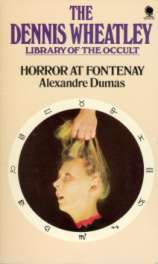 Horror at Fontenay, by Alexandre Dumas.
Let me start with the double horror of the cover — the grotesquerie it depicts and then the travesty of design (let's just say it belongs to another era).
Then there's the horror of the smell of my second-hand (quite probably eighth- or twenty-third-hand) copy, ferociously tickling my sinuses every time I opened it.
The horror of the translation: it's translated and adapted by Alan Hull Watson (who has also translated De Sade and Huysmans). In his introductory notes he states that "considerable revision and re-writing, some elimination and some expansion were essential, together with paraphrase rather than translation, more or less throughout," on the assumption that Dumas dashed off these pieces, for whatever reason, without careful thought. Watson took it upon himself to add details to "improve characterization" and "heighten atmosphere," while eliminating unnecessarily wordy descriptions. Hmmm.
The horror of the ending: well, it's not Dumas's ending, it's Watson's. Whatever cuts and additions Watson made throughout the story, as much as the idea of them makes me cringe, they aren't noticeable. The ending, however, is both a little far-fetched and too neat, needlessly. From what little else I've read of Dumas, I don't think he was troubled by having to have all the little loose ends tied up; seemingly important events or objects might remain forgotten, and some characters' secrets remain secret. So Watson's end didn't feel genuine.
But the horrors within this slim volume are delightful. The book starts with a man presenting himself at the mayor's house, confessing to the murder of his wife. He claims the severed head of his wife spoke to him and bit him. After the scene of the crime is investigated and testimony taken, the mayor invites many of the witnesses (of the confession) to his home for dinner, the main topic of conversation being the events of the day and whether the murderer's tale is to be believed.
Dumas himself is a guest at the mayor's dinner party (as is an allegedly almost 300-year-old man), so the stories have a stamp of validity, as if to say these things really happened to a friend of a friend of mine... (a fairly standard technique these days, but effectively engaging nontheless).
All the stories bear the mark of Dumas. A bit melodramatic perhaps, but heart-wrenching:
Words cannot describe my feelings during the next few moments, for hardly had my hand reached down to grab a head than I felt my fingers being pressed by lips which still retained something of the warmth of life in them.
The only way I can express it is by saying that I experienced such an access of terror that the sheer intensity of my fear somehow restored my courage. I removed my fingers from their proximity to the lips, seized the head by the hair, and going back to my chair, stood it on the table in front of me.
As I looked I was petrified as a man turned to stone. The lips seemed still warm and living, the eyes were half open, and the head — the head was that of Solange!
I thought I must be insane, and I remember, shouting over and over again: "Solange! Solange! Solange!" Then the eyes opened wide, and, looking at me, seemed to light up for an infinitesimal part of a second, while two large tears trickled slowly down the cheeks. Then they closed once more, never to open again in this life.
Love and honour, and revenge and justice on these counts, are not terminated by mere death. The sense of chivalric duty is strong. Guillotined heads, hanged men, the desecration of the Royal Tombs. There's even a vampire story (which predates Dracula).
The stories were published in 1849. While there's nothing startlingly horrific here, nothing new, it's interesting to note that the conventions of the genre were only just being established.
These stories were intended as the introduction to a much larger collection, for which Dumas supplied the general title of "Les mille et un fantômes," but it seems he abandoned the project. Too bad, cuz this book's a gem.
Some reviews and background.
French text of Les mille et un fantômes.
Dumas was keenly interested in the question of whether a guillotined person suffered pain after being beheaded. It seems a number of his characters are interested in "the occult sciences." Alchemy and mesmerism figure in his tales. He wrote a play about a vampire and is credited with having written one of the first modern werewolf stories.
Must. Read. More. Dumas.
The horrors of Friday the 13th
- J-F's mom wants Helena's company for the weekend. On announcing the plans to Helena, she has a fit of hysterics. (After a couple hours, she does come round to the idea.)
- I do not procure a copy of Lemony Snicket's The End.
- Traffic en route to J-F's mom's place is hellish. (Not really an effect of the curse of the day, but the first time I've experienced it since a bridge collapsed along our usual route.)
- J-F tries to buy cigarettes, but the dépanneur has had its license suspended. (Not a bad thing in the grand scheme of things, but the minutes between J-F deciding he wants a cigarette and eventually actually having one are decidedly unpleasant.)
- Upon deciding tonight's the night we're going to try the pizza from the place down the street (four and a half years in this city, and we've yet to find a pizza joint we're willing to call our regular), we arrive to the news that their oven is broken. (We settle for the sub-par pizza from across the street.)
- Arriving home, we crack open a 12-pack to find it contains only 11 beers. (I haven't gotten over this yet.)
- Inexplicably, we have no trouble finding a copy of Art School Confidential to rent. (Not a bad thing — a very good thing, in fact — but surely a supernatural intervention, even if benevolent compensation for all the other horrors of the day.)
Things that went right this weekend: child-free evening, with pizza, beer and cigarettes, and a movie.
Helena returns home from her grandmother's with a nasty cough and fever and stays home from daycare yesterday. Her sweetness in her vulnerable state is overwhelming, even if fever does cause her to be a bit (more) temperamental (than usual). Again this week she insists on cuddling on my lap to watch Doctor Who, and again I worry what trauma watching the program may inflict on her. First thing on waking she tells me what fun it was watching Doctor Who with me, how the wolf became moonlight. She insists on going to daycare this morning, but explains that if she's coughing a lot she'll ask the éducateur to phone us to pick her up. She's being very together.
Monday, October 16, 2006
Friday, October 13, 2006
Manguel's library
"In any of the pages of any of my books may lie a perfect account of my own secret experience of the world."
The Library at Night, by Alberto Manguel.
Review:
October 15–21, 2006, is Semaine des bibliothèques publiques, coinciding with library week in several other provinces, all part of Canadian Library Month.
The Library at Night, by Alberto Manguel.
Review:
At its heart, it is a meditation on knowledge and memory, on the links between the two, on the limits of each. For Manguel, the library is the "emblem of man's power to act through thought." More even than that, it is a "monument intended to defeat death, which, as poets tell us, puts an end to memory."
[...]As in The History [of Reading], the narrative is deftly leavened with literary anecdotes. There is the Czech librarian who runs after the retreating German army, insisting that they return the books they have borrowed. There are the secret libraries of the inmates of Auschwitz and Bergen-Belsen. There are the Colombian peasants who refuse to return their copy of The Iliad: "They explained that Homer's story exactly reflected their own: It told of a war-torn country in which mad gods willfully decide the fate of humans who never know exactly what the fighting is about, or when they will be killed." There is the librarian Mrs. Calloway, the terror of Eudora Welty's childhood. "You could take out two books at a time and two books only," Welty remembered. "This applied as long as you were a child and also for the rest of your life."

October 15–21, 2006, is Semaine des bibliothèques publiques, coinciding with library week in several other provinces, all part of Canadian Library Month.
Thursday, October 12, 2006
My father's moustache
Speaking of moustaches...
My father wore a moustache all his life, certainly I never knew him without one.
Legend has it that he lost it once in a poker game. It's the only time my mother saw him without one, and it didn't take long for his look to be reestablished. (I don't know if my siblings existed yet, but I imagine they'd have been too young to remember.)
I have one photo of him sans moustache, age 17, but I don't see the resemblance. It was taken by an army buddy, inscribed and dated on the back so I know it to be him, but he looks a stranger. Indeed, it troubles me to look at it.
There are a few other pictures from his youth — but he was sufficiently angled, the photos grainy and shadowed... The effect is such as if the moustache were there.
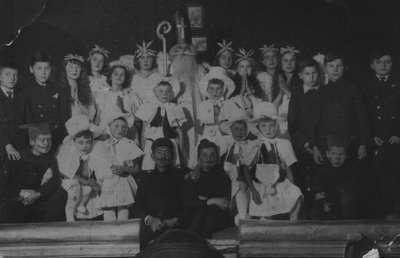
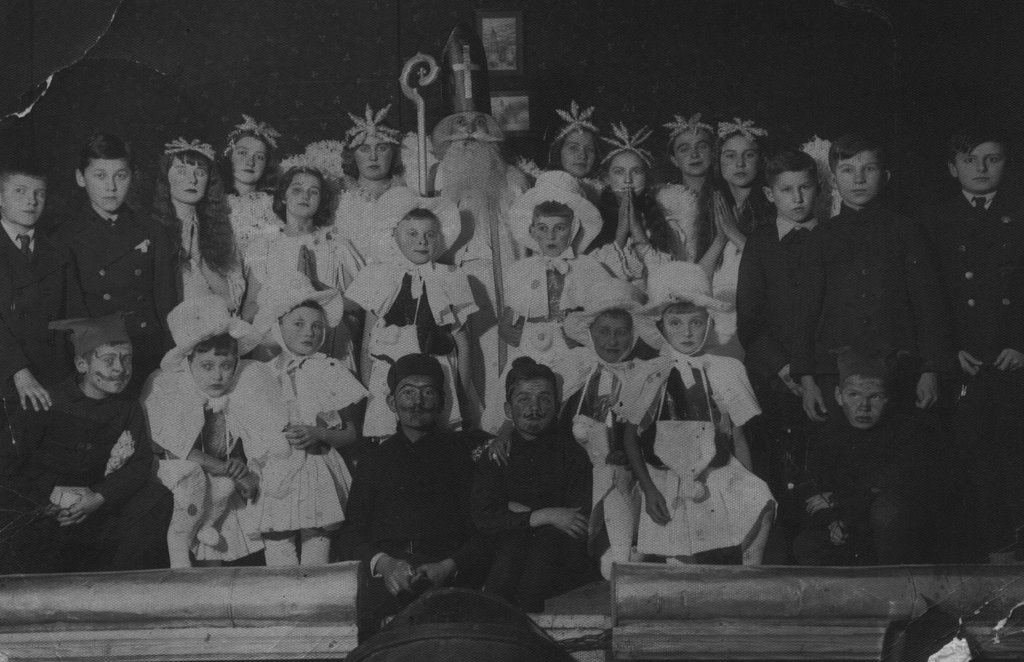
Here's a school photo from childhood (circa early 1930s, Poland now Lithuania). That's my dad at the very front, the one on the left, looking very much like the man he grew up to be. He's, well, moustached.
My father wore a moustache all his life, certainly I never knew him without one.
Legend has it that he lost it once in a poker game. It's the only time my mother saw him without one, and it didn't take long for his look to be reestablished. (I don't know if my siblings existed yet, but I imagine they'd have been too young to remember.)
I have one photo of him sans moustache, age 17, but I don't see the resemblance. It was taken by an army buddy, inscribed and dated on the back so I know it to be him, but he looks a stranger. Indeed, it troubles me to look at it.
There are a few other pictures from his youth — but he was sufficiently angled, the photos grainy and shadowed... The effect is such as if the moustache were there.
Here's a school photo from childhood (circa early 1930s, Poland now Lithuania). That's my dad at the very front, the one on the left, looking very much like the man he grew up to be. He's, well, moustached.
Wednesday, October 11, 2006
A book and a movie
Not to imply that there is any connection between them other than my experiencing them in tandem, but they both have me thinking about what exactly is this thing we call reality.
There are spaces in between the material substance of our world, and sometimes you can see them, but no one else will see what you see, and it will form you, become a part of you. Wherever you go, there you are. You cannot get out of your own head.
The book
I finished reading M John Harrison's Light — has anyone else read it? I'm still not quite sure what to make of it. It's unlike anything I've ever read before, which is a fairly meaningless statement given that I haven't read very much SF, even if I read somewhat more than do people who don't read SF at all. I'm told it's both hard science fiction and space opera.
There's Michael in our present day, doing research in quantum physics. And he's a serial killer, which fact is revealed on page 3, so I don't think I'm spoiling anything for you, and besides, it has next to nothing to do with the plot. (Except for hinting at that he may be insane, or schizophrenic. I did find myself wondering about his brain chemistry, how he sees fractals everywhere, and feeling that he had episodes (alternately of sanity, genius, and murderous rampage, all inextricably linked and triggered by I know not what (though this "imaginary" ghost/demon Shrander connective tissue/god(?) is somehow a factor)), kind of like how epileptic seizures can be brought on by video games, strobe lights, etc.) Four hundred years in the future, there's Ed, who seems to be living his present in a tank, having his reality piped in to him, as a means of escape from reality as well as from the people to whom he owes large sums of money; and Seria Mau, running missions as a disembodied pilot who interfaces directly with the mathematics — she is the ship. Their plots are connected and have interesting parallels and intersections.
Weirdly, they're all rather sympathetic, haunted by the question of being. Ironically, it's Seria Mau who's the most sympathetic of the lot, though arguably she's the least human, having given up her physicality to technology, or maybe her humanness has been distilled to its essence, or maybe I find her so because she's female. They do all find "redemption," whatever that means.
It's a very uncomfortable read, partly because it's so unfamiliar (in its world setting, but also in my reading experience), partly because of the violence — not because it's graphic, though it sometimes is, but because it's so casually dismissed. But mostly for its attitude toward women, I think — I can't quite put my finger on it. They indulge in pleasure-seeking behaviour as much as the males, but it feels like they're being victimized — I can't tell if this is deliberate and essential to the novel's workings or if it's something else, or if it's even there. It just feels uncomfortable.
Iain Banks says "Harrison is the only writer on Earth equally attuned to the essential strangeness both of quantum physics and the attritional banalities of modern urban life." I don't know that Harrison's the only such writer, but the basic assessment of his ability is valid. (If you can call senseless murder a banality of urban life.)
If anyone has read it, I would love to hear what you make of it and where you think it fits within the genre and within its canon.
Excerpt.
The Literary Saloon review, with links to others.
M John Harrison's top 10 "books which link the inside to the outside, the scientific to the personal, the individual to the universal."
The movie
Last week I came across a mention of a novel, La Moustache, the premise of which greatly intrigued me (so I looked it up!), amid refections on the uncanny. Naturally, everywhere I turned in the ensuing days the author's name, Emmanuel Carrère, popped out at me — in my internet reading, in my real-life bookstore browsing, and at the videostore.
While I didn't find a copy of the novel La Moustache, I had to rent the (freshly released on DVD) film adaptation (directed by the author himself).
The plot: man shaves off his trademark mustache and nobody notices.
It's quite funny to start with, in an it's so absurd you chuckle out loud kind of way. Then it gets a bit weird.
When he confronts his wife she insists he's never had a mustache the whole time she's known him, and over the next few days the status of things — varying in significance from restaurant menus and wardrobe contents to her denying the existence of friends they dined with last week to whether his father is alive — slips into uncertainty and beyond.
When he first shaves, he hides it from her, waiting for the right moment to spring the surprise. He couldn't answer the door for her in time, he lies, because his shoelace broke. About halfway through the movie, his shoelace really breaks, as if the little white lie started him on the road to total breakdown. Maybe.
It's deliberately ambiguous, from beginning to end: we never know what really happened, is this all in his head, is it an elaborate joke cum conspiracy against him, is he insane, or maybe his wife is insane, or is it a splicing of universes, one where he's always had a mustache and one where he never did. Did he ever have a mustache and did he really shave it off?
(There are a few scenes of evidence being washed away or erased, maybe just forgotten, a reminder of how tenuous, and individual, our grasp on identity can be. For example, I've misplaced my jump log, the only physical evidence I have of the fact that I ever parachuted out of a plane. I'm no longer in contact with those people who witnessed it. The older I get, the less likely, I feel, I am to be believed. Does it matter? Not really. Except for that I feel this act is somehow essential to my identity, at least to the person I once was, and it would be weird and I would be sad if it unhappened. For another example, my mother in the last few years has "invented" an Easter ritual that she claims has been forever a family tradition. Her insistence has led me to doubt my own memory, once unwavering in the belief that this tradition was not part of my childhood, to the point that I'm not comfortable to proclaim I'm 100% certain on this anymore. And rather than dwell on it (which I still do in my head) and upset her, it seemed easier, and kinder, to let it go, because it doesn't really matter. Or does it?)
In my opinion the acting is superb; there's not a lot of anything you could call action, and no superfluous dialogue. Mostly there's the lead character, Marc, looking at people, waiting for a reaction, and people looking at Marc, wondering what the hell he's looking at or waiting for, and Marc looking at his wife, thinking she must be thinking what he thinks she's thinking, and then knowing she must think he's crazy, and her watching him, knowing he knows she thinks he's crazy, and no one ever actually knowing what anyone is thinking, which is kind of the point.
(I rarely bother with foreign movies anymore — the price of compromise in my cohabitating condition. Which is a shame. I miss them. Their pace. Their ambiguity. The leaving of things unsaid. The not always happy endings. The naturalness of bodies and of living spaces (with bookshelves, and books strewn about!))
From a review:
Maybe.
Official website.
Trailer.
There are spaces in between the material substance of our world, and sometimes you can see them, but no one else will see what you see, and it will form you, become a part of you. Wherever you go, there you are. You cannot get out of your own head.
The book
I finished reading M John Harrison's Light — has anyone else read it? I'm still not quite sure what to make of it. It's unlike anything I've ever read before, which is a fairly meaningless statement given that I haven't read very much SF, even if I read somewhat more than do people who don't read SF at all. I'm told it's both hard science fiction and space opera.
There's Michael in our present day, doing research in quantum physics. And he's a serial killer, which fact is revealed on page 3, so I don't think I'm spoiling anything for you, and besides, it has next to nothing to do with the plot. (Except for hinting at that he may be insane, or schizophrenic. I did find myself wondering about his brain chemistry, how he sees fractals everywhere, and feeling that he had episodes (alternately of sanity, genius, and murderous rampage, all inextricably linked and triggered by I know not what (though this "imaginary" ghost/demon Shrander connective tissue/god(?) is somehow a factor)), kind of like how epileptic seizures can be brought on by video games, strobe lights, etc.) Four hundred years in the future, there's Ed, who seems to be living his present in a tank, having his reality piped in to him, as a means of escape from reality as well as from the people to whom he owes large sums of money; and Seria Mau, running missions as a disembodied pilot who interfaces directly with the mathematics — she is the ship. Their plots are connected and have interesting parallels and intersections.
Weirdly, they're all rather sympathetic, haunted by the question of being. Ironically, it's Seria Mau who's the most sympathetic of the lot, though arguably she's the least human, having given up her physicality to technology, or maybe her humanness has been distilled to its essence, or maybe I find her so because she's female. They do all find "redemption," whatever that means.
It's a very uncomfortable read, partly because it's so unfamiliar (in its world setting, but also in my reading experience), partly because of the violence — not because it's graphic, though it sometimes is, but because it's so casually dismissed. But mostly for its attitude toward women, I think — I can't quite put my finger on it. They indulge in pleasure-seeking behaviour as much as the males, but it feels like they're being victimized — I can't tell if this is deliberate and essential to the novel's workings or if it's something else, or if it's even there. It just feels uncomfortable.
Iain Banks says "Harrison is the only writer on Earth equally attuned to the essential strangeness both of quantum physics and the attritional banalities of modern urban life." I don't know that Harrison's the only such writer, but the basic assessment of his ability is valid. (If you can call senseless murder a banality of urban life.)
If anyone has read it, I would love to hear what you make of it and where you think it fits within the genre and within its canon.
Excerpt.
The Literary Saloon review, with links to others.
M John Harrison's top 10 "books which link the inside to the outside, the scientific to the personal, the individual to the universal."
The movie
Last week I came across a mention of a novel, La Moustache, the premise of which greatly intrigued me (so I looked it up!), amid refections on the uncanny. Naturally, everywhere I turned in the ensuing days the author's name, Emmanuel Carrère, popped out at me — in my internet reading, in my real-life bookstore browsing, and at the videostore.
While I didn't find a copy of the novel La Moustache, I had to rent the (freshly released on DVD) film adaptation (directed by the author himself).
The plot: man shaves off his trademark mustache and nobody notices.
It's quite funny to start with, in an it's so absurd you chuckle out loud kind of way. Then it gets a bit weird.
When he confronts his wife she insists he's never had a mustache the whole time she's known him, and over the next few days the status of things — varying in significance from restaurant menus and wardrobe contents to her denying the existence of friends they dined with last week to whether his father is alive — slips into uncertainty and beyond.
When he first shaves, he hides it from her, waiting for the right moment to spring the surprise. He couldn't answer the door for her in time, he lies, because his shoelace broke. About halfway through the movie, his shoelace really breaks, as if the little white lie started him on the road to total breakdown. Maybe.
It's deliberately ambiguous, from beginning to end: we never know what really happened, is this all in his head, is it an elaborate joke cum conspiracy against him, is he insane, or maybe his wife is insane, or is it a splicing of universes, one where he's always had a mustache and one where he never did. Did he ever have a mustache and did he really shave it off?
(There are a few scenes of evidence being washed away or erased, maybe just forgotten, a reminder of how tenuous, and individual, our grasp on identity can be. For example, I've misplaced my jump log, the only physical evidence I have of the fact that I ever parachuted out of a plane. I'm no longer in contact with those people who witnessed it. The older I get, the less likely, I feel, I am to be believed. Does it matter? Not really. Except for that I feel this act is somehow essential to my identity, at least to the person I once was, and it would be weird and I would be sad if it unhappened. For another example, my mother in the last few years has "invented" an Easter ritual that she claims has been forever a family tradition. Her insistence has led me to doubt my own memory, once unwavering in the belief that this tradition was not part of my childhood, to the point that I'm not comfortable to proclaim I'm 100% certain on this anymore. And rather than dwell on it (which I still do in my head) and upset her, it seemed easier, and kinder, to let it go, because it doesn't really matter. Or does it?)
In my opinion the acting is superb; there's not a lot of anything you could call action, and no superfluous dialogue. Mostly there's the lead character, Marc, looking at people, waiting for a reaction, and people looking at Marc, wondering what the hell he's looking at or waiting for, and Marc looking at his wife, thinking she must be thinking what he thinks she's thinking, and then knowing she must think he's crazy, and her watching him, knowing he knows she thinks he's crazy, and no one ever actually knowing what anyone is thinking, which is kind of the point.
(I rarely bother with foreign movies anymore — the price of compromise in my cohabitating condition. Which is a shame. I miss them. Their pace. Their ambiguity. The leaving of things unsaid. The not always happy endings. The naturalness of bodies and of living spaces (with bookshelves, and books strewn about!))
From a review:
At first "La Moustache" seems to be a darkly witty commentary on what we notice or don't notice about one another; we're so lulled by the predictable and the commonplace, it implies, that we fail to recognize change. Then it widens into a reflection on marriage and the notion that two people, no matter how intimately connected, inhabit separate worlds. An illusion of oneness requires each partner to overlook or deny the other's unknowable qualities.
Maybe.
Official website.
Trailer.
Tuesday, October 10, 2006
Be good and behave
I try to lay down some ground rules for Helena, giving in to her insistence that she accompany me on what was supposed to be a super quick nip out to the grocery store. She must behave, and very solemnly she nods her head to my instructions, then trots off to put on her shoes. She's back in a minute, looking timid and puzzled.
"Qu-est-ce que veut dire "have" [pronounced /heiv/]? Tu m'as dis qu'il faut que je sois une good girl, être "have"?"
She will be good, she will be-have. I'm glad she asked.
"Qu-est-ce que veut dire "have" [pronounced /heiv/]? Tu m'as dis qu'il faut que je sois une good girl, être "have"?"
She will be good, she will be-have. I'm glad she asked.
Monday, October 09, 2006
Giving thanks
Today was Thanksgiving in Canada. I like to think that most days I give appropriate thanks where thanks are due — my friends and family, my lucky stars. Every day I count my blessings.
But today was a special day. Today I give especial thanks for the return of the Doctor (Finally!, she says with feigned exasperation that cannot disguise her glee)!
But today was a special day. Today I give especial thanks for the return of the Doctor (Finally!, she says with feigned exasperation that cannot disguise her glee)!
Thursday, October 05, 2006
Reading group project the next
Goodbye, Tolstoy; hello, Stendhal!
The Red and the Black.
Discussion to begin in November and carry into the new year. Pace will be relatively slow, to accommodate my late-November vacation, Christmas preparations and festivities, and the fact that I will be attempting to read it in French.
Register your interest here, or there, or by email. I'll be setting up contributers and updating the group blog with Stendhal-appropriate links and resources over the coming weeks.
The Red and the Black.
Discussion to begin in November and carry into the new year. Pace will be relatively slow, to accommodate my late-November vacation, Christmas preparations and festivities, and the fact that I will be attempting to read it in French.
Register your interest here, or there, or by email. I'll be setting up contributers and updating the group blog with Stendhal-appropriate links and resources over the coming weeks.
Wednesday, October 04, 2006
Fractious
Main Entry: frac·tious
Pronunciation: 'frak-sh&s
Function: adjective
Etymology: fraction (discord) + -ous
1 : tending to be troublesome : UNRULY [a fractious crowd]
2 : QUARRELSOME, IRRITABLE
- frac·tious·ly adverb
- frac·tious·ness noun
The book I'm reading: I wasn't sure what to make of it, didn't think I liked it, and wondered what review had made me take note of it and buy it (almost a year ago, according to the receipt tucked inside the cover). It's Light, by M John Harrison, and it's anything, and everything, but light. I really liked the first chapter, read in-store, and appreciated how the fact that the guy's a serial killer is treated pretty much as an aside, though it is a bit offputting, but the subsequent chapters, introducing the two other main story threads, just confused me. Although, these are both set in 2400, like they must have a closer relation to each other than with the mathematician-who-happens-to-be-a-serial-killer story; maybe it's this imbalance that's setting me off kilter. Mostly, I'm hugely disappointed to have finished my Dumas book and to have no more Dumas at the ready (oh, if I had a copy of Queen Margot [I liked that movie, wasn't aware of the Dumas connection]). No book quite felt right, none would, and what with work obligations and some meaty reading planned ahead I thought some light reading would be in order, and the title tricked me, so now I'm reading Light, and after 40 some pages and a few days, I'm finding my rhythm with it and wanting to know what happens next.
Maybe it's the fact that in 40 some pages, the word "fractious" has appeared a handful of times, and Anna says it's like they're in a Tom Waits song. Anna's fractious, the book is fractious. I'm fractious, Helena, J-F, work, my sleep, my reading behaviour, my nasty blog habit — all fractious.
Today I took a breather from work to shop for winter accoutrements for the girl: boots, coat. I carry her footprints with me, their outline, to slip them into footwear to size it properly. Because shopping with Helena, especially with a specific task at hand, is usually not fun (but oh how I love pointless wandering with her). So this is how I usually buy footwear for her. And I always end up hesitating between the "perfect fit" and the slightly larger ones, because the difference seems almost negligible. And I always buy the bigger ones, because it's better to have a little extra toe-wiggle room. And they're always too big. But she's always grown into them eventually. Today's lovely boots: too big. Allowing her to grow into them doesn't seem practical, as our still only potential snow will likely have melted by then.
And I've been wanting to buy Snakes and Ladders, but I've found only fancy gigantic snakes and ladders, or tiny magnetic snakes and ladders, or over-priced cartoon-character-themed snakes and ladders, and I want classic snakes with classic ladders. Because I am oh so tired of playing Cache-Cache Grenouilles with her every morning and every evening. And the novelty of some card games has already worn off, and the difficulty of others seems insurmountable at this point. So when Rachel mentioned dominos, I obsessively latched on to this idea — the perfect game! (for 3-year-olds) — and the thought of acquiring some has been all-consuming, for days. Again, I eschewed the cartoon-character-themed ones, and the farm-animal-themed ones, and the colour-coded geometric-shape-themed ones, and I found some! plain ol' white dots on black! for a dollar! We gave it a go this evening, but it's too early to tell if it'll take. Helena was more keen on serving them up as biscuits at her tea party (oh I am so tired of tea parties).
After my little shopping expedition I was to pick up Helena from daycare (J-F's out of town), so I descended the stairs to the metro station to find access barred and hordes of students just standing there, waiting (don't you have better things to do?), and I still have no idea why the station was closed. I did find a bus, but I was late, and it was generally hellish. Did I mention it was raining?
However. En route from pseudo-mall to metro station are bookstores, used. One, a bust, today. Another has changed hands and sells only new books now, and literary ones (note to self: return for pretty editions of Paul Bowles collections as birthday gift to self). Yet another, one I've never before set foot in as it keeps unpredictable hours, is filled with odd-smelling, mostly genre, very definitely used-many-time-over paperbacks. There I found Alexandre Dumas's Horror at Fontenay, his "immortal occult novel," in which it is wondered how long does life persist after the head is severed. I love you, Madame la Guillotine, for the inspiration you've served this master storyteller.
Fractious.
Oh, I really should be working right now...
Pronunciation: 'frak-sh&s
Function: adjective
Etymology: fraction (discord) + -ous
1 : tending to be troublesome : UNRULY [a fractious crowd]
2 : QUARRELSOME, IRRITABLE
- frac·tious·ly adverb
- frac·tious·ness noun
The book I'm reading: I wasn't sure what to make of it, didn't think I liked it, and wondered what review had made me take note of it and buy it (almost a year ago, according to the receipt tucked inside the cover). It's Light, by M John Harrison, and it's anything, and everything, but light. I really liked the first chapter, read in-store, and appreciated how the fact that the guy's a serial killer is treated pretty much as an aside, though it is a bit offputting, but the subsequent chapters, introducing the two other main story threads, just confused me. Although, these are both set in 2400, like they must have a closer relation to each other than with the mathematician-who-happens-to-be-a-serial-killer story; maybe it's this imbalance that's setting me off kilter. Mostly, I'm hugely disappointed to have finished my Dumas book and to have no more Dumas at the ready (oh, if I had a copy of Queen Margot [I liked that movie, wasn't aware of the Dumas connection]). No book quite felt right, none would, and what with work obligations and some meaty reading planned ahead I thought some light reading would be in order, and the title tricked me, so now I'm reading Light, and after 40 some pages and a few days, I'm finding my rhythm with it and wanting to know what happens next.
Maybe it's the fact that in 40 some pages, the word "fractious" has appeared a handful of times, and Anna says it's like they're in a Tom Waits song. Anna's fractious, the book is fractious. I'm fractious, Helena, J-F, work, my sleep, my reading behaviour, my nasty blog habit — all fractious.
Today I took a breather from work to shop for winter accoutrements for the girl: boots, coat. I carry her footprints with me, their outline, to slip them into footwear to size it properly. Because shopping with Helena, especially with a specific task at hand, is usually not fun (but oh how I love pointless wandering with her). So this is how I usually buy footwear for her. And I always end up hesitating between the "perfect fit" and the slightly larger ones, because the difference seems almost negligible. And I always buy the bigger ones, because it's better to have a little extra toe-wiggle room. And they're always too big. But she's always grown into them eventually. Today's lovely boots: too big. Allowing her to grow into them doesn't seem practical, as our still only potential snow will likely have melted by then.
And I've been wanting to buy Snakes and Ladders, but I've found only fancy gigantic snakes and ladders, or tiny magnetic snakes and ladders, or over-priced cartoon-character-themed snakes and ladders, and I want classic snakes with classic ladders. Because I am oh so tired of playing Cache-Cache Grenouilles with her every morning and every evening. And the novelty of some card games has already worn off, and the difficulty of others seems insurmountable at this point. So when Rachel mentioned dominos, I obsessively latched on to this idea — the perfect game! (for 3-year-olds) — and the thought of acquiring some has been all-consuming, for days. Again, I eschewed the cartoon-character-themed ones, and the farm-animal-themed ones, and the colour-coded geometric-shape-themed ones, and I found some! plain ol' white dots on black! for a dollar! We gave it a go this evening, but it's too early to tell if it'll take. Helena was more keen on serving them up as biscuits at her tea party (oh I am so tired of tea parties).
After my little shopping expedition I was to pick up Helena from daycare (J-F's out of town), so I descended the stairs to the metro station to find access barred and hordes of students just standing there, waiting (don't you have better things to do?), and I still have no idea why the station was closed. I did find a bus, but I was late, and it was generally hellish. Did I mention it was raining?
However. En route from pseudo-mall to metro station are bookstores, used. One, a bust, today. Another has changed hands and sells only new books now, and literary ones (note to self: return for pretty editions of Paul Bowles collections as birthday gift to self). Yet another, one I've never before set foot in as it keeps unpredictable hours, is filled with odd-smelling, mostly genre, very definitely used-many-time-over paperbacks. There I found Alexandre Dumas's Horror at Fontenay, his "immortal occult novel," in which it is wondered how long does life persist after the head is severed. I love you, Madame la Guillotine, for the inspiration you've served this master storyteller.
Fractious.
Oh, I really should be working right now...
Monday, October 02, 2006
Friday, September 29, 2006
The Knight of Maison-Rouge

It was the night of the tenth of March, 1793. The bell at Notre-Dame had just struck ten, and each stroke rang out clear and distinct, one after the other, before flying off into the ether like a night bird soaring from some bronze nest, sad, monotonous, and resonant.
Night had descended on Paris. But it was not the usual noisy, stormy Paris night, punctuated by lightning yet cold and misty. Paris itself was not the Paris we know today, dazzling by night with its thousands of lights reflected in its golden mire, the Paris of busy promeneurs, jubilant whisperings, and deliciously sleazy outskirts where fierce feuds and reckless crimes flourish, a wildly roaring furnace. It was a shabby little dive, tremulous, beetling, whose rarely seen inhabitants would run whenever they had to cross a street and scuttle away into their alleyways or under their porte-cochères, the way feral creatures pursued by hunters sink into their burrows.
It was, in a word, the Paris of the tenth of March, 1793, as I think I might have said.
Can't.
Stop.
Reading.
Or laughing, or gasping, or smirking, or raising my eyebrows. Or telling anyone who'll listen, and many who won't, how good this book is. Or reading bits aloud to the others who live in this house (including the cat).
We know early on that Maurice, patriot, would sacrifice duty for a friend. What then would he do for love?! Oh, be careful, Maurice — she's using you.
Am fairly certain that Marie Antoinette will indeed be rescued from the Conciergerie, saved from the guillotine. Fairly certain.
Excerpt.
Review.
Just wow.
Thursday, September 28, 2006
Turning the screw
Well, what with everyone reading or planning to read Henry James's ghostly The Turn of the Screw, I finally pulled it out of my purse, where it has resided for some months now, holding the privileged position of transit reading and being the reason that I'd made next to no headway through it as I've had little oppurtunity to ride public transit in recent times, and I read the damn thing.
It's all perfectly clear to me (if you mean to read it for yourself and don't want me spoiling anything for you, go away, and come again another day). The notes below are not very coherent, rather intended as notes to self so that I can hold a proper conversation on the subject should the opportunity present itself. So.
The governess is a parson's daughter and proper young woman, but perhaps not so proper in accepting this post that many had refused, one reason for doing so being that she's quite taken with the worldly, handsome master. She's horrified by and fascinated with sex.
Not sure why or when it all starts sounding sexual; perhaps the prologue sets the reader's mind on that path with its talk of love. Interesting: Douglas, the keeper of the governess's story identifies her as his sister's governess, about 10 years older than him. He is not Miles, but we readily attribute Douglas's fondness and admiration — indeed, love — for the woman to him.
The ghosts are in the governess's head.
First sighting (Quint) (p15): Governess wills encountering someone charming, handsome.
Second sighting (Quint) (p20): Leaving for church. Guilt.
Third (Jessel) (p28): While watching Flora put a stick in a hole.
Fourth (Quint) (p39): Reading Fielding's Amelia, which includes stories of young women ruined by handsome men and reveals the 'half-innocent meanness, scoundrelism, and vanity' of a young couple.
Subsequent sightings are fed by hysteria, suspicion, guilt. Flora and the housekeeper both deny seeing them. They are never overtly addressed with Miles.
The governess is in love with, or at least longs for some recognition from, the master, who made a favourable impression on her at their only two meeting.
Flora likes a naughty boy (p11). Laughingly suggests Miles might corrupt governess (p12), governess takes to the idea...
"He seems to like us young and pretty!" Is confused over who "he" is (p12). She means the master, but then wonders if the housekeeper does; it occurs to her the housekeeper might mean someone else. That someone else could only be Miles (not yet aware of existence of Quint).
In her questions to the housekeeper about the previous governess, she has a tone like jealousy (p 12).
Miles is "incredibly beautiful" (p13). So angelic, there is no evil in him — it must come from outside.
Governess wants to meet someone, someone handsome — she wills the first apparition (p15).
I don't think the description of the apparition is relevant. Housekeeper dwells on whether or not he appears to be a gentleman and that he's handsome. She does not even acknowledge the other details, as if to dismiss them. She's more than willing corroborate the "horror," knowing the evil Quint already conducted in the household (p23).
Hysteria (p27): "I could succeed where many another girl might have failed." "We were cut off, really, together; we were united in our danger. They had nothing but me, and I — well, I had them."
Jessel is called by our first narrator "a most respectable person" (p5). (On the basis of what? The governess's account?) Housekeeper won't tell tales about her (p12). Governess is certain of identity of apparition (because of her own jealusy, suspicions, transference). Housekeeper eventually comes round to confirming Jessel was infamous (p31). Governess's descriptions were not so detailed; identity of apparitions established through jumping to conclusions based on characteristics that weren't really physical at all, more to do with demeanour.
Flora (age 8) knows all about Miles. Likely it's Miles who's made Flora sexually aware, not Jessup and Quint, or Miles had to explain it to her, or even demonstrate. There is something incestuous going on here.
The governess is smitten with Miles, the 10-year-old boy, charmed by him. May even harbour inappropriate thoughts regarding him (transferred from the out-of-reach master and inspired by the stories, or her imaginings, of the goings on of the previous hires).
Miles calls her my dear. Encourages her. Maybe flirts with her or even makes more overt advances.
Chapter 17 sees the governess and Miles alone. Positively brimming with sexuality and innuendo.
Jessel shows up again, while Flora appears "to read and accuse and judge me" (p70). Flora know what goes on between governess and Miles, and is angry, I think, for having been replaced.
Miles "wanted, I felt, to be with me" (p73).
Housekeeper has heard from Flora shocking horrors! "It's beyond everything, for a young lady; and I can't think wherever she must have picked up — — " (p76). That's not talking about ghosts.
Governess intent on "saving" Miles. All her attempts futher tempt an unnatural relation between them.
Chapter 23. Well. It's all sex. Sex, sex, sex.
And chapter 24.
Miles was expelled from school, because he "said things," only to people he likes. Obviously sexual propositions.
Not quite sure what's up with the heart stopping. Is it literal? Not much else is. It's quite a frenzied, orgasmic end.
And on and on and on.
Etext.
Some discussion.
Here at present I felt afresh — for I had felt it again and again — how my equilibrium depended on the success of my rigid will, the will to shut my eyes as tight as possible to the truth that what I had to deal with was, revoltingly, against nature. I could only get on at all by taking "nature" into my confidence and my account, by treating my monstrous ordeal as a push in a direction unusual, of course, and unpleasant, but demanding, after all, for a fair front, only another turn of the screw of ordinary human virtue.
It's all perfectly clear to me (if you mean to read it for yourself and don't want me spoiling anything for you, go away, and come again another day). The notes below are not very coherent, rather intended as notes to self so that I can hold a proper conversation on the subject should the opportunity present itself. So.
The governess is a parson's daughter and proper young woman, but perhaps not so proper in accepting this post that many had refused, one reason for doing so being that she's quite taken with the worldly, handsome master. She's horrified by and fascinated with sex.
Not sure why or when it all starts sounding sexual; perhaps the prologue sets the reader's mind on that path with its talk of love. Interesting: Douglas, the keeper of the governess's story identifies her as his sister's governess, about 10 years older than him. He is not Miles, but we readily attribute Douglas's fondness and admiration — indeed, love — for the woman to him.
The ghosts are in the governess's head.
First sighting (Quint) (p15): Governess wills encountering someone charming, handsome.
Second sighting (Quint) (p20): Leaving for church. Guilt.
Third (Jessel) (p28): While watching Flora put a stick in a hole.
Fourth (Quint) (p39): Reading Fielding's Amelia, which includes stories of young women ruined by handsome men and reveals the 'half-innocent meanness, scoundrelism, and vanity' of a young couple.
Subsequent sightings are fed by hysteria, suspicion, guilt. Flora and the housekeeper both deny seeing them. They are never overtly addressed with Miles.
The governess is in love with, or at least longs for some recognition from, the master, who made a favourable impression on her at their only two meeting.
Flora likes a naughty boy (p11). Laughingly suggests Miles might corrupt governess (p12), governess takes to the idea...
"He seems to like us young and pretty!" Is confused over who "he" is (p12). She means the master, but then wonders if the housekeeper does; it occurs to her the housekeeper might mean someone else. That someone else could only be Miles (not yet aware of existence of Quint).
In her questions to the housekeeper about the previous governess, she has a tone like jealousy (p 12).
Miles is "incredibly beautiful" (p13). So angelic, there is no evil in him — it must come from outside.
Governess wants to meet someone, someone handsome — she wills the first apparition (p15).
I don't think the description of the apparition is relevant. Housekeeper dwells on whether or not he appears to be a gentleman and that he's handsome. She does not even acknowledge the other details, as if to dismiss them. She's more than willing corroborate the "horror," knowing the evil Quint already conducted in the household (p23).
Hysteria (p27): "I could succeed where many another girl might have failed." "We were cut off, really, together; we were united in our danger. They had nothing but me, and I — well, I had them."
Jessel is called by our first narrator "a most respectable person" (p5). (On the basis of what? The governess's account?) Housekeeper won't tell tales about her (p12). Governess is certain of identity of apparition (because of her own jealusy, suspicions, transference). Housekeeper eventually comes round to confirming Jessel was infamous (p31). Governess's descriptions were not so detailed; identity of apparitions established through jumping to conclusions based on characteristics that weren't really physical at all, more to do with demeanour.
Flora (age 8) knows all about Miles. Likely it's Miles who's made Flora sexually aware, not Jessup and Quint, or Miles had to explain it to her, or even demonstrate. There is something incestuous going on here.
The governess is smitten with Miles, the 10-year-old boy, charmed by him. May even harbour inappropriate thoughts regarding him (transferred from the out-of-reach master and inspired by the stories, or her imaginings, of the goings on of the previous hires).
Miles calls her my dear. Encourages her. Maybe flirts with her or even makes more overt advances.
Chapter 17 sees the governess and Miles alone. Positively brimming with sexuality and innuendo.
"Well, I think also, you know, of this queer business of ours."
I marked the coolness of his firm little hand. "Of what queer business, Miles?"
"Why, the way you bring me up. And all the rest!"
I fairly held my breath a minute, and even from my glimmering taper there was light enough to show how he smiled up at me from his pillow. "What do you mean by all the rest?"
"Oh, you know, you know!"
I could say nothing for a minute, though I felt, as I held his hand and our eyes continued to meet, that my silence had all the air of admitting his charge and that nothing in the whole world of reality was perhaps at that moment so fabulous as our actual relation.
Jessel shows up again, while Flora appears "to read and accuse and judge me" (p70). Flora know what goes on between governess and Miles, and is angry, I think, for having been replaced.
Miles "wanted, I felt, to be with me" (p73).
Housekeeper has heard from Flora shocking horrors! "It's beyond everything, for a young lady; and I can't think wherever she must have picked up — — " (p76). That's not talking about ghosts.
Governess intent on "saving" Miles. All her attempts futher tempt an unnatural relation between them.
We continued silent while the maid was with us — as silent, it whimsically occurred to me, as some young couple who, on their wedding journey, at the inn, feel shy in the presence of the waiter. He turned round only when the waiter had left us. "Well — so we're alone!"
Chapter 23. Well. It's all sex. Sex, sex, sex.
And chapter 24.
Miles was expelled from school, because he "said things," only to people he likes. Obviously sexual propositions.
Not quite sure what's up with the heart stopping. Is it literal? Not much else is. It's quite a frenzied, orgasmic end.
And on and on and on.
Etext.
Some discussion.
Wednesday, September 27, 2006
Helena's game
A product of her very own brain. I'll call it Jigsaw Concentration.
For 2 players (though we've never tried to play with more, and Helena refuses to play by herself).
Take one jigsaw puzzle. The game was devised using a none-too-challenging 12-piece puzzle. We usually play with the 20- or 24-piece ones. Play with the 48-piece puzzle was successful, but long. It should be a puzzle that the child is able to complete by themselves easily, or at least without major frustration.
Turn all the pieces face down, so you face a sea of grey cardboard.
The player who goes first — that would be Helena — turns over 2 pieces.
If these 2 pieces don't fit together (and they probably won't), return them to the facedown position. Play passes to the next person, who tries to choose 2 pieces that will fit together. (This is the concentration part of the game; this could take a few tries, taking turns, of course.)
When 2 pieces finally fit together, great! Go again! Turn over another 2 pieces!
If both pieces either fit together or fit to the existing picture, great! Go again.
If only 1 piece or neither piece fits to the existing picture, return the loose pieces to the facedown position. Play passes to the next person.
Whoever places the last piece wins.
The opening is surprisingly difficult, but there comes a point when all the pieces start falling into place, and the "rules" often fly out the window. Helena decides when it's appropriate to start turning over just 1 piece at a time instead of 2. Often the game degenerates into a race. Sometimes it's a contact sport in lunging for the last pieces. Helena always wins, and if she doesn't, she says she wins anyway.
I'm amazed — and proud — that she found a way to give new life to the tired (small) puzzles in our home. Perhaps even more than of books, her love of a puzzle challenge tells me she's mine.
For 2 players (though we've never tried to play with more, and Helena refuses to play by herself).
Take one jigsaw puzzle. The game was devised using a none-too-challenging 12-piece puzzle. We usually play with the 20- or 24-piece ones. Play with the 48-piece puzzle was successful, but long. It should be a puzzle that the child is able to complete by themselves easily, or at least without major frustration.
Turn all the pieces face down, so you face a sea of grey cardboard.
The player who goes first — that would be Helena — turns over 2 pieces.
If these 2 pieces don't fit together (and they probably won't), return them to the facedown position. Play passes to the next person, who tries to choose 2 pieces that will fit together. (This is the concentration part of the game; this could take a few tries, taking turns, of course.)
When 2 pieces finally fit together, great! Go again! Turn over another 2 pieces!
If both pieces either fit together or fit to the existing picture, great! Go again.
If only 1 piece or neither piece fits to the existing picture, return the loose pieces to the facedown position. Play passes to the next person.
Whoever places the last piece wins.
The opening is surprisingly difficult, but there comes a point when all the pieces start falling into place, and the "rules" often fly out the window. Helena decides when it's appropriate to start turning over just 1 piece at a time instead of 2. Often the game degenerates into a race. Sometimes it's a contact sport in lunging for the last pieces. Helena always wins, and if she doesn't, she says she wins anyway.
I'm amazed — and proud — that she found a way to give new life to the tired (small) puzzles in our home. Perhaps even more than of books, her love of a puzzle challenge tells me she's mine.
Subscribe to:
Comments (Atom)


