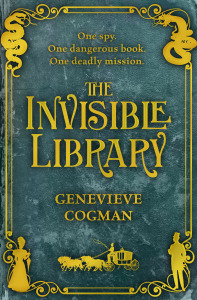
For a book purportedly about a library, The Invisible Library, by Genevieve Cogman, has very little librarying going on here.
"I and Mr. Strongrock are agents of a library which exists between the alternate worlds. Our task is to collect books for the Library from all those worlds, to preserve them."
That's the premise. While the laws of physics are upheld throughout the worlds, they allow for magical elements and creatures like fairies and dragons, vampires and werewolves. Each world is governed by forces of order and of chaos, in varying degrees. I don't really see how all this jives with the claim that science remains true, but blah, blah, blah, suspension of disbelief, it's just a lame excuse to tell stories about different realities.
This story covers one particular mission in one particular alternate. This world is very Victorian-era steampunk, with a murdered vampire, zeppelins, and mechanical alligators. Our librarians seem to have stepped into a conspiracy, though whether it's masterminded by the Fae folk, the Iron Brotherhood, or Luxembourg is not clear. There's a bit of penny dreadful about it, as our chief protagonist, Librarian Irene, herself notes.
The book she's after is a version of Grimm's Fairy Tales. We're treated to a small sample of it, but my sense is that the object of the chase could have just as easily been another type of artefact.
Librarians also have access to the Language, a type of magic that seems to depend on naming things very precisely, but it's mostly just mysterious and convenient.
So what is the point of the Library? Although it opens onto all the alternate worlds, librarians are careful not to interfere in the workings of those worlds. They collect knowledge, but squirrel it away without ever really using it or even understanding it.
The conversation shifted, much to Irene's relief, into a debate on poetry that lasted for most of the journey. She herself was mostly silent, being more used to acquiring it than reading it.
Which doesn't seem very librarian-like to me.
It's a fun book, but mostly forgettable. I've had trouble focusing the last couple weeks, so this book was easy, not too demanding, and provided some distraction. There were some funny bits, and it reminds me a little of the Thursday Next books, but without the clever literary references. I won't be searching out the subsequent volumes of Cogman's series.
Everything my daughter knows about Shakespeare she learned from watching Doctor Who. (And she's known it for a couple years already, since first that Shakespeare episode aired.)
She knows "To be or not to be," that he wrote comedies and tragedies, "Shall I compare thee to a summer's day," about the Globe Theatre, that he had a son Hamnet, who died, and that he wrote about witches. That may not sound like a lot, but it's enough to surprise grown-ups at brunch, and it's more than I knew at the age of 8 (it wasn't till grade 7 that I played the role of Polonius; although, there was that story we read in grade 2, about the girl who loved her father as much as meat loves salt, which sentiment was reason enough to disown her — oh, I loved that story). (Helena can also tell you about Charles Dickens, Vincent van Gogh, the destruction of Pompeii, and Madame de Pompadour, thank you, Doctor.)
This to say: I'm all for using popular culture as a vehicle to the classics. There's nothing so sacred about Shakespeare that a divide should be drawn to keep him unsullied. Let his blood mingle with the rest of our entertainments — let him be popular culture.
So I was thrilled to receive a copy of Kill Shakespeare, graphic novel, created and written by Conor McCreery and Anthony Del Cor, and drawn by Andy Belanger.
Think Jasper Fforde's Thursday Next world, only less tongue in cheek and populated exclusively by Shakespearean characters. The politics are of a more vicious time, and the characters' awareness that they are literary creations has a more metaphysically somber tone.
Kill Shakespeare, as you might divine by the title, involves a plot to kill Shakespeare.
As summed up in the foreword by Darwyn Cooke, "All of Shakespeare's 'creations' live in a kingdom ruled by their deity: the Bard himself. The good and evil forces within this kingdom are in a race to possess the Bard's mythical quill — the source of all power and life."
It starts off with a touch of Rosencrantz, a bit of Guildenstern (á la Tom Stoppard), and pirates! Then Hamlet's Act IV takes a different turn.
Before you know it, Hamlet agrees to do the bidding of Richard III, on the promise that his father be returned to life.
Oh, and, as the witches tell it, there's a prophecy about the Shadow King:
The father's gated shall open swing,
A welcome to the Shadow King.
The two shall clash and blood will pour,
And things that were shall be no more.
Soon enough, we encounter Falstaff (about which all I know is from the post-apocalyptic Mad Maxified version of Henry IV, part something, I saw staged, one high school field trip), and Juliet and Othello and Lady MacBeth, among others.
There's enough action, threats, blood, and double-crossing to equal any of Shakespeare's histories.
The artwork is expressive, but dark, almost unrelentingly so, like the pace, that I wish Hamlet might've dallied more with characters from the comedies. I suppose Shrewsbury is meant to reference Katherine, and there's a lovely Adriana, but if there were any further invocation of the Bard's lighter works meant to give respite, it was lost on me. (Also, I did have trouble keeping a couple of the characters straight, but then, I'm not a particularly practiced reader of comic books — or graphic novels, or whatever the preferred sensitive yet serious-while-unpretentious term of choice is these days.)
I'm not convinced the characters are true to the natures Shakespeare devised for them. I have to agree with Cooke in his encapsulation of Hamlet as "emo douche," and I'm not sure he'd really want his father back. And while Shakespeare's Juliet does show a great deal of strength and courage, I'm sceptical that she has it in her to rally the people behind her to rise up. (When I heard the people calling for Lady Capulet, I was sure they meant her mother.)
Also, I'm not entirely sure what the rules are: If you die in Act II or earlier, well, you're really dead, in this world too it seems. But if you don't die till the final scenes these new creators are OK with pretending those pages were never written. I mean: at what point are Shakespeare's characters plucked to populate this world? And what about Ophelia? But I guess Hamlet, at sea with R&G, beset by pirates, doesn't know about her yet.
So it may sound like I have a lot of little gripes with this work, but it's been a gripey kind of week, and I wouldn't take me too seriously on these points. The fact is: I ate it up, and I'm on the lookout for subsequent volumes.
It's original, and gives new life, and liveliness, to a set of dusty old names that not many people other than dead academics pay much attention to.
I can't wait till my daughter discovers this book on my shelf.
The epigraph that starts off Shades of Grey: The Road to High Saffron, by Jasper Fforde, is taken from Alfred North Whitehead and sets up its most interesting premise:
There is no light or colour as a fact in external nature. There is merely motion of material. . . . When the light enters your eyes and falls on the retina, there is motion of material. Then your nerves are affected and your brain is affected, and again this is merely motion of material. . . . The mind in apprehending experiences sensations which, properly speaking, are qualities of the mind alone.
Fforde's world this time is not to be found on library shelves or in nursery rhymes; it's a wholly new invention, taking as its foundation the light spectrum. Citizens are classed by what they see; that is, their station in life is determined not by the colour of their skin, but by the colours they are able to perceive. Heredity also plays a role in that colours can be mixed; offspring are generally expected to inherit the ability to perceive to a certain degree a mix of the colours of their parents (marriages between complementary colours are forbidden).
This is a parody of a dystopia, set in our future. The event that brought about this society is never specified, but there are a few references to the world and personages we know.
Every page sheds light on some absurdity, the structure of this society dependent on such rules. For the most part, the book plays as sheer entertainment, although there is the occasional glimmer of social commentary, where the danger of blind conformity to order is quite pointed.
But Shades of Grey is funny.
Suddenly my eye was caught by the figure of a man in his early thirties, standing in the shadows of the alleyway opposite. He was grimy and unshaven and had NC-B4 carved rather clumsily below his left clavicle — most scars were neat affairs, but his looked like a bad weld. He was also inappropriately naked and, while staring vacantly up at the sky, was actually peeing on his left foot.
"Stafford?" I whispered, a tremor of fear sounding in my voice.
"Yes, Master Edward?"
"There's a naked man in the alleyway behind us. I think it might be . . . Riffraff."
Stafford turned around, looked at the man and said, "I don't see anyone."
"How can you not see him? He's peeing on his own foot."
"Master Edward, you can't see him."
"I can."
"You can't. He doesn't exist, Master Edward — take Our Munsell's word for it."
I suddenly understood. The Rules, despite their vast complexity and extensive range, had no way of dealing with anything that had no explainable position within a world of absolutes. So instead of attempting to understand or explain them, they were simply awarded the status of Apocrypha and stridently ignored lest they raise questions of fallibility.
"He's Apocryphal?" I asked.
"He would be if he were there — which he isn't."
I understood Stafford's reticence. Admitting that Apocrypha actually existed was a grave impiety punishable by a five-hundred-merit fine. A whole range of euphemistic language had developed to refer to them, but no one generally did — a slip of tense could leave your hard-won merit score in tatters.
"I've never actually seen an Apocryphal man," I noted, unable to stop staring, "and, um, still haven't. Do you think they might all look the same — if they existed?"
"I've only not seen one," said Stafford, following my gaze to where the unseeable man was now pouring cooling water over himself from a water butt, "so I've no idea what one shouldn't look like."
The plot of Shades of Grey is at times a little unfocused, but the world-building is an extraordinary feat! It seems the spoons in my house go missing for entirely different reasons, thankfully, than those which brought about the spoon shortage in Fforde's world. (The version I read was colorized for spelling.)
I've read, and loved, all but one of the Thursday Next books; I read the first Nursery Crimes book and intend to read on. I'm pleased that Fforde is capable of stretching his creativity in this entirely new direction, and I look forward to reading further adventures set amid this colour-based society.
Miscellaneous - Milorad Pavić died this week. Go read Dictionary of the Khazars. It remains one of the most original books I've ever read. The "story" is told via encyclopedia entries, with many of the same entries being reworked in each of the 3 major sections — Christianity, Islam, and Judaism — the mystery being to which of the religions did the Khazar people convert. There was a time when the problem of translation greatly fascinated me, and I worried over whether it would be better to change an entry heading and risk deviating from the very right word in order to preserve the alphabetical order of the original or to change the order of the entries in compliance with the target language but thereby tainting the impact of the proper unfolding of the narrative. In Krakow I came across a Polish version, which I treasure for its binding. I spent some time comparing translations, but I arrived at no conclusions.
Books I haven't said much about - The Geographer's Library, by Jon Fasman. Don't bother. This review says it all.
- Geek Love, by Katherine Dunn. Weird and wonderful and really touching, provided you have a weird sense of humour and can get past all the freakshow stuff.
- Generosity, by Richard Powers. It's ages since I read this already, and I still don't know what to say about it. Wonderful premise, and worth talking about. But as to the question of happiness, its essence, other recent reads have handled this with more passion and guts (namely The Museum of Innocence, by Orhan Pamuk).
- The Confessions of Max Tivoli, by Andrew Sean Greer. I read this back in the spring and loved it. Very poignant. Much like the movie of The Curious Case of Benjamin Button, in plot and mood.
- Platform, Michel Houellebecq. Houellebecq is very provocative and challenges my comfort zone. I quite liked Platform (I read it in March) and found the characters more mature (read: morally acceptable) than in the other couple novels of his I'd read. I think I have more to say on this book yet. I find myself rather hoping that Houellebecq has something new out soon.
Books I plan to read soon - The Magic Mountain, by Thomas Mann. Under way; stay tuned.
- The Wind-up Bird Chronicle, by Haruki Murakami. Because one day I was in a bookstore and I felt like buying a book, and I've been meaning for a couple years to look this one up, so I took a look and it just felt right, really right.
- The Glass Room, by Simon Mawer. Review copy.
- The Last Supper, by Paweł Huelle. I'd read about 100 pages when I realized I had no idea what was going on. A little too frenetic for the headspace I've been living in of late. But I'll come back to it in short order.
- The Book of Fathers, by Miklós Vámos. Review copy.
- The Invention of Morel, by Adolfo Bioy Casares. Because it was cited by Roberto Bolaño as a book that marked his life. Plus I had trouble stopping after reading the first paragraph. (You can read the introduction for yourself.)
- Shades of Grey, by Jasper Fforde. Advance reading copy, of the US colorized version (ie, edited for spelling and I know not what else). Can't wait actually. I could use a little levity.