Showing posts with label Margaret Atwood. Show all posts

Saturday, March 14, 2020

The tears you couldn't waste time crying before

The SanctuCare women went over and welcomed them and said, "You're her now, it's all right," and the Gilead women started to cry. At the time I thought, Why cry, you should be happy, you got out. But after all that's happened to me since that day, I understand why. You hold it in, whatever it is, until you can make it through the worst part. Then, once you're safe, you can cry all the tears you couldn't waste time crying before.
Last week I read The Testaments, Margaret Atwood's sequel to The Handmaid's Tale. It's a good book.

I had little interest in it in the lead up to publication — I was dytopiaed out, having finished watching the related TV series. But I was curious how Atwood would treat a sequel — in what timeframe and through which characters would she continue her story?

On publication day, a copy made its way into my house (a gift), and while I wasn't ready to read it yet, I read a review. I learned that this was Aunt Lydia's story. And then I read an excerpt, and thought twice before setting it aside.

I don't need to tell you to read this novel. You will or you won't. You know that it can't live up to its predecessor. You know that you can't come to this novel cold — you already know too much.

You know that, no matter what Atwood wrote, we won't know how the story ends until it ends. You know. The real story happening around us.

The Testaments is not a great work of Literature. It is not deeply philosophical. My daughter had The Handmaid's Tale as assigned reading last summer (going into grade 11), and I will encourage her to read the follow-up. It's a thriller with great characters (some greater than others). And it's important for other reasons.

Unlike the television show, it doesn't make you want to slit your wrists. It shows a way out.

It's also Atwood taking back her story, her characters, and having the final word, to say what she wants to say. Queen!

#fuckthepatriarchy

Sunday, May 14, 2017

Watching, waking, leaking, planning

Life is busy of late. My reading is very piecemeal. Somehow I've managed to get myself to this point where, unnaturally for me, I'm reading four books or more at the same time. I'm highly distractible these days, and the lack of reading focus exacerbates the feeling of being unmoored. This blog in fact brings some kind of structure and routine to my life, and I miss it when I ignore it. That ends today.

Here's some of what's been going on.

Watching
My mother is a feminist, but she doesn't know it. And she's far more open-minded than she believes herself to be.

Thank gawd for television. If it weren't for television, my mother might not recognize Margaret Atwood for the Canadian icon she is. Somehow, Peter Mansbridge and I convinced my mom to give the television adaptation of The Handmaid's Tale a try, arguing that it's deeply relevant commentary on our Trumpian times.


It's dark and riveting, and my mother agrees.

My mom asked me in our first telephone debriefing, "It's almost like... is this science fiction?" I said the only thing I could say. "Ummm, nnnoooo."

Waking
Impulse purchase at a checkout counter: We Should All Be Feminists, by Chimamanda Ngozi Adichie. I was suddenly overcome with the feeling that I should own a copy of this, leave it lying around the house for visitors to pick up. But I don't have many visitors. I thought about wrapping it up for my teenage daughter, but then thought better of it. She'll find her own brand of feminism without my pressing manifestoes on her. So I sent it to my mother.

If you haven't already, watch Adichie's TED Talk. (Or just listen to Beyoncé. See also.)

Leaking
As part of this year's Blue Metropolis literary festival, Barbara Gowdy was interviewed by Kathleen Winter, substituting for Heather O'Neill at the last minute. I've read only one of Gowdy's books, The White Bone, and it devastated me to the point that I deliberately stayed away from everything else she published for fear of further devastation or, worse, disappointment. But O'Neill was in fact the main draw for me to attend this event; had I known she was absent, I might not have made the effort, but I'm glad I did.

Gowdy's latest is Little Sister, about a woman who through paranormal means ends up inhabiting another's body, but, if I understood correctly, that body is not a mere vehicle (à la Being John Malkovich) — it's a catalyst for a much deeper experience.

The conversation was fantastic, weaving around this idea of fluidity, that so many boundaries have lost their rigidity, particularly in terms of identity, and everything is leaking into everything else. They also discussed, admiringly, George Saunders' Lincoln at the Bardo, which covers some similar territory (as well as the phenomenon of how similar, or even the same ideas, can crop up independently of one another). I'm very much looking forward to reading both the Gowdy and the Saunders (eventually).

Planning
The flights are booked: the kid and I are planning a holiday, splitting our time between Edinburgh, London, and Brighton (with daytrips to the likes of Stonehenge and Oxford).

I'm full up on English literature, but I'd like to read some novels set in Edinburgh. Any recommendations?

Saturday, October 29, 2016

A diagram of woe

Noble people don't do things for the money, they simply have money, and that's what allows them to be noble. They don't really have to think about it much; they sprout benevolent acts the way trees sprout leaves.
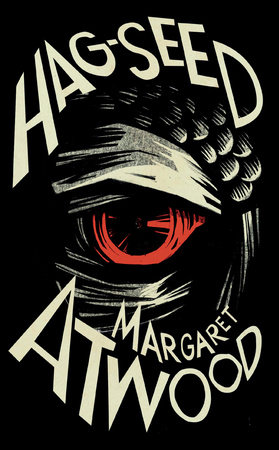
So says Felix's figment daughter Miranda of her father, who's staging The Tempest at a local correctional facility and casting himself as Prospero. Hag-Seed, like The Tempest which it retells, is about vengeance, that most noble of acts.

I'm an Atwood fan from way back — 30 years now. I'm more familiar with Atwood than I am with Shakespeare. Sure, I like Shakespeare as much as anyone does — I acknowledge his genius even if I don't always recognize it. But Atwood never fails to disappoint. Noble Atwood sprouting devourable fiction.

The reviews of Margaret Atwood's Hag-Seed: The Tempest Retold are quite boring in their consistent and unsurprising praise for her wit and overall skill. There is nothing, absolutely nothing, to find fault with. That may not sound much like praise; more like the absence of criticism. It's a relatively compact, near-perfect novel.

So I'm not sure what I can offer you by way of review. I give you this.

You don't need to know anything about The Tempest to enjoy Atwood's Hag-Seed.
I don't know The Tempest. I always assumed it must be cool, based on it being quoted by Laurie Anderson in Blue Lagoon; oh, and by Eliot in The Wasteland. I did see Peter Greenaway's Prospero's Books, but, visually and aurally stunning as it was, it can't be said that I understood it. I suspect that knowledge of Shakespeare's original would give the reader an added layer or two of appreciation, but it's not a prerequisite for reading this book.

I now want to see The Tempest staged.
More specifically, I want to see Atwood's version of The Tempest staged, just as she outlines the direction in this novel. A cloak of the pelts of stuffed animals, heads and all, nightmarified Disney princess puppets, rap musical numbers. Sounds awesome. (A couple reviews nitpick that Atwood's rhymes are substandard. I didn't find them out of place.)

Atwood is a master of language.
One character is described as "a diagram of woe." I love that. Her passages may not be liltingly beautiful, but they are crafted to great effect.
There's a click. The door unlocks and he walks into the warmth, and that unique smell. Unfresh paint, faint mildew, unloved food eaten in boredom, and the smell of dejection, the shoulders slumping down, the head bowed, the body caving in upon itself. A meagre smell. Onion farts. Cold naked feet, damp towels, motherless years. The smell of misery, lying over everyone within like an enchantment. But for brief moments he knows he can unbind that spell.
Atwood is a skilled storyteller.
While reading Station Eleven, by Emily St. John Mandel, I kept thinking how much it felt like a Margaret Atwood novel, just missing some unpindownable something that would make it great and lasting. So it was interesting to read Atwood so shortly afterwards. Both novels cover the production of Shakespeare. I know it's not fair to compare them — these books set out to do very different things. But I keep trying to figure out, what is it in Station Eleven that reminds me so much of Atwood, and why it falls short of Atwood. Atwood's Hag-Seed is clearly focused and controlled. Maybe this: maybe Station Eleven is trying to be bigger than it needs to be; Hag-Seed is only as big as it needs to be and is careful not to let anything else in.

This book teaches me a new way of reading.
Hag-Seed is a lesson in how to read critically, and this evolves quite naturally out of the context, is never didactic. Felix teaches the prisoners how to read — really read — The Tempest: what do the words mean, what do they really mean, what do they say about the characters who speak them, what is the nature of these characters, human or otherwise, what makes them who they are, why do they do what they do. What happens to them when the play is done? Felix asks his actors to imagine their characters' lives after Shakespeare leaves off. What happens after can inform what happened before. I'm not overly interested in close reading, I read novels for fun, but I think the best works of literature inspire these questions anyway, leading readers to run away with their thoughts. Shakespeare does it. Atwood too.

Atwood on rewriting The Tempest in The Guardian:
The last three words Prospero says are "Set me free." But free from what? In what has he been imprisoned?

Sunday, October 16, 2016

Too much shit is monotonous

The theatre class at the correctional facility has a rule about swearing: the prisoners must "limit" themselves to the curses used in the play at hand, in this case Shakespeare's Tempest.
Bent Pencil takes the floor and reads out, gravely and impressively, in his best board-meeting voice: "Born to be hanged, A pox o'your throat. Bawling, blasphemous, incharitable dog. Whoreson. Insolent noisemaker. Wide-chapp'd rascal. Malignant thing. Blue-eyed hag. Freckled whelp hag-born. Thou earth. Thou tortoise. Thou poisonous slave, got by the devil himself. As wicked dew as e'er my mother brushed, With raven's feather from unwholesome fen, Drop on you both. A south-west blow on ye, And blister you all o'er. Toads, beetles, bats light on you. Filth as thou art. Abhorr'ed slave. The red plague rid you. Hag-seed. All the infections that the sun sucks up, From bogs, fens, flats, fall on — add name here — and make him, By inch-meal a disease. Most scurvy monster. Most perfidious and drunken monster. Moon-calf. Pied ninny. Scurvy patch. A murrain on you. The devil take your fingers. The dropsy drown this fool. Demi-devil. Thing of darkness."

"Well done," says Felix. "That sounds fairly complete. I can't think of anything you've missed. Any questions or comments?"

"I been called worse," says PPod.

[...]

"I got one," says Shiv. "One question. Is 'shit' a curse word? Can we use it, or what?"

It's a fine point, think Felix. Technically, "shit" might not be considered a curse word as such, only a scatological expression, but he doesn't want to hear it all the time. Shit this, shitty that, you shit. He could let them vote on it, but what's the point of being in charge of this motley assemblage if he refuses to take charge? "'Shit' is offbounds," he says. "Adjust your cursing accordingly."

"'Shit' was okay last year," says Leggs. "So how come?"

"I changed my mind," says Felix. "I got tired of it. Too much shit is monotonous, and monotony is anti-Shakespeare."
—from Hag-Seed, by Margaret Atwood.

And I am cursing my family (most lovingly) for having descended on me this past week, leaving me no time to read.

Tuesday, October 11, 2016

Nobel thoughts

The 2016 Nobel prize in literature will be announced Thursday, October 13.

New Republic gives a rundown of who's in the running, in full awareness that there are more factors at play than merely the quality of the work.

I've been rooting for Adam Zagajewski for several years. Because Polish poets rock. But his rank has been slipping, and another Eastern European after Alexievich is unlikely.

Adonis has been favoured by the odds for about a decade now. This choice would not surprise me. I'm not very familiar with his work; it doesn't really speak to me. Poetry's like that.

Haruki Murakami would be disappointing. Entertaining as his books can be, I think he lacks depth.

Margaret Atwood is deserving. I'm surprised she didn't win years ago, but as a Canadian she may have several more years to wait.

Ursula K. Le Guin would be awesome. It may be America's turn, but perhaps she's too genre.

Elena Ferrante would be an inspired choice, an opportunity for the committee to send a message about privacy rights, women's rights, or the intersection of truth and fiction. No odds listed just a few days ago, but now she does.

Currently leading Ladbrokes at 4/1: Kenyan writer Ngugi wa Thiong’o — completely unknown to me, but he has the right geography to be a winner this year.

But the odds are changing daily. The Guardian covers some of the movement.

Thursday, August 27, 2015

O virtuous Atwood! Virtuous beer!

Great Canadian novelist, environmental activist, inventor, poet. Margaret Atwood is also a brewmaster.

A colleague stumbled across some NooBroo at a local dépanneur, and picked up a bottle for me. I couldn't be more chuffed (any chuffier?)!

Beau's All Natural teamed up with Margaret Atwood and Graeme Gibson to create MaddAddamites NooBroo, inspired by Atwood's novel MaddAddam and including many of the botanicals noted therein. Proceeds support the Pelee Island Bird Observatory.

According to the brewery website, "Atwood personally tasted and selected the bouquet of botanicals included in this delicate, delicious gruit." She describes it as, "Fresh and spring-like, confident and down-to-earth yet inspirational, rooted in the wild world of foraging and gathering."

Also: most excellent label. I especially love the bee. (Why yes, that is a wind-up frog sitting in the background on my desk at work.)

However, my daughter has raised a concern: she thought K~ was simply showing me the bottle, hadn't realized K~ gave it to me. And now I can't sleep because it seems to me I must've got it wrong. Just last week K~ was offering a taste of the honey her father had made, er, harvested, to the bossman at work, and he mistakenly claimed the whole jar. And so with NooBroo, I couldn't just admire the concept and the packaging; I had to take it, I have to drink it.

I have not yet sampled the brew. Quite in addition to clarifying the issue of ownership, I believe the gruit requires a leisurely weekend to serve as an excellent accompaniment to some fine literature. Perhaps it shall wait even, for The Heart Goes Last. (No, I don't think it can wait that long. Atwood's new novel comes out at the end of September.)

Sunday, May 11, 2014

The future of reading

Today's episode of Spark on CBC Radio focused on the future of reading in the internet age. How, generally, the rhythm of our lives and the rhythm of deep reading no longer intersect.

Listen online:

Robotics in work and life: Margaret Atwood on robots and AI.

Bite-sized reading: Rooster, an app that breaks down novels into easily digestible bite-sized chunks.

Scanning and skimming: It turns out we do read differently whether text is on screen or on paper. A conversation with Maryanne Wolf, neuroscientist and author of Proust and the Squid. One of the points made is that reading is not a natural thing — it's totally learned. So internet reading feeds our predatory/preservationist instincts for watching, searching, jumping, quick processing. "The quality of our attention is a mirror of the quality of our thought."

Social reading: The idea of "social reading" is not for me — I read alone, I don't want to be intruded upon. But this segment is about a story-sharing app, Wattpad. Of course stories are a social phenomenon, and this app seems to be about engaging with people who want to tell them.

With commentary by bookfuturist Tim Carmody.

The 53-minute podcast is worth a listen. . . or you may wish to spend that time reading instead.

Saturday, April 05, 2014

Closing the circle

The Circle, by Dave Eggers.
I mean, all this stuff you're involved in, it's all gossip. It's people talking about each other behind their backs. That's the vast majority of this social media, all these reviews, all these comments. Your tools have elevated gossip, hearsay and conjecture to the level of valid, mainstream communication. And besides that, it's fucking dorky.

Like, smile, favorite, zing, tweet, thumbs up, vote up, recommend, pin, forward, plus, doubleplusgood.

Recommended for anyone who has ever tweeted, messaged, sent an email, answered a customer survey, reviewed, commented, posted a status update, joined a community.

Reviews

Bookpuddle:
Society buys into the idea that ever increasing levels of "transparency" are of ultimate benefit to all. The Circle implements what sounds like great ideas at first — politicians that wear cameras on them at all times, criminals that are easily identifiable in a crowd, children that can never be abducted because they are instantly trackable via GPS, etc., — but along the way, all personal freedoms are one by one jettisoned, and the reader is faced with seeing (literally) what it would really be like to be at all times monitored, and "known" by anyone else who wanted to observe what you were up to.

So Many Books:
The Circle was a page-turner, the horror of watching Mae get sucked into the hivemind is delicious.

Betsy Morais: Sharing Is Caring Is Sharing, The New Yorker
But even without the searing wit of "1984," the book is capable of landing on point—when it's at its most irksome. Where "1984" has the vigilant Police Patrol and Thought Police, "The Circle" has SeeChange and Clarification. Surveillance isn't a bad word; it's a gift, even a human right.

Margaret Atwood: When Privacy Is Theft, The New York Review of Books
The nineteenth-century art critic John Ruskin—who famously said, "Tell me what you like and I’ll tell you who you are"—viewed bad taste as a moral offense, and the young Circlers subscribe to this dogma: nothing gets you the brushoff more quickly than a pair of uncool jeans. Utopia, it seems, is an awful lot like high school, but with even more homework.

Ellen Ullman: Ring of Power, The New York Times
She is more a high school mean girl than an evil opponent. Perhaps this is what Eggers wants to say: that evil in the future will look more like the trivial Mae than it will the hovering dark eye of Big Brother.

Saturday, December 21, 2013

Telling the story is hard

"I am writing the story," she says. "The story of you, and me, and the Pigoons, and everyone. I am writing about how we put Snowman-the-Jimmy and Adam One into the ground and Oates too, so that Oryx can change them into the form of a tree. And that is a happy thing, isn't it?"

"Yes. It is a happy thing. What is wrong with your eyes, Oh Toby? Are you crying?" says Blackbeard. He touches her eyebrow.

"I'm just a little tired," says Toby. "And my eyes are tired as well. Writing makes them tired."

"I will purr on you," says Blackbeard.

Among the Crakers, the small children do not purr. Blackbeard is growing quickly — they do grow faster, these children — but is he big enough to purr? Apparently so: already his hands are on her forehead, and the mini-motor sound of Craker purring is filling the air. She's never been purred on before: it's very soothing, she has to admit.

"There," says Blackbeard. "Telling the story is hard, and writing the story must be more hard. Oh Toby, when you are too tired to do it, next time I will write the story. I will be your helper."

"Thank you," says toby. "That is kind."

Blackbeard smiles like daybreak.

MaddAddam, by Margaret Atwood, is a most satisfying conclusion to the near-future postapocalyptic scenario laid out in Oryx and Crake and The Year of the Flood. But I think you do really need to read the first two books to fully understand the dynamics of this one.

This volume gives Zeb's backstory, and through him, the story of Adam One.

MaddAddam is funny, mostly in its depiction of the Crakers, the naïve genetically engineered humans, as they are beginning to undergo evolution, at least of a social and cultural sort as they learn from the surviving "natural" humans and develop a mythology of their own. And it seems that the future of humanity depends on their interbreeding.

The characters are wonderful — genuine and sympathetic if not always likeable. While the first two volumes set the stage of this new world, its creatures, environments, and issues all reasonably extrapolated from science that is being performed today, this volume, in my view, now that the world-building is done, is simply about a group of (somewhat misfit) survivors trying to get along and cope with a (very) tough situation. The first two might be considered cautionary; this book, remarkably, is unabashedly hopeful.

It made me smile like daybreak.

Thursday, December 05, 2013

All best, Margaret Atwood

What a remarkable lady!

Last night I saw Margaret Atwood at the Rialto. One can't always be sure what one is going to get when an author makes an appearance; expectations aren't always properly set*, and so much depends on the author's personality, the venue, the crowd's energy. Chances were good this would be good. But Atwood was brilliant. I think she must always be brilliant. (I have seen her before, and she's always been brilliant.)

*I made the trek last week to see Chris Hadfield, but was disappointed to find it was a signing only — no reading, no musical number, no magic tricks I mean science experiments, just some dumb astronaut signing your book, I mean oh my gawd I shook an astronaut's hand and his handshake is so firm and he signed my book! But you see my point, I hope.

She started off singing, a hymn from The Year of the Flood. She is by no means an extraordinary singer, but she sings just fine, loud and proud. She actually sang! And cracked that some people really do tell her to keep her day job.

And she read, from MaddAddam, the recently released third book in the speculative trilogy that began with Oryx and Crake. I only started reading the book a few days ago, and in a happy coincidence, she read the section that I had just arrived at (she read pages 106 to 109).

And then she talked. With the very personable Sheila Heti (whose work I have not read, but I intend to someday). That's them in the picture above. (Really.) They chatted (well, mostly Peggy chatted, while Sheila prompted) about the power of storytelling, and what parts of the brain light up when engaging in narrative, indicating that it's a basic thing in humans, along with language, music, rhythm, not like algebra or reading for that matter.

Also edible body products (when the apocalypse comes, go to the spa), cats (everyone knows that one of the most useful things to do for a migraine is to put a purring cat on your head; science has yet to figure out how to keep it there), the future (and extrapolating toward it), Menippean satire (but the world is moving so fast, satire has to push farther to keep up), the Amazon drones (if she'd included that technology back in the day of Oryx and Crake, it would've been considered beyond belief), Archie comics, Northrop Frye, origin stories and the tendency to mythologize (which comic books and science fiction are particularly great at). And other stuff.

Oh, right, and a bit about the book: how God's Gardeners mix scripture, nature, and science with imperfect results; the nature of the Crakers (in their society there would never be a book by Sheila Heti called Women in Clothes); why Jimmy is reluctant to share his story — he cannot envisage a reader — contrasted with Toby, who can, which is hopeful.

She entertained questions from the audience: She advised against hallucinogens as a writing aid, affirmed that social media is good for literacy (citing Smarter Than You Think), commented on Rob Ford (Toronto is paying for its great sin of puffed-uppedness), and scoffed at the idea of writing exercises (you mean like summer camp? let's pretend to be a triangle).

Also she said some smart things about the control (or lack thereof) the author has over the reader. You never know who your readers are going to be. A reader doesn't want to see Austen pulling the puppet strings; the reader would much rather sit and listen to Mr. Darcy. As for authors connecting with their audiences, well, isn't that what the book is for?

And she signed my book! (Which I must hurry up and finish reading this week.)

Check out Margaret Atwood's website; it will lead you to new and interesting places. Also, know that there's a MaddAddam app, the game Intestinal Parasites (which I'm downloading this very minute).

Thursday, August 29, 2013

Its humane manner

Margaret Atwood's Maddaddam includes a marvelous typography note honouring Walbaum, #17 on a list of the 100 best typefaces of all time. I'm wishing Atwood would write an account of the circumstances concerning the great mystery of its designer.

Monday, January 14, 2013

Indebted

I watched Payback yesterday, the documentary based on Margaret Atwood's book — Payback: Debt and the Shadow Side of Wealth — that served as the 2008 Massey Lectures (a book I believe I have a copy of, but have not read).

It covers the notion of debt, but primarily non-monetary debt: paying one's dues, paying for one's crimes — a debt to society.

This film looks at some particular cases: a code of family honour and revenge in an Albanian village, one man's time in prison for breaking and entering and his guilt for the seemingly irreparabe damage he did to an old lady's sense of security, the 2010 Gulf of Mexico oil spill, and the working conditions of Mexican migrant tomato pickers in Florida. Conrad Black and Raj Patel have supporting roles.

The pacing's a bit slow (I've seen better documentaries lately, for example, Freakonomics), and it doesn't cover the material I'd expected to (I've read better treatments of the subject, like the anthropoligical persepective in David Graeber's Debt: The First 5,000 Years, which I admit I haven't yet read the whole of).

The movie finally comes together for me when the concept of debt, or payback, is rephrased as making reparation — what sets the balance right again. Money, time, spiritual penance? And of course there will be differing views on whether a debt has been settled depending on whether you're talking to a labour lawyer, a victim of crime, a priest, etc.

What makes this movie interesting to me, though, is that I watched it against the backdrop of a weekend in which I was immersed in Lilith's Brood, a trilogy by Octavia Butler in which extraterrestrials salvage humans and other species after Earth's nuclear destruction. The Oankali restore the humans and the planet, and restore them to each other, kind of.

The book makes me think of debt insofar as it questions: what do we owe our planet, our species, other species; to what do we owe our humanity (and how much of that debt is cultural versus genetic); to what extent would we owe someone or something for saving our life (or saving our species) and at what price?

That's fairly superficial, but there's something else too. I get the feeling we wouldn't have a sense of debt if there weren't a sense of honour or pride which could be injured. And that sense can originate within an individual, a family, a community, a species — any debt we feel is based in the thing, the unit, the code to which we feel allegiance.

So suddenly, this little science fiction trilogy is about a lot more than repopulating the planet — it's become socioeconomic. The Oankali call themselves a species of traders — they trade in knowledge and genetic material. A communal species with high intelligence, they claim their primary sense of debt is to the preservation, or continuity, of life.

Monday, September 28, 2009

Saint Peggy

Margaret Atwood rocks!

I have to admit, I had a tough time at first giving myself over to her new novel, The Year of the Flood — it was exactly the wrong mood to follow my other recent reads. And I felt like I was somehow morally obliged to like this book.

I've already mentioned how awed I was by the marketing machine moving this book. I wonder how much the average reader feels it though. I'm coming to think I see it only because I'm already plugged into those channels, the blogging and the twittering and the books pages.

The more it goes, the more I see it less as marketing and more as... I don't know... something between style and lifestyle. It's less directly about buy this book and more about here's some interesting information about urban bee-keeping, which has only a very little to do with the novel as a whole.

So the whole promotional angle is pretty unique and turning out to be pretty powerful, I think. I guess one can't really go wrong when publishing a Margaret Atwood novel, so there's a lot of creativity and freewheeling energy about it. How refreshing that the author tour is not a staid reading of an excerpt in some awkward space of a big-box bookstore; it's an enactment, an event. (Now let's promote lesser-selling authors this way!)

I find myself since closing this book putting light around people. And generally feeling kind of, well, floaty and flaky, kind of hippy, like I should get back to the earth. Not that I would actually give up eating red meat or anything.

But it's like this. I loved this book. I think my initial hesitation, my scepticism about this book is, in a way, built into the novel's structure. The two main viewpoints we follow are those of Toby and Ren, each of whom is brought into the fold of God's Gardeners in less than ideal circumstances, and in no way due to their having found anything remotely like God. They are grateful for the kindnesses but irreverent as concerns the core beliefs. They're basically good people, but they find the work of the Gardeners laughable; they're there by accident. But in the end, they're really more "Gardener" than any of them, in spirit and in practice. And I feel like that kind of describes my relationship with this book.

Do I need to tell you anything about the premise? The near future, gene-spliced creatures roaming the landscape, society fractured into haves and have-nots, the haves generally working for and living in the compounds of biotech corporations. The world is seeing various ecological disasters, resulting in migrations and the breakdown of social and economic structures. (Did anyone see Earth 2100? Kind of like that.) And there's a Plague, one following many caused by mutated viruses, that devastates the human population. Oh, do I love a dystopia!

In case you don't already know, Margaret Atwood is sharp. Throwaway lines are loaded with sociopolitical commentary:

[...] but I also had to do something so I might as well get an education. That's how they talked about it, as if an education was a thing that you got, like a dress.


She can be laugh-out-loud hilarious:

Bernice said the West Coast was perfect for that because although they all did stuff like yoga and said it was Spiritual, they were really just twisted, fish-crunching, materialistic body-worshippers out there, with facelifts and bimplants and genework and totally warped values.


And she still has everything of the philosophical poet about her:

There was a close-up of her dead face, looking more gentle and peaceful than I'd ever seen her look in life. Maybe that was the real Bernice, I thought — kind and innocent. Maybe she was truly like that inside, and the fighting we used to do and all her sharp and unpleasant edges — that was her way of struggling to get out of the hard skin she'd grown all over herself like a beetle shell. But no matter how she hit out and rage, she'd been stuck in there. That thought made me feel so sorry for her that I cried.


I love the ease with which she transcribes the cadence of a woman's mind. I became aware of this particularly with Cat's Eye, but it's probably there in her earlier novels too. (I studied Surfacing in high school, and that put me off early Atwood, but maybe I'll go there again some day.) Maybe it's because I'm female, and Canadian, and living in this time, that I relate to how Atwood writes, but I think it's something very special, and it's not a matter of how she captures dialogue, though she does that too, but really of grasping the flow of thoughts.

Notable reviews
Ursula K LeGuin, in the Guardian:

The personality and feelings of characters in Oryx and Crake were of little interest; these were figures in the service of a morality play. The Year of the Flood is less satirical in tone, less of an intellectual exercise, less scathing though more painful. It is seen very largely through the eyes of women, powerless women, whose individual characters and temperaments and emotions are vivid and memorable. We have less of Hogarth and more of Goya.


(I wasn't a big fan of Oryx & Crake, by the way. Some interesting ideas, but as a novel it was a little cold. I am now, however, really keen to revisit it. (TYOTF can be read and enjoyed independently of O&C.))

Jeanette Winterson, in the New York Times:

As ever with Atwood, it is friendship between women that is noted and celebrated — friendship not without its jealousies but friendship that survives rivalry and disappointment, and has a generosity that at the end of the novel allows for hope. Atwood believes in human beings, and she likes women. It is Toby and Ren who take the novel forward from the last page, not the genetically engineered new humans.


(Right. Did I mention? Genetically engineered humans!)

About the roadshow
The Guardian
Bookpuddle

Podcasts
The Next Chapter.
Q, September 18, 2009, in which Atwood asks Jian Ghomeshi if he even knows what a hippie is (God's Gardeners are not them).

Give thanks to Saint Peggy for clear-sighted literature! Let us sing!

Tuesday, September 01, 2009

Generosity abounds

Every day, the last few weeks, I rush to check the mailbox. I've been waiting and waiting and waiting.

Amid the usual bills and flyers I've had a couple nice surprises — for example, review copies of Nick Hornby's Juliet, Naked (I like most of his other novels better than this, but still breezy and delightful) and Margaret Atwood's Year of the Flood (slowgoing, so far — I'm not in the right headspace for it, but maybe the upcoming cottage weekend will resolve that).

But I've been waiting for something in particular. And yesterday it came!

I pulled it out of the mailbox, and when I recognized the publisher's address, the world ceased to exist. "Oh my god oh my god oh my god" as I carried it reverentially into the house. Bag dropped off my shoulder, I let other mail slip to the ground. Child babbling incoherently in an auditory distance (she's right beside me, but she sounds like I'm underwater). My fingers fumbling at the pull tab. J-F said "You look like a junkie who just scored 10k of crack-cocaine. Do they send that by mail?" They do. It is.

Richard Powers' Generosity, about the genotype for happiness.

The blurb asks us, "What will happen to life when science identifies the genetic basis of happiness? Who will own the patent? Do we dare revise our own temperaments?"

I've been grappling with the problem of happiness for some 30 years. I think this feeling — when you open the mailbox and find an advance reading copy of a novel with an astounding premise that taps one of your own life obsessions by a guy who wrote one of your favourite books of all time — is something akin to it.

Tuesday, August 18, 2009

The waterless flood

Margaret Atwood has a new book coming out in a few weeks, The Year of the Flood, the website for which launched this weekend.

The new novel is a simultaneouel in relation to the dystopian Oryx and Crake, featuring some of the same characters in an overlapping timeframe. I look forward to reading it, and I expect I'll be revisiting some of O&C as I do so.

(Read an excerpt from The Year of the Flood.)

The new website is a marketing marvel. Beyond promoting the book, a CD of associated "hymns" (lyrics by Atwood, and which figure in the novel), and related merchandise (t-shirts and totebags), it's selling environmental awareness.

Part of me is sceptical. Ultimately, it's all about selling books. But it's commendable that Atwood is taking her message (whatever exactly it might turn out to be) quite seriously, and putting her money where her mouth is.

For example, in embarking on tour to promote the book, she's publicly pledging to keep her carbon footprint to a minimum (she's taking a boat to England!), stay only in hotels that have environmental policies, and avoid bottled water.

Among the many links of interest on this website, two in particular caught my eye:

Victimless leather. Grow your own! Not sure how I feel about this. We've so much moved away from adorning ourselves with leathers and furs that being able to grow your own brings us back to a world where it's valued. I can see this encouraging poaching among those who can't afford the genetic synthetics.

Ecoburial. This is totally the way I want to go. Turned into dry pink crumbs, for easy and safe composting! Read about the environmental drawbacks of both cremation and traditional burial on the Promessa website.

Atwood will be blogging while she's on the road.

(You can also follow her on Twitter, where she repeatedly proves just how funny she is, in 140 characters or less: "I made a typo [...] 'Imperonating' is pretending to be Evita." "Good thing not me in charge of world!")

Now just to see what The Year of the Flood is actually about...

Wednesday, October 22, 2008

Debt

The 2008 Massey Lectures are under way. Margaret Atwood speaks about "Payback: Debt and the Shadow Side of Wealth."

These are not lectures about how to get out of debt; rather, they're about the debtor/creditor twinship in the broadest sense — from human sacrifice to pawnshops to revenge. In this light, what we owe and how we pay is a feature of all human societies, and profoundly shapes our shared values and our cultures.


She presented part 4 of the series the other night here in Montreal. (When I first heard tell of it weeks ago, the event was already sold out.)

The lecture, titled The Shadow Side, [. . .] took on the subject of debt in the philosophical and literary sense, with references to Machiavelli, Charles Dickens and, most thoroughly of all, William Shakespeare. (You didn't have to be a seer to guess Shylock would show up somewhere. Her rigorous analysis of how anti-Semitism is rooted in historical concepts of debt was breathaking [sic].)


The lectures will be broadcast on CBC, November 10–14. Or you can read them.