Showing posts with label Vasily Grossman. Show all posts

Saturday, April 21, 2012

Reeling from the rot

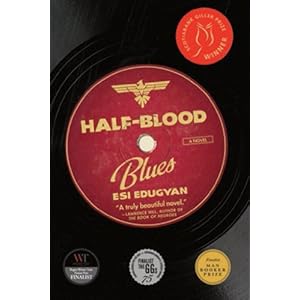
Esi Edugyan is the author of Half Blood Blues. Her second novel, it won the 2011 Giller Prize and was a finalist for several other awards, including the Governor General's Award and the Booker. I have not read this novel yet, but it's been on my list owing to the endorsement given it in Kim's review at Reading Matters.

This afternoon she was interviewed on stage by Shelagh Rogers, and Shelagh asked the question that I'm sure is on everybody's mind: "Did The Wire have anything to do with this book?" The answer is No.

Shelagh asked because some of the characters hail from Baltimore, and there's something in the clip of the language in that television program and in this novel that's similar. Esi later came back to The Wire actually, in talking about the time she lived in Baltimore, that it's a city of stories, if you get into a cab you're going to hear a story, and that it's weird, and well, very much like it's depicted in The Wire (a show I've never seen, but which comes highly recommended — maybe I'll start watching it tomorrow).

The novel is about a group of jazz musicians in Nazi Germany. Today's conversation discussed some of its themes: whether talent is "god-given" and how it differs from genius; the black experience in the Weimar Republic and the seeming randomness and sometime contradiction in its laws with regard to... what's the correct term here? non-Aryans? (for example, a Jewish teacher was fired and replaced by an African-German teacher); the nature of friendship, how people slip into patterns in any relationship, and whether friendship can withstand betrayal (of which there's some in the story); how creativity thrives (or not) under an oppressive regime; how we define and establish identity, whether by blood or geography (which reminds me of some of what Vasily Grossman had to say in Life and Fate).

It's clear that Esi did a lot of research in writing this novel, on the dialect and slang, on Berlin, on jazz, the politics and the day-to-day circumstances of the time, on Louis Armstrong. She admits that several elements (what Louis said, or some of the slang terms) may not be true to life, but she feels no qualms about this because she believes them to be true to the spirit. (When she was taking journalism classes she shied away from doing interviews for her assignments to the point of making up quotes — a sign, I think, that fiction was a better career choice.)

I picked up a copy of the book and had it signed afterward, and felt like an idiot for having nothing to say, just "I hear it's really good," which may be the dumbest thing I've ever said to an author. But truly, I'm more eager to read this now after having heard her — she's thoughtful in her responses, seems very sweet and honest if shy, and really does have a lot to say about all sorts of things.

Excerpt from Half Blood Blues:
Chip told us not to go out. Said, don’t you boys tempt the devil. But it been one brawl of a night, I tell you, all of us still reeling from the rot – rot was cheap, see, the drink of French peasants, but it stayed like nails in you gut. Didn’t even look right, all mossy and black in the bottle. Like drinking swamp water.

Wednesday, October 19, 2011

Life, fate

Life and Fate. Sounds big, deep, sprawling. It is.

Life's a mess. Really there's no getting around it. You make plans, they go wrong. You make other plans, they go wrong in a different way. After much consideration I've come to the conclusion that life has a multiplicity of different ways in which things can go wrong. Incidentally, my father's a physicist and is very keen on things like multiplicity, which is how we ended up a million miles from Moscow in Kazan, because he was working on something important for the war. The War. Now there you have a serious example of things going wrong. However, because of it, we socialists had a real chance to show the world what we were made of, which is steel. Ask Comrade Stalin. My mother is not a scientist. She believes in fate. But it seems to me that in the end fate is just as messy and hard to live with as life.
— from Life and Fate, by Vasily Grossman, a BBC4 dramatization.

So here's a book I had absolutely no interest in reading. I knew a little bit about its history (written in 1959 and banned in the USSR and not published there till nearly 30 years later), and a little about it's subject matter (life — and the lives of some Russian Jews in particular — in Stalinist Russia during World War II). I don't find either point very compelling — I've had my fill.

But then this radio dramatization caught my ear, and I was hooked. As it stars Kenneth Branagh and David Tennant, you could say the production is of decent quality. I have trouble with audiobooks and radio plays in general in that they tease me into believing they're conducive to multitasking. But I can't do it. If I'm to get anything out of them, I need to give them my attention, at which point I figure I might as well just read the book. I ended up listening to most parts of this drama twice, to ensure I had the characters and events straight, but I was very glad to do so.

Some of the early great lines include: "How could I talk to a woman who thought Balzac wrote Madame Bovary?" and: "A way to a Russian's heart is through his brain."

As you might guess from the book's title, there's a great deal of philosophizing going on.

Identity's one of the major themes. There's a passage I went back to — it turns out it was just a short sentence, but in my head it had expanded into something unwieldy. I can't recall the original phrasing, but its sense was that the woman hadn't ever really thought of herself as Jewish; she went to Russian school, had Russian friends, played Russian games, read Russian books — of course she was Russian. (This is something I actually spend a lot of time thinking about, albeit with regard to identities other than Jewish and Russian.)

There's some similar musing about science. That there's no such thing as Stalinist science, or Jewish science, etc, it's just science, that's all, but of course not everyone sees the world this way. Isn't that mind-boggling? That someone could dispute your science because it wasn't Soviet enough?

Then there's love.

I wanted to tell him everything, and I told him nothing at all. I wanted to ask him everything, and I asked him about eating black bread. Is it possible to lose everything because we don't speak when we must? I was an idiot...

[Oh, I have been an idiot. Listening to this production is an emotional double-whammy these days, for what it is and for the real life it reminds me of.]

It's quite a drama. There are funny bits, and poignant bits, and clever bits, and bits that made me cry. There's a lot about doing the right thing, and a lot of "if we only knew," and of course we never do, which makes it all the harder.

Some people see it as a counterpart to Tolstoy's War and Peace. I think there's more war, and less peace, in Life and Fate. Maybe only it seems more brutal because these historical events are closer in time. But the comparison captures the right sprawl, and there's a similar quality of introspection.

The radio drama leaves some plot points unresolved. Perhaps they are treated this way in the book as well. I'm tempted to find out.

The BBC4 Life and Fate page has a couple video clips featuring Kenneth Branagh and David Tennant, on the story but also on the nature of radio drama, as well as some other background material. Apparently the podcasts are no longer available for download, but if you ever come across the opportunity to give them a listen, take it.

Reviews
The Economist
The Times Literary Supplement