Showing posts with label jazz. Show all posts

Tuesday, May 19, 2020

Close-packed human chaos

Writing, I'm convinced, is often nothing but revenge — a way of twirling one's mustache, donning buckler and sword and feathery hat, shaking one's gauntleted fist at the gods.
I thought I could use some laughter in dark times; Geoff Dyer's recommendations of funny books came just when needed. He reminded me that I've been meaning to read Eve Babitz, but of all the books he listed, the library had only Terry Castle.

I got off to a rocky start with The Professor and Other Writings. This collection of essays opens with a piece on World War I, which I found neither funny nor particularly interesting, so I was a little wary of what I'd gotten myself into.

While I wouldn't call these essays funny exactly (certainly not in an uproariously side-splitting way), Castle certainly knows how to tell a story.

There's a piece on Susan Sontag, about whom I know shamefully little, and pieces about Agnes Martin and Art Pepper, about whom I'd known nothing at all (and now want to know more).
I realize there may be a few lost souls who've never heard of him. Forget the overrated (and vapid-looking) Chet Baker. Art Pepper (1925-1982) was an authentic American genius. One of the supreme alto saxophone players of all time, Charlie Parker included. A deliriously handsome lover boy in the glory days of his youth. A lifelong dope addict of truly Satanic fuck-it-all grandeur. A natural writer of brazen, comic, commanding virtuosity. A proud long-term denizen of the California prison system. And now, no doubt, a tranquil if desiccated corpse.
In "Home Alone," Castle shares her "shelter mag obsession" and highlights how the industry was traumatized by 9/11, when the idea of "home" was attacked and our sense of "sanctuary" threatened. She later turns a bit morbid considering the furnishings of death and evokes the avian-flu epidemic of 1918-19, noting that bird-to-human influenza viruses were much in the news at the time of writing in 2006. It was somewhat eerie to be reading this against the backdrop of quarantine. In 2020, with virus on all the airwaves, home is our only safespace — it is our office and our entertainment and it circumscribes our whole life. Remind me to check out a home decor magazine next time I pass the newsstand.

Ostensibly the star of the show, is "The Professor," about Castle's relationship with a teacher when she was in grad school. Perhaps because this essay is the longest and most personal, my feelings toward it are ambivalent. It's got some great lines: "Cathy and Heathcliff were like old acquaintances — my weird second cousins or something." But it is also self-indulgent — Castle's old journals are a springboard to the 70s, an emotionally juvenile time. The drama of the affair feels out of proportion, despite the morally questionable behaviour (a student-teacher relationship of this sort today might be judged much more harshly).

Castle's lesbianism is a constant presence, and if not central, then certainly significant to some stories. It made me wonder to what extent is my sexuality present in my writing, even when not the subject of it. Castle's references throughout to therapy also has me reconsidering whether I should give psychotherapy another try. (Why should I? What is it that fascinates me? Why do I feel I'm not good at it? Why do some people get so much from it, and why can't I be one of them?)

All in all, this is the kind of book I'd prefer to have in print, to pick up and browse at my leisure. A bookful of Castle is a lot of Castle. Were this not a library book with a due date, I'd've approached it differently. I'd rather take an essay at a time now and then.
Sometimes in raucous old bebop recordings from the late forties — the grotty straight-ahead bootleg ones with murky nightclub sound, people talking and glasses clinking in the background — the music doesn't end properly, with the usual reprise and nail-it-down final chord. It just breaks off abruptly in the middle of a solo or chorus as if someone had knocked over the mike. You're left with the sense of a close-packed human chaos, now terminated. Art Pepper is a kind of mannequin or decoy, I guess, the sort of mummified icon that even a person as terrified by mortality and other people as I am can latch onto and worship. It's true: I love his deftness and valor and craziness, and the exorbitant beauty of his playing. I love the quick, creamy sound he gets out of his alto. I love his shame-free storytelling. I love his handsome young male face.

Tuesday, February 05, 2013

When the curtain comes down


If you are rich, if you are poor
It's all the same I'm sure...

Saturday, April 21, 2012

Reeling from the rot

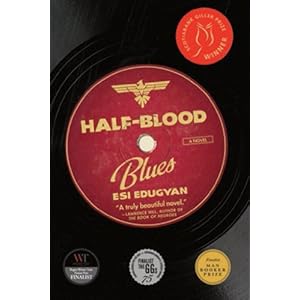
Esi Edugyan is the author of Half Blood Blues. Her second novel, it won the 2011 Giller Prize and was a finalist for several other awards, including the Governor General's Award and the Booker. I have not read this novel yet, but it's been on my list owing to the endorsement given it in Kim's review at Reading Matters.

This afternoon she was interviewed on stage by Shelagh Rogers, and Shelagh asked the question that I'm sure is on everybody's mind: "Did The Wire have anything to do with this book?" The answer is No.

Shelagh asked because some of the characters hail from Baltimore, and there's something in the clip of the language in that television program and in this novel that's similar. Esi later came back to The Wire actually, in talking about the time she lived in Baltimore, that it's a city of stories, if you get into a cab you're going to hear a story, and that it's weird, and well, very much like it's depicted in The Wire (a show I've never seen, but which comes highly recommended — maybe I'll start watching it tomorrow).

The novel is about a group of jazz musicians in Nazi Germany. Today's conversation discussed some of its themes: whether talent is "god-given" and how it differs from genius; the black experience in the Weimar Republic and the seeming randomness and sometime contradiction in its laws with regard to... what's the correct term here? non-Aryans? (for example, a Jewish teacher was fired and replaced by an African-German teacher); the nature of friendship, how people slip into patterns in any relationship, and whether friendship can withstand betrayal (of which there's some in the story); how creativity thrives (or not) under an oppressive regime; how we define and establish identity, whether by blood or geography (which reminds me of some of what Vasily Grossman had to say in Life and Fate).

It's clear that Esi did a lot of research in writing this novel, on the dialect and slang, on Berlin, on jazz, the politics and the day-to-day circumstances of the time, on Louis Armstrong. She admits that several elements (what Louis said, or some of the slang terms) may not be true to life, but she feels no qualms about this because she believes them to be true to the spirit. (When she was taking journalism classes she shied away from doing interviews for her assignments to the point of making up quotes — a sign, I think, that fiction was a better career choice.)

I picked up a copy of the book and had it signed afterward, and felt like an idiot for having nothing to say, just "I hear it's really good," which may be the dumbest thing I've ever said to an author. But truly, I'm more eager to read this now after having heard her — she's thoughtful in her responses, seems very sweet and honest if shy, and really does have a lot to say about all sorts of things.

Excerpt from Half Blood Blues:
Chip told us not to go out. Said, don’t you boys tempt the devil. But it been one brawl of a night, I tell you, all of us still reeling from the rot – rot was cheap, see, the drink of French peasants, but it stayed like nails in you gut. Didn’t even look right, all mossy and black in the bottle. Like drinking swamp water.

Tuesday, July 05, 2011

Everybody had matching towels

The B52s closed the jazz festival tonight.

I don't know that they're jazz, but they are jazzy.

Glad I was there.

Saturday, July 03, 2010

Brave new jazz

Last night, we took in a show at the Festival International de Jazz de Montréal: John Zorn with Laurie Anderson and Lou Reed. Arguably, Lou Reed is the most recognized name in this trio, but it's actually the other two whose music I'm more familiar with.

Laurie Anderson holds a special place in my musical development. It was a thrill for my teenage-self to realize playing violin (which I did) didn't restrict you to Vivaldi. I saw her in concert back around 1989, and that was a "performance."

As for John Zorn, saxophone god, I stumbled upon the first of his Masada albums in 1994 (it was playing in the record store; I asked what it was, bought it on the spot), and I continue to regard it as my desert-island pick. We saw his Acoustic Masada at the festival a few years ago, and it was one of the most spectacular concerts, of any musical genre, I've ever seen, in terms of intensity and vitality.

Lou Reed? I don't know much about Lou Reed. Walk on the Wild Side. Sweet Jane. That thing in the Wim Wenders movie.

What to expect from this show? I didn't expect Zorn to be playing Velvet Underground tunes, Anderson to interpret Masada, or Reed to be singing Home of the Brave. (I admit I was a bit nervous, actually, having heard about Anderson and Reed's recent gig in Australia that was audible only to dogs.) I jokingly tweeted that this combination was something akin to, in lit terms, interleaving the pages of Julio Cortázar, William S Burroughs, and Nelson Algren. I think I'm not far off. It's a brave new animal I heard, growling its way into existence. (I learned after the fact that it was all improv.)

Preshow press conference with Anderson and Reed: This is really interesting, actually — I just listened to it — wrt Anderson's relationship to technology and approach to art in general. She talks about what you hear, as a violinist, happening right next to your ear, the grinding, the overtones and harmonics, how the synths are a way to bring that to the whole audience, to lay bare the machinery of the music. (But, no, Lou, there was no rock and roll.)

Reed contributed, I think, very little to the show, and compared with the others on stage, he seemed not invested in the music, not fully present. (He's also old, and not very mobile.)

Musically, Reed laid down a floor of sound, a kind of throbbing static, a loud white noise, over which Anderson and Zorn stomped and frolicked. Four guitars were onstage — he switched between a couple of them and put a few notes on sustain, but there was very little discernible guitar playing. For one piece his attention was entirely on the reddish panel in front of him — some kind of equalizer? synthesizer? sound board? but I couldn't see any knobs, keys, levers. It looked like he was operating it like a touch pad.

Two pieces in came the booing, "Play some music!"; Zorn suggested to those audience members who don't like to "get the fuck outta here." Allegedly, many people did.

[I couldn't help thinking that this was the perfect soundtrack to my current read (China Miéville's Kraken) — the squelch and roar of the end of the world through which strains this near-angelic tinkling, like delicate glass.]

It felt like being at the centre of a wet sponge — there's a heaviness, but with all these porous spaces teasing you through a labyrinth toward light and air.

Anderson and Zorn traded off between (some semblance of) rhythm and melody. Cacaphony at times, but ordered — Anderson kept time with her feet, Zorn slapped is sax.

I couldn't tell you what kind of violin Anderson was playing, how it differs from the traditional instrument (apart from being electric). What struck me, though, is that despite her musical evolution and reputation for avant-gardism, her playing was decidedly more traditional than ever; that is, although there were instances of her sliding her hand over the fingerboard from the left, and that sound when you play on the wrong side of the bridge, the execution of this improv was fully grounded in basic, traditional bowing and fingering techniques. And this to me was a nice surprise — to hear the strains of something almost Vivaldi-like issuing up through something completely modern. This music isn't just new, it comes out of what came before.

Zorn is delightful. He plays (and I credit this description to J-F) like a kid who just got a new toy, determined to squeeze every ounce of life out of it, run it through its paces, try to break it. The man's a genius.

The main criticism levelled in the review in the local newspaper (in which they get the photo caption wrong) is that the show was short, barely over an hour.

I choose to believe this was not in response to the hostile reception. What Zorn does is extremely physically demanding. (Can anyone play saxophone for more than an hour? Can anyone play saxophone the way John Zorn does for more than an hour?) The Masada show of a few years ago was of similar length. Simply, the show had reached its (physical, but no doubt also emotional) limit.

I don't feel equipped to describe music, let alone jazz. I don't know jazz beyond knowing what I like. This was undeniably experimental. Was it music? I think so. Was it art? Definitely. Not for everyone, but I'd do it again.