Showing posts with label family. Show all posts

Friday, August 21, 2020

The basement of joy

We're packing up my mother's house to move her to Montreal. I'm finding joy scattered throughout her basement. 

  • My father's typewriter (deceased)
  • A nugget of fool's gold
  • A box full of Polaroids my brother (deceased) took while bored, drunk, and/or inspired
  • The album I loved that I thought he'd sold
  • Several books to learn German
  • A note from my cousin (deceased, age 36) to tell me about the Smiths and his turntable

Thursday, October 17, 2019

Blessed is he who leaves

This is why tyrants of all stripes, infernal servants, have such deep-seated hatred for the nomads — this is why they persecute the Gypsies and the Jews, and why they force all free peoples to settle, assigning the addresses that serve as our sentences.

What they want is to create a frozen order, to falsify time's passage. They want for the days to repeat themselves, unchanging, they want to build a big machine where every creature will be forced to take its place and carry out false actions. Institutions and offices, stamps, newsletters, a hierarchy, and ranks, degrees, applications and rejections, passports, numbers, cards, election results, sales and amassing points, collecting, exchanging some things for others.

What they want is to pin down the world with the aid of barcodes, labelling all things, letting it be known that everything is a commodity, that this is how much it will cost you. Let this new foreign language be illegible to humans, let it be read exclusively by automatons, machines. That way by night, in their great underground shops, they can organize readings of their own barcoded poetry.

Move. Get going. Blessed is he who leaves.
– from Flights, by Olga Tokarczuk.

Last weekend I saw Memory Is Our Homeland, a documentary film charting the story of Polish refugees during World War II. This film covered the journey of Poles through Siberia and Iran to Africa. My mother's story is similar, though it veered east to India.


I've always known this story as part of my family history. It's a personal narrative. What this film helped me understand was its broader political significance. Most people don't know the history of the Soviet invasion of Poland and the deportation of Poles by Soviets, because the Soviet government wanted to keep it quiet. How tightly that government (no doubt with a little help from the British) controlled the release of images once Poles were allowed to mobilize. How they propagandized their involvement in the

It's still a bit puzzling to me how it was determined who left and who stayed. (Which was privilege and which was punishment?) Did some people not hear the news in the street? Did they miss the train?

Flipping through Tokarczuk's Flights in recent days reinforces my interpretation of events. They were homeless, even while the tyrants directed their trajectory. The tyrants redrew the borders. It's no wonder people chose not to return, for it would be to a different geography, land they'd never known, under the tyrants' control.

(It's eerie how Tokarczuk reflects many of the issues of home and identity and belonging and memory, as if these attitudes are embedded in the Polish psyche, the cultural subconscious.)
Far from home, at a video rental shop, rummaging around the shelves, I swear in Polish. And suddenly an average-sized woman who looks to be about fifty years old stops beside me and awkwardly says in my language:

"Is that Polish? Do you speak Polish? Hello."

Here, alas, her stock of Polish sentences is at an end.

And now she tells me in English that she came here when she was seventeen, with her parents; here she shows off with the Polish word for "mummy". Much to my dismay she then begins to cry, indicating her arm, her forearm, and talks about blood, that this is where her whole soul is, that her blood is Polish. This hapless gesture reminds me of an addict's gesture — her index finger showing veins, the place to stick a neeedle in. She says she married a Hungarian and forgot her Polish. She squeezes my shoulder and leaves, disappearing between shelves labelled "Drama" and "Action".

It's hard for me to believe that you could forget the language thanks to which the maps of the world were drawn. She must have simply mislaid it somewhere. Maybe it lies wadded up and dusty in a drawer of bras and knickers, squeezed into a corner like sexy thongs acquired once in a fit of enthusiasm that there was never really an occasion to wear.
To what extent are you your language?

If you can't speak Polish, are you still Polish? If you haven't been to Poland in 80 years, are you still Polish? If the only land you knew as Poland is no longer Polish territory, are you still Polish? Yes.

Sunday, August 25, 2019

Slightly deranged scrutiny

I'm not sure why I decided to read Mary Karr's The Liar's Club — tragically depressing memoir is not my go-to genre. Of course, I knew about it, and it must've been recently impressed upon me that this was the mother of my generation's memoirs. And what the hell, all reading is research.

But it is good — compelling and funny and full of quirky characters and attitude. Karr wasn't just born into a memoir, she finely crafted one. It's dark and disturbing and lovely.

Read it.

Karr's a poet, and I wondered that I wasn't finding more quotable passages, but I know that poetry isn't about a choice word, it's a rhythm, it's the timing of a punchline and a punch to the gut. It turns on a dime from charming dietary quirks to alcohol-fueled danger, from naive neighbourhood antics to sexual abuse. This is not an easy book.

What's magical about The Liar's Club is that despite her traumatic childhood, there's a whole lot of love, and something like awe for the parents who neglected her and failed her in so many ways.
Much later, when Mother could be brought to talk about her own childhood, she told stories about how peculiar her mother's habits had been. Grandma Moore didn't sound like such a religious fanatic back then. She just seemed like a fanatic in general. For instance, she had once sent away for a detective-training kit from a magazine. The plan was for her and Mother to spy on their neighbors — this, back when the Lubbock population still fit into three digits. According to Mother, this surveillance went on for weeks. Grandma would stirrup Mother up to the parson's curtained windows — and not because of any suspected adultery of flagrant sinning, but to find out whether his wife did her cakes from scratch or not. She kept the answers to these kinds of questions in an alphabetized log of prominent families. She would also zero in on some particular person who troubled her and keep track of all his comings and goings for weeks on end. She knew the procedure for taking fingerprints and kept Mother's on a recipe card, in case she was ever kidnapped. Grandma even began to collect little forensic envelops of hair and dust that she found on people's furniture when she visited them. Mother said that for the better part of a year, they'd be taking tea at some lady's house, when her mother would suddenly sneak an envelope with something like a dustball in it into the pocket of her pinafore. Whatever became of this evidence Mother couldn't say. The whole detective-training deal got dropped as abruptly as it had been undertaken.

When Grandma came to our house, she brought with her that same kind of slightly deranged scrutiny.
In her introduction to the 10th anniversary edition, Mary Karr observes, "a dysfunctional family is any family with more than one person in it." I've this summer had occasion several times over to corroborate this.

I love this story about Grandma and her spy kit because I read it while visiting relatives this summer, and my crazy aunt (by marriage) pulled out her shoebox of quartered recipe cards, on which she had jotted down everything she knew about us. Which wasn't much and was slightly wrong and oddly selective. For example, she had my ex listed as an accountant (not quite, but maybe if you squinted), and she didn't have a clue what I did for a living. So I know people, even family, do strange things for unaccountable reasons.

And Karr's family gets up to some crazy shit.

The Liar's Club is how she referred to her father's coterie — blue collar workers who drank together at the Legion and told outlandish tales. Her trips with Daddy to the Legion trailed off at puberty. She returns once when she's home from college.
Something about the Legion clarified who I was, made me solid inside, like when you twist the binocular lens to the perfect depth and the figure you're looking at gets definite. Maybe I just liked holding a place in such a male realm.
It's a peculiar thing to title this book, because it's her mother (in my view) who leads the book; with so many secrets, her mother is the biggest liar of them all.

You can read Lena Dunham's foreword to the 20th-anniversary edition at The Paris Review.

See "They're Liars, and That's Just the Least of Their Problems," by Michiko Kakutani in the New York Times.

Tuesday, June 28, 2016

Leading me by circumlocution

I was charmed by his conversation, and despite its illusion of being rather modern and digressive (to me, the hallmark of the modern mind is that it loves to wander from its subject) I now see that he was leading me by circumlocution to the same points again and again. For if the modern mind is whimsical and discursive, the classical mind is narrow, unhesitating, relentless. It is not a quality of intelligence that one encounters frequently these days. But though I can digress with the best of them, I am nothing in my soul if not obsessive.
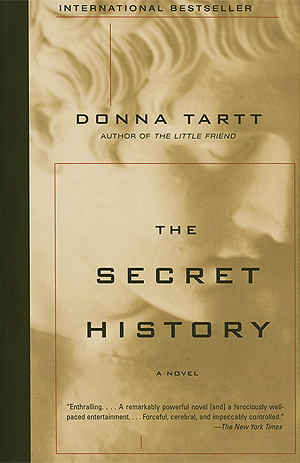
The Secret History, by Donna Tartt, reminds me hugely of my dead cousin Peter. Everything about it. Well, not everything. I mean, it's not the dead body at the beginning of book that reminds me of the deadness of Peter. But Peter's world was academic — and we connected. He was my favourite cousin, my closest — we were just a year apart.

We would talk for hours in theoretical terms about politics and the law, about literature and philosophy, about music and film, about artificial intelligence and the possibility of extraterrestrial life. We talked about how theory could be implemented in practice.

I wonder if he read The Secret History before he died.
It was funny, but people never seemed to notice at first glance how big Henry was. Maybe it was because of his clothes, which were like one of those lame but curiously impenetrable disguises from a comic book (why does no one ever see that "bookish" Clark Kent, without his glasses, is Superman?). Or maybe it was a questions of his making people see. He had the far more remarkable talent of making himself invisible — in a room, in a car, a virtual ability to dematerialize at will — and perhaps this gift was only the converse of that one: the sudden concentration of his wandering molecules rendering his shadowy form solid, all at once, a metamorphosis startling to the viewer.
Peter had that gift too.

His air of being moneyed. His cultivated persona, in how he wore his clothes and his hair, whom he was seen with and where, what he was seen to be reading and studying, what he was seen to be drinking, the drugs he did. How he would deem you with a glance for inclusion or exclusion. Yet he was charming. I wanted to be in his club — when I was 9 and visiting his family's cottage, hen I was 19 and hanging out in downtown Toronto. We all wanted into his club.
Hampden College, as a body, was always strangely prone to hysteria. Whether from isolation, malice, or simple boredom, people there were far more credulous and excitable than educated people are generally believed to be, and this hermetic, overheated, atmosphere made it a thriving black petrie dish of melodrama and distortion.
Peter claimed his mother was prone to hysterics. I knew our grandmother had "episodes," but bloody hell, two world wars, a philandering husband, and exile from her homeland... hysterics seems like a perfectly reasonable response. So it seems reasonable too that one of the daughters might've learned that behaviour (my own mother tended toward melancholic). And I never figured out if any of it was true, or if his perception was the product of male entitlement, dismissal of the feminine, mommy issues, or simply drug-addled revisionist personal history. But then, I kind of think he inherited the hysteria gene himself.
I could say that the secret of Julian's charm was that he latched onto young people who wanted to feel better than everybody else; that he had a strange gift for twisting feelings of inferiority into superiority and arrogance. I could also say that he did this not through altruistic motives but selfish ones, in order to fulfill some egotistic impulse of his own. And I could elaborate on this at some length and with, I believe, a fair degree of accuracy. But still that would not explain the fundamental magic of his personality of — even in the light of subsequent events — I still have an overwhelming wish to see him the way that I first saw him: as the wise old man who appeared to me out of nowhere on a desolate strip of road, with a bewitching offer to make all my dreams come true.
Julian is a suspicious character. Well, they all are really. But him maybe more so. The professor. Because we don't know anything about him, yet he's an older authority figure — we have the sense he should know better.

This whole book is very Hitchcockian, I find. It's not about the crime; it's about the psychology of the people involved. Specifically Rope. But also Strangers on a Train and Shadow of a Doubt and others. In Hitchcock, it's about the idea of a perfect crime. In The Secret History it's that too, but it starts as something purer: simply, putting theory into practice.

The Secret History reminds me of the classes I never took, at the college I never went to, with the people I never knew.

I think I'm a modern mind, Peter was classical.

Ten reasons why we love Donna Tartt's The Secret History