One cad with a bullet in his chest. Eight women's stories, collected by lawyer Marie-Martine Lepage (her own story is included). She says of another of the women, the film actress, "Her delivery would have put a sub-machine-gun to shame."
Sebastien Japrisot's delivery of Women in Evidence is a little more careful than that, leaving barely any bodies in its wake, but for all his control, causing a lot of confusion. Days after finishing reading it, I'm still trying to fit the pieces together.
A prologue gives us a scene with Christophe — or Vincent, or Tony, Francis, Frédéric, or Maurice — we are relatively certain they are the same man — seemingly dying on a beach. Some of the women's stories begin with a fugitive and end with shots fired, so I was a few stories in before I was confident that the dying figure was in fact the end of the story.
The testimonies are quite a marvel, each having a very distinct voice (prostitute, schoolteacher, Japanese student, etc). Each woman tells what she knows of Christophe, most of the women meeting him just as the previous one leaves off, though there is some overlap, and plenty of contradictions.
I was drawn along, not caring who ultimately drops him at death's door so much as trying to determine the truth of the testimony and to piece together Christophe's past. He's allegedly on the run after escaping from prison, having been wrongly convicted — but if he didn't rape and murder that girl, then who? He's also an army deserter (the events occur during World War II). His adventures take him around the world and strain credibility. Just who is this guy really?
All the women believe he is innocent, but they're also in love with him. Beyond whether you can trust a woman in love is the question of a verifiable reality versus what she herself believes to be true. How much of the evidence is projected fantasy? Christophe's "Javert-like accuser" pops up from time to time to remind the reader of the issues at stake.
The novel is somewhat erotic, the woman enjoying many sexual escapades with our (anti)hero. I was also entranced by him, rooting for him, but in hindsight I wonder why. We know him to be good-looking, but his charm and charisma are never fully in evidence, only their effects. I was entranced by the women's entrancements. The sexual interludes read rather more like a man's idea of what women's sexual fantasies of him might be.
The epilogue somewhat surreally addresses this and explains away the contradictions in the evidence, but it's also something of a cheap trick. I'd've much preferred the epilogue be left out, leaving me to sort out the ambiguities for myself rather than nipping my line of questioning just when I thought I was making headway. Still, it's the journey and all that, the book is a wonderful concept, and I can understand Japrisot's inclusion on the list of Great Underappreciated Authors, and I will definitely look out for more of his work.
Women in Evidence, along with Japrisot's other novels, has been called "atmospheric" — I'm not sure what that means, but I agree.
French Wikipedia offers some interesting biographical details: The pseudonym Sebastien Japrisot is an anagram of his real name (Jean-Baptiste Rossi). One of his earliest literary endeavours was the translation into French of The Catcher in the Rye (for publication, 1953). He's written as many (or more) screenplays (including The Story of O) as he has novels.
Women in Evidence was originally published in English as The Passion of Women.
Tuesday, September 19, 2006

Friday, September 15, 2006
Busy
...I have been, the last 7 days having included, but not being limited to, receiving guest from Iowa, groceries, receiving guests from Japan, and a surprise visit from a friend of theirs, unknown to us, from Albany; wandering around Old Montreal in the rain, a museum, with multimedia historical presentation, lunch with a bored and cranky child, more wandering, passing on more museum activities in attempt to assuage child's crankiness, whirlwind shopping excursion to find birthday gift for child's friend, barbecue, discussion of War and Peace and war and peace, scenic drive, stop at lookout to admire view of city, stop at other lookout, not nearly enough coffee, visit to botanical gardens, passing on tour of Olympic stadium and finding other means by which to entertain cranky child, contending with traffic jams and reroutes the likes of which I've never seen, due to marathon, birthday party in outer reaches of city for daycare friend of cranky child at community gym and with trampolines, which cranky child wanted no part of, but the cake was good, childcare arrangements for evening, dinner out, adults only, thank goodness, with conversation ranging across Japanese ceramics, Kansas school boards, and Polish cuisine, though I was alone in indulging in zubrowka ("It smells of freshly mown hay and spring flowers, of thyme and lavender, and it's so soft on the palate and so comfortable; it's like listening to music by moonlight." – W Somerset Maugham, The Razor's Edge), wandering in the old town, wandering downtown, one church, another church, a clock, and a bank for its architectural interest, breakfasts, lunches, and coffees and chocolates, and shopping, more shopping, then J-F in the wee hours driving guests to the airport for an early morning flight; some laundry, one guest remaining in town and will stay with us a night, bribing Helena to give up her bed by letting her sleep in a tent in our room, assembling said tent, some semblance of normality returning (ignoring for the moment the tent in my bedroom), visits to parks, and more laundry (where did it all come from?), burgers for supper, movie rental (Why the boys chose a chick flick — Shopgirl — is beyond me. Verdict: sweet, even poignant, but lacking the novella's wit.) with popcorn, and sleep interrupted to move cars, and may as well say goodbye, at 5 in the morning, as the neighbourhood is cordoned off for the filming of "Nitro" (Keywords: transplant, race car, action hero. "Max leads a well-ordered life. He has a seven-year-old son, Théo, and a girlfriend, Alice, who lies in a hospital bed waiting for a new heart that never arrives. He gathers together all the money he has and contacts a gang of criminals, shady characters from his troubled past." Really.), though amid running errands the only shooting I see is the one I see on tv, our visitors will have something to talk about, we drove past the site in preceding days, and I think to myself the book I'm reading was purchased across the street, and phonecalls from my mother intended as a shared reaction to tragedy sound less like concern and more like blame for choosing this life, my life, in a godforsaken city so far from "home," and sleep, more laundry, more sleep; I think I'm coming down with something.
Wednesday, September 13, 2006
Alatriste in pictures
Swordplay! Assassination plots! Corrupt church officials! Raised eyebrows and twirling mustaches! The mosqueteros! The code of swordsmen! The glory of Spain! More swordplay!
The story of Captain Alatriste, by Arturo Pérez-Reverte, takes place just a couple years before Dumas's saga of The Three Musketeers begins. The plot turns around the matrimonial negotiations between Charles I of England and Infanta Maria of Spain (sister of King Philip IV). Charles is accompanied on his voyage to Spain to meet his potential bride by none other than the Duke of Buckingham. (Negotiations will fail, and England will declare war on Spain, but that is beyond the timeline of this novel.) But it's not really about them — just as d'Artagnan and his musketeers upstage all the political figures that drive them to action, so Captain Diego Alatriste is the hero battling for the heart and soul of Spain, along with his life.
The Captain's adventures are recounted by his 13-year-old charge, Inigo Balboa, son of a fallen comrade.
There he is!
One of my favourite lines:
This passage comes in the opening pages, and we encounter Angélica only a few times, with no hard evidence of her evil, but the novel breaks off with the promise of more, much more, to come.
Everything about this novel — story, characters, dialogue — drips with cliché, but we like it that way. Pérez-Reverte pays (another) homage to Dumas, but putting Spain in the forefront of that turbulent era.
And this is to me one of the more interesting, and highly effective, aspects of this novel: Pérez-Reverte often invokes Velazquez and quotes the poets regularly, as if to say, "I'm not making this up. Look at the strength of character, or pain, or humour, conveyed in the tilt of that head. Velazquez saw it. Listen to the hiss of swords and the honour of men already told by great literary figures. It is the heart and soul of Spain that other men have already borne witness to. It really happened this way."
Some of the images that add colour:
I cannot pinpoint a painting of a woman that meets the clues in the text. A Young Lady was painted in 1635; Portrait of a Lady to my eye is a better example of "splendid beauty" though it was painted a couple years earlier; neither subject has the golden curls and blue eyes of our Angélica. Perhaps the next book in the series will paint a clearer portrait.
The second Alatriste novel, Purity of Blood, was released early this year. Three more will become available in English over the next 3 years. I can't wait!
Excerpt.
The movie, Alatriste, is compiled from all 5 books (trailer).
The story of Captain Alatriste, by Arturo Pérez-Reverte, takes place just a couple years before Dumas's saga of The Three Musketeers begins. The plot turns around the matrimonial negotiations between Charles I of England and Infanta Maria of Spain (sister of King Philip IV). Charles is accompanied on his voyage to Spain to meet his potential bride by none other than the Duke of Buckingham. (Negotiations will fail, and England will declare war on Spain, but that is beyond the timeline of this novel.) But it's not really about them — just as d'Artagnan and his musketeers upstage all the political figures that drive them to action, so Captain Diego Alatriste is the hero battling for the heart and soul of Spain, along with his life.
The Captain's adventures are recounted by his 13-year-old charge, Inigo Balboa, son of a fallen comrade.
They say that Diego Alatriste and he were very good friends, almost like brothers, and it must be true, because later, on the bulwarks of Julich, where my father was killed by a ball from a harquebus — which was why Diego Velazquez did not include him in his painting of the Surrender of Breda, as he did his friend and fellow Diego, Alatriste, who is indeed there, behind the horse — he swore that he would look after me when I grew out of childhood.

There he is!
One of my favourite lines:
It was also the year in which I fell in love like a bawling calf, then and forever, with Angélica de Alquézar, who was as perverse and wicked as only Evil in the form of a blonde eleven- or twelve-year-old girl can be. But we will tell everything in its time.
This passage comes in the opening pages, and we encounter Angélica only a few times, with no hard evidence of her evil, but the novel breaks off with the promise of more, much more, to come.
Everything about this novel — story, characters, dialogue — drips with cliché, but we like it that way. Pérez-Reverte pays (another) homage to Dumas, but putting Spain in the forefront of that turbulent era.
What Golden Age, eh? The truth is that those of us who lived and suffered through it saw little gold and barely enough silver. Sterile sacrifice, glorious defeats, corruption, rogues, misery, and shame, that we had up to the eyebrows. But then when one goes and looks at a painting by Diego Velazquez, listens to verses by Lope or Calderon, reads a sonnet by Franciso de Quevedo, one says to oneself that perhaps it was all worthwhile.
And this is to me one of the more interesting, and highly effective, aspects of this novel: Pérez-Reverte often invokes Velazquez and quotes the poets regularly, as if to say, "I'm not making this up. Look at the strength of character, or pain, or humour, conveyed in the tilt of that head. Velazquez saw it. Listen to the hiss of swords and the honour of men already told by great literary figures. It is the heart and soul of Spain that other men have already borne witness to. It really happened this way."
Some of the images that add colour:
The fact is that a wedding between the young heretic and our infanta — who was no Venus but was not all that bad, if you go by how Diego Velazquez painted her a little later, young and blonde, a lady . . . with that very Hapsburg lip, of course — would peacefully open the ports of commerce in the West Indies to England, resolving the burning problem of the Palatinate in favor of the British. That is a story I do not choose to go into here, because that is what history tomes are for.

My lord and king, the fourth Philip, was known to be an elegant horseman and a fine shot, an aficionado of the hunt and of horses — once, in a single day, killing three wild boars by his own hand but losing a fine mount in the process. His sporting skills were immortalized in the paintings of don Diego Velazquez, as well as in poems by many authors and poets such as Lope de Vega or Franciso de Quevedo.

But no one paid much attention to him. Despite his friend Fonseca's recommendations, don Francisco de Quevedo had not forgotten that the minute the young artist reached Madrid, he had painted a portrait of Luis de Gongora, and although he had no reason not to like the youth, he meant to purge that capital sin by ignoring him for a few days.
Although the truth is that don Francisco and the young Sevillian were soon as thick as thieves, and the best portrait we have of the poet is precisely the one that the same young man later painted. Over time, he also became a very good friend to Diego Alatriste and to me, but that was when he was better known by his mother's family name: Velazquez.


At the time of my story, Angélica de Alquézar must have been around eleven or twelve years old, and she was already a promise of the splendid beauty she would become, beauty of which Velazquez himself would give a good account in the famous portrait she posed for sometime around 1635.
I cannot pinpoint a painting of a woman that meets the clues in the text. A Young Lady was painted in 1635; Portrait of a Lady to my eye is a better example of "splendid beauty" though it was painted a couple years earlier; neither subject has the golden curls and blue eyes of our Angélica. Perhaps the next book in the series will paint a clearer portrait.
The second Alatriste novel, Purity of Blood, was released early this year. Three more will become available in English over the next 3 years. I can't wait!
Excerpt.
The movie, Alatriste, is compiled from all 5 books (trailer).
Friday, September 08, 2006
Au claire de la lune
The moon was slung low in the sky, clouds veiling its full and ghastly yellow face. Extraordinarily big. (Why are there days it looks so big?) Helena's usual suggestion to hoist a ladder — we can climb up to visit Pierrot! — seems almost workable.
I turn her to face southeast. She lifts her gaze to just over the rooftops and gasps. "C'est pas la lune — c'est une planete!" (Poor Pluto, I think to myself.)
She thinks about it for a while, then hollers out, "Pierrot!" just in case. But it seems we always call him during bathtime.
I turn her to face southeast. She lifts her gaze to just over the rooftops and gasps. "C'est pas la lune — c'est une planete!" (Poor Pluto, I think to myself.)
She thinks about it for a while, then hollers out, "Pierrot!" just in case. But it seems we always call him during bathtime.
Thursday, September 07, 2006
Cherchez la femme
The Black Dahlia, the movie, is to be released next week. It's based on James Ellroy's novel, which in turn is based on the true-life murder mystery of Elizabeth Short. I read it about a decade ago. The incisive psychological portrayal of a cop's grim obsession with the Dahlia is undoubtedly informed by events in Ellroy's life, the rape and murder of his own mother.
James Ellroy on his mother and the Dahlia:
Cherchez la femme.
James Ellroy on his mother and the Dahlia:
It was a salutary ode to Elizabeth Short and a self-serving and perfunctory embrace of my mother. I acknowledged the Jean–Betty confluence in media appearances and exploited it to sell books. My performances were commanding at first glance and glib upon reappraisal. I cut my mother down to sound-bite size and packaged her wholesale. I determined the cause of my ruthlessness years later.
She owned me. Her claim rankled. I wanted to portray myself as a man above all Oedipal constraints. I had created a fictional Elizabeth Short to usurp my mother’s claim and upstage her. It worked in the novel. It sold a great many books. It left Jean Hilliker still dead on that roadside, unblessed with love.
Cherchez la femme.
A little bit about Kevin
It feels like ages since I read this book, but I had wanted from the gitgo to say a little something about it here. Even now, I'm unable to fully articulate my response to this book in any objective, level-headed way. My only hope is to inspire someone else to pick it up. This is by far the most intense reading experience I've had in recent years.
We Need to Talk about Kevin, by Lionel Shriver, is a powerful and highly emotional novel; that is, it evoked in me a deep emotional response without ever straying into gimmicky sentimentality. The narrator might even be described as cold.
It's the story of a boy who as a teenager goes on a killing spree at his school (when America was still reeling from Columbine) as relayed by his mother in a series of letters to the absent (and not responding) father.
I'd had no interest in reading this book, assuming it'd be thinly veiling a handful of social, political, moral discussions I could do without — something like "the effects of modern culture on America's youth and how it contributes to the rise in violence and, gawd, wasn't Columbine horrible, we must raise our children right so it never happens again."
What I found instead was a very intimate and "honest" portrayal of Eva, a mother grappling, for years, with motherhood, in all its emotional and logistical aspects, who is judged for her son's actions.
I put "honest" in quotation marks because I don't know how to gauge that quality. It's written in such a way to make it feel honest, and I relate to it very closely — I assume many mothers would, but maybe I'm a freak, and by some freak coincidence Shriver has tapped into my psyche, maybe shared by a few others. These feelings, and discussion of them, are still pretty taboo; how can we know if they're normal? Many readers find Eva unlikeable — heartless and selfish; I do like her — she's introspective and human, that bit of being human that gets pushed aside, that's ignored or denied, or sometimes just forgotten, when you become, and aspire to embody all it means to be, a mother.
(I would note also that the narrator is emotionally "honest," but not necessarily factually reliable.)
Lionel Shriver on Kevin:
We also witness a relationship change when a child comes into the picture and new dynamics and power struggles emerge.
And that pesky nature–nurture question:
Doris Lessing's The Fifth Child had a lasting impression on me, as it expressed many of my own fears regarding motherhood — what if a child is born evil, or bad, or "off" some way; what control and responsibility do parents have over the condition and its outcome? I skimmed through it again after reading Kevin. The sons are different kinds of "monsters," Lessing's novella is much sparer, almost as if to examine these issues in the abstract, but the similarity of themes in the two books is striking.
Both books also consider the state of pregnancy. While the effects of diet, for example, are scientifically proven, and effects of say, music, are surmised, there remains something mysterious about the effect of a mother's thoughts and the general mood that surrounds her. Are they transmitted to a fetus in utero too? I think about that mystical state often, and about how lucky I am, that good vibes and hopes are more responsible for my wondrous offspring than any single action I took (or didn't take).
(I read a novel years ago in which the child simply didn't want out into the nasty world — the mother, a musician I think, stayed pregnant for years. Does that ring any bells with anyone? At least I think it was a book; it could've been a coworker's dream or something.)
No, Shriver does not give us any answers, and it's an uncomfortable read, but curiously, I think all her characters find redemption.
We Need to Talk about Kevin, by Lionel Shriver, is a powerful and highly emotional novel; that is, it evoked in me a deep emotional response without ever straying into gimmicky sentimentality. The narrator might even be described as cold.
It's the story of a boy who as a teenager goes on a killing spree at his school (when America was still reeling from Columbine) as relayed by his mother in a series of letters to the absent (and not responding) father.
I'd had no interest in reading this book, assuming it'd be thinly veiling a handful of social, political, moral discussions I could do without — something like "the effects of modern culture on America's youth and how it contributes to the rise in violence and, gawd, wasn't Columbine horrible, we must raise our children right so it never happens again."
What I found instead was a very intimate and "honest" portrayal of Eva, a mother grappling, for years, with motherhood, in all its emotional and logistical aspects, who is judged for her son's actions.
I put "honest" in quotation marks because I don't know how to gauge that quality. It's written in such a way to make it feel honest, and I relate to it very closely — I assume many mothers would, but maybe I'm a freak, and by some freak coincidence Shriver has tapped into my psyche, maybe shared by a few others. These feelings, and discussion of them, are still pretty taboo; how can we know if they're normal? Many readers find Eva unlikeable — heartless and selfish; I do like her — she's introspective and human, that bit of being human that gets pushed aside, that's ignored or denied, or sometimes just forgotten, when you become, and aspire to embody all it means to be, a mother.
(I would note also that the narrator is emotionally "honest," but not necessarily factually reliable.)
Lionel Shriver on Kevin:
I think Kevin has attracted an audience because my narrator, Eva, allows herself to say all those things that mothers are not supposed to say. She experiences pregnancy as an invasion. When her newborn son is first set on her breast, she is not overwhelmed with unconditional love; to her own horror, she feels nothing. She imputes to her perpetually screaming infant a devious intention to divide and conquer her marriage. Eva finds caring for a toddler dull, and is less than entranced by drilling the unnervingly affectless, obstreperous boy with the ABC song. Worst of all, Eva detects in Kevin a malign streak that moves her to dislike him. Her misgivings seem well founded when, at the age of 15, he murders nine people at his high school. Whether Kevin was innately twisted or was mangled by his mother's coldness is a question with which the novel struggles, but which it ultimately fails to answer. That verdict is the reader's job.
We also witness a relationship change when a child comes into the picture and new dynamics and power struggles emerge.
And that pesky nature–nurture question:
How we came to conceive of children as passive objects upon which adults act is beyond me. From my earliest years, I remember being a conscious agent. I knew when I was not supposed to do something, and sometimes I did it anyway.
Doris Lessing's The Fifth Child had a lasting impression on me, as it expressed many of my own fears regarding motherhood — what if a child is born evil, or bad, or "off" some way; what control and responsibility do parents have over the condition and its outcome? I skimmed through it again after reading Kevin. The sons are different kinds of "monsters," Lessing's novella is much sparer, almost as if to examine these issues in the abstract, but the similarity of themes in the two books is striking.
Both books also consider the state of pregnancy. While the effects of diet, for example, are scientifically proven, and effects of say, music, are surmised, there remains something mysterious about the effect of a mother's thoughts and the general mood that surrounds her. Are they transmitted to a fetus in utero too? I think about that mystical state often, and about how lucky I am, that good vibes and hopes are more responsible for my wondrous offspring than any single action I took (or didn't take).
(I read a novel years ago in which the child simply didn't want out into the nasty world — the mother, a musician I think, stayed pregnant for years. Does that ring any bells with anyone? At least I think it was a book; it could've been a coworker's dream or something.)
No, Shriver does not give us any answers, and it's an uncomfortable read, but curiously, I think all her characters find redemption.
Tuesday, September 05, 2006
A present
In Helena's world, every day is somebody's birthday, which is of course in one sense true in the real world, but the real world does not usually celebrate the same individual's birthday — mine, or the cat's, or the Teletubbies' — every 3 days or so.
The only essential ingredient to the birthday party (and if it's your birthday, there must be a party) is the song — Helena must sing "Bonne Fete" — but the event is often accentuated with hats, "tea" (with or without juice, and these days usually featuring special imaginary cappuccino for me), play-doh cake with popsicle-stick candles, and, my favourite, des cadeaux.
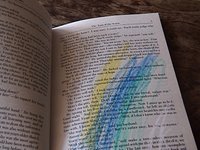 Here is a recent present, plucked by Helena from the table by the door and lovingly personalized. (Fortunately, I've already read that page.)
By far the biggest present of this last weekend was the weekend itself, being relatively child-free so that J-F and I could revisit the scene of our first date 10 years ago, and other familiar places, and old friends.
Also, I've been enjoying not reading War and Peace and the thrill of finishing a book after only a couple hundred pages, namely, Isabel's Bed, by Elinor Lipman, and Little Children, by Tom Perrotta, both very funny and excellent light reading.
The only essential ingredient to the birthday party (and if it's your birthday, there must be a party) is the song — Helena must sing "Bonne Fete" — but the event is often accentuated with hats, "tea" (with or without juice, and these days usually featuring special imaginary cappuccino for me), play-doh cake with popsicle-stick candles, and, my favourite, des cadeaux.
 Here is a recent present, plucked by Helena from the table by the door and lovingly personalized. (Fortunately, I've already read that page.)
By far the biggest present of this last weekend was the weekend itself, being relatively child-free so that J-F and I could revisit the scene of our first date 10 years ago, and other familiar places, and old friends.
Also, I've been enjoying not reading War and Peace and the thrill of finishing a book after only a couple hundred pages, namely, Isabel's Bed, by Elinor Lipman, and Little Children, by Tom Perrotta, both very funny and excellent light reading.
Wednesday, August 30, 2006
About elevators
It feels like a crime novel. Noir. The prose is clipped, the images gritty and surreal; the plot and characters are wholly engrossing. It's philosophical and allegorical. The Intuitionist, by Colson Whitehead, is beautiful.
There's a Guild, for which the position of Chair, a government office, is up for election next week. An accident and an investigation. Internal Affairs. The minions of unknown employers conducting "interviews" and ransacking homes. Corporate interests and mob involvement.
And it's all about elevators.
There are two schools of elevator inspectors: the Empiricists (by-the-book examiners of the machinery) and Intuitionists (who are guided by, for example, the sound and "feel" of an elevator to detect problems). Lila Mae Watson graduated from the Institute for Vertical Transport and is the Guild's first black woman inspector. She's also an Intuitionist.
(One of the most interesting things (to me) about this novel is that if you tilt your head just right you can almost see how it might be written, how this slightly off reality could be created from everday scraps filtered through an uncommon perspective (in this case, the elevator inspector's). I felt a similar effect reading Auster's In the Country of Last Things and to a lesser degree Mantel's Beyond Black. It's a different kind of creative imagination than involves original plotting or oddball characters. There's something skewed, exaggerated, brought into relief, but you can sense something you know at its core, you can almost see it when you walk through that part of the city at a certain time of day.)
Here's a flashback to Lila Mae's school days I found highly entertaining:
Wikipedia.
Excerpt.
Reviews:
Brainwashed
New York Times
There's a Guild, for which the position of Chair, a government office, is up for election next week. An accident and an investigation. Internal Affairs. The minions of unknown employers conducting "interviews" and ransacking homes. Corporate interests and mob involvement.
And it's all about elevators.
There are two schools of elevator inspectors: the Empiricists (by-the-book examiners of the machinery) and Intuitionists (who are guided by, for example, the sound and "feel" of an elevator to detect problems). Lila Mae Watson graduated from the Institute for Vertical Transport and is the Guild's first black woman inspector. She's also an Intuitionist.
(One of the most interesting things (to me) about this novel is that if you tilt your head just right you can almost see how it might be written, how this slightly off reality could be created from everday scraps filtered through an uncommon perspective (in this case, the elevator inspector's). I felt a similar effect reading Auster's In the Country of Last Things and to a lesser degree Mantel's Beyond Black. It's a different kind of creative imagination than involves original plotting or oddball characters. There's something skewed, exaggerated, brought into relief, but you can sense something you know at its core, you can almost see it when you walk through that part of the city at a certain time of day.)
Here's a flashback to Lila Mae's school days I found highly entertaining:
"The Dilemma of the Phantom Passenger asks what happens when the passenger who has engaged the call button departs, whether he changed his mind and took the stairs or caught an up-tending car when he wanted to go down because he did not feel like waiting. It asks what happens to the elevator he summoned."
Professor McKean said, "That's right. Fulton asks this question and leaves it to the reader, abruptly proceeding on to the psychology of the Door Close button. How do you think Fulton would answer his question?"
"Obviously, " Gorse said, "the elevator arrives, the doors open for the standard loading time, and the doors close. That's it."
Johnson, the burly freshman who always sat next to Lila Mae, ignored Gorse and offered in his stumbling voice, "I think that Fulton would say that the elevator arrives but the doors do not open. If there's no need for the doors to open, then the vertical imperative does not apply."
Professor McKean nodded. "Any other theories?"
Bernard, who could usually be relied upon to provide a sensible response, said, "For one thing, the vertical imperative applies to the elevator's will, and doesn't apply to passengers. I think what Fulton was referring to in this section was the 'index of being' — where the elevator is when it is not in service. If, as the index of being tells us, the elevator does not exist when there is no freight, human or otherwise, then I think in this case the doors open and the elevator exists, but only for the loading time. Once the doors close, the elevator returns to nonbeing — 'the eternal quiescence' — until called into service again." Bernard sat back in metal chair, satisfied.
Professor McKean said simply, "That's good. Anyone else?"
Lila Mae waited for someone to give her an answer. No one did. Lila Mae cleared her throat and said in a thin voice, "Fulton is trying to trick the reader. An elevator doesn't exist without its freight. If there's no one to get on, the elevator remains in quiescence. The elevator and the passenger need each other."
Professor McKean nodded quickly and then inquired of this pupil, "And if we set up a film camera in the hallway to see what would happen, what would we see when we developed the film, Watson?"
Lila Mae met his eyes. "By leaving the camera there, you've created what Fulton calls 'the expectation of freight.' The camera is a passenger who declines to get on the elevator, not a phantom passenger. The film would record that the doors open, the elevatar waits, and then the doors close."
Wikipedia.
Excerpt.
Reviews:
Brainwashed
New York Times
Betraying a weakness
My mother lets out a cry, a sharp intake of breath stifling a pained sob. "My table!" An apparent scratch, a thin line like wood wriggling across white, about an inch long at the very middle of the table. Her face is clenched in an awful vise, part horror, part dismay, part dam against the welling of tears.
I know that face. I've inherited that face.
It turns out not to be a scratch, not in the veneer but on close examination bulging convex on its surface. The faintest whisper of a drizzle of jam tracing the shadow of the spoon path from jar to plate. Or maybe chocolate milk splatter from the flick of Helena's straw. It flakes away under my fingernail. My mother sighs with relief.
The table is near 25 years old. Round, white particle board atop tubular legs. Nothing special.
An extreme, unjustified reaction, I think, on the part of my mother. I wonder was it always this way? Was she always like this? When I was little, too? Or did it start only after I left home?
It's a long week.
Helena is tired after a full day's shopping, and bored. I'm on the phone. Helena bundles up a doll, finds keys, packs a purse with snacks, for their metro journey to some imaginary place. My purse. My purse after our shopping expedition contains a bottle of cranberry juice, about a third full. Helena gives some to her doll and returns it to my purse. I'm on the phone.
I relay hugs and kisses from her Papa. Helena invites me to sit beside her in the metro, asks if I'm thirsty, retrieves the bottle from the purse, offers me a sip of her juice. I grasp the bottle. Not just sticky. Dripping.
I grab my purse and set it on the kitchen table (yes, that kitchen table), stretch open its mouth and begin the extraction with a lump in my throat, as if the removal of contents in the wrong order might release a secondary detonation from the shallow red pool collected at the bottom.
I don't mind about the purse, my carryall, a messenger bag really. Wallet, case for my glasses, comb, powder compact, empty tupperware-type snack container, pens — all wipe clean easily. A package of kleenex, some stray receipts are garbage. The bag itself rinses easily, will be dry well before I leave the house again. It's the books I mind about.
I take a deep breath. Helena has already apologized, is standing by, wanting to help. I say nothing. We take care of our books. She knows this. And you shouldn't play with mommy's purse either. She doesn't often, and when she does I don't mind. This was an accident, I know. I wipe the books down, fan the pages, prop them up to dry. I go hide in the bathroom to cry.
My emergency transit reading, a cheap Dover Thrift Edition, I expected to someday look worn. But I feel sorry for Harold's Circus, purchased just the day before — for $3.99 and it's not even mine.
Weeks later, my transit reading is back in my bag — the dye crept off the page as it dried, leaving a faint pink tinge along the book's bottom edge. Harold also retained barely any colour; the bottom few millimetres of every page are "water" stained and lightly rippled — it looks still wet. It has not diminished Helena's enjoyment of the story.
That night we survey the damage. It's still wet, but that's not going to stop us from reading it. Very seriously Helena tells me, "C'est pas grave, Maman."
Something passed between us that day, a look, when first I yelped and later when my eyes were tired. She knows I overreacted. And she knows I know I overreacted. I think she is both startled and amused by this knowledge, puzzled by what (im/ap)plication it might have. I can't help feeling like I've given her something she may choose to call up many years from now — ammunition.
12 books in 120 seconds
A series of unfortunate events summarized, narrated by Tim Curry. View at your own risk. Better perhaps to frolic on a pony.
Monday, August 28, 2006
About the bookshop
The Haunted Bookshop, by Christopher Morley, refers to Roger Mifflin's Parnassus at Home, the Brooklyn shop where he (having retired from the bookmobile business) sells used books, haunted by "the ghosts of books I haven't read. Poor uneasy spirits, they walk and walk around me. There's only one way to lay the ghost of a book, and that is to read it."
So I read it. It is charming, sweet, funny, etc, but not quite so carefree as its predecessor.
Written in 1919, this little mystery story (no ghosts or hauntings, by the way) strings together several monologues (some disguised as debates or letters) mostly about the importance of literature, the power of books (in shaping our leaders!), but also against war, and with plenty of anti-German sentiment thrown in.
One of the most interesting exchanges, still timely today, concerns whether the publishing industry drives the public's tastes or feeds its demands and what role the bookseller plays between them.
While I agree with most of his points, Roger Mifflin tends to sermonize, and given the type of person likely to pick up this book, he's preaching to the choir. Repeatedly he makes the case for "good books" — real literature — over the pulp the vast majority of the public consumes (without ever really defining the qualities that constitute either; we all have a sense of what falls into these categories...).
This book then is a light snack, nutritious and tasty, but not very filling. The stuff's amusing, and has its place.
So I read it. It is charming, sweet, funny, etc, but not quite so carefree as its predecessor.
Written in 1919, this little mystery story (no ghosts or hauntings, by the way) strings together several monologues (some disguised as debates or letters) mostly about the importance of literature, the power of books (in shaping our leaders!), but also against war, and with plenty of anti-German sentiment thrown in.
One of the most interesting exchanges, still timely today, concerns whether the publishing industry drives the public's tastes or feeds its demands and what role the bookseller plays between them.
While I agree with most of his points, Roger Mifflin tends to sermonize, and given the type of person likely to pick up this book, he's preaching to the choir. Repeatedly he makes the case for "good books" — real literature — over the pulp the vast majority of the public consumes (without ever really defining the qualities that constitute either; we all have a sense of what falls into these categories...).
"...if the stuff's amusing, it has its place. The human yearning for innocent pastime is a pathetic thing, come to think about it. It shows what a desperately grim thing life has become. One of the most significant things I know is that breathless, expectant, adoring hush that falls over a theatre at a Saturday matinee, when the house goes dark and the footlights set the bottom curtain in a glow, and the latecomers tank over our feet climbing into their seats — [...] but it makes me sad to see what tosh is handed out to that eager, expectant audience, most of the time. There they all are, ready to be thrilled, eager to be worked upon, deliberately putting themselves into that glorious, rare, receptive mood when they are clay in the artist's hand — and Lord! what miserable substitutes for joy and sorrow are put over on them! Day after day I see people streaming into theatre and movies, and I know that more than half the time they are on a blind quest, thinking they are satisfied when in truth they are fed on paltry husks. And the sad part about it is that if you let yourself think you are satisfied with husks, you'll have no appetite left for the real grain."
This book then is a light snack, nutritious and tasty, but not very filling. The stuff's amusing, and has its place.
Sunday, August 27, 2006

Friday, August 25, 2006
Renee's audio book club
Because sometimes we want to talk and listen about books, rather than write and read about them.
Renee has the brilliant idea to produce an audio montage of readers talking about a single book. The first selection is Never Let Me Go, by Kazuo Ishiguro. Call 415.992.8622:
At present there is no fixed deadline for voicemall submissions. I haven't read the book yet, but am considering it.
Read more about Renee's project here.
I can't wait to hear what everyone has to say about this book, to put voices to your names, and to know what future selections are in store.
Renee has the brilliant idea to produce an audio montage of readers talking about a single book. The first selection is Never Let Me Go, by Kazuo Ishiguro. Call 415.992.8622:
Tell me whatever you want about the novel. Tell me what you liked, what you disliked, or just your reactions. What made you think? What images or words stuck with you? Read me passages from the book... Feel free to be creative.
At present there is no fixed deadline for voicemall submissions. I haven't read the book yet, but am considering it.
Read more about Renee's project here.
I can't wait to hear what everyone has to say about this book, to put voices to your names, and to know what future selections are in store.
Thursday, August 24, 2006
Acquisitions
I generally read one book at a time.
While I found the recent essay on compulsive book-starting mildly amusing, I couldn't relate. I readily admit to the compulsion to buy and to own books, but I work through them rather methodically. I actually feel pretty smug at this, my restraint, but also knowing what reading material I have on hand, knowing my pace and having a sense of the time available to me, knowing what can wait for later. My stack of unread books is under control. So I thought.
When other bloggers started counting and listing, I thought I'd do the same. I checked to see what was by my bed, and then I noticed there were books under the bed and remembered the bottom shelf of the nearby bookcase. I thought uh-oh, and walked away.
A few days later I'd mustered up the courage for a closer look. In all, about three dozen books, including nonfiction, which I don't read very often and which I don't always read cover to cover, dipping into it over years, using it as a reference; some titles had already been dipped into. There are a few books I will likely never read: a couple used books that smell funny, a couple misguided impulses, a couple castoffs from friends. Some are books I fully intend to read someday, but haven't found the time or frame of mind for (among these, Proust, Ulysses, Dickens, and Neal Stephenson's Baroque Cycle), and some of them have been there for years, but I do not suffer guilt for these. Only a handful of the unread books chastise me. Not so bad.
My book-buying binges may result in one step back, but I rationalize that my reading and general acquisition habits push me many more steps forward.
Book acquired before going on vacation, in case I couldn't cope with War and Peace and finished my ongoing light read (remaindered):
Captain Alatriste, Arturo Pérez-Reverte — Which begins, "He was not the most honest or pious of men, but he was courageous." I've thoroughly enjoyed all of Pérez-Reverte's books (although The Nautical Chart significantly less so, but I think because I was reading it in the obgyn's waiting room — the stages of my pregnancy were measured in novels).
Books ordered via internet and picked up at depot while on vacation (bargain prices):
The Knight of Maison-Rouge, Alexandre Dumas — A review of which I'd saved from 2003. Because it's Dumas! and there's swordplay! and revolution! And it's my Napoleonic summer!
The Gold Bug Variations, Richard Powers — For my left brain. All the cool kids read it ages ago, and I want to hang out with them.
Little Children, Tom Perrotta — Having saved two reviews of this book from 2004, being still intrigued by it, and hoping for a laugh at the expense of suburb dwellers.
Isabel's Bed, Elinor Lipman — Which I came across while browsing a bookstore near my sister's place when I visited her in 2002 (or was it the trip before that one?) and neglected to buy and have kicked myself for ever since. I have a fondness for characters who bear my name, or some variant. (Does anyone else thrill to see their name used in fiction?)
Women in Evidence, Sebastien Japrisot — Considered by Danielle to be a great underappreciated author. It's noir and said to be "diabolically clever."
Honeymoon, Bittermoon, Ramon Perez de Ayala — Because I needed to spend $2 more to be able to apply my $5 coupon to the total purchase and it leapt out at me, having heard about it previously in connection with Polanski's Bitter Moon (which I loved) tho' that film is in fact based on a different novel, but it's surmised there are some thematic connections.
Book purchased on impulse while picking up book order noted above, because I had to take just a quick look to see what gems they might have out on the floor:
Harold's Circus, Crockett Johnson — Because it's Harold! with his purple crayon! It begins, "One moonlit evening, mainly to prove to himself that he could do it, Harold went for a walk on a tightrope." We must have more Harold! It's not actually for me though.
Book acquired in passing, while out "shopping" (by which I mean wandering about the mall close to my mom's house cuz we didn't seem to have anything better to do), and for which I feel very guilty (remaindered and further discounted):
The Red and the Black, Stendhal — (I see just now that I'd also kept a review of this one.) Yes, I already have a copy. It was a Mother's Day present. When they presented me with the paberback, I had to suppress my disappointment, having expressed my wish for a particular translation (which this was) and given explicit directions regarding the location of the hardcovers near the right edge of the second shelf from the top on the bargain shelves facing the checkout of the store situated at a particular intersection. It didn't take long for me to get over the soft- vs hardcover, as I was quickly engrossed in the introduction and already making this copy my own; but it niggled at me that he spent more than $6.99 and on a lesser version. I made a joke about it in the days that followed. He told me this book was also marked down, $3.99. Which made me unbelievably happy, and I forgot all about it. Till I did laundry a few days later and found the receipt for full price in a pocket (from that same store). While I'm still flummoxed by the inability to carry out instructions (copies in question were still to be had weeks later), I'm touched that he knows so well what pushes, and releases, my buttons. Still, when I found a copy (hardcover, Modern Library, just so tactilely pleasant) further reduced because of a coffee splotch on the jacket (easily wipeable; I checked), I couldn't resist. Please don't tell J-F. Gawd, I feel so guilty. And I have it and mean to read it in French, too.
Book acquired in the days following my return from vacation, while browsing used book shops — it now being a mission to search out and explore (finally) all the (few) English-language book stores in the city, one neighbourhood at a time (my own neighbourhood is predominantly French) — which, both the browsing and the purchase (and the subsequent reading), helped balm some work-related stress (used):
The Haunted Bookshop, Christopher Morley — Which I've already read and may have some words about in days to come.
Thus concludes my book acquisitions for calendar year 2006, excepting books received as gifts for my birthday and for Christmas and including those select two (one on each of those occasions) that I will warrant to bestow as gifts on myself.
And I will read them all. Soon.
Monday, August 21, 2006
On finishing the masterpiece
I did it. I finished War and Peace. All 1456 pages. One could even say I read it twice, what with circling back to refresh my mind and hunting down specific passages.
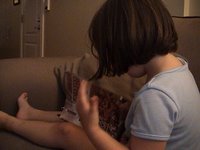 Helena, after begging me to read to her from it and then having sat through my reading of a couple pages of the epilogue, seems to be undertaking to read the whole thing for herself from the beginning.
Greatest novel ever written? At the risk of losing the respect of, umm, anybody who's read War and Peace, I must say: Not in my opinion. Sure, it's pretty good, they don't call it a classic for nothing, but...
(Possible spoilers ahead.)
(Consider this space a dumping ground for some of the things running through my head; some of these ideas may be further thought out and, someday, posted here.)
I mentioned previously that the book takes off for me with Prince Andrei's vision of the heavens. The book ends for me with Andrei's death (p 1177; cut out all the philosophizing that repeats the second epilogue, which is now placed at the beginning, and you've got yourself a manageable 800-page book) — it's all (well, mostly) downhill from there.
The second epilogue really ought to be used as an introduction. Moving that chunk of text would save many people the compulsion to reread the damn thing. Once you know Tolstoy's views on the mechanical and spiritual forces of history, the significance of the characters's actions and inactions, the patterns and themes are far more evident.
John Bayley's introduction to my edition ought never to be reprinted again. Who the hell is John Bayley anyway? "There are more happy marriages in War and Peace than in any other novel" — hah! There are two, maybe three (counting the old Rostovs). He says of Middlemarch that Dorothea is interesting while unhappily married but loses her interest once she is happily married. I would level the same criticism at Natasha, Marya, Nikolai... Not Pierre so much, though of all of them he's the only one previously unhappily married; he remains interesting, perhaps because he's offscreen for most of the first epilogue (to which all of married life is relegated for that examination in such fine detail, according to Bayley) and he's developing a new politically minded passion; rather in many ways he reminds me of Andrei when we first met him, married but not fulfilled and looking outwards for purpose (how compatible can this be with Natasha, whose life's meaning is found in family?)
(One book that I wish had been written, though I answered differently a short while ago, and I'm sure I'm borrowing this idea from something I've read over the lat week or so: the early life of Prince Andrei, including his engagement and marriage to Lisa, up to that point at which we make his acquaintance at Anna Pavlovna's.)
And poor Sonya. Says Natasha:
(Watched Match Point this weekend: "I'd rather be lucky than good." Are we born one way or another? It seems Dostoevsky thought so (Match Point's main character has an interest in him). Maybe Tolstoy too. Not exactly unlucky, but Sonya seems kind of doomed. That beyond free will or predistination lies some essential element of character? I'm liking this movie better the more I think about it. Another great line: "faith is the path of least resistance.")
I'd had some trouble understanding Andrei's death. Karatayev's story (told in complete ignorance of Andrei and his death; a completely separate element, not related to Andrei at all except in my head) spoke a little to me about it; it could be said of Andrei that God pardoned him (but still, for what? for Lisa? for lack of faith?) and he was dead. And it is still not clear to me why suddenly Andrei decided to die; he did not give up, he let death in. And why did he break off from discussing the Gospels with Marya? Because he understood that she already knew, it didn't need discussing, or because he couldn't yet admit his change of mind/heart (to himself, that his life to that point had been meaningless after all? to others, that he'd been wrong in mocking them?)?
Ellen's death was disappointing, serving only to free Pierre. Tolstoy was lazy on this one.
I'm glad I read it, cuz it's a good book, but also to be able to say I actually read it. Would I ever reread War and Peace? Would I reread it 5 or 6 times? No. There are scenes I'd like to revisit (namely the hunt, and the visit with Uncle), but I don't imagine myself having an ongoing love affair with this book. Maybe it wasn't in the right time for me; I wasn't particularly enthusiastic about undertaking it. Maybe I really don't get it, its full significance hasn't yet clicked, and maybe when I do, when it does, I'll feel differently. I would recommend War and Peace to history buffs, but not to most casual readers I know.
Go ahead. Tell me what a literary heathen I am. I can take it. I read War and Peace, and at age 36 I'm brave enough to formulate (and modify as necessary) an opinion on it. What did you do this summer?
 Helena, after begging me to read to her from it and then having sat through my reading of a couple pages of the epilogue, seems to be undertaking to read the whole thing for herself from the beginning.
Greatest novel ever written? At the risk of losing the respect of, umm, anybody who's read War and Peace, I must say: Not in my opinion. Sure, it's pretty good, they don't call it a classic for nothing, but...
(Possible spoilers ahead.)
(Consider this space a dumping ground for some of the things running through my head; some of these ideas may be further thought out and, someday, posted here.)
I mentioned previously that the book takes off for me with Prince Andrei's vision of the heavens. The book ends for me with Andrei's death (p 1177; cut out all the philosophizing that repeats the second epilogue, which is now placed at the beginning, and you've got yourself a manageable 800-page book) — it's all (well, mostly) downhill from there.
The second epilogue really ought to be used as an introduction. Moving that chunk of text would save many people the compulsion to reread the damn thing. Once you know Tolstoy's views on the mechanical and spiritual forces of history, the significance of the characters's actions and inactions, the patterns and themes are far more evident.
John Bayley's introduction to my edition ought never to be reprinted again. Who the hell is John Bayley anyway? "There are more happy marriages in War and Peace than in any other novel" — hah! There are two, maybe three (counting the old Rostovs). He says of Middlemarch that Dorothea is interesting while unhappily married but loses her interest once she is happily married. I would level the same criticism at Natasha, Marya, Nikolai... Not Pierre so much, though of all of them he's the only one previously unhappily married; he remains interesting, perhaps because he's offscreen for most of the first epilogue (to which all of married life is relegated for that examination in such fine detail, according to Bayley) and he's developing a new politically minded passion; rather in many ways he reminds me of Andrei when we first met him, married but not fulfilled and looking outwards for purpose (how compatible can this be with Natasha, whose life's meaning is found in family?)
(One book that I wish had been written, though I answered differently a short while ago, and I'm sure I'm borrowing this idea from something I've read over the lat week or so: the early life of Prince Andrei, including his engagement and marriage to Lisa, up to that point at which we make his acquaintance at Anna Pavlovna's.)
And poor Sonya. Says Natasha:
Perhaps she lacks egoism, I don't know, but from her is taken away — and everything has been taken away. I feel dreadfully sorry for her sometimes. I used to be awfully anxious for Nicolas to marry her, but I always had a presentiment that it wouldn'thappen. She is a sterile flower, you know, like a strawberry blosson. Sometimes I feel so sorry for her, and at other times I think she doesn't feel as you or I feel.
(Watched Match Point this weekend: "I'd rather be lucky than good." Are we born one way or another? It seems Dostoevsky thought so (Match Point's main character has an interest in him). Maybe Tolstoy too. Not exactly unlucky, but Sonya seems kind of doomed. That beyond free will or predistination lies some essential element of character? I'm liking this movie better the more I think about it. Another great line: "faith is the path of least resistance.")
I'd had some trouble understanding Andrei's death. Karatayev's story (told in complete ignorance of Andrei and his death; a completely separate element, not related to Andrei at all except in my head) spoke a little to me about it; it could be said of Andrei that God pardoned him (but still, for what? for Lisa? for lack of faith?) and he was dead. And it is still not clear to me why suddenly Andrei decided to die; he did not give up, he let death in. And why did he break off from discussing the Gospels with Marya? Because he understood that she already knew, it didn't need discussing, or because he couldn't yet admit his change of mind/heart (to himself, that his life to that point had been meaningless after all? to others, that he'd been wrong in mocking them?)?
Ellen's death was disappointing, serving only to free Pierre. Tolstoy was lazy on this one.
I'm glad I read it, cuz it's a good book, but also to be able to say I actually read it. Would I ever reread War and Peace? Would I reread it 5 or 6 times? No. There are scenes I'd like to revisit (namely the hunt, and the visit with Uncle), but I don't imagine myself having an ongoing love affair with this book. Maybe it wasn't in the right time for me; I wasn't particularly enthusiastic about undertaking it. Maybe I really don't get it, its full significance hasn't yet clicked, and maybe when I do, when it does, I'll feel differently. I would recommend War and Peace to history buffs, but not to most casual readers I know.
Go ahead. Tell me what a literary heathen I am. I can take it. I read War and Peace, and at age 36 I'm brave enough to formulate (and modify as necessary) an opinion on it. What did you do this summer?
Friday, August 18, 2006
Book clubs
From We Need to Talk about Kevin, by Lionel Shriver:
"They" are the black mothers in the prison visitors' waiting room, and the analogy made me smile (as it reflects largely how I feel about the cameraderie surrounding my reading of War and Peace).
Are book clubs a shared prison sentence?
They may not always talk, but there is an assumption of fellowship in their proximity, an esprit de corps reminiscent of a book club whose members are all plowing through the same arduously long classic.
"They" are the black mothers in the prison visitors' waiting room, and the analogy made me smile (as it reflects largely how I feel about the cameraderie surrounding my reading of War and Peace).
Are book clubs a shared prison sentence?
Thursday, August 17, 2006
Movies
Recently watched and enjoyed:
Kung Fu Hustle: It has kung fu! and hustle! and an awesome soundtrack!
V for Vendetta: No, I didn't read the comic, but I might. It reminds me a lot of War and Peace, thematically, but then everything reminds me of War and Peace these days. And China Miéville's Iron Council. As far as what makes a hero, a revolution, a pivotal historic event, etc. The movie had the unfortunate effect of planting in my head a continuous loop of Tchaikovsky's 1812 Overture, probably only made continuous by the confluence of also currently reading War and Peace. This confused me actually, what with V's referencing the Boston Tea Party and all sort of revolutionary-type things American, because, I thought to myself, it's Tchaikovsky, he's Russian, obviously it was written to commemorate Napoleon's march on Moscow, though I'd never given it any thought before and didn't know for sure, but I'd just reached that point in the book, so this realization made me feel pretty smart, and pleased with myself for it, but this is neither here nor there.
Recently watched and not enjoyed:
A completely forgettable zombie movie with almost no redeeming qualities, which is a shame, cuz I love zombies, especially in movies.
Lists:
Best science movies (via Maxine).
Cuz it's science! (See Primer.)
Best sports movies (via Tim).
I can't say I'm a big fan of sports movies, but 1. I've been for years wanting to see Damn Yankees, I don't remember why, it couldn't just be that Lola song, could it? — oh, right, that whole Faustian thing, and 2. having recently espied a copy at the local video store, I intend to rent Game 6 in the near future, cuz Don DeLillo wrote it, and in the first 100 or so pages of Underworld, boy, he made baseball sing.
Wednesday, August 16, 2006
Back
I am back, and have been for a few days, but I have work to do. You may have spotted my ISP visiting your blogs, and I may even have left comments — that's just me procrastinating.
I've acquired more books, I've read some more of War and Peace (but little else), I've seen some movies, Helena acquired a bicycle, I'm consumed with motherhood-related angst, and I need some sleep. And I have paying work to do, as well as laundry.
Back later.
I've acquired more books, I've read some more of War and Peace (but little else), I've seen some movies, Helena acquired a bicycle, I'm consumed with motherhood-related angst, and I need some sleep. And I have paying work to do, as well as laundry.
Back later.
Sunday, August 06, 2006
Gone
I'll be back in a week or two after a visit, as yet undetermined in length (long enough that it doesn't seem too short, not so long that we come to hate each other), with my mother.
Why don't you go read War and Peace while I'm gone so we can talk about it when I get back.
Why don't you go read War and Peace while I'm gone so we can talk about it when I get back.
Friday, August 04, 2006
Child's play wordplay
Documenting the evidence of Helena's linguistic understanding, mastery, and mockery at age 3 and a half (these instances having occurred and been repeated over the last few months):
I.
Helena's favourite word: bibliothèque. We don't go very often together, but she goes about once a week with her daycare group. Some mornings I hear this word a hundred times, broken down into syllables and then at breakneck speed, tying up her tongue around the "l"; a whisper in my ear and a public broadcast through the paper towel tube megaphone; in her baby voice and in her monster voice. One word affirms that she is her mother's daughter.
II.
Helena riffs on green. "Vert. Il y'a trois 'verts.' Vert, verre, et ver. Oh, et verre. Quatre 'verts.'"
That's (respectively): green, glass (receptacle), and worm. And glass (material).
Yet to be identified by her: "vers" (verse) and "vers" (toward).
III.
Cross-lingual homophony:
"Il n'y'a pas de trou. That's true. It's true there's no trou."
We've been watching the animated Cat in the Hat, and singing: "Cat. Hat. In French: chat, chapeau. In Spanish he's a gato in a sombrero." Naturally, this leads to Helena's own improvisations about a gato in a gateau.
IV.
Helena no longer corrects my French pronunciation or makes fun of my accent (although I'm certain this little entertainment has years of life still ahead). On the other hand, she's only just realized her father has an accent when he speaks English.
There's a reason I'm the one who usually gets stuck with reading Dr Seuss. But when Helena puts The Cat in the Hat in J-F's hands, he complies. When first we meet Thing One and Thing Two, Helena gets angry. "Pas 'ting,' Papa." 'Ting' is the sound phasers make. Of course, Helena has a little pronunciation difficulty of her own. "C'est 'fing,' Papa. 'Fing!'"
V.
Helena babbles. Sheer and utter nonsense. Not simply to fill a silence. It's a game. It started with pipi and caca being used to replace other everyday words. Then strings of nonsense syllables within barely identifiable sentences. Now strings of sentences, with inflections and pauses and a face full of expression, but otherwise meaningless (to me). If I dare ask for clarification, or for a confirmation of my haphazard guess at interpretation, she retorts, "Mais, je peux dire qu'est-ce que je veux." (I can say what I want.) By which I know Helena to mean: "Words mean what I want them to mean."
"When I use a word," Humpty Dumpty said, in rather a scornful tone, "it means just what I choose it to mean — neither more nor less."
"The question is," said Alice, "whether you can make words mean so many different things."
"The question is," said Humpty Dumpty, "which is to be master — that's all."
Myths
Victor Pelevin reinvents the myth of the Minotaur in The Helmet of Horror, the book in Canongate's Myths series I've been most looking forward to.
 From Jon Fasman's review:
 From Jon Fasman's review:
A myth, Pelevin explains, can refer either to an explicative, time-honored story or to "a widely held but false belief or idea." From that telling dual meaning Pelevin draws the twin premises of his book: first, that progress naturally harbors hostility to the lessons and belief systems contained within myths, and that "the concept of progress has been around for so long that now it has all the qualities of a myth. It is a traditional story that pretends to explain all natural and social phenomena. It is also a belief that is widespread and false." The second premise reminds you that Pelevin, for all his literary pyrotechnics, has a background in science (he was trained as an engineer); for him, myths function as the mind's "shell programs: sets of rules that we follow in our world processing, mental matrices we project onto complex events to endow them with meaning." Hence this novel, in which technology and myth conspire to trap and disembody eight people, who end up returning to humanity's primal drives — love, religion, storytelling — in order to make some sense of their surroundings.
Great underappreciated authors — quick reference
Where "underappreciated" is a subjective term.
Great underappreciated authors
Banville, John
Bradbury, Ray
Chavez, Denise
Donaghue, Emma
du Maurier, George
Ford, Ford Madox
Hamilton, Patrick
Hlasko, Marek
Hudson, WH
Japrisot, Sebastien
Kavan, Anna
Lambrichs, Louise
LeGuin, Ursula K
Lipsyte, Sam
Maalouf, Amin
McCarthy, Mary
Morley, Christopher
O'Brian, Patrick
Selimovic, Mesa
Sorrentino, Gilbert
Stamaty, Mark Alan
Walker, Lars
Webb, Mary
Wesley, Mary
West, Rebecca
Willis, Sarah
Wiseman, Adele
Specific underappreciated books
Baker, Nicholson. U and I.
Bock, Dennis. The Ash Garden.
cummings, ee. The Enormous Room.
Shriver, Lionel. We Need to Talk About Kevin.
Resources
See the original list with links to background information and comments.
The Underrated Writers Project:
Introduction.
Syntax of Things — 2005 list.
Syntax of Things — 2006 list.
Metaxu Cafe — thread.
The Neglected Books Page.
Moorish Girl: underappreciated books archive.
Dimensions
For a better understanding of life as a Flatlander (as in Flatland, by Edwin A Abbot) or other-dimensioned being, see the animation primer Imagining the Tenth Dimension.
See also: thoughts on having your own corner of the world, in 33 dimensions.
(Via Collision Detection.)
See also: thoughts on having your own corner of the world, in 33 dimensions.
(Via Collision Detection.)
Thursday, August 03, 2006
A little ado about nothing much
I had it all planned. A midweek evening out. Meeting up with my man and our child after their day at work and daycare respectively. A stroll through Old Montreal. A quick supper, maybe even just fries and ice cream. And then a little Shakespeare. In the park.
I was ready to go, planning to take care of an errand or two on my way. Then it started to rain. To storm.
I phoned the theatre office. They told me to bring an umbrella. No, there was no indoor backup venue. But the show must go on.
Much Ado About Nothing — I'd been looking forward to this for weeks, and Ella's recent review had upped my aniticipation. But it'd be pushing my luck to get either J-F or Helena to sit through Shakespeare in the rain. I'd go on my own, I decided. I whipped over to the store to get a frozen pizza for their dinner, to buy their indulgence. Plenty of time still to get them fed and hear about Helena's day before showtime. Even the skies cleared up.
The Old Port was quite desolate when I got there. Show cancelled. In that small window of time between when I called and when the rain let up. I was home before J-F and Helena returned from the park.
I've been moping about this all day. Why bother living in a city with great cultural attractions if you never bother to take advantage of them (oh, just to know that I could if I wanted to)? Of course, it's no one's fault, but I feel picked on — why me? I never get to go anywhere...
The show runs through August 15, but I'm set to leave town in a few days, and the venues for shows between now and then are far from convenient. I missed last year's production cuz I was visiting my mother. I'm debating postponing this trip to see my mom for another day to catch a performance close to home, but I don't know how I'd break it to her, and this show will probably be rained out anyway.
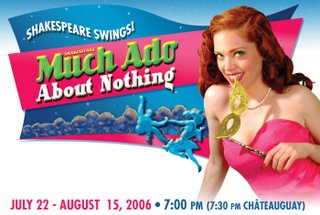
Repercussion Theatre presents Much Ado About Nothing, swing-style, "as if it is inhabited by The Rat Pack."
I was ready to go, planning to take care of an errand or two on my way. Then it started to rain. To storm.
I phoned the theatre office. They told me to bring an umbrella. No, there was no indoor backup venue. But the show must go on.
Much Ado About Nothing — I'd been looking forward to this for weeks, and Ella's recent review had upped my aniticipation. But it'd be pushing my luck to get either J-F or Helena to sit through Shakespeare in the rain. I'd go on my own, I decided. I whipped over to the store to get a frozen pizza for their dinner, to buy their indulgence. Plenty of time still to get them fed and hear about Helena's day before showtime. Even the skies cleared up.
The Old Port was quite desolate when I got there. Show cancelled. In that small window of time between when I called and when the rain let up. I was home before J-F and Helena returned from the park.
I've been moping about this all day. Why bother living in a city with great cultural attractions if you never bother to take advantage of them (oh, just to know that I could if I wanted to)? Of course, it's no one's fault, but I feel picked on — why me? I never get to go anywhere...
The show runs through August 15, but I'm set to leave town in a few days, and the venues for shows between now and then are far from convenient. I missed last year's production cuz I was visiting my mother. I'm debating postponing this trip to see my mom for another day to catch a performance close to home, but I don't know how I'd break it to her, and this show will probably be rained out anyway.

Repercussion Theatre presents Much Ado About Nothing, swing-style, "as if it is inhabited by The Rat Pack."
Scientific editing
Visualize it as a game: Rapids of Inaccurate References, Castle of Convoluted Conclusions...
"Referring manuscripts to Scientific Editing really boosts my self-esteem. When my documents come back the editor has usually changed nothing, except for all the words, punctuation, and figures."
(Ya, well, I thought it was funny.)
"Referring manuscripts to Scientific Editing really boosts my self-esteem. When my documents come back the editor has usually changed nothing, except for all the words, punctuation, and figures."
(Ya, well, I thought it was funny.)
Wednesday, August 02, 2006
Nine times one book
Pearl tagged me.
1. One book that changed your life:
I find this question extremely difficult. So I searched my archives to see how I've answered this previously. The New York Trilogy, Paul Auster. It made itself felt on that time in my life, fed my fascination with the myth of the Tower of Babel and my choice (finally) to study linguistics, and solidified my tastes in literature. I'd love to say the answer to this question is an Important Book, like George Eliot's Middlemarch (which has changed the way I read) (Will any book I read from here on in be powerful enough to change my life, or is reading at an age on the brink of adulthood crucial? I think the context is more telling than the actual book.), but that wouldn't be honest.
2. One book that you’ve read more than once:
The Razor's Edge, W Somerset Maugham.
3. One book you’d want on a desert island:
A notebook (with pens).
4. One book that made you laugh:
The Pleasure of My Company, Steve Martin.
5. One book that made you cry:
Moonlight on the Avenue of Faith, Gina B Nahai. I honestly don't remember much about this book, but I remember the crying over it. Ordinarily it'd have to be quite an exceptional book to make my eyes water, and in this case pregnancy hormones were a contributing factor.
6. One book that you wish had been written:
The Complete Book of English Prepositional Idioms and Phrasal Verbs. Really.
7. One book that you wish had never been written:
There's one book in recent history I hated vehemently (and I can't believe I bothered to read the whole thing!) and I decry its publication as a waste of resources, but it's not polite to name names. So I will tell you instead about a book I loved, Paul Glennon's The Dodecahedron (yes, I mentioned it months ago; yes, I mean to tell you more someday soon) — I wish it had never been written because it comes eerily close to the book I might've written.
8. One book you’re currently reading:
The Intuitionist, Colson Whitehead.
9. One book you’ve been meaning to read:
The Crusades through Arab Eyes, Amin Maalouf. I single this one out from the lists of "latests" (the latest Saramago, Auster, Eco), being books I know I will get to in short order, and of classics to read before I die, which, now that I've put a few big ones behind me, are no longer pressing. The Crusades has been on my nighttable for years, and I feel I ought to read it, both to fill a gap in my knowledge of history and to round out my assessment of Maalouf as a great underappreciated writer.
10. One person you will tag [I edited this one to make it parallel]:
Cipriano of Bookpuddle.
Tuesday, August 01, 2006
My weekend
1 sexy haircut.
1 hour in a used bookstore, whose stock I've determined smells funny and is generally overpriced and in worse condition than that of other used bookstores — no purchases.
1 online book-buying spree.
2 trips to 2 different parks with wading pools.
2 trips to yet 2 other parks for good ol' sandbox and slides.
1 excruciatingly powerful novel.
1 fairly entertaining B-movie, resplendent with stilted dialogue and crappy acting, its only truly memorable aspect being the heroine's boots — sleek and sexy yet sporting remarkably sensible heels.
1 Parc Safari excursion, complete with:
-giraffes! I love giraffes!
-and camels!
-countless slobbering beasts poking their heads into our vehicle
-picnic lunch
-playground, with bouncy tent
-amusement park rides
-1 very delighted little girl with a new and sudden fascination with zebras
-2 slightly sun-tendered shoulders, plus exhaustion
Friday, July 28, 2006
On the reading of the masterpiece
Tolstoy and Gilmour
I was greatly interested to pick up the current issue of the Walrus upon discovering it contained a memoir by David Gilmour, "My Life with Tolstoy," with a focus on War and Peace.
I do have to question how close Gilmour really is to W&P, though, when he describes it as starting in Anna Pavlovna's luxurious Moscow apartments — it starts in Petersburg.
I was delighted to note a web "extra" regarding translations, but it's so spare as to be utterly pointless. He mentions the "good" ones but provides no reasoning for his judgement — Garnett is his favourite, but from the print article I can only believe it's for sentimental reasons. He mentions neither Dunnigan (which I'm reading) nor Briggs (the general buzz about which makes its oversight glaring). It's improbable that he's read more than the Garnett in its entirety and he is likely basing his judgement on generally held opinions and a random sampling of passages. To be fair, that's how most of choose which translation to read, but as an extra to a mostly engaging article in a reputable publication, this sidebar is a missed opportunity.
Gilmour also makes a snide aside: "how anyone over the age of twenty-five can prefer Dostoevsky to Tolstoy is a mystery to me, rather like fancying the Rolling Stones over the Beatles." Well, I'd always thought I preferred Dostoevsky, but then I was well under 25 when I came down on that side, having read only a few works by each. Perhaps when I finish W&P I'll reassess my stance. There might be something to it, typing people by dichotomies — Tolstoy/Dostoevsky, cats/dogs, chocolate/vanilla; more apt than Gilmour's pairing by which to identify camps might be Lennon/McCartney (butI won't say which way I think they align).
Within the print article, Gilmour calls it a dull section where Pierre joins the Freemasons, and I didn't find it so. So. Let each reader's experience of it be their own.
Tolstoy and me
I made the mistake of reading the introduction to my Dunnigan edition. I immediately wished I hadn't as it contained spoilers regarding who was coupled with whom. But a couple hundred pages in, none of them had come to pass, and some even seemed contraindicated. I dare not reread the introduction for clarification at this stage. The "spoilers" in Gilmour's essay further contradicted both what I'd read and what I'd been lead to expect by other sources. So it's almost like not having read any spoilers at all.
(I previously noted that by p 177 there was still no evidence for John Bayley's claim in the introduction that "there are more happy marriages in War and Peace than in any other novel." I'm now on p 737, and there are still no happy marriages.)
So where to start? It's just so big — not just the page count; the whole thing sprawls interesting characters, pithy observations, deeply soulful descriptions, moral and spiritual questions, and millions of associations. I've dogeared almost every other page to note something Important, which has had the same effect as having taken particular note of nothing at all.
Andrei
The book begins for me on p 377. That is, really begins — this is where I realize there's more going on than soirées and troop movements.
Prince Andrei is wounded (B1, P3, ch17).
This scene is often cited as being one of the most memorable in W&P. I held my breath for the next few chapters; I shifted with Andrei, in and out of consciousness, between reality and something else. He is before Napoleon, "such a small, insignificant creature compared with what was taking place between his soul and that lofty, infinite sky with the clouds sailing over it."
This bit still puzzles me: What did he see? What did it inspire in him? Not God. He's ill for some time. When he returns, his wife dies with a reproachful look on her face. For 2 or 3 years it seems Andrei is merely going through the motions; he's in a depressive state. Is he mourning (the wife he thought stupid)? Is it posttraumatic stress disorder? Somehow that clarity, that sense of what it all means, translates into inaction, the pointlessness of everything? Russian fatalism? All that is left for him is his son, he thinks, and this does not seem much to him.
There's the oak tree; we pass by it a few times. I love the oak sequences better than the lofty heavens.
Andrei inspired by the first blush of love finally recognizes the oak for the metaphor it is. "All the finest moments of his life suddenly rose to his mind. Austerlitz with its lofty heavens, the reproachful look on his wife's face in death, Pierre at the ferry, that young girl thrilled by the beauty of the night, and the night itself and the moon — all this suddenly came to his mind." Wait a minute! His wife's reproach, a fine moment?! (Then, "No, life is not over at thirty-one!" Hah!)
Pierre
So Pierre doesn't believe in God. He meets a Freemason. He starts reading Thomas a Kempis, sent to him anonymously.
And about a week later, just like that, Pierre believes in God (p 432). Or he says he does when asked. He actually thinks about it and hesitates before answering, then very quickly reaffirms his position. Is this genuine? A sudden realization? Or does he give this response to gain access to the Brotherhood, for all the other benefits and social good he believes in? Is he fooling himself, or others?
A couple years go by and he is disillusioned. A line I really like (p 527):
"At this meeting Pierre for the first time was struck by the endless variety of men's minds, which prevents a truth from ever appearing the same to any two persons."
And he sinks into a depression (p 529).
The Russian mentality
What strikes me as evident particularly in Andrei and Pierre, but also Nikolai, is a swaying between extremes. From "Life is meaningless" to "life is full of purpose" and back again, and again, in 60 seconds.
Is this a Russian characteristic? Is this part of Russian fatalism? What is Russian fatalism anyway? Nietzsche said "Against it the invalid has only one great remedy — I call it Russian fatalism, that fatalism without revolt with which the Russian soldier, when a campaign becomes too strenuous, finally lies down in the snow. No longer to accept anything at all, to take anything, to take anything in — to cease reacting altogether." That phrase — "Russian fatalism" — is usually considered gloomy, depressing, pessimistic. Is it?
(I mean, I sway between meaning and purpose every day. I hold a "que sera sera" attitude on pretty much everything. Is that my Slavic blood? I'd like to think there can be something a little positive in this. There's only so much I have any control over at all.)
Opposites
All this back and forthing has me thinking about Pythagorean dualism or a dualism of contraries (a subject I don't know a whole lot about, but read some stuff on many, many years ago). Aside from swaying between meaning and meaninglessness, Tolstoy sways also between (obviously) war and peace, big picture and small details, masculine and feminine (on p517 he refers to "the feminine world, society").
From Dictionary of the History of Ideas: "The Pythagoreans taught that all things are composed of contraries: the one and the many, the limited and the unlimited, the odd and the even, right and left, masculine and feminine, rest and motion, the straight line and the curve, light and darkness, good and evil, etc."
I'm not sure what to make of this. My understanding is that Pythagoras blended mathematical principles with the mystical, and it's also my understanding that Tolstoy tries to apply a mathematical calculus to History, and I find this kind of exercise interesting.
Nietsche
Tolstoy said "Neitzsche was stupid and abnormal." In trying to find out a little about this thing called Russian fatalism, I came upon some quotes by Nietzsche, on women, war, truth, etc, and was astounded by how well suited many of them are to summing up the attitudes expressed in War and Peace. I'll probably look into this a bit further myself, but thought I'd ask if anyone knows anything more about their relationship or how their ideas relate.
Middlemarch
This bit reminds me of Middlemarch, this idea of tying to be a good person, the betterment of the world depending on unhistoric acts...
Notes to self
Dreams
There's some references to the dreamlike quality of things (by Pierre, primarily, I thought, but can't find references now). I think Andrei's lofty sky counts. Also, meeting Speransky, then seeing him in a new light, as if for what he really is — somehow separating the essence from the actions, the superficial representation. And Natasha at the opera. These scenes feel like I'm watching a movie stoned, the difference between thinking in analog and digital. Look up my notes on Dostoyevsky — what story?, that dream sequence — why do I think of it now? Is there something Platonic in all this?
Music
Again, Natasha at the opera is in stark contrast to the other musical moments. She is not technically perfect but sings with "soul," charms everyone. Also, at Uncle's house after the hunt — this is my favourite and the most enchanting episode thus far.
I was greatly interested to pick up the current issue of the Walrus upon discovering it contained a memoir by David Gilmour, "My Life with Tolstoy," with a focus on War and Peace.
I do have to question how close Gilmour really is to W&P, though, when he describes it as starting in Anna Pavlovna's luxurious Moscow apartments — it starts in Petersburg.
I was delighted to note a web "extra" regarding translations, but it's so spare as to be utterly pointless. He mentions the "good" ones but provides no reasoning for his judgement — Garnett is his favourite, but from the print article I can only believe it's for sentimental reasons. He mentions neither Dunnigan (which I'm reading) nor Briggs (the general buzz about which makes its oversight glaring). It's improbable that he's read more than the Garnett in its entirety and he is likely basing his judgement on generally held opinions and a random sampling of passages. To be fair, that's how most of choose which translation to read, but as an extra to a mostly engaging article in a reputable publication, this sidebar is a missed opportunity.
Gilmour also makes a snide aside: "how anyone over the age of twenty-five can prefer Dostoevsky to Tolstoy is a mystery to me, rather like fancying the Rolling Stones over the Beatles." Well, I'd always thought I preferred Dostoevsky, but then I was well under 25 when I came down on that side, having read only a few works by each. Perhaps when I finish W&P I'll reassess my stance. There might be something to it, typing people by dichotomies — Tolstoy/Dostoevsky, cats/dogs, chocolate/vanilla; more apt than Gilmour's pairing by which to identify camps might be Lennon/McCartney (butI won't say which way I think they align).
Within the print article, Gilmour calls it a dull section where Pierre joins the Freemasons, and I didn't find it so. So. Let each reader's experience of it be their own.
Tolstoy and me
I made the mistake of reading the introduction to my Dunnigan edition. I immediately wished I hadn't as it contained spoilers regarding who was coupled with whom. But a couple hundred pages in, none of them had come to pass, and some even seemed contraindicated. I dare not reread the introduction for clarification at this stage. The "spoilers" in Gilmour's essay further contradicted both what I'd read and what I'd been lead to expect by other sources. So it's almost like not having read any spoilers at all.
(I previously noted that by p 177 there was still no evidence for John Bayley's claim in the introduction that "there are more happy marriages in War and Peace than in any other novel." I'm now on p 737, and there are still no happy marriages.)
So where to start? It's just so big — not just the page count; the whole thing sprawls interesting characters, pithy observations, deeply soulful descriptions, moral and spiritual questions, and millions of associations. I've dogeared almost every other page to note something Important, which has had the same effect as having taken particular note of nothing at all.
Andrei
The book begins for me on p 377. That is, really begins — this is where I realize there's more going on than soirées and troop movements.
Prince Andrei is wounded (B1, P3, ch17).
He opened his eyes, hoping to see how the struggle between the gunner and the Frenchman ended; he wanted to know whether the red-haired artilleryman had been killed or not, and whether the cannons had been captured or saved. But he saw nothing. Above him there was nothing but the sky, the lofty heavens, not clear, yet immeasurably lofty, with gray clouds slowly drifting across them. "How quiet, solemn, and serene, not at all as it was when I was running," thought Prince Andrei, "not like our running, shouting, fighting; not like the gunner and the Frenchman with their distraught, infuriated faces, struggling for the rod; how differently do those clouds float over the lofty infinite heavens! How is it I did not see this sky before? How happy I am to have discovered it at last! Yes! All is vanity, all is delusion, except those infinite heavens. There is nothing but that. And even that does not exist; there is nothing but stillness, peace. Thank God..."
This scene is often cited as being one of the most memorable in W&P. I held my breath for the next few chapters; I shifted with Andrei, in and out of consciousness, between reality and something else. He is before Napoleon, "such a small, insignificant creature compared with what was taking place between his soul and that lofty, infinite sky with the clouds sailing over it."
This bit still puzzles me: What did he see? What did it inspire in him? Not God. He's ill for some time. When he returns, his wife dies with a reproachful look on her face. For 2 or 3 years it seems Andrei is merely going through the motions; he's in a depressive state. Is he mourning (the wife he thought stupid)? Is it posttraumatic stress disorder? Somehow that clarity, that sense of what it all means, translates into inaction, the pointlessness of everything? Russian fatalism? All that is left for him is his son, he thinks, and this does not seem much to him.
There's the oak tree; we pass by it a few times. I love the oak sequences better than the lofty heavens.
A whole new sequence of thoughts, hopeless but ruefully satisfying, rose in Prince Andrei's soul in connection with that oak tree. He considered his life afresh as it were and arrived at the same hopeless but soothing conclusion as before, that it was not for him to begin anything anew, but that he must live out his life harming no one, disturbed by nothing, desiring nothing.
Andrei inspired by the first blush of love finally recognizes the oak for the metaphor it is. "All the finest moments of his life suddenly rose to his mind. Austerlitz with its lofty heavens, the reproachful look on his wife's face in death, Pierre at the ferry, that young girl thrilled by the beauty of the night, and the night itself and the moon — all this suddenly came to his mind." Wait a minute! His wife's reproach, a fine moment?! (Then, "No, life is not over at thirty-one!" Hah!)
Pierre
So Pierre doesn't believe in God. He meets a Freemason. He starts reading Thomas a Kempis, sent to him anonymously.
One thing, and one thing only, he realized as he read this book: the hitherto unknown joy of believing in the possibility of attaining perfection, and the possibility of an active brotherly love among men.
And about a week later, just like that, Pierre believes in God (p 432). Or he says he does when asked. He actually thinks about it and hesitates before answering, then very quickly reaffirms his position. Is this genuine? A sudden realization? Or does he give this response to gain access to the Brotherhood, for all the other benefits and social good he believes in? Is he fooling himself, or others?
A couple years go by and he is disillusioned. A line I really like (p 527):
"At this meeting Pierre for the first time was struck by the endless variety of men's minds, which prevents a truth from ever appearing the same to any two persons."
And he sinks into a depression (p 529).
It was all the same to him: nothing in life seemed to be a matter of great consequence, and under the influence of the depression that possessed him, he valued neither his liberty nor his determination to punish his wife.
The Russian mentality
What strikes me as evident particularly in Andrei and Pierre, but also Nikolai, is a swaying between extremes. From "Life is meaningless" to "life is full of purpose" and back again, and again, in 60 seconds.
Is this a Russian characteristic? Is this part of Russian fatalism? What is Russian fatalism anyway? Nietzsche said "Against it the invalid has only one great remedy — I call it Russian fatalism, that fatalism without revolt with which the Russian soldier, when a campaign becomes too strenuous, finally lies down in the snow. No longer to accept anything at all, to take anything, to take anything in — to cease reacting altogether." That phrase — "Russian fatalism" — is usually considered gloomy, depressing, pessimistic. Is it?
(I mean, I sway between meaning and purpose every day. I hold a "que sera sera" attitude on pretty much everything. Is that my Slavic blood? I'd like to think there can be something a little positive in this. There's only so much I have any control over at all.)
Opposites
All this back and forthing has me thinking about Pythagorean dualism or a dualism of contraries (a subject I don't know a whole lot about, but read some stuff on many, many years ago). Aside from swaying between meaning and meaninglessness, Tolstoy sways also between (obviously) war and peace, big picture and small details, masculine and feminine (on p517 he refers to "the feminine world, society").
From Dictionary of the History of Ideas: "The Pythagoreans taught that all things are composed of contraries: the one and the many, the limited and the unlimited, the odd and the even, right and left, masculine and feminine, rest and motion, the straight line and the curve, light and darkness, good and evil, etc."
I'm not sure what to make of this. My understanding is that Pythagoras blended mathematical principles with the mystical, and it's also my understanding that Tolstoy tries to apply a mathematical calculus to History, and I find this kind of exercise interesting.
Nietsche
Tolstoy said "Neitzsche was stupid and abnormal." In trying to find out a little about this thing called Russian fatalism, I came upon some quotes by Nietzsche, on women, war, truth, etc, and was astounded by how well suited many of them are to summing up the attitudes expressed in War and Peace. I'll probably look into this a bit further myself, but thought I'd ask if anyone knows anything more about their relationship or how their ideas relate.
Middlemarch
This bit reminds me of Middlemarch, this idea of tying to be a good person, the betterment of the world depending on unhistoric acts...
He surprised me by asking whether I remembered the threefold aim of the order: (1) The preservation and study of the mystery. (2) The purification and reformation of oneself for its reception, and (3) The improvement of the human race by striving for such purification. Which is the principal aim of these three? Certainly self-reformation and self-purification. Only to this aim can we always strive independently of circumstances. But at the same time just this aim demands the greatest efforts of us; and so, led astray by pride, losing sight of this aim, we occupy ourselves either with the mystery which in our impurity we are unworthy to receive, or seek the reformation of the human race while ourselves setting an example of baseness and profligacy.
Notes to self
Dreams
There's some references to the dreamlike quality of things (by Pierre, primarily, I thought, but can't find references now). I think Andrei's lofty sky counts. Also, meeting Speransky, then seeing him in a new light, as if for what he really is — somehow separating the essence from the actions, the superficial representation. And Natasha at the opera. These scenes feel like I'm watching a movie stoned, the difference between thinking in analog and digital. Look up my notes on Dostoyevsky — what story?, that dream sequence — why do I think of it now? Is there something Platonic in all this?
Music
Again, Natasha at the opera is in stark contrast to the other musical moments. She is not technically perfect but sings with "soul," charms everyone. Also, at Uncle's house after the hunt — this is my favourite and the most enchanting episode thus far.
The Distroboto distribution project
 As you may recall, earlier this summer I bought some art from a cigarette machine. Well, after a few weeks, I felt a little niggling, an urge; so I set forth to search out one of the other machines in the city.
I found one at Le Divan Orange. I popped in my toonie, pressed a button nearly at random, and out came my prize, this time in a real (painted-over) cigarette packet. Only, I couldn't really justify feeding what felt like the stirrings of a compulsion, so I packed it up and sent it to Patricia. See what she got!
Yes. The stirrings of a compulsion. Better to call it a "project," no? I need to see all of Montreal's Distroboto machines this summer, and I want to know what's in them. You can help, by relieving me of the burden of guilt for hoarding trash (or art, whatever).
Send me an email with your postal address, and I'll send you a cigarette-machine "art" surprise. (C'mon, you know you want to, Martha.) I can't guarantee what you'll get; I ask only that you blog about it.
Went fishing
 The Dora fishing rod (Zebco) actually works. I caught 2 fish with it last weekend.
It's been a favourite toy of Helena's since she received it at Christmas, but the tedium of the real-life conditions of fishing, after the delight of live bait waned, outweighed her capacity for patience. She fell asleep, hatted and lifejacketed, in a corner of the pontoon, and so did not witness what Dora would yield forth.
She'd anticipated our cottage weekend for days, and on arriving she was in nonstop-go-go-go mode to see all the water, trees, fish, frogs, bugs, and loons; we played pirates, marching on and off boats, yo-ho-hoing, stepping inside the cottage only to pillage and plunder her grandmother's grapes. I'd been worried about Helena's reaction to the realization that this was a short trip, less than 24 hours. But after a full afternoon's excietment and a late night, she woke up wanting to go home. So we did.
Tuesday, July 25, 2006
Saramago, Pinter, et al, loud and clear
This letter, signed by Jose Saramago, Harold Pinter, Noam Chomsky, and John Berger, appeared July 21 buried in The Independent's letters page. A quick internet search on these authors' names shows the letter to have been printed in (as far as I can tell) Portuguese, Turkish, Spanish, Swedish, and Italian across Europe, Turkey, and South America, with almost no notice of it in English.
The letter has since been endorsed by Tariq Ali, Eduardo Galeano, Naomi Klein, Arundhati Roy, Giuliana Sgrena, and Howard Zinn.
The latest chapter of the conflict between Israel and Palestine began when Israeli forces abducted two civilians, a doctor and his brother, from Gaza. An incident scarcely reported anywhere, except in the Turkish press. The following day the Palestinians took an Israeli soldier prisoner — and proposed a negotiated exchange against prisoners taken by the Israelis — there are approximately 10,000 in Israeli jails.
That this "kidnapping" was considered an outrage, whereas the illegal military occupation of the West Bank and the systematic appropriation of its natural resources — most particularly that of water — by the Israeli Defense (!) Forces is considered a regrettable but realistic fact of life, is typical of the double standards repeatedly employed by the West in face of what has befallen the Palestinians, on the land allotted to them by international agreements, during the last seventy years.
Today outrage follows outrage; makeshift missiles cross sophisticated ones. The latter usually find their target situated where the disinherited and crowded poor live, waiting for what was once called Justice. Both categories of missile rip bodies apart horribly — who but field commanders can forget this for a moment?
Each provocation and counter-provocation is contested and preached over. But the subsequent arguments, accusations and vows, all serve as a distraction in order to divert world attention from a long-term military, economic and geographic practice whose political aim is nothing less than the liquidation of the Palestinian nation.
This has to be said loud and clear for the practice, only half declared and often covert, is advancing fast these days, and, in our opinion, it must be unceasingly and eternally recognized for what it is and resisted.
John Berger
Noam Chomsky
Harold Pinter
José Saramago
Mieussy, France
The letter has since been endorsed by Tariq Ali, Eduardo Galeano, Naomi Klein, Arundhati Roy, Giuliana Sgrena, and Howard Zinn.
Friday, July 21, 2006
The extravagant claims of madmen
Umberto Eco on Hollow Earth theories:
I remember first reading about and being fascinated by the concave hollow Earth theory in Omni magazine. Martin Gardner has discussed it elsewhere. From Wikipedia:
On various occasions I have written about "literary madmen," but they are not merely a fixation of mine. I find that reflecting upon outlandish theories that were taken seriously for a long time teaches one to distrust many ideas that are accorded full credence in the media, and even in some scientific circles.
I remember first reading about and being fascinated by the concave hollow Earth theory in Omni magazine. Martin Gardner has discussed it elsewhere. From Wikipedia:
Martin Gardner notes that "most mathematicians believe that an inside-out universe, with properly adjusted physical laws, is empirically irrefutable". However, Gardner rejects the concave hollow Earth theory, not as disproven, but instead entirely on the basis of Occam's Razor.
Wednesday, July 19, 2006
Changing orbit
Tomorrow is World Jump Day! Science or performance art — you decide.
It's claimed that if 600 million people in the Western hemisphere jump simultaneously (11:39:13 GMT, July 20, 2006), Earth will be driven out of its current orbital rotation. "The change of planetary positioning would very likely stop global warming, extend daytime hours and create a more homogeneous climate."
It's claimed that if 600 million people in the Western hemisphere jump simultaneously (11:39:13 GMT, July 20, 2006), Earth will be driven out of its current orbital rotation. "The change of planetary positioning would very likely stop global warming, extend daytime hours and create a more homogeneous climate."
Tuesday, July 18, 2006
The spider in the bathtub
There's a spider living in our bathtub. I noticed him about a week ago. There he sits, occasionally runs a lap, minding his own business. Just a regular, non-threatening, garden-variety spider, the kind you find in most people's basements. Though this one looks pretty healthy. About an inch in diameter with legs splayed, his body the size of the tip of my pinky.
Then bath night came along. I scooped him up on a magazine and deposited him in the opposite corner of the bathroom.
A couple days later he'd made his way down the hall to Helena's room. Oh, the shrieks. She loves pretending to be scared, but perhaps he'd crossed a little far into her comfort zone. This time I transported him to the laundry room. It didn't occur to me at the time that the cat, whose litter box is in the area, might take an interest. As a matter of fact, he didn't — the cat is unbelievably lazy these dog days.
By next morning, Spidey had crossed the hall and settled back into the tub. Then it's bath night again; J-F in preparing the bath area must now find a safe haven for the critter. He picks him up, and... drops him. Down the drain. There's nothing to be done about it. The bath must proceed. Water will be evacuated through those pipes.
It took a couple nights, but this morning, Spidey's back.
Helena wants to build him a house.
Saturday, July 15, 2006
Travel reading
David Gilmour in "My Life with Tolstoy" (July/August 2006, The Walrus):
There's a way you read when you travel; it is, in itself, a kind of transport, the purity with which you pay attention. You never read like that at home. In fact, as the years have gone by and with them a dozen other trips, it has occurred to me that reading, all on its own, may well be the best reason to travel.
Hero or despot? Napoleon and the Big Bad Wolf
Share your thoughts on Napoleon while we dissect War and Peace. This novel is turning into quite the history lesson.
I'm still exhausted after having spent Wednesday with Helena and her daycare at Wonderland. A 2-hour round trip on a schoolbus with small children, the noise, the cruel sun, the lameness of it all, the difficulty of seeing it through the eyes of a 3-year-old, being generally overwhelmed not by the task of minding one's own child so much as resisting the smothering effect of the collective energy of so many small children on their own territory and the occasional but harsh intrusion of some ill-mannered parents — it was all worth it to see the sparkle in Helena's eyes when she came face to face with the Big Bad Wolf. I'd consciously left the camera at home so I could be there with her.
 Helena has an affinity for the tale of Little Red Riding Hood (my mother will be pleased to know).
So Wednesday we visited Little Red Riding Hood's grandmother's house twice. The wolf is tame now, though he a has a bright pink bandaid plastered across his nose where Red Riding Hood bopped him to put him back in his place. Helena tried unsuccessfully to make him talk, settled for a hug and a kiss and another hug. She'll be talking about this for months.
I'm still exhausted after having spent Wednesday with Helena and her daycare at Wonderland. A 2-hour round trip on a schoolbus with small children, the noise, the cruel sun, the lameness of it all, the difficulty of seeing it through the eyes of a 3-year-old, being generally overwhelmed not by the task of minding one's own child so much as resisting the smothering effect of the collective energy of so many small children on their own territory and the occasional but harsh intrusion of some ill-mannered parents — it was all worth it to see the sparkle in Helena's eyes when she came face to face with the Big Bad Wolf. I'd consciously left the camera at home so I could be there with her.
 Helena has an affinity for the tale of Little Red Riding Hood (my mother will be pleased to know).
So Wednesday we visited Little Red Riding Hood's grandmother's house twice. The wolf is tame now, though he a has a bright pink bandaid plastered across his nose where Red Riding Hood bopped him to put him back in his place. Helena tried unsuccessfully to make him talk, settled for a hug and a kiss and another hug. She'll be talking about this for months.
Thursday, July 13, 2006
Parnassus
Christopher Morley's Parnassus on Wheels is delightful — "graceful in style, light in substance, merry in its attitude toward life, and entertaining in every aspect of its plot and insight into character," to quote the Boston Evening Transcript as cited in the introduction to my 1955 edition. Written in 1917, its stylings and rhythms are of another era, and this only adds to its charm.
I read it in just a couple sittings. It's definitely a feel-good book; I suspect I'll turn to it again next time I'm in bed with the flu.
Has anybody not heard about this book? Just a few months ago it seemed to be on every blogger's lips. If you haven't read it — if you love books and have a soft spot for books about books — find it.
One day, an adventure knocks on Helen McGill's farmhouse door — she buys a bookmobile from a strange little man, only to stop her brother, now a writer who's as good as abandoned the farm, from doing same. Having compiled an anthology of 6000 loaves of bread over the years, she's hankering after a few carefree days of her own, so she ups and leaves the farm to learn the itinerant bookseller's trade, and a little something about life and love.
I'm pretty sure the bored, pudgy clerk behind the counter had no idea what he sold me.
I read it in just a couple sittings. It's definitely a feel-good book; I suspect I'll turn to it again next time I'm in bed with the flu.
Has anybody not heard about this book? Just a few months ago it seemed to be on every blogger's lips. If you haven't read it — if you love books and have a soft spot for books about books — find it.
One day, an adventure knocks on Helen McGill's farmhouse door — she buys a bookmobile from a strange little man, only to stop her brother, now a writer who's as good as abandoned the farm, from doing same. Having compiled an anthology of 6000 loaves of bread over the years, she's hankering after a few carefree days of her own, so she ups and leaves the farm to learn the itinerant bookseller's trade, and a little something about life and love.
I began to see something of the little man's idealism in his work. He was a kind of travelling missionary in his way. A hefty talker, too. His eyes were twinkling now and I could see him warming up.
"Lord!" he said, "when you sell a man a book you don't sell him just twelve ounces of paper and ink and glue — you sell him a whole new life. Love and friendship and humour and ships at sea by night — there's all heaven and earth in a book, a real book I mean. Jiminy! If I were the baker or the butcher or the broom huckster, people would run to the gate when I came by — just waiting for my stuff. And here I go loaded with everlasting salvation — yes, ma'am, salvation for their little, stunted minds — and it's hard to make 'em see it. That's what makes it worth while — I'm doing something that nobody else from Nazareth, Maine, to Walla Walla, Washington, has ever thought of. It's a new field, but by the bones of Whitman it's worth while. That's what this country needs — more books!"
I'm pretty sure the bored, pudgy clerk behind the counter had no idea what he sold me.
Tuesday, July 11, 2006
A brief report of bookish things
While I often crave and seek out the solace of a bookstore, I rarely find it, particularly since generally only big-box bookstores are within a comfortable walkable radius when that urge overcomes me — I leave them feeling unsatisfied and angsty; so I have over the years learned to subdue the urge, and my intuition is now better honed to knowing the right time and place for achieving bookstore zen.
(The fact that the bookstores closest to home are predominantly French has been a blessing in disguise. One shop has a tiny section of English books, but I feel they've been selected with care and individualized to my literary taste (Am I the only anglophone in the neighbourhood? Have they been tracking my buying patterns? Or do all the anglophones in the neighbourhood actually share my preferences in reading material? If so, where are they?). Another shop has no English section per se; English books are shelved alongside French, alphabetical by author within genre. This store has more tables than shelves though, the stacks having no discernible order; it's a treasure hunt.)
I browsed bookshops this morning, successfully — I came home with heavy bags (well, mostly owing to War and Peace, which foolishly I carried with me to read on the metro), but with a lightness in my step and in my soul.
I went looking for one great underappreciated author in particular, but found works by others instead. I brought home Christopher Morley's Parnassus on Wheels (a 1955 edition in excellent condition with very funny "preliminary footnotage") and Lionel Shriver's We Need to Talk About Kevin (remaindered, cheap). (Also, Colson Whitehead's The Intuitionist, which appeals to my left brain.) Also found: Rebecca West's The Thinking Reed, not purchased, but of which I read the first chapter in-store; it leaves me with a niggling sensation — I must return for it.
(I am loving great underappreciated authors. I plan to update the list to include all the suggestions left in the comments. Handy sidebar link coming soon!)
Sighted, on some book, the title of which I've conveniently forgotten, a blurb from Neil Gaiman stating that the author's "command of language borders on scary." Maybe I paraphrase a little, just a little, but really, Gaiman's command of language borders on scary.
The lights went out
We had a spectacular, if relatively brief, thunderstorm yesterday evening, just around Helena's bedtime. We lost power, and seeing as she was already in bed and there was still enough light through the window by which to read her a story — and even though she sleeps with a light on in her room, I had a small battery-operated lamp at the ready — you'd think it wouldn't directly affect her routine, but it seems all the energy inpired by flashes of lightning and cracks of thunder necessitated extra-long stories and extra-long cuddling and hair-stroking before she would settle down to sleep (fiercely gripping my itty-bitty book light).
She'd asked for, I don't know, something, and I explained that whatever it was wasn't possible cuz the lights had gone out, and she immediately jumped up to standing on her bed to look out the window and nodded, "Ah, oui," they're outside, I see the lights over there, which was confusing to me, then extremely funny, and I wonder, do all 3-year-olds do that? Or is it a function of her bilingualism — a little slower to understand an expression but perhaps paying more careful attention to it?
She'd asked for, I don't know, something, and I explained that whatever it was wasn't possible cuz the lights had gone out, and she immediately jumped up to standing on her bed to look out the window and nodded, "Ah, oui," they're outside, I see the lights over there, which was confusing to me, then extremely funny, and I wonder, do all 3-year-olds do that? Or is it a function of her bilingualism — a little slower to understand an expression but perhaps paying more careful attention to it?
Sunday, July 09, 2006
Wednesday, July 05, 2006
At war and peace with myself
Discussion opens today (we hope) on the first chunk of Tolstoy's War and Peace (as if anyone else ever wrote a book called "War and Peace").
Confession: I'm not loving it. I mean, it moves along swiftly enough, it holds my interest, it's funny even, and I'd like to get to know all these characters better. It's certainly not hard. But it doesn't really grab me; I don't really care about it. Maybe this will change; I'm only about 180 pages in (about 12%), but it's getting kind of far on to be drawing a reader along without drawing them in. (Or maybe this is not the right time for me and War and Peace to come together.)
I can't even make out what, so far, is discussion-worthy. Excuse me while I clear my head...
One problem I'm stumbling over: it turns out I know nothing about the Napoleonic Wars. Rather, knew nothing. I know quite a bit now (at least, so far, about the rise of Napoleon's career to about 1805), not because Tolstoy has taught me anything but because I keep looking up information to feed my understanding of passing references. I'm assured that one doesn't need to know these things to appreciate the work as a whole, but I have trouble passing over the characters' comments, politely smiling and nodding, when the reference is not to something vague or wholly fictitious but is a matter of actual historical events and their consequent interpretation.
Thus far, the references seem to add only a little to the character of Pierre. Pierre is a sympathizer (of Napoleon and the French Revolution), a Jacobin. He has the brashness of youth, a revolutionary spirit. Indeed, among aristocratic circles, he could be seen as if not a subversive then certainly an unpleasantness, a threat, at the very least a fool.
Prince Andrei seems to like Pierre. We know Andrei to be smart and level-headed (though perhaps a little inconsiderate of his pregnant wife). Andrei strikes me as a good judge of character.
The other problem that is a thorn in the forefront of my brain is that I read the introduction by John Bayley. (By the second page he is judging Middlemarch unfavourably: "George Eliot combined a power of intellect with a power of human sympathy, but she could not begin to render a common experience as Tolstoy did." I'm not sure I agree.) He begins by telling us there are more happy marriages in War and Peace than in any other novel. Well, I'm only on page 177, it's just 1805, but I've had insight into exactly one marriage (Andrei and Lisa) and it doesn't seem all happy to me. (The merest glimpse into the Rostov's life together is just that — a glimpse.) Other marriages loom on the horizon, but from where I stand they are rife with expectations and jealousies.
None of this really matters, except for that I read the introduction and I wish I hadn't; it's planted an unwelcome (at this point) answer to the seed of the question of "what's this novel all about anyway?"
I'm also realizing how very strongly the answer, for me, now, to that question is nourished by the other books I've recently read (specifically Miéville, also responsible for leading me to search out the historical reality behind Tolstoy's references).
Subscribe to:
Posts (Atom)
