While I like to think I'm above judging a book by its cover, I do put some store by the jacket copy.
Wonder, by R.J. Palacio, is not the kind of book I ever would've considered picking up on my own, for me or my child. I'm all for overcoming adversity, and most novel plots play on some variation of this theme, but reading about overcoming physical adversity (as opposed to, say, character flaw — and I recognize that a good book, which this is, will still incorporate all that fine moral, social, character stuff regardless) generally isn't my thing.
But eleven years on, I am still hopeless at gauging my daughter's tastes.
She received Wonder back in November, and over several weeks I'd been reading it aloud to her at bedtime.
August Pullman was born with severe facial deformities. Because of his health and all the surgeries he'd undergone, he was homeschooled. But at age 10 he enters fifth grade at a mainstream school, where he learns all about the real world of the social politics kids play at. This, compounded by the fact that he has the kind of face that makes people scream, shudder, turn away. Born to stand out, and sometimes invisible because of it. But he makes some true friends, and ultimately the entire school rallies around him.
The novel starts from Auggie's perspective, but it switches between several narrators, including Auggie's sister and some of his friends. This helps keep the story fresh, unpredictable, and moving swiftly through the school year.
It's all told with a light touch — it's funny and deeply affecting. And when Auggie's dog dies, Helena and I were in tears (I think reading it aloud made me feel it more intensely); we had to skim over a couple pages.
Books with "serious" subject matter, aimed at kids, I think run the risk of moralizing too much. For my taste, it could've been a tad more subtle: For example, one teacher at the beginning of every months presents precepts for consideration, which are nothing if not hitting you over the head with a life lesson. But coming from a teacher, these were more natural and easier to swallow than if they'd come from the narrator, or even a parent. That said, Helena was unfazed, and didn't detect any preachiness at all. (And to be fair, many of the precepts come from the likes of Virgil, Confucius, Pascal.)
Helena rates it four and half stars out of five, and is hoping for a sequel. It's a book we continue to talk about well after having turned the final page. Consider it recommended for that age set.
The open call (now closed) for postcard precepts on the author's website indicates that another book is in the works, but there's no indication how it will relate to Wonder.
Book trailer.
Friday, January 31, 2014
Sunday, January 26, 2014
Waiting for socialism
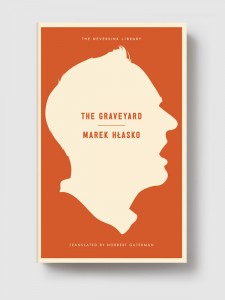
It took me a long time to read The Graveyard, by Marek Hłasko, despite its being merely 140 pages long. It's dense with politics and a whole country's emotional baggage.
I first read Hłasko about 20 years ago — The Eight Day of the Week was just about the only book of his readily available in English. The Polish crowd I ran with couldn't sing his praises strongly enough. Hłasko is Poland's James Dean, its Angry Young Man. It's 1950s angst, but on another planet; Holden Caulfield's life of privilege shrinks to nothing when compared with growing up in the shadow of Communism. You want phoney, try on some party propaganda.
It's the story of Franciszek Kowalski, a factory worker and party man. He meets up with an old friend and they go for a few drinks. On his way home, drunk, he manages to insult a couple police officers. Very soon, the exact nature of his innocent drunken outburst is called into question. A night in the drunk tank pales against the ensuing difficulties at work, with the party, and at home.
What begins with bureaucratic absurdities moves into surreal, nightmarish wartime flashbacks. And then. One by one, Kowalski hunts down his old comrades in the underground, looking to restore his faith but instead finding deeper truths.
There's joke early on that sums up the moral-political confusion of the times:
Reviews
Cleaver Magazine
Numéro Cinq
The School of Washington
I first read Hłasko about 20 years ago — The Eight Day of the Week was just about the only book of his readily available in English. The Polish crowd I ran with couldn't sing his praises strongly enough. Hłasko is Poland's James Dean, its Angry Young Man. It's 1950s angst, but on another planet; Holden Caulfield's life of privilege shrinks to nothing when compared with growing up in the shadow of Communism. You want phoney, try on some party propaganda.
"It's funny," Franciszek said. "Man always dreamed of one thing — knowledge. That was the meaning of his eternal struggle. He dreamed of only one thing — to understand his times, his purpose, his place, his meaning, and his moment in eternity. And now that he has come closest to this understanding, knowledge is his main enemy. It's better not to understand — knowledge is a disease."The Graveyard was firmly rejected for publication in Poland. It appeared first in France in 1956.
"No," the painter said. "it's death. It's worse than death. It's an encore piece, and encore to something that didn't exist, that couldn't be taken seriously." He waved the bottle joyfully. "How about a drink?"
It's the story of Franciszek Kowalski, a factory worker and party man. He meets up with an old friend and they go for a few drinks. On his way home, drunk, he manages to insult a couple police officers. Very soon, the exact nature of his innocent drunken outburst is called into question. A night in the drunk tank pales against the ensuing difficulties at work, with the party, and at home.
What begins with bureaucratic absurdities moves into surreal, nightmarish wartime flashbacks. And then. One by one, Kowalski hunts down his old comrades in the underground, looking to restore his faith but instead finding deeper truths.
He rose suddenly and began to pace the room. His neck grew purple, and his upper lip quivered. "Goddam it to hell!" he said. "To hell with this goddam chatter! What matters are the consequences, the final consequences. Once you've started a revolution, you have to realize that it can't be stopped, or moderated, or turned off, or delayed. A revolution can be only won or lost, and that's all. What horrifies you? The dimensions? The methods?"Franciszek wants only to know what kind of man he really is, what he really is, but what a quagmire of mistruths he stirs up. That should teach him drink vodka on a weeknight.
"The consequences," Franciszek said. "What you said a moment ago. Is the revolution a blind, brutal force?"
Birch gripped Franciszek by the arm and led him to the window. Before them lay the wet city, bristling with scaffoldings. "Here, to this place," Birch said, "in I don't know how many years, a man will come who hasn't yet been born. He will come and he'll want to live, to have food, an apartment, children, a family; he will want to live in security and he will expect the time he lives in to provide everything a man is entitled to. I assure you that he won't be concerned with your sufferings and doubts, or mine. He will evaluate the world he finds by the yardstick of his reason. And that's all."
There's joke early on that sums up the moral-political confusion of the times:
Once again he ran in his unbuttoned overcoat through the wet, muddy streets. He stopped suddenly. [...] He heard the furious screech of brakes behind him, and jumped aside.
"What are you waiting for?" the driver screamed, "For applause?"
"For socialism," someone said on the sidewalk.
Reviews
Cleaver Magazine
Numéro Cinq
The School of Washington
Labels:
Marek Hłasko,
Melville House,
Polish literature
Monday, January 20, 2014
A short story about storytelling
One of the MOOCs I started last week — Content Strategy — is, ironically, less than engaging. The definitions — of content strategy, content marketing, journalism, branding, and other terms — are muddled at best, where I so desperately yearn for clarity. So far I've learned only that "people will only learn about things they're motivated to learn about."
I was, however, heartened to find, buried in the discussion forums, a note on the importance of storytelling (and a link to this clip). While I find the marriage of narrative concept to business context a bit unsettling (I like narrative, business not so much), it's also reassuring — it acknowledges a truth that great authors have long known, that Don Draper has long known, that I've long known.
Labels:
mooc
Sunday, January 19, 2014
The strife of love in a dream
This weekend I saw the exhibition Splendore a Venezia.
It was lush and overwhelming, probably very much like the times it was meant to depict. It aimed to explore the interrelationships between the visual arts and music in the Venetian Republic, from the early sixteenth century to the fall of the Serenissima at the close of the eighteenth century. Ambitious.
In fact, it's several exhibitions rolled into one. I for one could do without the filigree and flourish; you can keep your Venetian School paintings. I was perfectly enthralled by the instruments of the era, musical manuscripts (a first edition of Vivaldi's Four Seasons), and other texts.
Some specific things I learned:
Standing Man Playing a Viola da Gamba, by Paris Bordone (1500–1571). Pictured here. A small chalk sketch, to my eyes a gem among the oversize oils. "The composition anticipates the poetic depictions of mythological subjects that became popular in the mid-sixteenth century."
Sonata in G minor, for cello and basso continuo, RV 42, by Antonio Vivaldi. The piece was included in the audioguide of the exhibition, and this version was much lighter than any other rendition I can find on the internet.
Viola d'amore, which somehow looks wrong yet beautiful, flat-backed and with too many strings. Sympathetic strings, it turns out. This one had a scroll that, looked at head on, formed a heart.
Hypnerotomachia di Poliphilo, attributed to Francesco Colonna, and translated into English as The Strife of Love in a Dream. There wasn't much of a description, just publication details. It's only with further research that I learned it incorporates many languages into a tale replete with Roman gods and goddesses, exquisite architecture, trysts with nymphs, and hidden messages. The book lay open; latinate text and a woodcut image, nothing special at a glance. What was noteworthy, however, is how clean it was for a 500-year-old book — trim pages, crisp text, clear lines.
Ah, Hypnerotomachia! This is just the beginning.
It was lush and overwhelming, probably very much like the times it was meant to depict. It aimed to explore the interrelationships between the visual arts and music in the Venetian Republic, from the early sixteenth century to the fall of the Serenissima at the close of the eighteenth century. Ambitious.
In fact, it's several exhibitions rolled into one. I for one could do without the filigree and flourish; you can keep your Venetian School paintings. I was perfectly enthralled by the instruments of the era, musical manuscripts (a first edition of Vivaldi's Four Seasons), and other texts.
Some specific things I learned:
- Venice was a republic. Despite many hours of Assassin's Creed gameplay, the nuances of the political structures and relations of the time eluded me.
- Venice was a great publishing centre. This was in part owing to the standardization of musical notation; the local music industry created many printing opportunities — scores, libretti, programs.
- Venice enjoyed a thriving tourist industry several hundred years ago. This is evidenced by bound albums of commemorative woodcuts of public ceremonies and other occasions.
Standing Man Playing a Viola da Gamba, by Paris Bordone (1500–1571). Pictured here. A small chalk sketch, to my eyes a gem among the oversize oils. "The composition anticipates the poetic depictions of mythological subjects that became popular in the mid-sixteenth century."
Sonata in G minor, for cello and basso continuo, RV 42, by Antonio Vivaldi. The piece was included in the audioguide of the exhibition, and this version was much lighter than any other rendition I can find on the internet.
Viola d'amore, which somehow looks wrong yet beautiful, flat-backed and with too many strings. Sympathetic strings, it turns out. This one had a scroll that, looked at head on, formed a heart.
Hypnerotomachia di Poliphilo, attributed to Francesco Colonna, and translated into English as The Strife of Love in a Dream. There wasn't much of a description, just publication details. It's only with further research that I learned it incorporates many languages into a tale replete with Roman gods and goddesses, exquisite architecture, trysts with nymphs, and hidden messages. The book lay open; latinate text and a woodcut image, nothing special at a glance. What was noteworthy, however, is how clean it was for a 500-year-old book — trim pages, crisp text, clear lines.
Ah, Hypnerotomachia! This is just the beginning.
Friday, January 17, 2014
Novels not included
Having read, and absolutely loved, Roadside Picnic some time ago, I'm really excited about the upcoming release of Definitely Maybe, by Arkady and Boris Strugatsky, from Melville House.
So I was inspired, as I am from time to time, to poke around the Internet to see what else by the Strugatsky brothers is available in English these days. And I found the little gem known as Novels by Arkady and Boris Strugatsky (Book Guide):
The book description begins thusly:
A list of chapters and an excerpt follow. And the excerpt is very boring.
The excerpt alone must account for nearly 5% of the whole of the book's contents. And for just $17.21 you can have several more pages just like it of material you can access online for free.
The spirit of capitalism never ceases to amaze me.
So I was inspired, as I am from time to time, to poke around the Internet to see what else by the Strugatsky brothers is available in English these days. And I found the little gem known as Novels by Arkady and Boris Strugatsky (Book Guide):
The book description begins thusly:
Please note that the content of this book primarily consists of articles available from Wikipedia or other free sources online. Commentary (novels not included). Pages: 24.
A list of chapters and an excerpt follow. And the excerpt is very boring.
The excerpt alone must account for nearly 5% of the whole of the book's contents. And for just $17.21 you can have several more pages just like it of material you can access online for free.
The spirit of capitalism never ceases to amaze me.
Labels:
Strugatsky
Wednesday, January 15, 2014
One step closer to ruining my entire life
I discovered the Hyperbole and Half webcomic blog several years ago and thought it was one of the funniest things I'd ever read. No hyperbole.
And now there's a book: Hyperbole and a Half: Unfortunate Situations, Flawed Coping Mechanisms, Mayhem, and Other Things That Happened, by Allie Brosh. Yay!
So I bought it for my other half at Christmas. (Am I the hyperbole, and is he the half? Are we together a hyperbole, and the child is a half? Half what?)
It's a tradition that I get him a graphic novel at Christmas (I wonder if he realizes that), and this year I thought the book should be funny, and this book is very funny, even though in tackling depression as a subject it's no less serious than the memoirs, journalistic experiences, and apocalyptic dystopias I've gotten for him in the past.
But I don't think he likes it. I can't tell if it hits too close to home to be funny or if it's too foreign to strike a chord. Maybe because he's not really a dog person (though, nor am I). After thumbing though it he told me, "It's very female."
?#!?
I really don't know what to make of his comment. I don't know what to make of him. (Do you?)
Anyway, I whiled away an afternoon with this book. It was far more enjoyable than vacuuming or doing laundry.
Interview. "Good comedy has a lot in common with good horror."
The making of Hyperbole and a Half — in pictures.
And now there's a book: Hyperbole and a Half: Unfortunate Situations, Flawed Coping Mechanisms, Mayhem, and Other Things That Happened, by Allie Brosh. Yay!
So I bought it for my other half at Christmas. (Am I the hyperbole, and is he the half? Are we together a hyperbole, and the child is a half? Half what?)
It's a tradition that I get him a graphic novel at Christmas (I wonder if he realizes that), and this year I thought the book should be funny, and this book is very funny, even though in tackling depression as a subject it's no less serious than the memoirs, journalistic experiences, and apocalyptic dystopias I've gotten for him in the past.
But I don't think he likes it. I can't tell if it hits too close to home to be funny or if it's too foreign to strike a chord. Maybe because he's not really a dog person (though, nor am I). After thumbing though it he told me, "It's very female."
?#!?
I really don't know what to make of his comment. I don't know what to make of him. (Do you?)
Anyway, I whiled away an afternoon with this book. It was far more enjoyable than vacuuming or doing laundry.
Most people can motivate themselves to do things simply by knowing that those things need to be done. But not me. For me, motivation is this horrible, scary game where I try to make myself do something while I actively avoid doing it. If I win, I have to do something I don't want to do. If I lose, I'm one step closer to ruining my entire life. And I never know whether I'm going to win or lose until the last second.It's funny (did I say that already?), and sweet. And it all sounds very genuine and sincere. And it reminds me of my own childhood, even though Allie's anecdotes are nothing like anything that happened to me as a child.
Interview. "Good comedy has a lot in common with good horror."
The making of Hyperbole and a Half — in pictures.
Labels:
Allie Brosh,
comics
Sunday, January 12, 2014
The MOOC experience, continued
I recently completed my second massive open online course (MOOC). This time the course was User Experience for the Web offered by Open2Study. The course was self-paced.
It was completely different from my first MOOC.
The differences are attributable to three main things:
While the recent course was self-paced, mostly what this means is the material is already canned. You don't have to wait until the following week for the next block of videos and quizzes to be released.
This course does actually have some structure, 4 modules that could be consumed over 4 weeks. (Quite likely this course may actually have been first introduced with weekly releases.)
The course information for User Experience indicated that the material would require 2-4 hours a week. I'd say it's significantly less. (For Kierkegaard, I'd put in more time than indicated.)
(One could at this point access the Kierkegaard material and consume it at one's own pace, condensing it all into a week or so. But I doubt many people would want to do so, given the intensity of the subject and the time commitment for an 8-week course.)
Each module consisted of 8-10 topics presented in videos ranging in length from about 2 to 7 minutes. There is a 1-question quiz at the end of each video segment that reinforces a key point.
I did most of the coursework (that is, watched the videos) over my morning coffee. With the videos at about 4 minutes a pop, they're bite-sized and it's really easy to say, just one more. I did about 2 modules a week (with a break for Christmas between weeks). I can easily imagine that one might complete the entire course in 1 day.
This setup really did motivate me to keep going.
The videos show the instructor talking, and writing key points on a clear-glass whiteboard. It's all shot against a black background; he uses pink, yellow, green, and blue pens. The presentation is very clean and minimal. While it doesn't compare to the production of the Kierkegaard course videos, it is well suited to the course material.
No required reading. No essay.
Because the course is self-paced, the forum has the feel of a static archive more than of an ongoing and dynamic discussion. The discussion is filtered by module, but this wasn't obvious to me. The setup does not encourage participation.
Class stats indicate that 8,386 students have taken this course and that there are 1,316 classroom posts. (Less discussion and fewer students than Kierkegaard, but no organization. Invisible yet chaotic.)
Open2Study gives you badges for "accomplishments" (like linking a social media account). I hate this kind of thing (I wonder who likes this kind of thing). The alerts are distracting, not motivating. (The alerts are probably configurable, but I'm lazy.) (My skepty-sense is tingling: badges are less to do with motivating a user than generating soundbites that are sharable on social media for the purpose of product promotion disguised as individual accomplishment.)
The final grade is based on the module "assessments" — multiple-choice tests consisting of 5 or 10 questions. (I suspect the format may have been changed from 5 to 10 questions sometime during my enrollment, as for the first three modules, 10 questions now appear, 5 of which I have not answered.)
This course was not affiliated with any university or other learning institution (other than Open2Study itself). The instructor was a professional consultant.
Intangibles
For Kiekegaard, the course page felt like its own place, with discussions, assignments, resources all handy and centralized. I felt engaged and immersed in the course material. I felt like a student.
For User Experience (ironically) I felt very much like a consumer; the classroom is just a slight corner of the Open2Study brand.
I felt less invested in the User Experience course, partly because of the subject, but the whole of the presentation of the course contributed to my not taking it too seriously.
This was reflected in my grade, an easy 88%. A perfect score would be in easy grasp for anyone, but because of both online and real-life distractions, I didn't care enough to make it happen. Contrast this to the 92% I scored for Kierkegaard, of which I am immensely proud and I feel I worked hard for.
I don't feel that I learned anything; rather it served to consolidate what I already know from business experience, editorial instinct, and common sense. (This is still worth something.)
The User Experience course felt very lightweight. That's definitely due to a combination of factors: the subject and my attitude towards it, as well as the course design.
Summary
It's probably fair to say that you get from MOOCs what you put in to them.
I took the User Experience course because I have a mild interest in the subject as it relates to my work; it's not a deep personal interest or an academic curiosity as I felt with Kierkegaard. And I was curious to see how other types of courses in different MOOC environments operated.
Also, I think I may be somewhat addicted to MOOCs, the rush of the combination of learning, discipline, and achievement.
This week I start 2 more courses: Content Strategy for Professionals: Engaging Audiences for Your Organization and Writing for the Web. They are a little more closely related to each other in terms of subject matter (and I'm taking both because of how they're related to my work, rather than purely for personal interest), but they are on different platforms, so they should be easier to compare.
See you on the other side.
It was completely different from my first MOOC.
The differences are attributable to three main things:
- subject matter: User Experience for the Web vs Søren Kierkegaard: Subjectivity, Irony, and the Crisis of Modernity
- platform: Open2Study vs Coursera
- course format: self-paced vs weekly assignments
While the recent course was self-paced, mostly what this means is the material is already canned. You don't have to wait until the following week for the next block of videos and quizzes to be released.
This course does actually have some structure, 4 modules that could be consumed over 4 weeks. (Quite likely this course may actually have been first introduced with weekly releases.)
The course information for User Experience indicated that the material would require 2-4 hours a week. I'd say it's significantly less. (For Kierkegaard, I'd put in more time than indicated.)
(One could at this point access the Kierkegaard material and consume it at one's own pace, condensing it all into a week or so. But I doubt many people would want to do so, given the intensity of the subject and the time commitment for an 8-week course.)
Each module consisted of 8-10 topics presented in videos ranging in length from about 2 to 7 minutes. There is a 1-question quiz at the end of each video segment that reinforces a key point.
I did most of the coursework (that is, watched the videos) over my morning coffee. With the videos at about 4 minutes a pop, they're bite-sized and it's really easy to say, just one more. I did about 2 modules a week (with a break for Christmas between weeks). I can easily imagine that one might complete the entire course in 1 day.
This setup really did motivate me to keep going.
The videos show the instructor talking, and writing key points on a clear-glass whiteboard. It's all shot against a black background; he uses pink, yellow, green, and blue pens. The presentation is very clean and minimal. While it doesn't compare to the production of the Kierkegaard course videos, it is well suited to the course material.
No required reading. No essay.
Because the course is self-paced, the forum has the feel of a static archive more than of an ongoing and dynamic discussion. The discussion is filtered by module, but this wasn't obvious to me. The setup does not encourage participation.
Class stats indicate that 8,386 students have taken this course and that there are 1,316 classroom posts. (Less discussion and fewer students than Kierkegaard, but no organization. Invisible yet chaotic.)
Open2Study gives you badges for "accomplishments" (like linking a social media account). I hate this kind of thing (I wonder who likes this kind of thing). The alerts are distracting, not motivating. (The alerts are probably configurable, but I'm lazy.) (My skepty-sense is tingling: badges are less to do with motivating a user than generating soundbites that are sharable on social media for the purpose of product promotion disguised as individual accomplishment.)
The final grade is based on the module "assessments" — multiple-choice tests consisting of 5 or 10 questions. (I suspect the format may have been changed from 5 to 10 questions sometime during my enrollment, as for the first three modules, 10 questions now appear, 5 of which I have not answered.)
This course was not affiliated with any university or other learning institution (other than Open2Study itself). The instructor was a professional consultant.
Intangibles
For Kiekegaard, the course page felt like its own place, with discussions, assignments, resources all handy and centralized. I felt engaged and immersed in the course material. I felt like a student.
For User Experience (ironically) I felt very much like a consumer; the classroom is just a slight corner of the Open2Study brand.
I felt less invested in the User Experience course, partly because of the subject, but the whole of the presentation of the course contributed to my not taking it too seriously.
This was reflected in my grade, an easy 88%. A perfect score would be in easy grasp for anyone, but because of both online and real-life distractions, I didn't care enough to make it happen. Contrast this to the 92% I scored for Kierkegaard, of which I am immensely proud and I feel I worked hard for.
I don't feel that I learned anything; rather it served to consolidate what I already know from business experience, editorial instinct, and common sense. (This is still worth something.)
The User Experience course felt very lightweight. That's definitely due to a combination of factors: the subject and my attitude towards it, as well as the course design.
Summary
It's probably fair to say that you get from MOOCs what you put in to them.
I took the User Experience course because I have a mild interest in the subject as it relates to my work; it's not a deep personal interest or an academic curiosity as I felt with Kierkegaard. And I was curious to see how other types of courses in different MOOC environments operated.
Also, I think I may be somewhat addicted to MOOCs, the rush of the combination of learning, discipline, and achievement.
This week I start 2 more courses: Content Strategy for Professionals: Engaging Audiences for Your Organization and Writing for the Web. They are a little more closely related to each other in terms of subject matter (and I'm taking both because of how they're related to my work, rather than purely for personal interest), but they are on different platforms, so they should be easier to compare.
See you on the other side.
Friday, January 10, 2014
Such faces
A corpulent man with a friendly face rose from his seat behind the desk. He had the clay-colored complexion of those who never get enough to eat, live in stuffy rooms, and breathe large amounts of stale smoke. His cheeks were pendulous and his eyes red from constant lack of sleep; most of the people entrusted with looking after the souls of others have such faces.— from The Graveyard, by Marek Hłasko.
That's how I feel this week. And it shows. All those souls to look after.
Labels:
Marek Hłasko,
Melville House,
Polish literature
Thursday, January 09, 2014
Interzone
Last week I went to Interzone. David Cronenberg: Evolution, an exhibition exploring the filmmaker's oeuvre, is on at TIFF until January 19.
Seeing as my brother's a film buff, and an enthusiast of Cronenberg in particular, this seemed like an appropriate event to make a present of over the holidays. My sister joined us (she drove).
While I wouldn't exactly call myself a fan of Cronenberg — I've seen his work from The Fly through Crash, and a smattering of more recent movies — Naked Lunch is one of my favourite films of all time (perhaps because it affirms that art is shit).
You don't need to be a film geek to appreciate this exhibit, though there were plenty on the premises. You don't need to know anything about Cronenberg going in; you will know plenty when you come out. It would help at least to like movies, and be open to exploring one of the twisted minds that creates them.
The minutiae of film-making
Multiple drafts, discarded drafts, deleted scenes. Promotional material. Comment cards from focus group screenings (of Videodrome, "awful").
The periodicals strewn across coffee tables. The letterhead notepads on desks. Those horrid surgical instruments from Dead Ringers. The Telepod. Labels on pill bottles, labels on bus spray. Storyboards, designs, mock-ups. Loads of props and costumes.
Film clips on monitors throughout the exhibit give context, as well as behind-the-scenes footage and commentary.
Here's a picture of my brother sidling up to a Mugwump.
One employee (at least, I think he was an employees) approached us to share anecdotes of Cronenberg's early days of filmmaking in Montreal. When he found a suitable apartment complex for his film location, he rewrote the characters of the neighbours to match the actual residents. The employee was brimming with enthusiasm for this method, as if he'd just learned of it and was dying to share.
Cronenberg on Cronenberg
Three short films were being screened on a loop just outside the main exhibition space. They are framed as being an autobiographical commentary.
Camera (2000), created as part of the celebration of the 25th anniversary of the Toronto Film Festival, features an older man being filmed by a group of kids who've found a camera, and sharing his internal monologue while he experiences it. He comments that we think of a camera as recording a moment, but rather it records the death of a moment.
At the Suicide of the Last Jew in the World in the Last Cinema in the World (2007), commissioned by Cannes Film Festival for its 60th anniversary, is hilarious, in a very dark way (as if that really needs to be qualified). Reality-TV style, the title character, played by Cronenberg, prepares to shoot himself, while the annoying commentators natter on about Jews and Hollywood.
The Nest was made expressly for this exhibition. It's weird in a way that's precariously balanced between funny and uncomfortable. This is a recording of a woman's presurgery consultation filmed from the perspective of the doctor, as if he has a camera strapped to his head. Her top is bare; she wants to have her left breast cut open in order to remove the nest of insects she hears rustling around in there. The "doctor" — who denies being a psychiatrist, she thought she'd be meeting a psychiatrist — is hesitant about the procedure and wonders about consulting with an entomologist, although he makes some pretty precise observations for someone who claims not to know anything about bugs. Also, the consultation takes place in what is obviously a dingy garage, complete with air pump, paint cans, gardening tools, and a pile of old fluorescent tubes.
Ongoing immersive narrative
Upon exiting the exhibition space, one is encouraged to visit "the lab." Serious stuff — 3D printers, walls of jars, embryonic pod structures in fluid. The narrative begins with the activities of BMC Labs, a fictional biotech firm that has partnered with David Cronenberg to develop biotech accessories inspired by the intellectual property found in his films.
(The white-coated lab technicians are remarkably straight-faced, but I managed to reduce one to laughter.)
The real adventure is online. Body/Mind/Change uses an "artificial intelligence recommendation engine" to custom-design a POD (Personal On-Demand), a biotech enhancement for implantation into your brain stem.
A series of unsettling questions is used to calibrate your personal pod with a psychological profile on scales of fear, anger, joy, sadness, regret. The experience unearths flashes of memories that you are asked to respond to and to interconnect. My pod's story has now been woven into that of other pods, and the narrative continues. The algorithm also offers suggestions for books to read, personal challenges to undertake, and career choices.
A wholly unique and clever exercise to undertake if you're at all interested in how we construct identity and tell stories: www.bodymindchange.ca.
Seeing as my brother's a film buff, and an enthusiast of Cronenberg in particular, this seemed like an appropriate event to make a present of over the holidays. My sister joined us (she drove).
While I wouldn't exactly call myself a fan of Cronenberg — I've seen his work from The Fly through Crash, and a smattering of more recent movies — Naked Lunch is one of my favourite films of all time (perhaps because it affirms that art is shit).
You don't need to be a film geek to appreciate this exhibit, though there were plenty on the premises. You don't need to know anything about Cronenberg going in; you will know plenty when you come out. It would help at least to like movies, and be open to exploring one of the twisted minds that creates them.
The minutiae of film-making
Multiple drafts, discarded drafts, deleted scenes. Promotional material. Comment cards from focus group screenings (of Videodrome, "awful").
The periodicals strewn across coffee tables. The letterhead notepads on desks. Those horrid surgical instruments from Dead Ringers. The Telepod. Labels on pill bottles, labels on bus spray. Storyboards, designs, mock-ups. Loads of props and costumes.
Film clips on monitors throughout the exhibit give context, as well as behind-the-scenes footage and commentary.
Here's a picture of my brother sidling up to a Mugwump.
One employee (at least, I think he was an employees) approached us to share anecdotes of Cronenberg's early days of filmmaking in Montreal. When he found a suitable apartment complex for his film location, he rewrote the characters of the neighbours to match the actual residents. The employee was brimming with enthusiasm for this method, as if he'd just learned of it and was dying to share.
Cronenberg on Cronenberg
Three short films were being screened on a loop just outside the main exhibition space. They are framed as being an autobiographical commentary.
Camera (2000), created as part of the celebration of the 25th anniversary of the Toronto Film Festival, features an older man being filmed by a group of kids who've found a camera, and sharing his internal monologue while he experiences it. He comments that we think of a camera as recording a moment, but rather it records the death of a moment.
At the Suicide of the Last Jew in the World in the Last Cinema in the World (2007), commissioned by Cannes Film Festival for its 60th anniversary, is hilarious, in a very dark way (as if that really needs to be qualified). Reality-TV style, the title character, played by Cronenberg, prepares to shoot himself, while the annoying commentators natter on about Jews and Hollywood.
The Nest was made expressly for this exhibition. It's weird in a way that's precariously balanced between funny and uncomfortable. This is a recording of a woman's presurgery consultation filmed from the perspective of the doctor, as if he has a camera strapped to his head. Her top is bare; she wants to have her left breast cut open in order to remove the nest of insects she hears rustling around in there. The "doctor" — who denies being a psychiatrist, she thought she'd be meeting a psychiatrist — is hesitant about the procedure and wonders about consulting with an entomologist, although he makes some pretty precise observations for someone who claims not to know anything about bugs. Also, the consultation takes place in what is obviously a dingy garage, complete with air pump, paint cans, gardening tools, and a pile of old fluorescent tubes.
Ongoing immersive narrative
Upon exiting the exhibition space, one is encouraged to visit "the lab." Serious stuff — 3D printers, walls of jars, embryonic pod structures in fluid. The narrative begins with the activities of BMC Labs, a fictional biotech firm that has partnered with David Cronenberg to develop biotech accessories inspired by the intellectual property found in his films.
(The white-coated lab technicians are remarkably straight-faced, but I managed to reduce one to laughter.)
The real adventure is online. Body/Mind/Change uses an "artificial intelligence recommendation engine" to custom-design a POD (Personal On-Demand), a biotech enhancement for implantation into your brain stem.
A series of unsettling questions is used to calibrate your personal pod with a psychological profile on scales of fear, anger, joy, sadness, regret. The experience unearths flashes of memories that you are asked to respond to and to interconnect. My pod's story has now been woven into that of other pods, and the narrative continues. The algorithm also offers suggestions for books to read, personal challenges to undertake, and career choices.
A wholly unique and clever exercise to undertake if you're at all interested in how we construct identity and tell stories: www.bodymindchange.ca.
Labels:
art,
David Cronenberg,
exhibition,
movie,
science fiction,
William S Burroughs
Tuesday, January 07, 2014
Weight, comfort, inevitability
Lata went for poetry. On the way, however, she paused by the science shelves, not because she understood much science, but, rather, because she did not. Whenever she opened a scientific book and saw whole paragraphs of incomprehensible words and symbols, she felt a sense of wonder at the great territories of learning that lay beyond her — the sum of so many noble and purposive attempts to make objective sense of the world. She enjoyed the feeling; it suited her serious moods; and this afternoon she was feeling serious. She picked up a random book and read a random paragraph:
It follows form De Moivres's formula that zn = rn (cos n + i sin n). Thus if we allow complex number z to describe a circle of radius r about the origin, zn will describe n complete times a circle of radius rn as z describes its circle once. We also recall that r, the modules of z, written |z|, gives the distance of z from O, and that if z'=x'+iy', then |z-z'| is the distance between z and z'. With these preliminaries we may proceed to the proof of the theorem.
What exactly it was that pleased her in these sentences she did not know, but they conveyed weight, comfort, inevitability. [...]
She read the paragraph again, looking serious. "We also recall" and "with these preliminaries" drew her into a compact with the author of these verities and mysteries. The words were assured, and therefore reassuring: things were what they were even in this uncertain world, and she could proceed from there.
— from A Suitable Boy, by Vikram Seth.
Labels:
poetry,
science,
Vikram Seth
Sunday, January 05, 2014
No resolution
In 2013 I read approximately 50 books. Some were very long, and some were very short. I say approximately because some were so short it doesn't quite seem fair to count them. And it depends if you count all three parts of the trilogies that were packaged as single volumes. And there's the book I mostly reread, cuz I was looking for something and got sucked in, but I didn't count it because I skipped a few pages here and there. And then I included something I read for work and not for fun. And I'm too lazy to make a decision about these things and go back and count them properly. I read approximately 14,000 pages (why, yes, I did keep track). I say approximately because some page counts include endpapers and other book matter, and given the wide variety of material I read, one cannot establish a standard page. Also, about a third of my reading was e-reading.
About a book a week. That's about normal for me for the last several years. About 38 pages a day. That's not likely to ever change much, as that's just how much time there is in a day. Good for me. As for people who continue to say they don't have time to read: whatever.
My very favourite book that I read in 2013 was Kate Atkinson's Life after Life.
To everyone who visits my humble little blog, cheers! I just uncovered a slew of comments I was previously unaware of, made mostly via Google+, I think. I didn't mean to ignore you, I just didn't know you were there.
Random Things
How awful was The Time of the Doctor? Taking shortcuts in all the wrong places in favour of overly drawn-out sentimentality. And a bunch of it was just dumb (see this review, for example).
The article "How Do E-Books Change the Reading Experience?" demonstrates how people continue to conflate content with form. One of the contributors writes, "E-reading opens the door to distraction." Get a little self-discipline, I say.
I started a self-paced MOOC back in December, User Experience for the Web, mostly for work-related reasons but also because I'm kind of hooked on the MOOC concept. I'm determined to finish it in the next couple days, and I plan to report on the experience here.
Started playing Psychonauts with the kid. It's no Grim Fandango, but it's fun, and it does take me back... (to a simpler time? a previous life?).
I am reading A Suitable Boy, by Vikram Seth, with a few people. A very big book. A coworker and I had drawn up a reading schedule — we're slated to finish by May. I was a couple weeks late getting started, but now I find myself pulling ahead. It's really wonderful — soap-opera-y and political. I was delighted to find that it is being read by dovegreyreader and company, so there are some resources for us to fall back on.
About a book a week. That's about normal for me for the last several years. About 38 pages a day. That's not likely to ever change much, as that's just how much time there is in a day. Good for me. As for people who continue to say they don't have time to read: whatever.
My very favourite book that I read in 2013 was Kate Atkinson's Life after Life.
To everyone who visits my humble little blog, cheers! I just uncovered a slew of comments I was previously unaware of, made mostly via Google+, I think. I didn't mean to ignore you, I just didn't know you were there.
Random Things
How awful was The Time of the Doctor? Taking shortcuts in all the wrong places in favour of overly drawn-out sentimentality. And a bunch of it was just dumb (see this review, for example).
The article "How Do E-Books Change the Reading Experience?" demonstrates how people continue to conflate content with form. One of the contributors writes, "E-reading opens the door to distraction." Get a little self-discipline, I say.
I started a self-paced MOOC back in December, User Experience for the Web, mostly for work-related reasons but also because I'm kind of hooked on the MOOC concept. I'm determined to finish it in the next couple days, and I plan to report on the experience here.
Started playing Psychonauts with the kid. It's no Grim Fandango, but it's fun, and it does take me back... (to a simpler time? a previous life?).
I am reading A Suitable Boy, by Vikram Seth, with a few people. A very big book. A coworker and I had drawn up a reading schedule — we're slated to finish by May. I was a couple weeks late getting started, but now I find myself pulling ahead. It's really wonderful — soap-opera-y and political. I was delighted to find that it is being read by dovegreyreader and company, so there are some resources for us to fall back on.
Labels:
Doctor Who,
ereader,
Kate Atkinson,
mooc,
Vikram Seth
Monday, December 30, 2013
"Why write? Life is a cage of empty words."
The Diary of Edward the Hamster 1990-1990, by Miriam Elia and Ezra Elia, was waiting for me under the Christmas tree.
Edward was a hamster who smoked, went on hunger strikes, questioned his existence. Edward loved and Edward lost. These are his scratchings, translated from the original Hamster.
This little hardcover book, illustrated with black and white sketches, full of hamster musings, was a lovely way to spend an hour and round out my year of Kierkegaard.
Read an excerpt.
Article: New York Post.
Quiz: Who said it? Edward the Hamster or some other existentialist philosopher?
Friday, September 26th
He says his name is Wolf, although he is not a wolf.
He is a hamster.
I tried to goad him into debate on the nature of our captivity, on the emptiness of life and our irrational will to live.
He burped, laughed and defecated in the food tray.
He is either mad or profoundly stupid.
I am crushed.
He sleeps again. Perhaps I shall do the same.
It is my only option.
Edward was a hamster who smoked, went on hunger strikes, questioned his existence. Edward loved and Edward lost. These are his scratchings, translated from the original Hamster.
This little hardcover book, illustrated with black and white sketches, full of hamster musings, was a lovely way to spend an hour and round out my year of Kierkegaard.
Read an excerpt.
Article: New York Post.
Quiz: Who said it? Edward the Hamster or some other existentialist philosopher?
Labels:
comics,
Miriam Elia,
Søren Kierkegaard
Saturday, December 28, 2013
Why do you want to write? It must be so upsetting!
"Leontii Sergeyevich" remarked Ivan Vasilievich, "has brought me a play."
"Whose play?" asked the old woman, gazing at me sorrowfully.
"Leontii Sergeyevich has written the play himself."
"What for?" asked Nastasya Ivanovna anxiously.
"What do you mean — what for?... H'm... h'm..."
"Aren't there enough plays already?" asked Nastasya Ivanovna in a tone of kindly reproach. "There are such lovely plays and so many of them! If you were to start playing them you couldn't get through them all in twenty years. Why do you want to write? It must be so upsetting!"
She was so convincing that I could find nothing to reply, but Ivan Vasilievich drummed his fingers and said:
"Leontii Leontievich has written a modern play!"
This disturbed the old lady and she said: "We don't want to attack the government!"
"Why should anyone want to?" I said in her support.
"Don't you like The Fruits of Enlightenment?" asked Nastasya Ivanovna shyly and anxiously. "Such a nice play... and there's a part in it for dear Ludmilla..." She sighted and got up. "Please give my respects to your father."
"Sergei Sergeyevich's father is dead," put in Ivan Vasilievich.
"God rest his soul," said the old lady politely. "I don't suppose he knew you were writing a play, did he?"
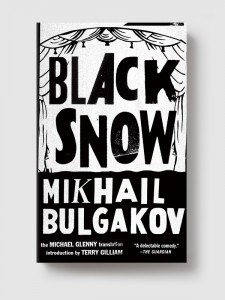
Black Snow, by Mikhail Bulgakov, is a very funny novel. Bulgakov never finished it, and it was not published for more than thirty years after his death.
It starts off as a book about the creative process, and veers off into the surreal (weird). There's a failed suicide attempt (funny) and a Mephistophelean editor (funny!), and before long it's a nightmare of financial dealings, with characters, offices, and assets disappearing over night (funny, in a dark way). Most of the novel, however, has the pacing and tenor of a 1930s screwball comedy, befitting the theatrical farce that it is.
For example, the theatre itself is opulent, the foyer hung with portraits in gilded frames, including depictions of Sarah Bernhardt, Molière, Shakespeare, various actors and other theatrical personages, and the Emperor Nero (hilarious!).
"By order of Ivan Vasilievich," said Bombardov, keeping a straight face. "Nero was a singer and an artiste."
The business of the theatre is chaotic and has a logic all its own. Bulgakov captures the mystique with an almost filmic precision:
The three telephones rang incessantly and sometimes the little office was deafened by all three ringing at once. None of this disturbed Philipp in the least. With his right hand he picked up the receiver of the right-hand telephone, clamped it between his shoulder and his cheek, with his left hand he picked up the other receiver and pressed it to his left ear. Freeing his right hand he used it to take one of the notes being handed to him and began talking to three people at once — into the left-hand telephone, the right-hand and then the visitor again. Right-hand telephone, visitor, left, left, right, right. Dropping both receivers back on to their rests at once and thus freeing both hands, he took two of the scraps of paper. Refusing one of them, he picked up the receiver from the yellow telephone, listened for a moment and said: "Ring up tomorrow at three o'clock." He hung up and said to the petitioner: "Nothing doing."
In time I began to understand what they wanted from Philipp Philippovich. They wanted tickets.
Black Snow is based on Bulgakov's own experiences with writing for the Moscow Art Theatre. Bulgakov mercilessly satirizes the theatre milieu and its famous director, Konstantin Stanislavski (he of the eponymous acting method). It is much less political than I might have expected, but it does deal with censorship of a kind — how a playwright's work ceases to be his own.
Despite feeling uneven, like three or four different novels rolled into one though they might have wandered off in different directions, Black Snow is a highly entertaining insider's view of the workings of the theatre.
Labels:
Mikhail Bulgakov,
theatre
Tuesday, December 24, 2013
O'er the hills of snow
Christmas Freilachs, by the Angstones.
Pretty much my favourite Christmas medley ever, capturing the chaotic spirit of the season.
I bought this cassette single back in... I dunno, some 20 years ago or so. And in 20 years of Internet, I haven't found an easy way to share it, but finally I found a link.
It never fails to put a smile on my face. Hope you're smiling too.
Pretty much my favourite Christmas medley ever, capturing the chaotic spirit of the season.
I bought this cassette single back in... I dunno, some 20 years ago or so. And in 20 years of Internet, I haven't found an easy way to share it, but finally I found a link.
It never fails to put a smile on my face. Hope you're smiling too.
Labels:
music
Saturday, December 21, 2013
Telling the story is hard
"I am writing the story," she says. "The story of you, and me, and the Pigoons, and everyone. I am writing about how we put Snowman-the-Jimmy and Adam One into the ground and Oates too, so that Oryx can change them into the form of a tree. And that is a happy thing, isn't it?"
"Yes. It is a happy thing. What is wrong with your eyes, Oh Toby? Are you crying?" says Blackbeard. He touches her eyebrow.
"I'm just a little tired," says Toby. "And my eyes are tired as well. Writing makes them tired."
"I will purr on you," says Blackbeard.
Among the Crakers, the small children do not purr. Blackbeard is growing quickly — they do grow faster, these children — but is he big enough to purr? Apparently so: already his hands are on her forehead, and the mini-motor sound of Craker purring is filling the air. She's never been purred on before: it's very soothing, she has to admit.
"There," says Blackbeard. "Telling the story is hard, and writing the story must be more hard. Oh Toby, when you are too tired to do it, next time I will write the story. I will be your helper."
"Thank you," says toby. "That is kind."
Blackbeard smiles like daybreak.
MaddAddam, by Margaret Atwood, is a most satisfying conclusion to the near-future postapocalyptic scenario laid out in Oryx and Crake and The Year of the Flood. But I think you do really need to read the first two books to fully understand the dynamics of this one.
This volume gives Zeb's backstory, and through him, the story of Adam One.
MaddAddam is funny, mostly in its depiction of the Crakers, the naïve genetically engineered humans, as they are beginning to undergo evolution, at least of a social and cultural sort as they learn from the surviving "natural" humans and develop a mythology of their own. And it seems that the future of humanity depends on their interbreeding.
The characters are wonderful — genuine and sympathetic if not always likeable. While the first two volumes set the stage of this new world, its creatures, environments, and issues all reasonably extrapolated from science that is being performed today, this volume, in my view, now that the world-building is done, is simply about a group of (somewhat misfit) survivors trying to get along and cope with a (very) tough situation. The first two might be considered cautionary; this book, remarkably, is unabashedly hopeful.
It made me smile like daybreak.
Labels:
dystopia,
Margaret Atwood
Thursday, December 19, 2013
Sunday, December 15, 2013
My ambiguous self
One of the most beautiful books I read this year was Azazeel, by Youssef Ziedan, an Egyptian scholar who specializes in Arabic and Islamic studies. It won the International Prize for Arabic Fiction in 2009 and has been condemned by the Coptic Orthodox church.
In a wonderful review, "In Case of Doubt, Choose Doubt," Andreas Pflitsch says that this historical novel is a plea against religiously motivated violence.
Set in the 5th century AD, these are the memoirs of Hypa, a Coptic monk who journeyed from Upper Egypt to Alexandria and then Syria.
It's not a period in history that I know much about, but several aspects of it are fascinating. It covers a culture in transition between pantheism and Christianity. It shows the significance of the life and death of woman mathematician and philosopher Hypatia of Alexandria.
And it features Nestorius, Archbishop of Constantinople, condemned by the Council of Ephesus for his belief that Christ's human and divine natures could not be reconciled. (Lucky for me I read this novel while studying Kierkegaard, who didn't care so much about reconciling them, so I had ample opportunity to consider the absurdity of faith.)
Hypa meanwhile is consumed with the problem of reconciling, or accepting, his own human and divine natures, that is, satisfying both physical and spiritual yearnings. Azazeel, the devil, is the voice inside him, a daimon, who does not lead him to temptation so much as reflect it back to his conscience.
Azazeel is by turns adventurous, sensuous, thrilling, and mysterious; it is laden with historical detail and religious intrigue. It shows great insight and sensitivity to matters of spirituality and faith (or lack thereof, as I have none), and lends itself to slow and contemplative reading.
Reviews
The Bookbag
The Guardian
Winston's Dad
There is also a sampling of international response to the novel on the book's website.
In a wonderful review, "In Case of Doubt, Choose Doubt," Andreas Pflitsch says that this historical novel is a plea against religiously motivated violence.
Set in the 5th century AD, these are the memoirs of Hypa, a Coptic monk who journeyed from Upper Egypt to Alexandria and then Syria.
It's not a period in history that I know much about, but several aspects of it are fascinating. It covers a culture in transition between pantheism and Christianity. It shows the significance of the life and death of woman mathematician and philosopher Hypatia of Alexandria.
And it features Nestorius, Archbishop of Constantinople, condemned by the Council of Ephesus for his belief that Christ's human and divine natures could not be reconciled. (Lucky for me I read this novel while studying Kierkegaard, who didn't care so much about reconciling them, so I had ample opportunity to consider the absurdity of faith.)
Hypa meanwhile is consumed with the problem of reconciling, or accepting, his own human and divine natures, that is, satisfying both physical and spiritual yearnings. Azazeel, the devil, is the voice inside him, a daimon, who does not lead him to temptation so much as reflect it back to his conscience.
I sat up, filled with a fear the source of which I did not know. I asked myself: should I go to church now, to feel a little peace of mind? The night prayers must have started. Being in a group would relieve the anxiety, since nothing is more conducive to fear than being alone. Or should I go to Martha's cottage nearby and mend what was broken in our relationship, then sleep on the floor under her bed? Does Martha sleep in the bed where we made love two days ago? Or does she lie on the floor like me? I don't know much about her. I've never seen her from the inside. In fact I've never seen anything from the inside. I always skirt around the surface of things and never go deep. In fact I think I'm afraid of looking deep inside myself, yet I know the truth about my ambiguous self. Everything about me is ambiguous — my baptism, my being a monk, my faith, my poems, my medical knowledge, my love for Martha. I am one ambiguity after another, and ambiguity is the opposite of faith, just as Satan is the opposite of God.
Azazeel is by turns adventurous, sensuous, thrilling, and mysterious; it is laden with historical detail and religious intrigue. It shows great insight and sensitivity to matters of spirituality and faith (or lack thereof, as I have none), and lends itself to slow and contemplative reading.
Reviews
The Bookbag
The Guardian
Winston's Dad
There is also a sampling of international response to the novel on the book's website.
Labels:
religion,
Søren Kierkegaard,
Youssef Ziedan
Friday, December 13, 2013
War was where it belonged — in the hands of the individual
Based on Robert Sheckley's short story "Seventh Victim."
(via)
See also Movies and Books Like The Hunger Games (full text of the story is posted there).
(via)
See also Movies and Books Like The Hunger Games (full text of the story is posted there).
Labels:
dystopia,
movie,
Robert Sheckley,
science fiction
Wednesday, December 11, 2013
I would not have gone crazy about Beethoven so unexpectedly
I went crazy for Beethoven quite unexpectedly.
Witold Gombrowicz on Beethoven:
I went crazy for Beethoven quite unexpectedly. Overrated sellout, I used think; as a teenager, I snubbed the establishment. But then I listened, I was made to listen. And it's the aural sculpture of the quartets that sent me reeling into the unknown depths of my own self. To this day I cannot get enough of the quartets.
It was about the same time I discovered Gombrowicz's Diary.
Witold Gombrowicz on Beethoven:
Quartets! Sixteen quartets! It is one thing to dip occasionally into one of them, in passing, and another to step into the building, to immerse oneself, to wander from hall to hall, wander in the galleries, take in the vaults, examine the architecture, uncover the inscriptions and frescoes ... with a finger to one's lips. Form! Form! It is not him I look for, the building is not full of him, but his form, which I get to know in the course of this gradual self-composition of adventures, changes, acquisitions — similar to creatures human and nonhuman from ancient fairy tales. […]
Certainly, if not for that elegant sound of four stringed instruments, if not for that polyphonic quartet refinement, thanks to which all music that passes between these four instruments undergoes an inordinately subtle transformation, I would not have gone crazy about Beethoven so unexpectedly.
I went crazy for Beethoven quite unexpectedly. Overrated sellout, I used think; as a teenager, I snubbed the establishment. But then I listened, I was made to listen. And it's the aural sculpture of the quartets that sent me reeling into the unknown depths of my own self. To this day I cannot get enough of the quartets.
It was about the same time I discovered Gombrowicz's Diary.
Labels:
Beethoven,
music,
Polish literature,
Witold Gombrowicz
Monday, December 09, 2013
The MOOC experience
I've completed my first massive open online course (MOOC). It was weird at the start, but it didn't take long to get my bearings.
Here's how it worked.
I enrolled in Soren Kierkegaard: Subjectivity, Irony, and the Crisis of Modernity. So did 23,000 other people.
Every week new course material was released: 3 or 4 videos, each on average about 20 minutes long; a list of required reading (PDFs were supplied); a discussion question; a quiz.
So over the last 2 months, I have watched several hours of professional documentary-quality video, and read a couple hundred pages of Kierkegaard, with some Plato and Hegel thrown in.
The quality of the video lectures really surprised me; this was not merely a recording of some fuddy-duddy lecturing in front of a classroom. This professor was a great speaker; he was filmed in various locations around Copenhagen. There were also several interviews with other Kierkegaard scholars. Each video ended with a quiz question, which was not graded but was meant simply to reinforce your understanding of the video material.
The weekly quiz consisted of 10 multiple-choice questions. These did count toward the final grade. They weren't hard, but they weren't easy. I learned early to take my time and refer to my notes, which meant taking better notes during the lectures. Before you submit each quiz, you must check the box indicating that you will abide by the honor code, which states something to the effect of your work being your own (but there's nothing to preclude me from using my notes).
In the first days, the discussion forum exploded with 23,000 people sharing their enthusiasm and trying to get to know each other. That was a bit overwhelming. But I eventually learned to identify which discussions I wanted to follow and know that I couldn't stay on top of them all in any meaningful way even if I devoted all my waking hours to the task. I learned to tune out the white noise.
The course information indicated that the material would require 3-5 hours a week. I'd say it's a bit more. And that estimate doesn't include the potential timesink of the forums.
Some people complained about the deadline for the final essay. I was amazed, and disappointed, that the deadline was adjusted to accommodate the whiners. The schedule had been made clear at the outset of the course, and I expected everyone to stick to it; in fact, pushing back the deadlines by a week very nearly jeopardized my ability to complete the final stage (peer review) because I had organized my life around the original dates. It worked out though, but this shouldn't happen. An extra week for the final essay should've been built in from the start — working on an essay while keeping up with the regular weekly assignments is tough.
It's difficult to grade the humanities in the best of circumstances, and a MOOC is not the best of circumstances. The grade breakdown for this course was 70% from quiz scores (best 7 of 8) and 30% from an averaging of your peers' assessments of your essay. My feeling is that the quizzes were too easy to be given that weight. Essay marks, however, are hard to control — less quantifiable, more open to dispute.
Is it a perfect setup? No. But can you teach the humanities via MOOCs? Absolutely.
According to this article in The Chronicle of Higher Education and the survey they conducted, the median for MOOC registrations is about 33,000 students (so my Kierkegaard course is a bit on the low side).
So I'm proud to have finished.
And I've already registered for more.
Here's how it worked.
I enrolled in Soren Kierkegaard: Subjectivity, Irony, and the Crisis of Modernity. So did 23,000 other people.
Every week new course material was released: 3 or 4 videos, each on average about 20 minutes long; a list of required reading (PDFs were supplied); a discussion question; a quiz.
So over the last 2 months, I have watched several hours of professional documentary-quality video, and read a couple hundred pages of Kierkegaard, with some Plato and Hegel thrown in.
The quality of the video lectures really surprised me; this was not merely a recording of some fuddy-duddy lecturing in front of a classroom. This professor was a great speaker; he was filmed in various locations around Copenhagen. There were also several interviews with other Kierkegaard scholars. Each video ended with a quiz question, which was not graded but was meant simply to reinforce your understanding of the video material.
The weekly quiz consisted of 10 multiple-choice questions. These did count toward the final grade. They weren't hard, but they weren't easy. I learned early to take my time and refer to my notes, which meant taking better notes during the lectures. Before you submit each quiz, you must check the box indicating that you will abide by the honor code, which states something to the effect of your work being your own (but there's nothing to preclude me from using my notes).
In the first days, the discussion forum exploded with 23,000 people sharing their enthusiasm and trying to get to know each other. That was a bit overwhelming. But I eventually learned to identify which discussions I wanted to follow and know that I couldn't stay on top of them all in any meaningful way even if I devoted all my waking hours to the task. I learned to tune out the white noise.
The course information indicated that the material would require 3-5 hours a week. I'd say it's a bit more. And that estimate doesn't include the potential timesink of the forums.
Some people complained about the deadline for the final essay. I was amazed, and disappointed, that the deadline was adjusted to accommodate the whiners. The schedule had been made clear at the outset of the course, and I expected everyone to stick to it; in fact, pushing back the deadlines by a week very nearly jeopardized my ability to complete the final stage (peer review) because I had organized my life around the original dates. It worked out though, but this shouldn't happen. An extra week for the final essay should've been built in from the start — working on an essay while keeping up with the regular weekly assignments is tough.
It's difficult to grade the humanities in the best of circumstances, and a MOOC is not the best of circumstances. The grade breakdown for this course was 70% from quiz scores (best 7 of 8) and 30% from an averaging of your peers' assessments of your essay. My feeling is that the quizzes were too easy to be given that weight. Essay marks, however, are hard to control — less quantifiable, more open to dispute.
Is it a perfect setup? No. But can you teach the humanities via MOOCs? Absolutely.
According to this article in The Chronicle of Higher Education and the survey they conducted, the median for MOOC registrations is about 33,000 students (so my Kierkegaard course is a bit on the low side).
- The rate of completion in MOOCs is believed to be around 10 percent.
- For students who so much as submit the first assignment, the completion rate leaps to 45 percent.
- And it goes up again if students pay for the course.
So I'm proud to have finished.
And I've already registered for more.
Labels:
education,
mooc,
Søren Kierkegaard
Subscribe to:
Posts (Atom)