Showing posts with label David Mitchell. Show all posts

Wednesday, August 12, 2020

Music will still do to people what it does to us now

"Songs do not change the world," declares Jasper. "People do. People pass laws, riot, hear God and act accordingly. People invent, kill, make babies, start wars."
Here's a novel that's mostly fun, if a little long (what is it with men shamelessly throwing hundreds upon hundreds of pages of their excess verbosity upon you?). Utopia Avenue, by David Mitchell, is the name of a fictitious British band in the late 1960s, fusion folk psychedelic rock 'n' roll, their struggles and adventures.
"Songs like dandelion seeds, billowing across space and time. Who knows where they'll land? Or what they'll bring?" [...] "Where will these song-seeds land? It's the Parable of the Sower. Often, usually, they'd land on barren soil and not take root. But sometimes, they land in a mind that is ready. Is fertile. What happens then? Feelings and ideas happen. Joy, solace, sympathy. Assurance. Cathartic sorrow. The idea that life could be, should be, better than this. An invitation to slip you into somebody else's skin for a little while. If a song plants an idea or a feeling in a mind, it has already changed the world."
We get to know three of the band members quite intimately, while the drummer remains aloof. Each of them standouts in their fields, the manager brought them together with the goal of forming a genre-spanning supergroup. So it was a little less than organic, but on the whole, they're hardworking, decent people who make respectably good music; they pay some dues but find some level of success. And they at times succumb to the lifestyle excesses that come with the job.

The guitarist's story thread veers off into the paranormal. This makes me roll my eyes a little, even if I can't turn the pages fast enough; it's also classic Mitchell territory and fodder for late-night weed-fueled conversations about life, the universe, and everything.

The characters do not get equal airtime, and this felt unbalanced to me. The manager also stars in a story a two, but it's impossible to ignore the cameos. David Bowie, Brian Jones, Leonard Cohen, Syd Barrett, Janis Joplin, and others. Gimmicky to the point of tiresome. It irked me that Cohen mentions Toronto but not Montreal. 
"Once, I took the elevator up there." Leonard nods at the Empire State Building. "I looked over Manhattan and was seized by an absurd desire to take it. To own it. Do we write songs as a substitute for possession?" 

"I write songs to discover what I want to say," says Elf. 

"I write 'em 'cause I just bloody love it," says Dean. 

"Maybe you're the purest artist here," remarks Lenny.
Cue music. It just feels a little cheap.

Although, I thoroughly enjoyed the extended scenes with Francis Bacon, one of a few non-musicians on the London scene at the time to make their way into this novel, but likely I responded to that only because he's been a topic of conversation around here lately, his art grim and eerie and visceral. His art is not on stage here, only his lifestyle.

These walk-on parts add nothing to the story. But in a sense, they are the story. This is Mitchell's love letter to a bygone era of music that I can only assume played a significant role in shaping him.
"In fifty years," said Jasper, "or five hundred, or five thousand, music will still do to people what it does to us now. That's my prediction."
So, what does it do to us now? Music is our balm, our panacea. It can encircle you with your people, it can shut out the entire world. I think it is used more often as a distraction than as a connection. It blares everywhere, but who really listens? 
Hundreds of people pass by. Reality erases itself as it rerecords itself, Elf thinks. Time is the Great Forgetter. She gets her notebook from her handbag and writes, Memories are unreliable . . . Art is memory made public. Time wins in the long run. Books turn to dust, negatives decay, records get worn out, civilisations burn. But as long as the art endures, a song or a view or a thought or a feeling someone once thought worth keeping is saved and stays shareable. Others can say, "I feel that too."
It transcends language and creates an illusion of oneness; one person responds to a beat, another to a melody, another to the story the lyrics tell, but it taps a harmony of being. It's much more complex than a shared feeling.

Utopia Avenue is not about music, it's about its creators. It explores the inspiration for the music — love, loss, drugs, schizophrenia, otherworldly experience. Sometime the art comes about because it's a better option than not trying to make art. Sometimes it pays the rent. Art can come equally from hard work or divine luck or happenstance.  

Super entertaining and full of flavor (though some not always to my taste), but a little short on substance. It took me to some unexpected places, dramatically speaking, and it was not a terrible way to spend midsummer evenings on my balcony. Even if I can reel off better band names in my sleep.

Monday, December 07, 2015

It's Hunger and Run!

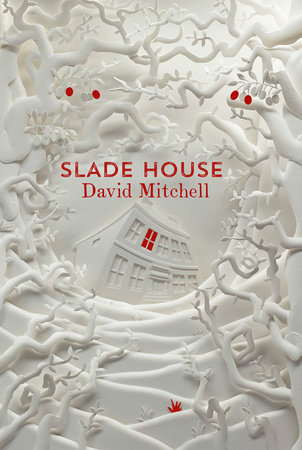
I thoroughly enjoyed Slade House by David Mitchell.
I turn round to tell Jonah to stop the game something's wrong, we need a grown-up. Any second now he'll come hurtling round the far corner. The brambles sway like underwater tentacle. I glance back at the garden. There was a sundial but it's gone now, and the damson trees too. Am I going blind? I want Dad to tell me it's fine, I'm not going blind, but Dad's in Rhodesia, so I want Mum. Where's Jonah? What if this dissolving's got him too? Now the lattice tunnel thing's erased. What do you do when you're visiting someone's house and their garden starts vanishing? The blankness is moving closer like a storm-front. Then, at the far end of the brambly side path, Jonah appears, and I relax for a second because he'll know what to do , but as I watch, the running-boy shape gets fuzzier and becomes a growling darkness with darker eyes, eyes that know me, and fangs that'll finish what they started and it's pounding after me in sickening slow motion, big as a catering horse and I'd scream if I could but can't my chest's full of molten panic it's choking me choking it's wolves it's winter it's bones it's cartilage skin liver lungs it's Hunger it's Hunger it's Hunger and Run! I fun toward the steps of Slade House my feet slipping on the pebbles link in dreams but if I fall it's have me, and I've only got moments left and I stumble up the steps and grip the doorknob turn please turn it's stuck no no no it's scratched gold it's stiff it's ridged does it turn yes no yes no twist pull push pull turn twist I'm falling forwards onto a scratchy doormat on black and white tiles and my shriek's like a shriek shrieked into a traffic cone all stifled and muted —
I mean, shriek! Wow, molten panic, Hunger, no, shriek.

Slade House is told in five sections, each relating an encounter at the house, occurring nine years apart. The house is an illusion that requires considerable psychic strength to maintain, and the twins who run the house need to fuel that energy. They do so by luring some particularly dynamic souls into their circle.

This short novel belongs in the world of Mitchell's Bone Clocks, which I have not read, so let me assure you that it stands perfectly well on its own. It does a good job of the haunted house story tradition, with loads of ambiance (the chilling kind) and family secrets. But it doesn't take itself too seriously — there are plenty of skeptical characters to keep things reasonable, if not exactly grounded in reality.

There's creepy yet poetic weirdness:
I find a dead cat lying on the ground at the first corner. It's gray like dust on the moon. I know it's dead because it's as still as a dropped bag, and because big flies are drinking from its eyes. How did it die? There's no bullet wound or fang marks, though its head's at a slumped angle so maybe it was strangled by a cat-strangler. It goes straight into the Top 5 of the Most Beautiful Things I've Ever Seen. Maybe there's a tribe in Papua New Guinea who think the droning of flies is music. Maybe I'd fit in with them.
There's some lovely intense blackness:
It's black, nothing-black, like the gaps between stars.
Blacker than black:
"Try the coffee first. It'll make a man of you." I lift the mug and peer down. Inside's black as oil, as holes in space, as Bibles.
I'd've liked to read Slade House in one sitting upon a dark and stormy night, but circumstances were such that I read it in very small pieces in strange places and over several dark days.
Grief's an amputation, but hope's incurable haemophilia: you bleed and bleed and bleed. Like Schrödinger’s cat inside a box you can never ever open.
Reviews
Guardian: Slade House by David Mitchell review – like Stephen King in a fever
Huffington Post: David Mitchell has a Halloween present for us
New York Times: David Mitchell's "Slade House" Plunges Into a Battle of Immortals
NPR: It's Coming From Inside The House ... "Slade House," That Is
Wall Street Journal: David Mitchell's Haunted "Slade House"

Excerpt.

Recommended for anyone in a witching-hour mood.

Wednesday, November 25, 2015

It was all a dream

Mrs. Todds my English teacher gives an automatic "F" if anyone ever writes "I woke up and it was all a dream" at the end of a story. She says it violates the deal between reader and writer; that it's a cop-out, it's the Boy Who Cried Wolf. But every single morning we really do wake up and it really was all a dream.
— from Slade House, by David Mitchell.

Saturday, August 25, 2012

Both prize & battlefield

I finished reading David Mitchell's Cloud Atlas this morning, and I'm not entirely sure what to make of it. It's a set of six stories nested within each other.

At the centre (I mean this in a very literal sense — this story is in the middle of the book sandwiched by the next story, which is sandwiched by the next. That is, the books starts with half a story, which ends in midsentence and is followed by the first half of another story, and so on. We get the second halves of the stories in reverse order on the way out of the novel.)...

At the centre is post-apocalyptic tale; the society is fairly tribal, technology is near nonexistent, the pockets of humanity are isolated. We have no idea how the world got this way. The presence of a visitor, an outsider, hints that there may be some remnant of a more highly evolved civilization out there somewhere, but the reader isn't given anything to go on. One character has access to an instrument of the visitor's, by which he watches (or experiences) an archival record.

The archive concerns the life of revolutionary. She's a "fabricant," genomically programmed and "born" to serve in a fast-food restaurant. Such fabricants are produced in great numbers to fulfill menial or dangerous jobs. But she attains a level of consciousness and ascends to the outside world. The world is a consumption-oriented corpocracy (there are quotas for how much a citizen must spend in a given month). Our fabricant seems to be an agent of change, but she is also a pawn of the powers that be. One of the experiences she most enjoyed in the outside world was watching a movie.

The story of the movie is that of an author and editor committed against his will to a seniors' residence by a spiteful brother. His outrage is taken for senility and he struggles for some autonomous control over his life. He's been reading a manuscript submitted for publication, which he finds promising.

The manuscript is a thriller. Set in the 70s, a journalist comes across information that a report calling into question the safety of a nuclear power plant has been suppressed. There's plenty of corruption, and murder. She comes into a packet of letters one of her sources has carried with him for decades — they entrall her.

The letters are from a young English musician, who in the 20s worked in Belgium as an amanuensis for a renowned composer. He'd fled England, disinherited, to flee his debts but he accrues more along the way. Shady dealings and sexual adventures serve as balm, financial and otherwise. He's working on a composition — the Cloud Atlas Sextet — and reading a journal to distract him from his difficulties.

The journal is that of an American notary returning home from somewhere in the vicinity of New Zealand. He's seen Maori and Moriori tribes, and he has some mysterious illness, but most of the diary describes his time at sea.

The only thing obviously connecting these stories is a comet-shaped birthmark near the shoulder blade — a character in each of the stories has one. Are they reincarnations of the same individual? I have a feeling the movie version will play this angle up, but I hope not. While it contributes to a sense of connectedness, I think this one little image is flimsy.

A thematic connection is hard to find. Most of the stories touch on how some segment of society has been wronged or oppressed, but it doesn't hold up for the musician's segment. Maybe betrayal? I can come up with a couple themes, but I can't find one overarching theme that fits all the narratives.

Some people love this novel, and I can easily see how most readers could latch onto some aspect. There's something for everyone. I loved parts of the books — I could easily have read hundreds more pages about the future corpocracy and the cause of the fabricants, or the musician's attempts to stay ahead of his debtors. But as a rule I hate seafaring adventures, so I struggled with the journal of the South Pacific, which unfortunately for me opens and closes the novel. I didn't much like the first half of the tale of the publisher in the senior's residence (the style too pretentious), but I warmed to the second half (more human and lively). Your mileage may vary.

While the notary's tale didn't affect me, I'll leave you with some of his closing words. In my view, reading these words make for an easier in to these stories. I'd hate to think that some readers might drop off from Cloud Atlas midway and miss them.

My thoughts flow thus. Scholars discern motions in history & formulate these motions into rules that govern the rises & falls of civilizations. My belief runs contrary, however. To wit: history admits no rules; only outcomes.

What precipitates outcomes? Vicious acts & virtuous acts.

What precipitates act? Belief.

Belief is both prize & battlefield, within the mind & in the mind's mirror, the world. If we believe humanity is a ladder of tribes, a colosseum of confrontation, explitation & bestiality, such a humanity is surely brought into being, & history's Horroxes, Boerhaaves & Gooses shall prevail. You & I, the moneyed, the privileged, the fortunate, shall not fare so badly in this world, provided our luck holds. What of it if our sconsciences itch? Why undermine the dominance of our race, our gunships, our heritage & our legacy Why fight the "natural" (oh, weaselly word!) order of things?

Why? Because of this: — one fine day, a purely predatory world shall consume itself. Yes, the devil shall take the hindmost until the foremost is the hindmost. In an individual, sefishness uglifies the soul; for the human species, selfishness is extinction.

Is this the entropy written within our nature?

If we believe that humanity may transcend tooth & claw, if we believe divers races & creeds can share this world as peaceably as the orphans share their candlenut tree, if we believe leaders must be just, violence muzzled, power accountable & the riches of the Earth & its Oceans shared equitably, such a world will come to pass. I am not deceived. It is the hardest of worlds to make real. Tortuous advances won over generations can be lost by a single stroke of a myopic president's pen or a vainglorious general's sword.

A life spent shaping a world I want Jackson to inherit, not one I fear Jackson shall inherit, this strikes me as a life worth living.

Wednesday, August 22, 2012

Stop a mind scratching itself raw

Mother used to say escape is never further than the nearest book. Well, Mumsy, no, not really. Your beloved large-print sagas of rags, riches and heartbreak were no camouflage against the miseries trained on you by the tennis-ball launcher of life, were they? But, yes, Mum, there again, you have a point. Books don't offer real escape but they can stop a mind scratching itself raw.

— from Cloud Atlas, by David Mitchell.

Tuesday, August 21, 2012

Historical inevitabilities

All revolutions are the sheerest fantasy until they happen; then they become historical inevitabilities.

— from Cloud Atlas, by David Mitchell.

Friday, August 17, 2012

Why keep genre separated?

I've had my copy of Cloud Atlas lying around for months, but it's only last week that I started reading it in earnest.

But, visually rich though it may be, it's not the recently released trailer for the film adaptation that me spurred me to read it (in particular I find the music to be overly manipulative). Rather, it's the directors' commentary, and their genuine enthusiasm for the source material:


So far: Adventure! Cannibals! A lost tribe of Moriori! Weird rituals! Sea-faring! Mysterious illness! Strange dreams! Music! Eluding debtors! Elaborate schemes! Romance! Treachery! Stolen manuscripts! Investigative jounalism! Nuclear power plants! Social activism! Corporate spin! Mysterious deaths! Clandestine meetings! And a sad little boy next door.

And I'm barely into the third of the six nested stories comprising this novel.

Have you read Cloud Atlas? Have you seen the trailer? How do you feel about this book being translated to screen?

Wednesday, August 15, 2012

Her box of confidences

When one unlocks a woman's body, her box of confidences also spills. (You should try 'em yourself one time, women I mean.) Might this be connected to their hopelessness at cards? After the Act, I am happier just lying still, but Jocasta talked, impulsively, as if to bury our big black secret under littler grey ones. Learnt Ayrs contracted his syphilis at a bordello in Copenhagen in 1915 during an extended separation and has not pleasured his wife since that year; after Eva's birth, the doctor told Jocasta she could never conceive another child. She is v. selective about her occasional affairs, but unapologetic about her right to conduct same. She insisted that she still loves Ayrs. I grunted, dubiously. That love loves fidelity, she riposted, is a myth woven by men from their insecurities.

— from Cloud Atlas, by David Mitchell.