Showing posts with label horror. Show all posts

Saturday, January 30, 2021

A kind of secretly ruined beauty

For an entire year I spent my allowance on expensive medical books, while my friends all spent theirs on drugs. Nothing brought me as much happiness as those books. All those beautiful medical terms that didn't mean anything, all that hard jargon — that was pornography. [...]

It was clear what I liked, where I fell on the map, and once I'd clarified the specialty, I dedicated myself to it alone: I liked pulmonary illnesses (certainly reminiscent of Helen, Ippolit, and the other tubercular patients), and cardiac patients. These latter had their tawdry side, but only if they were elderly (or over fifty, when frightful things like cholesterol started to intervene). If they were young... what elegance. Because, in general, it was a kind of secretly ruined beauty. All the other illnesses tended to have a timeline, but this one was different. A person could die at any moment. Once, I bought a CD in a medical bookstore (where all the employees though I was a student — I'd been sure to slip that in, as a precaution) that was called Cardiac Sounds. Nothing had ever brought me so much joy. I guess that what normal men and women feel when they hear their preferred gender moaning in pleasure, I felt when I heard those ruined hearts beat. Such variety! So may different rhythms, all meaning something different, all of them beautiful! Other illnesses could be heard. Plus, many of them could be smelled, which I found unpleasant. If I took my MP3 player out on a bike ride, I'd have to stop because I was too turned on. So I listened to it at night, at home, and during that time I got worried because I wasn't interested in real sex. The audio tracks of heartbeats took he place of everything. [...]

After a while I decided to get rid of the recorded heartbeats. They were going to drive me crazy. From then on, one of the first things I did with a man was lay my head on his chest, to see if there was any arrhythmia, or a murmur, an irregular beat, a third heart sound, or an atrial flutter, or anything else. I always wondered when I would find someone who was an unbeatable combination of elements. I remember that longing now, and I smile bitterly.

— from "Where Are You, Dear Heart?" in The Dangers of Smoking in Bed, by Mariana Enríquez.

It's weirdly beautiful and erotic, a powerful story of perversion, persuading me nothing could be more intimate than massaging my lover's heart, feeling it pulse against the palm of my hand. Truly fleshly, visceral love. 

Following in the tradition of Argentinian fabulists, the reviews of this story collection invoke global masters, from Shirley Jackson, Borges, and Cortázar (I see why) and Ocampo (I must read her) to Bioy Casares, Bolaño, and Schweblin (yes).

Most of Enríquez's stories have a paranormal element, either vaguely or outright horrific, where the horrors of life — of the body, of stolen children, of the disappeared — carry over beyond death. These fables are not for the fainthearted; they might inspire nightmares or teenage girls to become witches.

As with the best short stories, most of the events are ambiguous in nature, with no clear resolution. I wish some of them could go on forever.

Stories
The Intoxicated Years (from Things We Lost in the Fire
Back When We Talked to the Dead (from The Dangers of Smoking in Bed
On a French Love Affair and a Man Lost to Time

Thursday, November 19, 2020

The world would be a blur of gold

The mushrooms glowed brighter, and she thought perhaps later she might touch them, running her hands against the wall and settling her face against the softness of their flesh. It would be good to rest there, skin pressed tight against their slick bodies, and maybe they'd cover her, the lovely fungi, and cram into her mouth, into her nostrils and eye sockets until she could not breathe and they nestled in her belly and bloomed along her thighs. And Virgil, too, driving deep within her, and the world would be a blur of gold.

Mexican Gothic, by Silvia Moreno-Garcia, is classic gothic. A mist-shrouded cemetery with ghostly presences. Eccentric aristocrats. A rule-enforcing matron. A town healer. Symbolic dreams. Family tragedies and secrets. The house itself is a character ("I've never been in a house with a name.").

It's Gas Light and Rebecca and The Yellow Wallpaper and Chronicle of the Murdered House and a dash of the grimmest fairy tales whipped in a blender and strained through the racism and cosmic horror of H.P. Lovecraft, garnished with a touch of "Notorious" — you know, for the Nazis and slow poison. 

Catalina writes that her husband is poisoning her and pleads with Noemi to come save her from the remote house so, at her father's insistence, Noemi sets aside her cocktail parties and frivolous pursuit of anthropological studies to do just that. Catalina's husband is heir to the perhaps-already-squandered Doyle fortune, built on silver mines already long dormant, and its legacy of exploitation. The ailing ruling patriarch is too interested in eugenics. What's not to love?

Some of the characterizations and dialogue felt a little anachronistic, but perhaps I'm just resentful that a woman could be oh so modern so long before me.

I read Mexican Gothic on Halloween weekend, and in fact the anticipation of it overpowered some of its clever beauty. I read it too fast, I read the wrong thing before it, I read it in an agitated state. (I wish I'd known there was a playlist.)

[As I sit in my reading chair and glance at the plant beside me, I am relieved that the mushrooms are gone, I spooned out their shriveled stalks.] 

My book purchase included "admission" to a virtual event: a conversation between Silvia Moreno-Garcia and Carmen Maria Machado, whose work and interests intersect in lively ways. I'm inspired to revisit their books with a heightened awareness of their feminist subversion of classic gothic horror tropes (did I just write that sentence?).

Definitely I will keep Mexican Gothic on my shelf to be reread nostalgically some perfectly wretched gloomy day.

"There're heavy places. Places where the air itself is heavy because an evil weighs it down. Sometimes it's a death, could be it's something else, but the bad air, it'll get into your body and it'll nestle there and weigh you down. That's what's wrong with the Doyles of High Place, " the woman said, concluding her tale.

Like feeding an animal madder plants: it dyes the bones red, it stains everything inside crimson, she thought.

Review
Excerpt

Monday, November 04, 2019

Living life more meaningfully

I mean, people have actually said to me, "Wow, I guess having cancer so young must have given you a whole new perspective on life?" And I always nod and try to look inscrutable, but in fact, if I am completely honest with myself, I have the same old skewed perspective I've always had, except now I get to feel guilty about it. Likewise with living life more meaningfully. What the fuck does that mean anyway? How do you actually do it, in reality, besides taking up yoga?
The Bus on Thursday, by Shirley Barrett, is laugh-out-loud funny, kind of dumb and possibly offensive.

Eleanor is diagnosed with breast cancer, has a mastectomy, undergoes reconstructive surgery (but not the nipple yet). When she finally feels ready to get back to work (although it's more about avoiding support groups), she take a job as a teacher in some remote village, where the previous teacher — beloved by all (that is, Eleanor hasn't got a hope in hell of stepping into her shoes satisfactorily) — had suddenly and mysteriously disappeared. Weirdly, no one's really bothered enough by the event to have gone looking for her.

Meanwhile, her BFF gets married and pregnant and is generally insensitive to her situation, particularly as far as dating goes. And her ex-boyfriend — they broke up because he definitely didn't want kids, and isn't it ironic that now Eleanor possibly won't be able to have kids anyway — has been dating some busty girl who is now very pregnant.

And work is just horrible. It's a one-classroom situation and she can't live up to her predecessor, she's always saying the wrong thing, and really, some of the kids, the people in this town are just shitty.

She starts "dating" the guardian, the older brother, of her problem student. A body turns up. Townspeople continue to be incompetent. Everything seems... inappropriate.

A large number of people seem to think the cancer is her own fault, to the point where she starts thinking, "Am I so despicable a person that even my own body can't stand me?"

It's a comedy horror story, which is often the way with life with cancer — it can be a real mindfuck. And then the story gets weird.

Tuesday, February 26, 2019

Anything is possible in the present tense

All I want on the screen, Arlo said, is the present tense. Anything is possible in the present tense. Failure and love and stillness and change.

He's an artist, Davi said. Artists are mercenaries.
What drew me to The Third Hotel, by Laura van den Berg, was the promise of walking in the footsteps of love (where did it go?), an attempt to retrace and delimit a relationship.

What hadn't registered with me when this novel first came on my radar was that it has horror story elements — but then what love story doesn't?

Her husband Richard was a horror film scholar; he recently died in a car accident. So Clare ventures to the film festival in Cuba on her own. And there he is. (Did he really die? Why is he here? Where do the dead go?)

Weird things happen in this book.
Visitors longed for not a dislocation of reality but an insulation from reality — yet these layers of insulation were supposed to be invisible, imperceptible. People did not like to be too sharply reminded of their status as tourists.
I've often explained to people that one of the things I love about traveling is the opportunity to become someone else — in a place where nobody knows you, you can be anybody. But conversely, traveling lets you shed the baggage of your everyday life, to become more yourself. I think about this a lot when I travel, and I hold both these things to be true. This is my dislocation.
The traveling self was supposed to be temporary, disposed of when it was time to go home — there, how could this self be held responsible? But maybe a person became even more themselves when away, liberated from their usual present tense and free to lie. Maybe travel sent all that latent, ancient DNA swimming to the surface.
Clare has a secret self, the one that goes on the road alone for work. She's not working in Cuba, but she gives everyone who asks a different name. (Who is she really? Does she even know?) She suspects her husband had a secret life too.
Clare struggled to imagine what, forty years into a life, would cause a person to suddenly change the way they walked. There were alien, interminable silences when she called from the road, and when she was home he took long, solitary strolls in the evening hours, a symptom that would eventually lead to his demise.
There's unease simmering beneath every page. I'll leave analysis of the horror-story tropes to the academics, but there's the thing about the order the girls get killed in, the girls are always killed. There's the girl who goes missing. There's Clare being followed, and Clare following. (Will Clare be killed?)

I liked the idea of this book more than the actual book. Clare's past didn't interest me so much as her present with un-Richard.
In the lobby of the festival hotel, a mural of a forest spanned the length of a wall. On her first night, in the middle of a reception, she found herself standing in front of that mural. She peered into the shadows, imagined the secrets living in there. She rubbed the green leaves. The paint was smooth, the treetops tinged with gold. She licked a tree and tasted chalk, feeling wild.
Is she crazy? Has she always been crazy? Did she kill him? What is past and what is present?

(Apparently this novel owes quite a debt to Yoko Tawada's The Naked Eye, which quite coincidentally I have queued up on my shelf. Stay tuned.)

See also
Entropy: What Quivers Under the Surface of Laura van den Berg's The Third Hotel

The Paris Review: The Vocabulary of Tourism: An Interview with Laura van den Berg

Tin House: To Thicken and Complicate through Linear Time: A Conversation with Laura van den Berg

Thursday, January 24, 2019

The empty drift

In the elevator, the silence made her arms itch and she was relieved when the foreman broke it, until he informed her that he had just observed her soul leaving her body. Apparently souls left bodies all the time — what entity didn't need a break every now and again? He believed this was only a problem if the soul in question lacked a reason to return. He explained that he had seen her soul climb right out of her chest — he stepped forward and pressed a freckled hand against her clavicle — and perch like a gargoyle on her shoulders, and when it was clear that she was utterly oblivious to what was transpiring, well —

The foreman sighed and shrugged, as though the departure of a soul was a terrible shame, but a situation for which there was little recourse. She told him she was under the assumption that souls only left bodies when people died, and he began to laugh and — his tone pivoting to indicate this was among the more idiotic things he'd heard in his life — said, You thing that's what happens when people die? [. . .]

The foreman had been possessed by a completely different notions of how the spiritual realm operated and he had spoken about it with a confidence that seemed preposterous in the moment, but who could say for sure that he was wrong, that the empty drift that gripped some people at certain moments in life was not in fact due to their souls — perhaps temporarily, perhaps permanently — abandoning their bodies.
— from The Third Hotel, by Laura van den Berg.

How often does your soul leave your body? (What if another soul crept in while your body was "empty"?)

Wednesday, January 16, 2019

Cracking up the concrete like claws

I was reading in the metro this morning and I read a sentence that reminded me of another sentence. I made a mental note of the sentence and read on. Something made me want to check the author’s resources — I’d noticed that she includes research notes at the end of the book. That something — I don’t recall now what is was — was possibly not fictitious, but a reference to something (a book, a movie) in our nonfictitious lived reality.

The sentence was this:
From the Third Hotel, the closest CADECA was on La Rampa, on a street corner shaded by a banana tree, the roots cracking up the concrete like claws.
And the sentence it reminded me of was this:
It's just one of those pieces of Rome that cracks through the concrete of the present day like a bad memory, a way in for grass, for all kinds of untidy thoughts.
And it made me think of the difference between a horror story and a love story, and it made me think that maybe they're the same thing.

I am reading The Third Hotel by Laura van den Berg, which put me in mind of one little sentence from Break.up by Joanna Walsh, whose Hotel was listed in the notes. Coincidence, of course, like the coincidence of all horror stories.

There's this thing about how horror springs up when someone's compass is taken away, leaving them unable to navigate the world. Rural horror tends to rely on some literal abyss or dislocation from "reality"; whereas urban horror relies on a different kind of gap in our reality — abandoned lots, alleyways, cracks in sidewalks.

The Third Hotel and Break.up are indeed very similar, women traversing an urban landscape, tracing a lost love, following their footsteps, repeating their words. So they are both horror stories. (The horror of a break-up?) How are they different?

[Possibly I should spend more time writing about books while I'm reading them instead of waiting till I'm done.]

Thursday, January 11, 2018

Beauty in desolation

Far worse, though, was a low, powerful moaning at dusk. The wind off the sea and the odd interior stillness dulled our ability to gauge direction, so that the sound seemed to infiltrate the black water that soaked the cypress trees. This water was so dark we could see our faces in it, and it never stirred, set like glass, reflecting the beards of gray moss that smothered the cypress trees. If you looked out through these areas, toward the ocean, all you saw was the black water, the gray of the cypress trunks, and the constant, motionless rain of moss flowing down. All you heard was the low moaning. The effect of this cannot be understood without being there. The beauty of it cannot be understood, either, and when you see beauty in desolation it changes something inside you. Desolation tries to colonize you.
— from Annihilation, by Jeff Vandermeer.

This passage should give you an idea of why it's being called eco-horror. Annihilation is creepy, but also surprisingly beautiful.

This reminded me of a conversation in Ali Smith's Winter (the books are talking to each other again!), though it stands in stark contrast to it:
Beauty is the true way to change things for the better. To make things better. There should be a lot more beauty in all our live. Beauty is truth, truth beauty. There no such ting as fake beauty. Which is why beauty is so powerful. Beauty assuages.
...for which comments Sophia is roundly ridiculed, but she suggests they tell each other the most beautiful thing they've ever seen.

This got me to thinking. I see beautiful things often enough. But the most beautiful? Today I'm thinking it's the parking lot forest of dead Christmas trees. An act of art. Beauty in desolation.

What's the most beautiful thing you've ever seen? (Was it in desolation?)

Sunday, December 03, 2017

Perceiving the emptiness and slow lightness of its body

The unevolved axolotl is an apt pet for Javier Cetarti, although he comes to care for it quite by accident and later abandons it without a thought.
He imagined it at that moment, settled at the back of the fish tank, in the darkness of the shuttered house, wondering in its crude way at what moment a blurry shadow would come to scatter food over the surface of the water, and perceiving the emptiness and slow lightness of its body, emptier and lighter with each passing day.
Under This Terrible Sun, by Carlos Busqued, is oppressively bleak and disturbing. It's mostly the story of Cetarti who travels to a small town to settle the affairs of his mother and brother, who allegedly were murdered by the mother's boyfriend Molina before he turned the gun on himself.

The town is literally a cesspit, the water table having risen, the cesspits overflowing, shit and piss seeping up through the ground. The trees have died (so the sun is punishing), the place stinks, but people have gotten used to it. There are giant poisonous flying cockroaches.

The cop Duarte was a longtime friend of Molina; they were in the airforce together and, it's hinted, later collaborated on other business dealings. These days Danielito, Molina's son, helps out Duarte in his ventures.

In addition to simple insurance scams, Duarte has some kidnapping racket going on. He's also a connoisseur of extreme pornography, although it's not clear if he may be involved with porn in a deeper, more criminal way.
There's some pornography you don't watch to jerk off, you watch it more out of curiosity about how far the human species will go. [...] This is what I was telling you is interesting, to see the limits of what a person is capable of doing or letting others do to them.
Under This Terrible Sun is well written. The text is clear; the novel's ambiguity — and its creepiness — arises from not being privy to the whole picture. The characterization, the minimalist plotting, the sense of dread (both existential and visceral), and the pacing are excellent. If you have the stomach for it.

One of Duarte's videos is graphically described, and had it gone on for longer or were there more, I might've had to put the book aside. As it is, that scene certainly pervaded the mood of the entire book, to great effect.

Warning: there are also some vile descriptions of insects and brutality against dogs.

Everyone smokes a lot of weed. Duarte watches a lot of military history and builds model airplanes. Cetarti and Danielito appear to be cut from the same cloth (even though their characters don't interact till late in the book) in their penchant for Discovery Channel and Animal Planet.

There are recurring references to cephalopods, on TV and in magazine articles, which may be somewhat allegorical of Cetarti's situation as a whole.

Squid have cannibalistic tendencies: the squid that fishermen pull in often is often not the one that swallowed the lure, but a larger one eating the originally hooked squid.

Cetarti reads some details about the giant squid — three hearts and two brains — but he doesn't find what he's looking for. The monsters have never been captured alive. They live in an environment that is hostile to life. One only ever glimpses a small part of the horror at a time, never seen in its entirety.

This is the third book from Argentina I've read this year (the others being the subversive Savage Theories, by Pola Oloixarac, and the insidiously unsettling Fever Dream, by Samanta Schweblin). I've decided that Argentina must be a very strange (possibly depraved) place.

Reviews
Three Percent
Tony's Reading List

Wednesday, September 13, 2017

A bigger, much harder kind of pea

The first few years of Helena's life, I used to imagine her dying. All the time. It was exhausting. Not senseless, horrific deaths, exactly. Well, yes, that, but very possible senseless, horrific deaths.

In the beginning I thought they might be premonitions, but it didn't take long to realize they were warnings.

For example, pushing her stroller down the sidewalk, I'd imagine — very vividly, I might add, almost hallucinatorily, like a glimpse of an alternate parallel existence — a random car swerving up onto said sidewalk, putting us — most importantly, her — in mortal danger. I'd imagine throwing myself in front of her, or maneuvering the stroller out of the car's path. Or I'd glance away and she'd be face down in the wading pool. Or the approaching dog would turn out to be rabid and think of her as an easy meal. Or she might decide to put a pencil up her nose, all the way up her nose. I'd see blood, all over my flesh and blood, and my breath would catch in my chest, and I'd replay the instant, over and over — how could I save her?

Now, it wasn't "obsessive/compulsive" in the sense that it didn't affect how I lived my life (our lives). I still walked down the sidewalk, went to the wading pool, sat in the park, left her unattended (for seconds, minutes?) at a time. It's only effect was to make me hyper-vigilant. And that's a good thing. I was constantly rehearsing deadly scenarios and optimizing my responses. The hormones of new motherhood fed the ninja instinct. Ninja for mommies.

The older, more self-sufficient Helena got, the fewer and farther between my imaginings. But I still have them, these dark visions.

It took years to realize I wasn't alone in this experience. It's a hard thing to talk about without coming off as crazy, but I've heard other mothers talk about imagining the worst, and how they learned to use it as a tool for creating a safe environment. It's a safety mechanism regarding the child, but also, perhaps counterintuitively, a sanity mechanism for the mother self, to assure that you have considered all possibilities and are doing everything you can for a potentially endangered child. That you are a good mother.

This is the closest I come to understanding what Samanta Schweblin means by "rescue distance" — an algorithm involving the actual distance from one's child in some measure against all potential dangers in the vicinity (calculating number, distance, severity). Distancia de rescate is the original Spanish title of her first novel.
Why do mothers do that?
What?
Try to get out in front of anything that could happen — the rescue distance.
It's because sooner or later something terrible will happen.
There's not much I can say about Fever Dream, by Samanta Schweblin, other than wow.

It's an intense reading experience, and creepy, but blessedly short. It reminds me most of The Other, by Thomas Tryon, possibly only because of the creepy children, but maybe also the vaguely rural setting, the hint of something occult.

The pacing is exquisite. The urgency is masterful.

There's not much I can say that wouldn't be considered a spoiler; however, I'd skimmed through a discussion of the book and didn't feel my experience was diminished by it. But if that kind of thing worries you, stop reading now.

The story (but not the book) really starts about 6 years previous to the current narration. A 3-year-old (or thereabouts) boy, David, appears to have been poisoned. His mother, Carla, takes him to the woman in the green house, and agrees to her conducting a migration of his soul into a healthy body, bringing an unknown spirit into the boy's body, something of each of the souls remaining in the other's body. Spread over two bodies, the poison could be vanquished.

Six years later, Carla relates this to Amanda who is vacationing with her small daughter Nina...

The novel is billed as eco-horror: the ecological implications are hinted at early on but are only manifestly clear relatively late in the story. It's also a story of maternal bonding.

In my initial reading, the supernatural factor is primary; that is, the nature of David and of the transmigration process is top of mind, ever present with every turn of the page. Knowing the original Spanish title, however, changes the thematic emphasis.

Riffing on a fever dream...

1. What are the worms? When do the worms start? Are these worms signalling decomposition of the body? Or do they come earlier, in the poison that bring death? Or I they related to soul migration? They come toward the end of David and Amanda's conversation, but too soon for bodily decomposition, I think. The exact moment of the worms is significant.

2. Is David — the leading, questioning David — real? Does anyone else ever really see David? Is he inside Amanda's head? If so, is he a voice conjured out of her delirium, or did his soul migrate there?

If he migrated there, how long has he been there? Was it after his poisoning, or after Amanda and Nina's poisoning?

3. If the original David's soul was split, who else lives/lived in David's body? Could it have been Amanda? That might explain her obsession with him (Not exactly an obsession: attraction to? She is drawn to him and the story of him. Is that only because of her proximity to him now?). Would that imply her own soul/body was previously weakened.

4. Did he or did he not have all his fingers when he was born? What Carla would give for that first David, an imagined David.

5. Nina speaks in the royal "we." David likes that. (I like it too.) The self is plural.

6. Why is Amanda even vacationing in this godforsaken place? Why did her husband not come with her? She claims he was to join them later, but perhaps she was running from him. Why do I think this?

7. Why are the men so absent? Except for fleetingly, in a dream, and at the end. They are so external, powerless in the face of all this ... motherness.
My husband takes the can and turns it so I can see the label. It's a can of peas of a brand I don't buy, one I would never buy. They're a bigger, much harder kind of pea than what we eat, coarser and cheaper. A product I would never choose to feed my family with, and that Nina can't have found in our cupboards. On the table, at that early-morning hour, the can has an alarming presence. This is important, right?
8. Did Carla orchestrate the poisoning? Certainly she had no control over whether Amanda came to call before leaving town, but it seems like she was looking, waiting, for an opening. She's killing them.

9. Does Carla really take Amanda to the clinic? Why do I feel Carla may have taken Amanda to the green house? "The edge of the neck of her white shirt is stained a light green. It's from the grass, right?" But no, there's a nurse, with blister packs.

10. What's with the dirty hands, dirty with mud? First David's, later Nina's. How is this an effect of migration?

11. David pushes Amanda forward. Forward in time? Just like he pushed the ducks, the dog, the horses. Pushed toward death? A spirit guide? Is he even alive?

12. Carla's gone at the end, her husband says so. Not there just at that moment, or gone for good? Where did she go?

13. The ropes. Amanda feels a rope emanating from her stomach joining her to Nina, but it's metaphorical, an umbilical cord of sorts. David is tied down with ropes while migrating — to make sure the body stays, only the spirit leaves. At the end, rope ties most everything together, except bodies or souls, maybe just representations of them. The rope is for hanging. But when it's finally slack, the rope is a fuse.

14. What is the important thing? Really important? Why is David pushing her toward it? What does Amanda need to understand? Listen to David's father. What does he say that's so important? What did I miss?

Reviews
The Guardian: Terrifying but brilliant
The Mookse and the Gripes
The New Yorker: The Sick Thrill of "Fever Dream"
NPR: Brief But Creepy, 'Fever Dream' Has A Poisonous Glow
The Washington Post: A haunting story by one of the best young Spanish-language writers

The rope between Helena and me was pulled to its fullest when we lost each other on a hike in a foreign country. The summer she was 12. We survived this. The rope is there and not there.

Wednesday, February 01, 2017

Time didn't leak away as it should

A sudden mist, a mumble of thunder over the sea, the wind scurrying along the beach with its crop of old bones and litter, was sometimes all it took to make you feel as though something was about to happen. Though quite what, I didn't know.

I often thought there was too much time there. That the place was sick with it. Haunted by it. Time didn't leak away as it should. There was nowhere for it to go and no modernity to hurry it along. It collected as the black water did on the marshes and remained and stagnated in the same way.
The Loney, by Andrew Michael Hurley, was a real treat.

The Loney is creepy, in layered way. There's the suspicious religious community that's making a pilgrimage to this corner of England — something seems off about their dynamic, maybe they're too religious, and they definitely appear to be harbouring some secrets from the new priest. There's something the boy's not telling us about the old priest either.

Then there's the creepiness of Catholicism itself: the somber rites of Holy Week, every action steeped in prayer and tragedy. (Having grown up Catholic, this element holds a great deal of interest for me in trying to gauge what is a normal level of religiosity.)

The setting is utterly windswept and gothic, a bleak house by the sea. And the tower across the way, where hanged the witch who lived there. Secret rooms. An underground shrine. Pagan charms and strange goings on in the woods at night.
The Church of the Sacred Heart was an ancient place — dark and squat and glistening amphibiously in the rain.
The locals are mostly unwelcoming, thoroughly unpleasant.
Like most drunks, Billy bypassed the small talk and slapped his bleeding, broken heart into my palm like a lump of raw beef.
Creepy also is the disconnect between now and then. The Loney is a coming-of-age story in a way — of two teenage brothers growing up in the 1970s. Back then, Hanny was mute, and everyone prayed for a miracle. The story is told by the other brother. Something happened that drastically changed how they are today.

I don't recall how I came to learn of this book, but I'm glad I did. A perfect read for a damp blustery day.

Reviews
The Guardian: The Loney by Andrew Michael Hurley review — horror days by the sea:
This is a novel of the unsaid, the implied, the barely grasped or understood, crammed with dark holes and blurry spaces that your imagination feels compelled to fill.
The Telegraph: The Loney by Andrew Michael Hurley, review: 'haunted and haunting':
The Loney is certainly a book about bloody rituals and ancient survivals, but it pays considerably more attention to the mechanisms of Christian faith, and to the strange arcana of esoteric Catholicism, than it does to the half-glimpsed paganism of this timeless corner of England.

Sunday, July 10, 2016

An unspace

This Census-Taker, by China Miéville, is short and creepy, and hints at a much larger narrative. Something small and intense that makes you ache for childhood and innocence. And truth.

I found no truth. Only vague impressions, vague questions.

Who is this census-taker? Is it the census-taker who comes asking questions? Or is the narrator referring to himself, the way this reader might speculate about the possible interpretations?

The epigraph, from Jane Gaskell. Houses built not for something, but against — the sea, the elements, the world, etc. Built with hatred. I think it makes this story one of social commentary. It's the father against the community, the community against him. Us and them. To which side does the census-taker belong? He is from the father's city, but maybe he kills him. He is bureaucrat, claiming authority, but one senses that the community would be against him. Where does the hatred come from?

I believe the father killed the mother. But I cannot know this.

What are his father's keys? His customers asked for "love, money, to open things, to know the future, to fix animals, to fix things, to be stronger, to hurt someone or save someone, to fly." He would sketch the keys, correcting the lines as his customers spoke. Is this magic or metaphor? A key that changes the weather.

What is the nature of the hole? This is where they tip their rubbish, but no one else disposes of their garbage this way. Is their rubbish different? Does this serve a sacrificial purpose?

As an adult, as he writes, now, he is an honoured guest. But I believe he's in prison. It must be prison. Why is he in prison? Could it be a hospital ward? There is a chandelier and a wasp and a typewriter. Could he truly be a visiting dignitary afforded the usual honours?
The manager of my line told me, You never put anything down except to be read. Every word ever written is written to be read and if some go unread that's only chance, failure, they're like grubs that die without changing. He said, you'll keep three books.
Is that an order for the boy, now a grown-up? Do others also keep three books? Is this a rule for census-takers? The first book is numbers, for everyone; this one sounds official. The third book is for its writer alone, the book of secrets. The second book is for readers; it is performance. Although it too may tell secrets cryptically. The second book is chronologically the third that he writes. Why is it called the second book? This story is that book. What secrets does it tell? It is a conversation with a previous book, that of his predecessor. Where is the place with the raised neglected rails where outcasts live? The hope became the hate.

His second book begins:
In
Keying, No Obstacle Withstands.
What does he know? In keying the keys of the typewriter. The magic of writing? The magic of his father's keys?

Just what is his mother's business in town? Is it really just trade? I believe it to be something more nefarious. Why does she trust the boy to the derelict children?
The bridge had been inhabited once but some ordinance had forbidden that practice, broken though it was by the parentless children who squatted collapsing derelicts between the shops.

Houses built on bridges are scandals. A bridge wants to not be. If it could choose its shape, a bridge would be no shape, an unspace to link One-place-town to Another-place-town over a river or a road or a tangle of railway tracks or a quarry, or to attach an island to another island or to the continent from which it strains. The dream of a bridge is of a woman standing at one side of a gorge and stepping out as if her job is to die, but when her foot falls it meets the ground right on the other side. A bridge is just better than no bridge but its horizon is gaplessness, and the fact of itself should still shame it. But someone had built on this bridge, drawn attention to its matter and failure. An arrogance that thrilled me. Where else could those children live?
What was it the mother used to do? In an office, they were training her, she was doing papers for them.

Where is the father from? The visitor wanting a key calls him councilman. Why does the father want a silver flower, "something you give someone for running away"? For helping them run away, or as a reward for the thing accomplished?

The traveller who stays at the picture-house. Things went wrong with her boss, when finally she could read all the paperwork and realized things were off. What repeal is she asking after?

What are the mother's papers? "A description of a carved box that was supposed to contain a person's soul."

What happened to the orphan boy Drobe? Did he really leave? Or did the father kill him too? Was he victim of some authority?

What does the census-taker see at the bottom of the hole? I believe he kills the father. Who used to work for him? She took off with the records. The traveller? Could it be the mother? Who is the agent following him? Is that the traveller? Issuing forgeries of what? What is this census-taker's authority?

This second book is only a prologue. This census-taker is rogue.

Some Theories

The Critical Flame: The Mastery of Absences: China Miéville’s This Census-Taker
The missing pieces in his story are organically missing and are of are two basic types. The first is what adults refuse to tell children and they cannot find out for themselves. The second is what children do not think to ask, because they don’t have an adult’s understanding of people and the world. From the perspective of adulthood, the book’s chain of logic is painfully deformed; yet from the perspective of the boy narrator, the gaps seem rather infrequent. His world is full of effects for which he does not instinctively seek causes. Effects without causes are called miracles. The book shimmers with miracles, as childhood does.
Strange Horizons: This Census-Taker by China Miéville
Filled with mystery, suspense, and magic—and, above all, secrets—This Census-Taker is a lot more than you'd think at first glance. It contains many stories, and storyworlds, nestled inside each other. A lizard that spends its whole life imprisoned in a bottle is not just a powerful symbol, but also echoes a recurring motive from China Miéville's novel Kraken (2010). There are descriptions of trains and of people who have never seen the sea that remind us of Railsea (2012), and a derelict cinema much like the one inspired by London's Gaumont State building in "Looking for Jake." There are children's games like the one at the beginning of Embassytown, and there are many other recurring motives and personal favourites of the author's: Gaskell, banyan trees, sending lamps down sinkholes, angry birds, bats, trains, the sea.
Out There Books: Is This Census-Taker Set in Bas-Lag?
The city where the narrator’s father is from is a mystery in itself. [...] The next stage of the mysterious city’s history is the great census-taking, which we only hear about in very vague terms in this book. For some reason the city decides that it needs to send agents out into the world to find out where all of its citizens are. Sounds like the kind of paranoid reaction New Crobuzon’s government might have.
Seven Circumstance: Imprecision with purpose — This Census-Taker, by China Miéville
The book has a sub-theme of hatred which runs end to end — the boy for his father, his mother for his father, his father for his clients and for the foreign census-taker, the townspeople for his parents and for the wild beggar children. What the census does is to neutralize hatred-filled situations in the town, and in the country, and even in the neighbouring countries, by being a record of the situation stated as neutral, objective numbers and facts. By simply interrogating and documenting the world, the foreign census-taker allays the boy’s fear, and is himself immune to the town’s hatred and quite powerful. Of all the characters, he is the calm, considered, fearless one.

Wednesday, July 06, 2016

A dark tangle

It was as if dawn had been told to come quicker on that side, as if the greater emptiness of the streets sucked the light in. What watchers you noticed may as well have been dispassionate observers from some austere alternative, so opaque were their regards. Destitutes lying but not asleep under leaves in a graveyard, marking you from their locations, cosied up to the railings as if to give the dead their room. In a chair by her open doorway a woman waited for the sun and nodded as your escorts took you past. You cried out because something terrible clawed from her mouth, a dark tangle, as if something hook-footed was emerging from her and she didn't care.

"Hush," Drobe said. "We have to be quick and quiet."

To the east there are beetles the size of hands and their shells tell fortunes. If you boil them you can chew their dead legs, as did the woman, and suck out narcotic blood. But you didn't know that then.
— from This Census-Taker, by China Miéville.

It's a short book, 140 pages, I'm just past halfway. It's bloody terrifying. Not for any really tangible horror. It's slow, dense passages like the above, and suddenly their implications set in.

Monday, December 07, 2015

It's Hunger and Run!

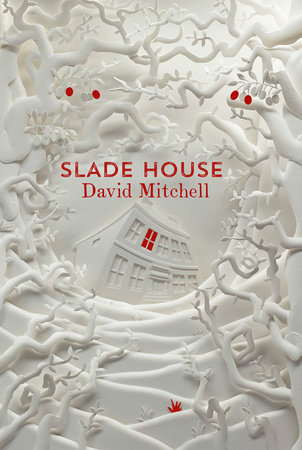
I thoroughly enjoyed Slade House by David Mitchell.
I turn round to tell Jonah to stop the game something's wrong, we need a grown-up. Any second now he'll come hurtling round the far corner. The brambles sway like underwater tentacle. I glance back at the garden. There was a sundial but it's gone now, and the damson trees too. Am I going blind? I want Dad to tell me it's fine, I'm not going blind, but Dad's in Rhodesia, so I want Mum. Where's Jonah? What if this dissolving's got him too? Now the lattice tunnel thing's erased. What do you do when you're visiting someone's house and their garden starts vanishing? The blankness is moving closer like a storm-front. Then, at the far end of the brambly side path, Jonah appears, and I relax for a second because he'll know what to do , but as I watch, the running-boy shape gets fuzzier and becomes a growling darkness with darker eyes, eyes that know me, and fangs that'll finish what they started and it's pounding after me in sickening slow motion, big as a catering horse and I'd scream if I could but can't my chest's full of molten panic it's choking me choking it's wolves it's winter it's bones it's cartilage skin liver lungs it's Hunger it's Hunger it's Hunger and Run! I fun toward the steps of Slade House my feet slipping on the pebbles link in dreams but if I fall it's have me, and I've only got moments left and I stumble up the steps and grip the doorknob turn please turn it's stuck no no no it's scratched gold it's stiff it's ridged does it turn yes no yes no twist pull push pull turn twist I'm falling forwards onto a scratchy doormat on black and white tiles and my shriek's like a shriek shrieked into a traffic cone all stifled and muted —
I mean, shriek! Wow, molten panic, Hunger, no, shriek.

Slade House is told in five sections, each relating an encounter at the house, occurring nine years apart. The house is an illusion that requires considerable psychic strength to maintain, and the twins who run the house need to fuel that energy. They do so by luring some particularly dynamic souls into their circle.

This short novel belongs in the world of Mitchell's Bone Clocks, which I have not read, so let me assure you that it stands perfectly well on its own. It does a good job of the haunted house story tradition, with loads of ambiance (the chilling kind) and family secrets. But it doesn't take itself too seriously — there are plenty of skeptical characters to keep things reasonable, if not exactly grounded in reality.

There's creepy yet poetic weirdness:
I find a dead cat lying on the ground at the first corner. It's gray like dust on the moon. I know it's dead because it's as still as a dropped bag, and because big flies are drinking from its eyes. How did it die? There's no bullet wound or fang marks, though its head's at a slumped angle so maybe it was strangled by a cat-strangler. It goes straight into the Top 5 of the Most Beautiful Things I've Ever Seen. Maybe there's a tribe in Papua New Guinea who think the droning of flies is music. Maybe I'd fit in with them.
There's some lovely intense blackness:
It's black, nothing-black, like the gaps between stars.
Blacker than black:
"Try the coffee first. It'll make a man of you." I lift the mug and peer down. Inside's black as oil, as holes in space, as Bibles.
I'd've liked to read Slade House in one sitting upon a dark and stormy night, but circumstances were such that I read it in very small pieces in strange places and over several dark days.
Grief's an amputation, but hope's incurable haemophilia: you bleed and bleed and bleed. Like Schrödinger’s cat inside a box you can never ever open.
Reviews
Guardian: Slade House by David Mitchell review – like Stephen King in a fever
Huffington Post: David Mitchell has a Halloween present for us
New York Times: David Mitchell's "Slade House" Plunges Into a Battle of Immortals
NPR: It's Coming From Inside The House ... "Slade House," That Is
Wall Street Journal: David Mitchell's Haunted "Slade House"

Excerpt.

Recommended for anyone in a witching-hour mood.

Wednesday, November 25, 2015

It was all a dream

Mrs. Todds my English teacher gives an automatic "F" if anyone ever writes "I woke up and it was all a dream" at the end of a story. She says it violates the deal between reader and writer; that it's a cop-out, it's the Boy Who Cried Wolf. But every single morning we really do wake up and it really was all a dream.
— from Slade House, by David Mitchell.

Sunday, April 05, 2015

Nest

David Cronenberg's short film The Nest documents a medical consultation with a woman who wants her left breast removed because she believes it to be full of insects.


I love how it's set in a garage.

I was lucky enough to see The Nest during the Christmas holidays of 2013 at a TIFF exhibition exploring Cronenberg's work.

Cronenberg's novel, Consumed, explores the same subject matter further. It's just one of several weird and typically Cronenbegian narrative threads in the book, but having watched this film gave the novel another dimension — it's become a kind of multimedia experience.

Saturday, November 08, 2014

"Matter is made up of a whole lot of nothing"

Edge, by Koji Suzuki, is billed as quantum horror. That is, it's horror derived from quantum physics. Or maybe it's that you don't know if it's really horror till you open the book and look inside.

The story is set in our now. It has some science-y stuff going on, but also a hint of supernatural. I don't think it quite qualifies as science fiction. Also, it's not post-apocalyptic dystopia; nothing post about it — this is how the apocalypse unfolds.

It starts with people disappearing, suddenly and inexplicably, there one minute gone the next. And math starts going wrong; pi and other "constants" and equations just aren't stable anymore.

Saeko starts investigating a set of disappearances. Ever since her own father disappeared 18 years previously, she's been rather obsessed with these types of occurrences. Not to mention having all kinds of daddy issues.

Saeko's father imparted to her all sorts of knowledge, along with a general wonder about the universe. Sadly, Suzuki flashes back on their time together, and the father's speeches are used as massive info dumps. How dreadfully boring, I thought; so glad he disappeared, I wouldn't be able to stand him another day. Maybe I was a little jaded after having just read an elegant and eloquent nonfiction treatment of similar issues, but I think Suzuki could give his readers a little more credit — no need for him to talk down to his readers the way Saeko's father evidently did to her.

But there's some food for deep thought buried in there: "The odds for the string of coincidences necessary to create our universe were basically nil." And, "matter is made up of a whole lot of nothing." "The real mystery is, why does the universe have any structure at all?"

So math and physics suddenly going all wonky is, I think, a fantastic concept. And a journalistic investigation into the strange disappearances could make for a good story too. But mash them together? And throw in a handful of coincidences, some supernatural-type visions, two-dimensional characters, and an appearance by the devil? I'm kind of glad that [spoiler alert] the world ends — having it go on just wouldn't make sense. Taken on their own, there are a couple deliciously creepy scenes and other interesting setups, but the book doesn't hang together for me.

Reviews

Saturday, October 11, 2014

Why is this a book?

I'm mildly obsessed with Consumed, a new novel by David Cronenberg. I haven't actually read it yet — I'm still hoping someone will think to buy it for me for my birthday next month — but I'm reading every review I can find.

I'm not even that big of a Cronenberg fan (excepting Naked Lunch, which is one of my favourite films ever). I just feel compelled to watch his films, and now read his novel, even though I fully expect it to be an unpleasant experience.

According to Jason Sheehan on NPR (In Cronenberg's 'Consumed,' An Appetite For Sex, Death And The Latest Gear):
Here's everything you need to know about Consumed in one sentence: This is a book that is unmistakably written by David Cronenberg.

Not so much the newer, grayer Cronenberg either. Not Eastern Promises Cronenberg or A History Of Violence Cronenberg. No, this is something that feels more like the young, perverse, freakishly laser-beam-obsessive and deeply, deeply strange Cronenberg.
But what I desperately want to know, and which no reviews that I've found address, is, why is this book? Did this need to be a book? Is it better as a book than it would be as a movie? What is it about the narrative that makes it better suited to this medium?

David Cronenberg’s consuming obsession, by Geoff Pevere in Quill & Quire:
"I really wanted to become an obscure novelist."

And I come to understand that Cronenberg's influences are more literary than filmic, which may explain my interest in him.

What Cronenberg says
Virtual Reality, Corporeality Collide In Cronenberg's First Novel, NPR:
"I always thought I'd be a novelist. I never thought I'd be a filmmaker."

Flavorwire Interview: David Cronenberg on Body Horror, Dick Pics, and His First Novel, Consumed:
"Movies, in some way, are very restrictive — compared to what you can do in a novel."

It came from within, The National Post:
"Seduction of the reader is definitely where it’s at. In a novel it’s much more intimate, because you can be in the interior of these characters."

About the book
David Cronenberg’s debut novel, Consumed, is one of the strangest books you’ll encounter all year, by Pasha Malla in the Globe and Mail:
It’s really, really weird.

All Atwitter, by Jonathan Lethem in The New York Times:
The book presents a locked-room mystery of sorts: Can it be possible that a woman said to be dying of cancer, and whose philosopher-cannibal-husband left a record of her ­dismemberment, is still alive? Or was she a consensual accomplice to her own murder? This core plot is elaborated in a highly traditional (and satisfying) way: twin investigations, apparently unrelated, which gradually entwine. Amateur detectives who become complicit — and, of course, involved sexually — with their suspects.
and
These passages are typical of the book's descriptive exactitude and flatness, its use of banal signifiers like "GarageBand," and the constant germane ­citations of psychoanalytic or philosophical brands. The book seems to desublimate itself for you: No sooner does the reader think, "This is like the case of Louis Althusser's murder of his wife," than some character makes the comparison for you. The result is provocatively comic, and surreal in the manner of a Max Ernst collage.

The Strange and the Familiar: David Cronenberg's Consumed, by Karin L Kross at Tor.com:
So much of it exactly what you would expect from him — especially if your ideas of his films are shaped largely by his earlier work; pre-M. Butterfly, to put an arbitrary stake in the ground — that you occasionally wonder if he's not deliberately sending himself up.

[...] In its energy and content, Consumed feels like a younger man's work — specifically, a younger David Cronenberg's, though with the confidence of someone who has been telling stories for decades.

Body horror and techno lust in director's debut novel, by Steven Poole in The Guardian:
The 21st century's version of the hall of mirrors is the infinite regress of embedded recording devices. Naomi and Nathan are always stealthily recording their conversations with other characters by means of some hidden app on a MacBook Air or iPhone, when they are not overtly putting obscenely expensive Swiss voice recorders on glass coffee tables. Cronenberg's fiction is one of omnipresent multimedia surveillance and retention, though we never witness the heroes performing the subsquent grunt work of transcription and editing. Perhaps deliberately, because a major plot question becomes what one can trust of electronic recording, and what was only cleverly fabricated using Photoshop or its video equivalents.

Other
Excerpt.

David Cronenberg becomes novelist; other directors decide to pull a Cronenberg, by Mark Krotov at MobyLives:
A connoisseur of violence, brutality, and grotesquerie — all of which are banned in Canada, where he was born — David Cronenberg has been making dark and weird masterpieces since the late 1960s. And while he has directed films based on novels — including such conventional, mainstream, user-friendly books as William Burroughs's Naked Lunch, J.G. Ballard's Crash, and Don DeLillo's Cosmopolis — he had never actually written one himself until Consumed.

Monday, August 25, 2014

Vampires!

Importance of names —
Most appellations appear to displease them; they would prefer not to be discussed at all, I believe. The expression "un-dead" is often considered distasteful. (I use it privately here, but would never utter it aloud in the club.) "Revenant" will do at a pinch, though the connotations of burial and return are a little indelicate. I asked Verner what name he preferred. He said that I was considering the question from the wrong angle. "We don't need words for ourselves," he said. "It's the living we're always watching out for."

"What do you call us, then?" I asked.

He said that there were few names he would care to repeat — the kindest being "bleaters." "Blood bag" is another. A buxom human female, in low circles, might be termed a "claret jug." He added that amongst those with better manners, the most widespread term for us is "the Quick."

Then he smiled — an effort made solely to discompose me. "Not always quick enough, of course."

Lauren Owen's The Quick is a vampire novel. Why this should be a secret is beyond me. But I'm betting that:
1. If you've heard at all about The Quick through the usual internetted ways, then you already know there are vampires.
2. Readers of this blog would be more inclined to pick up this novel knowing it's actually a vampire novel, not just a romance steeped in Victorian gothic atmosphere.

(Quite frankly, while the jacket copy about secret societies intrigued me, it wasn't enough to get me to read this book. It's the vampires that grabbed me; I agreed to a review copy only after I'd heard about this twist.)

It's a hefty book, but action-packed and with interesting characters, so it's quick to read.

It's positively dripping with Victorian gothic atmosphere. It reminds me of Susanna Clarke's Jonathan Strange (though I can't recall the details of that book, the mood stays with me) and Diane Setterfield's Bellman & Black (which I loved for how it let the reader hover in uncertainty). The most obvious reference would of course be Bram Stoker's Dracula, but at the time of the events told in The Quick it was not yet written.

Owen's creatures fit nicely into the vampire tradition, building on fundamental notions we have, primarily via Dracula, but with a few qualities invented or borrowed from elsewhere. These vampires have not been reinvented into something unrecognizable; they are updated classic, and they are scary.

And as in Dracula, those affected by the creatures take up a scientific exploration of their nature, so fact and myths are affirmed and dispelled for the reader as they are learned by the characters. In both books we see the investigators turning to medical and technological innovations (even if to establish a scientific basis in folkloric remedies) to aid them in defeating, or curing, the monster. Certainly typewriters will record their accumulated knowledge for posterity.

Owen discussed some the themes in her novel in an interview with The Bookseller:
"In modern representations of the vampire, the vampire is a metaphor for sex and romantic relationships, but in earlier depictions of the vampire there is more leeway into folklore," Owen says. "There's the idea of the vampire coming back to his family and sickening them and the rest of the village with his attacks, so that was part of the choice.

"I think family relationships are very interesting; the idea of what you tell the people who are closest to you and what you don't tell them — or what you're able to tell them, and whether or not being able to tell them everything about yourself means that your love for your family is not complete."

The vampire as metaphor for sex is already firmly established in Dracula, and it's nice to see this fiction stretch a little further back into the lore. Owen explores a lot of different family relationships in this novel, which puts some store in the saying that blood is thicker than water. Vampires would live by that too.

Wednesday, October 23, 2013

Die schwarze Spinne

Another, this time animated, interpretation of Jeremias Gotthelf's story The Black Spider.

Monday, October 21, 2013

What makes The Black Spider so creepy

The Black Spider, by Jeremias Gotthelf, has an incredibly high creepiness factor. The exceedingly creepy cover should have fully primed my expectations, but the book's contents managed to work their way even deeper under my skin.

Jeremias Gotthelf was the penname of Albert Bitzius, a Swiss pastor and novelist, who is celebrated for his detailed depiction of rural life. He lived 1797 to 1854, which makes him a contemporary of Adalbert Stifter, which I mention because the opening of The Black Spider quite reminded me of the style of Rock Crystal, the lyrical way in which the pastoral scene is set.

The story goes something like this:

An attendee of a christening party draws attention to a rough old post beside a window in an otherwise attractive home. Grandfather tells its tale:

A few centuries beforehand, the Swabian Hans von Stoffeln ruled the land, and by grandfather's account, he was not a reasonable man. After building his castle, the peasants were ordered to line the walk with trees. Having neglected their own harvests for several years already, the villagers had reached the point of desperation. A red-bearded huntsman in green comes upon them and offers to help. In exchange for an unbaptized child. After some deliberation, the villagers agree. The huntsman seals the deal with a kiss upon the cheek of the strong-willed Christine.

Babies are born and hastily baptized, cheating the devil out of his payment. Christine's cheek, meanwhile, burns and blackens and gives birth to a plague of spiders that infect the land, killing livestock and people. When Christine's attempt to kidnap a newborn to pay the debt is thwarted, the spider within bursts from her cheek — Christine shrinks into it and it fully consumes her. The spider is finally caught and imprisoned within a hole dug into that blackened post, which was plugged up.

Generations later, the people scoffed at the tale of the spider, and the spider came to be released. Again it was captured and imprisoned, and care was taken that it should not be released again. Thus the grandfather's tale serves to remind the villagers of their blessings, and that God is watching — and that the devil is, too.

A simple-enough pact-with-the-devil story, right?

The Swabian
The first creep factor to set me off was the mention of the "Swabian." It's a term I wasn't familiar with before reading Roberto Bolaño's 2666. and now every mention of Swabia, the region or its people, invokes for me the horror of 2666.

It turns out that there's a little something more to the connection. In the first section of 2666, The Part About the Critics, one of the critics has written a couple papers on Archimboldi, including one:
on the various guises of conscience and guilt in Lethaea, on the surface an erotic novel, and in Bitzius, a novel less than one hundred pages long, similar in some ways to Mitzi's Treasure, the book that Pelletier had found in an old Munich bookstore, and that told the story of the life of Albert Bitzius, pastor of Lützelflüh, in the canton of Bern, an author of sermons as well as a writer under the pseudonym Jeremiah Gotthelf.

Clearly Bolaño was familiar with Gotthelf, and that being the case, he was undoubtedly aware of (and likely read) the book considered to be his masterpiece: The Black Spider. Bolaño's influences were notoriously wide and varied, and I don't doubt Gotthelf (and specifically The Black Spider) was among them. (While it is fairly unknown among English readers, the story does seem to have cult following in German, and quite possibly other languages. Witness this rendering in Warcraft.)

It seems to me that The Black Spider and 2666 share a kind of insidious evil, that at times is embodied within an individual, sometimes pervades the collective social conscience, is part of the natural order of things, and at other times takes on cosmic proportions. It's Evil with a capital E, the likes of which not many novels can grapple with subtly and successfully (by which I mean they are not laughable allegories).

The contract
The second creep factor concerns the nature of the contract. The devil asks for an unbaptized child, and the villagers agree. It is not a contract concerning a particular child, or a particular mother-to-be. The child whose soul is at stake is not yet born, let alone consulted. The particular parents also are ignorant, though it may be argued that as villagers they have been complicit in the deal.

I read a commentary recently, I think it was in relation to the Rosemary's Baby (the movie, but I'm sure it applies to the book just the same), that the horror was not so much in the baby, or the devil, or the satanic cult even — it's in the fact that control is wrested from this poor woman, over her pregnancy and her child. I couldn't help but think of this while reading The Black Spider as one woman after another went into labour fearing for their babies. The women are forced to bear the consequences of not fulfilling a contract they had no part of.

So much of the horror has nothing to do with the spider or the huntsman who introduces it. It's to do with the fact that the villagers have decided someone else's fate.

The specific terms had not been set out in the contract. That is, there were no predefined rules. This is the horror.

The justice
Everybody ultimately gets theirs in this tale. What makes this justice uncomfortable is that it's not clear who is meting it out. The first wave of spiders killed indiscriminately, chaotically. But the Christine-spider strikes those villagers who were implicated in striking the bargain. She kills Hans von Stoffeln and his knights. But she spares those castle servants who had treated the peasants rightly. Is this Christine's justice, then? Or God's? If so, how could it come from what was implanted by the devil? And clearly it still sought an unbaptized child by which to fulfill the obligation. Is it God or the devil who demands a sacrifice?

Premonitions of a dreadful future rose before them, but not one had the courage to put a stop to things; their fear of the devil's plagues was stronger than their fear of God.

A story within a story
This novella has excellent pacing, making it feel much fuller than its 108 pages. When once I thought the story was coming to a head, it took another turn to keep me on the edge of my seat.

Also because the internal story has two parts within a frame story, it is enriched by the sense that it spans time. The frame story's present day seems to be in danger of falling into gluttony and sloth, thus making the hardships of the original peasants all the more poignant.

Unusually, this new edition from NYRB Classics translated by Susan Bernofsky has no introduction or afterword, no supplemental information of any kind. And if ever a story wanted some context, this Swiss horror classic from 1842 does.