Showing posts with label Wolf Haas. Show all posts

Sunday, May 25, 2014

"Even the murders move more slowly down here."

Resurrection, by Wolf Haas, is a charming little crime novel. That is, there's very little crime in it, it just zips along from taxicab to curling strip to castle to restaurant, and before you know it, you're halfway through when you realize, oh, right, it started with a couple of dead bodies, presumably foul play, now what's that all about?

The setting is Zell, an Austrian ski resort, but with very much a small town vibe. Inspector Simon Brenner, recently resigned from the police force, is now "investigating" (that is, writing occasional reports), this time on behalf of an insurance company.

It's been three-quarters of a year since the bodies on the ski lift, so it's not exactly an "active" investigation. Brenner's just muddling into situations.
The German had this bad habit. Purely insofar as, let's say, cars and drivers go. She always looked you right in the eye when she was talking to you. Now, normally, that's not necessarily uncomfortable. But in this case. She was hissing down the Autobahn at 130. And on top of that, well, no hands after all, even if she was a good driver, unbelievable, but still, just her two arm-stumps on the steering wheel. And when she was talking, she always took her eyes off the road and looked right at Brenner with those enormous eyes of hers. Because they were magnified so big by her farsighted glasses.

"It's quite lovely here," she says.

"Here in the tunnel?" Brenner says.

He was thinking, I'll make a joke, and if I make a joke, maybe I'll get her to look back at the road again, at least in the tunnel, because this here's a place with oncoming traffic. But, nothing doing, she didn't understand it was joke, and Brenner, of course, ready with a stereotype: Germans, no sense of humor. She looked at him with her polyp eyes and said:

"No, here in Zell."

"You don't like it in Hamburg?"

"I do. Quite lovely. Quite lovely indeed. But everything moves very fast there. Whereas here, everything's allowed to move a tiny bit — just a bisserl — more slowly."

Needless to say, we're all the same down here. We don't like it when a German imitates our dialect. And it wasn't any different for Brenner, a bisserl. And then that bit about the "slowly," practically — well, it's true, of course, but we don't like hearing it. But Handless didn't mean it quite so generally, because now she says:

"Even the murders move more slowly down here. In Hamburg, shot on the spot. And here, deep frozen."

And then, she even laughed. Brenner thought: This I don't understand, either, what's so funny about that.
This is the very first Inspector Brenner novel, but the third to be available in English. I really enjoyed Brenner and God for its wit and philosophical musing; The Bone Man was a bit madcap, and the crime seemed to bog down the story. But Resurrection is simply delightful. What little story there is moves with more agility than Brenner's migraine-addled thought processes. That may sound like a back-handed compliment, but without all those pesky crime details getting in the way, it's simple, swift, and funny.

And there's more by Wolf Haas — Come, Sweet Death — coming from Melville House soon.

(See also my recap of Wolf Haas at the Blue Met a few weeks ago.)

Friday, May 02, 2014

"It's not real German, it's more like the nightmare of German."

Wolf Haas is the author of a series of comic crime novels featuring private investigator Simon Brenner, a former cop. Three of them are now available in English, and a fourth is on its way. (The English publications are not in the order of their original release.) I saw Haas yesterday evening at the Blue Metropolis Literary Festival.

Haas is Austrian, and so is his German. "If it sounds weird, sounds wrong, it's a good translation." He apologizes for his English, but explains that when he reads in German, he also has to apologize for his German: "It's not real German, it's more like the nightmare of German." There is not only one kind of German.

His writing style is unique. It's very much like spoken language, lively, verbal tics and all. He writes the way he does because he likes the sound of it. (And it makes for very compelling reading.)

He likes reading in English because it's as if he's reading a book someone else wrote. He is distanced from the words; the words come as a surprise and he's not as judgemental of them as if he were reading them in his own language.

On top of which, in English they sound more like a real whodunit. He seems to romanticize the American crime thriller. As I riffle through scads of Scandinavian bestsellers in my head, I realize he means the hard-boiled, noir tradition.

In his view (and mine) it's the narrator of these books who's the main character, not the detective.

There's an attempt to explain the detective Simon Brenner to those who have not read any of the books. The interviewer likes the Columbo analogy; I don't. Brenner may have a common-man appeal about him, but he's not that clever. A bit oafish; not exactly clumsy, but intellectually sloppy. He never controls a situation; things happen to him.

Haas describes Brenner as a dinosaur of a man, an old-fashioned stereotype, only he tried to make him more likeable. Like his uncles. The kind of man who has to appear strong, tough; says little, but drinks a lot. Remember, Brenner's an ex-cop, and all-round fuck-up. "He tries to think, but he's too tired."

So how does he solve anything then (or does he)? "I don't want to be rude in a foreign language, but that's when the narrator kicks his ass."

While some of his writing has a basis in reality, Haas admits that much of it is pure fantasy; for example, Brenner's hometown is a real village, but Haas has never been there. Haas travels to promote his books, of course, and he discusses how those experiences are creeping into his books. But he's wary of opening his mind too far; his books are, after all, about small villages with narrow-minded people.

When did Wolf Haas realize he needed to write? He sets the interviewer straight: "I do not need to write. I want to write." Being a writer was a more attractive alternative to having a proper job, though not so viable in the beginning. What he learned from his days writing advertising copy: when you have an idea, you have to stick with it, run with it past the point of no return. He confesses that it's somewhat embarrassing to write crime stories — it's ridiculous.

I picked up a copy of Resurrection and he signed it for me. We even managed some (very) small talk. I asked him whether he reads a lot of crime novels, does he have a favourite crime writer, but it turns out, no, he reads maybe 2 or 3 a year, he likes reading all kind of things, "even poetry" (and it sounded to me a little like a line). Lovely man, shy, a bit nervous and awkward — real, with things to say.

Read Wolf Haas.

Wednesday, April 02, 2014

Looking forward to Blue Met

The launch of the festival program is like Christmas for me. I look forward to it every year. Then I sit with my various coloured pens, marking the must-sees and the maybe-interestings, mapping and scheduling.

The 16th Blue Metropolis Montreal International Literary Festival, themed "The Power of Words," runs April 28 to May 4, with some pre- and post-festival events.

This year's recipient of the Blue Metropolis International Literary Grand Prix is Richard Ford. (But I'm not yet convinced I need to read him.)

At my first go over the program, I've identified two standout events:
  • Thursday, May 1, an interview with Austrian crime writer Wolf Haas, author of the darkly humorous Simon Brenner books and for whom I've developed a fondness. I'm giddy with anticipation.
  • Friday, May 2, Shelagh Rogers interviews Heather O'Neill, author of the amazing Lullabies for Little Criminals. No, I haven't actually read it, but I own a copy and I know all sorts of things about it and I expect it to be thoroughly amazing. She has a new book out.
I'll be poring over the event listings in more detail in the coming days — I'll let you know what else I find. The full program is available on the Blue Metropolis website.

Friday, May 10, 2013

A crocheted toilet-paper-cover doll

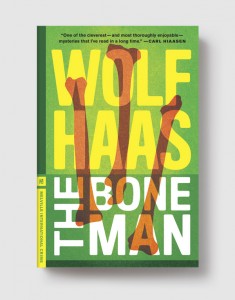
I finished Wolf Haas's The Bone Man the other night, and I enjoyed it, but I also have some mixed feelings about it that I'll try to talk out here.

The narration is pretty wonderful, most of the time, except when it isn't. And that's not because the narration changes, no, not at all, it's because, you know, life. You as a reader change chapter to chapter, from your morning commute to waiting for the timer to go off indicating supper's ready. Mostly there's something really compulsive about it, it's lively, it chatters, it hooks you, but occasionally it grates, because, I dunno, just shut up already, like when you're cornered into a conversation with someone who is in fact charming and interesting, but at some point it's just too much, I have other people to talk to, things to do, books to read, but the other party fails to acknowledge this. It can be pretty exhausting. I'm not saying the novel trapped me in any real way, except maybe it did with its wily wiles. It's not like I felt I had to be polite about it and read through to the end. But it addicted me and sometimes I resented that. It's complicated.

So sometimes the chattiness grates, or starts to, anyway. I apologize for subjecting you to it here, but it seems I'm unable to help myself in this matter, I'm hopelessly stuck in the groove of mimicry.

This is the second novel featuring Austrian private eye Simon Brenner to be made available in English, thanks to Melville House Publishing, but the events of The Bone Man are much earlier in Brenner's timeline than what transpires in Brenner and God.

The narrator has all these verbal tics, needless to say, part of his charm. And we don't know who this narrator is, although what he relates is pretty much from Brenner's perspective, with a running commentary, so we associate the narrator very closely with Brenner, and then suddenly we recognize those verbal tics, trademark phrasings, coming out of another character's mouth. And that's a bit, you know, jarring.

And at this point I should probably insert a spoiler warning, because I want to quote a passage, and it was really difficult to choose a passage because the thing about this book — the style, the story, the humour — is that everything builds on everything else, and it won't do to tell you the punchline, it needs, I mean really needs, the long, drawn-out set-up. So to quote a passage, I have to give you context, and really, it shouldn't spoil the book for you (and don't you let it), by the time you get round to reading it you will have forgotten the details of what I write here.

But you need to know that an artist has gone missing, only he hasn't really gone missing at all, he simply decided to live as a woman, so that's what he's been doing, quite openly, working as a waitress (a really ugly waitress we're often reminded) and enjoying (if what's heard through the paper-thin walls is to be believed) a very exuberant sex life.

The Ford was full of the kind of crap that certain people have in their cars, a CD was dangling from the rearview mirror, a crocheted toilet-paper-cover doll was standing on the rear shelf, and a "Get Home Safe" picture frame was glued next to the glove box. But the yellowing photo of the man in the frame must have been circa Elvis Presley, because the kiss curl — a catastrophe.

It didn't come as a particular surprise to Brenner that today's man can decide: I'd rather be a woman. And there are even operations, and he understood all that. And that an artist might think, I'd like to be an ordinary person again, he understood, too. But that someone would go so far in his transformation as to have a crocheted toilet-paper-cover doll in his car — that was something Brenner couldn't comprehend. And was thinking to himself now, maybe that's the reason why the waitress made such a racket every night. Maybe it wasn't purely lust. Maybe there was also some twinge of a desire to be caught, i.e. "liberate me from my toilet-paper doll."

I'm not even sure that's funny anymore. But somewhat interesting, no? A crocheted toilet-paper-cover doll!

Oh, right, the story, there's an actual story. Story feels pretty secondary to style here, but it still does pretty well. I got confused a few times about who was who, but ultimately it all hung together.

Yes, I'll read more Haas.

Tuesday, May 07, 2013

Why I don't like dogs

The two Rottweilers, very well behaved now — they obey that wisp of a woman, heel, incredible. And you see, that's why I don't like dogs, one minute they're practically tearing your head off, and the next they're pandering to you — if that's what you're looking for, you might as well just stick with people.

— from The Bone Man, by Wolf Haas.

I really enjoyed the narrator first time out in Brenner and God. But this time, you know, starting to grate. So I gave it a rest for a couple days, let the stress dissipate — not the stress of the book, I was more or less enjoying that, but the stresses of life and such I mean — drank it away, really. And now I'm in love with the narrator all over again. Also, craving fried chicken and a beer.

Thursday, August 09, 2012

God, death, and atheism

Brenner and God
I read Brenner and God, by Wolf Haas, earlier this summer and thoroughly enjoyed the story and the fresh manner of its telling (see my review).

A Q&A with the book's translator on the publisher's website offers some insight into the author's style:

What constitutes good style has been drummed into us to such an extent that, as good readers, we still bristle when a writer upsets those ingrained ideas. And what I see Wolf Haas doing is prying open this chasm between, on the one hand, how language behaves, and on the other, how language is enforced — and then letting his reader fall right in.

********************

Death in Breslau
I don't recall how I first came across the series of Eberhard Mock investigations by Marek Krajewski, but they're among the most curious mysteries I've ever read.

Melville House Publishing is set to release the first novel, Death in Breslau, in September.

The first three books in this series were previously released by Quercus Publishing — and I've written a bit about them here (Death in Breslau, The End of the World in Breslau, Phantoms in Breslau) — but I'm pleased that Melville House will be making (at least) the first book available to a whole new audience, even while I'm trying to get my hands on the fourth: The Minotaur's Head.

Set in interwar Breslau (now Wrocław), these books offer a weird view on a society that is a historical and cultural mix of German, Polish, and Jewish. Nostalgic for the past, that society is shown to be perverted and corrupted and completely hypocritical in its drive to be modern and free-thinking. I enjoyed the first book particularly for how the police investigation was shown to be conducted amid inquiries regarding internal affairs and with a hovering Gestapo presence. Dark and original.

********************

Shoes for atheists
At long last, atheists have their own shoes — atheists have soles too!

These shoes started off as a Kickstarter project. They look well-crafted and divinely comfortable. And they have a sense of humour — a black hole for a logo and a sole stamped with a message.

I haven't decided which colour I want, but I love the write-up for the literarily inspired "Nabokov cream":

Is there anything more beautiful in life than the pure, sweet, wondrous innocence of an unblemished, open and untainted soul?

Yes... the delightful process of getting that sole so fucking filthily dirty, and soiling its purity with so much titiliating sin and hedonistic whoredom that it can scarcely remember what colour it was to begin with.

This creamy, ivory, blank canvas of a shoeling is resplendent in her off-white milky maidenhood... but not for long, the little nymph, for you will introduce her to the real world... blemishing and sullying her with every step you take.

You're about to make a grown-up of this shoe.

The website as a whole is a cheeky bit of atheism-awareness, which maybe the world could use a little bit more of. And I could use some new shoes.

Sunday, June 24, 2012

Interesting, though: Brenner and God

There was never a riotous crowd in front of the abortion clinic, but somehow that silent threat from the church-types was even more menacing, because there's nothing worse than a sighing aggressor. A well-known fact: behind every mass murderer there's a mass sigher.

Simon Brenner is an ex-cop. Now he works as chauffeur for the 2-year-old daughter of an abortion doctor and a construction magnate, shuttling her between them. One day while he's at a gas station counter, little Helena is stolen out the car.

His sense of duty (not so much to his employers but to the job he was hired to do) as chauffeur and guardian, his feeling of guilt, and his old police instinct conspire to overrule any compunction he has about leaving this matter to the proper authorities. Really, even while he's following up leads, he wants to know, and he wants the job done right, but you sense that he'd rather not be involved at all.

Brenner and God, by Wolf Haas, is newly translated and issued by Melville House (available June 26). It turns out that this story is several books along in a series starring Brenner (and a few of them have been made into movies). There are hints of back-story, but certainly this novel reads well as a standalone. Definitely I would love for more of this Austrian series to be available in English, please.

The real cops are essentially absent from the story, and since we follow the plot from Brenner's point of view, when they do appear they come off, unsurprisingly, as somewhat incompetent. There are lots of leads (and nonleads) on this case, and it's not immediately clear which ones to follow. On the mother's side, there are antiabortionists and politics, and on the father's side there's a lot of money and politics, and on both sides there are people with their hands in other people's pockets.

But here again is the advantage of being the murderer. You don't have to go around agonizing about the little moral prescriptions.

The undisputed star of this novel is its narrator, exhorting us to "pay attention, because this is important" (which makes you pay attention) and making witty observations — "interesting, though:..." — about the characters, or life, and interpreting situations for us, occasionally skipping ahead a bit of the story and prefacing the retelling with "believe it or not" (which makes it more believable). Also, there's a constant reminder that the immediate events are unfolding 35 hours after Helena disappeared, or 53 hours, etc, which makes for excellent pacing.

There are some graphic bits, but the overall tone thanks to the narration is light, and even when the narration casts doubt on Brenner's sanity and motivation, we root for him the whole way.

What does God have to do with all this? Well, Brenner meets him, and the experience is pivotal in spurring Brenner on to follow through.

The good lord just gazed upon all this with a smile because — free will.

Sunday, June 10, 2012

The detective counterquestion

You should know, there's a right moment for everything. For plants, when to plant them, when to water them, when to harvest them; for animals, when to feed them, when to milk them, when to slaughter them; for children, when to make them, when to nurse them, when to kick them out on their own; for fingernails, when to cut them, when to file them, when to polish them; and hair, too, very important. But only a very few know how important the right moment is for the detective counterquestion.

— from Brenner and God, by Wolf Haas.