Saturday, November 16, 2013

The Zola project

I am enthralled by The Paradise. This television series pushes all the right buttons for me, though I can't identify them all. Music is one positive factor, and the beautiful people are another. For some reason I find the department store setting fascinating. Exquisite production value, fine acting, etc., but why I should be so enamored of this program while others leave me cold (ahem, Downton Abbey) is due to some ineffable je ne sais quoi.

(I'm watching on PBS Masterpiece Theater and we're nearing the end of season 1, but I've just discovered that most of the series is available on YouTube. I expect I'll be binging on season 2 before Christmas.)

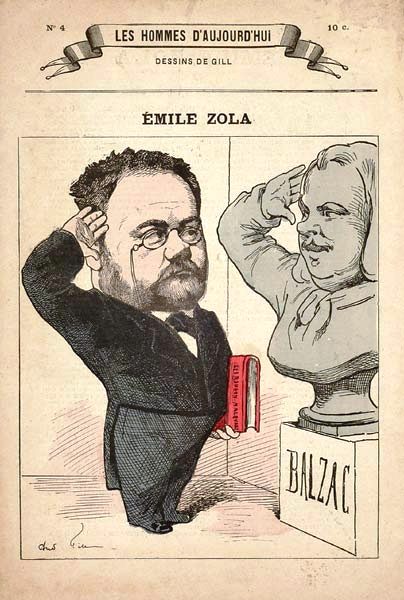
The Paradise is based on Émile Zola's Au Bonheur des Dames, the eleventh novel in his 20-volume Rougon-Macquart series. The television program has transposed the story from Paris to somewhere in northeast England. Of course, this leaves me wondering how much else has been changed. And what better way to find out than to read the source material for myself?

Meanwhile, my other half has been reading up on L'Assommoir, another novel in that series, after we were speculating about the origin of the name of a local bar that goes by that appellation. And he's become somewhat obsessed with Zola's concept.

The Rougon-Macquart cycle follows the life of a family during the Second French Empire. It includes a couple of Zola's best known works: Nana (which I in fact read, about 25 years ago) and Germinal, and lo they are interconnected.

In Différences entre Balzac et moi, Zola noted:
In one word, his work wants to be the mirror of the contemporary society. My work, mine, will be something else entirely. The scope will be narrower. I don't want to describe the contemporary society, but a single family, showing how the race is modified by the environment. (...) My big task is to be strictly naturalist, strictly physiologist.

The challenge then, for me and my other: to read the whole Rougon-Macquart cycle. Also, to read it in French. (This may take years.)

I will be following Zola's own recommended reading order with the following exception: I will pick up Au Bonheur des Dames first. The fact that I have some familiarity now with the story should help ease me into the language. Plus, I want all my pressing questions answered.

Wednesday, November 13, 2013

What is a poet?

What is a poet? An unhappy person who conceals profound anguish in his heart but whose lips are so formed that as sighs and cries pass over them they sound like beautiful music. It is with him as with the poor wretches in Phalaris's bronze bull, who were slowly tortured over a slow fire; their screams could not reach the tyrant's ears to terrify him; to him they sounded like sweet music. And people crowd around the poet and say to him, "Sing again soon" — in other words, may new sufferings torture your soul, and may your lips continue to be formed as before, because your screams would only alarm us, but the music is charming. And the reviewers step up and say, "That is right; so it must be according to the rules of esthetics." Now of course a reviewer resembles a poet to a hair, except that he does not have the anguish in his heart, or the music on his lips. Therefore, I would rather be a swineherd out on Amager and be understood by swine than be a poet and be misunderstood by people.
— from "Diapsalmata," in Either/Or, by Søren Kierkegaard.

This is a very strange and disjointed text, mostly dwelling on Kierkegaard's (self-termed) "depression." He sounds overly dramatic, and very much like those German Romantics he rails against.
I have, I believe, the courage to doubt everything; I have, I believe, the courage to fight against everything; but I do not have the courage to acknowledge anything, the courage to possess, to own, anything. Most people complain that the world is so prosaic that things do not go in life as in the novel, where opportunity is always so favorable. I complain that in life it is not as in the novel, where one has hardhearted fathers and nisses and trolls to battle, and enchanted princesses to free. What are all such adversaries together compared with the pale, bloodless, tenacious-of-life nocturnal forms with which I battle and to which I myself give life and existence.

How self-indulgent.

I was completely unprepared for this. It seems that after having defended his thesis (The Concept of Irony), Kierkegaard threw all notions of structure and form to the wind, one big middle finger to the Man, his traditions and institutions. This strikes me as a little at odds with his being a Christian theologian, but what do I know. (Maybe we'll cover this issue later in the course.) To Kierkegaard's credit, he practiced what he preached, practiced irony and found his own subjective truth.

It's pages upon pages of aphorisms concerning death, cereal, erotic love, Mozart, boredom, salmon, Sunday afternoons. It begs to be parodied. And it's wildly beautiful.
This is the way, I suppose, that the world will be destroyed — amid the universal hilarity of wits and wags who think it is all a joke.

Monday, November 11, 2013

No genuinely human life is possible without irony

In our age there has been much talk about the importance of doubt for science and scholarship, but what doubt is to science, irony is to personal life. Just as scientists maintain that there is no true science without doubt, so it may be maintained with the same right that no genuinely human life is possible without irony. Irony limits, finitizes, and circumscribes and thereby yields truth, actuality, content; it disciplines and punishes and thereby yields balance and consistency. Irony is a disciplinarian feared only by those who do not know it but loved by those who do. Anyone who does not understand irony at all, who has no ear for its whispering, lacks eo ipso [precisely thereby] what could be called the absolute beginning of personal life; he lacks what momentarily is indispensable for personal life; he lacks the bath of regeneration and rejuvenation, irony's baptism of purification that rescues the soul from having its life in finitude even though it is living energetically and robustly in it. He does not know the refreshment and strengthening that come with undressing when the air gets too hot and heavy and diving into the sea of irony, not in order to stay there, of course, but in order to come out healthy, happy, and buoyant and to dress again.

Therefore, if at times someone is heard talking with great superiority about irony in the infinite striving in which it runs wild, one may certainly agree with him, but insofar as he does not perceive the infinity that moves in irony, he stands not above but below irony. So it is always wherever we disregard the dialectic of life.

— from The Concept of Irony, by Søren Kierkegaard.

(Which is weirdly both unscholarly yet pretentious.)

Saturday, November 09, 2013

Subject to the profoundest doubt

Written in 1963, The Group, by Mary McCarthy, follows the intertwined lives of a set of Vassar graduates, class of '33.

I only became aware of this book because in season 3 of Mad Men, Betty slips into the bath with it. Generally regarded as an early feminist novel, The Group this year celebrated the 50th anniversary of its publication, though it is set several decades earlier still.

The book could equally be regarded as a set of intertwined short stories. Each chapter focuses on one member of the group, and we hear about the rest of the group from that perspective. The chapters could for the most part stand on their own, but they are more powerful within the context of the group.

Kay:
She had been amazingly altered, they felt, by a course in Animal Behaviour she taken with old Miss Washburn who had left her brain in her will to Science) during their junior year. This and her work with Hallie Flanagan in Dramatic Production had changed her from a shy, pretty, somewhat heavy Western girl with black lustrous curly hair and a wild-rose complexion, active in hockey, in the choir, given to large tight brassieres and copious menstruations, into a thin, hard-driving, authoritative young woman, dressed in dungarees, sweat shirt, and sneakers, with smears of paint in her unwashed hair, tobacco stains on her fingers, talking airily of "Hallie" and "Lester," Hallie's assistant, of flats and stippling, of oestrum and nymphomania, calling her friends by their last names loudly — "Eastlake," "Renfrew," "MacAusland" — counseling premarital experiment and the scientific choice of a mate. Love, she said, was an illusion.

Helena:
Her mother's habit of stressing and underlining her words had undergone an odd mutation in being transmitted to Helena. Where Mrs. Davison stresses and emphasized, Helena inserted her words carefully between inverted commas, so that clauses, phrases, and even proper names, inflected, by her light voice, had the sound of being ironical quotations. While everything Mrs. Davison said seemed to carry with it a guarantee of authority, everything Helena said seems subject to the profoundest doubt.

Norine is an outsider, not a member of the group, but after graduation she is a neighbour of Kay's and her life also becomes caught up in the group's fate:
"All I knew that night was that I believed I something and couldn't express it, while your team believed in nothing but knew how to say it — in other men's words."

And:
Watching her, Helena granted Norine a certain animal vitality, and "earthiness" that was underscored, as if deliberately, by the dirt and squalor of the apartment. Bedding with her, Helena imagined, must be like rolling in a rich moldy compost of autumn leaves, crackling on the surface, like her voice, and underneath warm and sultry from the chemical process of decay.

Chapter two covers Dottie's deflowering, and even while I was thinking, "Dottie, don't do it," and "The dialogue is ridiculous," and "Girls in 1933, huh", and "You're overthinking it," there was some laughing too, it also managed to make me blush. I may not have read 50 Shades, but I'm no prude, and this event was unabashedly, genuinely, beautifully female.

Is this book still relevant today? I want to say yes, but if I'm to be honest with you, I'll have to stammer that, well, it's not irrelevant, anyway. Certainly it was noteworthy on its release in 1963, but women have changed. Society and social expectations have not changed as much as they ought, and I fear today's women may neither recognize nor heed the warnings — about love, marriage, motherhood, parenting, career, gender equality, life — carried in The Group's gentle observations of what becomes of college girls.

See also:
Vassar, Unzipped!, by Laura Jacobs, Vanity Fair, July 2013.
The Mary McCarthy Case, by Norman Mailer, The New York Review of Books, October 1963.

Monday, November 04, 2013

The idea for which I am willing to live and die

What I really need is to be clear about what I am to do, not what I must know, except in the way knowledge must precede all actions. It is a question of understanding my own destiny, of seeing what the Deity really wants me to do; the thing is to find a truth which is truth for me, to find the idea for which I am willing to live and die. And what use would it be in this respect if I were to discover a so-called objective truth, or if I worked my way through the philosophers' systems and were able to call them all to account on request, point out inconsistencies in every single circle? And what use would it be in that respect to be able work out a theory of the state, and put all the pieces from so many places into one whole, construct a world which, again, I myself did not inhabit but merely held up for others to see? What use would it be to be able to propound the meaning of Christianity, to explain many separate facts, if had no deeper meaning for myself and my life?

— from Journal AA:12, Søren Kierkegaard, 1835.

I haven't decided how I feel about Kierkegaard. This passage speaks to me, but even while saying, "Yes, Søren, I can totally relate," another part of me is saying, "Really? Just how old are you? Every college student goes through this shit, and most of us get over it." Though the sentiments are common and it could've been written by any kid, the above passage is oft-cited because it is from a philosopher's journal.

One fellow MOOC student recently accused another of having reduced Kierkegaard to the psychological realm; I'm not sure it's wrong to do so. Kierkegaard is whiny, lovelorn, and full of bitter resentment.

Meanwhile, I'm currently suffering from irony overload (Socratic and other), and yeah, still looking for an idea for which I am will to live and die.

Friday, November 01, 2013

Unhappy few mortals

I'm one of those unhappy few mortals that can't put down a novel till I know how it comes out. Words cast a spell on me. Even the worst words in the worst order.

— from The Group, by Mary McCarthy.

Monday, October 28, 2013

Nature does not change

The One-Straw Revolution, by Masanobu Fukuoka, is a "manifesto about farming, eating, and the limits of human knowledge" that challenges our views on agriculture and how it fits into our (modern) way of living.
Few are able to grasp correctly that natural farming arises from the unmoving and unchanging center of agricultural development.

To the extent that people separate themselves from nature, they spin out further and further from the center. At the same time, a centripetal effect asserts itself and the desire to return to nature arises. But if people merely become caught up in reacting, moving to the left or to the right, depending on conditions, the result is only more activity. The non-moving point of origin, which lies outside the realm of relativity, is passed over, unnoticed. I believe that even "returning-to-nature" and anti-pollution activities, no matter how commendable, are not moving toward a genuine solution if they are carried out solely in reaction to the overdevelopment of the present age.

Nature does not change, although the way of viewing nature invariable changes from age to age. No matter the age, natural farming exists forever as the wellspring of agriculture.

And later,
There are always those who try to mix natural and scientific farming. But this way of thinking completely misses the point. The farmer who moves toward compromise can longer criticize science at the fundamental level.

Natural farming is gentle and easy and indicates a return to the source of farming. A single step away from the source can only lead one astray.

As if the point of our otherwise pointless lives is to aspire toward stillness.

I heard about this book when it was published as a New York Review Books classic a few years ago and it came up in relation to balcony gardening, which I was reading up on. Fukuoka's "do-nothing" philosophy has a great deal of appeal, although "do-nothing" is more work than it implies — more like "do no harm."

Fukuoka describes an epiphany he had that humanity knows nothing and that all our effort has no intrinsic value, is meaningless. I cannot help but relate this to my current readings on Socrates, Kierkegaard, and Hegel — having reached aporia, he intends to transmute it via negative action, not doing. Although nature does not change, Fukuoka states also that "nature is everywhere in perpetual motion"; he tries to achieve balance — a state (but, I think, not a process) of becoming.

I tend not to read much nonfiction but I am motivated because The One-Straw Revolution is a current book club selection. Come discuss it at Argo Bookshop tomorrow evening.

Larry Korn, a student of Fukuoka, and translator and editor of this book, has compiled several resources on Fukuoka and natural farming.

Thursday, October 24, 2013

As if they are from nature

Persian Ceiling

We are using gravity, centrifugal force, the heat, the fire, all of these different elements and in many ways we are not totally in control. Its letting the glass also make the form. Going with it, I want the pieces to be very often as if they are from nature. And so you are not sure, is it man-made? Is it made by nature?

— Dale Chihuly

Turquoise Reeds

Chihuly is on exhibit at the Musée des Beaux Arts de Montréal for a few more final days. See it. Download the app.

Like trying to understand the moon

And so when you're working with transparent materials, when you're looking at glass, plastic, ice, or water, you're looking at light itself. The light is coming through, and you see that cobalt blue, that ruby red, whatever the colour might be — you're looking at the light and the colour mix together. Something magical and mystical, something we don't understand, nor should we care to understand. Sort of like trying to understand the moon.
— Dale Chihuly

Wednesday, October 23, 2013

Die schwarze Spinne

Another, this time animated, interpretation of Jeremias Gotthelf's story The Black Spider.

Monday, October 21, 2013

What makes The Black Spider so creepy

The Black Spider, by Jeremias Gotthelf, has an incredibly high creepiness factor. The exceedingly creepy cover should have fully primed my expectations, but the book's contents managed to work their way even deeper under my skin.

Jeremias Gotthelf was the penname of Albert Bitzius, a Swiss pastor and novelist, who is celebrated for his detailed depiction of rural life. He lived 1797 to 1854, which makes him a contemporary of Adalbert Stifter, which I mention because the opening of The Black Spider quite reminded me of the style of Rock Crystal, the lyrical way in which the pastoral scene is set.

The story goes something like this:

An attendee of a christening party draws attention to a rough old post beside a window in an otherwise attractive home. Grandfather tells its tale:

A few centuries beforehand, the Swabian Hans von Stoffeln ruled the land, and by grandfather's account, he was not a reasonable man. After building his castle, the peasants were ordered to line the walk with trees. Having neglected their own harvests for several years already, the villagers had reached the point of desperation. A red-bearded huntsman in green comes upon them and offers to help. In exchange for an unbaptized child. After some deliberation, the villagers agree. The huntsman seals the deal with a kiss upon the cheek of the strong-willed Christine.

Babies are born and hastily baptized, cheating the devil out of his payment. Christine's cheek, meanwhile, burns and blackens and gives birth to a plague of spiders that infect the land, killing livestock and people. When Christine's attempt to kidnap a newborn to pay the debt is thwarted, the spider within bursts from her cheek — Christine shrinks into it and it fully consumes her. The spider is finally caught and imprisoned within a hole dug into that blackened post, which was plugged up.

Generations later, the people scoffed at the tale of the spider, and the spider came to be released. Again it was captured and imprisoned, and care was taken that it should not be released again. Thus the grandfather's tale serves to remind the villagers of their blessings, and that God is watching — and that the devil is, too.

A simple-enough pact-with-the-devil story, right?

The Swabian
The first creep factor to set me off was the mention of the "Swabian." It's a term I wasn't familiar with before reading Roberto Bolaño's 2666. and now every mention of Swabia, the region or its people, invokes for me the horror of 2666.

It turns out that there's a little something more to the connection. In the first section of 2666, The Part About the Critics, one of the critics has written a couple papers on Archimboldi, including one:
on the various guises of conscience and guilt in Lethaea, on the surface an erotic novel, and in Bitzius, a novel less than one hundred pages long, similar in some ways to Mitzi's Treasure, the book that Pelletier had found in an old Munich bookstore, and that told the story of the life of Albert Bitzius, pastor of Lützelflüh, in the canton of Bern, an author of sermons as well as a writer under the pseudonym Jeremiah Gotthelf.

Clearly Bolaño was familiar with Gotthelf, and that being the case, he was undoubtedly aware of (and likely read) the book considered to be his masterpiece: The Black Spider. Bolaño's influences were notoriously wide and varied, and I don't doubt Gotthelf (and specifically The Black Spider) was among them. (While it is fairly unknown among English readers, the story does seem to have cult following in German, and quite possibly other languages. Witness this rendering in Warcraft.)

It seems to me that The Black Spider and 2666 share a kind of insidious evil, that at times is embodied within an individual, sometimes pervades the collective social conscience, is part of the natural order of things, and at other times takes on cosmic proportions. It's Evil with a capital E, the likes of which not many novels can grapple with subtly and successfully (by which I mean they are not laughable allegories).

The contract
The second creep factor concerns the nature of the contract. The devil asks for an unbaptized child, and the villagers agree. It is not a contract concerning a particular child, or a particular mother-to-be. The child whose soul is at stake is not yet born, let alone consulted. The particular parents also are ignorant, though it may be argued that as villagers they have been complicit in the deal.

I read a commentary recently, I think it was in relation to the Rosemary's Baby (the movie, but I'm sure it applies to the book just the same), that the horror was not so much in the baby, or the devil, or the satanic cult even — it's in the fact that control is wrested from this poor woman, over her pregnancy and her child. I couldn't help but think of this while reading The Black Spider as one woman after another went into labour fearing for their babies. The women are forced to bear the consequences of not fulfilling a contract they had no part of.

So much of the horror has nothing to do with the spider or the huntsman who introduces it. It's to do with the fact that the villagers have decided someone else's fate.

The specific terms had not been set out in the contract. That is, there were no predefined rules. This is the horror.

The justice
Everybody ultimately gets theirs in this tale. What makes this justice uncomfortable is that it's not clear who is meting it out. The first wave of spiders killed indiscriminately, chaotically. But the Christine-spider strikes those villagers who were implicated in striking the bargain. She kills Hans von Stoffeln and his knights. But she spares those castle servants who had treated the peasants rightly. Is this Christine's justice, then? Or God's? If so, how could it come from what was implanted by the devil? And clearly it still sought an unbaptized child by which to fulfill the obligation. Is it God or the devil who demands a sacrifice?

Premonitions of a dreadful future rose before them, but not one had the courage to put a stop to things; their fear of the devil's plagues was stronger than their fear of God.

A story within a story
This novella has excellent pacing, making it feel much fuller than its 108 pages. When once I thought the story was coming to a head, it took another turn to keep me on the edge of my seat.

Also because the internal story has two parts within a frame story, it is enriched by the sense that it spans time. The frame story's present day seems to be in danger of falling into gluttony and sloth, thus making the hardships of the original peasants all the more poignant.

Unusually, this new edition from NYRB Classics translated by Susan Bernofsky has no introduction or afterword, no supplemental information of any kind. And if ever a story wanted some context, this Swiss horror classic from 1842 does.
Sunday, October 20, 2013

Die schwarze Spinne

I stumbled across this clip while doing a little background research into The Black Spider, by Jeremias Gotthelf, before I set about writing about it. I read it a couple days ago and it's creepy as all get out. This video captures the story and mood quite well.


Story by Jeremias Gotthelf. (The Black Spider is recently reissued by NYRB Classics.)

Soundtrack by Carlos Perón (possibly best known as a founding member of Yello).

Music and images from Mark M. Rissi's 1983 full-length film "The Black Spider."

Friday, October 18, 2013

Many walk their last roads without knowing it

Hans, the husband of the unfortunate woman, had kept his promise all too well. Slowly he had made his way, stopping to contemplate every field, gazing after every bird, watching as the fish in the brook leapt up to catch little flies before the storm. Then he would lurch forward and pick up his pace, at times even breaking into a run; there was something in him that drove him forward, that made his hair stand on end: It was his conscience telling him what a father deserved who betrayed his wife and child, it was the love he still bore for his wife and the fruit of his loins. But then something else held him back, something stronger than the first thing: his fear of men, his fear of the devil, and his love of all the devil could take from him. Then he walked more slowly again, slowly as a man walking his last road to the gallows. And perhaps he really was walking toward the place where his life would end; many walk their last roads without knowing it, and if they did, how differently they might walk there.
— from The Black Spider, by Jeremias Gotthelf.

Thursday, October 17, 2013

We think, therefore we are


Cool math aside, in this TED talk Adam Spencer talks up the power of collaborative mindset and distributed computing projects (such as SETI and GIMPS), that this is the greatness of the human race.

Tuesday, October 15, 2013

"The language neuterized at last!"

Acquired recently at the Antiquarian Book Fair, a pamphlet called The Sexless Dictionary, by John D. Hancock, published by Neuter Press, copyright 1976. A gem of a handbook, keeping my texts politically correct and my coworkers thoroughly entertained.

Because using "chairperson" and "salesperson" doesn't go far enough to establish gender equality.

Here's a representative sampling of entries:
APERSONS, interj. term used to notify the Deity that one's prayer is finished.

DEPERSONDS, n. humble requests made to the powerful by oppressed minorities.

GERPERSONY, n. a pacifistic country in Europe divided into two parts known as East Gerpersony and West Gerpersony.

ROPERSONTIC, adj. (1) characteristic of the delightful atmosphere favored by real and would-be lover; (2) characteristic of the notion that the good persons will always win.

Friday, October 11, 2013

How magnificent it is

"My friends, even if understanding is in fact an intellectual process, it is also a spiritual process, because the truths we arrive at through logic and mathematics, unless we feel them with our souls, will remain raw facts, and we will fall short of grasping how magnificent it is that we perceive them."

— from Azazeel, by Youssef Ziedan.

These words are attributed to Hypatia.

Thursday, October 10, 2013

No one knows nothing

First, let me dispose of Socrates because I am sick and tired of this pretense that knowing you know nothing is a mark of wisdom.

No one knows nothing. In a matter of days, babies learn to recognize their mothers.

Socrates would agree, of course, and explain that knowledge of trivia is not what he means. He means that in the great abstractions over which human beings debate, one should start without preconceived, unexamined notions, and that he alone knew this. (What an enormously arrogant claim!)

In his discussions of such matters as "What is justice?" or "What is virtue?" he took the attitude that he knew nothing and had to be instructed by others. (This is called "Socratic irony," for Socrates knew very well that he knew a great deal more than the poor souls he was picking on.) By pretending ignorance, Socrates lured others into propounding their views on such abstractions. Socrates then, by a series of ignorant-sounding questions, forced the others into such a mélange of self-contradictions that they would finally break down and admit they didn't know what they were talking about.

It is the mark of the marvelous toleration of the Athenians that they let this continue for decades and that it wasn't till Socrates turned seventy that they broke down and forced him to drink poison.

— from "The Relativity of Wrong," by Isaac Asimov.

This week I'm reading Plato's Euthyphro and Socrates' Defense as part of the coursework for Søren Kierkegaar​d — Subjectivity, Irony and the Crisis of Modernity.

The concept of subjectivity has not been raised in this week's lecture, but deducing from my own subject experience, I'd have to say it pervades pretty much everything. As a reader certainly I've observed that a lot of what I get out of a text depends on what I put into it.

Not just effort to understand, willingness to suspend disbelief, research into historical or biographical background, but simply mood. I can think of a few books that I approached with such seriousness that I failed to appreciate that they were intended to be comic; others that I was lighthearted about should have imbued me with sadness or heaviness. Sometimes it is the fault of the writer, not giving sufficient clues in the opening pages as to the tone in which a book ought to be read, or relying too much on the reader to carry a tone without providing the words to support it. More often than not, it's simply a matter of the wrong book at the wrong time.

And so it is with Socrates that I came with openness, enthusiasm, and humour (thinking all the time: Really? I'm taking a course on Kierkegaard? How ridiculous am I? What the hell?).

Euthyphro in particular I found funny. I picture Socrates smirking, even winking at a hypothetically more-evolved thousands-of-years-hence audience, as he mocks his victim to the point of humiliation, being deliberately obtuse and nitpicking over semantics. Sure, it's in the service of a greater good, establishing a higher truth, but it's not nice, and I wonder if sometimes he goes too far, ignoring other perhaps lesser but still valid truths that emerge along the way (for example, it's clear to me that Euthyphro values the ties that bind society over the ties that bind his family; but this potential tangent is swept away). Certainly he brings nothing positive to the interrogation — he destroys his opponent, but creates nothing in the place of the void he has unmasked.

In short, I agree with Asimov' implied assessment: Socrates is a real jerk.

Monday, October 07, 2013

The scary thing in the story

What really counts is less how believable we find the scary thing in the story, but how believable we find the characters who encounter those scary things in the story.

That's a really smart thing Andrew Pyper said, and it explains completely why I think Diane Setterfield's Bellman & Black is stronger than her Thirteenth Tale (which I'll shut up about in due course).


Has anyone read Andrew Pyper? Do you recommend him?

Andrew Pyper will be at Concordia University tomorrow night, part of the Writers Read series. (I may are may not be going.)

Later this week, Emma Donaghue.

Saturday, October 05, 2013

Rooks are made of thought and memory

Will Bellman seems to lead a charmed life. Despite starting out with a few marks against him, life is relatively easy (though he works hard) and good. Until...
It was a source of puzzlement to remember a time when the world had seemed an entirely benign sort of place. He had rarely been ill and never for long; he had never gone hungry; he had been met everywhere with smiles and friendship; his efforts had been rewarded, his failings largely forgiven. Though he was a boy who knew how to get into trouble he had the useful knack of being as good at getting out of it. What little there had been to frighten or pain him was left behind in the forgotten days of childhood: as a man he saw no reason to be afraid. Now some great hand had peeled back the kind surface of that fairy-tale world and shown him the chasm beneath his feet.

Until people start dying around him. Years of death, and business, and the business of death, and Bellman becomes a husk of a man.
"Appetite all right? Sleep?"

It was impossible to describe accurately the horror of his nights. Bellman was loathe to admit, I am tormented by dreams. Birds tap at my window in the night with their black beaks, they are trapped inside my lungs and leave me gasping for breath, they feed on my heart, and when I shave in the morning I can see them looking out at me through my own eyes. Of course not.
Bellman & Black, by Diane Setterfield, traces the tragedy of the trajectory of Will Bellman's life from when he was 10 years old and shot a crow dead with his slingshot, through his success as a business man, finding love and having a family, more continued business success, and his unravelling, unto his death.

Will, you see, is haunted. Bellman & Black is plainly marked as "a ghost story" (at least on the UK edition, pictured here; my e-book gave no such indication on the cover, but the novel is qualified as such on the title page). This may set the wrong expectations for some readers. In my view, the novel needs no such help; the ghost is there from the beginning, though its nature be not clear.

Following Will are the crows, or the absence of crows, and Setterfield's rook facts are interspersed throughout the text. Also, there are the many dead. And then there's Mr. Black. One thing I particularly like about this novel is that it's not clear whether the ghost has external existence or is purely internal to Will. I expect this may bother readers who come for a real ghost, but the way I see it, this ambiguity follows in a great classic tradition (think: Turn of the Screw).

There are several reviews of this book noting disappointment that Bellman & Black does not live up to the expectations set by Setterfield's first novel. While I enjoyed The Thirteenth Tale, little of it has stayed with me except for the mood of it (though I'm inspired to revisit it now*). Bellman & Black on the other hand will stay with me a long time, and I have no qualms about calling it a tighter, more mature novel. I loved it. Its net effect on me is like a cross between two other stellar books I read this year: John Williams' Stoner and Kate Atkinson's Life After Life.

*Since I first starting drafting this post, I have dipped into The Thirteenth Tale, and I can't get past the feeling that it's some kind of trickery, its hold on people. Sure, there's a story there somewhere, but it draws readers in by relying on their love of bookish things, old bookstores, getting lost in a book, special editions, the romance of writing, libraries. Bellman & Black seems to me purer, it's just the story of one man's life.

The standard description of this book does it a disservice, blithely summing up what amounts to nearly half of the novel in a few sentences, and implying that what follows — Will's meeting a stranger and establishing a new business — is the crux of the story. This is a gross imbalance. The second half of this story would not be worth nothing at all if the first half weren't so deeply felt and wonderfully told.

This book is about grief, and also the business of grief. I wonder if you have to have known grief to appreciate this book, the full devastation of grief, the kind where you make deals with your gods, anything, to abate it.

Or maybe you have to have known crows.
There is a story much older than this one in which two ravens — ravens being large cousins to rooks — were companions and advisers to the great God of the north. One bird was called Huginn, which in that place and time meant Thought, the other Muninn, which meant Memory. They lived in a magic ash tree where the borders of many worlds came together, and from its branches they flew blithely between worlds, gathering information for Odin. Other creatures could not cross the borders from one world to another, but Thought and Memory flew where they pleased, and came back laughing.

Thought and Memory had a great many offspring, all of whom were gifted with great mental powers allowing them to accumulate and pass on a good deal of knowledge from their ancestors.

The rooks that lived in Will Bellman's oak tree were descendants of Thought and Memory. The rook that fell was one of their many-times-great-grandchildren.

On the day that Will Bellman was ten years and four days old these rooks did what needed to be done to mark their loss. Then they departed from that dangerous place. They never returned.

The tree still stands. Even now you can go and see it — yes, right now, in your time — but you will not see a single rook alight in its branches. They still know what happened. Rooks are made of thought and memory. They know everything and they do not forget.
Well written and subtly atmospheric. Also, I recommend this novel for its fascinating historical detail to anyone with an interest in the history of supply chain management or in the Victorian business of mourning emporiums.

Friday, October 04, 2013

I am I don't know

My daughter is under the weather and has stayed home from school yesterday and today (and I've stayed with her). She's relatively sedate, and enjoying the company of the cat.

She's been asking if I've written anything about her lately. No, I haven't.

But I recently found this note on my phone. (Allegedly an experiment in Siri dictation.)

Also, she is insisting that I post a photo of the cat.


Thursday, October 03, 2013

Tu lis quoi?

Posters around town are informing me that it's saison de la lecture. (As if I need a PSA to tell me that the cooling nights are perfect for curling up with a good book.)

La Saison de la lecture de Montréal réunit de nombreux acteurs du domaine du livre désireux de promouvoir la lecture comme source de plaisir, mais aussi comme instrument de réussite scolaire et de développement socio-économique et culturel.

Auteurs, bibliothécaires, éditeurs, libraires, promoteurs d'événements littéraires, intervenants du milieu de l'éducation et autres passionnés, tous s'unissent dans un même mouvement pour offrir une grande célébration de la lecture tout au long de l'automne 2013.

In addition to several author events around town, and storytelling hours for the kids, there are some digital clinics scheduled, where you can get information and help regarding your reading devices.

Wednesday, October 02, 2013

Two Italians

Today's issue of Shelf Awareness dedicated to Rizzoli's Ex Libris imprint delighted me because it features two of my favourite Italians.

Umberto Eco
An oldie but a goodie. As the years pass, I like Eco's fiction less and less — it was all downhill after Foucault's Pendulum. But my appreciation of his work in the realms of semiotics, aesthetics, etc. continues.

His new book, The Book of Legendary Lands, will be published November 19. "This book is not concerned with fictional places alone. [...] I am dealing instead with those places that many people believed to have really existed, like the Earthly Paradise or Atlantis."

While I think the legend of Atlantis is a little tired (and for this reason I'm having a heckuva time plodding through William Azuski's Travels in Elysium), I'm curious to read Eco's erudite take "on why writers are compelled to create these worlds — and why readers are drawn to them."

Plus, it's illustrated, and if the publisher's website is anything to go by, it's bound to be gorgeous.

Gianrico Carofiglio
Sigh.

My literary crush of earlier this year was resurrected on reading this short interview. I mean, we share some of the same favourite authors! And he loves Stoner. And some of the books that changed his life changed my life! And he's so handsome and charming!

Sigh.

Carofiglio's new novel, The Silence of the Wave, is a standalone thriller involving a former undercover narcotics agent, his visits to a psychiatrist, and an 11-year-old boy's nightmares.

Sunday, September 29, 2013

The aura of places

In my first days in Jerusalem, I thought about the secret of pilgrimage and asked myself what drove me out of my native country and brought me to this holy spot. Could I not have touched the essence of holiness in my soul while secluded in the desert close to my homeland? If a place can reveal what is inside us, and travel can bring that to light from the depths of our being, is it not possible that humility, chastity, the monastic life, and constant prayer and glorification of the Lord can bring to light divine grace and the saintliness that is latent within us? Where then lies the aura places? Is the aura a secret inside us that pervades places when we reach them after travelling with impatient zeal? The awe I felt when I reached the walls of the Church of the Resurrection, did it arise from my sense of the imposing building, or was it from the meaning implicit in the event of the resurrection itself? Did Jesus really rise from the dead? As God, how could he die at the hands of men? Is man able to kill and torment God, and nail him to a cross?
— from Azazeel, by Youssef Ziedan.

I expect the coming weeks to be a time of slow reading, much needed; some reflection to still my mind. I have begun reading Azazeel, by Youssef Ziedan. It reads very fluidly, but it is packed with history and religious doctrine, neither of which I'm particularly well versed in.

The monks and priests who serve the Church of the Resurrection are good and simple, and most of them warmed to me when they learnt that I practise medicine and the art of healing. They were not interested that I was a poet.

I'm hoping that this slowdown in reading will afford me the mental space to catch up on some writing — I've read plenty of books recently and I've yet to discuss some of them here.

Also, the class I signed up for on Coursera — Søren Kierkegaard – Subjectivity, Irony and the Crisis of Modernity — starts next week. (You can sign up too!) The reading assignment for the first week consists of selections from Plato's Euthyphro and The Apology. No doubt I will be noting interesting passages here on this blog along with commentary as it occurs to me.

Saturday, September 28, 2013

And no birds sing

Famous men read famous poetry.

I am partial to Ben Whishaw's reading of La Belle Dame Sans Merci:


Other standouts on BlackBook's list are Dennis Hopper and Bono.

Friday, September 27, 2013

Sleep is a divine gift

Sleep is a divine gift without which the world would go raving mad. Everything in the universe sleeps, wakes up and sleeps again, except our sins and our memories, which have never slept and will never subside. Today I awoke from a sleep full of dreams so strong they seemed like reality, or perhaps it is my reality that has collapsed and faded until it has turned into dreams?

— from Azazeel, by Youssef Ziedan.

Wednesday, September 25, 2013

Intimacy changes the scale of the universe

Yes, she thought, this is one reason I always come back to these beds, because intimacy changes the scale of the universe, folding down the vast and overwhelming horizon until there is only the small world that is my body, upon which toothsome storms, sweating floods, and soulful earthquakes break their might forces, and I lie ravaged and raw and blissfully alive.

It starts with a witch, Zoya, and her paramour prey.

Another plotline follows Will and the misunderstanding that ensues when he confirms that he works for "the agency."

These stories are joined by love, of course, and the police investigation into the gruesome end of Zoya's victim (even while the chief investigator is turned into a flea) threads them together.

Babayaga, by Toby Barlow, is a fairly impossible sounding novel. Part fairytale, part police procedural, part madcap comedy, part love story. And all Paris.

It should be noted that George Plimpton is the inspiration for one of the characters central to Will's comedy of errors. George Plimpton, who cofounded The Paris Review 1n 1953 Paris, was also known as an agent of influence for the CIA, who funded the Review through the Aga Khan, as it was used as a cover for agency activities. Really. I'm not making this stuff up. And neither is Toby Barlow. If I hadn't known better, I might've thought this plot was stretched a little too far.

The witchy part of the novel draws on Slavic folklore for inspiration, and we follow Zoya and her elder through parts of Russia and Poland. But witches are not born; they are created. By men, one might say. There's a feminist bent to their power.

When doubts arose in Zoya's heart, and over the years they intermittently did, Elga seemed to have a knack for showing up by her side, consoling Zoya with blunt woodland wisdom, explaining how it was all righteous, even merciful. "It is only fair and only just," Elga would say. "Men have dragged us by our hair through the ages, and whether they give us crumbs or bright, shiny rocks, they truly give us nothing at all. If you have not opened your legs for them so that they could crawl out as babies or crawl in as men, then they will leave you to starve like a dog on the street. So now we are done playing the way they want us to play. Now we are moving to music they cannot hear, to a rhythm they cannot understand. They call it madness and we call it truth and find me the magistrate you can trust to judge between the two? Bah. So we dance on, we dance on."

Though they are clearly criminals, it's hard not to feel sorry for them in their circumstances — Zoya for being a (relatively) young and naïve romantic, and Elga simply crazy from age and the horrors she's lived. Zoya's motivation is not always clear, but we love her as much as Will does, and all is forgiven.

There are several (twelve) witches' songs that interrupt the text. This element didn't work for me at all. They suggest neither rhythm nor tune, too cryptic and disordered to work as ballads, too specific and banal in their lyrics to feel like laments, nothing incantatory or enchanting about them. Clearly they are songs sung by witches, but they don't settle on a perspective — witch or human, inner or all-seeing. They neither bring insight nor cause intrigue. They have no charm. (These songs have quashed any temptation I might've had to check out Barlow's werewolf novel, Sharp Teeth, written in free verse.)

Witch songs aside, it's a fun book, a quick read, that tugged at my heart strings to rip my romantic streak a little wider.

A sentence I love: "There, finally, she spotted the police car, parked like a turtle sleeping in the sun, waiting to be cracked open for its meat."

Excerpt.

Reviews
Los Angeles Times:
"The blend of James Bond, folk tale, Gogol's humor and surrealism with a corny French detective and a young man's love story all improbably works."

Washington Post:
"Toby Barlow's Babayaga is a novel that asks not to be taken too seriously. This is its most fundamental mistake."

Monday, September 23, 2013

Supreme creature that he is

The first time I saw Alfred Hitchcock's The Birds I was a teenager, and I saw it at the rep cinema, on a big screen. It terrified me.

I remember the crows from when I was little. An old neighbourhood — century-old homes — downtown. From our front porch, we could see the length of Woodland, which ran perpendicular to our street. And the agèd trees were shrouded in black, so the street bore a thick feather canopy absorbing any remaining daylight before it could reach the ground below. Thousands of them, cawing their hoarse insults and threats at us. Some years were worse than others.

The rook, supreme creature that he is, can find all the food he needs in a couple of hours a day and consider the rest of his time leisure.

What does the rook do with this leisure time?

1. He tells jokes and gossips.
2. He engineers handy, throwaway tools.
3. He learns to speak foreign languages. The rook can imitate the human voice, a logger's crane, the crash of broken glass. And if he wants to really make fun, he can call your dog to him — with your own whistle.
4. He enjoys poetry and philosophy.
5. He is an expert on rook history.
6. He knows more geology than you do — but since it is knowledge passed down through the generations from his ancestors he calls it family anecdote.
7. He has a good grounding in mythology, magic, and witchcraft.
8. He has a keen passion for ritual.

In essence the benefits of having the key to world's larder are that rooks have the time to think, the brain power to remember — and the wisdom to laugh.

— from Bellman & Black, by Diane Setterfield.

I am loving Diane Setterfield's new novel and stayed up way past my bedtime to read it last night, but fell asleep before I could finish.

There are crows in this book, or ravens or rooks. Also, there are some interludes — avian facts and anecdotes. I cannot tell the difference between these birds, but I spent much of the weekend reading up.

Setterfield also informs us of many of the collective nouns used for these birds, and I have discovered several others.

A murder of crows, a hover, a muster, a parcel, a storytelling. An unkindness of ravens, an aerie, a conspiracy. A parliament of rooks, a building, a clamour, a congregation, a parish, a shoal or a wing.

A storytelling...

Sunday, September 22, 2013

Down in the tub, man, you know who you are

"You know what I like most about this city?"

"What?" Will asked.

"The tubs," Flats said.

"The tubs?" said Kelly.

"Yeah, the bathtubs," said Flats. "See, when I was growing up down South, we didn't have any kind of proper tub or shower or bathroom, we were, you know, what's the word for it?"

"Poor," said Red.

"That's right. That's the word. Flats smiled. "We were poor. Dirt poor. So I won't even tell you how we washed up back then. But in the army, they put us in those big shower rooms with all the other men. It was all right, but it was the military, so how good could it be? But now, here, in my little flat, I have got this white Parisian-style tub, and I tell you it fits me like a glove. I dig getting in there, crouching down and scrubbing in all my nooks and whatnot. I tell you, it keeps me familiar and intimate with every bit of myself. You take a shower, your head is up, far away from everything, lost in the clouds, but down in the tub, man, you know who you are."

— from Babayaga, by Toby Barlow.

I read about a book a week. Compared to many book bloggers, that's not a lot. But given that I am not involved with the book publishing industry in a professional capacity, many people, namely several of my coworkers, are blown away by the volume of books I consume.

But let's take a page average: say, 350 pages a novel. That's 50 pages a day. I manage maybe 10 pages per commute — I have a relatively short commute, but factor in a couple minutes of platform waiting. Another 10 pages in the morning, relaxing with coffee or while waiting for coffee (why would I choose instead to confront the news of the day, reality, bleary-eyed?; I have the rest of the day for that), or in the bathroom (gasp!). Some 20 pages in bed before I drop of to sleep.

Weekends take away commute reading, but allow for a little bit of lying in. Also, reading while waiting for the laundry cycle to end, or while supper simmers. Rainy days are even better, allowing for longer guilt-free stretches of reading.

And I have recently rediscovered the joys of the bubble bath. More time to read, of course.

I have a family. I even have a social life, occasionally, though a quiet one (let's say that for the most part, my family is my social life; I like hanging out with them). I still watch television and movies, maybe a little less than some people. The time I spend online is fairly limited and controlled (that is, I don't surf randomly; I have particular destinations in mind).

Yes, I consume books at such a rate that sometimes I don't retain plots beyond a few days. Sometimes books are a simple entertainment. But for this, I have time.

Tuesday, September 17, 2013

Nobody paused to notice

Vidot made a small tsk-tsk sound. He never liked to share information about cases he was investigating. He was relieved that the tale of the Parisian man impaled impossibly high on the irons about rue Rataud, had so far, miraculously, not appeared in the local papers. He did not need the attention. He would have thought an incredible death like that would have headlined as the crime of the year, but Mitterrand's scandal, Cuba's charismatic young Fidel Castro, and the ongoing unrest in Algiers continued to eat up the headlines. Vidot thought these were indeed amazing times, when a man could be hung high on the street with a spike through his neck and nobody paused to notice.
— from Babayaga, by Toby Barlow.

The past several weeks I've been enjoying a free subscription to a national newspaper. I don't usually go in for sales pitches for this type of product, but: free! and no commitment! Besides, I've always admired people who manage to read the paper daily (my other half among them). I've never considered myself sufficiently well informed on current events (adequately, perhaps). So, I thought, I would read the newspaper and become smarter.

I have realized a few things these past weeks:
  • I know more than I think I do. It seems that through osmosis and the generally passive process of clicking through on random assortments* of links (i.e., in my non–newspaper-reading life), I learn more than nothing.
  • Print newspapers are full of ads. They are not as annoying as online ads, however, and sometimes they are interesting to read. They also contribute to bulking out the page count and the sense of accomplishment for having plowed through it all.
  • Print newspapers have more contributions from the community than I remember, beyond letters to the editor. They solicit personal essays, reviews, and opinions. They are often as pointless and as poorly written as the commentary the online world is reputed to have.
  • "This day in history" qualifies as "news," worthy of page 2. I suspect there is a long tradition of this, with the intent of educating the public or fuelling water cooler discussion by providing a common touchpoint. But, really?
  • It is enjoyable to read the newspaper with my morning coffee, but no more so than doing a crossword puzzle with my morning coffee, or checking my email and online news with my morning coffee.

While not especially witty or significant, the above passage (Babayaga: a tale of spies, Paris, and witches!) stands out for me.

What qualifies as news? What gets lost amid the din? Amazing times indeed.

*Random assortments tend to be in fact vaguely directed, given that I gravitate toward certain websites, and within those sites only certain items on certain subject matter will capture my attention, etc. In general, I do not play dice with the Internet.

Friday, September 13, 2013

It was a dark and stormy night

So begins Madeleine L'Engle's A Wrinkle in Time. "It was a dark and stormy night." What kind of deprived childhood did I have that I'm reading it only now?

It's touted as a classic, and I'd picked up a copy this summer thinking it would make for perfect mother-daughter bedtime story reading. I hadn't read it, and I figured I could force it into Helena's perfect childhood, or rather, with this act I would perfect her childhood, and right my own.

(Also, she reads at this level comfortably in French, and readily picks up whatever her peers deem the cool livre du jour. She's not exposed to English books much except through me, and I continue to find it tough to inspire her with anything other than comic books and compilations of weird facts [not that there's anything wrong with that]. This novel seemed likelier than some.)

So we started. And she fell asleep. A few nights later, we decided to continue. Only she didn't remember anything, so we went back to the beginning. And she fell asleep. And some nights after that... Lather, rinse, repeat.

I know chapter 1. I know every square inch of Meg's attic. I can picture every shelf of the pantry. I know intimately Mrs Whatsit's socks. (Helena has not yet had the pleasure. Or at least, she doesn't remember it.)

One dark and stormy night this week I'd had enough and stormed off to read the rest on my own.

Suddenly she was aware of her heart beating rapidly within the cage of her ribs. Had it sopped before? What had made it start again? The tingling in her arms and legs grew stronger, and suddenly she felt movement. This movement, she felt, must be the turning of the earth, rotating on its axis, traveling its elliptic course about the sun. And this feeling of moving with the earth was somewhat like the feeling of being in the ocean, out in the ocean beyond this rising and falling of the breakers, lying on the moving water, pulsing gently with the swells, and feeling the gentle, inexorable tug of the moon.

Beautiful! And it reminded me of something else I'd heard by a fellow also familiar with time travel.

Do you know like we were saying? About the Earth revolving? It's like when you're a kid. The first time they tell you that the world's turning and you just can't quite believe it 'cause everything looks like it's standing still. I can feel it. The turn of the Earth. The ground beneath our feet is spinning at 1,000 miles an hour and the entire planet is hurtling around the sun at 67,000 miles an hour, and I can feel it. We're falling through space, you and me, clinging to the skin of this tiny little world, and if we let go... That's who I am.

Verdict: utterly charming. Space travel, time travel. A showdown between good and evil. A two-dimensional planet. Alien music. A dystopian planet with some semblance of a hivemind but controlled by an evil intelligence. Furry, tentacle creatures of wisdom. What's not to like? The religious references felt a bit heavy and unnecessary, but really, I didn't mind. I think Helena would like it.

Oh, and! Tesseract! And lots of useful quotations in various languages! And a general appreciation for math and science and history and words.

"In your language you a have a form of poetry called the sonnet." [...] "It is a very strict form of poetry, is it not?" [...] "There are fourteen lines, I believe, all in iambic pentameter. That's a very strict rhythm or meter, yes?" [...] "And each line has to end with a rigid rhyme pattern. And if the poet does not do it exactly this way, it is not a sonnet, is it?" [...] "But within this strict form the poet has complete freedom to say whatever he wants, doesn't he?"

[...]

"You're given the form, but you have to write the sonnet yourself. What you say is completely up to you."

Tuesday, September 10, 2013

"For most people hindsight only works backwards"

The most ridiculous thing I read this summer was a Doctor Who book. And it wasn't even a "proper" Doctor Who book. The Angel's Kiss: A Melody Malone Mystery.

It's written by Justin Richards channelling Melody Malone, who wrote the pulp mystery novel the Doctor was reading in "The Angels Take Manhattan," and Melody Malone turns out to be the pen name of River Song, back in time. It's not actually the same novel that was worked into the plot of that episode, but it's all River à la femme fatale.
Evening was drawing in and the cars had their lights on, cutting through the inevitable rain. I watched the drops paint clear lines down the grubby cab windows. We drove in binary fashion — either stop or go. Go was fast, and stop was sudden. The journey was punctuated by a liberal use of the horn, presumably to make up for the complete avoidance of the indicator lights.

Finally the cab drew up at the kerb with a jerk. The jerk stayed behind the steering wheel as I eased myself out.

"You need a ride later?" he asked, apparently serious.

I found the exact fare and told him: "Oh, I hope not." If he wanted a tip, then I was ready with: "Stop for red lights."

It's a short book, short for a novella even, and it's not exactly big on plot, though there is one. It makes up for all that in attitude.

It made me laugh — and I was guffawing loudly at its awful punniness more than chuckling lightly at its charming wit.

Much of the humour is pretty sexy, "buttoned and unbuttoned in the best places and pointing in the right direction." Nothing I wouldn't let my 10-year-old read, but the flirtation would be entirely lost on her. Too much River. Not enough Cybermen, or Daleks, or Weeping Angels. Hell, the Doctor's not even in it. The kid would be bored to tears.

I, on the other hand, am old enough to know better. I love the Doctor and science fiction, River and noir. And it's easy, and thrilling, to imagine this story being purred to you in the voice of River Song herself.

Ridiculous, but such fun!

Have you read anything embarrassing lately?

Sunday, September 08, 2013

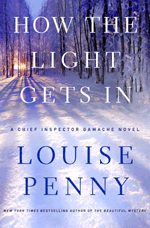
How the light gets in

I spent the better part of the weekend in bed reading Louise Penny's How the Light Gets In. Most of the other part of the weekend I spent curled up on the sofa or at the kitchen table reading Louise Penny's How the Light Gets In.

I have been reading this series of Chief Inspector Gamache novels out of order. So while some readers gush about the overarching story development, I'm not qualified to comment — I've been exposed to several pieces, but I'm still not seeing the full picture.

However, I'm here to tell you that this novel stands perfectly well on its own. An appreciation of the magical village of Three Pines and its eccentric inhabitants would no doubt be enhanced by having read one or two other novels set here, but I think that would be true no matter what order you read them in.

The case Gamache is on in How the Lights Gets In is related to the death of a quintuplet and delves into a fictionalized historical past inspired by the real-life Dionne Quintuplets. It raises some interesting questions about living life under public scrutiny, the life of celebrity, public versus private, the fabrication of reality for public consumption, the branding and commodification of people.

What non-Quebec readers may not be aware of (and certainly there's been no mention of it in the reviews I've read) is how much the rest of the novel, those supplementary plots that belong to the series-spanning story arc of corruption at high levels, is also based in fact.

This novel starts in the Ville-Marie Tunnel of Montreal. As Audrey drives through, she fears that it, and the city above, may crash down on top of her.

Anyone who lives in Montreal could not but recall the collapse of said tunnel two summers ago. Miraculously no one was hurt, but everyone was afraid.

It is one of the events that led to the establishment of the Charbonneau Commission, an ongoing inquiry into corruption with regard to public construction contracts, implicating organized crime and the mayoralty of Montreal (and other players).

I'd love to know from other readers to what extent you find this aspect of the story — regarding collusion among the powers that be in the Ministry of Transportation and other government departments — believable.

The story of the quintuplet is certainly interesting enough, but it's not as compelling as some of Penny's earlier mysteries. It's thoroughly overshadowed by the other events of the book. The corruption on the force and the mystery as to how far it spreads is by far the stronger storyline in this novel, and I say this without complete knowledge of all that's come before. That is, the novice Penny reader should start with a different book.

Now that Penny is garnering an international reputation, I wish she'd have a little more local recognition for her insightful depiction of life in Montreal and environs.

There's something so perfectly cozy about these cozy mysteries, especially at this time of year. I can see myself reading through the rest of Penny's back catalogue before Christmas. And I'm inspired to get out to the Eastern Townships for a little visit...

(Check out what peril other readers are imbibing this season.)

Friday, September 06, 2013

Bulgakov and the case of the missing galoshes

"Yes, a rack of galoshes. I have been living in this house since 1903. And from then until March 1917 there was not one case — let me underline in red pencil not one case — of a single pair of galoshes disappearing from that rack even when the front door was open. There are, kindly note, twelve flats in this house and a constant stream of people coming to my consulting rooms. One fine day in March 1917 all the galoshes disappeared including two pairs of mine, three walking sticks, an overcoat and the porter's samovar. And since then the rack had ceased to exist. And I won't mention the boiler. The rule apparently is — once a social revolution takes place there's no need to stoke the boiler. But I ask you: why, when the whole business started, should everybody suddenly start clumping up and down the marble staircase in dirty galoshes and felt boots? Why must we now keep our galoshes under lock and key? And put a soldier on guard over them to prevent them from being stolen? Why has the carpet been removed from the front staircase? Did Karl Marx say anywhere that the front door of No. 2 Kalabukhov House in Prechistenka Street must be boarded up so that people have to go round and come in by the back door? What good does it do anybody? Why can't the proletarians leave their galoshes downstairs instead of dirtying the staircase?"

"But the proletarians don't have any galoshes, Philip Philipovich," stammered the doctor.

"Nothing of the sort!" replied Philip Philipovich in a voice of thunder, and poured himself a glass of wine. "[...] Nothing of the sort! The proletarians do have galoshes now and those galoshes are — mine! The very ones that vanished in the spring of 1917. Who removed them, you may ask? Did I remove them? Impossible. The bourgeois Sablin?" (Philip Philipovich pointed upwards to the ceiling.) "The very idea's laughable. Polozov, the sugar manufacturer?" (Philip Philipovich started to turn purple.) "Why on earth do they have to remove the flowers from the landing? Why does the electricity, which to the best of my recollection has only failed twice in the past twenty years, now go out regularly once a month? Statistics, Doctor Bormenthal, are terrible things."

The Heart of a Dog, by Mikhail Bulgakov, is a little weird and hilarious. Philip Philipovich has brought home a stray on which to conduct a medical experiment. The doctor transplants the testes and pituitary gland of a dead man into the dog. He and his associate observe and document the dog's progress, his gradual transformation into a human.

While medically speaking the experiment might be said to be a success, it doesn't go so well at all on a social level. The humanized dog is a lazy but subtly scheming drunken lecher (much as we assume the donor of his human parts must've been). Attempts to educate and cultivate him become hopeless. When the doctor risks losing more of his rooms to the proletarians invading his house, he decides there's nothing do but to turn the dog back.

Translator Michael Glenny in his foreword (reprinted in the new Melville House edition with the fabulous cover art) argues that it can be read as a parable, that the doctor represents the Communist party and his operation is the revolution. "The bitter message is that the Russian intelligentsia, which made the Revolution is henceforth doomed to live with — and eventually be ruled by — the crude, unstable and potentially brutal race of hominids — homo sovieticus — which it has called into being."

I rather see Philip Philipovich as wholly unsympathetic to the cause and wanting to inject a counterrevolutionary element, a better human. But Sharikov (he needs papers, after all) eschews betterment in favour of "behaving naturally," proving a kind of fatalism — that people, or dogs, are what they are, despite the accoutrements of class or, on the contrary, the attempts to annihilate it.

Thursday, September 05, 2013

How a sigh might look

Had the Chief Inspector been blindfolded he could have described the familiar shop. The walls were lined with bookcases filled with hardcovers and paperbacks. With fiction and biography, science and science fiction. Mysteries and religion. Poetry and cookbooks. It was a room filled with thoughts and feeling and creation and desires. New and used.

Threadbare Oriental rugs were scattered on the wood floor, giving it the feel of a well-used library in an old country home.

A cheerful wreath was tacked on the door into Myrna's New and Used Bookstore, and a Christmas tree stood in a corner. Gifts were piled underneath and there was the slight sweet scent of balsam.

A black cast-iron woodstove sat in the center of the room, with a kettle simmering on top of it and an armchair on either side.

It hadn't changed since the day Gamache had first entered Myrna's bookstore years before. Right down to the unfashionable floral slipcovers on the sofa and easy chairs in the bay window. Books were piled next to one of the sagging seats and back copies of The New Yorker and National Geographic were scattered on the coffee table.

It was, Gamache felt, how a sigh might look.

— from How the Light Gets In, by Louise Penny.

Tuesday, September 03, 2013

A stationmaster of words

Polish poet Tomasz Różycki is featured in Words without Borders' Black Markets issue.

Paweł Huelle writes "A Letter to a Young Poet: On Tomasz Różycki":
At last I had found the missing link of a language that could name and describe that which I was not able to express. And that which was an important, significant event in my memories of childhood, of vacation trips south, to my grandmother Maria's house in Mościce near Tarnów. Suddenly — and unexpectedly — Tomasz Różycki became a participant in them. A stationmaster of words. An interpreter of memory's labyrinth. An important poet. Very important.

Huelle draws a line to Różycki from the Polish renaissance and through Młoda Polska, brushed by Stefan Grabiński and T.S. Eliot, tracing Rilke.

Here are a few choice lines from the Różycki translations published in Words without Borders:

"The Guy Who Bought the World"
The guy who bought the world is out for a walk
down Thirty-seventh Street. No one in the least
suspects that the deal just took place and the stock
exchanges keep noting each little increase,

"In the Evening, Love"
Oh, how he likes it: the glass warming in hand,
the arrangement of object in an order
readily apparent only from a certain
height. Go ahead and solve the code for romance.

"This Is My Room"
Columbus was wrong. There’s no earth whatsoever
after sunset, a boat sails into the dead
of night and goes on and on forever:

Różycki recites his poetry in this clip from the Poetry Center Archives:

Monday, September 02, 2013

An event mingling the beginning of worlds and their apocalypse

Where Tigers Are at Home, by Jean-Marie Blas de Roblès, is a massive, sprawling monster of a book. I have been reading it since March, and I'm finished.

It's 832 pages, and I read most of it on my phone (for various reasons, and that may have been a mistake). For all it's length, the reviews of this book are remarkably short. Most of the reviews call this novel subversive. I'm not sure I understand how.

I found this to be an incredibly difficult read (perhaps in part because I was reading it on my phone). I won't say it was rewarding, but it was certainly entertaining and for the most part engrossing.

He stuck the wax tip of the tube in one of his nostrils; when the shaman blew down it, he was immediately thrown back on the stretcher. After a few seconds of an intense burning sensation spreading through his sinuses, Dietlev had the very clear impression that the right side of his brain had frozen with no hope of it ever unfreezing. Opening his eyes, he was alarmed to see the sepia tones of the forests: the harmony of an old photo abruptly torn apart by sudden flashes of lightning, revealing incredible perspectives in which amber and mauve shaded into infinity. A Piranesian delirium, architectural tumors ceaselessly proliferating. He could hear the slow grinding of icebergs, the overthrust of continental plates. Distant whirlwinds started to stir up space with their spirals, cracks appeared all over the earth, which opened up like a round loaf under the irresistible force of the mountains. Stones rose in the air! Before he lost consciousness Dietlev was award he was witnessing something grandiose, an event mingling the beginning of worlds and their apocalypse.

The reviews identify several (five? seven? more?) narrative threads. Myself, I note three of consequence: the manuscript Eléazard is working on (i.e., the story of Athanasius Kircher), the story of Eléazard's ex-wife traipsing through the jungle on some esoteric archeological pursuit, and that of their daughter experimenting with sex and drugs on the beaches of Brazil. Yes, there are a couple other storylines, but they don't get the page-time these do, so while I think they're meant to have more weight, they are weaker and out of balance.

These three threads could almost stand on their own as separate novels. (Certainly, they're long enough.) Apart from a couple plot points, I fail to see how they fit together, or how they need each other thematically. I don't see the necessity for the sprawl.

However, I absolutely loved reading about 17th-century Jesuit scholar Athanasius Kircher.

This novel feels Important. It also manages to make me feel dumb. I don't understand who the tigers are supposed to be, or where they are. I mean, there's some great story in it, but it doesn't hang together for me — I just don't see the point.

Thoughts and excerpts
No one can walk beneath palm trees with impunity
A slap in the face from fate
We haven't got anywhere yet
Returning to the bosom of obedience
Looking for the amazing
List of minor Chinese officials

Reviews
Three Percent Review
[T]he various narratives that radiate out into seven different directions, each a quest of varying and dubious goals, but all of it conveyed with seriousness, more often with dark humor.

Cleveland.com
In the fictional biography, Kircher is an audacious blend of Don Quixote, Baron von Munchausen, Sherlock Holmes and Buckaroo Banzai, with a ravenous "taste for the fantastic, the extraordinary, the mysterious."

The friction Blas de Robles creates between facts and nonsense highlights one of his novel's primary themes: the fluidity of identity and history; the elusive solidity of reality; the uncertainty of veracity.

You hate the proletariat

"I want to ask you" — here the woman pulled a number of coloured magazines wet with snow, from out of the front of her tunic — "to buy a few of these magazines in aid of the children of Germany. Fifty kopecks a copy."

"No, I will not," said Philip Philipovich curtly after a glance at the magazines.

Total amazement showed on the faces, and the girl turned cranberry-colour.

"Why not?"

"I don't want to."

"Don't you feel sorry for the children of Germany?"

"Yes, I do."

"Can't you spare fifty kopecks?"

"Yes, I can."

"Well, why won't you, then?"

"I don't want to."

Silence.

"You know, professor," said the girl with a deep sigh, "if you weren't world-famous and if you weren't being protected by certain people in the most disgusting way" (the fair youth tugged at the hem of her jerkin, but she brushed him away), "which we propose to investigate, you should be arrested."

"What for?" asked Philip Philipovich with curiosity.

"Because you hate the proletariat!" said the woman proudly.

"You're right, I don't like the proletariat," agreed Philip Philipovich sadly [...]."

— from The Heart of a Dog, by Mikhail Bulgakov.