
Thursday, December 31, 2015

Monday, December 21, 2015
A quivering at the corners of her mouth
— from The Dinner, by Herman Koch.In all domestic arguments — as in all fistfights and armed conflicts, for that matter — there comes a moment when both, or one, of the parties can step back and prevent the situation from deteriorating any further. This was that moment. I wondered briefly what it was I was hoping for. As family and table companions, it was our role to intervene, to speak words that would put things into perspective and so allow the parties to be reconciled.
But did I feel like doing that, to be frank? Did we feel like doing that? I looked at Claire, and at the same moment Claire looked at me. Playing around her lips was something outsiders would not have recognized as a smile, but which was in fact a smile. It was to be found in a quivering at the corners of her mouth, invisible to the naked eye. I knew that invisible quiver well. And I knew what it meant: Claire, too, felt absolutely no urge to referee. No more than I did. We were not going to do anything to intervene. On the contrary, we would do everything in our power to enable things to escalate even further. Because that suited us best at this moment.

May all your holiday dinners be free of such domestic disputes, and all your knowing glances be loving ones.
Wednesday, December 16, 2015
"Generally swims against the orthodox flow"
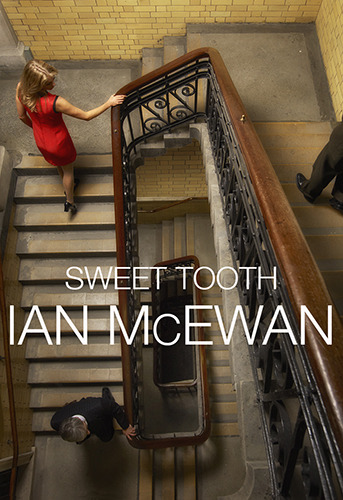
Literature as propaganda.
Serena has been recruited by MI5. In her spare time, she devours paperback novels. The project to which she's been assigned, codename Sweet Tooth, is to handpick some writers, academics, and journalists, finance them, and nurture their craft. There are political motivations for sidestepping the usual national arts funding mechanism. Recipients should be talented enough to become popular and thus hold some sway over public opinion, unknowingly helping to shape MI5-preferred sentiments regarding communism, freedom, and other matters of national interest.
"We're not interested in the decline of the West, or down with progress or any other modish pessimism. [...] We're looking for the sort who might spare a moment for his hard-pressed fellows in the Eastern bloc, travels out there perhaps to lend support or sends books, signs petitions for persecuted writers, engages his mendacious Marxist colleagues here, isn't afraid to talk publicly about writers in prison in Castro's Cuba. Generally swims against the orthodox flow."This wasn't the first Western strike in the culture war; the CIA had previously none-too-subtly backed a highbrow culture magazine, so obvious it backfired. And as propaganda, without the broad appeal to the masses, it failed.
All this takes place in 1972 England (the Cold War is still going strong, but a new threat has developed: the IRA). Sweet Tooth's chosen writer turns in a prize-winning novel, but it didn't take the Booker.
A cross-check with reality shows that the 1972 Booker Prize was awarded to John Berger for G. Berger donated half his cash prize to the Black Panther Party in Britain and retained half to support his work on the study of migrant workers, both being necessary parts of his political struggle. I'd never heard of him.
Art has always been political. It got me thinking: Could propaganda of this nature actually be alive and well in the West? Are there intelligence-agency puppet masters pulling the strings of pop culture?
A man writing a feminist novel.
Perhaps Sweet Tooth is not so strikingly feminist, only my sensibilities in the last few weeks have primed me to see it so. I read most of Orhan Pamuk's A Strangeness in My Mind, which he calls a feminist novel, but the first two-thirds of which is not really. I read Monica Ali's In the Kitchen, featuring a very dislikeable man with very little regard for women, and tangentially addressing the issue societal expectations of women (oh, and, human trafficking and prostitution). Last but not least, I saw Gloria Steinem speak, and she drove home the point that of course we should all be feminists.
McEwan has an uncanny way of getting inside a woman's head. (My head at least.)
I was beginning to feel a distinctive and unusual kind of pleasure, a sense of being set free. In a portion of mental space, perhaps quite a large portion, I was actually cleverer than Tom. How strange that seemed. What was so very simple for me, for him was apparently beyond comprehension.No man would ever feel this.
[It's not that the realization of one's cleverness is striking in itself. It's that it's worth noting at all, even by oneself, to oneself. Mid-80s, high-school calculus; I was cleverer than all the boys in the room, and it was mostly boys in the room. And teacher made a point of saying so. If it was a compliment, why did I feel condescended to? Why did he say it if not to shame them and embarrass me?]
The novelist character at one point talks about the need to be a transvestite, figuratively I assume, to fully inhabit his women characters. I wonder what McEwan's method of study is. Did he shag a spy? (I bet he's good in bed.)
I couldn't bear to look at him. I was irritated by the way he conflated his own shifting needs with an impersonal destiny. I want it, therefore... it's in the stars! What was it with men, that they found elementary logic so difficult? I looked along the line of my shoulder towards the hissing gas rings. The kitchen was warming up at last and I loosened my dressing gown at the neck. I pushed my dishevelled hair clear of my face to hep me think clearly. He was waiting for me to make the correct confession, to align my desires with his, to confirm him in his solipsism and join him in it. But perhaps I was being too hard on him. This was a simple misunderstanding. At least, that was how I intended to treat it.In all McEwan's Serena feels like an accurate rendition of the female psyche. And the novel's portrayal of life for a working woman in 1972 feels pretty authentic too. I bought into it; the novel works for me.
On the other hand, Maureen Corrigan hated Sweet Tooth (warning: her review is ambiguously spoiler-y): "Oh, what fun McEwan has squirting acid over everything simple Serena — clearly, the Common (Female) Reader — enjoys in a novel." Your mileage may vary.
Thursday, December 10, 2015
London was all belly

In the Kitchen starts with a dead body in the basement, but the book's not about that either.
While I started off rather enjoying it, quite suddenly the protagonist became very unlikeable. I couldn't understand why Ali would do that to her main character, and I spent the rest of the book being befuddled and a little angry about it. I now realize how much of a slow burn this novel is; it's taken a couple weeks for it to properly set in my head.
"My father say, in old days, Soviet days, is easy to tell what is lie. Everything is lie. Now, he says, is more hard. What is truth and what is lie? How we can know?" She pulled her shoulders up by her ears and let them drop. "But he is wrong. There is no truth. Is only a new kind of lie."Very little of this novel actually takes place in the kitchen. But the kitchen — the idea of "kitchen" — is strongly associated with two things (things Ali has written about before): women and immigrants. Women, of course, belong in the kitchen, but only when that kitchen is a domestic one. It takes a man to run a kitchen like a business, like a well-oiled machine. But it takes the right kind of man, one who stands above the others — the others who work long hours in difficult conditions for slave wages. This kitchen runs thanks to Africans and Eastern Europeans.
It took me a while to see how all the flavours blend together, because I was so caught up in Chef Gabe being a jerk. Maybe I'm overreacting, but no: rescuing the damsel in distress but then allowing yourself to believe that her having sex with you has nothing to do with the power dynamic you've established is a pretty jerk thing to do. And lying to his girlfriend about it. Jerk.
But it's little things too, like in the way he regards his sister:
Gabe held the phone away from his ear. Two years ago — was it three? — he had been affronted when Jenny walked into the kitchen in Plodder Lane and he saw how old she had become, how middle age had enveloped her like the layers of fat on her arms, her legs, her neck. Jenny, who used to wear torn denim miniskirts and a fuck-off glare. Who use to drop one laconic word in the pub and send everyone scurrying to pick it up, frame it, and hand it around. She used so many words now and all of them passed you by.I wondered how Ali could be so mean to women, letting Gabe get away with crap like that. Shouldn't she be championing the feminist cause? Gabe's girlfriend was made out to have a strong character in life, but be a mere background character in the novel.
Charlie, standing with her back to the kitchen counter, dug her hands into her jeans pockets. Her sweater, samphire green, showcased her curves. Once he had said to her she should be on a tailfin, a mascot for our brave boys as they went to "liberate" whichever godforsaken country they were sent to next. "You mean I've got World War Two hips," she said. He knew by then that she said these things as a parody of female insecurity and also because she was insecure. He said nothing because, confirm or deny, either way it would be taken as attempt to patronize.But I realized how astute, how true. This is the way the world is. We parody our insecurity while still insecure. Feminism lurks here. Ali's women characters are not the centre of this story — they are side dishes, dessert, a bit of home cooking — they have an awareness of themselves and their fate that Gabe does not have of himself.
So this novel turns out to be much vaster than the midlife drama of a petty and pathetic character. I really don't care how Gabe's little life turns out, and he really unravels at the end, but I am a little more concerned for the world: How real is human trafficking? How does Great Britain really treat its immigrants? How representative is Gabe's father when he bemoans that Great Britain has lost its Britishness.
London wasn't the brains of the country, as people said; it certainly wasn't the heart. London was all belly, its looping intestinal streets constantly at work, digesting, absorbing, excreting, fueling and refueling, shaping the contours of the land.Ali is a keen observer of human nature. I think Gabe's nature is very true, but sadly it makes him so unlikeable that it gets in the way of a good story.
"But every refugee knows how to tell his story. For him, you understand, his story is a treasured possession. For true, it is the most important thing he owns."Possibly Ali is making the point that Gabe bears the privilege of not having to treasure his own story (but then why should I?).
Tuesday, December 08, 2015
All I want for Christmas
So I have a little free time* these days, as I'm basically on stress leave** from work, and I'm indulging in a little armchair shopping***.
*If you can call "Christmas is coming and we will be travelling, and oh, we're moving in less than 6 weeks so I should get organized and pack up the household," free time.
**Let's see, in the past year, my husband left me, I've been adjusting to single motherhood and struggling to mitigate the pressure of feeling that I have to be always on, underwent a bathroom renovation, had a vacation which however fantastic it was came with its own set of logistical complications, shopped for a new home and made an offer, endured no end of bureaucratic obstacles in settling the current property with my ex, my brother had brain surgery and died of lung cancer within 2 months of his diagnosis****, my daughter became a teenager, I can't fathom that my ex believes his sum total responsibility toward his daughter is to take her to brunch for an hour on Sunday, I bought some new furniture, and now I'm preparing to move. Plus regular work crap. Last week I went to the hospital, convinced I was having a heart attack. Turns out, it's stress. Basically, you know that checklist of stressful life events, when you go for a massage or whatever? Just check all. 2015, you suck.
***Armchair shopping in this instance should be taken figuratively to mean shopping from the comfort of my home, as opposed to shopping for armchairs, which is something I'm also doing these days, sometimes also from the comfort of my home, albeit without an actual armchair, hence my being in the market for one. I hesitate as to whether I require it to have arms, but, leaving aside the semantic conundrum that poses, what then would I fling my legs over?
****If that sounds flippant — one more item in my litany of otherwise quotidian complaints — it's not meant to. It's heartbreaking. I just don't have the strength to address it any meaningful way.
 So I'm checking some of the year-end book lists to see what I could get for others, what I should reserve for myself, and one title jumps out as one I'd registered previously. I don't generally read customer reviews for books on Amazon, but I thought it might jog my memory of what I knew of this novel.
This review (by "James") made my day:
*****To be clear, my want is not based solely upon this review, but rather on the general critical and popular reception of this novel. Also, I love the title.
*If you can call "Christmas is coming and we will be travelling, and oh, we're moving in less than 6 weeks so I should get organized and pack up the household," free time.
**Let's see, in the past year, my husband left me, I've been adjusting to single motherhood and struggling to mitigate the pressure of feeling that I have to be always on, underwent a bathroom renovation, had a vacation which however fantastic it was came with its own set of logistical complications, shopped for a new home and made an offer, endured no end of bureaucratic obstacles in settling the current property with my ex, my brother had brain surgery and died of lung cancer within 2 months of his diagnosis****, my daughter became a teenager, I can't fathom that my ex believes his sum total responsibility toward his daughter is to take her to brunch for an hour on Sunday, I bought some new furniture, and now I'm preparing to move. Plus regular work crap. Last week I went to the hospital, convinced I was having a heart attack. Turns out, it's stress. Basically, you know that checklist of stressful life events, when you go for a massage or whatever? Just check all. 2015, you suck.
***Armchair shopping in this instance should be taken figuratively to mean shopping from the comfort of my home, as opposed to shopping for armchairs, which is something I'm also doing these days, sometimes also from the comfort of my home, albeit without an actual armchair, hence my being in the market for one. I hesitate as to whether I require it to have arms, but, leaving aside the semantic conundrum that poses, what then would I fling my legs over?
****If that sounds flippant — one more item in my litany of otherwise quotidian complaints — it's not meant to. It's heartbreaking. I just don't have the strength to address it any meaningful way.
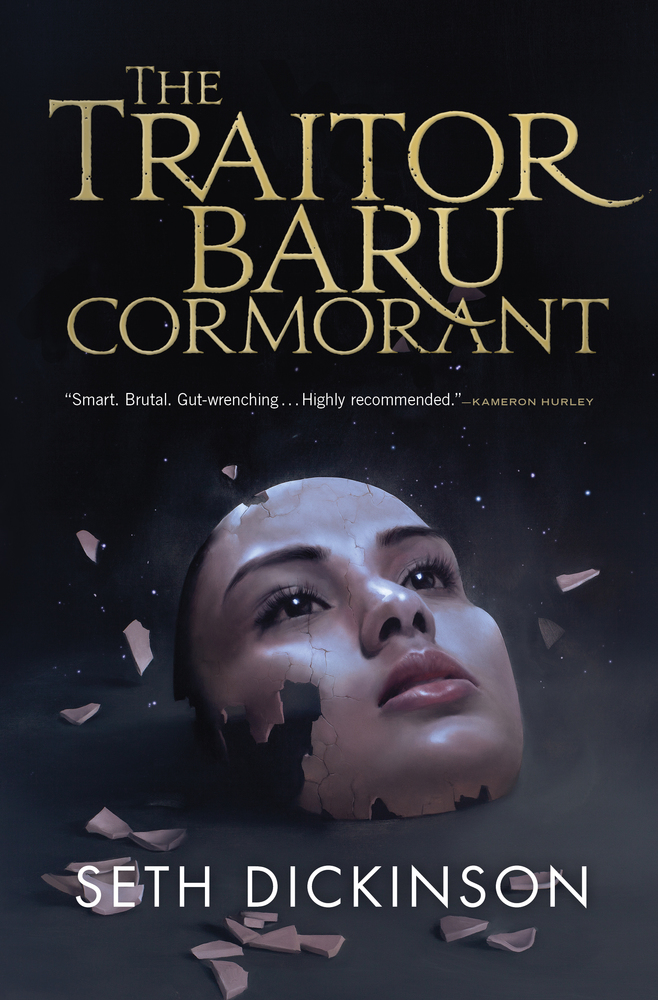
This review (by "James") made my day:
I bought this book because the cover was cool and I was a little drunk. I didn't read it for a few days because someone else called it "a geopolitical fantasy" and that combination of words alone almost put me to sleep. Luckily for me fate intervened and I got stuck on a plane with only this and sky-mall for entertainment and subsequently dug into it. My god it was good. I finished it in under 24 hours and am eagerly awaiting whatever the author puts out next.The book is The Traitor Baru Cormorant, by Seth Dickinson. This is the book I want***** for Christmas, please. (And also maybe some time to read it.)
*****To be clear, my want is not based solely upon this review, but rather on the general critical and popular reception of this novel. Also, I love the title.
Monday, December 07, 2015
It's Hunger and Run!
I turn round to tell Jonah to stop the game something's wrong, we need a grown-up. Any second now he'll come hurtling round the far corner. The brambles sway like underwater tentacle. I glance back at the garden. There was a sundial but it's gone now, and the damson trees too. Am I going blind? I want Dad to tell me it's fine, I'm not going blind, but Dad's in Rhodesia, so I want Mum. Where's Jonah? What if this dissolving's got him too? Now the lattice tunnel thing's erased. What do you do when you're visiting someone's house and their garden starts vanishing? The blankness is moving closer like a storm-front. Then, at the far end of the brambly side path, Jonah appears, and I relax for a second because he'll know what to do , but as I watch, the running-boy shape gets fuzzier and becomes a growling darkness with darker eyes, eyes that know me, and fangs that'll finish what they started and it's pounding after me in sickening slow motion, big as a catering horse and I'd scream if I could but can't my chest's full of molten panic it's choking me choking it's wolves it's winter it's bones it's cartilage skin liver lungs it's Hunger it's Hunger it's Hunger and Run! I fun toward the steps of Slade House my feet slipping on the pebbles link in dreams but if I fall it's have me, and I've only got moments left and I stumble up the steps and grip the doorknob turn please turn it's stuck no no no it's scratched gold it's stiff it's ridged does it turn yes no yes no twist pull push pull turn twist I'm falling forwards onto a scratchy doormat on black and white tiles and my shriek's like a shriek shrieked into a traffic cone all stifled and muted —I mean, shriek! Wow, molten panic, Hunger, no, shriek.
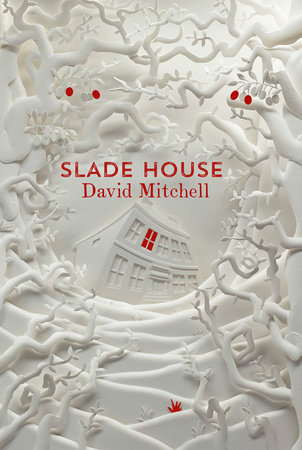
Slade House is told in five sections, each relating an encounter at the house, occurring nine years apart. The house is an illusion that requires considerable psychic strength to maintain, and the twins who run the house need to fuel that energy. They do so by luring some particularly dynamic souls into their circle.
This short novel belongs in the world of Mitchell's Bone Clocks, which I have not read, so let me assure you that it stands perfectly well on its own. It does a good job of the haunted house story tradition, with loads of ambiance (the chilling kind) and family secrets. But it doesn't take itself too seriously — there are plenty of skeptical characters to keep things reasonable, if not exactly grounded in reality.
There's creepy yet poetic weirdness:
I find a dead cat lying on the ground at the first corner. It's gray like dust on the moon. I know it's dead because it's as still as a dropped bag, and because big flies are drinking from its eyes. How did it die? There's no bullet wound or fang marks, though its head's at a slumped angle so maybe it was strangled by a cat-strangler. It goes straight into the Top 5 of the Most Beautiful Things I've Ever Seen. Maybe there's a tribe in Papua New Guinea who think the droning of flies is music. Maybe I'd fit in with them.There's some lovely intense blackness:
It's black, nothing-black, like the gaps between stars.Blacker than black:
"Try the coffee first. It'll make a man of you." I lift the mug and peer down. Inside's black as oil, as holes in space, as Bibles.I'd've liked to read Slade House in one sitting upon a dark and stormy night, but circumstances were such that I read it in very small pieces in strange places and over several dark days.
Grief's an amputation, but hope's incurable haemophilia: you bleed and bleed and bleed. Like Schrödinger’s cat inside a box you can never ever open.Reviews
Guardian: Slade House by David Mitchell review – like Stephen King in a fever
Huffington Post: David Mitchell has a Halloween present for us
New York Times: David Mitchell's "Slade House" Plunges Into a Battle of Immortals
NPR: It's Coming From Inside The House ... "Slade House," That Is
Wall Street Journal: David Mitchell's Haunted "Slade House"
Excerpt.
Recommended for anyone in a witching-hour mood.
Sunday, November 29, 2015
Strangeness
A novel, for me, is an excuse to pin down, collect, and put together all the little things about daily life that I like writing about. A novel is an excuse to, just like a museum, preserve the details, colors, tastes, social relationships, rituals, advertisements, smells, the chaotic richness and the sentiments that that richness lends us in the city.— Orhan Pamuk, "I Walk in the City All the Time": An Interview with Orhan Pamuk by Tobias Carroll, Hazlitt Magazine.
It's a new year, baby! Starting now.
It seems I've allowed my time to be swallowed by life, death, and facebook these last few months instead of blogging. I have, however, continued to read, though at a slower rate than in past years. I hate the feeling of not being able to organize my thoughts and set them down in this little piece of internet I call home (you know, at the house icon); I hate the feeling of not having the time to do so.
I have a few comments about A Strangeness in My Mind, the latest novel from Orhan Pamuk. I have not finished reading this book, but I want to. I had a digital review copy, which I let languish a little because life, but then I found myself taking train rides and having the luxury of long, uninterrupted blocks of time to read, and in this way I managed to read about two-thirds of this not so slender novel.
One morning I was happily reading along. My layover gave me time to grab a coffee. Cozily settled into the connecting train, I opened up my e-reader to be greeted by an error — the rights had expired.
So I want to know what happens next, but not because I'm invested in these characters' fates, but because I need to know if
there's a payoff. Frankly, most of what I'd read verged on boring; that is, it wasn't the novel I was expecting to read after the opening chapters describing an elopement. The next 400 pages cover the plight of the peasant coming to the big city to find his fortune, details regarding street vendors and the yogurt-selling trade, against a diachronic view of Istanbul.
I was cut off in my reading just as the narrative was returning to that promised in the beginning, and Mevlut was, it seems to me, discovering religion. That is, just as it was getting interesting.
I need to know if the last third of the novel, makes the first two-thirds relevant. How Istanbul has changed over the last several decades — culturally, socioeconomically, and politically — is actually interesting to me. But to my mind that story would've been better served in a separate collection of stories. I wanted to know more about how it was that, and what came to transpire when, Mevlut married the "wrong" girl.
I'd read some blurbs to the effect that this was a feminist novel. After 400+ pages, I wouldn't say so, but I need to know if the remaining 200 pages make it so.
The novel also makes use of a narrator-switching gimmick. That totally worked in My Name Is Red, but in Strangeness it's a distracting element. There's no regularity to it, or much reason for it beyond laziness to tell of events that couldn't otherwise be easily incorporated into a singular perspective; none of those secondary voices are much developed. Perhaps it works better in print where voices can be distinguished typographically.
Also, what exactly is the strangeness in Mevlut's mind? Is it something to do with religion?
I deliberately stayed away from reviews of this novel, so I could form an unbiased opinion. Let me pause a moment to check out some of those reviews now.
The Guardian, Alberto Manguel:
Though at times it reads as a cross between a history manual and private memoir, A Strangeness in My Mind is above all a love letter to the city in all its faded, messy, dusty glory.The Independent, Boyd Tonkin:
Across the 600-odd pages of this epic fusion of soap opera, family saga and state-of-the-nation novel, Pamuk's beloved Istanbul mutates into that kind of skyscraping agglomeration: no longer a "familiar home" but "dreadful and dazzling at once".The New York Times, Martin Riker:
A Strangeness in My Mind becomes a tremendous concatenation of voices and places and politics and culture, gathered around a melancholy hero and a winding psychological plot.The Scotsman, Stuart Kelly:
Mevlut, of course, is a model not of prevarication, but the awful capability of seeing the virtues in both sides. He likes the Communists because they care about the poor, and he likes the conservatives because a good man needs a break. He even likes the Islamists because their heritage should not be disparaged, and God, is after all, Great. He is not a weathercock, but an amalgam: it is possible to have all these beliefs at once, Pamuk suggests, and that complexity is in itself a good thing.I was unable to get my review copy extended, and when I first checked, by library didn't yet have it. I won't buy it, because I'm doubtful that the ending is worth it. My library has since acquired it, and I'm second in line for it now. So maybe my disappointment with A Strangeness in My Mind will coalesce into something more positive in a few months' time.
Has anyone read A Strangeness in My Mind? Is it worth seeing through to the end?
These are the other books I've finished reading since August, and I have every intention of writing more about them here.
- Zofloya; or, The Moor: A Romance of the fifteenth century, by Charlotte Dacre — which was not at all what I'd expected, omitting as it does "gothic" from its subtitle, which might have better prepared me for its hysterical revenge, bloodlust, and satanic qualities.
- Via Roma, by Mary Melfi — which was mostly forgettable, but portrayed both Montreal and Italian culture and so made for a nice comfort read after my Italian vacation this summer.
- A God in Ruins, by Kate Atkinson — which made me sob, several times, but the part about one minor character dying from brain cancer helped me deal with the fact of my brother's brain tumour.
- Slade House, by David Mitchell — which was creepy and intense and perfect for when I was alone at night
- The Windup Girl, by Paolo Bacigalupi — which was difficult, but represents the kind of book I wish I were more fluent in reading.
- The Utopia of Rules, by David Graeber — which was somewhat cathartic amid the paperwork and complications I encountered in buying a condo and negotiating a mortgage.
- In the Kitchen, by Monica Ali — which made me hate dumb men for doing dumb things.
Wednesday, November 25, 2015
It was all a dream
— from Slade House, by David Mitchell.Mrs. Todds my English teacher gives an automatic "F" if anyone ever writes "I woke up and it was all a dream" at the end of a story. She says it violates the deal between reader and writer; that it's a cop-out, it's the Boy Who Cried Wolf. But every single morning we really do wake up and it really was all a dream.

Friday, November 20, 2015
Three library things

A virtual exploration of the great libraries of the world, inspired by Alberto Manguel's essay.
Step into a recreation of Manguel's own library. "The library in the morning suggests an echo of the severe and reasonably wishful order of the world, the library at night seems to rejoice in the world's essential, joyful muddle."
Exhibition at the Grande Bibliothèque (Bibliothèque et archives nationales du Québec) until August 28, 2016. (I'll review it when I see it, but sadly that may not be for a while.)
Fallout 4
Disclaimer: I've never played Fallout, but I've logged several hours watching other people play Fallout.
In the latest installment, players can return overdue library books, strewn about the wasteland, for valuable tokens.
"There's certainly no harm in including a library in an imagined dystopian future — if anything, it's a great reminder that overwhelming violence can destroy valuable culture and knowledge."
The Library
A short film about the romance of books.
"It still carries a magical feeling for me, this special kind of sanctuary full of knowledge, full of stories, all covered in a sense of quiet respect and revery." (via)
Monday, October 26, 2015
Science in the service of Fiction
La Science au service de la Fiction:
 Premier prototype d'écriture automatique avec images, typographies et pourcentages. Carte postale extraite du livre «Lapsus Mordicus», 2013.
A friend of mine recently sent me this fabulous postcard from France. It oozes cool, but I can't be entirely certain how the machine works.
The retro-futuristic computer appears to be designed to generate fiction according to the input configuration of narrative elements.
I'm not convinced that this machine covers all the components required for a satisfying read: violence, suspense, emotion, and femme fatale. I might add the elements of comedy, character, and cats.

A friend of mine recently sent me this fabulous postcard from France. It oozes cool, but I can't be entirely certain how the machine works.
The retro-futuristic computer appears to be designed to generate fiction according to the input configuration of narrative elements.
I'm not convinced that this machine covers all the components required for a satisfying read: violence, suspense, emotion, and femme fatale. I might add the elements of comedy, character, and cats.
Wednesday, October 21, 2015

Wednesday, October 07, 2015
Notebooks, neckties, and homework

For one and half school years, between sixth and seventh grade, Mevlut worried constantly about where to sit in the classroom. The inner turmoil he endured while grappling with this question was as intense as the ancient philosophers' worries over how to live a moral life. Within a month of starting school, Mevlut already knew that if wanted to become "a scientist Atatürk would be proud of," as the principal liked to say, he would have to befriend the boys from good families and nice neighbourhoods, whose notebooks, neckties, and homework were always in good order. Out of the two-thirds of the student body who, like Mevlut, lived in a poor neighbourhood, he had yet to meet anyone who did well in school. Once or twice in the school yard, he'd bumped into boys from other classes who took school seriously because they, too, had heard it said, "This one's really clever, he should be sent to school," but in the apocalyptically overcrowded school, he had never managed to communicate with these lost and lonely souls who, like the quiz team, were belittled by the rest as nerds. This was partly because the nerds themselves regarded Mevlut with some suspicion, as he, too, was from a poor neighborhood. He rightly suspected that their rosy worldview was fatally flawed: deep down, he felt that these "clever" boys, who thought they would become rich one day if only they could learn the sixth-grade geography textbook by heart, were, in fact, fools, and the last thing he wanted was to be anything like them.— from A Strangeness in My Mind, by Orhan Pamuk.
Wednesday, September 23, 2015
There was no prize
— from A God in Ruins, by Kate Atkinson.When she sat back down at her table she found that a group of men dresses as condoms were staggering across St Helen's Square. They were in one of the best-preserved medieval cities in Europe and they were dressed as condoms. What was wrong with Benidorm? Or Magaluf? ("You want everyone to behave better, but you don't behave better yourself," Bertie said.)
One of the condom men squashed himself like an insect against the large plate-glass of Bettys and leered at the diners. The pianist glanced up from his keyboard and then continued serenely with Debussy. A van drew up in the centre of St Helen's Square and disgorged several people dressed as zombies. The zombies proceeded to chase the men who were dressed as condoms. The condom men didn't seem very surprised, as if they were expecting to be chased by zombies. ("They pay for it," Bertie said.) Was this fun? Viola despaired. It was possible, she thought, that she had won the race to reach the end of civilization. There was no prize. Obviously.

It's a devastatingly lovely book. The above excerpt should not considered representative, but it did make me laugh amid the general bleakness of war, and of life in general.
Thursday, September 17, 2015
All alike, perhaps just because they all wanted to be different
— from The Woman of Rome, by Alberto Moravia.Here the pavements were swarming with feet wearing shoes, boots, high boots, shoes with heels and shoes without, and some in sandals, which, to look at them, make one's head go round; here the people were strolling up and down in couples, or in groups of men, women and children, or alone: some slow, some in a hurry, all alike, perhaps just because they all wanted to be different, with the same clothes, the same hair, the same faces, eyes, and mouths. Here were the furriers, bootmakers, stationers, jewelers, watchmakers, booksellers, florists, drapers, toyshops, hardware stores, milliners, hosiers, glove shops, cafés, theaters, banks; here were the lighted windows of the buildings with people walking up and down or working at desks; the electric signs, always the same; on the street corners stood the newspaper kiosks, the chestnut sellers, the unemployed selling ruban de Bruges and rubber fins for umbrellas. Here were the beggars, a blind man with black spectacles, cap in hand at the top of the street, his head thrown back against the wall, lower down an elderly woman suckling a child at her shrunken breast, and lower still an idiot with a shiny yellow stump like a knee-joint where his hand should have been. As I ground myself once more in that street, among such familiar things, I had a funereal impression of immobility, which made me shudder profoundly and feel momentarily naked, as if the icy breath of fear had passed between my body and my clothes.

Wednesday, September 16, 2015
Library for the soul

Libraries sometimes happen in unexpected places, right when you need them.
Last week I spent a night with my mother and my sister at Mark Preece Family House while my brother had brain surgery at the hospital next door. The idea for the House is to function as a home away from home for families whose loved ones are critical care patients in nearby facilities. So families can spend time being families instead of worrying about the price and logistics of travel and accommodations.
Part of the comfort of the House comes from its library. (Other House comforts: the kitchen, the bountiful complimentary baked goods, the fact that everyone there is going through something like what you are.) For me, a library signals both normalcy and escape.

I picked out Ian McEwan's Sweet Tooth — something I'd been meaning to get to someday. I made it tens of pages in, but decided to leave it for someone else to discover. (I already know I want to read it.)
Staying at the House was a really positive experience, and I encourage you to support ventures like this one. Sadly, a lot of people don't recognize the value of this sort of organization until they need one.
Tuesday, September 08, 2015
A factory to manufacture sorrow
You may well doubt words themselves, but there is often no mistaking the tone of voice in which they are uttered.I had occasion recently to read Alberto Moravia's The Woman of Rome, in Rome. This was a marvelous reading experience, for several reasons, and I am definitely motivated to read more Moravia on its basis, quite apart from the enticement of the several of his novels issued by NYRB Classics.
I anticipate a surge in this novel's popularity due to its being featured in a near-final episode of Mad Men. That was certainly a factor in my choice to read it at this time. It is currently hard to come by in print, but it's readily available electronically. I hope for an NYRB edition, but at 336 pages, it's a little longer than their average publication.

But really, The Woman of Rome is about Don Draper. Don is Adriana, both of them saddled with expectations, both realists in their way even if they are mostly deluded. They are fully in themselves but not of themselves.
I can remember that when I found myself in the street, among the crowds, on a fine and cloudy day of that mild winter, I felt with better certainty that my life, like a river that has been artificially turned from its course for a brief period, had begun once more to flow in its usual direction, without change or novelty, after an interruption caused by my hopes and the preparations for my marriage. Perhaps this sensation was due in part to the fact that in my bewilderment I was looking around me with a gaze shorn of its original bright hopefulness. The crowd, the shops, the streets, appeared to me, for the first time in many months, in a pitilessly objective light, neither beautiful nor ugly, neither interesting nor dull, but just as they were — as they must appear to a drunkard when his state of intoxication is past. But more probably it derived from my realization that the normal things of life were not, as I had supposed, my plans for happiness, but the exact opposite — I mean, all those things that are inimical to planning and programs are casual, faulty, and unforeseen agents of disillusionment and sorrow. If this were true, as I thought it must be, I had undoubtedly begun that morning to live again, after a state of intoxication lasting several months.Adriana is desperately trying to rise above her circumstances, to break out of a cycle but condemned to it.
I climbed the steps, pushed aside the heavy covering over the door, and entered, putting a handkerchief on my head. While I dipped my fingers in the holy water stoup, I was struck by a scene carved around the edge of the stoup — it showed a naked woman, her hair streaming in the wind, her arms raised as she fled, pursued by a foul dragon, with a parrots' beak, that was standing upright on its hind legs like a man. I seemed to recognize myself in that woman and thought how I, too, was fleeing just such a dragon, that the course of my flight was circular, like hers, but that as I ran around in circles, I sometimes found I was not fleeing but was following a desire and gaily pursuing the ugly beast.

I was not at all ashamed; I only felt an occasional sense of servitude and betrayal of my own nature.Adriana's relationship with her mother is central to this novel, and that complex relationship appears to have been Moravia's starting point. Mother is always there, complaining about eyestrain and a shortage of sewing work, she's always there in the background, in the next room, or waiting for Adriana to return home, or trying to keep out of the way. Adriana's character is formed by this and the expectations set on her. (Note, the Wikipedia entry on this novel gets a key point wrong: Adriana's mother is not herself a prostitute, although she certainly encourages Adriana to cash in on her looks.)
I had always loved the Madonna because she carried a baby in her arms and because her baby, who became a man, was killed; and she who bore him and loved him as any mother loves her son and suffered so when she saw him hanging on the cross. I often thought to myself that the Madonna, who had so many sorrows, was the only one who could understand my own sorrows, was the only one who could understand my own sorrows, and as a child I used to pray to her alone, as the only one who could understand me. Besides, I liked the Madonna because she was so different from Mother, so serene and tranquil, richly clothed, with her eyes that looked on me so lovingly; it was as if she were my real mother instead of the mother who spent her time scolding me and was always worn out and badly dressed.Then there's the police chief who offers to keep her. Adriana doesn't like him much, but she comes to rely on him for advice and favours. Meanwhile she falls in love with a politically active student. She's still working and encounters some unsavoury characters. There is theft and murder, thuggishness and underground pamphleteering. All the characters and storylines are threaded together quite nicely.
If it's not clear, I loved this book. Adriana is a wonderfully drawn, complex character. According to the promo copy:
One of the very few novels of the twentieth century which can be ranked with the work of Dostoevsky, The Woman of Rome also tells the stories of the tortured university student Giacomo, a failed revolutionary who refuses to admit his love for Adriana; of the sinister figure of Astarita, the Secret Police officer obsessed with Adriana; and of the coarse and brutal criminal Sonzogno, who treats Adriana as his private property. Within this story of passion and betrayal, Moravia calmly strips away the pride and arrogance hiding the corrupt heart of Italian Fascism.The story is not, to me, obviously political. I needed to be reminded about Italian Fascism. The novel reads very smoothly and could easily be set anytime over the last century. Reading the story in Rome leant it an extra golden hue, and brought to life the streets, the bars, the shops. Ultimately I found it to be a very introspective novel, about what we demand of life and how unfairly it can treat us.
My room, which was always full of cigarette smoke, seemed to me like a factory working day and night to manufacture sorrow, without a moment's break; and the very air I breathed had by now become a thick gelatinous mass of sad, obsessive thoughts.
The Paris Review
Alberto Moravia, The Art of Fiction No. 6
On the writing process:
I had intended it to run to no more than three or four typescript pages, treating the relations between a woman and her daughter. But I simply went on writing. [...] It was a case, simply, of my thinking initially that I had a short story and finding four months later that it was a novel instead.On the psychology of his characters:
For the psychology of my characters, and for every other aspect of my work, I draw solely upon my experience; but understand, never in a documentary, a textbook, sense. No, I met a Roman woman called Adriana. Ten years afterward I wrote the novel for which she provided the first impulse. She has probably never read the book. I only saw her that once; I imagined everything, I invented everything.On writing novels, generally:
I do not foresee a time when I shall feel that I have nothing to say.
Monday, September 07, 2015
A lifelong state of expectancy

Since then I have given and received many kisses, and God knows I have given and received them without participating in them, either emotionally or physically, as you give and receive an old coin that has been handled by many people; but I shall always remember that first kiss because of its almost painful intensity, in which I seemed to be expressing not only my love for Gino but a lifelong state of expectancy. I remember that I felt as if the whole world were revolving around me and the sky lay beneath me, the Earth above. In fact, I was leaning back slightly, his mouth on mine, so that the embrace would last longer. Something cool and living pressed against my teeth and when I unclenched them I felt his tongue, that had caressed my ears so long with the sweetness of his words, now penetrating wordlessly into my mouth to reveal to me another sweetness I had never suspected. I did not know people could kiss in that way for so long, and I was soon breathless and half intoxicated. In the end, when we broke away from one another I was obliged to lean back against the seat with my eyes closed and my mind hazy, as if I were going to faint. And so I discovered there were other joys in the world than merely living peacefully in the bosom of one's family.— from The Woman of Rome, by Alberto Moravia.
I was seventeen, the back seat of a cab.
Tuesday, September 01, 2015
Happiness is a new IKEA catalogue
It was with unreasonable joy that I discovered the latest IKEA catalogue in my mailbox the other week. My daughter and I made an event of it.
But what keeps us coming back to this long-standing series, year after year, awaiting each new edition? Is it the characters? The narrative structure?
A German literary critic reviews the publication:
(via CBC)
But what keeps us coming back to this long-standing series, year after year, awaiting each new edition? Is it the characters? The narrative structure?
A German literary critic reviews the publication:
"Happiness is a super-comfy sofabed, a few side tables and a strong wifi connection." But happiness, according to Freud, was never intended in creation's plan as a permanent state.
(via CBC)
Thursday, August 27, 2015
O virtuous Atwood! Virtuous beer!

A colleague stumbled across some NooBroo at a local dépanneur, and picked up a bottle for me. I couldn't be more chuffed (any chuffier?)!
Beau's All Natural teamed up with Margaret Atwood and Graeme Gibson to create MaddAddamites NooBroo, inspired by Atwood's novel MaddAddam and including many of the botanicals noted therein. Proceeds support the Pelee Island Bird Observatory.
According to the brewery website, "Atwood personally tasted and selected the bouquet of botanicals included in this delicate, delicious gruit." She describes it as, "Fresh and spring-like, confident and down-to-earth yet inspirational, rooted in the wild world of foraging and gathering."
Also: most excellent label. I especially love the bee. (Why yes, that is a wind-up frog sitting in the background on my desk at work.)
However, my daughter has raised a concern: she thought K~ was simply showing me the bottle, hadn't realized K~ gave it to me. And now I can't sleep because it seems to me I must've got it wrong. Just last week K~ was offering a taste of the honey her father had made, er, harvested, to the bossman at work, and he mistakenly claimed the whole jar. And so with NooBroo, I couldn't just admire the concept and the packaging; I had to take it, I have to drink it.
I have not yet sampled the brew. Quite in addition to clarifying the issue of ownership, I believe the gruit requires a leisurely weekend to serve as an excellent accompaniment to some fine literature. Perhaps it shall wait even, for The Heart Goes Last. (No, I don't think it can wait that long. Atwood's new novel comes out at the end of September.)
Wednesday, August 12, 2015
This most improbable of cities

I began reading en route from Florence, in the train.
He saw it once more, that landing-place that takes the breath away, that amazing group of incredible structures the Republic set up to meet the awe-struck eye of the approaching seafarer: the airy splendour of the palace and Bridge of Sighs, the columns of lion and saint on the shore, the glory of the projecting flank of the fairy temple, the vista of the gateway and clock. Looking, he thought that to come to Venice by the station is like entering a palace by the back door. No one should approach, save by the high seas as he was doing now, this most improbable of cities.I immediately regretted our approach. Although by our original plan we were to fly to Venice, and travel from the airport to the city by boat, we had been forced to revise several arrangements. Here we were on the railroad tracks stretching out from the mainland onto the sea with no inkling of what we were approaching — a train station like any other, the back door.
It would be days later that I fully understood, when we returned over water from neighbouring islands. Fairy-tale splendour, unreal city.
But at last we would leave with dignity and pride, not slinking through the servants' entrance.
Then I read about the gondolas.
Is there anyone but must repress a secret thrill, on arriving in Venice for the first time — or returning thither after long absence — and stepping into a Venetian gondola? That singular conveyance, come down unchanged from ballad times, black as nothing else on earth except a coffin-what pictures it calls up of lawless, silent adventures in the plashing night; or even more, what visions of death itself, the bier and solemn rites and last soundless voyage! And has anyone remarked that the seat in such a bark, the arm-chair lacquered in coffin-black and dully black-upholstered, is the softest, most luxurious, most relaxing seat in the world?I was amused by Mann's description, but then shocked to discover its accuracy. They are blacker than black. Mann spoiled it for me. Why would I climb into that foreboding conveyance, glide to my afterlife? It took me some days to come to my senses: hundreds of people travel by gondola daily, my stepping into a gondola would not herald my death. Yes, it is the softest, most luxurious, most relaxing seat in the world. Maybe this is my afterlife.
Leaning back among soft, black cushions he swayed gently in the wake of the other black-snouted bark, to which the strength of his passion chained him. Sometimes it passed from his view, and then he was assailed by an anguish of unrest. But his guide appeared to have long practice in affairs like these; always, by dint of short cuts or deft maneuvers, he contrived to overtake the coveted sight. The air was heavy and foul, the sun burnt down through a slate-coloured haze. Water slapped gurgling against wood and stone. The gondolier's cry, half warning, half salute, was answered with singular accord from far within the silence of the labyrinth. They passed little gardens, high up the crumbling wall, hung with clustering white and purple flowers that sent down an odour of almonds. Moorish lattices showed shadowy in the gloom. The marble steps of a church descended into the canal, and on them a beggar squatted, displaying his misery to view, showing the whites of his eyes, holding out his hat for alms. Farther on a dealer in antiquities cringed before his lair, inviting the passer-by to enter and be duped. Yes, this was Venice, this the fair frailty that fawned and that betrayed, half fairy-tale, half snare; the city in whose stagnating air the art of painting once put forth so lusty a growth, and where musicians were moved to accords so weirdly lulling and lascivious.

The gondolas have names. Some of them are engraved on a silver plaque affixed at the front: Cristina, Laura, Elena. Antonio's boat is called Pruna, after his mother.
Solitude gives birth to the original in us, to beauty unfamiliar and perilous — to poetry. But also, it gives birth to the opposite: the perverse, the illicit, the absurd.Today the gondoliers all steer while texting.
Passion paralyses good taste and makes its victim accept with rapture what a man in his senses would either laugh at or turn from with disgust.Venice is absurd in its luxury, it drips with overindulgence, the lushness of its interiors, the richness of its food, the mystery of its labyrinths, the magic of its squares.
Death in Venice I knew by reputation to be a tragic love story of sorts. I was prepared for this, the perverse ramblings of an ailing old man. He obsesses over youth and beauty. I sat on Lido beach and watched, as Mann did, young bodies. I was prepared for despair.
I had expected something nostalgic and mournful. What I found was something altogether sinister. Not only is a plague of lusts, desires, and disappointments visited upon the central character, a literal plague descends upon Venice, not for the first time. A conspiracy of silence supports the bubble of the Venetian fairy tale. I regret that we were not present for the festa del redentore, which celebrates the end of the plague of 1576; perhaps the plague has not really ended.
Thomas Mann wrote Death in Venice in 1911. In 1954 he published The Black Swan, which I read last winter, which revisits many of the same themes, but this time from a female perspective. I'm astounded by Mann's ability to convey human experience in all its complexity, its joy and shame.
The contrast between youth and age is aligned with that of passion and knowledge. The passion of youth, the wisdom of age. With age, one should know better. The heart and the head. Forget the head.
Knowledge is all-knowing, understanding, forgiving; it takes up no position, sets no store by form. It has compassion with the abyss — it is the abyss. So we reject it, firmly, and henceforward our concern shall be with beauty only. And by beauty we mean simplicity, largeness, and renewed severity of discipline; we mean a return to detachment and to form.Today marks the 60th anniversary of Thomas Mann's death, not in Venice.
Subscribe to:
Posts (Atom)


