Showing posts with label Stefan Zweig. Show all posts

Tuesday, December 16, 2014

A presentiment of indistinct terrors

"Yesterday their childhood came to an end." Yesterday, their mother dismissed their governess, pregnant with their cousin's child. The governess was so happy in love, but lately she's been sad. The girls overheard that there was a baby; they think that's why she's sad — the governess in another life somewhere had to leave behind her baby to come work for them. Well, not quite. And then the governess is gone, and the circumstances of her departure are a little ambiguous even, but this is not her story.
That afternoon they grow many years older. And only when they are alone in the darkness of their room in the evening do childish fears surface in them, the fear of loneliness, of images of dead people, as well as a presentiment of indistinct terrors. [...] They still dare not talk feely. But now the younger girl at last burst into tears, and her elder sister joins her, sobbing wildly. They weep, closely entwined, warm tears rolling down their faces hesitantly at first, then falling faster, hugging one another breast to breast, shaking as they share their sobs. They are united in pain, a single weeping body in the darkness. They are not crying for the governess now, or for the parents who are lost to them; they are shaken by a sudden horror and fear of the unknown world lying ahead of them, after the first terrifying glimpse that they had of it today. They are afraid of the life ahead of them into which they will now pass, dark and menacing like a gloomy forest though which they must go. Their confused fears become dimmer, almost dreamlike, their sobbing is softer and softer. Their breath mingles gently now, as their tears mingled before. And so at last they fall asleep.
— from "The Governess," in The Collected Stories of Stefan Zweig, by Stefan Zweig.

Do you remember crying yourself to sleep? Was it like that, puberty? Some inkling of the mysteries of love, a sexual awakening of a sort. The dark and menacing forest of fairy tales.

I rather think it must be like that. In a phenomenon like childbirth, the memory of the pain of it disintegrates over time as it yields to a greater thing. But Zweig and the intensity of my daughter's emotions these days (she is 12; the girls in the story, 12 and 13) convince me of its reality.

Zweig writes love well — the blooming of it, the tragedy of it, the awareness and secrecy of it. In one story ("A Summer Novella"), one character suggests to another that he is telling "a story like your German novelists, that's to say with lyrical fancies, broad, sentimental, tedious," and it is taken as a criticism. Indeed, I am seeing Zweig falter when he paints broader landscapes, whole villages in historical context. But when Zweig writes of the personal and intimate, I think he is "German" (without the tedium), and he is magnificent.

About the stories.

Wednesday, November 26, 2014

Novembernebel

"The season in which we were born is peculiarly akin to us, and we to it. [...] For really, in my experience, there is a sympathetic relation between ourselves and the season that produced us. Its return brings something that confirms and strengthens, that renews our lives."
— from The Black Swan, by Thomas Mann.

That's how I feel about November.

I have been taking German classes now for eight weeks. I have learned how to count, how to conjugate, and how to conduct a stilted and limited conversation in a very specific, unrealistic scenario.

I have learned also that German is much stranger than I'd ever imagined. For example, the verb takes second position in a sentence. Weiso? So the addition of a sentence adverb therefore changes everything.

I still cannot read Rilke.

The compounding of nouns, however, has its own kind of poetry. Like "der Kugelschreiber" — the pen, a bullet for writing. And "der Fernseher" — the television, for watching at a distance.

I love the fact of Novembernebel, that November has its own kind of fog.

The assignment in lesson 4 was to describe a scenario in a train using the vocabulary learned to date. Here is the story I wrote:
Der Zug
Robert Walser, Stefan Zweig, und Thomas Mann fahren nach Berlin. Sie spielen Karten für kurze Zeit. Robert schläft. Stefan schreibt eine Fabel. Thomas weint. Sie arbeiten zu viel.

Friday, October 24, 2014

The fire of life

How is it that I can claim a familiarity with Stefan Zweig's oeuvre when I've read merely two of his novellas? (And I've seen Wes Anderson's Zweig-inspired Grand Budapest Hotel, but that hardly counts.) I'll try not to make sweeping generalizations about his work, but the temptation is great, owing to the shroud of intimacy with which he encircles the reader. I feel like I have secret knowledge of the workings of Zweig's heart and mind, but I know it is a trick.

Burning Secret, by Stefan Zweig, is a terrific story — intensely, relentlessly, heart-poundingly emotional.

It's established in the opening pages that the Baron is a ladykiller. It's no secret how this will play out...
It was very likely that he wold not pursue his quarry in vain. She was at that crucial age when a woman begins to regret having stayed faithful to a husband she never really loved, when the glowing sunset colours of her beauty offer her one last, urgent choice between maternal and feminine love. At such a moment a life that seemed to have chosen its course long ago is questioned once again, for the last time the magic compass needle of the will hovers between final resignation and the hope of erotic experience. Then a woman is confronted with a dangerous decision: does she live her own life or live for her children? And the Baron, who had a keen eye for these things, thought he saw in her just that dangerous hesitation between the fire of life and self-sacrifice.
There are a few secrets in play that aren't much of a secret to anyone: that the Baron is using 12-year-old Edgar to make a play for his mother; that the Baron and the mother may be about to embark on something illicit (she is quite married, after all); that both of them want Edgar to keep out of the way. But Edgar, "he had a secret of his own now. Its name was hatred, boundless hatred for both of them."

The burning secret is the one kept from Edgar: the mystery of love.

What's most remarkable about this short work is how much psychology is packed into it. The events take place over just a couple days, and Zweig essentially gives a play-by-play of the characters' actions and intentions: why they say and do what they say and do, what they hope to gain, what they stand to lose, what they're hiding from others.

Nicholas Lezard sums this up nicely in "Zweig's Perfect Triangle" (The Guardian):
One wonders what they were putting into the water in Vienna a century or so ago to produce people with such a capacity to enter into the human soul, and then render it into art or analysis. Around the time Zweig published this, Freud was writing On Narcissism, and there are moments here when you marvel at the psychological accuracy and plausibility of Zweig's characters.
Related

Wednesday, October 01, 2014

Lady-killers

He was the kind of young man whose handsome face has brought him plenty of success in the past and is now ever-ready for a new encounter, a fresh experience, always eager to set off into the unknown territory of a little adventure, never taken by surprise because he has worked out everything in advance and is waiting to see what happens, a man who will never overlook any erotic opportunity, whose first glance probes every woman's sensuality and explores it, without discriminating between his friend's wife and the parlour-maid who open the door to him. Such men are described with a certain facile contempt as lady-killers, but the term has a nugget of truthful observation in it, for in fact all the passionate instincts of the chase are present in their ceaseless vigilance: the stalking of the prey, the excitement and mental cruelty of the kill. They are constantly on the alert, always ready and willing to follow the trail of an adventure to the very edge of the abyss. They are full of passion all the time, but it is the passion of a gambler rather than a lover, cold, calculating and dangerous. Some are so persistent that their whole lives, long after their youth is spent, are made an eternal adventure by this expectation. Each of their days is resolved into hundreds of small sensual experiences — a look exchanged in passing, a fleeting smile, knees brushing together as a couple sit opposite each other — and the year, in its own turn, dissolves into hundreds of such days in which sensuous experience is the constantly flowing, nourishing, inspiring source of life.
— from Burning Secret, by Stefan Zweig.

Friday, March 14, 2014

Reasons to read Stefan Zweig

I've only ever read Stefan Zweig's Chess Story, but there is so much more.

Wes Anderson

"It’s more like me trying to do a Zweig-esque thing" (via A Different Stripe).

That Zweig-esque film is The Grand Budapest Hotel.

Zweig biographer George Prochnik interviews Wes Anderson: How a Viennese author inspired The Grand Budapest Hotel.

Beware of Pity
The Sheila Variations: Beware of Pity, by Stefan Zweig
Although it is, essentially, a domestic tale, a kind of effed-up twisted drawing-room romance of horror (Jane Austen on crystal meth), surrounding it is the world at large, the military maneuvers and gleaming by-rote ritual that seems to give an order and continuity to a crazy world. Zweig knows what is coming, and so do we, which is what gives the book such a creepy pallor.

The Outlet: Beware of Memory: On Reading Stefan Zweig's "Beware of Pity"
Beware is a novel about the complexity of human emotions: about how people hurt one another without meaning to, about how love is as much borne of the happiness one can give as the happiness one can get, and how its absence is inextricably tied up with embarrassment, with shame, with the fear of proclaiming one's love before one's fellow soldiers, fellow men. It is about how Hofmiller grows up, with brutal abruptness, and realizes that he lives in a world far more complex, with boundaries between emotions far more easily blurred, than he expected.

Letter from an Unknown Woman
The Mookse and the Gripes: Stefan Zweig: Letter from an Unknown Woman
This is signature Zweig: highly emotional, almost ridiculously dramatic, yet it works. It works marvelously.

Les derniers jours de Stefan Zweig
Le Figaro: Stefan Zweig au cœur de la tempête
Plongée profonde au cœur de la tempête intérieure qui secoua l'un des grands écrivains du XXe siècle...

Tuesday, September 04, 2012

Those baleful dusks

He continued to work with his Russian teacher, Andrescovich, but something had started to go wrong with the mechanism. The young Polish master stopped winning tournaments. Instead, he would always come second or third. These were anxious years, and the history of Poland, which had always been sad, seemed to be somehow embodied in this young man full of dreams. And what happens to young men like Ferenck, when they gain a certain fame and their personal lives get in a mess? They generally start to develop a weakness for hard liquor, which they justify by stress, or nerves, or those baleful dusks when the sky of Warsaw fills with a purple light, as if tongues of fire were swallowing the city and souls of its citizens, and then the glasses succeed one another on the bar counters, filled with transparent, highly concentrated liquids intended to counteract that complicated sense of abandonment in which the mind can find no rest, a glass, knocked back in one go, is followed by a second, then a third, and so Oslovski's hours started to darken and black clouds cover his soul, presaging bad weather.

— from Necropolis, by Santiago Gamboa.

I like this passage because if references the history of Poland. I've known a few Polish souls, tormented poets (I call them "poets" in a poetic sense) who, it might be said, also embodied that anxious, desperate, tragic history. Maybe you have to be Polish, or know Polish history at least, to fully appreciate what this means. Or maybe one can say similar things about citizens of countries all over the world — embodying the histories of, say, Panama, Sri Lanka, Kenya, Portugal.

This excerpt comes from a story about two chess players, a Pole and a Swede, which story is being presented at a conference in Jerusalem on memory and biography attended by the narrator of Necropolis.

There are elements of Oslovski's biography (and here's one peeve: Ferenck Oslovski is not a very Polish name — the first name is near unpronounceable, and as for the surname, there's no "v" in the Polish alphabet) that remind me of Hans Reiter in 2666, by Roberto Bolaño, and this is one of the beauties of Necropolis — how it draws, often explicitly, on wide and varied sources.

The narrator recalls Stefan Zweig's Chess Story (or Royal Game, as it is sometimes known) as a point of reference, but while these chess players are also obsessed with the game (as it seems all decent players must be), they channel it, or sublimate it, into something altogether more reasonable — healthier, happier, wiser.

Coltodino drank his beer as he listened to them, and said, how is it that the two of you, who not only have a passion for chess, but also play it brilliantly, never wanted to take is farther? and Gunard said, there's too much pressure to deal with. Oslovski confirmed his friend's words, and added, what prize in the world is greater then [sic] this? Watching the sun set over the sea, playing with a friend, eating and drinking, eh? That's life, friend, what a privilege it is to be alive, would you like a sandwich?

Friday, May 11, 2012

Three French graphic novels

There's a long, strong tradition of the bande dessinée — bédé or BD for short — in the French language. It's so much more than Tintin. I am awed by the range of material covered by this format — neither "graphic novel" nor "comic strip" or "cartoon" comes close to adequately describing the possibilities.

Bookshops in Montreal have big sections devoted to BDs, and my local bookstore is no exception. The floorspace devoted to BDs is larger than that for any category or genre (the non-genre of "general fiction" aside), and it's bigger than the English books section — although, to be fair, the BDs span genres and include some English editions. I always need to stop and look.

French BD readers surely are already in the know, but here are 3 fascinating-to-me bédés (and we won't even mention the Assassin's Creed series of French-language graphic novels) I recently stumbled upon in-store:

1. Les derniers jours de Stefan Zweig [The last days of Stefan Zweig], by Laurent Seksik (text) and Guillaume Sorel (illustrations).

The author adapted his own book on the subject. It covers the period of August 27, 1941 — the day Austrian writer Zweig and his wife set foot in Rio — to February 22, 1942 — the day they died (suicide by drug overdose), holding hands.

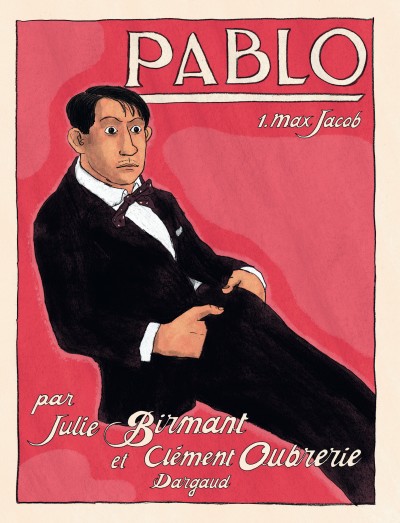
2. Pablo (tome I, Max Jacob), by Julie Birmant (text) et Clément Oubrerie (illustrations).

The first of four volumes, Pablo recounts the daily life of a young Picasso in Montmartre, 1900–1912. Max Jacob, poet and Pablo's roommate, figures prominently as an influence.

3. Nietzsche, by Michel Onfray (text) and
Maximilien Le Roy (illustrations).


This volume follows Nietzsche's quest for happiness, in an attempt to rehabilitate his reputation and position him as a hero for our times.

I hope these books find English translators/publishers some day soon. In the meantime, I suspect I'll be splurging on the above titles anyway, in the interest of practicing my French.

Friday, April 16, 2010

I♥NYRB

The lovely, eclectic selection of books published by New York Review Books is meant to be read, of course, but the colours, the texture, the look, the feel lead me to believe NYRB books are designed to be fetishized.

 
Maylin of The Dewey Divas and the Dudes recently shared a little NYRB love with me (thanks for the ARCs!), so I thought I'd do my part to spread a little NYRB enthusiasm.

 
First off, check out Maylin's NYRB challenge, to read 50 NYRB Classics within the year. It's this series of posts that made me sit up and take notice of them and learn to focus my book-fetishizing tendencies.

 
Spotlight Series will be featuring NYRB Classics during the week of May 16, 2010, and you can sign up to participate by reviewing an NYRB Classic (maybe I will).

 
I haven't purposely embarked upon an NYRB challenge myself, but it seems I'm amassing quite a collection of them. I'll try not to let the acquisition too far exceed the consumption.

 
Here's a list of those I now own, with links to reviews where applicable:
Let me mention also a couple favourites, even though I don't own the NYRB editions (my reading predated their release):

And a couple more I'm dying to own:
The New York Review Children's Collection also has its charms:
The NYRB Classics blog: A Different Stripe.
And follow @nyrbclassics on Twitter.

 
Is there a particular NYRB title that you have your eye on? Or one that you especially recommend?

Wednesday, March 03, 2010

Chess

Chess Story (previously published as The Royal Game), by Stefan Zweig, is a great novella, with all the elegance I'm told the game itself possesses.

Chess fascinates me, but on some level, I feel I don't really know how to play. That is, I know all the moves, but I can't make the pieces dance the way I think they ought to. I played the very occasional game when I was growing up, with a cousin at the cottage, on game day at school. I sought out a few more games as an adult; my boyfriend du jour (well, three I can think of off the top of my head) would say he played, so we would, every other night for a week or two, and I was pathetic really, but eventually I'd beat him, and we'd never play again, and then we'd break up. I'd say these most satisfactory wins had more to with pig-headedness, somehow magically staring the board into submission, than with any kind of mastery of skill or insight.

(I can't possibly be very good; I still find it challenging to play.)

These days the kid is in chess club, so I'm learning terms and notation, and rules I never knew existed. I guess I'm also trying harder to see the art and philosophy of it, to know its mindset, to help her find a way in. I know that the possibilities on the board at any given time are finite. Certainly I cannot calculate them all, nor is there a need to — so many of them amount to being meaningless or inconsequential (it's not quite the same thing, is it?) that the relevant possibilities are significantly reduced. Still, I can only "think ahead" so far, and I'm in awe of the "instinct" some people seem to have for it.

Anyway. The book. The story is essentially a meeting of two players, two different types of player who come to the game via very unique histories. It's also very clear that psychology is a major element of the game — the very particular game that's the main event here, but also of their individual game styles.

One player is world chess champion. Of humble upbringing, he came to the game quite by accident as a teenager, and rather astounded everyone with his skill, because he was otherwise generally thought to be something of an idiot. He is criticized by some for his limitation of not being able to play "blind" — he has to have a board physically in front of him — and this betrays a lack of imaginative power. But it's a power game, isn't it? He bullies his way through, controlling the conditions, intimidating his opponent.

The other player also came upon chess quite accidentally. In confined circumstances a chess manual comes into his possession, and he spends his days, for months on end, poring over it. He has never played on a board, only in his mind.

I don't doubt, given the reference to the politics of Nazism, that there is some allegory here also, for the struggle between classes, or whatever else these two characters might represent, but that interests me less.

Right, so: 84 pages, absolutely gripping.

I first heard about this book from Richard: Thanks! I may search out some more Stefan Zweig. I admit I got a bit tired of hearing about The Post-Office Girl, and I still can't get excited about it, but I hear Beware of Pity is devastatingly good. Also, the recent screed against Zweig in the London Review of Books makes me want to read him more.

(According to Wikipedia, Chess Story inspired the 1960 Gerd Oswald film Brainwashed (Die Schachnovelle), as well as the 1980 Czechoslovakian film The Royal Game, neither of which seem to be readily available, but I'll keep an eye open for them.)

If this sort of book interests you, might I also suggest The Master of Go, by Yasunari Kawabata, which relates a real-life match of Go ("If chess is a battle, Go is a war."), pitting the upstart modern world against the traditional old guard.

At this point, my rambling here is almost as long as Chess Story itself. (Oh, I hope I haven't said too much and spoiled it for anyone.) Go read it.

Tuesday, February 23, 2010

Monomaniacs

All my life I have been passionately interested in monomaniacs of any kind, people carried away by a single idea. The more one limits oneself, the closer one is to the infinite; these people, as unworldly as they seem, burrow like termites into their own particular material to construct, in miniature, a strange and utterly individual image of the world.


— from Chess Story, by Stefan Zweig.