Monday, May 16, 2011

The girl who ate what was given her

"A simile," he said, "is true because you say so. It's a persuasion: this is like that. That's not enough for it anymore. Similes aren't enough." He stared. "It wants to make you a kind of lie. To change everything.

"Simile spells an argument out: it's ongoing, explicit, truth-making. You don't need . . . logos, they used to call it. Judgement. You don't need to . . . to link incommensurables. Unlike if you claim: 'This is that.' When it patently is not. That's what we do. That's what we call 'reason,' that exchange, metaphor. That lying. The world becomes a lie. That's what Surl Tesh-echer wants. To bring in a lie." He spoke very calmly. "It wants to usher in evil."

As of this writing, Embassytown is my favourite China Miéville novel, but then, I once studied linguistics and philosophy, and being that I work as an editor, it should go without saying that I'm a bit of a language geek, and I would happily discuss with you why a given metaphor is more effective and/or appropriate than a simple simile, or vice versa, so, these factors taken together, it's no wonder Embassytown rocks my world.

Embassytown is about Avice Benner Cho, who returns to her hometown, on a planet that humans (which she is one) colonized. The humans coexist with the Ariekei, though communication is difficult given the complex Ariekei language (more on this later) (and it seems that the humans benefit more from their trade relationship than vice versa).

Avice grew up wanting to leave, and then she did. She trained as an immernaut and travelled subspace as crew on ships delivering passengers (usually in sopor) and cargo.

The steersperson took us close to Wreck. It was hard to see. It looked at first like lines drawn across space, then was briefly, shabbily corporeal. It ebbed and flowed in solidity. It was many hundreds of metres across. It rotated, all its extrusions moving, each on its own schedule, its coagulated-teardrops-and-girder-filigree shape spinning complexly.

Wreck's architecture was roughly similar to Wasp's, but it was antiquated, and it seemed many times our dimensions. It was like an original of which we were a scale model, until abruptly it altered its planes and became small or far off. Occasionally it wasn't there, and sometimes only just.

All this backstory to demonstrate that Embassytown is far, far away, the last outpost, a final frontier. As a colony under Bremen's control in geopolitical terms, it functioned according to its own rules, much like the New World operated a little differently than its European masters might've known or liked.

So Avice goes back to Embassytown, with her husband, a linguist who is fascinated by the Language of the Ariekei. The Ariekei are insect-like, winged and hoofed, with eyestalks. They speak with two simultaneous voices.

Their language is organised noise, like all of ours are, but for them each word is a funnel. Where to us each word means something, to the Hosts, each is an opening. A door, through which the thought of that referent, the thought itself that reached for the word, can be seen.

In this linguistic system, thoughts cannot precede words, indeed they cannot be thought without having the words for them. The Ariekei need similes to express their reality. They need to be able to say what something is like. If they can express it, it is a truth. They are unable to lie.

And then the new Ambassador shows up, and says something in Language, causing what can only be called a diplomatic incident. But, oh, just wait and see.

(I've read several reviews of Embassytown that are critical of it taking so long before the story gets started. For me, these first 100+ pages of world-building are the richest, and would be worth reading even if nothing followed. But maybe you have to have sat, and appreciated, a class on the philosophy of language to totally get that.)

I like to think of this novel as being all about linguistics.

"Words don't signify: they are their referents. How can they be sentient and not have symbolic language?"

It takes the Sapir-Whorf Hypothesis to the extreme. It's about linguistic relativity and Wittgenstein. And about Lakoff:

Metaphor has been seen within the Western scientific tradition as purely a linguistic construction. The essential thrust of Lakoff's work has been the argument that metaphors are primarily a conceptual construction, and indeed are central to the development of thought.

So, if an alien (Arieke) speaks a language (Language) and there's no one there to hear it, does it still think? What if the alien can't hear itself speak, can't hear itself think? Then there are no words, no thoughts, and reality collapses.

Avice when she was young herself was made a simile and incorporated into the language. Her assimileation (ooh, I just made that up!) was scripted or planned or faintly conceived, and then recounted. There was a human girl who in pain ate what was given her in an old room built for eating in which eating had not happened for a time. Avice was the girl who ate what was given her. It's never entirely clear what the Ariekei meant by her, by the simile of her, and Avice comes to wonder: if she changes her experiential truth, can she change the Ariekei's reality?

There's this wonderful Doctor Who–type moment toward the end that's a life-affirming vindication of what it is to be alien (cognitively, politically) and joy that, yes, good sense has prevailed, see, if only people would (could) just talk to each other, communication is brilliant, words are more powerful than any weapons, and more menacing: You get to live. It's a reward, but also a sentence.


Ten things about China. (Are you paying attention, Steven Moffat? Really, Neil Gaiman's Doctor Who episode was almost as disappointing as Gaiman himself is overrated. But China Miéville, his monsters — big scary, political monsters — would make the Doctor run.)

Sunday, May 15, 2011

Atomic secrets

The Atomic Weight of Secrets, or The Arrival of the Mysterious Men in Black, by Eden Unger Bowditch, is the first book in The Young Inventors Guild trilogy.

Jasper and Lucy ran up to their rooms and dropped off their bags. Looking around for a place to put their satchels, they opted to shove the lot under their beds.

"That's as good a place as any," said Jasper, pulling the edge of his quilt down so the satchel was completely hidden.

"I really think it's just awful keeping all these things from Rosie," said Lucy, "and from Miss Brett and. . . It make me feel like a naughty girl."

"Well, you're not a naughty girl. None of us is naughty. And we're not telling lies either. Not really," he said. He stopped rushing for a moment and looked Lucy in the eyes. A sneaky smile spreading across his face, he said, "It is terribly exciting, isn't it, Lucy? I mean, it's exciting as well as dangerous, amazing, historic, and brilliant, and, of course, terrifying, and horridly worrying. Still, all said, it is frightfully thrilling, isn't it?"

Lucy smiled. "Yes," she said in earnest. "Frightfully."

It's a mysterious and charming story. Helena is a little young yet for the attention a book like this requires, but I will encourage her to read it someday. Reminds me a little of Lemony Snicket, but without so much snark, and maybe not quite so nefarious.

A group of kids — 2 girls, 3 boys — ranging in age from 6 to 13, specializing in different kinds of science and themselves the children of the world's most important scientists, are taken from their parents and thrown together into a private boarding school, for them alone.

There's not much the teacher can teach such clever children, but she does find a gap in their education that she is able to fill: nursery rhymes and other children's literature.

On weekends the children are taken to their respective parentless homes, where the nannies attend to their needs. The homes abut a shared meadow.

The children come from unique backgrounds but find they have quite a bit in common when they start to discuss the circumstances by which they came together, so they put their inventive, scientific minds to work toward a common goal. The mysterious men in black factor into their separation from their parents, but it's never clear whether they are their jailers or their protectors.

The review at Young Adult Books Central sums it all up more succinctly than I can.

Tuesday, May 10, 2011

Unholy verbs

ACL — Accelerated Contact Linguistics — was, Scile told me, a speciality crossbred from pedagogics, receptivity, programming, and cryptography. It was used by the scholar-explorers of Bremen's pioneer ships to effect very fast communication with indigenes they encountered or which encountered them.

In the logs of those early journeys, the excitement of the ACLers is moving. On continents, on worlds vivid and drab, they record first moments of understanding with menageries of exots. Tactile language, bioluminescent words, all varieties of sounds that organisms can make. Dialects comprehensible only as palimpsests of references to everything already said, or in which adjectives are rude and verbs unholy. I've seen the trid diary of an ACLer barricaded in his cabin, whose vessel has been boarded by what we didn't then know as Corscans — it was first contact. He's afraid, as he should be, of the huge things battering at his door, but he's recording his excitement at having just understood the tonal structures of their speech.

— from Embassytown, by China Miéville.

I'm not very far along yet, but this seems to be a novel about linguistics, and the linguistics major in me is somersaulting. A novel about an alien race with a language, Language, where thoughts cannot precede words, indeed they cannot be thought without having the words for them, where Language and Reality are one.

And some of the sentences are gorgeous.

Excerpt. (On sale May 17.)

Tuesday, May 03, 2011

Housecleaning

I love that when I perched on Helena's bed this morning and she opened her eyes, the first thing she thought to say was, "Who won last night?"

************

I love democracy. Despite the overall result, I love that we did this, that for the first time since moving here, my vote in my riding really counts. It feels like the Quebec I fell in love with, my adopted home, a country within a country, may be returning to itself.

************

I'm still reading Martin Chuzzlewit. It's rather long. And enjoyable enough, if not deep. A third of the way through and I'm still wondering whether the title means to refer to Martin Jr or Sr. I'm just at the bit where Jr's recently arrived in America. Frankly, I'm more interested to see what comes of the Pecksniffs and Tom Pinch.

************

Has anybody been watching Doctor Who? That timey-wimey stuff is hurting my brain. And I've spent far too many hours lately searching the forums and trying to figure out what the hell is going on. [SPOILERS] Especially wrt Rory. I mean, when Rory came back as the android Roman centurion toward the end of last season, and then the Doctor reset the universe, I thought Rory'd be restored, or undone, or set right. But even when the Doctor first comes back he's all "How could we forget the Doctor?" — how could he even forget to remember? It's not quite like being at the eye of the storm — the whole universe poured out of Amy's head. So who did she remember — who's the Rory she brought back? Real Rory of flesh and blood, or Roman Rory who believed he was real, who stood guard over her for 2,000 years? Who would you bring back?

And I think, when Rory says he was there, when Rome fell, I think the Doctor's thinking, whoa, how could he remember being not real?, which is why he starts to probe with "personal" questions. So this is the problem behind Amy's quantum pregnancy. It's not a mystical timehead or genetic transfer pregnancy — it's quantum because Rory's not resolved. Poor Rory.

************

Every now and then, I realize that someone's missing from my blogroll. I follow most blogs through Google Reader, and with an adjustment here, an update there, sometimes my lists don't match up. Sorry. If you're missing from my sidebar, let me know.

************

I love that there's a flower stall outside the metro station near my work so I can buy flowers on my way home.

Friday, April 29, 2011

Old heads upon young shoulders

An ancient proverb warns us that we should not expect to find old heads upon young shoulders; to which it may be added that we seldom meet with that unnatural combination, but we feel a strong desire to knock them off; merely from an inherent love we have of seeing things in their right places. It is not improbable that many men, in no wise choleric by nature, felt this impulse rising up within them, when they first made the acquaintance of Mr Jonas; but if they had known him more intimately in his own house, and had sat with him at his own board, it would assuredly have been paramount to all other considerations.

— from Martin Chuzzlewit, by Charles Dickens.

Mr Jonas, you may gather, is not very likable.

I love how Chuck delivers an insult.

Monday, April 18, 2011

Very swaggering and very slinking

It happened on the fourth evening, that Mr. Pecksniff walking, as usual, into the bar of the Dragon and finding no Mrs. Lupin there, went straight up-stairs; purposing, in the fervour of his affectionate zeal, to apply his ear once more to the keyhole, and quiet his mind by assuring himself that the hard-hearted patient was going on well. It happened that Mr. Pecksniff, coming softly upon the dark passage into which a spiral ray of light usually darted through the same keyhole, was astonished to find no such ray visible; and it happened that Mr. Pecksniff, when he had felt his way to the chamber-door, stooping hurriedly down to ascertain by personal inspection whether the jealousy of the old man had caused this keyhole to be stopped on the inside, brought his head into such violent contact with another head that he could not help uttering in an audible voice the monosyllable "oh!" which was, as it were, sharply unscrewed and jerked out of him by very anguish. It happened then, and lastly, that Mr. Pecksniff found himself immediately collared by something which smelt like several damp umbrellas, a barrel of beer, a cask of warm brandy-and-water, and a small parlour-full of stale tobacco smoke, mixed; and was straightway led down-stairs into the bar from which he had lately come, where he found himself standing opposite to, and in the grasp of, a perfectly strange gentleman of still stranger appearance who, with his disengaged hand, rubbed his own head very hard, and looked at him, Pecksniff, with an evil countenance.

The gentleman was of that order of appearance which is currently termed shabby-genteel, though in respect of his dress he can hardly be said to have been in any extremities, as his fingers were a long way out of his gloves, and the soles of his feet were at an inconvenient distance from the upper leather of his boots. His nether garments were of a bluish grey — violent in its colours once, but sobered now by age and dinginess — and were so stretched and strained in a tough conflict between his braces and his straps, that they appeared every moment in danger of flying asunder at the knees. His coat, in colour blue and of a military cut, was buttoned and frogged up to his chin. His cravat was, in hue and pattern, like one of those mantles which hairdressers are accustomed to wrap about their clients, during the progress of the professional mysteries. His hat had arrived at such a pass that it would have been hard to determine whether it was originally white or black. But he wore a moustache — a shaggy moustache too: nothing in the meek and merciful way, but quite in the fierce and scornful style: the regular Satanic sort of thing — and he wore, besides, a vast quantity of unbrushed hair. He was very dirty and very jaunty; very bold and very mean; very swaggering and very slinking; very much like a man who might have been something better, and unspeakably like a man who deserved to be something worse.

— from Martin Chuzzlewit, by Charles Dickens.

Once upon a time I vowed to read a Dickens a year. Seeing as they're so long, I think one every two years or so should suffice.

Several commenters on this blog have in the past mentioned Martin Chuzzlewit, for its humor, for its women characters, and for some of the more memorably Dickensian characters going. Not being the least bit familiar with it, and it bearing the distinction of not having been recommended by Oprah, I decided to take it up.

Not much has happened yet. I'm a little daunted that my e-reader calculates this novel at 3167 page turns — I've barely made a dent.

But it is funny, although mostly in attitude, in an almost self-parodying tone. This effect is somewhat exaggerated by the fact that I can't help but hear the text in my head as narrated by Simon Callow, and am reminded of the Doctor's judgment that the American bit (which I've got a way to go before I get to it) is rubbish.

One may read a defense of the American bit — indeed, the novel as a whole — by GK Chesterton, from which I learned that this is a novel about a selfishness, and, despite its humour, this novel is sad.

I have just recently encountered Mark, the barman, who is a jolly fellow, who is looking to find a new situation in the city, a gloomy and difficult one, one in which his jollity might be seen as a credit, for there is no trial of character in being jolly as a barman, surely it be a virtue only when overcoming some adversity, working as a grave-digger or taxman perhaps.

Thursday, April 14, 2011

Literary Mad Men

It's taken a while, but finally I've watched all Mad Men episodes to date. From the start of the series, it's been impossible not to notice what these wonderfully culturally literate (it is advertising, after all) characters were reading.

I've tried to keep a list of those books that were directly discussed or in the hands of readers. In chronological occurrence of their mention:

  • Lawrence, DH: Lady Chatterley's Lover (S01e03)
  • Jaffe, Rona: The Best of Everything (S01e06)
  • Uris, Leon: Exodus (S01e06)
  • Rand, Ayn: Atlas Shrugged (S01e08, but with several mentions)
  • O'Hara, Frank: Meditations in an Emergency (S02e01)
  • Fitzgerald, F Scott: Babylon Revisited and Other Stories (S02e04)
  • Forester, CS: Horatio Hornblower (S02e08)
  • Porter, Katherine Anne: Ship of Fools (S02e09)
  • Faulkner, William: The Sound and the Fury (S02e11)
  • Gibbon, Edward: Decline and Fall of the Roman Empire (S03e03)
  • Ogilvy, David: Confessions of an Advertising Man (S03e06)
  • Twain, Mark: Tom Sawyer (S03e06)
  • Hilton, Conrad: Be My Guest, Autobiography of Conrad Hilton (S03e07)
  • McCarthy, Mary: The Group (S03e10)
  • Benedict, Ruth: The Chrysanthemum and the Sword: Patterns of Japanese Culture (S04e05)
  • Keene, Carolyn: The Clue of the Black Keys (S04e09)
  • Berne, Eric: Games People Play: The Psychology of Human Relationships (S04e10)
  • Le Carré, John: The Spy Who Came in from the Cold (S04e13)

Of course, there have been countless literary allusions throughout the series. TS Eliot's The Hollow Men was recited. A reference to The Man in the Gray Flannel Suit (Sloan Wilson) is as much a cultural touchstone as it has to do with any novel. Moby Dick. I can't help but think of The Bell Jar when you mention the summer the Rosenbergs were executed, but very likely that's the sort of reference that wasn't necessarily intended.

I've read only a few of those listed, some of them many years ago, but on watching some episodes, I have been inspired to directly seek out some titles, particularly since they are not merely props but have direct bearing on the plot or characters at issue. I know I'm not the only one to be reading up. Frank O'Hara's rediscovery has been widely noted.

Similarly, according to NPR, "Interest in Rand and her philosophy is on the upswing. Since the 2008 presidential election, according to Brook, the novel Atlas Shrugged has sold more than 1 million copies, far more than in any similar period in the book's 54-year history." While this is linked to the rising popularity of the Tea Party, no doubt sales for this particular novel were boosted by its exposure on Mad Men.

But I think my favourite book sighting, late in season 4, is the Nancy Drew mystery in Sally Draper's hands. We've seen the books in the house she grew up in; it should come as no surprise that Sally too should find escape in a good book. Reminds me a little of my own young self, visiting my dad's office and being told to sit quietly — I'd read. Though I can't recall it specifically, I'm sure I read The Clue of the Black Keys — I read them all. I'll be sure to dig this one out of the box in my mom's basement as soon as the opportunity presents itself.

Have you been reading along with the Mad Men?

Tuesday, April 12, 2011

A quick note

Not my usual fare, but I accepted a copy of Attachments, by Rainbow Rowell, because I am fascinated by email relationships.

I don't feel particularly good about admitting that I've read a book written by someone named Rainbow. But everything about this book will be sold to people who wouldn't mind that fact. Ironically, it's exactly this sort of thing that it'd be likely the two female leads would kvetch over.

So the plot: the new IT security guy is charged with monitoring company email (it's a newspaper office), and surprise, he gets caught up in their story.

Being that I work in an office where it's widely known that the email is monitored, and it's surmised that the CEO spends his day doing little else but reading it, I was interested to see how this might play out in fiction.

While people who work together do share news and laughs via email, they still talk. My experience is that when there's real news to dish, we go for coffee. So while Rowell's email exchanges are necessary (this is the whole premise, after all), liberty is taken with them to the point where they no longer ring true — they're too long, too conveniently structured, and not all of them meet the criteria for being flagged by Web security.

I love the copy-desk setting. When Lincoln starts befriending his coworkers, he realizes that the copy-desk crowd is much like his D&D gang, only without the D&D. Weirdly, it's only Lincoln who knows all the words to Auld Lang Syne, which is exactly the sort of thing a bunch of copyeditors would know.

There's nothing very original about this novel — it's fairly predictable, with very ordinary characters — but it does have a modern moral bent in terms of email privacy. It was a nice way to spend a Saturday morning blanketed in bed, and I admit, I raced toward the end to see how things panned out for everybody. I'm not much for romantic comedies when it comes to movies either, but every now and then it makes for a nice change of pace.

Tuesday, April 05, 2011

L'Amour

With no trace of irony, she clinks her glass against his. He would rather not know what they are drinking to. To his leaving? To the peacefulness of their breakup? To Scotland's mild summer? Silently, he drinks to l'Amour, and everything he knows about it. Its 2,700 miles, from its source in the Argun region to its mouth on the Tatar Strait, opposite Sakhalin. He keeps his bad joke about the River Amour to himself. A pity he doesn't realize that the river's English name, Armur, is closer to the word "armor" than to "love," and — worse — that armur means "muddy" in Buriat.

Our hero takes a sip from this dark, bitter beer that he does not like, which is precisely why he chose it. He had to give the whole debacle a degree of harmony.

— from The Intervention of a Good Man, by Hervé Le Tellier.

Slight, but a mostly pleasant read. It continues to astound me that 20- and 30-year-old women would want to associate with or attach themselves to 50-year-old men, but that's not a problem of the novella, that's life. The story gives a nice play-by-play of the thought processes of one party to a such relationship as it disintegrates.

I hate the title. En français, c'est Je m'attache très facilement — much better. I suppose it's an intervention of sorts, but I think "intervention" is semantically loaded with things not present here. And I don't think he's a particularly good man. We have only his word for it, and his carrying on an affair with an as-good-as-married younger woman in a very insecure and needy way doesn't exactly speak to his goodness. The Slight Disturbance of Some Pathetic Chump, more like.

And there's that thing with the Polish girl who works at the hotel. Do you really have to bring up Nazi concentration camps just because she's Polish? That was weird and out of place.

Although Le Tellier is an Oulipo member, I didn't recognize any of the qualities related to that group in this novella. However, I did very much enjoy his Enough about Love, and I see the Oulipo in it in retrospect, and I look forward to reading more by him.

Read Le Tellier on what exactly is French love...

Saturday, April 02, 2011

Suspended in a mystic delirium

Here are some of the questions I have. How content should I aim to be? How discontent? What is the proper balance and how is it to be managed?

How aggressive should I be in seeking out new experiences? In challenging myself? How much should I hope to accomplish?

How fragile should I strive to be? How efficient, how dreamy, how routine? What depth of engagement with others should I hope to achieve? Why have friendships become so difficult?

What is life's richest possible template, and how bad should I feel if it doesn't suit me? Assuming that everyone has their own richest possible template, how do I go about finding my own?

If you could only get to the center of all questions, then the questions themselves would vanish and you'd be left hanging there, suspended in a mystic delirium.

The Saint: The True Story of How One Man's Search for Virtue Led to the Brink of Madness, by Oliver Broudy, raises these questions and many, many more. And it's as much the author's meditation on these issues, his dissatisfaction with the statusphere of New York City, as it is the story of a crazy man, a rich man with good intentions, who collects Gandhi memorabilia. With a bit about Gandhi thrown in for good measure.

I connected with this memoir right from the epigraph, which comes from one of my very favourite books (The Razor's Edge, W Somerset Maugham), a passage beginning thusly: "You're not altogether stupid. As a matter of fact, you sound like a very religious man who doesn't believe in God."

Lots of questions. Really good questions.

Friday, April 01, 2011

Polish noir

Marek Krajewski was a wonderful discovery and Death in Breslau is full of, in my opinion, fantastic story elements. I won't repeat myself on those points, but I can add now to that list: a lost manuscript, a Kurdish sect, a centuries-old prophecy, and a retelling of an Oedipal tragedy. One would expect no less from an author who's a Classics scholar.

Oh, and! Our detective! Eberhard Mock likes to combine his enthusiasms for chess and brothels. He gets away with as much shit as he does only because he has dirt on everyone.

Also, I would clarify that this novel definitely falls on the side of entertainment(!) — not that there's anything wrong with that — and doesn't have the philosophical depth of Simenon's romans durs. Nor does it have the kind of reflection and wit I so like in Fred Vargas's novels — not that there should be any similarity between these authors beyond that of broad crime genre label. I bring these names up only because I know and like their work, so they're a kind of benchmark against which I can position new discoveries.

Krajewski is straight up: sex and violence and Nazis, and never knowing for sure who's on whose side.

I'm looking forward to reading the rest of Krajewski's Breslau novels.

Reviews
The Independent
Where the Long Tail Ends

Thursday, March 31, 2011

This too shall pass

I don't sleep well of late.

I spent the start of my week in the arms of Morpheus, in hospital bed with a kidney stone. I don't recommend the experience. There are easier ways to get a day off work. Although, morphine is pretty spectacular, rolling through your body in waves, rendering each segment heavy, limp, unencumbered. Weighty and weightless at the same time.

By chance, I am fortunate to be back in touch with a dear, dear friend of my adolescence. We were going to write poetry, change the world, dance however we damn well pleased. I've missed her.

I received a complimentary copy of The Saint, by Oliver Broudy, the recounting of days he spent travelling with a very charismatic man who happened to be very rich and a collector of Gandhi memorabilia, only he's not just a collector, he's a spiritual disciple, and this leads to all kinds of moral paradox: cuz there's this tension between means and ends, he's a rich man helping the poor; and it makes for a fascinating study of where ego fits in the world, and the tremendous ego required to achieve complete self-erasure; and it brings to the forefront the audacity, the crazy logic, of forsaking the value of actual individuals for some principle of greater good.

It's quite a compelling tale, and very thoughtful, and thought-provoking, and I expect I'll have a bit more to say about it yet. Among other nuggets: "age is the bitter process by which we gradually learn to aim low."

I'm suspended in this mood where I have to believe that this confluence of events holds some significance. That this stone in me is the detritus of gritty reality, that I will filter a new reality from my experience.

Thursday, March 24, 2011

Planet Earth


Not sure anything can top the understated weirdness of the original video, but now it's Lynchian.

Tuesday, March 22, 2011

Imagination was a filter for wondrous transformations

The patient Herbert Anwaldt had survived "the house of torture", as he called the psychiatric clinic on Marien-Allee in Dresden, for already five years, thanks to his imagination. Imagination was a filter for wondrous transformations; the nurses' jabs and punches became gentle caresses, the stench of faeces became the scent of a spring garden, the cries of the sick became baroque cantatas and the shabby panelling frescoes by Giotto. Imagination obeyed him. After years of practice, he had managed to tame it to such an extent that he had entirely extinguished in himself something, for example, which would otherwise not have allowed him to survive incarceration: desire for a woman's body. He did not have to "extinguish the fire in his loins" like a sage from the Old Testament — that flame had long ago gone out.

Imagination did, however, betray him when he saw small, busy insects scuttling across the room. Their yellowish-brown abdomens flitting in and out of the gaps between the floorboards, their flickering antennae sticking out form behind the washbasin, the individual specimen crawling on to his eiderdown: a pregnant female dragging a pale cocoon, or a handsome male holding its body high on quick limbs, or the helpless young tracing circles with thin feelers — all this would lead to Anwaldt's brain being shaken by an electrical charge of neurons. The whole of him would curl up painfully, flickering feelers would burrow into his skin and he would be tickled, in his imagination, by thousands of limbs. He would then fall into a fury and was a potential danger to other patients, especially since the occasion on which he had discovered that some of them were catching insects, putting them into matchboxes and hiding them in his bed. Only the smell of insecticide would calm his jittering nerves. The matter could have been dealt with by transferring the sick man to another hospital — one less infested by cockroaches — in another town, but here unanticipated, bureaucratic obstacles wold present themselves and successive heads of clinic would forsake the idea. Doctor Bennert had restricted himself to transferring Anwaldt to a private room disinfected somewhat more frequently. In periods preceding the swarming cockroaches, the patient Anwaldt would be calm and occupied himself for the most part by studying Semitic languages.

— from Death in Breslau, by Marek Krajewski.

I'm not sure how this book first came to my attention, but it's been on my list of books-I-really-should-look-up-someday for years. And something made me think to look it up this weekend, so now I have a copy (electronic), and I'm reading and loving it.

Polish noir, they say. Morally ambiguous characters and sordid settings. Reminiscent of Simenon, only there's a little more going on in the plot department and the evidence of living in a Nazi state is a little more in your face.

Plus (as if that's not enough going for it!), it's set in Wrocław (or Breslau, as it was known prior to the end of WWII) — a town I have some familiarity with.

Double plus, I think the cover design for this series of Krajewski's novels (all set in interwar Breslau), from Quercus Publishing, is spectacular (to the point that I'm coveting actual print copies).

I'm only about 40 pages in. The murder case — involving hints of sexual perversion, scorpions, and ancient Syrian script, on a train car — has just been closed to everyone's satisfaction — everyone being the police department (chief of which is a prominent Freemason), the recently installed Nazi officials, and the victim's father (a connoisseur of esoterica) — except maybe that of the convicted Jew. I suspect we're not quite done yet.

Sunday, March 20, 2011

Lately

I found myself recently reading Caspian Rain, by Gina B Nahai, because somehow or other, the subject of Jewish Iranians came up at work. It happens that I work with a number of Iranians, and for some reason or other someone non-Iranian was saying something like, "But you don't have Jews in Iran, do you," and I thought, "How ignorant," and one of the Iranians proceeded to set this fellow straight on the matter. But it made me think, how did I know this, and is this a common piece of knowledge or is it privileged, and how did I come by this knowledge?

And I remembered having read Moonlight on the Avenue of Faith, by Gina B Nahai, the story of a Jewish family living in the ghetto of Tehran, with a twist of magic realism about it. That's about all I remember about the book. That and the fact that I loved it, and oh, how it made me cry and cry and cry. I wept oceans reading that book, that summer. That was just about the time I figured out I was pregnant.

So I wondered what else she may have written, and thus I embarked upon Caspian Rain. I enjoyed it, but I can't really recommend it.

I love it for the glimpse it gives of Iranian Jewish life at a certain time and place, that place otherwise being a relatively inaccessible and mysterious one. I have a thing for the Middle East, which isn't entirely logical or explicable. I have little to no interest in the politics and history of the region. It's not exactly the "culture" that I'm drawn to, though it's to do with a poetic and storytelling tradition. A thousand and one nights, and all that. A sense of exoticism that may not be founded in anything real.

Anyway, Caspian Rain starts off as a kind of love story, and it's lovely, pushing all the right buttons with me. The narrator relates the story of her parents. About halfway through, the novel turns to centre around the narrator herself, the hardships she's suffered as a result of her parents' relationship being so strained but also because of her medical difficulty (well, let's just call it that for the sake of expediency). And then it felt like the novel was trying to be two different stories, and they just didn't work that well together. And it felt like the author was trying too hard to be poetic and vague and deep, and it stopped working for me, and the last page was terrible.

I'm currently reading A Polish Book of Monsters. I have mixed feelings about it so far, and I suspect I'll have a lot to say about it when I'm done, not least being regarding the problem of how one defines "monster."

Also, I've spent far too much time this weekend considering what ebook I should use my coupon to acquire. Should I actually get the book my boss recommended to me? I finally decided yes, because so many other people had esteemed it, and because it's set in an ad agency, which fact I hadn't recalled from the original commotion surrounding this novel but is a selling point with me. But then no, because the coupon couldn't be used for books from this publisher, so I could buy this book at any time, I wouldn't be saving any money by doing it today. (But I did buy some Polish noir.)

I'm missing loving a book right now. I need a book to really love.

But I found a plant for my office. And mostly I'm happy I spent most of my weekend hanging out with the kid, shopping for rainboots and almonds.

Wednesday, March 16, 2011

Solid or hollow

It's strange, how a person carries around the shadow of those that matter most to her. You can always see it — that presence, or its absence — in the eyes, in the movements of the hands, in a person's laugh. You can see it — if an old woman had a father who loved her when she was a child; if a teenage girl has a best friend she knows she can run to. You see it in the way people move and speak, in the subjects they choose and the things they avoid, in the way they appear solid or hollow, certain or plagued with doubt.

— from Caspian Rain, by Gina B Nahai.

Tuesday, March 15, 2011

New machine jihad

"You'll have nothing to rule."

"The New Machine Jihad does not need to rule. It needs only itself."

A thwarted kidnapping, a Japanese businessman who apparently runs his affairs yakuza-style, a Russian organitskaya boss. So far, so thriller.

Equations of Life, by Simon Morden, is set in the 2020s, some time post Armageddon. We don't know much about what happened. Nuclear strikes? Japan sank into the sea. There's a Cold War reference, which may or may not have anything to do with Armageddon times. So, vaguely futuristic, but still more thriller than sci-fi.

In fact, for the first half of the novel, there's very little of anything hinting of sci-fi going on. It's suggested when we learn Petrovitch is working on this little quantum gravity thing, and again when Oshicora-san reveals his pet project: VirtualJapan.

Our protagonist, Samuil Petrovitch, is 22 and has serious heart trouble. For a few pages I suspected this book might head in the direction of organ development and/or trade, organic or otherwise.

But no. Just the faintest whiff of science.

The cop on the case is old-school — rough around the edges, but effective when it suits his purposes to be. Then there's the amazonian nun who keeps turning up to save Petrovitch's ass.

The cast and their context, while not as fully realized as I felt they could be, were certainly compelling enough to draw me forward. It seems, however, that some of the history was previously developed in Morden's short stories, so when I say I feel like I was dropped in the middle of something, it's because I kind of am. This novel does stand up entirely on its own, though.

There's an awful lot going on here, and I had to flip back on a few occasions to keep things straight (but I'm not the most practiced at reading — or watching, for that matter — "action"; characters and events start to blur for me if the pace is too frenetic and the language is combat).

Also, I did roll my eyes a couple times in the early stages, when, for example, (I think it was) the ventilator fans "were ancient with age." As the story progressed, however, such linguistic rough spots pretty much vanished.

As far as I'm concerned, things start to get sci-fi at about halfway, when the new machine jihad begins to assert itself. And that's very cool. And then it gets really sci-fi in the final pages. And that's totally cool. And now I'm dying to read the next book in the Petrovitch trilogy (the books are being released the end of March, April, and May, respectively).

I can't stress how unsettling it was to be finishing up this novel last Friday, after having heard the news of the disaster in Japan. This is a novel in which Japan had sunk into the sea(!); the world is reeling from nuclear fallout, and London is overflowing with immigrant ghettoes. So. Yeah. Unsettling. Still. The whole VirtualJapan idea was really cool, and it's almost reassuring to believe that should any parts of our world be lost, they could be revirtualized.

This is a novel where actions speak louder than words, and that's fun, but I liked those bits best that slowed down and considered themselves.

"Is this what it's like, then?" she said, eyes closed, dreaming. "People like us, we think differently, don't we? We are different. We do all the things that others do. We go out to parties and concerts, we go to conferences and drink and talk, we play music and games and we laugh and cry. But when it comes down to it, we don't actually need anyone else. We're happy doing what we do and having obligations interferes with that. Does that make us selfish, or something else?"

"I don't know. To them, I guess it is selfish. Me? I just have such a monstrous sense of self, I don't need to feel love. I don't even feel lonely." He watched Pif's hair beads swinging slightly in time with her breathing. "Sometimes I wonder what it might be like. To be with someone, well, who isn't me. And sometimes I think we don't even need ourselves. What's most important is to find out whether we're right or not."

Wednesday, March 09, 2011

Despair, disillusionment, hell, reality

I like Murakami. I like that his books have libraries and music and cats, and people reading and listening and caring about cats. I love that the narrator of Hard-boiled Wonderland and the End of the World has read Somerset Maugham's The Razor's Edge (a favourite of mine) three times.

But like a boat with a twisted rudder, I kept coming back to the same place. I wasn't going anywhere. I was myself, waiting on the shore for me to return.

Was that so depressing?

Who knows? Maybe that was "despair." What Turgenev called "disillusionment." Or Dostoevsky, "hell." Or Somerset Maugham, "reality." Whatever the label, I figured it was me.

The Wind-up Bird Chronicle is definitely my favourite Murakami, but Hard-boiled Wonderland and the End of the World is a solid second.

Two stories, chapters intersected and running in parallel. They don't seem to bear much relation to each other at first.

One thread is set in a slightly altered almost-now. The narrator is a Calcutec; he processes data for the System, and is wary of Semiotecs; he doesn't have much of a past, but there's a Duran Duran song he keeps thinking back to. Then there's the end of the world — fairly idyllic, but as with most utopias (is this an afterlife?), something's a bit off — a true sense of self seems to be lacking. To enter the town, the narrator has to have his shadow cut off; he's assigned the job of "dreamreader" and he reads dreams by sensing them through his fingertips from animal skulls. The Calcutec has a skull too; the mad scientist who gave it to him is working on how the trapped soundwaves should enable you to reconstruct memories. Both narrators (the same narrator?) grow into awareness of their realities.

You almost don't notice how odd the plots are until you try to summarize them for someone else. Despite the weirdness, the mind-bendiness, the surreality of Murakami's novels, there's something simple and sincere, completely unpretentious, about how their told. It's honest.

"I don't understand." In fact, I didn't understand. On the whole, I'm a regular guy. I say I understand when I do, and I say I don't when I don't. I try not to mince words. It seems to me a lot of trouble in this world has its origins in vague speech. Most people, when they go around not speaking clearly, somewhere in their unconscious they're asking for trouble.

Which is why, usually, I don't say much at all. (Maybe this is why I'm an editor — ridding the world of trouble one vague sentence at a time.)

Sunday, March 06, 2011

Matrix literature

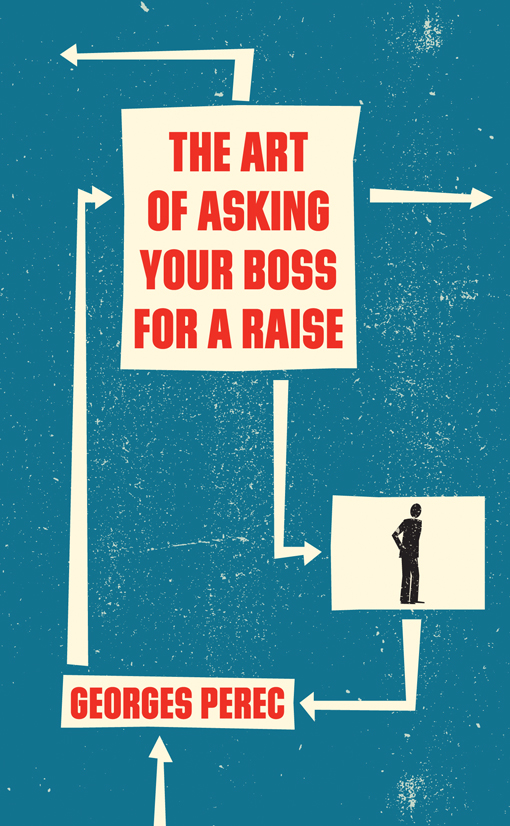
My copy of The Art of Asking Your Boss for a Raise, by Georges Perec, finally arrived! This slim little volume is exquisite!

The title has been pared down a little from the original (l'art et la maniѐre d'aborder son chef de service pour lui demander une augmentation): the art and craft of approaching your head of department to submit a request for a raise.

(Some of the background I set forth here is covered in greater detail by translator David Bellos in his introduction to the book.)

In 1968, a computer company set the challenge for writers to use a computer's basic mode of operation as a writing device. The outline: a flow-chart, a simple algorithm, a decision matrix.

The flow-chart is reproduced on this volume's endpapers.

By its nature, the algorithm is well-suited to being experienced electronically.

Of course, it has Oulipoian roots, as an exploration of how mathematics can be used to generate literature. In fact, I'm sure we're all quite familiar with another, very popular style of "matrix literature," an experiment in which (A Story As You Like It), by Raymond Queneau, is available online. (Hypertext literature has come a long way since the 1960s. I'm currently working through one such "traditional print" example with Helena.)

Perec reused the material from the art and craft in chapter 98 (Réol) of Life A User's Manual, which upon the learning of said fact I immediately reread.

I don't recall it having such a potent effect on me the first go around, but this time it brought tears to my eyes. Remember the Réols? — the young couple with the extravagant, expensive bed purchased on credit. And it puts me in mind of, no doubt because I've been reading so many articles related to the release of The Pale King, David Foster Wallace and his maximalist approach to literature (did he ever read Perec's Life, I wonder), in which he does not excise the excruciating minutiae of our lives and minds. I see now that Perec does something similar in Life. The chapter concerning Réol — and it can be read as a wholly self-contained narrative — tells a story through a perspective entirely restricted to the management of Réol's finances. There's the logistical problem of fixing an appointment with his boss (which day of the week his boss is likely to be in a good mood, not distracted, and so on), but mostly it's utilities payments due, rent in arrears, groceries on credit, loans, percentages, meeting the requirements for the assistance plan, etc. There is nothing about the Réols' life — no chance encounters or romantic situations, no grand parties or disastrous meals, no anecdotes about their son. And yet, financial management is life, one version of their life, and it's a full story. With a beautifully poignant (and happy) ending.

The Art of Asking Your Boss for a Raise is told in the second person. Story is secondary to the experiment.

either he thinks your idea is positive rich in possibilities worthwhile or he thinks it is stupid and will let you know in no uncertain terms that your logic is addled that's to say cock-eyed that's to say so devoid of understanding as to be close to either early-onset alzheimer's or congenital idiocy remember however that whether or not he calls you a nincompoop dimwit cretin nutcase crackpot woodenhead bananabrain dolt idiot or fool it comes to the same thing namely your plan will land in the wpb and you will return empty-handed to your desk while awaiting happier days it goes without saying that learning from experience you will improve your basic idea so when the day comes once again to talk with whole and open heart to your head of department he will be unable to dismiss you straight off as a nitwit so you allow yourself some months because one must always try to stack the odds in one's favour you swot up on the issue then when your plan seems perfect you go back to see mr x let's assume he's in

The text is, as is to expected given the structural constraint, repetitive and recursive, and the real-time computer-logic mood is enhanced by the lack of punctuation. (Also, it's set entirely in lowercase, but thankfully, and surprisingly, not in courier.)

I found it easiest to follow by reading it out loud. (In fact, I readily imagine the whole text being narrated and scored by Philip Glass à la Einstein on the Beach. Hey, Phil, give me a call, let's talk Perec!)

But there is a story! It's a little bit tragic even, but told with a light touch and great deal of humour.

The iterations come to be modified, and it's these variations in the phrasing that make for the funniest moments, unexpected as they are. Either they change as you reconsider them in light of all that has already occurred (the computer algorithm weights the possible outcomes and their likelihood of occurring as it acquires and learns to process the qualitative input from inside your head), or they change over time (the computer adds to the equation the actual fact of certain outcomes already having occurred).

It could be that all these thoughts pass through your neurotic head over a span of mere seconds when first you consider the possibility of asking for a raise. Or, this is a distillation of your entire career.

Either the employee is paralyzed by overthinking the situation and "we shall suppose to keep things simple — for we must do our best to keep things simple" never approaches the boss to ask for a raise; or the employees does in fact take action as governed by the logic of the algorithm, in which case years pass and the employee approaches retirement, without ever having asked for a raise. (The story does cover an approach and a request and a raise, but let's not complicate the point.)

I recommend The Art of Asking Your Boss for a Raise to those readers interested in experimental literature, but I suspect most readers will not find enough narrative thread to hold their attention for long. (On the other hand, it's short, and as an introduction to how a nontraditional approach to narrative can produce story it might serve you well alongside something like Calvino's t-zero stories, with which I see some similiarities in terms of the breakdown of processes into its smallest constituents, in a Zeno's paradox kind of way.)

If you have not read Perec's Life A User's Manual, I encourage you to read along at Conversational Reading.

Tomorrow marks what would've been Perec's 75th birthday.

To do
Approach the head of my department to submit a request for the transitioning of my role, and title, into Editor of Matrix-generated Literature and for the use of our proprietary decision support system to generate a novel in which the possible decision outcomes are not binary, but multiple and weighted and combined, where one can respond both a and b, or all of the above, to allow for the overlaying of choices and the "automatic" snipping and juxtaposition of appropriate segments of text, to tell a story about, say, a family's quest to acquire the perfect sofa, and while the daughter's preferences are considered they are of a different value than those of her parents, and the cat is also given due thought, all of which necessitates a careful study of how the sofa is used (playing video games, reading, napping, etc — each activity commanding different optimal bodily postures), how many people use the sofa over a given period of time to engage in those activities, and how many are likely to want to do so at the same time, budget of course being a key factor, but also available room, with an eye for spatial configuration of the entire room and allowing for the possibility of auxiliary seating (also to be determined through a similar decision matrix), no, no, it had better be more work-related, say, the design by committee and subsequent implementation of said design of the employee kitchen space, its general arrangement and furnishings, something like that.

Thursday, March 03, 2011

Evil weeds

The subject of Egyptian literature came up at work today, because someone's reading something Egyptian, and he mentioned it to our Egyptian-Palestinian coworker when she stopped by my desk, thinking she might be familar with the author, but he couldn't remember the author's name, and she suggested Nahguib Mahfouz, cuz really that's the first (or only) name that usually comes to mind, but no it's someone else, and she went on a bit about having read Palace Walk, and not liking it, and how it quite surprised her, whereas I had read Miramar eons ago and the only thing I can remember about it is that it bored me, and she expressed some, hmm, let's say regret, about how she's not as culturally well-versed as she'd like to be wrt her heritage, and then we chatted kind of generically, about audiobooks, and locking yourself in the bathroom — away from family distractions — to read, and a bit about work.

And I remembered I had a book: Three Egyptian Short Stories, by Youssef Idris — a bilingual edition (published 1991 by York Press, and not readily available these days it seems). The Arabic language fascinates me, and I'd taken a couple courses, and somewhere along the way I'd plucked this slim little volume out of some bargain bin or other, my aspiration being to read it in the original language. (Hah!)

So I came home from work and went straight to my shelf. Maybe my coworkers will be interested in this book. But I should read it first (had I ever actually read it?). So I read it.

Three short, very powerful stories. Poignant. Just plain sad.

The walls were half-covered in blackness in the form of paint, while the other half was stained with gloom.

Reading these stories I'm reminded a little bit of Simenon, bleak and seamy. Not so sordid as Simenon; these characters are just miserable, and poor.

Henceforth, the square witnessed an eccentric and gloomy man, whose dry and dark face was ever frowning, who broke his silence occasionally with a stray and fleeting word, only to be dominated again by dead silence, whose trembling moustache had grown wild like a bunch of evil weeds.

The stories are "Farahat's Republic," "The Wallet," and "Abu Sayyid." I trust they are available in other collections of Idris's work. While the latter two stories are sad in a pull-at-your-heartstrings kind of way, the first story packs an existential punch.

[Perhaps I feel this way because I made the mistake of checking the news online this evening. While I try to keep abreast of world events, in a shamefacedly superficial way, smaller-scale stories, if I can call them that, to differentiate them from the big picture, make me want to cry and scream, and I avoid them. Kids stuffed in luggage, dead. Some guy on speed driving around with his wife on the hood. I like to think you can change the World. But you can't do a damn thing about the sick fuck who lives down the street.]

"Farahat's Republic" is about a police officer. Even while he betrays a rich inner life, the real crime, he states, is that the rabble at the station won't give him a minute's peace, bothering him with their "petty" squabbles.

And so I feel morally defunct and guilty this evening.

Idris was nominated several times for the Nobel prize for literature.

Tuesday, March 01, 2011

Sandwich guy

Every day (well, most days), sometime between 11:45 and about 12:30 (although on at least two occasions as late as 1:20), there's a guy in a ski jacket and tuque who walks briskly down the main aisle (on which I'm situated) between the desks at my office, with a big blue cooler slung across his back. He calls out, "Sandwiches," brusquely; sometimes as he's approaching, but sometimes you just hear the echo of it — you look up and realize he's already turned the corner.

It took me a couple of weeks to figure it out: the man actually sells sandwiches. And a little while longer before I actually witnessed a transaction.

What era are we in? I see them sell sandwiches from the cart on Mad Men, but I never thought I'd see anything like it in my working career.

After monitoring his comings and goings for a few weeks, I finally asked some coworkers about him. They rewarded me with a spreadsheet recording the times of his appearance over the space of a few months, about a year ago. It seems my predecessor gave him the moniker I was already using in my head, and my time-tracking observations were confirmed.

Sandwich Guy does indeed sells sandwiches; and they're pretty good, they say.

He's associated with Les Sandwichs Volants, but nobody knows definitively his relationship with that organization, or how he comes to traverse our office space on a quasi-regular basis.

There's on ongoing debate as to whether his service commands tipping, and it seems my predecessor believed firmly that it did not — which, it's alleged, may have a little something to do with his unreliability. Past a certain hour, you just can't be sure that he'll have anything left to satisfy your particular lunchtime needs, or that he'll show up at all. (Although, it's hard to know if they ever really attended to Sandwich Guy's behaviour before my predecessor drew attention to it.)

Today, was my first first-hand experience with Sandwich Guy. I tagged behind a few coworkers who were hoping to head him off before he sold out of goods at the other end of the office. Alas, no carrot cake for the translator, but the vegetarian was in luck, and so was I.

Only two meat sandwiches left. I considered roast lamb, but opted otherwise.

Rôti de porc tranché, mayonnaise, piments marinés, sauce piquants, tomates, concombres, laitue. On a foot of baguette. Delicious. For $5.50.

And he called me mademoiselle.

I'm sorry I waited till winter is almost over. I could grow to really like Sandwich Guy.

Sunday, February 27, 2011

A vision of the superior sofa

The sofa was perfect for sleeping, Not too soft, not too hard; even the cushions pillowed my head just right. Doing different tabulation jobs, I've slept on a lot of sofas, and let me tell you, the comfortable ones are few and far between. Typically, they're cheap deadweight. Even the most luxurious-looking sofas are a disappointment when you actually try to sleep on them. I never understand how people can be lax about choosing sofas.

I always say — a prejudice on my part, I'm sure — you can tell a lot about a person's character from his choice of sofa. Sofas constitute a realm inviolate unto themselves. This, however, is something that only those who have grown up sitting on good sofas will appreciate. It's like growing up reading good books of listening to good music. One good sofa breeds another good sofa; one bad sofa breeds another bad sofa. That's how it goes.

There are people who drive luxury cars, but have only second- or third-rate sofas in their homes. I put little trust in such people. An expensive automobile may well be worth its price, but it's only an expensive automobile. If you have the money, you can buy it, anyone can buy it. Procuring a good sofa, on the other hand, requires style and experience and philosophy. It takes money, yes, but you also need a vision of the superior sofa. That sofa among sofas.

— from Hard-boiled Wonderland and the End of the World, by Haruki Murakami.

The sofa Murakami's character stretches out on is leather and, I believe, white — a tasteful decorator shade of white. Not exactly my style.

The Sofa must've been one of our first major purchases as a couple some dozen years ago, and it was complicated. It took a lot of time, discussion, and compromise before we settled on the Kalahari model (no, that's not it pictured here), which struck a reasonable balance, within our budget, between style and comfort — comfort coming out slightly ahead.

These days it's formidably cat-scratched and discoloured, so now covered, but still comfortable, if a little too large for our living space, and a little too small to accommodate toute la famille at once. I love it and I hate it and it will someday in the not-too-distant future be replaced. But I will always recall the Kalahari with fondness.

Tuesday, February 22, 2011

Two shocking scenes

It seems I am capable of being the kind of person who reads more than one book at a time (not including the couple books it's taking me years to get through and which I will not consider abandoned).

Even while I promised myself I'd make a concerted effort to move through The Magic Mountain this winter, it turns out that the book I consider myself to be reading (ie, the one I'd name if someone asked, so whatcha readin' these days?) is too cumbersome to carry on my commute as it doesn't slide nicely into either my purse or my lunch bag, and even though I carried it with me a couple times anyway in my hand, basically I've had enough of that shit, I don't like carrying stuff, I can't handle the extra baggage, it doesn't sit well in my psyche, so it's become my at-home book to read, usurping Thomas Mann at bedtime, and I've had to start reading yet another novel but this one chosen specifically for its virtue of travelling well (so it be one of several I've amassed lately in digital format).

So I read for a few minutes this morning, my at-home book, with my coffee while the child breakfasts and I await my turn to shower. I don't remember what I fell asleep to, but the caffeine jolts me into realizing oh my gawd he's dead and decapitated and he's watching his body be torn apart by wolves. And with this thought in my head I start my day — walk the kid to school, head down into the metro, and open my other book.

There's something very zen about my metro book — the long probable-ascent of the silent elevator, the blank office, the idyll of the animals outside the gate, the labyrinth of caves. Time to go to work.

I read again on my way home. "He spreads wide my right eye with his fingers and pushes the knife into my eyeball." Ew. "The knife sinks into my eyeball soft and silent, as if dipping into jelly." This time I say it out loud. Eww. On the metro. People look at me. It's my stop.

I don't know how people can stand the intensity of more than one book at a time, when you don't know what happens next and you can't balance your choices for mood, or attitude, it's too much of a good thing, or at least, too much of a thing, I don't think I can go on like this.

Monday, February 21, 2011

Do-San

(Proud mommy moment #83,214.)

This weekend was the arondissement pre-qualifying taekwon-do tournament for the 34th annual Jeux de Montréal. It was Helena's first competitive experience, and despite a certain amount of stress, and, yes, even a few tears, Helena came away with two medals: gold for her pattern, and silver in (yikes!) combat.

A slightly strange experience, but mostly a good one. We'll see what the next level holds.

Saturday, February 19, 2011

All in a week's work

Shop talk
I know the readership here to be smart and varied, so on the off chance some of you may actually be interested in this sort of thing, I'll mention this really interesting blog post the company I work for is promoting.

"This sort of thing" is business software, and the article addresses why so many enterprise resource planning systems fail; the researcher posits that it may be related to the professional allegiances and practices of the employees who use those systems.

If you have ever experienced (or indeed, been the victim of) the disruption of a company-wide implementation of the sort of system that's supposed to make you more productive, I encourage you also to participate in the survey that's discussed in the article.

Cat chat
I'm not a fan of Justin Bieber, but my daughter is, and I've come to terms with this — she will develop her own tastes; hopefully she will grow out of it (and someday soon!).

Now Justin Bieber reads The Cat in the Hat (via Dewey Divas). But not very well. He sounds dumb and bored.

While I can appreciate the attempt to promote literacy, or reading as cool, or the glory of pizza, I think this may backfire. This puzzling PR attempt brings him down another notch in my estimation. If the point is to sound like a (below?) average student being forced to read a text, well,... Is the point for millions of young girls to realize they read better than him? To realize that reading, for some people, is really pretty lame after all? He certainly doesn't bring a performer's verve to his reading. Does he even know what this story is about?

(Note: I couldn't actually watch it to the end. Maybe I'm missing Justin's spectacular finale?)

Life redux
For those who missed out on last year's group read of Life A User's Manual, by Georges Perec, and those of you eager to relive Life, a read-along is being hosted at Conversational Reading, starting mid-March and throughout April.

I'll follow the discussion, and as much as I still think about what an awesome wiki project it would be to annotate Life (and I do hope to dostart it someday), I expect I'll be occupied at about that time reading a Perec work never before translated, the soon-to-be-released The Art of Asking Your Boss for a Raise.

Wednesday, February 16, 2011

Hyperborean

The Sun Dogs were two well-built Brits or Scands in torn cashmere, and their gear consisted only of an electric cello, plugged into a compressed-air auxetophone amplifier that looked like a threatening tuba, and a Frying Pan amplified to the point of distortion. As soon as the room started to vibrate, and as a dark, ominous drone started to coil around the walls, it became palpably clear that this music directly linked one's eardrum to one's intestines and that it was, beyond good or bad, to be digested rather than listened to. It also had at times, under the murk, the repetitive, trance-like quality of Eskimo chant. This indeed was not without its effect upon intoxicated listeners, who swayed back and forth with the ebb and flow of the gravelly sound waves. The Sun Dogs' best song was called Hyperborean, and if Gabriel understood it correctly, it was a cryptic paean to snowcaine.

— from Aurorarama, Jean-Christophe Valtat.

It's kind of fun to be reading something with this setting when it's still so bitter cold outside. "April may be the cruellest month, but in North Wasteland, February was a tough bitch in her own right." The language is exuberant. I get the feeling he's trying to be more a China Miéville, but he's coming off like a Susanna Clarke. I don't mean for the comparison to be entirely discreditable, but there is a sense of being carried away by the language without there always being the substance to ground it. But that's OK; I like being carried away.

Sunday, February 13, 2011

With a bare bodkin

Everything my daughter knows about Shakespeare she learned from watching Doctor Who. (And she's known it for a couple years already, since first that Shakespeare episode aired.)

She knows "To be or not to be," that he wrote comedies and tragedies, "Shall I compare thee to a summer's day," about the Globe Theatre, that he had a son Hamnet, who died, and that he wrote about witches. That may not sound like a lot, but it's enough to surprise grown-ups at brunch, and it's more than I knew at the age of 8 (it wasn't till grade 7 that I played the role of Polonius; although, there was that story we read in grade 2, about the girl who loved her father as much as meat loves salt, which sentiment was reason enough to disown her — oh, I loved that story). (Helena can also tell you about Charles Dickens, Vincent van Gogh, the destruction of Pompeii, and Madame de Pompadour, thank you, Doctor.)

This to say: I'm all for using popular culture as a vehicle to the classics. There's nothing so sacred about Shakespeare that a divide should be drawn to keep him unsullied. Let his blood mingle with the rest of our entertainments — let him be popular culture.

So I was thrilled to receive a copy of Kill Shakespeare, graphic novel, created and written by Conor McCreery and Anthony Del Cor, and drawn by Andy Belanger.


Think Jasper Fforde's Thursday Next world, only less tongue in cheek and populated exclusively by Shakespearean characters. The politics are of a more vicious time, and the characters' awareness that they are literary creations has a more metaphysically somber tone.

Kill Shakespeare, as you might divine by the title, involves a plot to kill Shakespeare.

As summed up in the foreword by Darwyn Cooke, "All of Shakespeare's 'creations' live in a kingdom ruled by their deity: the Bard himself. The good and evil forces within this kingdom are in a race to possess the Bard's mythical quill — the source of all power and life."

It starts off with a touch of Rosencrantz, a bit of Guildenstern (á la Tom Stoppard), and pirates! Then Hamlet's Act IV takes a different turn.

Before you know it, Hamlet agrees to do the bidding of Richard III, on the promise that his father be returned to life.

Oh, and, as the witches tell it, there's a prophecy about the Shadow King:
The father's gated shall open swing,
A welcome to the Shadow King.
The two shall clash and blood will pour,
And things that were shall be no more.

Soon enough, we encounter Falstaff (about which all I know is from the post-apocalyptic Mad Maxified version of Henry IV, part something, I saw staged, one high school field trip), and Juliet and Othello and Lady MacBeth, among others.

There's enough action, threats, blood, and double-crossing to equal any of Shakespeare's histories.

The artwork is expressive, but dark, almost unrelentingly so, like the pace, that I wish Hamlet might've dallied more with characters from the comedies. I suppose Shrewsbury is meant to reference Katherine, and there's a lovely Adriana, but if there were any further invocation of the Bard's lighter works meant to give respite, it was lost on me. (Also, I did have trouble keeping a couple of the characters straight, but then, I'm not a particularly practiced reader of comic books — or graphic novels, or whatever the preferred sensitive yet serious-while-unpretentious term of choice is these days.)

I'm not convinced the characters are true to the natures Shakespeare devised for them. I have to agree with Cooke in his encapsulation of Hamlet as "emo douche," and I'm not sure he'd really want his father back. And while Shakespeare's Juliet does show a great deal of strength and courage, I'm sceptical that she has it in her to rally the people behind her to rise up. (When I heard the people calling for Lady Capulet, I was sure they meant her mother.)

Also, I'm not entirely sure what the rules are: If you die in Act II or earlier, well, you're really dead, in this world too it seems. But if you don't die till the final scenes these new creators are OK with pretending those pages were never written. I mean: at what point are Shakespeare's characters plucked to populate this world? And what about Ophelia? But I guess Hamlet, at sea with R&G, beset by pirates, doesn't know about her yet.

So it may sound like I have a lot of little gripes with this work, but it's been a gripey kind of week, and I wouldn't take me too seriously on these points. The fact is: I ate it up, and I'm on the lookout for subsequent volumes.

It's original, and gives new life, and liveliness, to a set of dusty old names that not many people other than dead academics pay much attention to.

I can't wait till my daughter discovers this book on my shelf.

Official Kill Shakespeare website.

The creators of Kill Shakespeare are at the Folger Shakespeare Library in DC on February 15. (Really, Ivonna, you should go.)

Friday, February 11, 2011

Objects were quieter than people

"But why did you push the boy off the tower?"

He did something bad, Chuck began, the crossed it out. He tore something of mine apart and hurt its feelings.
"But only people have feelings," Dr. Finkelstein said, "not objects."

This was the most ridiculous thing Chuck had ever heard. Objects were quieter than people, maybe, but no less sensitive. The one big difference was that objects could not move. They weren't able to fake their feelings or hide them. It was people who could lie, people who could pretend. People could laugh like friends and then beat you up. People could say they were your dad and hit you. Sometimes the faces of people seemed unreal to Chuck, inhuman. They were like masks they wore over their real faces. Masks to show how old or how young they were. Masks to show how healthy or how sick they were. People could cry out of sadness or happiness or anger. But then they could smile for the exact same reasons. The strangeness of people went on an on and on. Objects, on the other hand, were mostly simple and good. Chuck was always kind to them — it was a rule. They needed his help to make it in the world. They had no one else to to look out for them. That was why he was so upset about the book. He had tried fixing it and had let it down. It gave off more light now than it had before. Why, then, had he taken it at all, he wondered? He was no more than thief and kidnapper. The book would be better off with anyone but him. He might as well give it away to a stranger.

— from The Illumination, by Kevin Brockmeier.

I'm at about two-thirds, and even though the stories are progressively looser, weaker, and despite the alimony thing, and also the health care system as described in the novel (maybe this is one of those US–Canada differences, but I know someone who lost a section of finger — granted, not a thumb, as in the book — and after rushing to the emergency room and some swift medical attention he was sent back home, so when she spends days, nights, in hospital, I wonder what kind of insurance plan she might have as a photo editor or archivist or whatever, it's never made entirely clear but it seems a decent-enough living, unless it's something the alimony checks after 4 years of childless marriage afford her, and physio — really? — why am I letting myself get worked up over these details? honestly, so often, stuff like this passes me by...), it's proving to be a sweet (but not saccharine), thoughtful read.

Tuesday, February 08, 2011

Its syntax pure

The busker in the metro tunnels this morning was strumming out Satie's Gymnopédies, and it made the walk from the station to work feel like some misty confusion.

I finished Ian McEwan's Amsterdam last night. Very enjoyable. And funny. Especially the bits in the editorial offices.

"On this paper 'hopefully' is not a sentence adverb, nor will it ever be, specially in a leader for Godsakes. And none..." He trailed away for dramatic effect, while pretending to scan the piece. "'None' usually takes a singular verb. Can we get these two things generally understood?"

Vernon was aware of the approval round the table. This was the kind of thing the grammarians liked to hear. Together they would see the paper into the grave with its syntax pure.

I've never worked on a newspaper, but I know these battles well, and I'm no stranger to the struggle to balance editorial integrity with profit, which theme is central to one of the plots.

Both the main characters are fairly despicable, for different reasons, and they deserve what they get. So it seems McEwan is hit or miss with me, and Amsterdam's a hit.

(Though, if we're talking editorial, The Imperfectionists was a far more engrossing read.)

I received a copy of The Illumination, by Kevin Brockmeier, last week, and the review in Salon had me eager to read it next. Even though already it makes me sad. (Not in a maudlin way, in a good way. ["'What's good about sad?' It's happy, for deep people.'"] But it seems Brockmeier's world is a little less illuminated in this respect: Divorced young women without children but with decent jobs collect alimony. Really? Still? The dust jacket buckles a little because it got snowed on. Sometimes I care about these things, sometimes I don't.

I've spent much of my day thinking I may never write anything like a novel, because, after an evening, yesterday, of his pouting and my not being able to say anything for fear of saying the wrong thing, I know such a novel would be full of the wrong things, to be taken personally.

Monday, February 07, 2011

Dervishes and elephants

A prophecy. Hoopoes, harem gardens, and spies, oh my! The Oracle of Stamboul, by Michael David Lukas. I llllooovved this book! I ate it up in a day, and that's even after I slowed down at about the halfway mark trying to make it last.

This was an electronic review copy (and one of the cleanest — read: typo-free — proofs I've seen in a long time), but I'm set on acquiring a hard copy to place on the shelf so that my daughter might someday stumble upon it.

It's simply magical! The kind of book that wraps you up and keeps you warm and sends your soul aflutter. Maybe I'm predisposed to liking it. It's set in Stamboul, after all, to my mind one of the most romantic settings on Earth (I must go there one day!), and I seem to be surrounded by talk of Turkey these days. Also, it's about a very charming and clever 8-year-old girl, and as I have one of my own, I happen to think they make for fascinating subjects. It reads like a fairy tale.

The author in his essay "Oskar and Eleonora" explains how this novel is a meditation on the nature of history:

I was most taken, however, by those writers whose work falls into the subgenre I like to call historical fabulism — José Saramago, Günter Grass, Salman Rushdie, and Italo Calvino — storytellers of the old school who add a pinch of magic to the stew of history. I was particularly moved by Saramago's novel The History of the Siege of Lisbon, in which a bored proofreader literally rewrites the history of Lisbon, and by Grass's The Tin Drum, in which a clairvoyant young German boy named Oskar Matzerath disrupts the traditional narrative of World War II by beating on a tin drum. How wonderful, I thought, this idea that a single act, a single person, might change the course of history.

Eleonora is born in inauspicious circumstances. Her mother dies in childbirth while her village is ravaged by the 3rd Division of Tsar Alexander II's Royal Cavalry. Her childhood is mostly a decent one, even though her stepmother doesn't believe in educating her too much (Ruxandra's no ogress, but she has her ideas about how things ought to work). Elenora's good-natured about it though, and sticks to her monthly reading allotment of only one novel (gasp!). At the age of 8, she makes her way to Istanbul (I won't tell you how), where she has a taste of a more privileged lifestyle. But tragedy — and adventure — befalls her again.

It's not exactly a coming-of-age story, although Eleonora does have some growing up to do. The book's a little bit Dickens, a little bit Roald Dahl, every bit enchanting. And the ending is, in my view, perfect.

Late in the novel we meet Fredrick, a journalist, who latches on to Eleonora's story: "This is exactly what the readers want. They want dervishes and elephants. Just look at Kinglake. Look at the Arabian Nights. People want Oriental color."

I suppose that's not true for all people. But it works for me.

I'm curious to see to whom this book is going to be marketed, and what audience for it will finally emerge. It has about it everything of a children's classic: orphaned child confronted with adversity, a special gift, and a prophecy to fulfill. (And the magical tone reminds me specifically of one of my favourites: Frances Hodgson Burnett's A Little Princess.)

I found the prose to be fresh and lively:
  • "Hoopoes coated the town like frosting, piped in along the rain gutters of the governor’s mansion and slathered on the gilt dome of the Orthodox church."
  • "drinks in every hand and in every drink a piece of ice reflecting the sun."
  • "a small flight of cormorants swept over the water like marionettes"
  • "As the morning insinuated itself into her room, Eleonora lay curled around herself like a dried tea leaf..."
  • "...he had the aspect of a well-fed rodent and eyes the color of unripe grapes."

A number of reviews are critical of the book's slow pace, that nothing happens, but I don't understand them. I was completely entranced.

Excerpt.

Thursday, February 03, 2011

Succumbed to a half century of forty-watt bulbs

I don't know how long I slept, because when I awoke in my solitary cell, of the many things I did not see, most conspicuously absent was a digital-clock radio. Go tell the time, in a sunless room, from shadows on the wall. For all I knew, I was Rudolf Hess rising and shining in Spandau, because if he's as crazy and subject to persecution manias as his attorneys purport, what worse thing could he wish on himself than to wake up as me? I lay in my narrow, lumpy bed, calmly aware that the thin, tufted mattress had crippled me for life. A dancer could have an airtight damage suit, but a non-professional such as myself, who simply preferred a healthy spinal column for personal reasons, had no case. I couldn't find the energy to turn my head. Had anyone, I wondered, ever been this tired? There was a recent collection of pictures in my head, vivid and meaningless. Claude throwing my bags into the rear of Charles's car. A hotel lobby ugly with paintings, hanging metal objects, and fluorescent light fixtures. A skinny, balding night clerk ignoring me and handing Claude a key. Claude unlocking a door and dumping my worldly goods on a green, blue, and yellow linoleum floor worn brown in spots.

All through the room, cracks and burns exposed an underlayer of barren brown that was spreading as though blight had struck the skimpy surfaces. A yellowish lampshade next to the bed had succumbed to a half century of forty-watt bulbs and displayed its diseased patches of brown. There was no question in my mind that whatever had afflicted the room was contagious and would get to me next.

— from After Claude, by Iris Owens.

I first heard of this book a few months ago during NYRB Reading Week. (You can read reviews at Bibiliographing, Shelf Love, and The Dewey Divas.)

It starts off with wit and self-assurance ("I left Claude, the French rat.). The Bell Jar, The Dud Avocado, Fear of Flying — it has a voice in this class of books. Feminist spirit. Self-examination.

But it didn't take long — just a few pages — to find that I didn't like Harriet the narrator) all that much. She's deluded and downright mean-spirited.

This makes for a fascinating train wreck of a read, but I have to admit I had trouble getting past my distaste for her character. I had to repeatedly remind myself that I was supposed to be enjoying this, in a jaw-dropping OMG-how-can-she-do/say/think-that kind of way, and stop getting worked up over Harriet's poor decisions. (This book is pretty much dismissed by the Guardian, where, curiously enough, it's reviewed by a man, and I can't help but feel that's a factor in their low opinion.)

Midway, the novel takes a turn for the weird and becomes a very different novel from the one it started out to be.

While the first section is spent mostly in Claude's apartment, warlike and reliving the past inside her head, the second section takes place in a room at the Chelsea Hotel, where it's all peace and love, and Harriet actually looks outside herself and finds her saviour, man. These two sections almost don't belong together.

I'm ambivalent about After Claude for lots of reasons. If you've read and enjoyed the novels of Plath, Dundy, Jong, then Owens may entertain you and will bring a 1973 complement to the lives of women depicted therein. If you've not read those other books, go read them first.

Wednesday, February 02, 2011

Montreal, London, Amsterdam

He watched his own vaporised breath float off into the grey air. The temperature in central London was said to be minus eleven today. Minus eleven. There was something seriously wrong with the world for which neither God nor his absence could be blamed.

— from Amsterdam, by Ian McEwan.

It was a little bit colder than all that in Montreal this morning, but as of this writing we're at exactly that — minus eleven — the projected high for the day.

I wasn't sure what book to be reading next. Wasn't sure I'd made the right choice when I left the house this morning. But the signs point to "yes." The coincidence of the settings is serendipitous.

With the first sentence the story starts, "with their backs to the February chill."

I like when the boundary between my reality and the fictitious one in my hand is blurred.

Tuesday, February 01, 2011

Intrusion

While I wait for Embassytown to make its appearance, China Miéville is publishing a web comic on his blog: London Intrusion.

Minimalist in terms of narrative, rather realistic as far as the images go, it's actually even scary. Hauntingly beautiful.

(Discovered via Biblioklept.)