Thursday, June 09, 2016

Other people's babies

In her short essay "The Beginning of Misunderstanding," Rivka Galchen observes:
It's as if babies don't grow larger but instead smaller, at least in our perception.
Babies are all potential. Their acquiring the ability to communicate shatters this illusion of endless possibility. Their personhood is limited and delimited, made concrete. They become someone specific.

Helena is now very much someone specific. This fills me with relief, pride, astonishment, trepidation, and a little sadness. She's a teenager now.

Every so often, I realize she's grown, she's someone different. It's like I meet her anew, and have to reestablish a rapport; I have to get to know her all over again. Obviously, we don't continually restart from zero. But every day she's something more than the day before, and I spend the day identifying what the more is and determining how to deal with it.

I thoroughly enjoyed reading Little Labors. The book's beauty is in its juxtapositions: Small things, like the orange snowsuit, nosy neighbours, The Pillow Book, and Lucille Ball's pregnancy. And big things, like women writers and a whole world of maternal anxieties and deeper truths.

Little Labors warped time a little for me, and made me meditative and introspective. Which is, in my view, one of the best things a book can do.

Reviews
Feministing
NPR
Slate

Sunday, June 05, 2016

Lingua franca

I wave to the crowd, focusing on an imaginary space where my family ought to be standing. In these situations, I have to remember that I'm not a child who's won a prize; I'm an unpopular man whose contribution to humanity has been to diminish its worth. It's difficult to gauge the nature of the crowd. It's not exactly a mob. There are too many neutrals for that. But certainly there is a minority who would probably wish death upon me.
Lingua Franca, by William Thacker, is a terrifically entertaining novel.

Miles Platting is that blight upon humanity, founder of a successful agency called Lingua Franca. It specializes in branding. So Miles is busy partnering towns around England with corporate sponsors. (Miles lives in Stella Artois.)

His (kind of ex-)wife, meanwhile, is a high-school English teacher, a profession Miles left behind. So they have some pretty heated discussions about the importance of language, debating whether a rose by any other name would smell as sweet. And so on.

But one town's citizens don't take to being renamed after a frozen fish retailer. They stage a revolution the only way they can. They take back the language. Their ZipIt campaign promotes silence:
If you've ever visited the Sistine chapel, you'll know how much nicer it would be if everyone would shut the fuck up.
(I love that line, because it's true. I vividly recall the boom of the priest, Silencio!, failing to hush the multitudes.)

Language is this magical thing that's imbued with meaning and allows us to communicate. But it's also the source of miscommunication, and when misused can be meaningless. This novel is chock-full of linguistic theory, and takes sharp aim at marketing language and corporate practices.

This book brings to mind Tom McCarthy (Remainder and Satin Island) — about the same level of absurdity. Lingua Franca is more comic, a little less cerebral. It's clever, funny, fast, and fun.

I will definitely be watching for more from this author.

Reviews
Annabel's House of Books
The Bookbag
Little Bookness Lane
A View from the Balcony

Thursday, June 02, 2016

Her fearlessness

From Little Labors, by Rivka Galchen:


My own little labor of 23 hours, now a work in progress of thirteen and a half years, is away on a school trip for a few days, so when I'm not working long hours, I'm reading little things.

This little book makes me unreasonably happy, just looking at it, all orange joy with pink and yellow, so small and tactile and easy.

I bought this book on the basis of having read Galchen's essay in the New Yorker, The Only Thing I Envy Men.

So it's about motherhood and the creative process, and the intersection and interruption of those things, their juxtaposition, and the ambivalence of feeling in Galchen's relationship to those things.

I'm surprised by how strongly I relate to this book, being that I'm no longer the mother of a baby, that that experience is not immediate. I want to buy this book for nonmothers to say, this is what it's like, but for mothers too, to say, remember?

It's about creation, and other things. Fresh and lovely.

Sunday, May 29, 2016

The new always threatens the old

"Brilliance is rooted in a knowledge that is known to many, which a brilliant mind extends beyond the usual to new revelations."

"And genius?"

"Ah... genius is rooted in a totally new observation, as yet unknown, which the man of genius uncovers and which he alone has the capacity to extend to greater revelations — to new concepts. It's a very solitary state and one that carries great responsibility to see that the new concept is integrated into old experiences. That required not only genius, but charisma and celebrity to attract attention to the new thought, to convince that it brings a change that is nonthreatening, and to persuade not only to its application but to a total commitment. For the new always threatens the old."
A Man of Genius, by Lynn Rosen, is a serviceable novel.

I can't quite recall what the hook was for me in the early reviews and press releases. Maybe "Gothic suspense for lovers of Agatha Christie, Daphne DuMaurier, Gillian Flynn." I'll bite.

The story is about an architect and three women — two wives and a mistress — plus the lawyer tasked with executing his will. The books' several parts cover his life from these different perspectives. There's a mystery at the book's heart; although it's alluded to in the novel's opening section, the mystery doesn't really announce itself till about halfway through (if you're looking for a mystery novel, this one develops too far along for it be that).

Arguably the story is more about the women and their attraction to "genius," but sadly, I never saw any evidence of his genius, and I couldn't buy into their draw to him. Rosen might've learned from the fiction-writing MOOCs I'm enrolled in, to show not tell.

Perhaps I'm spoiled by having read so many good writers lately, with poetic sensibilities and philosophical outlooks and a clear love of language. A Man of Genius pales by comparison.

More than any plot or character, the real story of the book is that of its author. A Man of Genius is her first novel, written at the age of 84. If nothing else, I'm inspired to write a better book by the time I'm that age.

Interview with Lynn Rosen.

Tuesday, May 24, 2016

Fixed points

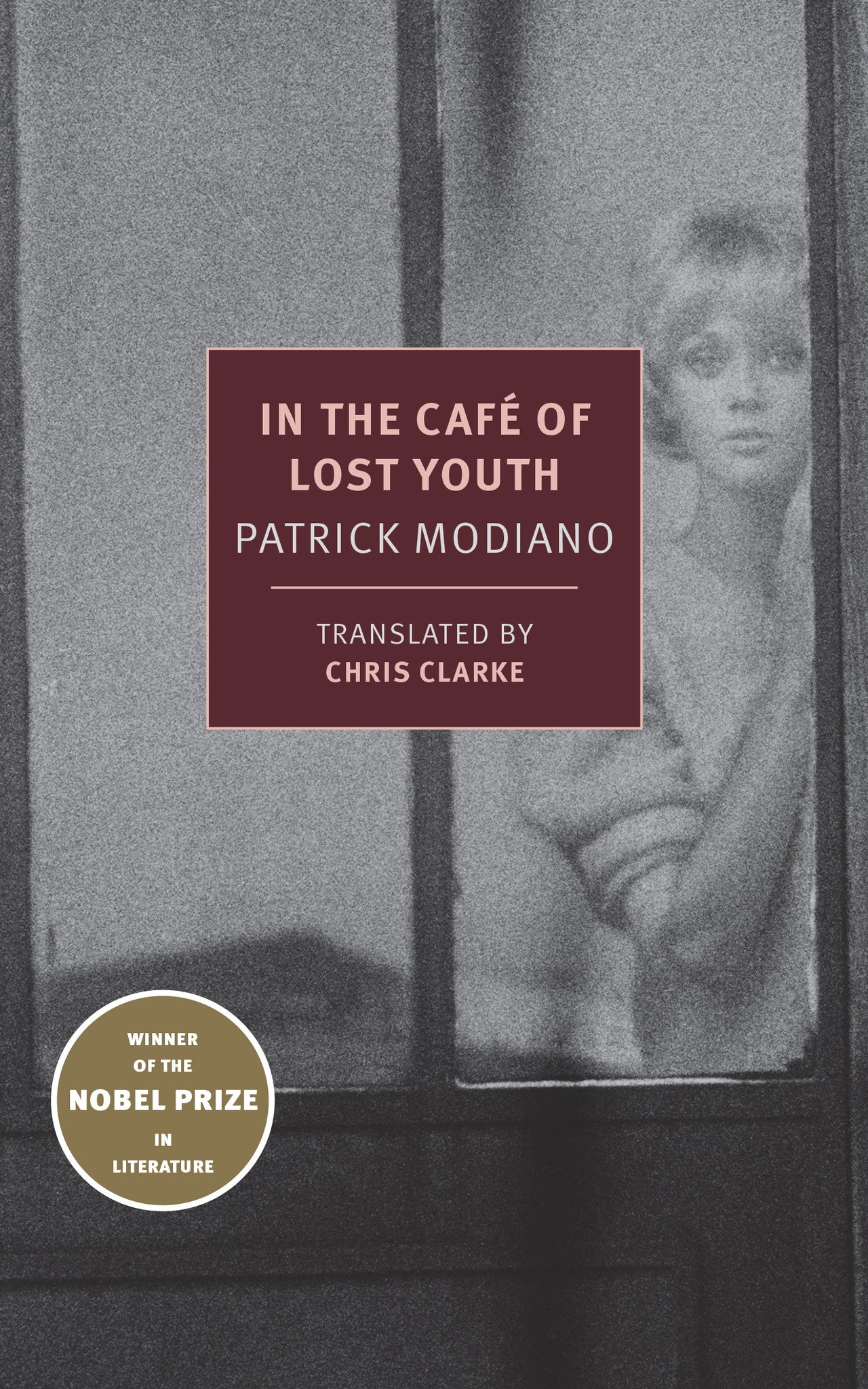
It is the café of lost youth not in the sense that I'm older now and I've lost my youth, nor that I lost my youth too by growing up too fast. This is the place where the lost souls come. A lost generation. Like every generation.

I know this place. I spent my twenties there. And in truth that café (pub, in my case) represents all these interpretations of lost youth.
I've always believed certain places are like magnets and draw you towards them should you happen to walk within their radius. And this occurs imperceptibly, without you even suspecting. All it takes is a sloping street, a sunny sidewalk, or maybe a shady one. Or perhaps a downpour. And this leads you straight there, to the exact spot you're meant to wash up.
The world Patrick Modiano weaves in The Café of Lost Youth is spell-binding. Time slows. Read a page or two on the commute and the walk across the neighbourhood is suddenly infused with new meaning. I move in a haze, embraced by the city, a stand-in for Paris, and I find myself looking for fixed points.
In this uninterrupted stream of women, men, children, and dogs that pass by and end up lost from sight among the streets, it would be nice to hold on to a face once in a while. Yes, according to Bowing, amidst the maelstrom that is a large city, you had to find a few fixed points.
Louki is the fixed point of this story, a young woman who frequents the café among the many writers and bohemians. Her identity is elusive, few know even her real name, but it is around her that the texts revolve.

Four sections, chronologically overlapped, with four distinct narrators, Louki herself one of them.

The opening section presents the café through the eyes of a student at École Supérieure des Mines. He dares not tell the clientele that he's a student though, for fear he'll be mocked.
At the Condé, we never questioned each other about our origins. We were too young and we didn't even have pasts to reveal, we lived in the present.
I remember wishing I had a past. I miss not having a past.

The second narrator is Caisley, who smokes American cigarettes and occasionally calls himself an art publisher. He seems to have connections on both sides of the law, and alludes to some shady dealings. This section tells of his stint as a private investigator, hired by a man whose wife has gone missing.
I had a habit of getting to know the lay of the land before jumping straight into the thick of things. In the past, Blémant criticized me for it and thought that I was wasting my time. Dive in, he told me, rather than running in circles around the edge of the pool. Personally, I felt the opposite way. No sudden movements, but instead a passivity and slowness that allow you to be softly penetrated by the spirit of the place.
Clearly he is penetrated by the spirit of the café.
In this life that sometimes seems to be a vast, ill-defined landscape without signposts, amid all of the vanishing lines and the lost horizons, we hope to find reference points, to draw up some sort of land registry so as to shake the impression that we are navigating by chance. So we forge ties, we try to find stability in chance encounters.
Louki narrates the third section. She's a liar, but she's honest about it. Kind of the way Holly Golightly's a phoney, but a real phoney. In fact, now that I've made the connection to Breakfast at Tiffany's, I wonder if more couldn't be made of it — the need to run, the need to reinvent oneself. What fixed points does one navigate by then?
I was never really myself when I wasn't running away. My only happy memories are memories of flight and escape.
It is through Roland, the fourth and final narrator, that we process Louki's end. As Louki's friend and lover, he is privy to Louki's spiritual longing, her need for a guru.
I had the impression that since those days at Guy de Vere's, no time had passed. Instead it had stood still, frozen into some sort of eternity. I remember the text I had trying to write back when I knew Louki. I had called it On Neutral Zones. There was a series of transitional zones in Paris, no-man's-lands where we were on the border of everything else, in transit, or even held suspended. Within, we benefited from a certain kind of immunity. I might have called them free zones, but neutral zones was more precise.
Roland obsessed about the Eternal Return.

Time stood still for me reading this book. As if I had regained my neutral zone. Anything is possible.

I want to read it again. I want to be 20 again.

This book may be a fixed point.

Wednesday, May 18, 2016

Wining

I love wine.

I love drinking wine almost as much as I love reading books. Sometimes more. Of course, I often do both at the same time. One can also drink wine while talking about books. And eating fine things.

There was a time I wanted to know more about wine. I bought the occasional issue of The Wine Spectator. I attended wine tastings. I watched Sideways and Bottle Shock (which strengthened my anti-French sentiments). I read about wine. I drank wine while reading about wine. I even took a MOOC about The World of Wine: From Grape to Glass (new session starting soon!).

And I have watched every documentary about wine and wine-making available on Netflix. I have a particular fondness for Somm ("freshly opened can of tennis balls"), in which it is impressed upon me that in addition to amassing knowledge and cultivating a nose, the connoisseur must exercise imagination and execute deadpan delivery, and its recent sequel Somm: Into the Bottle ("I feel like a sommelier when I'm opening a $5 bottle of wine with a $300 corkscrew."), in which is extolled the inspired pairing of popcorn and chardonnay (I've been saying that for years. Duh, butter!).

I'm practically an expert.

And I realized something: the world of wine doesn't fascinate me nearly so much as the world of the wine connoisseur.

Don't get me wrong. Wine is delicious. There is no occasion that wouldn't be complemented by a bottle. But it should be deftly woven into the fabric of life. It's the connoisseurship that demands to be noticed, and it both delights and shocks and awes and leaves me aghast.

This morning I found some clickbait in my inbox, and fully baited, I clicked. The 8 Worst Mistakes Wine Drinkers Make. I'd like to take this opportunity to call bullshit. The biggest mistake is believing these are mistakes.

Let me address these point by point.

1. Filling your wine glass up to the brim — not a mistake
Don't be a wine hog, but no, there is nothing wrong with filling your glass. Of course, much depends on context. If you're there to "taste" the wine, perhaps you need to be seen swirling and sniffing. But if you're there simply to taste the wine, save yourself another trip across the room — pour yourself a tumbler full and enjoy it.

2. Holding your wine glass by the bowl — not a mistake
Yes, it warms the wine. But any wine worth its oak will withstand the minute temperature change. What's more important? Not feeling awkward. You feel the stem may slip through your fingers, you're tipping the glass, so you grip tighter, and now you're afraid of snapping the stem. (Maybe if you hadn't filled it so much it would be easier to hold.) Just be comfortable. Hold it whatever way feels right.

3. Buying wine because of the label — not a mistake
How else are you supposed to decide? Yes, I buy books that way too. There's a lot of useful information on the label, including region, grape type, and suggested accompaniments. And a vineyard's approach to marketing — traditional or innovative, subdued or flashy — can say a lot about its product.

4. Drinking the same old stuff — not a mistake
Yes, one should keep an open mind and try new things. But there's nothing — NOTHING! — wrong with standing by an old favourite.

5. Sticking to classic wine pairing rules — just a bit of a mistake
OK, this one I actually agree with. It's a mistake. Rather than classifying by red or white, try thinking in terms of fullness, fruitiness, or acidity. But hey, there's nothing wrong with a colour-coordinated palate either.

6. Drinking too fast — not a mistake
Examining every slow sip may be one way to learn about wine, but it's not the only way to enjoy it. It can be thirst quencher and a palate cleanser. Not every wine needs to be an education.

7. Dissecting wine on the initial pour — not a mistake
No, you shouldn't share your impressions with the waiter, but that first sip is different from all the other sips you will be taking. It's certainly worth considering, and you can even set some expectations by it.

8. Not using Vivino — also not much of a mistake
I've tried using this app, and it's failed to identify the half-dozen or so labels I've scanned. I'm not sure if this is due to poor recognition technology or if the database just doesn't include the wines available to me locally.

Currently drinking: Château Cazal Viel Viognier 2014, Pays d'Oc, France. Initial purchase based on the vaguely Florentine styling of the label. Subsequent purchases based on how tasty it is.

Do I sound like a wine snob now?

An innate bitterness at the heart of education

They said I was clever.

I see now they meant that I was bookish, and suited to becoming a learned woman. A learned woman is a very different object from a wise man. I have had no experience of life; how could I see all the traps, particularly the ones that looked most like my own choices, my own happiness? Keats did not warn me, and neither did Dickens. I did not find myself within their writings.
This is The Arrival of Missives, by Aliya Whiteley.

This is a very weird story. In a good way. You know I like weird.

Whiteley's 2014 novella, The Beauty, is one of the most original and unsettling things I'd ever read. So I was ready for this.

Whiteley's recently released novella, The Arrival of Missives, starts off making you believe it's something else. A coming-of-age story, set in the past. I couldn't be sure at first if it was the real past or an imagined past. There was war. It becomes clear that this was the Great War, but war is done now. The setting is gently bucolic. Only it's not. You can feel some darkness lurking there. The story unfolds in "the place where the plans of the old and young do not quite meet."

Shirley is expected to marry someone capable, who can run the farm as her father ages. But Shirley believes herself to be part of the new era, in which women will be recognized as having something to contribute to "the upward path of humanity." Shirley dreams of escaping the farm and going to college. She wants to be a teacher. She has cultivated an attraction to her own teacher.
Look how love coats me in a shiny slick that no grim thought can penetrate. It lights the dark, and distinguishes my being. I am set alight by it.
Teacher has a secret he brought home from the war.

It reminds me very much of Bro, the first part of Vladimir Sorokin's Ice Trilogy. (Which I very much admired, though I have not yet read the rest of the trilogy. Missives is shorter by far and a swifter read.) Only instead of the Tunguska event, here the catalyst is the shrapnel of war. But in both cases something alien takes hold and demands action.

There are multiple sets of missives in this story. One is Mr Tiller's letters to Shirley, from teacher to student, a madman grasping for a shred of humanity and kindness. Another is correspondence from the college — an invitation to an interview, and then a decision letter. Another is from the future. In many ways they are the same.

Everywhere there is nature; on the farm it is made orderly and profitable, but elsewhere it is a wild tangle. And everywhere there are boys and men, and I feel Shirley's trepidation and diffidence. This is still a world ruled by men.

This is a story of how the old ways of thinking embed themselves and harden. But Shirley "will not be a foot soldier for pale old men, no matter where they live or what pretty patterns they weave." Perhaps it also a story of how women are patient like water, wearing away at stone.
For love is not the high ideal of beauty, of sacrifice, of noble deeds and chaste embraces that I had imagined when once I dreamed of Mr Tiller. It is a dirty business, of wanting and struggling and making do, and being each other's comfort because the world is cruel and there are few who want to do right by you with no thought of their own needs.
With all the intensity of a schoolgirl's heart and mind.
Once I thought that a bitter teacher spoils a pupil; I wonder now if there is not an innate bitterness at the heart of education, which always comes with hidden meanings and a high cost.
I highly recommend The Arrival of Missives. Poetic and engrossing. Quietly weird and patiently feminist.

Interview with Whiteley at The Thinker's Garden.
Excerpt.

Tuesday, May 10, 2016

So have you found your happiness?

Yes, that bookstore wasn't only a refuge; it was also a step in my life. I would often stay there until closing time. There was a chair next to the shelves, or rather a tell step stool where I would sit as I leafed through different books. I wasn't sure that he was even aware of my presence. After a few days, without looking up from his reading, he would speak to me, always the same sentence: "So have you found your happiness?" Much later, someone informed me with great certainty that the one thing we cannot remember is the tone of a voice. And yet even now, during my bouts of insomnia I often hear that voice and its Parisian accent — the accent of the slopes — asking me, "So have you found your happiness?" And that phrase has lost none of its kindness or mystery.
— from In the Café of Lost Youth, by Patrick Modiano.

Friday, May 06, 2016

A personal anecdote of longing and regret

It's a relaxed morning, the kid's away, and I'm feeling good. Heading to work in my Gucci sunglasses. The scarf I got at a Paris flea market, only one cigarette burn hole in twenty-five years.

Through the park to the metro it's dog walkers, joggers, and a juggler. A ruggedly handsome juggler. He's mesmerizing. The path I'm walking shifts trajectory to follow my gaze. I have to keep correcting my course. Three balls, red white blue, red white blue, under the leg, he's juggling with his foot now, red white blue. I'm staring. He drops one, finally. I'm smiling.

"Beau sourire," he calls out.

And in a millisecond I imagine several possible responses, not excluding allusions to his dexterity, and all potential outcomes, most of them variations of lusty abandonment. But the voice of "reason" drowns out the murmurs: what is he doing juggling at the park at 9:30 in the morning?, he can't possibly have a job, when you start planning to vacation together in Turkey next year who's going to pay for it?

I'm passing him now; I turn slightly and give him a thumbs up. (What the fuck does that even mean?) He laughs, and I walk on.

************

I take a seat in the metro and open my novel, In the Café of Lost Youth, by Patrick Modiano. It makes me melancholy.
I took the envelope from my pocket and I pored over the pictures for a long while. Where was she now? In a café, like me, sitting alone at a table? Doubtless the phrase he had spoken earlier had given me this idea: "It's all about trying to create ties." Encounters in the street, in a Métro station at rush hour. We ought to shackle ourselves to each other at that moment. What connection can resist the tide as it carries you away and diverts your course?

************

The busker is strumming out Wicked Game; I hum along. He sings more like Barry Gibb than Chris Isaak; it feels purer this way, less animal, but more tragic. I walk the long tunnel out to the exit, imagining myself clinging to Sailor's snakeskin jacket. I miss being twenty.

************

Why did he laugh?

************

"Maybe he's a dentist," one friend suggests. "They work odd hours."

"Independently wealthy. He's just always wanted to master juggling. What's wrong with that?"

"Cirque du Soleil, obviously."

"Lots of people take Friday off."

Some of them call me an idiot.

************
We ought to shackle ourselves to each other at that moment.
I can't wait for Monday and the walk through the park on my way to work. True story.

Missed connection w4m, Parc Laurier, May 6, 9:30 am.

Wednesday, May 04, 2016

Funny business

My sense of humour may be broken. Or maybe sex offenders just aren't that funny.
He has made mistakes.
Baldy Conscience was a terrific mistake.
Baldy Conscience was a turbine of a mistake.
He was a tubular bell of a mistake.
A Chernobyl-fucking-cloud of a mistake.
Martin John, by Anakana Schofield, according to cover copy is "hilarious."

John Self in The Guardian says in his opening paragraph that it's funny, but never elaborates.

Emily Keeler at the National Post laughed out loud at "deeply troubling jokes," which make me wonder if the laugh might come as a reaction to the awkwardness of uncomfortable truths rather than as a genuine response to humour.

David Hobbs in The Globe and Mail barely touches on "the sense of humour that guides its dark comedy."

But he astutely observes:
Do we believe that Martin John is driven by rage, or do we believe he is trying to satisfy women, coats and himself? Should we believe either? Does his intent change his effect? Are we inside Martin John’s head, or someone else’s attempt to decipher him?

A reader's initial response may depend on whether she feels Martin John is primarily a sexual offender or afflicted by psychological disorder. Yet Schofield is more interested in the sense of unease produced as the reader tries to sustain either impression. The arrows punctuating the novel's blank spaces resemble Post-It flags reminding us to sign our names in a legal agreement, but each subsequent paragraph reminds us that we are assenting to something beyond our comprehension.
It's clear to me that Martin John is both a sexual offender and afflicted by psychological disorder — these are not mutually exclusive conditions.

Eileen Battersby of The Irish Times describes the novel as a comic tour de force, with plenty of gags.
Be warned: regardless of one's views on sexual deviants who prey on women and who also get their kicks out of sustaining a very full bladder, Martin John will make you ill with laughing but also guilty for smiling at a human tragedy, which it is.

Is Martin John a comedy? Possibly, in the sense that it breezily employs linguistic acrobatics to describe aberrant situations that rub up against social norms. It's entertaining, enjoyable (as a thing to read, despite its subject matter, and somehow (this is Schofield's magic) light even while deeply ambiguous. But I wouldn't call it funny.

Maybe I just need a different word for the kind of funny this.

About that ambiguity... So much of the narrative is related from Martin John's perspective, it makes me question not just the nature of his relationships with other character (are we given verifiably true accounts?), but the very reality of the other characters. Who is Baldy Conscience if not Martin John's bald conscience. Does he live in the house, as Martin John's "tenant," or in his head? What about his mother? Is she a continuing presence in his life, or is it all torturous memory that nags him through his days?

All this makes the novel puzzling, like Martin John's character, his motivations, his worldview are puzzling. But not exactly funny.

Perhaps because the verdict on the Jian Gomeshi trial is still fresh. Perhaps because I work with a recently paroled sex offender, even though I personally, not being a young, male aspiring hockey player, feel no threat apart from that to my moral sensibility. Martin John is no rapist (I don't think), but he should not be excused for unacceptable behaviour simply because it is lies on the milder side of the spectrum.

We do not give sufficient voice to society's victims, so it becomes uncomfortable to spend the length of a novel inside a perpetrator's head. I think we have too much sympathy for the devil. Very much a tragedy.

Monday, May 02, 2016

What steals your memories?

"Do you know what steals your memories?"

I look at him. Because it is a strange question, one that has no answer and many answers. The river of sleep take memories down in the murk and silt. Night and the darkness take them. Waking takes them. Or our own sadness. Or maybe it's the forgetting is like a spore of blight inside each memory itself, and the two cannot ever be separated.
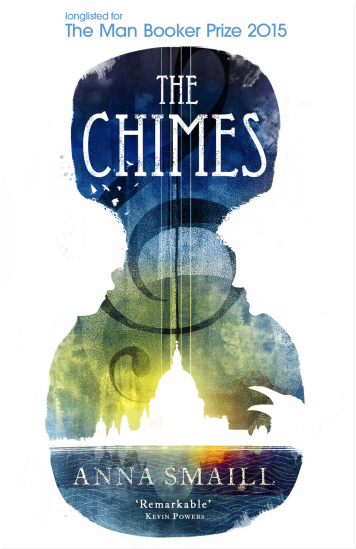
The Chimes, by Anna Smaill, is about memory and about music.

It's poetic and mysterious from the outset. A little Dickensian, but it's not bustling with life so much as buzzing in your head.

The jacket description explains some of the Chimes world, but it's not till I was well past a third of the way through that the world became clear.

Simon keeps his memories close. It seems people have a hard time keeping memories in their heads; they transfer them to objects. Simon can access a memory by examining an object. If you lose your objects, you're in trouble.

When Simon comes to London, the gang he runs with uses music to navigate the city, the tunes describing the paths they take, helping them to find the objects of their hunt as well as helping them find their way home.
He sings and time stands still, as if he is walking on water. His voice is stark and true, and in it there are stretches of empty skies and a bright rime of salt.
It's common wisdom that with the right music, you either forget everything or remember everything. The Chimes takes this aphorism to its dystopic extreme. Personal music links closely to memory, but the public music of the Chimes issued by the Order has a dulling effect, to keep the masses in line.

The language of The Chimes is punctuated with musical terminology; movements are subito, lento, presto. The poetry of "the sunlight's pale violence" drips off every page.
On my palm is a nugget of Pale. About three ounces, and shined with soapy, idle gleam in the thin light, as beautiful as anything I've ever seen. It pulses with silence.
At times I wished it were a little less beautiful. The evil at the heart of this dystopia is clouded by the beautiful language. But maybe that's the point: the musicality can obfuscate the reality.

See last year's review in the Guardian.

Tuesday, April 26, 2016

In praise of short novels

I recently convinced several people to read Valera Luiselli's The Story of My Teeth, not by describing the main character or his story or explaining the concept behind the book, but by praising how short it was. As if its brevity was its greatest virtue. Perhaps it was.

Of course you can read it over the weekend! It's so short! Only 134 pages, according to my e-version. And all those blank pages at the front. The table of contents is longer than expected. An epigraph or two. Decorative leaves between chapters. Then there are photo plates at the end, and the translator's chronology, which can't be said to be part of the book proper, though it was my favourite part. The author's afterword, also not really part of the book, although arguably it's what gives the book meaning. Still, it doesn't count as story. And more blank pages. Bringing us down to maybe a 100 pages of novel. Who can't manage that?

In this way I "sold" a book I didn't really like (I admire and respect it — I just didn't connect with it) because I had nothing better to say about it. It's really short! And an impromptu book club came into being.

I've read a lot of short books this year. It's all that my time and attention can hold.

Short novels means less commitment, cuz I just don't have it in me these days. Short novels sustain my interest, in ways most 400-page novels just can't. I can slip from one genre to another. More variety. I'm sampling more authors. And I have a sense of accomplishment. I can still read and finish books! And I can convince other people to read them too. Short novels are so digestible.

Saturday, April 23, 2016

Keep your memories close

I think about memory and what it is. Keep your memories close, people say. Say it to children as often as they can. Keep them schooled up in bodymemory from early on. Give them an instrument for their own. Get them prentissed. And make them mind their memories.

I think about what it means to keep them close. The tradespeople who live and work in the city and trade in the market, they keep them on their bodies at all time, in pouches or pockets. The moneyed guilds, instrument makers and such, have elaborate bandoliers, belts with many pockets. The strandpickers port theirs in stickwrap, rather than linen or leather. Even Harry who reads the weather, whose house changes with the tide and whose head is loose as muttering, still keeps his wrapped in whatever he can find, and pushes them in his old shopping trolley along the strand of the embankment.

But for all that everyone keeps them and coddles them, I tend to think most adults wouldn't know their own memories from anybody else's. Something in their eyes and how they greet you in the market. At a certain point in your life, it's like you have to choose what to keep.
— from The Chimes, by Anna Smaill.

Sunday, April 17, 2016

Fates and furies, wings and egos

I went to a wedding a long time ago, the wedding of close friends (where, coincidentally, I met my then future but now ex-partner), which made a huge impression on me. I was both moved and puzzled by what the priest said. That a marriage is more than one plus one. There are three in a marriage: husband, wife, and holy ghost. I'm skeptical about the holy ghost bit, but it's clear to me that any relationship is larger than its parts. But as most marrieds will tell you, the sum maintains its integrity only so long as the parts maintain their individual identity.

Sometimes, indeed, that third entity, Marriage, does not swallow up the others so much as form its own separate whole, for better or for worse.
Their marriage picked itself up off the ground, stretched, looked at them with its hand on its hips.
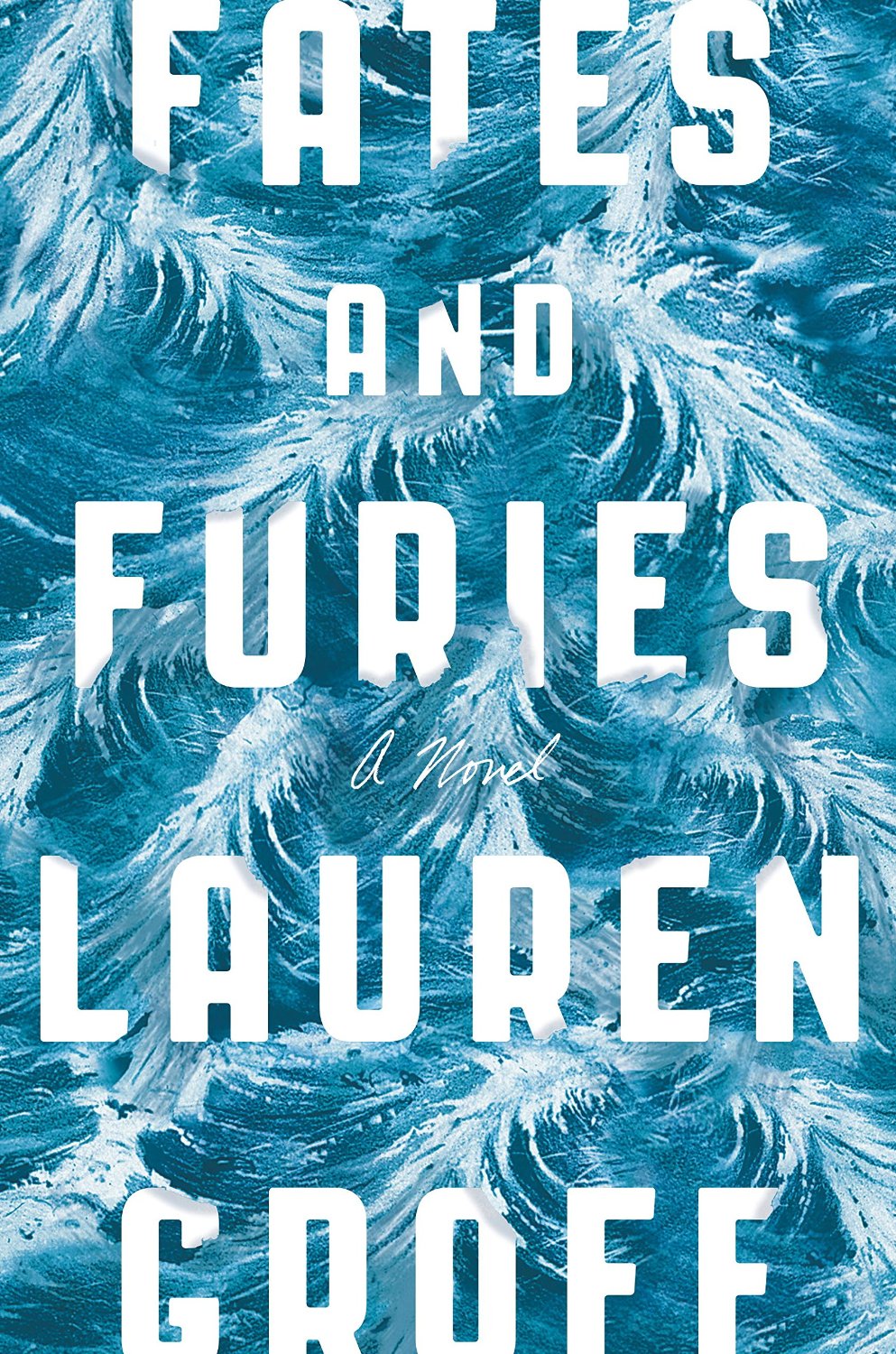
Fate and Furies, by Lauren Groff, is about a marriage. First we hear Lotto's version, and then Mathilde's. Surprise: they're not the same.

The novel has been making a lot of waves since it was published last fall. Obama's favourite book of the 2015. But the hype is starting to dwindle. It's when the novel came back as a zombie in this year's Tournament of Books that I finally felt compelled to read it.

I thoroughly enjoyed reading this book while I was in it. I couldn't wait to get home from work and go to bed early so I could find out what happened next. I spent several lazy Saturday hours in my reading chair with it. I mostly loved it. It gets all playwright-y and stylized at the end of part one, and I skimmed through a lot of that — just not my cup of tea — but I was pretty invested in this novel and cared how it turned out. A couple weeks on, however, I'd say the honeymoon is over, the thrill is gone, and I'm starting to wonder what I saw in it in the first place.

Here's a great but spoiler-infested review by James Woods. I wholeheartedly concur. There's just one thing he gets wrong; when Lotto finds success as a playwright, Woods notes, "Thanks to his wife, Lotto never again scrubs a toilet or pays a bill," but I'm fairly certain he hadn't done either since he met Mathilde nearly a decade earlier.
"Huge thing's your ego. Awful that you weren't the only man for her. Girl scrubs your toilets for twenty-three years, you begrudge her the life she had when you weren't around."
Laura Miller in her commentary on the TOB zombie round proclaimed "Gone Girl is brilliant, a better novel than Fates and Furies" (which so much makes me want to go read Gone Girl, which movie I loved):
One thing I like about the pairing of these two books, though, is that it does highlight the degree to which I think Fates and Furies has been enjoyed by readers as a kind of satire. It’s got a privilege-assuming, rather spoiled golden boy of a husband who is completely oblivious to the reality of his wife’s life.

Given that most readers of literary fiction are middle-class women, I’d bet a lot that this is a reason for its success.
Much is made of the novel's structure. I like the idea of changing perspectives, but these are hardly parallel narratives. Mathilde's story chronologically picks up where Lotto's left off, though through flashbacks, they do cover much of the same ground.

There's something like a Greek chorus that intermittently comments on the story, sometimes filling in the past, sometimes telling us the future, sometimes waxing philosophical.
[The ones made for music are the most beloved of all. Their bodies a container for the spirit within; the best of them is music, the rest only instruments of flesh and bone.]
I'm not familiar with Greek mythology beyond the basics, so all that fates and furies stuff is lost on me. I'm guessing that much of the tragedy in this novel comes from the Classics, but it reads like an engrossing domestic drama regardless. At times the prose feels a little too abstracted from reality, but it's mostly beautiful.
Rachel was afraid that Mathilde, whom Rachel loved as dearly as anyone, was about to bust out of it all in a commotion of wings. Poor Lotto. Poor all of them if Mathilde left him.
Mathilde's childhood and youth, it turns out, is so thoroughly fucked up, though not unbelievably, that it's no wonder she shuts the door on her past and lives a disciplined life in accordance with a strict set of rules. Lotto, on the other hand, is thoroughly oblivious, but also not unbelievably, because men can be stupid.

Was their marriage successful? I don't know.

Thursday, April 14, 2016

A bumblebee in a glass of beer

And they went on staring at him, examining this fat man who was too hot and had landed in their bar like a bumblebee in a glass of beer.
That's Dr Mahé, on holiday in Porquerolles. It gets under his skin — everything about the place, and especially a young girl. An irritation, an itch he needs to scratch.

It's been a while since I read a Simenon book. Maybe I'm out of practice. Maybe I've changed. The Mahé Circle was downright unpleasant. I mean that, of course, in the best possible way. It was intense and disturbing.

The sense of restlessness, malaise, agitation were palpable from the early pages. It made me uncomfortable. I was irritated with Dr Mahé, and with everything around me while I was reading this short novel.

The object of Dr Mahé's obsession is a mere child. I don't recall this type of scenario playing out in any of the previous romans durs I've read. So while Simenon's characters are hardly admirable, they are weirdly compelling, and the reading experience can be cathartic. Not so here.

Other Simenon characters are, if not sympathetic, at least pathetic. Not so with Dr Mahé. Am I being too harshly critical? I wonder if men find him more sympathetic than I do.

Arguably, Mahé is not obsessed with the girl per se (but he is!). It is the island, it is the languor, it is his childhood, it is some life outside of his bourgeois existence. It is the need to be noticed by his wife and his mother, the need to be respected by his nephew, the need to be accepted by the islanders. The need to catch that damn fish, claim his masculinity. But above all, it's the girl.
When he had married, he had not had like other men, who leave home, a feeling of freedom.
Arguably he is punished in the end. But I don't think he repents. I don't think he acknowledges how wrong he is. Metaphorically he finally gets the fish that got away, and that fish he was after was the negation of his actual reality.

I am fascinated by stories of those who walk away, why they walk away. This book, though — it's not about that. It's about the obsession. It's not about what he's walking away from, it's about what he thinks he's walking toward. I can't get over the wrongness of it being a barely pubescent girl.

Is that the point? Was that the point when it was written in 1946? Do men readers see it as the point? Certainly that's not what the reviews I've read center on. Is that because it's really not the point of the book? Is it because Simenon's primarily male audience (that's a big leap I'm making, an assumption with no facts to back it up) is as misogynistic as he was?

Maybe when I previously binged on Simenon it was a sign that I needed to walk away from my life. Maybe now that I'm in a better place, a better headspace, I no longer have the patience for the whining, or the dilly-dallying, or the quiet complacency. I just want them to get on with it. But not with too-young girls.

The writing: spare, psychologically perceptive, precise, and oh, so evocative. An infuriatingly good book.

Elsewhere
John Banville: Simenon's Island of Bad Dreams
Tony's Reading List: Review

Excerpt.

Georges Simenon's son Pierre will be hosting a literary brunch this weekend to talk about his father's works, part of the Blue Metropolis Literary Festival. (See the calendar for this and other Simenon-related events.)

Wednesday, April 06, 2016

Complexity and simplicity

"You're interested in time?"

"Complexity and simplicity," he replied. "Time was simple, is simple. We can divide it into simple parts, measure it, arrange dinner by it, drink whisky to its passage. We can mathematically deploy it, use it to express ideas about the observable universe, and yet if asked to explain it in simple language to a child — in simple language which is not deceit, of course — we are powerless. The most it ever seems we know how to do with time is waste it."

So saying, he raised his glass in salute to me, and drank it down, though I found suddenly that I was not in a drinking mood.
— from The First Fifteen Lives of Harry August, by Claire North.

Sunday, April 03, 2016

Surpassing the truth

After all, as Quintilian says, a hyperbolic is simply "a fissure in the relationship between style and reality."
I'd heard quite a bit about The Story of My Teeth, and I'd followed with interest its performance in this year's Tournament of Books, and spurred by the upcoming appearance of author Valeria Luiselli at this year's Blue Met festival, I read it.

It's a strange little book, which has it's own strange little story, but frankly, I don't understand what all the fuss is about.

I've actually encouraged a handful of people to read this. We'll make a night out of it. Hear what the author has to say. Adjourn for cocktails.

Its selling points: 1. It's really short. It clocks in at 134 pages, but there's front matter and back matter and decorative plates and really wide margins. 2. There are clowns. Well, that may scare some people, but I think it's a plus. 3. There are funny bits, where I smiled and chuckled (but no guffaws) — but hard to say if it's at all funny apart from occasionally being clever and pretentious or almost constantly parodic and hyperbolic.

On the whole, however, I didn't like it. Gustavo "Highway" Sánchez, is not very likeable. Not that I have to like a character to like a book. But the book did not connect with me at all, not the character, the story, the tone. There were glimmers of hope, in the humour, in the oddness, in the clowns, but it wasn't sustained. But it is a weird book, in a way that merits discussion.

The story, such as it is: Highway left his wife and son to pursue his calling. He's an auctioneer, who once bought at auction and had surgically implanted Marilyn Monroe's teeth. He returns to Mexico with a fine collection of... of objects, of collectibles, and in the course of auctioning of his collection of teeth, crosses paths with his grown son.

The thing about auctioneering — he creates value, by telling stories.
When Highway first began to recount his stories to me, I thought he was a compulsive liar. But then, living with him, I realized that it had less to do with lying than surpassing the truth.
There are some marvelous insights gleaned from several of Highway's esteemed relations...

Baudrillard:
I completely disagree with my second-uncle Juan Sánchez Baudrillard when he says that "Americans may have no identity, but they do have wonderful teeth."
Dostoevsky:
I suppose my uncle Fredo Sánchez Dostoyevsky was right when he said that insult, after all, is a purification of the soul.
Foucault:
In other words, as my uncle Miguel Sánchez Foucault said in relation to something else, these men and women are "singular lives transformed into strange poems through who knows what twists of fate."
And my favourite cousin, Sartre:
I was certain that I had gone to hell. During the long family meals I had to endure in my childhood, my cousin, Juan Pablo Sánchez Sartre, who used to wear white plastic flip-flops and couldn't hold his drink, would inevitably tell us — around the time when the dessert was being served — that we were hell.

One of the more mysterious elements of the book is "The Chronologic," contributed by translator Christina MacSweeney. It is in fact my favourite part of the book, for the great puzzle it presents. For example, why include an entry to mark the date that Saigon was renamed Ho Chi Minh City. It presents an interesting framework for thinking about the story, a real-world level of narrative.

The Story of My Teeth stems from a commission to catalog an actual art collection, and was created in large part by collaboration. It was meant to be read aloud and in instalments. Audience feedback was integrated into subsequent drafts. The author's and translator's collaboration mean the resulting book is a further version of the original, not a strict translation.

The Afterword is more of an Artist's Statement, and for clarity's sake, I wish it were labelled as such. This book is like that odd installation at a gallery that you can't make heads of tails of, but you finally find the little placard an you read and you think it makes sense, but you read it again to make sure, but you're not sure, and you look at the art again and something clicks, but just for a second; it's somehow been made more acceptable even if it's not any less opaque.

The problem is: I'm not convinced art should work that way; it should stand on its own, not propped up by justifications. And for some reason, if that art should be literary — it's already full of words — I think it has less right to go outside of itself in order to communicate about itself.

In that sense, The Story of My Teeth "works" as a piece of art, an artefact, an experiment, but not as a real novel, in my opinion. But I do look forward to hearing the author, discussing the book with others, and having my ignorance dispelled.

Sunday, March 27, 2016

Envy

A friend brought to my attention this wonderful "essay" by Rivka Galchen in the New Yorker, The Only Thing I Envy Men.

I write "essay" after looking for how the magazine labels it. It's a memoir (probably) but it reads like a short story, with wit, poignancy, and unexpected twists.

She starts off discussing "women writers" and I expected her to envy men that they hold the default position. This is true in part, but it runs much deeper that; it pokes gentle fun at our gender biases, but then picks away at the biological basis for how men and women form different emotional attachments.

Let me tell you why I love this "essay." Go read it first, I don't want to spoil it for you. It's short and lively.

First, doesn't it make you want to read everything? Helen DeWitt, Dorothy Hughes, Patricia Highsmith, Jane Bowles, Even Virginia Woolf. The joy of recognition: yes, I've read Natsuo Kirino.
For many years, Shirley Jackson was nearly the only "woman writer" I had read. Then, around age twenty-five, I had the blunt experience of looking at my bookshelves and noticing that my bookshelves were filled almost exclusively with books by men. Which was fine, I wasn't going to get in a rage about it, I loved those books that I had read. But I was unsettled, since my bookshelves meant either there were no good books by women, or I had somehow read in such a way as to avoid them all. I had never had my Jane Austen phase or Edith Wharton phase or even George Eliot phase, I associated those writers with puberty, or "courting," both things that repelled me. (I now know I was stupid to feel that way.) But, like I said, I wasn’t going to rage at myself, or at the world, I was just going to try to read some books by women. But where to start?
Second, it turns the issue of gender biases in literature and publishing on its head. What makes the writing of a woman writer so womanly? What makes Walser and Kafka sound "female," in Galchen's opinion? I love how she persists in believing Denis Johnson is a woman, even while being surprised that his book was written by a woman.

Third, it goes where good girls don't. It considers the possibility of (female) sexual behaviour without bearing the burdens of its consequences. It considers motherhood without the burden of children. The possibility of covert babies.

Fourth, it makes me wonder about the metaphorical children, the creative works that authors nurture and give birth to, letting them make their own way in the world. Do men and women relate to those offspring differently? Are women held to task for these children, while men more easily dissociate from them?

The essay comes from Galchen's book, Little Labors, due out in May. I'll be checking it out, along with everything else she's ever written.

Friday, March 25, 2016

Blue Met 2016

It's one of my favourite times of year again: The Blue Metropolis Literary Festival is just a couple weeks away, April 11–17, heralding the start of festival season in Montreal. But more importantly: books, books, writers, ideas, and books!

The program was released a few days ago. I'm looking forward to getting my hands on a print copy — I'll spend days perusing it, circling, highlighting, dog-earing, before I settle on my own schedule of events to attend.

This year's International Literary Grand Prix winner is Anne Carson. I've been meaning to read her for years, so maybe soon.

The standout guest in my opinion is Valeria Luiselli, who is being honoured for The Story of My Teeth, which I'm reading right now. She'll be interviewed on stage by Scott Esposito.

Stay tuned for recaps of select events.

Tuesday, March 22, 2016

Boredom

Boredom drove him to read the folder of hotel information from cover to cover, the fire escape plans on the back of the door, a copy of Yorkshire Life, anything that wasn't nailed down. He considered, and rejected, the idea of playing a mindless game on his phone and was eventually driven to look for a Gideon Bible in the bedside drawers but when he found one he realized he wasn't that desperate yet. A yellow Post-it note fluttered out of the Bible. In pencil, someone had written, "The treasure here is you." Jackson stuck the Post-it note on his forehead and died of boredom.

He came back from the dead after ten minutes, a Lazarus licked to life by a canine redeemer. The dog looked worried. Could a dog look worried?
— from Started Early, Took My Dog, by Kate Atkinson.

A coworker saw me in the metro and later asked, "What were you smiling at? You're so smiley!"

"My book."

The magic of Kate Atkinson: that stories so tragic can make me feel joyful.

Thursday, March 17, 2016

Millions of beautiful words

I'd been copyediting for a few years when I landed a dream job, at a very hip ad agency. Designers and copywriters were clamoring to work there. I didn't know anything about advertising (this is well before Mad Men came to tv), but I did know a little something about editing, about publishing, and about how language works.

What's nice about working for an agency is the variety: print ads to websites to custom reports, one-offs and multi-phase campaigns, across all media. This job had me fixing grammar, checking proofs, and touring print facilities, but also acting as sounding board for creative. Editing as end-to-end quality control.

But the best thing about that job was my boss, my mentor, from whom I learned the value of a holistic approach to editing. Editing is less about spelling, grammar, and punctuation than it is about listening, hand-holding, and ego-stroking.

Early on, she loaned me her copy of Max Perkins: Editor of Genius, by A Scott Berg — a biography of he who edited the greats: Fitzgerald, Hemingway, Wolfe. I got myself my own copy shortly thereafter. Every editor should read it.

Now it's been adapted for film.


Genius opens June 16th, and I'll be watching it. It looks like it takes quite the turn for the melodramatic, but hey, that's life, I'm living it.

Thanks, Edie, for everything.

Monday, March 14, 2016

You get to make sense of your yesterdays

Here's a book that I wouldn't ordinarily read, that I had no desire to read, that I had no intention of reading. Not my kind of book, I said. But even while trying to dismiss my coworker's recommendation, I was reminding myself to keep an open mind. How could I judge it if I hadn't read it?

Well, I've read it now. The Five People You Meet in Heaven, by Mitch Albom, was entirely adequate as a way to kill time: an easy-to-read, serviceable story. Despite this, perhaps because of it, I found it wanting, in three main ways.

1. The cosmology.
For starters, the theology of it, the cosmology, the whole construct of heaven just doesn't work for me. You may say that this is subjective and unfair of me, a nonbeliever, to judge. But I do read a lot of SF, so suspension of disbelief is not really a problem for me. Until the internal logic breaks down.

This is the story of Eddie's life, told after his death, through his interactions with five characters who had a profound effect on his life, or vice versa. These people have a lesson to impart. Why five people? That seems entirely arbitrary. Given that people lead very different lives in quantity and quality, I don't understand how this number could be applied across the board. But it is, it's the rule. What happens if there are twenty-three people clamoring for the right to meet with you? And what if the people best suited to explaining your life to you are still alive?

Once you've met your five people, you in turn get to impart a lesson to someone. This is not that book, but I can't figure out how it works. You pick just one person, to teach them a lesson? How do you choose? By having listened to five lessons, you're now qualified to impart great wisdom to the newly deceased? What happens after that?

One person in heaven, the Blue Man, explains that this is not Eddie's heaven, it's his own heaven. So, heaven is telling someone a lesson about their life? Not hearing it? So is Eddie in heaven, or isn't he? Shouldn't it be "the five people you meet before heaven"?

This heaven is Eddie-centric, but it pretends to be an example of a universal principle. It's a little like It's a Wonderful Life, only imagine a whole choir of angels trying to pass their finals by running all the citizens of Bedford Falls through series of flashbacks and trials of what-ifs at the same time, but that would still work because there's an independent angel-passing body to ensure everything runs smoothly and everyone in Bedford Falls is being processed separately. But what if there were no angels, and all the citizens suddenly had to do 360-degree reviews of each other, but not everybody, just five random, erm, I mean significant people, you can see how the structure begins to break down. What five people would George Bailey meet in heaven?

By taking Eddie's singular story and trying to slot it into a universal schema, his experience begins to lose integrity and sense. Do we all have the same lessons to learn?

The second person Eddie meets, his commanding officer during WWII, tells him, "That's what heaven is. You get to make sense of your yesterdays." In my worldview, my heaven is right now — you get to make sense of your life before you die.

2. The subtlety (or lack thereof).
Eddie meets five people, and they tell him exactly what he's supposed to learn. I prefer lessons that are a bit more nuanced. I am, in fact, generally a smart enough cookie to figure out the moral of the story on my own. Eddie's lessons are all pretty obvious: everyone is interconnected, hatred can eat away at you, love doesn't have to end, blah, blah.

Compare this with, for example, Kate Atkinson, just because I happen to be reading her right now, but she's as fine an example as any. There are easily "lessons" in her books, about interconnectedness, sacrifice, purpose, etc. But she never sits you down to tell you, "Dear stupid reader, here is the lesson you must learn." She explores much the same territory as Albom — how seemingly random acts can hugely impact others — but it is that: an exploration, not a hand-held guided tour.

Maybe heaven is for dumb people. Or heaven is like school. Not sure I want to go. Albom's message is impossible to miss; there are no grey areas in heaven. But in my experience, life and the lessons to be had from it are much more complicated than Albom allows.

3. The details.
The Blue Man was christened Joseph Corvelzchik. Polish. For some reason I thought also Jewish, but I can find no evidence of that now, and then, why christened. But that name! Completely made up. It's just not plausibly Polish. Even assuming the immigration officials managed to mangle the records, why not simply give the name, the spelling, he was christened with. When transcribing from Cyrillic, for example, one may encounter spelling variations, but Polish uses a Latin alphabet, so it's not reasonable for an initial K to be transformed into an initial C (and trust me, a surname starting with C-o would be odd). But it's the l and the z — it's a phonetically unnatural combination. This surname reflects someone's mistaken idea of what Polish looks like. And it reflects poorly on the author and the editorial staff that it was not questioned.

Am I petty to harp on this detail? Perhaps. But when one detail is wrong, it gives cause to doubt the credibility of the rest of the experiences, whether in WWII Philippines or a mid-century fairground

God is in the details. Or the devil is. Take your pick.

I didn't hate it.
It's mostly a sweet story about a mostly sweet man. It's not a demanding book. It's less sappy than I expected it to be. But I want my books to be more.

Tuesday, March 08, 2016

Your life wants to become another's

"I'm dead, but I'm fine."
Dead inside, she means. Or maybe just dead to some people in particular.

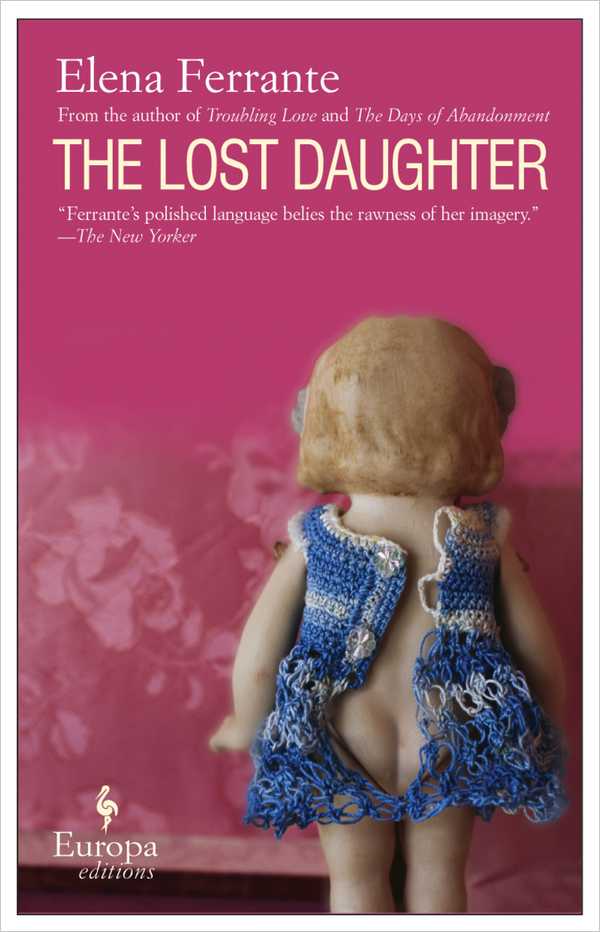
I found The Lost Daughter, by Elena Ferrante, to be an uncomfortable little book. Like The Days of Abandonment, it is an emotionally raw book with a narrator that says things that nice women, good mothers, aren't supposed to say.
One looks at a child and immediately the game of resemblances begins, as one hurries to enclose that child within the known perimeter of the parents. In fact it's just live matter, yet another random bit of flesh descended from long chains of organisms. Engineering — nature is engineering, so is culture, science is right behind, only chaos is not an engineer — and, along with it, the furious need to reproduce. I had wanted Bianca, one wants a child with an animal opacity reinforced by popular beliefs. She had arrived immediately, I was twenty-three, her father and I were right in the midst of a difficult struggle to keep jobs at the university. He made it, I didn't. A woman's body does a thousand different things, toils, runs, studies, fantasizes, invents, wearies, and meanwhile the breasts enlarge, the lips of the sex swell, the flesh throbs with a round life that is yours, your life, and yet pushes elsewhere, draws away from you although it inhabits your belly, joyful and weighty, felt as a greedy impulse and yet repellent, like an insect's poison injected into a vein.

Your life wants to become another's.
The novella spans the length of Leda's holiday on the coast, which she cuts short after just a couple weeks. An English professor at the university in Florence, she spends her vacation days at the beach, and she is quickly engrossed in unravelling the stories and dynamics of an extended Neapolitan family who have settled down near her. They are loud and rough — vulgar — exactly the kind of people Leda has struggled her whole life to escape.

She is particularly entranced by a 4-year-old girl, Elena, and her young mother. Their relationship is marked by intensity and tenderness; Leda obsesses over it and seemingly covets it. Then one day Elena loses her doll, and Leda is drawn into their drama more directly.
I watched the child, but, seeing her like that, alone and yet with all her ancestors compressed into her flesh, I felt something like repugnance, even though I didn't know what repelled me.
Leda's train of thought leads us back through her relatively short marriage. We learn that she has two daughters, now grown, whom she'd abandoned. We have occasional glimpses of her own mother ("How I suffered for her and for myself, how ashamed I was to have come out of the belly of such an unhappy person.") and the life she left behind in Naples.
"Now it seemed to that an encrusted sediment that had been lying for decades in the pit of my stomach was stirring."
Throughout The Lost Daughter, Leda is overwhelmed with feelings of disgust and revulsion. Beneath the surface layer, the fruit are overripe and rotten. The smell disgusts her. Insects on her pillow. A repulsion for an adult's fake-child voice and a child's fake-adult voice. The doll gurgles something bilious, stomach filth, stagnant liquid. Leda almost constantly feels irritated, exasperated, agitated, annoyed, distressed. She feels a vague irritation, an uncontainable aversion. And this attitude pervades the entire book.

So who is the eponymous lost daughter?

When Elena is briefly lost at the beach, Leda remembers herself being lost, and also when her firstborn was lost at the beach.
Bianca was crying when they found her, when they brought her back to me. I was crying, too, with happiness, with relief, but meanwhile I was also screaming with rage, like my mother, because of the crushing weight of responsibility, the bond that strangles.
Leda's daughters live in Toronto with their father; on many levels they are lost to her — they will never understand how their mother abandoned them. But the title references a singular daughter.

Perhaps Leda is the lost daughter; when she had ambitions beyond those circumscribed by Neapolitan life, she disconnected from her roots.

Perhaps Leda views Elena's mother as a lost daughter, a daughter preferable to the ones she had. She is more like her, and present.

Elena's doll is lost, and she is an imaginary daughter, and also a symbol of all the other daughters in this book. A nonexistent, ideal daughter. The doll herself, in play, mimicking Elena's aunt, is pregnant; perhaps the lost daughter is the bile inside her, expelled, aborted.
"Children are always cause for worry."
I love the intensity of Ferrante. Her writing is compelling in its honesty, but it is emotionally exhausting to read. It'll be a few months before I'm ready to face her again, but I look forward to the Neapolitan novels.

Sunday, March 06, 2016

Man does not actually accommodate science very much — he gets in the way of it

Sometimes I get strange thoughts, sometimes I think Chernobyl saved me, forced me to think. My soul expanded.
Voices from Chernobyl: The Oral History of a Nuclear Disaster, by Svetlana Alexievich, is an utterly devastating document, assembled some 10 years after the 1986 accident at the nuclear power plant in northern Ukraine.

These are the accounts of witnesses and survivors: power plant physicists, emergency workers, and local farmers; those in power and those following orders; those who left, those who stayed, those who returned.

The scope of this tragedy is so vast; it deals in ignorance, incompetence, and a sovietism that blends pig-headedness, denial, and a deliberate attempt to cover up certain facts.

I don't think anyone needs convincing that Chernobyl was a disaster, both the fact of it and how it was managed. Astoundingly, for many, although the dangers were already known, it was preferred over the alternative. Some people, mostly elderly, refused to be evacuated, or returned shortly thereafter. This was the only land, the only life, they'd known. Others, they felt safer living with the physical threat of radiation in ready-made homes than enduring struggles for independence. People from Tajikistan and from Chechnya chose to resettle in the area surrounding Chernobyl because it was better than where they came from.
I was running away from the world. At first I hung around train stations, I liked it there, so many people and you're all by yourself. Then I came here. Freedom is here.
While this book depicts real events, at times it reads like science fiction. In particular, the physical and mental preparation to journey into the zone, cleaning up upon return from the zone, and drinking vodka to protect against radiation (a fully sanctioned practice, but complete bullshit) — these read like they're straight out of Roadside Picnic. It's more than the use of the term "zone" — it's the dread that the term embodies.

Robots were initially deployed to clean up Chernobyl, but the radiation disrupted their electronics and they broke down; so human clean-up crews were used instead.

A former head of the Laboratory of the Institute of Nuclear Energy talks about growing up in the glory days of science and science fiction, dreaming of nuclear energy and space travel; nuclear physicists were the best and brightest, it was a "cult of physics."
Life is a surprising thing! A mysterious thing! Now I believe. I believe that the three-dimensional world has become crowded for mankind. Why is there such an interest in science fiction? Man is trying to tear himself away from the earth. He is trying to master different categories of time, different planets, not just this one. The apocalypse — nuclear winter — has already all been described in Western literature, as if they were rehearsing it, preparing for the future.

[...]

Life is such a surprising thing! I love physics and thought that I wouldn't ever do anything but physics. But now I want to write. I want to write, for example, about how man does not actually accommodate science very much — he gets in the way of it. Or about how a few physicists could change the world. About a new dictatorship of physics and math. A whole new life has opened up for me.
Had Alexievich not been awarded a Nobel prize, I doubt I would've picked this book up; I'm not naturally a nonfiction reader, and the subject matter is depressing. But I'm glad I read it. It is horrific, but it is also eerily compelling. Since these are credited oral accounts, it's difficult to say that Alexievich is a great writer or even a journalist. Rather her craft is more like that of an editor's, curating the testimonials, selecting them and giving them structure and context. These accounts are sad, but they are balanced with occasional bits of humour and imbued with a deep sense of humanity. Alexievich very gently guides the reader from ground zero to Moscow and back again, navigating personal remembrances, military accounts, and the official record. Truly this is a literary chronicle of the soul.

One recurring theme is that of freedom. Tragedy, it seems, brings with it the gift of perspective and liberation. You come to know what's essential, and let go of the rest.
We'd ask each other: is this what our life is like? It was the first time we saw it from the outside. The very first time. It made a real impression. Like a smack to the head... There's a good joke: the nuclear half-life of a Kiev cake is thirty-six hours. So... And for me? It took me three years. Three years later I turned in my Party card. My little Red book. I became free in the Zone. Chernobyl blew my mind. It set me free.
Excerpt.
Review.

Tuesday, February 23, 2016

The world simply did not permit plans

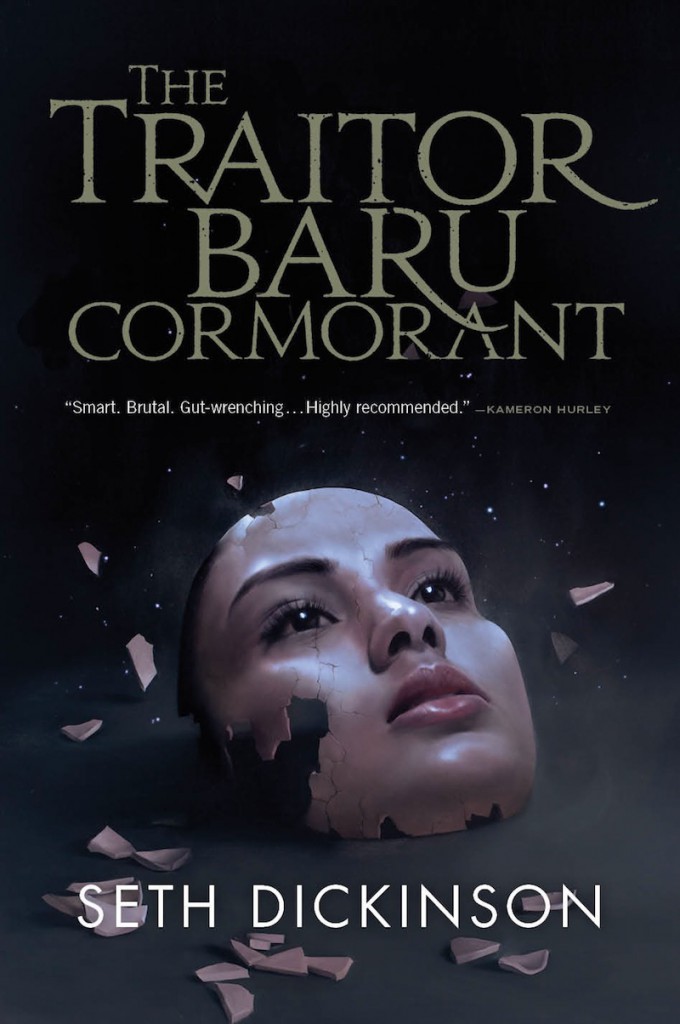
The Traitor Baru Cormorant, by Seth Dickinson, is the story of an accountant.
Baru's guard found a fulling mill by a nearby stream. They brought her there to wait.

The terror that took Baru came from the deepest part of her soul. It was terror particular to her, a fundamental concern — the apocalyptic possibility that the world simply did not permit plans, that it worked in chaotic and unmasterable ways, that one single stroke of fortune, one well-aimed bowshot by a man she had never met, could bring total disaster. The fear that the basic logic she used to negotiate the world was a lie.

Or, worse, that she herself could not plan: that she was as blind as a child, too limited and self-deceptive to integrate the necessary information, and that when the reckoning between her model and the pure asymbolic fact of the world came, the world would devour her like a cuttlefish snapping up bait.

The millwheel had been uncoupled from the machinery and it turned in useless creaking circles.
OK, so she's not an ordinary accountant. She was born in Taranoke, an island country with liberal sexual mores. When she was seven, it was conquered by the Empire of Masks, governed out of Falcrest (by committee, it turns out; the Emperor is a faceless — masked — figurehead). She goes to their schools, is indoctrinated into their Incrastic philosophy. It appears that she has a protector; she is essentially groomed for public service. She performs well on their exams and fresh out of school is awarded a post as Imperial Accountant of Aurdwynn. This conquered nation has a history of rebellion; Baru Cormorant determines that her task is to quell the insurgents, but instead she fuels a revolution.

I've described this book to some people in terms of Game of Thrones: a similar level of politics, machination, and battle planning, but minus the melodrama. A system of government that is if not exactly more modern, a little less barbaric — more complex. This book is more intimate, but somehow no less epic.

The Empire offers education and scientific advancements, medicine and sanitation. But. Incrasticism, possibly from Latin crāstinus ‎"of or belonging to tomorrow", from crās ‎"tomorrow", possibly related to Latin crassus "solid, thick". Never explicitly defined, but we have a clear sense of the dystopian evil of Incrastics.

It occurred to me early on in my reading that this could have been a work based on history. And that would've bored me to tears. Pages of balancing the books, examining the intricacies of trade agreements. Instead, it's genre fiction, so I'm all over it. But this world is ever so subtly removed from an actual one. The character's name are exotic. They practice — and enforce — social and moral hygiene, and some kind of eugenics ("hereditary regulation"). Midway through the novel we encounter the Clarified, conditioned from birth by drugs and other methods to serve.

Quite apart from that, this novel gave me the feeling that it's telling of a time in our actual history. These fantastical elements are expertly woven into the background world; the story is not about these things, but it is a story because of these things.

It was serendipitous to have read Claire North's Gameshouse novellas before embarking on the Traitor's story; it served well as a warmup game of chess, people as pawns.

There's a lot to chew on in this book: hegemony and colonialization, the logistics of rebellion, civic duty at what personal cost. I want to follow the rest of Baru Cormorant's career. I want to explore the rest of the Empire. I want to better understand the hygiene, the regulation, the Clarified, the Incrasticism.

Elsewhere
Seth Dickinson: The Secret Design of the Traitor Baru Cormorant
"In order to make Baru a useful citizen, the Masquerade hopes to create a state of learned helplessness: no matter what you do, it ends up serving our purposes. Accept your place."

Niall Alexander: Tor.com
"To tell the truth, Baru is terrifying at times; a barely-suppressed scream of a human being — yet we want what she wants."

Kameron Hurley: What Will You Sacrifice? The Traitor Baru Cormorant, Kameron Hurley
"It's set up from the beginning as a tragedy about power and commerce and sacrifice, and that's exactly what you get."

Arkady Martine: A Response (spoilers)
"From the beginning this is a book about complicity; it is a book about committing great and profound injustices for the sake of some future possibility of justice."

Excerpt

Tuesday, February 16, 2016

Short and uncertain

A note I made on my phone, February 9, 2014, 10:17 PM:

"She looked short and uncertain, like an accordion in pajamas."

It's further noted that it's on page 53, so it's not some clever observation I made, it's something I read in a book.

I have no idea which book.

I've checked page 53 of several plausibly possible books. I feel like an accordion in pajamas.

Monday, February 15, 2016

Chernobyl apples

"If you don't play, you lose. There was a Ukrainian woman at the market selling big red apples. 'Come get your apples! Chernobyl apples!' Someone told her not to advertise that, no one will buy them. 'Don't worry!' she says. 'They buy them anyway. Some need them for their mother-in-law, some for their boss.'"
— from Voices from Chernobyl: The Oral History of a Nuclear Disaster, by Svetlana Alexievich.

I'll take two, please.

Sunday, February 07, 2016

Lost property cupboard

This is my Lost Property Cupboard theory of the afterlife — when we die we are taken to a great Lost Property Cupboard where all the things we have ever lost have been kept for us — every hairgrip, every button and pencil, every tooth, every earring and key, every pin (think how many there must be!). All the library books, all the cats that never came back, all the coins, all the watches (which will still be keeping time for us). And perhaps, too, the other less tangible things — tempers and patience (perhaps Patricia's virginity will be there), religion (Kathleen has lost hers), meaning, innocence (mine) and oceans of time — Mr Belling and Bunty will find a lot of time in their cupboard. Mr Belling is always sitting at the wheel of the Rover, parked in the driveway, looking at his watch and fuming, "Do you know how much time we've lost waiting for you, Ruby? On the lower shelves will be the dreams we forgot on waking, nestling against the days lost to melancholy thoughts (if they paid dividends Patricia would be rich). And right down at the bottom of the cupboard, amongst the silt and fluff and feather, the pencil shavings and hair swept up from hairdressers' floors — that's where you find the lost memories. Deinde ipsa, virum suum complexa, in mare se deiecit. And perhaps we can sign our names and take them home with us.
Kate Atkinson's Behind the Scenes at the Museum is the story of Ruby Lennox, beginning with her conception, and of various things — a button, a rabbit's foot — commemorated in footnotes, telling of the three generations of (primarily) women before her.

Atkinson has discussed the title, but I have my own ideas. There's only one scene, in the book, in an actual museum, the Castle Museum, and it references Ruby's dream about the museum at night, the secret museum, where things came to life. The museum may as well be a symbol of marriage, what is meant to be seen, and this novel's footnotes show us the secret workings.

Like her most recent books, this novel — Atkinson's debut — also had me laughing out loud, and it made me weep; we live such stupid lives and die such stupid deaths and spend so much time misunderstanding each other. If it weren't so ridiculous and random we'd die from the tragedy of it.

Saturday, February 06, 2016

Games

All the men and women are merely players. But the world's not a stage; it's a gameboard.
At his command were seven other men, of whom two were brothers, four cousins and one they'd picked up as a child and brought along, and who suffered terribly for his lack of genetic bondage. He also had three elephants under his authority, which regarded the great turbulence of the humans about them with the patience of wily priests who have seen rebellion and heard the changing of the psalms, yet looked up and known the heavens never altered for man's delight.
Over the last few weeks I had occasion to devour Claire North's trilogy of Gameshouse novellas: The Serpent, The Thief, and The Master.

I meant to be reading other things, but I moved a few weeks ago, so books were being folded into boxes, at first in a fairly orderly fashion, almost shelf by shelf, but it quickly entropified, books were everywhere, and books were packed alongside the blankets and coffee cups they kept company with. Books I vowed not to lose track of haven't been seen in weeks, including the small book I decided to keep in my purse; at some point I must've decided that it would be safer not rubbing against the measuring tape and screwdriver that I also kept at hand in my purse — I'm confident that it will turn up eventually. Books are now spilling out of those same boxes rather randomly.

I always knew where my ebook was, however, along with my laptop and a few other "valuables." I found myself downloading books at odd hours, because, it seems, I needed them desperately. Someone told me about an article that said reading pageturners significantly reduces stress. I can't find the article, and I've puzzled over the many ways one might define "pageturner," but I've used this "research" to support my sometimes seemingly injudicious use of precious time — this was time I used not merely to read but to recalibrate my emotional and mental well-being.

I'm not sure exactly how I discovered these books. Somehow they were related to some book (which wasn't available) that I'd looked up based on some review. "In seventeenth century Venice exists a mysterious establishment known only as the Gameshouse,"and I was sold.

The Gameshouse novellas are certainly pageturners. The first book lays out the premise. What at first seems to be nothing more than a casino — a gathering place for the rich, the bored, and the desperate — is an institution that spans all of time and encircles the world, insinuating itself into the fabric of cities that hold wealth and power.

The games vary in breadth. In The Serpent, players vie to have their allotted token elected as Doge of Venice. Players are also dealt cards — representing people — which they may also bring into play.

The stakes are high. Fortunes and careers, but also memories, specialized knowledge, physical characteristics, time. The mechanism behind how these transactions are processed is never divulged, but I'd trade my funky knee for someone's facility with Sanskrit in a heartbeat. Others deal in heartbeats.

The Master is my favourite of this set of novellas. A game of hide and seek. The board is 1930s Thailand. Geographically more vast than The Serpent, the game is more intimate.
"Abhik thinks that a game can only be won with ruthlessness and calculation. Were this chess, he would be right, but you, Remy, you have the greatest gift of a higher league player — you remember that your pieces are human. At a superficial level, some might say that makes you kind, but I would suggest it makes you beautiful. To play people is a vastly more elegant skill than mere number-counting."
It also becomes clear that most games are only minor skirmishes in a much larger power struggle.

The third novella, in a modern-day setting, brought closure to the series, but I would love nothing more than an infinite series of Gameshouse game novellas, set in worldclass cities across time. It might bring a new level of paranoia to the conspiracy-minded. We are all, after all, merely pawns in the great game of chess.