The move
Thanks for asking.
Everyone has a different philosophy regarding packing and moving. Of course, mine's the only right way, so why do so many people fail to see that?
Pack everything in sight — what's out of sight is out of mind — in a more or less spatial progression. Open all cupboards and closets to have full view of full inventory at all times, and pack on a more conceptual basis. Carry 5000 boxes to the car in one trip, very slowly, and put your back out. Carry one little bag at a time. Throw everything in the vehicle on a first-come, first-served basis. Didn't anyone but me ever play Tetris?
The heart attack
Or the experience of mine that most closely resembles one. In mid diaper change, I ask J-F to move this bag, it's in the way. A garbage bag full of Helena's stuffed toys. An hour later it occurs to me that I don't see the bag in the hallway. I ask J-F about it — he has no recollection whatsoever of my request or the bag. It's also garbage day. I make him poke through the bags on the curb. I eventually find the bag amid other garbage bags (full of garbage) yet to be removed to the curb, on the balcony.
The mother-in-law
Would you put a 12 pack of beer empties in a box (?!) and move it to a new residence? Heck, if we don't manage to find time to run it over to the dep sometime during the week when we're cleaning our vacated unit, we put it on the curb for some bum to stumble over and factor the $1.20 into the cost of moving.
I got a little snippy with my mother-in-law about the beer. It wasn't about the empties per se, but it was the incident that put me over an edge. It wasn't even about her.
I've been "blog-ranting" about her in my head for days, because the stress build-up simply had to be relieved and it seemed reasonable to focus my energies on her. Now, with keyboard at the ready, there doesn't seem to be much to say about her. Apparently I did drive her to tears, though the tears did not materialize till many hours after my snippy outburst, and not in my presence.
To me, it's painfully obvious that events such as moving are stressful and tiring. A person's mood in this situation is not a fair indicator of that person's outlook or character in general. It should not be taken personally. That someone might fail to recognize this mystifies me.
The problem of "territory" arises from time to time. I still feel Helena's first birthday was taken away from me. Similarly, I walked into Helena's new bedroom and my heart sank, because it was all set up. With her non-favourite toys on her bed. And a dust ruffle on the bed (I hate those). Et cetera. While I know that my mother-in-law's intentions are well-meaning, these deeds do not significantly lessen my load. These are the details of a mother's affection for her daughter and desire to make a home for her being encroached upon.
The kid
If you have to move house with a toddler on hand, don't. And especially make sure the toddler's not sick.
Helena has been less than well and more than needy. This adds much to my stress level, Helena wanting Mama and only Mama, and Mama having to relinquish control and rely on others to get other things done (see above).
Helena's been feverish and snotty-nosed. She also has eczema (have I written about this before?), and it's been severly exacerbated in recent weeks. (I wonder if stress has anything to do with it. And dust.) She scratches till she bleeds (yes, I'm a sorely negligent mother). It's all very pathetic. When she's tired she starts scratching, she scratches in her sleep, she doesn't sleep restfully. When she's a little under the weather, everything's just a little worse. Her bug or cold or infection has passed, but the eczema has become acute.
J-F took Helena to a clinic yesterday (while I waited for phone guy, cable guy, and dishwasher delivery guy); we keep smothering her in creams till she grows out of it.
The doctor
I watched Doctor Who with Helena last night. She'd napped lots and late, and I'd be damned if I was going to let her intrude on the only television hour I give a damn about, again, so watching it together while sharing a muffin seemed like the way to go. She was quick to recognize that this program does in fact have the best theme song ever. At some point (dead bodies) my inner parenting chip pinged and it occurred to me that perhaps I should be "monitoring" for content — that is, not letting her watch, which would entail my not getting to watch. Whatever. She loved the dog and the "monster" ("Rrrrawwrr," giggle, giggle).
First the cataloguer, then the editor; both with an incredibly destructive thirst for information (and the power that comes with it). Hmmm.
Translating Eco
Umberto Eco's new translator, Geoffrey Brock, talks about the experience and the book (and quotes Laurence Sterne to describe Eco's writing style: "Digressions are the sunshine.")
What an extremely challenging, but satisfying, job that must be.
(Digression: Some years ago, I heard Eco speak on problems in translation. He gave examples regarding the translation of The Name of the Rose into Russian. Rather than the Latin found in the original Italian text and English translation, they decided Old Church Slavonic would convey the intended flavour within an appropriate cultural context.)
(Digression the second: Coincidentally, the website on which the interview is featured is the first site I ever bookmarked when we brought a PC home in 1996. The first thing I did with the internet at my fingertips was search for information on Eco.)
"Bad enough to be entertaining"
"Celebrating clunky sentences and mixed metaphors, self-indulgent prose and just plain old bad writing, Lit Lite, a weekly literary series, invites performers to select and read from their favorite bad books."
I love that "heavy drinking is encouraged."
The terrace
I wish I could access my camera. (I do know which box it's in, under all those other boxes.) Our terrace is finally being built and the hourly progress as viewed through the patio doors in what we will treat as the dining room slash office slash family room or play room is amazing.
The courtyard two days ago was a mud pit. Earth and gravel have been compressed, the land has been tiered, small walls are shaping the levels. Stairs run up and down a la Escher. I'm in awe of how this outdoor space has been defined to ensure each unit has its privacy.
The lair
The condo is huge. I love it more by the minute. It's a mess, but it's ours.
We're a little disoriented. Helena came out of the bathroom this morning wondering where the stairs went, taking a minute to figure out they weren't directly opposite the door but a little further down. Myself, I keep forgetting that we can run cold water in the kitchen sink (long story). And there are no ants.
Books will line the bedroom. This is my retreat from the world.
Wednesday, May 18, 2005

Thursday, May 12, 2005
Home!
This time tomorrow, we will be homeowners. Ack!
We do a final inspection with the contractor in the morning, sign a bunch of papers, hand over a lot of money, and get keys.
Then we move.
On the whole, things have been going remarkably smoothly. I anticipate catastrophe to strike within the next 48 hours.
Packing is progressing but slowly. Packing is hell. I've been working hard to deliver a project this week; packing would come after that.
But wouldn't you know, Helena's running a fever and complaining of various pains, so she's home today. While obviously not well, she's in fine spirits and super active. Or maybe she only seems more active cuz there's so many boxes and newspapers strewn about to play with, stacks of stuff everywhere, and nothing can really get put away. She gets upset when I ignore her pleas for a tea party and doesn't understand why I won't let her help pack the crystal.
(She says it's her ear, but there's no sign of infection. I think it's a bad bout of teething — all her teeth came in way ahead of schedule, except for these final molars.)
Sometime this weekend, the computer will be put in a box. I won't have anyplace to write down my thoughts or troubles. I will ignore your comments and email. Internet service will be interrupted. I will want to turn to drink, but the bottles will also be packed.
See ya!
We do a final inspection with the contractor in the morning, sign a bunch of papers, hand over a lot of money, and get keys.
Then we move.
On the whole, things have been going remarkably smoothly. I anticipate catastrophe to strike within the next 48 hours.
Packing is progressing but slowly. Packing is hell. I've been working hard to deliver a project this week; packing would come after that.
But wouldn't you know, Helena's running a fever and complaining of various pains, so she's home today. While obviously not well, she's in fine spirits and super active. Or maybe she only seems more active cuz there's so many boxes and newspapers strewn about to play with, stacks of stuff everywhere, and nothing can really get put away. She gets upset when I ignore her pleas for a tea party and doesn't understand why I won't let her help pack the crystal.
(She says it's her ear, but there's no sign of infection. I think it's a bad bout of teething — all her teeth came in way ahead of schedule, except for these final molars.)
Sometime this weekend, the computer will be put in a box. I won't have anyplace to write down my thoughts or troubles. I will ignore your comments and email. Internet service will be interrupted. I will want to turn to drink, but the bottles will also be packed.
See ya!
Wednesday, May 11, 2005
Wining
We had the pleasure of watching Sideways a couple weeks ago, ironically while enjoying a bottle of merlot (Beringer, 2000).
"If anyone orders merlot, I'm leaving. I am not drinking any fucking merlot."
I hadn't realized before watching the film that it was a stigmatized grape.
This article comes to its defense.
The film was a joy, the acting impeccable, and the soundtrack groovy. Even if the wine pourer did tip out different tastes into the same glass.
The passion for wine was real and unpretentious. It's not about the dinner parties or the status. One couple shares their wine stories — the lightbulb moments, when bottles burst with life and emotional flavour, when they realized wine could be something special. (I'm jealous of such epiphanies.) More than a hobby, good wine becomes a fervent pursuit.
I have had a couple memorable wine experiences — in particular, late-summer Boston, an outdoor lunch of pasta with grilled vegetables, and a fumé blanc (coincidentally also a Beringer).
I enjoy tastings, in private homes or in vineyards. I've been told by some oenophiles that I have a nose. For their benefit, I delight in swishing the liquid about my mouth and making slightly odd proclamations: Canteloupe! Mushrooms! Coriander! They nod in surprised agreement and with respect.
However, I've come to realize that for me what makes a wine special is its context, the event of it, an elusive collusion of elements, rather than the wine itself.
"Get drunk," wrote Baudelaire. Just drink the wine, taste it — really taste it — and enjoy the film.
"It is time to get drunk!"
If you do not want to be the martyred slaves of Time, get drunk, always get drunk!
With wine, with poetry or with being good.
As you please.
"If anyone orders merlot, I'm leaving. I am not drinking any fucking merlot."
I hadn't realized before watching the film that it was a stigmatized grape.
This article comes to its defense.
The film was a joy, the acting impeccable, and the soundtrack groovy. Even if the wine pourer did tip out different tastes into the same glass.
The passion for wine was real and unpretentious. It's not about the dinner parties or the status. One couple shares their wine stories — the lightbulb moments, when bottles burst with life and emotional flavour, when they realized wine could be something special. (I'm jealous of such epiphanies.) More than a hobby, good wine becomes a fervent pursuit.
I have had a couple memorable wine experiences — in particular, late-summer Boston, an outdoor lunch of pasta with grilled vegetables, and a fumé blanc (coincidentally also a Beringer).
I enjoy tastings, in private homes or in vineyards. I've been told by some oenophiles that I have a nose. For their benefit, I delight in swishing the liquid about my mouth and making slightly odd proclamations: Canteloupe! Mushrooms! Coriander! They nod in surprised agreement and with respect.
However, I've come to realize that for me what makes a wine special is its context, the event of it, an elusive collusion of elements, rather than the wine itself.
"Get drunk," wrote Baudelaire. Just drink the wine, taste it — really taste it — and enjoy the film.
"It is time to get drunk!"
If you do not want to be the martyred slaves of Time, get drunk, always get drunk!
With wine, with poetry or with being good.
As you please.
Tuesday, May 10, 2005
Fictionology
When fiction becomes religion:
[(My personal god would be found in a magic notebook (a la Auster).]
"Unlike Scientology, which is based on empirically verifiable scientific tenets, Fictionology's central principles are essentially fairy tales with no connection to reality."
Fictionology's central belief, that any imaginary construct can be incorporated into the church's ever-growing set of official doctrines, continues to gain popularity. Believers in Santa Claus, his elves, or the Tooth Fairy are permitted—even encouraged—to view them as deities. Even corporate mascots like the Kool-Aid Man are valid objects of Fictionological worship.
"Sure, it's total bullshit... But that's Fictionology. Praise Batman!"
[(My personal god would be found in a magic notebook (a la Auster).]
Monday, May 09, 2005
Narnia
The Chronicles of Narnia: The Lion, the Witch and the Wardrobe — movie trailer.
Magical and epic! as it should be.
Magical and epic! as it should be.
The lovely holiday that is Mothers' Day
Helena was extra sweet, super cute, and very kissy.
She even insisted on getting dressed all by herself.
Helena chose the outfit.
(Never mind that we'd barely reached double digits on the centigrade scale and we had to change into something more appropriate before going out.)
We enjoyed brunch out and hours in the park. Helena's smile is the best gift, and I'm lucky to see it most days.
Friday I'd been invited to share snacktime with Helena at the daycare, along with the other mothers. Cupcakes! Presents!
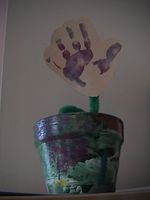
This is the flowerpot Helena painted for me.
Needless to say, I will treasure it forever.
She even insisted on getting dressed all by herself.
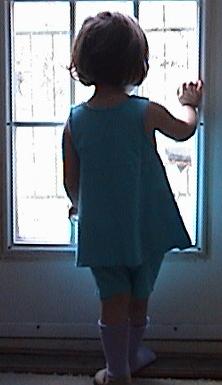
Helena chose the outfit.

(Never mind that we'd barely reached double digits on the centigrade scale and we had to change into something more appropriate before going out.)
We enjoyed brunch out and hours in the park. Helena's smile is the best gift, and I'm lucky to see it most days.
Friday I'd been invited to share snacktime with Helena at the daycare, along with the other mothers. Cupcakes! Presents!
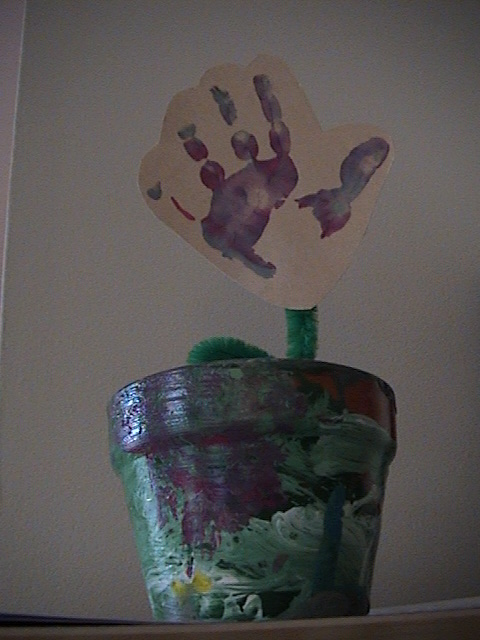
This is the flowerpot Helena painted for me.
Needless to say, I will treasure it forever.
Sunday, May 08, 2005
What I've been up to
1. Work. What timing for so much work to land in my lap earlier this week! Of course, it's work I'd previously committed to, and which is seriously behind schedule, and I'd been hoping it would be another two weeks behind schedule so we could get this whole buying a condo thing and moving into it out of the way, but no. I've been working late into the night even. But it's almost done now.
2. Procrastinating. Mostly during the day, leaving the late-night hours free for work. Sadly, I've resorted to playing solitaire. Procrastination by blogging would leave far too much tangible evidence of my lack of discipline (and my vulnerable psyche couldn't handle the guilt of that just now), as would reading anything of interest, as that would no doubt lead to inspired blogging.
3. Packing. But slowly. I'm averaging about a box a day. I haven't even packed the easy stuff (books!) yet. I don't even want to think about it, much less do it. And what the hell am I supposed to do with video cassette tapes? Or audio cassette tapes for that matter? Preserve boxes of things I don't use? Putting them out on the curb seems so rash.
4. Composing blog entries in my head. Just in case I felt I could allow myself the time to put it all down. But generally feeling uninspired. I do still have things to say about Mothers' Day, my mother and how we're so very different, the kid and how we seem to constantly engage in a battle of wills, Bambi, the movie Sideways, and the ants that are freaking me out. These thoughts may or may not materialize in this space in the hours or days ahead. Feel lucky that my rants on how I've yet to see the first 15 minutes of a Doctor Who episode because Helena knows it's the only night I actually care about where I am at 8:00 and on how nobody offers me a seat on the metro or bus while Helena insists I carry her have come and gone.
5. Missing a cousin's wedding in Chicago this weekend. I so badly wanted to be there, but then we went and bought this stupid condo, so time and money are a little short right now. To be honest, I don't know her very well, or many of my other cousins, but we do have a strong family bond — the rare occasions we find ourselves together (weddings and funerals) there's deep satisfaction, if not joy and enlightenment, in finding ourselves in each other's company. All of us. I mean, we're family. And among the cousins the opportunities for weddings are pretty much exhausted. So that leaves funerals, which one can't really plan in advance and aren't nearly as much fun. Sigh.
2. Procrastinating. Mostly during the day, leaving the late-night hours free for work. Sadly, I've resorted to playing solitaire. Procrastination by blogging would leave far too much tangible evidence of my lack of discipline (and my vulnerable psyche couldn't handle the guilt of that just now), as would reading anything of interest, as that would no doubt lead to inspired blogging.
3. Packing. But slowly. I'm averaging about a box a day. I haven't even packed the easy stuff (books!) yet. I don't even want to think about it, much less do it. And what the hell am I supposed to do with video cassette tapes? Or audio cassette tapes for that matter? Preserve boxes of things I don't use? Putting them out on the curb seems so rash.
4. Composing blog entries in my head. Just in case I felt I could allow myself the time to put it all down. But generally feeling uninspired. I do still have things to say about Mothers' Day, my mother and how we're so very different, the kid and how we seem to constantly engage in a battle of wills, Bambi, the movie Sideways, and the ants that are freaking me out. These thoughts may or may not materialize in this space in the hours or days ahead. Feel lucky that my rants on how I've yet to see the first 15 minutes of a Doctor Who episode because Helena knows it's the only night I actually care about where I am at 8:00 and on how nobody offers me a seat on the metro or bus while Helena insists I carry her have come and gone.
5. Missing a cousin's wedding in Chicago this weekend. I so badly wanted to be there, but then we went and bought this stupid condo, so time and money are a little short right now. To be honest, I don't know her very well, or many of my other cousins, but we do have a strong family bond — the rare occasions we find ourselves together (weddings and funerals) there's deep satisfaction, if not joy and enlightenment, in finding ourselves in each other's company. All of us. I mean, we're family. And among the cousins the opportunities for weddings are pretty much exhausted. So that leaves funerals, which one can't really plan in advance and aren't nearly as much fun. Sigh.
Thursday, May 05, 2005
Bringing you the world
World Literature Today honours Adam Zagajewski, the 2004 Neustadt laureate.
Also in the current issue of WLT, dozens of really interesting thing to read, which I don't really have time for, including:
- a tribute to Polish literary Nobelists
- Jelinek's Nobel lecture
- travels in New York, Berlin, and Kazakhstan
- a short story by Tim Wynne-Jones
- thoughts on translating Hopscotch (I loved Hopscotch!)
The celebration of Gombrowicz continues. I love this bit they've quoted from Ferdydurke (tr. Danuta Borchardt):
Naguib Mahfouz on the state of the novel and why we read:
Poetry is content with touching people’s injuries; thus they cry in pain. The novel, however, treats the injury as a skilled surgeon does; it delves into the injury and casts an illuminating light on its various dimensions and explores its multiple details.
Self-Portrait
Between the computer, a pencil, and a typewriter
half my day passes. One day it will be half a century.
I live in strange cities and sometimes talk
with strangers about matters strange to me.
I listen to music a lot: Bach, Mahler, Chopin, Shostakovich.
I see three elements in music: weakness, power, and pain.
The fourth has no name.
I read poets, living and dead, who teach me
tenacity, faith, and pride. I try to understand
the great philosophers — but usually catch just
scraps of their precious thoughts.
I like to take long walks on Paris streets
and watch my fellow creatures, quickened by envy,
anger, desire; to trace a silver coin
passing from hand to hand as it slowly
loses its round shape (the emperor's profile is erased).
Beside me trees expressing nothing
but a green, indifferent perfection.
Black birds pace the fields,
waiting patiently like Spanish widows.
I'm no longer young, but someone else is always older.
I like deep sleep, when I cease to exist,
and fast bike rides on country roads when poplars and houses
dissolve like cumuli on sunny days.
Sometimes in museums the paintings speak to me
and irony suddenly vanishes.
I love gazing at my wife's face.
Every Sunday I call my father.
Every other week I meet with friends,
thus proving my fidelity.
My country freed itself from one evil. I wish
another liberation would follow.
Could I help in this? I don't know.
I'm truly not a child of the ocean,
as Antonio Machado wrote about himself,
but a child of air, mint and cello
and not all the ways of the high world
cross paths with the life that — so far —
belongs to me.
— Adam Zagajewski (tr. Clare Cavanagh)
Also in the current issue of WLT, dozens of really interesting thing to read, which I don't really have time for, including:
- a tribute to Polish literary Nobelists
- Jelinek's Nobel lecture
- travels in New York, Berlin, and Kazakhstan
- a short story by Tim Wynne-Jones
- thoughts on translating Hopscotch (I loved Hopscotch!)
The celebration of Gombrowicz continues. I love this bit they've quoted from Ferdydurke (tr. Danuta Borchardt):
Oh, the power of Form! Nations die because of it. It is the cause of wars. It creates something in us that is not of us. If you make light of it you'll never understand stupidity nor evil nor crime. It governs our slightest impulses. It is at the base of our collective life. For you, however, Form and Style still belong strictly to the realm of the aesthetic — for you style is on paper only, in the style of your stories. Gentlemen, who will slap your pupa which you dare turn toward others as you kneel at the altar of art? For you form is not something that is human and alive, something — I'd say — practical and everyday, but just a feature for the holidays. And while you’re leaning over a piece of paper you forget your own self — you don't care about perfecting your own individual and concrete style, you merely practice an abstract stylization in a vacuum. Instead of art serving you, you serve art — and with a sheeplike docility you let it impede your development, and you let it push you into the hell of indolence.
Naguib Mahfouz on the state of the novel and why we read:
Poetry is content with touching people’s injuries; thus they cry in pain. The novel, however, treats the injury as a skilled surgeon does; it delves into the injury and casts an illuminating light on its various dimensions and explores its multiple details.
Tuesday, May 03, 2005
How I discouraged my child from pursuing a life in the theatre at a young age
...which may not be an entirely bad thing,
although instead I may have caused a trauma that will help instill a flair for drama.
We missed Helena's end-of-term theatre recital. (Yes, for two-year-olds. Last term was music.) I didn't know.
I assumed we missed the note — her course is on Mondays, and last Monday she stayed home.
Yesterday's daily report noted the performance, and that Helena was a bit stupefied in the presence of so many spectators.
The guilt that hit me when I read this was overwhelming. I didn't talk to her group leader about it for fear that I'd break down.
Helena seems to be OK with things. If anything, my tearful apologies are freaking her out more than my absence might have.
It turns out, J-F knew, and neglected to tell me. The oversight is somewhat mitigated by the fact he was writing an exam yesterday and had a lot on his mind, not to mention the general chaos of our surroundings and the effect of other home-purchase-related crap. But still...
I have to call this Parenting Fuck-up #1.
(Yes, #1 — we'll start counting fresh with this one, relegating all previous mishaps, like the time Helena rolled off the kitchen table, to another era, of Infant/Baby Care, as opposed to the active moral and social guidance, education, and encouragement of emotional or artistic expression required of actual Parenting.)
Forgive me, little one. I know you're awesome at pretending to be a fish, and you're a proficient puppetmaster, manipulating your stuffed toys and putting words in their mouths. You have a fine sense of comedic timing, and when we play monster hunting I totally buy into the concern and fear you emote. So please, understand why I wasn't there for you, and don't interpret it as a lack of support — if you really want a career on the stage, I know you have it in you to make it happen, and I'll do what I can to help.
although instead I may have caused a trauma that will help instill a flair for drama.
We missed Helena's end-of-term theatre recital. (Yes, for two-year-olds. Last term was music.) I didn't know.
I assumed we missed the note — her course is on Mondays, and last Monday she stayed home.
Yesterday's daily report noted the performance, and that Helena was a bit stupefied in the presence of so many spectators.
The guilt that hit me when I read this was overwhelming. I didn't talk to her group leader about it for fear that I'd break down.
Helena seems to be OK with things. If anything, my tearful apologies are freaking her out more than my absence might have.
It turns out, J-F knew, and neglected to tell me. The oversight is somewhat mitigated by the fact he was writing an exam yesterday and had a lot on his mind, not to mention the general chaos of our surroundings and the effect of other home-purchase-related crap. But still...
I have to call this Parenting Fuck-up #1.
(Yes, #1 — we'll start counting fresh with this one, relegating all previous mishaps, like the time Helena rolled off the kitchen table, to another era, of Infant/Baby Care, as opposed to the active moral and social guidance, education, and encouragement of emotional or artistic expression required of actual Parenting.)
Forgive me, little one. I know you're awesome at pretending to be a fish, and you're a proficient puppetmaster, manipulating your stuffed toys and putting words in their mouths. You have a fine sense of comedic timing, and when we play monster hunting I totally buy into the concern and fear you emote. So please, understand why I wasn't there for you, and don't interpret it as a lack of support — if you really want a career on the stage, I know you have it in you to make it happen, and I'll do what I can to help.
Monday, May 02, 2005
Stuff and nonsense
Spring, I can say with full confidence, has arrived, even if it still bloody effing cold. There's little tangible proof of it, apart from slightly greener grass, but it seems the spirit, in a combination of wishful thinking and denial on the part of this city's inhabitants, has taken hold.
The tax forms are done and delivered. The burden of paying taxes remains, and I curse this freelance lifestyle and the delusion that the income I earn is actually mine to spend, but I have come to terms with it, at least for the timebeing, in the knowledge that what moneys I owe the governments comes back to me in daycare, decent health services, and relatively low rent in this province.
Kid stuff
Helena has developed a sudden and strong attraction to a bear. She's never paid this bear any attention. Two and a half years we've had this bear (longer even than we've had Helena). He sat in her crib for months, unloved. He's been sitting on the shelf with other overlooked toys. Suddenly, he is chosen. He's The Bear. He comes with us for walks in the rain, to do the groceries, to visit family. She excitedly introduced him to her grandmother, her grandmother's partner, her grandmother's partner's mother, the nice lady at the liquor store, the old woman on the park bench, and her great grandfather. I wonder how long this will last.
Going out in the rain is something I generally try to avoid, but it's much harder to avoid when one has a toddler telling you she wants to go outside. Hard to resist, and hard to argue with really, when the apartment is small and currently upside-down, play spaces overrun with boxes, and the toddler has a lot of energy she obviously needs to expend.
To the park, in the rain, in search of ducks.
Sadly, the lakes are not yet filled, with either water or ducks, but to Helena's great pleasure, many walkways and the parking lot are filled with lake-size puddles.
If you've never been puddle-jumping with a toddler, and even if you have, I recommend it. We rounded out the excursion with some seagull-chasing, and some vigorous crying which stopped just short of her lying down in a puddle to pound her fists because I refused her the opportunity to go down the water slide, by which I mean the regular playground slide in the rain.
The sun did break through yesterday, so off we went to investigate the slide situation. The playground was full. Helena was timid. I wasn't prepared for that. By the time last summer had wound down, she owned that park. The few times we trudged out in the snow, and even in recent weeks, she had the run of the place. Helena is comfortable and social in daycare, but at heart I think she may be a loner. Or, like her parents, she'll assert herself only when she's good and ready, meaning she has to know the people or situation pretty well. So with all those strange kids running around, she hung back, gripped my finger tightly, watched the other little bodies intently. We chased each other around in one corner of the park. She giggled, kept calling "Viens, Mama!" She did warm up to negotiating the slide, was willing to share space, wait her turn, but it reminds me that her socialization isn't over — it's barely begun.
Helena was stopped in her tracks on seeing another little girl wearing her raingear. (And I must say, she didn't wear it nearly so cutely as Helena.)
I continue to be amazed by the detail of imaginative play. We play "bus" and "metro" fairly regularly, Helena donning hat and shoes, gathering backpack and shopping bag, preparing to "go out." It was weeks ago already that she first combined the pretend bus and metro, assigning one particular doorframe the function of transfer dispenser. While we often transfer from one mode of transport to the other in real life, I'd never realized to what extent the details register. Of course, her whole life is made up of such detail (and ours is too, though we may not take notice). I am now scolded severely when I neglect to acquire a transfer from the doorframe or raise my knees sufficiently when climbing/descending the stairs of the bus.
Much of this last week Helena has been engaged in cleaning up "accidents." It seems both Elmo and one the Tubbies are exhibiting typical Helena behaviour in refusing to wear their diapers and then producing "messes" on the floor, which I am grateful she most diligently and promptly attends to — there's nothing like stepping in an imaginary puddle and dealing with frantic near unintelligible toddler exclamations about peepee and kaka to help blur reality.
Book stuff
Yesterday, waiting in the car while J-F popped out, Helena asleep in her seat, I caught the tail end of Carlos Fuentes reading from, I believe, his recent book of essays (excerpt), on Writers and Company, about a flourishing literal cross-border trade in literature, the currency of ideas. (He sounds like a much younger man.) It makes me more than a little sorry that I had to miss Blue Metropolis this year.
I've been rereading Douglas Adams' Hitchhiker's trilogy (in five parts). We'd started before Christmas, reading aloud at bedtime, in anticipation of the movie. It didn't take long before we fell out of the habit, but I've been zipping through it over the last week whenever I find a few spare minutes, and this to some extent compensates for the fact that we won't be getting out to see a movie in a theatre any time soon. It turns out my memory of the radio play is much more vivid than that of the actual book. There are stretches I don't remember reading at all. Which makes it all very fresh and exciting.
Packing up books: Carter Beats the Devil , by Glen David Gold, puts a smile on my face. It's one of the more entertaining books I've read in recent memory. Magic! Murder! Romance! Traumatic childhood! Pirates! I mention it now only cuz I wish he'd write something else for me to read already.
Last call for free books. Some are spoken for, but many remain. I intend to have them shipped off to you by the end of the week.
Hilary Mantel's The Giant O'Brien is still up for grabs. Though maybe it shouldn't be — I'd received it as a gift and I notice now that there's an inscription. Plus, I did rather enjoy it. However, all the great press her new book is receiving notwithstanding (and it does sound intriguing), I had the misfortune of hearing her in interview a year or two ago, and I thought her sssoooo pretentious, so full of herself and her writerly life, "listen to me go on about my grand revelations" when in fact they are perfectly ordinary, please get over yourself, that I am loathe to read another word of hers.
(I remember hearing one young author talk about having lived in Greece. It turned out she spent a summer there. Three months. Sure, you set up a homebase, immerse yourself in the local culture, but that hardly qualifies as living there. A year maybe. Or if you had with you all your worldly possessions and were struggling to find work to support yourself the whole while. But mommy and daddy footing the bill and maintaining your apartment for your return doesn't count. That's a vacation, it's not "living abroad." I really hate when people exaggerate.)
The reports have swished about for some time, and the new library in town is there to drive the point home, but I have a hard time believing that Quebeckers (at least Montrealers) don't read. When I moved here three years ago one of the things I found most striking was that almost everyone who rode public transit had a book in their hands. This was in stark contrast to the blank-faced commuters in other cities I've spent any time in. Montreal drivers are dangerous, many of them so because they have newspapers open beside them. In summer, every park bench is occupied equally by people and books. No matter the age or language. They're reading international books and classics along with genre fiction (definitely more fiction than nonfiction). Maybe it's only those people who ride the same routes as I do, hang out in this particular park, sit in those cafés that flank my path. But I can't reconcile the anecdotal evidence to the official reports. Maybe I will take on the project this summer to document "books seen being read in Montreal."
Other stuff
Reality TV finds religion. (via Mirabilis)
The tax forms are done and delivered. The burden of paying taxes remains, and I curse this freelance lifestyle and the delusion that the income I earn is actually mine to spend, but I have come to terms with it, at least for the timebeing, in the knowledge that what moneys I owe the governments comes back to me in daycare, decent health services, and relatively low rent in this province.
Kid stuff
Helena has developed a sudden and strong attraction to a bear. She's never paid this bear any attention. Two and a half years we've had this bear (longer even than we've had Helena). He sat in her crib for months, unloved. He's been sitting on the shelf with other overlooked toys. Suddenly, he is chosen. He's The Bear. He comes with us for walks in the rain, to do the groceries, to visit family. She excitedly introduced him to her grandmother, her grandmother's partner, her grandmother's partner's mother, the nice lady at the liquor store, the old woman on the park bench, and her great grandfather. I wonder how long this will last.
Going out in the rain is something I generally try to avoid, but it's much harder to avoid when one has a toddler telling you she wants to go outside. Hard to resist, and hard to argue with really, when the apartment is small and currently upside-down, play spaces overrun with boxes, and the toddler has a lot of energy she obviously needs to expend.
To the park, in the rain, in search of ducks.
Sadly, the lakes are not yet filled, with either water or ducks, but to Helena's great pleasure, many walkways and the parking lot are filled with lake-size puddles.
If you've never been puddle-jumping with a toddler, and even if you have, I recommend it. We rounded out the excursion with some seagull-chasing, and some vigorous crying which stopped just short of her lying down in a puddle to pound her fists because I refused her the opportunity to go down the water slide, by which I mean the regular playground slide in the rain.
The sun did break through yesterday, so off we went to investigate the slide situation. The playground was full. Helena was timid. I wasn't prepared for that. By the time last summer had wound down, she owned that park. The few times we trudged out in the snow, and even in recent weeks, she had the run of the place. Helena is comfortable and social in daycare, but at heart I think she may be a loner. Or, like her parents, she'll assert herself only when she's good and ready, meaning she has to know the people or situation pretty well. So with all those strange kids running around, she hung back, gripped my finger tightly, watched the other little bodies intently. We chased each other around in one corner of the park. She giggled, kept calling "Viens, Mama!" She did warm up to negotiating the slide, was willing to share space, wait her turn, but it reminds me that her socialization isn't over — it's barely begun.
Helena was stopped in her tracks on seeing another little girl wearing her raingear. (And I must say, she didn't wear it nearly so cutely as Helena.)
I continue to be amazed by the detail of imaginative play. We play "bus" and "metro" fairly regularly, Helena donning hat and shoes, gathering backpack and shopping bag, preparing to "go out." It was weeks ago already that she first combined the pretend bus and metro, assigning one particular doorframe the function of transfer dispenser. While we often transfer from one mode of transport to the other in real life, I'd never realized to what extent the details register. Of course, her whole life is made up of such detail (and ours is too, though we may not take notice). I am now scolded severely when I neglect to acquire a transfer from the doorframe or raise my knees sufficiently when climbing/descending the stairs of the bus.
Much of this last week Helena has been engaged in cleaning up "accidents." It seems both Elmo and one the Tubbies are exhibiting typical Helena behaviour in refusing to wear their diapers and then producing "messes" on the floor, which I am grateful she most diligently and promptly attends to — there's nothing like stepping in an imaginary puddle and dealing with frantic near unintelligible toddler exclamations about peepee and kaka to help blur reality.
Book stuff
Yesterday, waiting in the car while J-F popped out, Helena asleep in her seat, I caught the tail end of Carlos Fuentes reading from, I believe, his recent book of essays (excerpt), on Writers and Company, about a flourishing literal cross-border trade in literature, the currency of ideas. (He sounds like a much younger man.) It makes me more than a little sorry that I had to miss Blue Metropolis this year.
I've been rereading Douglas Adams' Hitchhiker's trilogy (in five parts). We'd started before Christmas, reading aloud at bedtime, in anticipation of the movie. It didn't take long before we fell out of the habit, but I've been zipping through it over the last week whenever I find a few spare minutes, and this to some extent compensates for the fact that we won't be getting out to see a movie in a theatre any time soon. It turns out my memory of the radio play is much more vivid than that of the actual book. There are stretches I don't remember reading at all. Which makes it all very fresh and exciting.
Packing up books: Carter Beats the Devil
, by Glen David Gold, puts a smile on my face. It's one of the more entertaining books I've read in recent memory. Magic! Murder! Romance! Traumatic childhood! Pirates! I mention it now only cuz I wish he'd write something else for me to read already. Last call for free books. Some are spoken for, but many remain. I intend to have them shipped off to you by the end of the week.
Hilary Mantel's The Giant O'Brien is still up for grabs. Though maybe it shouldn't be — I'd received it as a gift and I notice now that there's an inscription. Plus, I did rather enjoy it. However, all the great press her new book is receiving notwithstanding (and it does sound intriguing), I had the misfortune of hearing her in interview a year or two ago, and I thought her sssoooo pretentious, so full of herself and her writerly life, "listen to me go on about my grand revelations" when in fact they are perfectly ordinary, please get over yourself, that I am loathe to read another word of hers.
(I remember hearing one young author talk about having lived in Greece. It turned out she spent a summer there. Three months. Sure, you set up a homebase, immerse yourself in the local culture, but that hardly qualifies as living there. A year maybe. Or if you had with you all your worldly possessions and were struggling to find work to support yourself the whole while. But mommy and daddy footing the bill and maintaining your apartment for your return doesn't count. That's a vacation, it's not "living abroad." I really hate when people exaggerate.)
The reports have swished about for some time, and the new library in town is there to drive the point home, but I have a hard time believing that Quebeckers (at least Montrealers) don't read. When I moved here three years ago one of the things I found most striking was that almost everyone who rode public transit had a book in their hands. This was in stark contrast to the blank-faced commuters in other cities I've spent any time in. Montreal drivers are dangerous, many of them so because they have newspapers open beside them. In summer, every park bench is occupied equally by people and books. No matter the age or language. They're reading international books and classics along with genre fiction (definitely more fiction than nonfiction). Maybe it's only those people who ride the same routes as I do, hang out in this particular park, sit in those cafés that flank my path. But I can't reconcile the anecdotal evidence to the official reports. Maybe I will take on the project this summer to document "books seen being read in Montreal."
Other stuff
Reality TV finds religion. (via Mirabilis)
Saturday, April 30, 2005
We have normality...
...Anything you still can't cope with is therefore your own problem.
Which Hitch-Hiker's Guide to the Galaxy character are you? (via SFSignal)
Read The Science Creative Quarterly. Because it's funny, and it kind of has to do with science, in a quasi-creative way. (via All My Shoes and Glasses)
Note especially: A dialogue with Sarah, aged 3: in which it is shown that if your dad is a chemistry professor, asking "why" can be dangerous.
Photographic proof of moon raccoons!
Evidence denied by NASA.
Which Hitch-Hiker's Guide to the Galaxy character are you? (via SFSignal)
You're Ford Prefect! Love to drink. You can't pronounce your own name, and your cousin has three arms, two heads and one recipe for a Pan Galactic GargleBlaster. Hey! Saz that hoopy there, Ford Prefect, now there's a Frood who really knows where his towel is.
Read The Science Creative Quarterly. Because it's funny, and it kind of has to do with science, in a quasi-creative way. (via All My Shoes and Glasses)
Note especially: A dialogue with Sarah, aged 3: in which it is shown that if your dad is a chemistry professor, asking "why" can be dangerous.
Photographic proof of moon raccoons!
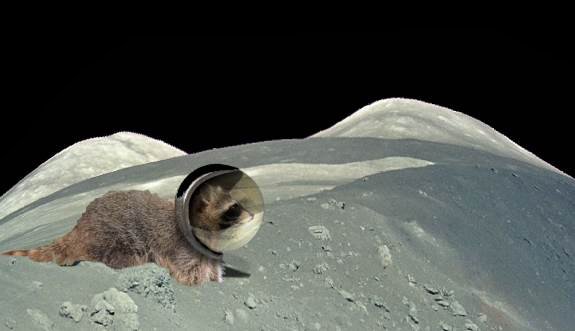
Evidence denied by NASA.
Friday, April 29, 2005
Thursday, April 28, 2005
The clothes make the woman
I've cleaned out my closet and drawers. Thoroughly. I've been ruthless — if it doesn't fit now, or if it hasn't been worn in the last three years (is that too generous?), away with it.
I threw out my red shoes. The faux-fur-lined red-vinyl lace-up ankle boots that made me feel so... individual in my final year of high school, 18 years ago. They had their day.
Then I opened the trunk. I thought I'd pretty much emptied the trunk; the only thing I remembered storing was a couple articles of maternity clothing, just in case.
The trunk.
My Brave New Waves t-shirt ("with apologies from CBC stereo"), black with pink logo, circa 1986, when Brent Bambury was host, which I won for some contest or other. When I worked late into the night on school projects, listening to Skinny Puppy and Einsturzende Neubauten. When I learned about Philip Glass and John Zorn. When I first heard of Italo Calvino, listened to a reading of If on a Winter's Night a Traveller.
The leather jacket. The black leather motorcycle jacket. My brother's jacket. It was his prize possession when he was in his early 20s; I was barely, not even, a teenager. My punk-ass brother and his jacket were the epitome of cool. Many years later he handed it off to me. It served me well through university. I wore it to London and to Paris. It hasn't really fit me in ages — it was always snug, but there's no hope of ever zipping it up again. But some seasons I still pull it out, feel the weight of it on my shoulders and hug it close. (There's a pin in the lapel, commemorative of Christmas in Italy, 1943 — my father's.)
A wide-brimmed black velvet hat with a spray of roses. I spent a fortune on it ($25 in 1988). I wore it only a couple times — in a photo shoot for a friend, and to a vernissage — because it wouldn't stay put. Also found: receipt for one large pearl hat pin ($1.50 plus tax) from retro shop. Helena is going to love this hat.
Various wearable nostalgia. Two The The concert tour shirts. A t-shirt from a vineyard on Long Island: "Life is a cabernet."
My father's fishing cap.
My mother's early 60s beaver pelt turban-style hat with glittery brooch.
Little black dresses. My mother's little black dresses. The wool dress with the fringed bustline (New Year's Eve 1956). The one tiered in lace ribbon with the wide velvet shoulder straps.
I remember those dresses sheathed in plastic hanging in my mother's closet when I was a little girl. She never wore them. Years later, home visiting from university and worrying over what to wear to some party or event or other, she gave them to me. I wore them a lot, to clubs and cafes and on dates, and I wore them well.
When I rediscovered those dresses in my mother's closet when I was 18, in some sense I discovered my mother, saw her as a woman for the first time. A woman with fashion savvy who went to dances and parties, who had special occasions that didn't involve her children's birthdays, who had a romantic soul, and an obvious sense of nostalgia.
I'm keeping some of my own dresses as well. The skirt and jacket my mother made for me out of red and black brocade upholstery fabric, cuz I asked her to. A couple sexy party dresses. The swishy-skirted dress I treated myself to in Poland. The yellow sundress I was wearing the day I first laid eyes on J-F, waiting at the bus stop with a mutual friend. The skirt and jacket I wore to that same friend's wedding, when I met and fell in love with J-F.
Someday, I expect Helena will be looking for something special to wear, for a party, maybe a date. We'll open up the trunk. Maybe she'll realize something about the woman her mother was before she had a family, and she'll wear that too.
I threw out my red shoes. The faux-fur-lined red-vinyl lace-up ankle boots that made me feel so... individual in my final year of high school, 18 years ago. They had their day.
Then I opened the trunk. I thought I'd pretty much emptied the trunk; the only thing I remembered storing was a couple articles of maternity clothing, just in case.
The trunk.
My Brave New Waves t-shirt ("with apologies from CBC stereo"), black with pink logo, circa 1986, when Brent Bambury was host, which I won for some contest or other. When I worked late into the night on school projects, listening to Skinny Puppy and Einsturzende Neubauten. When I learned about Philip Glass and John Zorn. When I first heard of Italo Calvino, listened to a reading of If on a Winter's Night a Traveller.
The leather jacket. The black leather motorcycle jacket. My brother's jacket. It was his prize possession when he was in his early 20s; I was barely, not even, a teenager. My punk-ass brother and his jacket were the epitome of cool. Many years later he handed it off to me. It served me well through university. I wore it to London and to Paris. It hasn't really fit me in ages — it was always snug, but there's no hope of ever zipping it up again. But some seasons I still pull it out, feel the weight of it on my shoulders and hug it close. (There's a pin in the lapel, commemorative of Christmas in Italy, 1943 — my father's.)
A wide-brimmed black velvet hat with a spray of roses. I spent a fortune on it ($25 in 1988). I wore it only a couple times — in a photo shoot for a friend, and to a vernissage — because it wouldn't stay put. Also found: receipt for one large pearl hat pin ($1.50 plus tax) from retro shop. Helena is going to love this hat.
Various wearable nostalgia. Two The The concert tour shirts. A t-shirt from a vineyard on Long Island: "Life is a cabernet."
My father's fishing cap.
My mother's early 60s beaver pelt turban-style hat with glittery brooch.
Little black dresses. My mother's little black dresses. The wool dress with the fringed bustline (New Year's Eve 1956). The one tiered in lace ribbon with the wide velvet shoulder straps.
I remember those dresses sheathed in plastic hanging in my mother's closet when I was a little girl. She never wore them. Years later, home visiting from university and worrying over what to wear to some party or event or other, she gave them to me. I wore them a lot, to clubs and cafes and on dates, and I wore them well.
When I rediscovered those dresses in my mother's closet when I was 18, in some sense I discovered my mother, saw her as a woman for the first time. A woman with fashion savvy who went to dances and parties, who had special occasions that didn't involve her children's birthdays, who had a romantic soul, and an obvious sense of nostalgia.
I'm keeping some of my own dresses as well. The skirt and jacket my mother made for me out of red and black brocade upholstery fabric, cuz I asked her to. A couple sexy party dresses. The swishy-skirted dress I treated myself to in Poland. The yellow sundress I was wearing the day I first laid eyes on J-F, waiting at the bus stop with a mutual friend. The skirt and jacket I wore to that same friend's wedding, when I met and fell in love with J-F.
Someday, I expect Helena will be looking for something special to wear, for a party, maybe a date. We'll open up the trunk. Maybe she'll realize something about the woman her mother was before she had a family, and she'll wear that too.
Wednesday, April 27, 2005
Things I don't know what to make of
A.S. Byatt:
"I think about how much thinner literary characters have got since the disappearance of Christianity."
Hmm.
1. When did that happen?
2. There are many great literary characters of whom I can't say I ever considered religion to be the driving force.
3. What does that say about her own characters?
"Without religion we've been reduced to sex and death." And that's bad?
"I think about how much thinner literary characters have got since the disappearance of Christianity."
Hmm.
1. When did that happen?
2. There are many great literary characters of whom I can't say I ever considered religion to be the driving force.
3. What does that say about her own characters?
"Without religion we've been reduced to sex and death." And that's bad?
Tuesday, April 26, 2005
Circus of angels
J-F and I went to the circus on Sunday. We'd received tickets for Cirque du Soleil as a Christmas present.
Corteo. I'd heard nothing about the new show.
The anticipation in the hours preceding the matinee performance was palpable. There's nothing like the childlike awe in beholding the whimsical shape and colours of the circus tent and stepping through its flaps into another world.
The curtain was raised on a man on his deathbed. Angels flit about, and he struggles to join him. A parade of life passes him by — I assumed it was his life, his memories — some unseemly characters threatening to thwart his ascent to the angelic orders. This was his struggle to find peace in death, to cross into the afterlife. Angels!
For a full hour, my face was strained from smiling, my jaw dropping at regular intervals. We nudged each other, giggled, and pointed. Breathtaking. Heart-stopping.
At intermission, we darted through the rain to other tents to admire the trophies available for purchase to those lucky enough to be in attendance. Seuss-like hats, masks and wings, full whimsy wardrobes, along with the more conventional programmes and CDs.
The second act, though thrilling, faltered. The pacing was off. One very slow, if beautiful, sequence featuring a proficient whistler accompanied by a glass orchestra was followed up with jugglers interrupted by a torrent of rubber chickens, and then a weak, almost charmless, slapstick midget theatre production.
The music too was uneven. It was unmistakably Cirque, with the usual Mediterranean and Arabic influences incorporated into a soundtrack designed to build suspense. It was perhaps a little jazzier than is typical of their sound, scat even, but sadly it lapsed into Kenny G-type solos and regressed to a style of early 80s rock ballad. Little of it matched the baroque-inspired set, nor were there songs of angels.
As a finale, our dead man achieves full wings and halo.
Reading about the show afterwards, I feel cheated of lofty themes. The premise as written seems more mundane. It was not clear to me that the dead man was a clown among his old troupe. While the parade was felliniesque, I saw in it a quest, a narrative drive, that seems not to have been intentional.
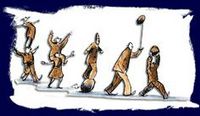
Parade of clowns.
I enjoyed the show immensely, but I can't deny that in the second half the illusion wore away, the mechanics came into evidence, and a little disappointment crept over me.
What was missing? Children.
Helena was not in attendance. I took mental note of the many elements that would enthrall her. I noted the irony of anticipating the day Helena would be old enough to appreciate such a performance.
Very few kids were in the audience. Very few kids could tolerate a three-hour outing such as this one. Very few parents would spend so much money on a spectacle their children would stop enjoying after an hour. I stopped fully enjoying it after an hour.
While it's well and good that adults should be encouraged to find their inner child, to squeal with delight in awe of human feats of strength and dexterity, it felt phony not to experience it among children.
I look forward to sunny days in the park this summer and hope once again the local circus folk — I mean those regular people who live in this neighbourhood, the ones who have steady jobs with the circus — will come with their kids and practice their backflips and swing from the structures while the children occasionally look up from their sandcastles.
Corteo. I'd heard nothing about the new show.
The anticipation in the hours preceding the matinee performance was palpable. There's nothing like the childlike awe in beholding the whimsical shape and colours of the circus tent and stepping through its flaps into another world.
The curtain was raised on a man on his deathbed. Angels flit about, and he struggles to join him. A parade of life passes him by — I assumed it was his life, his memories — some unseemly characters threatening to thwart his ascent to the angelic orders. This was his struggle to find peace in death, to cross into the afterlife. Angels!
For a full hour, my face was strained from smiling, my jaw dropping at regular intervals. We nudged each other, giggled, and pointed. Breathtaking. Heart-stopping.
At intermission, we darted through the rain to other tents to admire the trophies available for purchase to those lucky enough to be in attendance. Seuss-like hats, masks and wings, full whimsy wardrobes, along with the more conventional programmes and CDs.
The second act, though thrilling, faltered. The pacing was off. One very slow, if beautiful, sequence featuring a proficient whistler accompanied by a glass orchestra was followed up with jugglers interrupted by a torrent of rubber chickens, and then a weak, almost charmless, slapstick midget theatre production.
The music too was uneven. It was unmistakably Cirque, with the usual Mediterranean and Arabic influences incorporated into a soundtrack designed to build suspense. It was perhaps a little jazzier than is typical of their sound, scat even, but sadly it lapsed into Kenny G-type solos and regressed to a style of early 80s rock ballad. Little of it matched the baroque-inspired set, nor were there songs of angels.
As a finale, our dead man achieves full wings and halo.
Reading about the show afterwards, I feel cheated of lofty themes. The premise as written seems more mundane. It was not clear to me that the dead man was a clown among his old troupe. While the parade was felliniesque, I saw in it a quest, a narrative drive, that seems not to have been intentional.
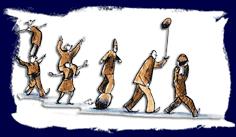
Parade of clowns.
I enjoyed the show immensely, but I can't deny that in the second half the illusion wore away, the mechanics came into evidence, and a little disappointment crept over me.
What was missing? Children.
Helena was not in attendance. I took mental note of the many elements that would enthrall her. I noted the irony of anticipating the day Helena would be old enough to appreciate such a performance.
Very few kids were in the audience. Very few kids could tolerate a three-hour outing such as this one. Very few parents would spend so much money on a spectacle their children would stop enjoying after an hour. I stopped fully enjoying it after an hour.
While it's well and good that adults should be encouraged to find their inner child, to squeal with delight in awe of human feats of strength and dexterity, it felt phony not to experience it among children.
I look forward to sunny days in the park this summer and hope once again the local circus folk — I mean those regular people who live in this neighbourhood, the ones who have steady jobs with the circus — will come with their kids and practice their backflips and swing from the structures while the children occasionally look up from their sandcastles.
Monday, April 25, 2005
Things I need to write about, someday
There just isn't the time these days, with computer-sharing and work and stuff to do, to put down all the things I want to say. I'm lacking the emotional space and perspective.
Some of the points I need to work out:
-mothers and daughters in general
-how desperately I miss Helena when she's not here
-how little I feel I see her when she is here
-how difficult tantrums are
-my mother's implied criticism of my parenting technique (or lack thereof)
-things my mother has told me about mothering in her day
-the general inadequacy I feel as a mother these days
All my current angst relates to home-buying, the process of packing, the prospect of building a home, including the financing of the home, my place in the household. I'm deliberately detaching. There's a lot to do, all there is to do is plow through. While I'm "feeling" a lot of emotions, I'm not really processing them. It's easier to move forward by ignoring the inner turmoils.
And I want to tell you about the nostalgia, the things I'm finding in dark spaces in closets, the relief and freedom in purging oneself of objects and the past. The irony of shedding matter when for the first time I have the space to store it.
Helena is home with me today. We both have head colds. Naps! Movies! Books! Chicken soup! More naps! Ah, lazy day.
Some of the points I need to work out:
-mothers and daughters in general
-how desperately I miss Helena when she's not here
-how little I feel I see her when she is here
-how difficult tantrums are
-my mother's implied criticism of my parenting technique (or lack thereof)
-things my mother has told me about mothering in her day
-the general inadequacy I feel as a mother these days
All my current angst relates to home-buying, the process of packing, the prospect of building a home, including the financing of the home, my place in the household. I'm deliberately detaching. There's a lot to do, all there is to do is plow through. While I'm "feeling" a lot of emotions, I'm not really processing them. It's easier to move forward by ignoring the inner turmoils.
And I want to tell you about the nostalgia, the things I'm finding in dark spaces in closets, the relief and freedom in purging oneself of objects and the past. The irony of shedding matter when for the first time I have the space to store it.
Helena is home with me today. We both have head colds. Naps! Movies! Books! Chicken soup! More naps! Ah, lazy day.
The Strad
The New York Times reviews Stradivari's Genius, by Toby Faber.
(Antonietta is an overlooked but wonderful book that may well have inspired The Red Violin. Anyone who loved the movie would do well to search this title out.)
The first, and to my knowledge only, time I heard a Strad up close and personal, it was played by Angèle Dubeau in an intimate chapel at the University of Ottawa. Angelic indeed!
I'd started playing violin when I was 8. There was a time I had talent, but no passion. From time to time the passion has surfaced, but I no longer had the technique.
For a time I toyed with the idea of making violins, partly for the romance of crafting an instrument from which music would resonate, but mostly to crack the mystery of the Stradivari sound. It seemed like the perfect merging of science and art (I hadn't considered that woodworking would be part of it too, or I might've abandoned the idea much sooner). I found books and blueprints, but had not enough passion to pursue this esoteric livelihood.
Related reading:
Delbanco, Nicholas. "The Countess of Stanlein restored: sound and soundness in a Stradivarius violoncello." Harper's Magazine. January 2001. p 39–54.
Highly prized and priced, Stradivaris have been traded, sold, hidden, stolen and even buried. They have been owned by royalty and rabble, played by amateurs and virtuosos, survived wars, floods and other natural disasters. In the right hands, these legendary instruments have made listeners weep, fall in love and believe in God; they have provided romantic fodder for novels like John Hersey's "Antonietta" and films like Francois Girard's "Red Violin." But "Stradivari's Genius," Toby Faber's first book and a work of nonfiction, is more enthralling, earthy and illuminating than any fiction could possibly be.
(Antonietta
is an overlooked but wonderful book that may well have inspired The Red Violin. Anyone who loved the movie would do well to search this title out.)The first, and to my knowledge only, time I heard a Strad up close and personal, it was played by Angèle Dubeau in an intimate chapel at the University of Ottawa. Angelic indeed!
I'd started playing violin when I was 8. There was a time I had talent, but no passion. From time to time the passion has surfaced, but I no longer had the technique.
For a time I toyed with the idea of making violins, partly for the romance of crafting an instrument from which music would resonate, but mostly to crack the mystery of the Stradivari sound. It seemed like the perfect merging of science and art (I hadn't considered that woodworking would be part of it too, or I might've abandoned the idea much sooner). I found books and blueprints, but had not enough passion to pursue this esoteric livelihood.
Related reading:
Delbanco, Nicholas. "The Countess of Stanlein restored: sound and soundness in a Stradivarius violoncello." Harper's Magazine. January 2001. p 39–54.
Atwood on London
The Guardian presents an extract from the soon-to-be-published Curious Pursuits: Occasional Writings by Margaret Atwood.
Atwood recalls the early 60s, the mood of the day, the clothes and hairdos, that set the scene for her first adventure abroad.
I'm reminded of the first time I travelled to "Europe," at the age of 19. London was not the destination of choice, but it was the one to which I could afford a plane ticket. There was little money left over for lodging or food. I spent my days looking for a place that would serve me tea with lemon. (I did find such a place — a Polish-run diner where I could also get a salad.)
Like Atwood, I wondered
Atwood recalls the early 60s, the mood of the day, the clothes and hairdos, that set the scene for her first adventure abroad.
The truth is that I didn't have much idea of what I was really doing. Certainly, I had almost no idea at all of where I was really going, and how much it had changed since I'd last checked in via the pages of Charles Dickens. Everything was so much smaller and shabbier than I had imagined. I was like the sort of Englishman who arrives in Canada expecting to find a grizzly bear on every street corner. "Why are there so many trucks?" I thought. There were no trucks in Dickens. There weren't even any in TS Eliot. "I did not know Death had undone so many", I murmured hopefully, as I made my way across Trafalgar Square. But the people there somehow refused to be as hollow-cheeked and plangent as I'd expected. They appeared to be mostly tourists, like myself, and were busy taking pictures of one another with pigeons on their heads.
I'm reminded of the first time I travelled to "Europe," at the age of 19. London was not the destination of choice, but it was the one to which I could afford a plane ticket. There was little money left over for lodging or food. I spent my days looking for a place that would serve me tea with lemon. (I did find such a place — a Polish-run diner where I could also get a salad.)
Like Atwood, I wondered
Had my soul been improved? Possibly, but not in the ways I'd anticipated. What I took back with me was not so much the churches and museums and the postcards of them I'd collected, but various conversations, in buses, on trains, and with the pickup men at the museums.
Saturday, April 23, 2005
Free books to good homes
I'm culling my bookshelves. Really.
If you would like any of the books listed below, email me with your selections and an address to which they might be sent.
Disclaimer:
I'm getting rid of these books because I don't much care for them, on some level or other. In fact, there's a few I really hated, so be warned. I've read all of them except the Blais, because I attended a reading of hers shortly after acquiring the book and she put me to sleep, and the Burgess, which I've owned for about 15 years and I just haven't gotten around to it, but maybe I'll check out the story of the meeting between Shakespeare and Cervantes later today. (But I am keeping a few other unread books I've owned for longer. Go figure.) Frankly, I can't imagine any of you really wanting any of these books.
Fiction
Amis, Martin. Einstein's monsters.
Amis, Martin. Night train. hc
Amis, Martin. Time's arrow.
Barnes, Julian. England, England. hc
Blais, Marie-Claire. These festive nights.
Burgess, Anthony. The devil's mode.
Carey, Edward. Observatory Mansions. hc
Cocteau, Jean. Les enfants terribles.
Deane, Seamus. Reading in the dark.
Grass Gunter. The call of the toad. hc
Hesse, Hermann. Beneath the wheel.
Johnson, Diane. Le mariage. hc
Kazan, Frances. Halide's gift. hc
Leyner, Mark. My cousin, my gastroenterologist.
Mahfouz, Naguib. Miramar.
Malarkey, Tucker. An obvious enchantment. hc
Mantel, Hilary. The giant O'Brien. hc
Morrissey, Donna. Kit's law.
Okri, Ben. The famished road.
Richardson, Bill. Waiting for Gertrude.
Tremain, Rose. The way I found her.
Woolf, Virginia. To the lighthouse.
Yourgrau, Barry. A man jumps out of an airplane wearing dad's head.
Nonfiction
Bergler. The talent for stupidity. (best title ever)
de Botton, Alain. How Proust can change your life.
Dreher, Diane. The tao of inner peace.
Gould, Terry. The lifestyle. hc
Hacking. Mad travelers. hc
McGilvray. Chomsky. hc
Stassinopoulos Huffington, Arianna. Picasso. hc
de Rougemont, Denis. Love in the western world.
Altmann, ed. Cognitive models of speech processing.
Bauer. Introducing linguistic morphology.
Braybrooke. Philosophy of social science.
Coates. Women, men and language.
Cormac. A cognitive theory of metaphor.
Cowan, Rakusan. Source book for linguistics.
Eimas and Galaburda, eds. Neurobiology of cognition.
Harris. How the brain talks to itself.
Jensen. English phonology. (by the most boring prof I ever had)
Ladefoged and Maddieson. The sounds of the world's languages.
O'Grady, Dobrovolsky. Contemporary linguistic analysis.
Ouhalla. Introducing transfomational grammar.
Palmer. Grammar.
Penalosa. Introduction to the sociology of language.
Stillings, Feinstein, Garfield, Rissland, Rosenbaum, Weisler, and Baker-Ward. Cognitive science: an introduction. hc
Wardbaugh. An introduction to sociolinguistics.
That list looks really short, but the pile in the middle of the living room floor looks so big. There's another stack, as big, of books I thought I'd part with, but I'm having second thoughts — I haven't lived with them long enough, or they're inscribed to me personally, or I've forgotten them entirely and their premise suddenly seems fresh and relevant.
Any books you don't want will be dispensed with at... oh, who's kidding whom? I'll just keep them, probably. Except for the Malarkey — it makes me angry to see that one sitting on the shelf. I'll leave it on a park bench.
If you would like any of the books listed below, email me with your selections and an address to which they might be sent.
Disclaimer:
I'm getting rid of these books because I don't much care for them, on some level or other. In fact, there's a few I really hated, so be warned. I've read all of them except the Blais, because I attended a reading of hers shortly after acquiring the book and she put me to sleep, and the Burgess, which I've owned for about 15 years and I just haven't gotten around to it, but maybe I'll check out the story of the meeting between Shakespeare and Cervantes later today. (But I am keeping a few other unread books I've owned for longer. Go figure.) Frankly, I can't imagine any of you really wanting any of these books.
Fiction
Amis, Martin. Einstein's monsters.
Amis, Martin. Night train. hc
Amis, Martin. Time's arrow.
Barnes, Julian. England, England. hc
Blais, Marie-Claire. These festive nights.
Burgess, Anthony. The devil's mode.
Carey, Edward. Observatory Mansions. hc
Cocteau, Jean. Les enfants terribles.
Deane, Seamus. Reading in the dark.
Grass Gunter. The call of the toad. hc
Hesse, Hermann. Beneath the wheel.
Johnson, Diane. Le mariage. hc
Kazan, Frances. Halide's gift. hc
Leyner, Mark. My cousin, my gastroenterologist.
Mahfouz, Naguib. Miramar.
Malarkey, Tucker. An obvious enchantment. hc
Mantel, Hilary. The giant O'Brien. hc
Morrissey, Donna. Kit's law.
Okri, Ben. The famished road.
Richardson, Bill. Waiting for Gertrude.
Tremain, Rose. The way I found her.
Woolf, Virginia. To the lighthouse.
Yourgrau, Barry. A man jumps out of an airplane wearing dad's head.
Nonfiction
Bergler. The talent for stupidity. (best title ever)
de Botton, Alain. How Proust can change your life.
Dreher, Diane. The tao of inner peace.
Gould, Terry. The lifestyle. hc
Hacking. Mad travelers. hc
McGilvray. Chomsky. hc
Stassinopoulos Huffington, Arianna. Picasso. hc
de Rougemont, Denis. Love in the western world.
Altmann, ed. Cognitive models of speech processing.
Bauer. Introducing linguistic morphology.
Braybrooke. Philosophy of social science.
Coates. Women, men and language.
Cormac. A cognitive theory of metaphor.
Cowan, Rakusan. Source book for linguistics.
Eimas and Galaburda, eds. Neurobiology of cognition.
Harris. How the brain talks to itself.
Jensen. English phonology. (by the most boring prof I ever had)
Ladefoged and Maddieson. The sounds of the world's languages.
O'Grady, Dobrovolsky. Contemporary linguistic analysis.
Ouhalla. Introducing transfomational grammar.
Palmer. Grammar.
Penalosa. Introduction to the sociology of language.
Stillings, Feinstein, Garfield, Rissland, Rosenbaum, Weisler, and Baker-Ward. Cognitive science: an introduction. hc
Wardbaugh. An introduction to sociolinguistics.
That list looks really short, but the pile in the middle of the living room floor looks so big. There's another stack, as big, of books I thought I'd part with, but I'm having second thoughts — I haven't lived with them long enough, or they're inscribed to me personally, or I've forgotten them entirely and their premise suddenly seems fresh and relevant.
Any books you don't want will be dispensed with at... oh, who's kidding whom? I'll just keep them, probably. Except for the Malarkey — it makes me angry to see that one sitting on the shelf. I'll leave it on a park bench.
Thursday, April 21, 2005
These are the buildings in my neighbourhood
Photo essay:
I live in such a city.
We are soon leaving this home (rented and temporary) among the, ahem, "more exclusive plexes...facing Montreal's Parc Lafontaine," to take up residence on the other side of the neighbourhood in one of the city's new urban "condoplexes."
Coincidentally, our new street is named for a Montreal architect responsible for some of the landmarks of the neighbourhood (but to my knowledge, he did not design any plexes).
There's a type of urban housing that is more versatile than rowhouses, more human-scaled than apartment buildings and far denser than single-family homes. It's called the plex — but unless you've lived in a select few cities, you've probably never heard of it.
I live in such a city.
We are soon leaving this home (rented and temporary) among the, ahem, "more exclusive plexes...facing Montreal's Parc Lafontaine," to take up residence on the other side of the neighbourhood in one of the city's new urban "condoplexes."
One of the greatest things about living in plexdom is the street life. Plexes — especially Montreal's plexes — are extremely conducive to what urban-planning visionary Jane Jacobs describes as "eyes on the street." The multiplicity of entrances, staircases and balconies maximizes the potential for interaction in the public realm, making plex-lined streets lively and interactive. There's always somebody coming and going and neighbours often stop for idle chit-chat. On warm summer evenings or sunny spring days, balconies fill up with people reading, relaxing or just watching passersby. "The rhythm of the street comes from the diversity of its people," says Dinu Bumbaru, the director of Héritage Montréal. The plex’s orientation towards the street makes that diversity all the more apparent.
Coincidentally, our new street is named for a Montreal architect responsible for some of the landmarks of the neighbourhood (but to my knowledge, he did not design any plexes).
Heralding copyeditors
A few words about and an interview with copyeditors (via Bookninja).
Ringing true:
Of course, the article was pretty much ruined for me about halfway, with the appearance of "CE's" instead of "CEs" (it's plural, not possessive!) throwing me into a fit.
Ringing true:
I work in fits and starts, bitch and moan to others in the business, toy with the idea of leaving everything just as it is, walk around the block when I find myself sarcastically reading passages aloud to myself. When the deadline looms close enough, I sit down and do what I'm being paid to do. You just do your best and wonder why you didn't make a career of grooming poodles or putting wheels on toy trains when you had the chance. And why you didn't have the business sense to whip out a piece of trash and sell it to a publisher for a huge advance.
Of course, the article was pretty much ruined for me about halfway, with the appearance of "CE's" instead of "CEs" (it's plural, not possessive!) throwing me into a fit.
Wednesday, April 20, 2005
Why I'm going to burn in hell
The election of a new pope has established the climate for an Apprentice spin-off.
Picture Joseph Ratzinger in Donald Trump's chair.
We bring you The Inquisitor.
Catchphrase: You're excommunicated! (Or maybe: You're going to burn in hell.)
Theologians vs the pastors.
Among the tasks for contestants:
Run a PR campaign to attract young men to the priesthood.
Convert a small village.
Renovate and repurpose the papal palace at Avignon.
Design a new line of vestments, to be judged by Gammarelli.
Who will be the next Inquisitor?
Picture Joseph Ratzinger in Donald Trump's chair.
We bring you The Inquisitor.
Catchphrase: You're excommunicated! (Or maybe: You're going to burn in hell.)
Theologians vs the pastors.
Among the tasks for contestants:
Run a PR campaign to attract young men to the priesthood.
Convert a small village.
Renovate and repurpose the papal palace at Avignon.
Design a new line of vestments, to be judged by Gammarelli.
Who will be the next Inquisitor?
Colour
I'm not alone in noting the problem of colour perception I alluded to the other day. (Diana gets it.) We all have trouble properly naming shades of aqua and teal, but we can measure the light frequencies and agree on a definition. But how do we know if the experience of the colour is universal?
I remember Stephen Pinker in How the Mind Works briefly addressing this problem that has haunted me for decades, and dismissing it.
I've been scanning the pages, looking for a reference, and found this (p 146):
Pinker's answer to this and similar quandaries of subjective experience is "Beats the heck out of me!"
And so he relegates this topic, and others, to late-night dorm-room bull sessions and similar forums.
There you have it. Do we really see the same colours? Who cares!
I remember Stephen Pinker in How the Mind Works briefly addressing this problem that has haunted me for decades, and dismissing it.
I've been scanning the pages, looking for a reference, and found this (p 146):
Might your experience of red be the same as my experience of green? Sure, you might label grass as "green" and tomatoes as "red," just as I do, but perhaps you actually see the grass as having the color that I would describe, if I were in you shoes, as red.
Pinker's answer to this and similar quandaries of subjective experience is "Beats the heck out of me!"
At least for now, we have no scientific purchase on the special extra ingredient that gives rise to sentience. As far as scientific explanation goes, it might as well not exist. It's not just that claims about sentience are perversely untestable; it's that testing them would make no difference to anything anyway.
And so he relegates this topic, and others, to late-night dorm-room bull sessions and similar forums.
There you have it. Do we really see the same colours? Who cares!
Tuesday, April 19, 2005
Don't panic.
Easy for you to say.
Good cause for panic is presented in the extended review of the new movie incarnation of The Hitchhiker's Guide to the Galaxy at the now-closed Planet Magrathea (via Maud Newton). "It's as if someone had filmed Gulliver's Travels but had made the Lilliputians and Brobdingnagians normal-sized and turned the Houyhnhnms from talking horses into yellow triangles. The film-makers, to borrow a phrase, 'just don't get it'."
Apparently, "The jokes have gone. The funny bits, the wit, the humour. The clever stuff that made it worth including in the first place.":
A wonderful summary of the book, the story, thus far, and where this version goes wrong:
Apparently, there is one genuinely funny line of dialogue, "just don't cough while the Magrathean hologram is speaking or you may have wasted 110 minutes of your life instead of just 109 minutes and 30 seconds."
What?
The Hitchhikers Guide to the Galaxy and God. Where's a Babel fish when you need one?
Huh?
Variety.com: The "Hitchhiker" book may be on the high school curriculum in Iceland but it isn't widely read in Idaho. It remains to be seen how Adams' unrepentant atheism will play in the U.S. "God and religion don't do well in this film," Jennings admits.
Good cause for panic is presented in the extended review of the new movie incarnation of The Hitchhiker's Guide to the Galaxy at the now-closed Planet Magrathea (via Maud Newton). "It's as if someone had filmed Gulliver's Travels but had made the Lilliputians and Brobdingnagians normal-sized and turned the Houyhnhnms from talking horses into yellow triangles. The film-makers, to borrow a phrase, 'just don't get it'."
This film, I'm very sorry to report, is bad.
Really bad. You just won't believe how vastly, staggeringly, jaw-droppingly bad it is. I mean, you might think that The Phantom Menace was a hopelessly misguided attempt to reinvent a much-loved franchise by people who, though well-intentioned, completely failed to understand what made the original popular — but that's just peanuts to the Hitchhiker's movie. Listen.
And so on...
Apparently, "The jokes have gone. The funny bits, the wit, the humour. The clever stuff that made it worth including in the first place.":
There are so many wonderfully quotable lines in Hitchhiker's Guide, most of which are notable by their absence from the film. There are, astoundingly, individual phrases and even words that have been removed. For example, in the Vogon poetry scene which, like Prosser's confrontation, is now so short as to be utterly pointless, Arthur’s line "counterpoint the surrealism of the underlying metaphor", a brilliantly crafted piece of faux literary critique, has become "counterpoint the underlying metaphor." How is that justified? Did someone try to keep the film under two hours by crossing out some of the long words?
A wonderful summary of the book, the story, thus far, and where this version goes wrong:
Somebody who really doesn't understand Hitchhiker's Guide, or who is trying to summarise it without having read/heard/seen it recently, might think that the story was about the search for the Ultimate Question. In fact, the whole central joke of Hitchhiker's, for Zarquon's sake, is that this massive philosophical enquiry into the meaning of it all is a minor subplot. None of the main characters are especially bothered about the Ultimate Question, the concept of which is in any case entirely unknown in our universe except to the Magratheans who built the Earth for beings from a different dimension. Arthur's quest is for a return home and a nice cup of tea; Zaphod's quest is a purely avaricious desire for fabulous wealth and the fame and sex that comes with it; Ford's quest is for a good party — 'a strong drink and a peer group'; and inasmuch as Trillian ever had a quest it was for something more than 'the dole queue again on Monday morning'.
When the possibility of learning the Question crops up, the characters are mildly interested, as who wouldn't be, but they are none of them driven by it — until now. A bunch of people ignoring the possibility of discovering the meaning of life because they are concerned about a party or a cup of tea or whatever is funny. A bunch of people searching for the meaning of life, well, isn't.
Apparently, there is one genuinely funny line of dialogue, "just don't cough while the Magrathean hologram is speaking or you may have wasted 110 minutes of your life instead of just 109 minutes and 30 seconds."
What?
The Hitchhikers Guide to the Galaxy and God. Where's a Babel fish when you need one?
Huh?
Variety.com: The "Hitchhiker" book may be on the high school curriculum in Iceland but it isn't widely read in Idaho. It remains to be seen how Adams' unrepentant atheism will play in the U.S. "God and religion don't do well in this film," Jennings admits.
More tentacles than you can shake a stick at
Tasty octopus pulp!
Sea Devils #21, February 1965,
from DC Publications. "Arms to Spare" cover.
More octupus art, links, and tidbits at Octopia.
(Via Scribbling Woman)
Octopus mama!
A heartwarming story of a mother who wouldn't give up on her eggs.
Last June, the octopus laid tens of thousands of eggs in her ALaska aquarium. It usually takes 6–8 months for eggs to hatch, but it seems to be taking longer because of the colder conditions.
They're hatching!

Aww, look at the baby octopus!
Sadly, "Aurora's fate, though, is sealed. Giant Pacific females usually die about the same time as their eggs hatch, mostly because they stop eating for months and spend their energy defending their eggs."
(Via Collision Detection)

Sea Devils #21, February 1965,
from DC Publications. "Arms to Spare" cover.
More octupus art, links, and tidbits at Octopia.
(Via Scribbling Woman)
Octopus mama!
A heartwarming story of a mother who wouldn't give up on her eggs.
Last June, the octopus laid tens of thousands of eggs in her ALaska aquarium. It usually takes 6–8 months for eggs to hatch, but it seems to be taking longer because of the colder conditions.
They're hatching!

Aww, look at the baby octopus!
Sadly, "Aurora's fate, though, is sealed. Giant Pacific females usually die about the same time as their eggs hatch, mostly because they stop eating for months and spend their energy defending their eggs."
(Via Collision Detection)
Sunday, April 17, 2005
Papal politics
The conclave
A historical look at conclaves: graph.
On the group dynamics.
The odds
The odds have changed daily over the last 2 weeks. As of this writing Cardinal Ratzinger leads the pack at 3:1.
Bear in mind:
Complete coverage:
CBC
CBS
CNN
The Guardian
The New York Times
NPR
There is some overlap, but all offer different shortlists for the papal successor. NYT and CBC include Canadian Marc Oullet (Friday odds were 80:1; today 50:1). CNN ignores Martini. CBS omits the Jesuit, Bergoglio.
The obvious
According to the New York Times, Ratzinger "appears to command the largest and most cohesive block, and at a minimum, it seems unlikely that the next pope will be chosen without his blessing."
The art
There was considerable leakage of information during the conclave that elected John Paul II in 1978, and the Vatican is taking measures to ensure it doesn't happen again.
Nobody really knows what happens inside the conclave, but there are educated guesses and imagination fills in the blanks.
The New York Times reviews conclaves, papal politics, and the personal struggles of cardinals as presented in books and movies.
Fiction:
The Cardinal, film, Otto Preminger, 1963.
The Shoes of the Fisherman, film, 1968, based on the novel by Morris L West.
White Smoke, Rev. Andrew M Greeley, 1996.
Conclave, Greg Tobin, 2001.
Angels & Demons, Dan Brown, 2003. (excerpt)
Nonfiction:
The autobiography of Pius II, 15th century.
The Making of the Popes, Rev. Andrew M Greeley, 1979.
Conclave: The Politics, Personalities and Process of the Next Papal Election, John L. Allen Jr, 2002.
Selecting the Pope: Uncovering the Mysteries of Papal Elections, Greg Tobin, 2003.
Heirs of the Fisherman: Behind the Scenes of Papal Death and Succession, John-Peter Pham, 2004.
Making of the Pope 2005, Rev. Andrew M Greeley, currently being researched.
I've read the following religious-themed books. Though not specifically focused on the election of a pope, they offer insight into the religious mind as well the workings of the Church.
Fiction:
The Name of the Rose, Umberto Eco, 1983; film, 1986.
On the Third Day, Piers Paul Read, 1991.
The Seville Communion, Arturo Perez-Reverte, 1995.
The Third Miracle, Richard Vetere, 1997; film, 1999.
Nonfiction:
In God's Name: An Investigation into the Murder of Pope John Paul I, David A Yallop, 1984.
If nothing else, they're good mysteries.
Drenched with ritual and cloaked in secrecy, the spectacle of the conclave makes for great theatre.
A lingering curiosity
The text of John Paul II's last will and testament is available in English. Though the media voiced some speculation at the time of the pope's death, I'm left puzzling as to the how and why of the resolution of this wish:
A historical look at conclaves: graph.
On the group dynamics.
The odds
The odds have changed daily over the last 2 weeks. As of this writing Cardinal Ratzinger leads the pack at 3:1.
Bear in mind:
In the last conclave in 1978, Vatican-watchers had concocted lists of potential popes 20 to 30 names long, hoping that would cover all the possibilities. But Karol Wojtyla, the cardinal from Poland who became Pope John Paul II after three days, made practically none of them.
Complete coverage:
CBC
CBS
CNN
The Guardian
The New York Times
NPR
There is some overlap, but all offer different shortlists for the papal successor. NYT and CBC include Canadian Marc Oullet (Friday odds were 80:1; today 50:1). CNN ignores Martini. CBS omits the Jesuit, Bergoglio.
The obvious
According to the New York Times, Ratzinger "appears to command the largest and most cohesive block, and at a minimum, it seems unlikely that the next pope will be chosen without his blessing."
The art
There was considerable leakage of information during the conclave that elected John Paul II in 1978, and the Vatican is taking measures to ensure it doesn't happen again.
Nobody really knows what happens inside the conclave, but there are educated guesses and imagination fills in the blanks.
The New York Times reviews conclaves, papal politics, and the personal struggles of cardinals as presented in books and movies.
Fiction:
The Cardinal, film, Otto Preminger, 1963.
The Shoes of the Fisherman, film, 1968, based on the novel by Morris L West.
White Smoke, Rev. Andrew M Greeley, 1996.
Conclave, Greg Tobin, 2001.
Angels & Demons, Dan Brown, 2003. (excerpt)
Nonfiction:
The autobiography of Pius II, 15th century.
The Making of the Popes, Rev. Andrew M Greeley, 1979.
Conclave: The Politics, Personalities and Process of the Next Papal Election, John L. Allen Jr, 2002.
Selecting the Pope: Uncovering the Mysteries of Papal Elections, Greg Tobin, 2003.
Heirs of the Fisherman: Behind the Scenes of Papal Death and Succession, John-Peter Pham, 2004.
Making of the Pope 2005, Rev. Andrew M Greeley, currently being researched.
I've read the following religious-themed books. Though not specifically focused on the election of a pope, they offer insight into the religious mind as well the workings of the Church.
Fiction:
The Name of the Rose, Umberto Eco, 1983; film, 1986.
On the Third Day, Piers Paul Read, 1991.
The Seville Communion, Arturo Perez-Reverte, 1995.
The Third Miracle, Richard Vetere, 1997; film, 1999.
Nonfiction:
In God's Name: An Investigation into the Murder of Pope John Paul I, David A Yallop, 1984.
If nothing else, they're good mysteries.
Drenched with ritual and cloaked in secrecy, the spectacle of the conclave makes for great theatre.
A lingering curiosity
The text of John Paul II's last will and testament is available in English. Though the media voiced some speculation at the time of the pope's death, I'm left puzzling as to the how and why of the resolution of this wish:
5.III.82 (March 5, 1982)
In connection with the last sentence in my testament of 6.III.1979 (March 6, 1979) ("concerning the site / that is, the site of the funeral / let the College of Cardinals and Compatriots decide") — I will make it clear that I have in mind: the metropolitan of Krakow or the General Council of the Episcopate of Poland. In the meantime I ask the College of Cardinals to satisfy, as far as possible, any demands of the above-mentioned.
Saturday, April 16, 2005
Everything you ever wanted to know about me, but were afraid to ask
Because Rachel wanted to know and wasn't afraid to ask:
1) What's the first "adult" book you ever read, and how old were you? (you may define "adult" however you wish)
Anais Nin's Delta of Venus, when I was 19 and discovering a world of earthly delights.
This is a very interesting question actually, in terms of "grown-up" books. I was reading a lot of Agatha Christie at 9 or 10. In grade 7 we read The Martian Chronicles (around the time the miniseries was aired) and I, Robot, Animal Farm, also Hamlet. Are they grown-up books? They certainly were not written as children's books, but they are accessible to young adults and open up new worlds.
As far as books not on the school curriculum: The Gormenghast Trilogy (which may also be considered a "crossover" work and an introduction to the fantasy genre).
At 14 I stumbled across (I don't know how) Dalton Trumbo's Johnny Got His Gun, and it scarred me. I don't think anyone is ever prepared to read that (I wonder what affect it would have on me now).
2) Whom would you rather date, Miguel de Cervantes or Fyodor Dostoyevsky? (substitutions allowed)
Dostoevsky, hands down. In fact, I think I did date him: a tormented writer — there was much vodka consumption, I generally paid his way. Late nights talking about the natures of Man and God, usually "privileged" to sit among the men. Lots of Polish jokes. But good parties and interesting social circles.
That said, though I still don't know Cervantes all that well, I rather suspect he's someone I'd consider settling down and living happily ever after with, in a mildly adventurous, self-delusional kind of way.
3) What is the most uniquely Montreal thing about living in Montreal?
In an obvious and superficial way:
The staircases, architecturally unique and almost stupid in a city that sees so much snow. Quaint, but positively treacherous in winter.
The general disregard for traffic lights.
The "bilingualism" in such utterances as "I have to stop at the guichet before we get to the dep," how the constant exposure affects your vocabulary and syntax. (Here's a fun list of similar Montreal peculiarities.)
But most striking to me:
Good lighting, by which I mean the restaurants, cafés, etc are darker than in other cities and thus more conducive to intimacy, whether among friends or lovers. It imbues conversations with the sense that they are more meaningful, even if they're about shopping.
4) What were your career aspirations at age 11, and do they make you laugh or cringe?
I do not have a clear recollection of ever wanting to be anything specific when I grew up (damn that lack of direction!), although at about that time I was somewhat enthralled with the idea, the romance, of being a writer or editor, but it's not as if I ever really wrote anything other than crappy angst-ridden teenage poetry. When I was 12, my teacher suggested I pursue philosophy — I was really hung up on the problem of colour perception, how do we know we're all seeing the same colour (and I maintain that we don't, and this explains why we have different tastes in art, fashion, home-decorating, etc).
When I did get my first editing job, someone asked, "Didn't you always want to be an editor when you grew up? What a cool job!" and I said, "Come to think of it, yeah, kind of."
5) If you ever did get around to writing a book, what kind of book would it be?
Mostly fiction. Which is maybe not such a good choice considering I have no imagination. Give me a seed and I can grow it, but I just can't make something out nothing.
I have for a very long time wanted to write a fictionalized account of my mother's experience of wartime — how the family left Poland in 1939, travelled through Russia and the Middle East, and eventually found refuge in India (of all places). But a decade after the idea first occurred to me, I feel as if this type of memoir has been done to death. Also, I suspect my family would be more of a hindrance than a source or a support — which makes it just too big a project to take on, emotionally. For the time-being anyway.
Meanwhile, interestingly, for the last few months, for the first time ever, I feel as if I might have a wholly original novel in me after all. It goes almost without saying that it should be bleak and dystopian, and I'd like to explore the relationship and the disconnect individuals experiences between real life and their online personas. I'm not sure I want to say anything more though, because then I'd feel committed to seeing it through, and I don't need that kind of pressure weighing on my lazy-ass self.
My questions for others I want to know more about will be posted in the days to come.
1) What's the first "adult" book you ever read, and how old were you? (you may define "adult" however you wish)
Anais Nin's Delta of Venus, when I was 19 and discovering a world of earthly delights.
This is a very interesting question actually, in terms of "grown-up" books. I was reading a lot of Agatha Christie at 9 or 10. In grade 7 we read The Martian Chronicles (around the time the miniseries was aired) and I, Robot, Animal Farm, also Hamlet. Are they grown-up books? They certainly were not written as children's books, but they are accessible to young adults and open up new worlds.
As far as books not on the school curriculum: The Gormenghast Trilogy (which may also be considered a "crossover" work and an introduction to the fantasy genre).
At 14 I stumbled across (I don't know how) Dalton Trumbo's Johnny Got His Gun, and it scarred me. I don't think anyone is ever prepared to read that (I wonder what affect it would have on me now).
2) Whom would you rather date, Miguel de Cervantes or Fyodor Dostoyevsky? (substitutions allowed)
Dostoevsky, hands down. In fact, I think I did date him: a tormented writer — there was much vodka consumption, I generally paid his way. Late nights talking about the natures of Man and God, usually "privileged" to sit among the men. Lots of Polish jokes. But good parties and interesting social circles.
That said, though I still don't know Cervantes all that well, I rather suspect he's someone I'd consider settling down and living happily ever after with, in a mildly adventurous, self-delusional kind of way.
3) What is the most uniquely Montreal thing about living in Montreal?
In an obvious and superficial way:
The staircases, architecturally unique and almost stupid in a city that sees so much snow. Quaint, but positively treacherous in winter.
The general disregard for traffic lights.
The "bilingualism" in such utterances as "I have to stop at the guichet before we get to the dep," how the constant exposure affects your vocabulary and syntax. (Here's a fun list of similar Montreal peculiarities.)
But most striking to me:
Good lighting, by which I mean the restaurants, cafés, etc are darker than in other cities and thus more conducive to intimacy, whether among friends or lovers. It imbues conversations with the sense that they are more meaningful, even if they're about shopping.
4) What were your career aspirations at age 11, and do they make you laugh or cringe?
I do not have a clear recollection of ever wanting to be anything specific when I grew up (damn that lack of direction!), although at about that time I was somewhat enthralled with the idea, the romance, of being a writer or editor, but it's not as if I ever really wrote anything other than crappy angst-ridden teenage poetry. When I was 12, my teacher suggested I pursue philosophy — I was really hung up on the problem of colour perception, how do we know we're all seeing the same colour (and I maintain that we don't, and this explains why we have different tastes in art, fashion, home-decorating, etc).
When I did get my first editing job, someone asked, "Didn't you always want to be an editor when you grew up? What a cool job!" and I said, "Come to think of it, yeah, kind of."
5) If you ever did get around to writing a book, what kind of book would it be?
Mostly fiction. Which is maybe not such a good choice considering I have no imagination. Give me a seed and I can grow it, but I just can't make something out nothing.
I have for a very long time wanted to write a fictionalized account of my mother's experience of wartime — how the family left Poland in 1939, travelled through Russia and the Middle East, and eventually found refuge in India (of all places). But a decade after the idea first occurred to me, I feel as if this type of memoir has been done to death. Also, I suspect my family would be more of a hindrance than a source or a support — which makes it just too big a project to take on, emotionally. For the time-being anyway.
Meanwhile, interestingly, for the last few months, for the first time ever, I feel as if I might have a wholly original novel in me after all. It goes almost without saying that it should be bleak and dystopian, and I'd like to explore the relationship and the disconnect individuals experiences between real life and their online personas. I'm not sure I want to say anything more though, because then I'd feel committed to seeing it through, and I don't need that kind of pressure weighing on my lazy-ass self.
My questions for others I want to know more about will be posted in the days to come.
A people's novelist
Nick Hornby "name-drops with learned affection, lovingly sifting and sorting by class and genre, distilling into Top Five lists. He revels in pop culture and, yes, crafts a kind of poetry from it."
I like Nick Hornby.
I like Nick Hornby.
Friday, April 15, 2005
Parental film units
Ann Douglas wants to know about parents in the movies. (She's right — this is way more fun than doing my taxes!)
Meanest movie mom ever
Shelly Winters' character in Kubrick's Lolita is horrid. She is to be disliked vehemently, but while she has occasional mean ourbursts, she's more a pathetic figure than a bad mother per se.
So my nomination goes to Mrs. Bates of Psycho. If her son's impressions of her are any indication, she was nasty.
Meanest movie dad ever
Jack Nicholson in The Shining. Jack's pretty creepy to start with — I'd steer clear of him most days. But all work and no play makes Jack one mean and very scary dad.
Best movie mom ever
Juliette Binoche portrays the ultimate mom in Chocolat. Free-spirited and kind, she's a pillar of strength. She live "goodness" and shows that it is not necessarily synonymous with Church or Law. And she runs a chocolate shop — what kid wouldn't love that?
(I have a soft spot also for Duchess of the Aristocats. "We must concern ourselves with self-improvement.")
Best movie dad ever
Roberto Benigni in Life is Beautiful. Because.
Most nauseating movie mom ever
Most nauseating movie dad ever
I am uninspired to nominate anyone for these categories other than the Maria von Trapp and Mrs Doubtfire.
Really, I ought to get out more, or at least rent more movies with families in them (as opposed to aliens, monsters, and lost souls — though a case could be made that it's all the same...).
J-F wants me to nominate Gene Hackman of The Royal Tenenbaums, but for all his struggles in trying to redeem himself, I have trouble fitting him into a category.
As for the film character who most reminds me of myself, and why, that may have to wait for another post. I doubt she's a mom, and may not even be female.
Which movie mom are you?
Meanest movie mom ever
Shelly Winters' character in Kubrick's Lolita is horrid. She is to be disliked vehemently, but while she has occasional mean ourbursts, she's more a pathetic figure than a bad mother per se.
So my nomination goes to Mrs. Bates of Psycho. If her son's impressions of her are any indication, she was nasty.
Meanest movie dad ever
Jack Nicholson in The Shining. Jack's pretty creepy to start with — I'd steer clear of him most days. But all work and no play makes Jack one mean and very scary dad.
Best movie mom ever
Juliette Binoche portrays the ultimate mom in Chocolat. Free-spirited and kind, she's a pillar of strength. She live "goodness" and shows that it is not necessarily synonymous with Church or Law. And she runs a chocolate shop — what kid wouldn't love that?
(I have a soft spot also for Duchess of the Aristocats. "We must concern ourselves with self-improvement.")
Best movie dad ever
Roberto Benigni in Life is Beautiful. Because.
Most nauseating movie mom ever
Most nauseating movie dad ever
I am uninspired to nominate anyone for these categories other than the Maria von Trapp and Mrs Doubtfire.
Really, I ought to get out more, or at least rent more movies with families in them (as opposed to aliens, monsters, and lost souls — though a case could be made that it's all the same...).
J-F wants me to nominate Gene Hackman of The Royal Tenenbaums, but for all his struggles in trying to redeem himself, I have trouble fitting him into a category.
As for the film character who most reminds me of myself, and why, that may have to wait for another post. I doubt she's a mom, and may not even be female.
Which movie mom are you?
Join the jihad
Kimberly lists some name generators so you too can join the revolution and join us for coffee and cookies in the Gandhi Room afterwards.
Sign me
The Boot Knife of Desirable Mindfulness
(aka Sister Light Sabre of Universal Dignity)
Sign me
The Boot Knife of Desirable Mindfulness
(aka Sister Light Sabre of Universal Dignity)
A place of our own
Life is a little surreal this week. I'm moving through it with an odd sense of detachment. Every few hours, I start to think about it a little too much. The energy spent on hyperventilating and quelling the feeling that I'm about to throw up is exhausting.
I worry that we made the wrong choice, that this isn't the condo for us. I worry that things are going too smoothly, that something's going to crash. Of course, things haven't gone smoothly at all. In fact, every little hiccup feels like a crisis of epic proportions, even if it's effectively resolved within minutes. The hiccup passes, cool heads prevail, it was nothing, and again we wait for the voice of doom.
Rant on a tangent regarding a mother's worth
Yesterday, our mortgage approval hiccuped.
Mortgage approval depends in large part on your net income of the last three years. Most of which, in my case, I spent at home with a baby, not working. While the mortgage officer may sit and nod her head, and she sees the direct relation between the increase in my income and the toddler being in daycare, as well as my mortgage-worthy pre-baby income levels, this is hard to express within a standard formulaire.
One option would've been to be removed from the paperwork. To be considered neither co-applicant, nor co-owner. But that hardly seems right.
Of course, we really should have planned our lives more carefully, bought a home before procreating, preferably before I'd embarked on any career path, or maybe held out a few more years till I was "established."
While my case worked out rather easily (if I did spend a few frenzied hours scrambling to file my taxes in order to supply an "official" statement of income, and a couple more hours poring over the details with our mortgage officer), it makes me mad for new mothers, mad at society.
A mother's work has no dollar value: we deny her the mortgage to provide a home for her children. Or she remains subordinate, in terms of ownership and rights, to the primary income earner. That hardly seems right.
So here we are at the front of the 21st century. J-F resents being a primary income earner. I resent him for resenting it. I feel guilty for having indulged in "staying home" with my baby daughter. I'm considered "worthless." But we will get through this. We were frightened, and I remain seriously angry, that this situation near jeopardized our mortgage approval. And I'm desperately sad for the new families who don't have it as "easy" as we do.
I worry that we made the wrong choice, that this isn't the condo for us. I worry that things are going too smoothly, that something's going to crash. Of course, things haven't gone smoothly at all. In fact, every little hiccup feels like a crisis of epic proportions, even if it's effectively resolved within minutes. The hiccup passes, cool heads prevail, it was nothing, and again we wait for the voice of doom.
Rant on a tangent regarding a mother's worth
Yesterday, our mortgage approval hiccuped.
Mortgage approval depends in large part on your net income of the last three years. Most of which, in my case, I spent at home with a baby, not working. While the mortgage officer may sit and nod her head, and she sees the direct relation between the increase in my income and the toddler being in daycare, as well as my mortgage-worthy pre-baby income levels, this is hard to express within a standard formulaire.
One option would've been to be removed from the paperwork. To be considered neither co-applicant, nor co-owner. But that hardly seems right.
Of course, we really should have planned our lives more carefully, bought a home before procreating, preferably before I'd embarked on any career path, or maybe held out a few more years till I was "established."
While my case worked out rather easily (if I did spend a few frenzied hours scrambling to file my taxes in order to supply an "official" statement of income, and a couple more hours poring over the details with our mortgage officer), it makes me mad for new mothers, mad at society.
A mother's work has no dollar value: we deny her the mortgage to provide a home for her children. Or she remains subordinate, in terms of ownership and rights, to the primary income earner. That hardly seems right.
So here we are at the front of the 21st century. J-F resents being a primary income earner. I resent him for resenting it. I feel guilty for having indulged in "staying home" with my baby daughter. I'm considered "worthless." But we will get through this. We were frightened, and I remain seriously angry, that this situation near jeopardized our mortgage approval. And I'm desperately sad for the new families who don't have it as "easy" as we do.
Progress report
Because I know it's weighing on your mind, you can't sleep at night, wondering how I'll ever muddle through and when I might resume blogging compulsively.
1–3,7,12,17,19,20,23–25: Done
4,5,8–10,18: Mostly done.
11. Buy condo: Done.
Remaining to do:
6. Work. The kind people pay me for.
13. Cull bookshelves.
14. Buy underwear.
15. Submit claim for eyeglasses.
16. Submit estimate for dental work.
21. Devise plan of action for spring cleaning and packing.
22. Buy jacket for Helena.
1–3,7,12,17,19,20,23–25: Done
4,5,8–10,18: Mostly done.
11. Buy condo: Done.
Remaining to do:
6. Work. The kind people pay me for.
13. Cull bookshelves.
14. Buy underwear.
15. Submit claim for eyeglasses.
16. Submit estimate for dental work.
21. Devise plan of action for spring cleaning and packing.
22. Buy jacket for Helena.
Wednesday, April 13, 2005
Science in America
Ideology is eclipsing empirical evidence. The article is long and frightening, but worth reading. Here are some choice bits:
The government ignored the protests of its top geologists in 2003 when it decided to allow the sale of a book at Grand Canyon National Park claiming that Noah's biblical flood created the chasm 4,500 years ago -- an estimate scientists suggest is short by six million years.
The author of As Jesus Cared for Women, Dr. Hager is known widely for having refused to prescribe contraception to unmarried women, and recommending Bible-reading to relieve PMS. His placement on the FDA Reproductive Health Drugs Advisory Committee is one of many controversial appointments Mr. Bush has made.
...statistics from the U.S. National Science Bureau that suggest 61 per cent of Americans believe in ESP and 41 per cent think astrology is scientific.
Just last month, movie theatres in Texas, Georgia and the Carolinas refused to run an IMAX film about volcanoes, fearing that it might offend people who do not believe in evolution.
"If you believe the world is going to end soon, then you don't need to worry about conservation."
No public-health official opposes teaching abstinence. But they argue that emphasizing it over other prevention ignores the fact that different people require different approaches. The vast majority of the roughly 40,000 new HIV infections in the United States each year, for example, involve gay men. But if sex outside marriage is considered wrong, and gays cannot marry, the implicit and unrealistic message is that gays should never have sex.
Where are we at? Scientists need to engage with the public, mounting a political campaign of their own.
The government ignored the protests of its top geologists in 2003 when it decided to allow the sale of a book at Grand Canyon National Park claiming that Noah's biblical flood created the chasm 4,500 years ago -- an estimate scientists suggest is short by six million years.
The author of As Jesus Cared for Women, Dr. Hager is known widely for having refused to prescribe contraception to unmarried women, and recommending Bible-reading to relieve PMS. His placement on the FDA Reproductive Health Drugs Advisory Committee is one of many controversial appointments Mr. Bush has made.
...statistics from the U.S. National Science Bureau that suggest 61 per cent of Americans believe in ESP and 41 per cent think astrology is scientific.
Just last month, movie theatres in Texas, Georgia and the Carolinas refused to run an IMAX film about volcanoes, fearing that it might offend people who do not believe in evolution.
"If you believe the world is going to end soon, then you don't need to worry about conservation."
No public-health official opposes teaching abstinence. But they argue that emphasizing it over other prevention ignores the fact that different people require different approaches. The vast majority of the roughly 40,000 new HIV infections in the United States each year, for example, involve gay men. But if sex outside marriage is considered wrong, and gays cannot marry, the implicit and unrealistic message is that gays should never have sex.
Where are we at? Scientists need to engage with the public, mounting a political campaign of their own.
Tuesday, April 12, 2005
Things I really need to do
Goals for the week, in no particular order, which I note here in order that I be reminded of them every time I am tempted to blog (and ultimately shamed into completing them):
1. Check all credit card balances and pay them off before it jeopardizes our mortgage approval.
2. Call a bunch of banks to track down where all my RRSPs are.
3. Watch Doctor Who tonight, and get over the fact that I missed the first 20 minutes of the first episode of the new series last week due to circumstances beyond my control.
4. Finish folding and putting away last week's laundry.
5. Do more laundry. And put it away pronto this time.
6. Edit, by Friday, at least two radiology journal articles.
7. Do my mom's taxes.
8. Do my taxes, and J-F's, though this being highly ambitious I will settle for getting all related papers organized and ready to go before the weekend.
9. Sort through and throw away most of the contents of all my very important file folders, certainly any statements dated from the last century.
10. Gather, wrap, and stash in one designated place those items intended as Christmas gifts for people we've been trying to visit but unable to since November.
11. Buy a condo.
12. Find a really nice-looking yet affordable slipcover with which to persuade J-F not to discard our not so terribly old but reasonably comfortable, severely cat-scratched sofa.
13. Cull my bookshelves. (Stay tuned for giveaways!) I can do this. Really.
14. Buy some good quality underwear. Because I want some, and I deserve it.
15. Submit a claim for eyeglasses. J-F and I both had been wanting new glasses. I hadn't had my eyes checked in about 5 years — remarkably, and for the first time in my ocular history, my prescription has not changed. Which means the increase in headaches must be due to stress, or the fact that I'm smoking a cigarette a day these days (due to stress) instead of the usual two on Saturday night, or sinus pressure as spring takes hold, or a brain tumour. Anyway, we picked up the new glasses, and they sure make me look smart (more so than usual!), and they make me feel sexy in a nerdy sort of way instead of just plain nerdy and unfashionably oh-so-last century.
16. Submit an estimate for further dental work required associated with the root canal I had last year.
17. Buy garbage bags. Today.
18. Clear all surfaces of papers. While I hadn't exactly done that before leaving to visit my mom, I had at least straightened up a couple piles of things to file, things to read before throwing away, etc, but J-F went ahead and tossed a flyer on one pile, so it's all messed up and I have to start all over again.
19. RSVP that sadly we will not be attending my cousin's wedding in Chicago at the beginning of May, what with buying a place and all and thus not really being able to afford the time or money at the moment, though I will wait until it is confirmed that we have a new home before doing so (we did make an official offer yesterday). Heck, even if the offer doesn't go through, we should be spending our time looking for a home, not drinking or sightseeing. So maybe I'll go ahead and RSVP right now.
20. Throw away my bottle collection. Even the funky bottle in which once was wine I purchased in Tunisia. And the ones shaped like cats.
21. Make another list regarding the order in which to tackle spring cleaning (that is, scrap all the crap in my life and start over) and packing.
22. Find Helena a spring jacket that fits.
23. Make certain all the recycling is deposited at the curb tomorrow morning. Important after a couple week's build-up. Also, set aside newspapers that can be used as packing material.
24. What on Earth are we going to have for dinner tonight?
25. Stop blogging. Now.
1. Check all credit card balances and pay them off before it jeopardizes our mortgage approval.
2. Call a bunch of banks to track down where all my RRSPs are.
3. Watch Doctor Who tonight, and get over the fact that I missed the first 20 minutes of the first episode of the new series last week due to circumstances beyond my control.
4. Finish folding and putting away last week's laundry.
5. Do more laundry. And put it away pronto this time.
6. Edit, by Friday, at least two radiology journal articles.
7. Do my mom's taxes.
8. Do my taxes, and J-F's, though this being highly ambitious I will settle for getting all related papers organized and ready to go before the weekend.
9. Sort through and throw away most of the contents of all my very important file folders, certainly any statements dated from the last century.
10. Gather, wrap, and stash in one designated place those items intended as Christmas gifts for people we've been trying to visit but unable to since November.
11. Buy a condo.
12. Find a really nice-looking yet affordable slipcover with which to persuade J-F not to discard our not so terribly old but reasonably comfortable, severely cat-scratched sofa.
13. Cull my bookshelves. (Stay tuned for giveaways!) I can do this. Really.
14. Buy some good quality underwear. Because I want some, and I deserve it.
15. Submit a claim for eyeglasses. J-F and I both had been wanting new glasses. I hadn't had my eyes checked in about 5 years — remarkably, and for the first time in my ocular history, my prescription has not changed. Which means the increase in headaches must be due to stress, or the fact that I'm smoking a cigarette a day these days (due to stress) instead of the usual two on Saturday night, or sinus pressure as spring takes hold, or a brain tumour. Anyway, we picked up the new glasses, and they sure make me look smart (more so than usual!), and they make me feel sexy in a nerdy sort of way instead of just plain nerdy and unfashionably oh-so-last century.
16. Submit an estimate for further dental work required associated with the root canal I had last year.
17. Buy garbage bags. Today.
18. Clear all surfaces of papers. While I hadn't exactly done that before leaving to visit my mom, I had at least straightened up a couple piles of things to file, things to read before throwing away, etc, but J-F went ahead and tossed a flyer on one pile, so it's all messed up and I have to start all over again.
19. RSVP that sadly we will not be attending my cousin's wedding in Chicago at the beginning of May, what with buying a place and all and thus not really being able to afford the time or money at the moment, though I will wait until it is confirmed that we have a new home before doing so (we did make an official offer yesterday). Heck, even if the offer doesn't go through, we should be spending our time looking for a home, not drinking or sightseeing. So maybe I'll go ahead and RSVP right now.
20. Throw away my bottle collection. Even the funky bottle in which once was wine I purchased in Tunisia. And the ones shaped like cats.
21. Make another list regarding the order in which to tackle spring cleaning (that is, scrap all the crap in my life and start over) and packing.
22. Find Helena a spring jacket that fits.
23. Make certain all the recycling is deposited at the curb tomorrow morning. Important after a couple week's build-up. Also, set aside newspapers that can be used as packing material.
24. What on Earth are we going to have for dinner tonight?
25. Stop blogging. Now.
What happened on the second day?
One day when visiting my mom, we strolled past the local branch of the public library. Stacks of discards were sitting outside, being sold for a quarter apiece. I picked out a couple, including On the Third Day, by Piers Paul Read.
This came as a fitting consequence — a reply, a sign even — to the brief, theologically weak, all-round blasphemous but highly entertaining discussion we'd had at supper a few nights previously: where was Jesus on the second day (in body or spirit)?
In brief, archeologists find what appear to be the remains of Christ in a cistern under the Temple Mount in Jerusalem. The Catholic expert in the expedition is found dead shortly thereafter, an apparent suicide, but some people suspect foul play.
From this beginning I expected a solid murder mystery with a religious twist. The book tries to be much more, exploring Catholic dogma and the philosophy of religion in general, Israeli politics, and the psyche of our characters, each significantly marked by their childhoods. The book is far too short to do justice to these topics and suffers as result — it's unfocused and jumpy.
The religious subject matter I personally find compelling; the writing was less engaging. The characters were over the top, and the politics confused and bored me (it's something I simply don't know much about). (I read another book by Piers Paul Read some years ago — Polonaise. Again, the material was fascinating to me for personal reasons, but I wouldn't recommend his books to just anyone.)
So. If you find Christ's body, like any other dead man's skeleton, what does this mean for your faith? If the body remains, was he or was he not resurrected? Does it matter?
The author explores personal faith — how it is lost and how it is found — rather well. Also colourful is the politics injected into the scenes featuring Church officials — the fictitious order of monks (or so I discern it to be, to the best of my Googling ability) is a very conservative one and, along with references to Cardinal Ratzinger (the novel was published in 1991), is shown in a curious, if not exactly critical, light.
The questions raised are certainly worth asking.
(For those people who ask why J-F and I don't get married, and for whom the reply "We already are" is too cryptic, I have memorized this passage: "The Church only blesses a marriage. The state only registers it. A marriage itself is made between two people who commit themselves to each other forever.")
This came as a fitting consequence — a reply, a sign even — to the brief, theologically weak, all-round blasphemous but highly entertaining discussion we'd had at supper a few nights previously: where was Jesus on the second day (in body or spirit)?
In brief, archeologists find what appear to be the remains of Christ in a cistern under the Temple Mount in Jerusalem. The Catholic expert in the expedition is found dead shortly thereafter, an apparent suicide, but some people suspect foul play.
From this beginning I expected a solid murder mystery with a religious twist. The book tries to be much more, exploring Catholic dogma and the philosophy of religion in general, Israeli politics, and the psyche of our characters, each significantly marked by their childhoods. The book is far too short to do justice to these topics and suffers as result — it's unfocused and jumpy.
The religious subject matter I personally find compelling; the writing was less engaging. The characters were over the top, and the politics confused and bored me (it's something I simply don't know much about). (I read another book by Piers Paul Read some years ago — Polonaise. Again, the material was fascinating to me for personal reasons, but I wouldn't recommend his books to just anyone.)
So. If you find Christ's body, like any other dead man's skeleton, what does this mean for your faith? If the body remains, was he or was he not resurrected? Does it matter?
The author explores personal faith — how it is lost and how it is found — rather well. Also colourful is the politics injected into the scenes featuring Church officials — the fictitious order of monks (or so I discern it to be, to the best of my Googling ability) is a very conservative one and, along with references to Cardinal Ratzinger (the novel was published in 1991), is shown in a curious, if not exactly critical, light.
The questions raised are certainly worth asking.
(For those people who ask why J-F and I don't get married, and for whom the reply "We already are" is too cryptic, I have memorized this passage: "The Church only blesses a marriage. The state only registers it. A marriage itself is made between two people who commit themselves to each other forever.")
Billboard books
There's a billboard beside the road we sometimes take to drive home. I suspect it is also visible to traffic on the bridge leading onto the island.
It advertises a book! L'enfant qui voulait dormir, by Michel Brulé.
The poster includes a graphic (though I'm unable to recall whether it's a slice of a cover illustration or an author photo), the title and author, and a line identifying Brulé as the third Québecois to be published by Grasset.
At least twice in recent memory I've glanced up at this particular space and believed I was seeing an ad for a book, but we zipped past too quickly for me to grasp any details by which to confirm this.
I have never, ever seen a billboard advertising a book in English. Not even one endorsed by Oprah. The ads I've seen for books are generally in book sections of newspapers, and similar venues where people seeing them are likely to be buyers of books anyway. Why not entice others to read?
Do billboards for books work?
It invigorates me to think that there are cultures who think of books as part of daily life, a regular commodity to be dealt in like Gap khakis, Suave shampoo, and radio talkshow personalities.
It advertises a book! L'enfant qui voulait dormir, by Michel Brulé.
The poster includes a graphic (though I'm unable to recall whether it's a slice of a cover illustration or an author photo), the title and author, and a line identifying Brulé as the third Québecois to be published by Grasset.

At least twice in recent memory I've glanced up at this particular space and believed I was seeing an ad for a book, but we zipped past too quickly for me to grasp any details by which to confirm this.
I have never, ever seen a billboard advertising a book in English. Not even one endorsed by Oprah. The ads I've seen for books are generally in book sections of newspapers, and similar venues where people seeing them are likely to be buyers of books anyway. Why not entice others to read?
Do billboards for books work?
It invigorates me to think that there are cultures who think of books as part of daily life, a regular commodity to be dealt in like Gap khakis, Suave shampoo, and radio talkshow personalities.
People of influence
Time magazine lists Alice Munro among this year's top 100 most influential people.
Also on the list in the Artists and Entertainers category are fellow authors Dave Eggers and Dan Brown, Art Spiegelman, and Johnny Depp (also voted one of the all-time most influential people in my dreams).
(Note too that Malcolm Gladwell and Karl Rove are Thinkers, while Michael Moore and Ann Coulter are Entertainers.)
I am surprised by the appearance of Cardinal Ratzinger on the list and suspicious of the timing.
"She takes on huge swaths of time, with breathtaking skips and breaks and vision, while still writing about women, about Canadians, about the extraordinary nature of ordinary love," Time said.
"She creates characters of mythic resonance, big people with radical trajectories who speak a language rooted in the vernacular of rural mid-century Canada," the magazine added.
Also on the list in the Artists and Entertainers category are fellow authors Dave Eggers and Dan Brown, Art Spiegelman, and Johnny Depp (also voted one of the all-time most influential people in my dreams).
(Note too that Malcolm Gladwell and Karl Rove are Thinkers, while Michael Moore and Ann Coulter are Entertainers.)
I am surprised by the appearance of Cardinal Ratzinger on the list and suspicious of the timing.
Monday, April 11, 2005
Home shopping
I've reviewed in detail easily a hundred listings; I've spent hours researching handfuls of them to find they don't meet our criteria. We've scouted out and snooped around at least a dozen places that we determined were not worth investigating further.
We whittled away at our list and visited over a dozen addresses, real estate agent holding our hands, only a couple of which we might consider a potential home.
None of them is perfect.
One of them comes close. Friday we visited a brand new 2-level condo apartment. While not perfect, it has a lot of things going for it. Its brand-new-ness is not to be slighted, being that our fixer-upperedness ability levels, enthusiasm notwithstanding, are limited to the occasional viewing of Trading Spaces, even though I did receive a drill for Christmas a couple years ago. Beyond the terrace is a tiny plot of land we could till and adorn. It's at the other end of the neighbourhood in which we currently live, which we love, in an area that is somewhat more residential. Within a three-block radius of its location are a primary school, a major-chain grocery store, a neighbourhood bar, a metro station, a deli, a park, an ice cream parlour, a pharmacy, and various retail establishments.
We're not in love with this place. But we can picture living there. It's sensible. We have reconciled ourselves to the fact that we cannot at this time afford our dream house, our forever home, and this is a practical alternative, for at least a few years. We slept on it. Then we slept on it again.
Yesterday, we called our agent. We'd like to make an offer.
It goes without saying that the process of a first home purchase is effing scary and fraught with emotion (am I a grown-up yet?). We wonder, have we seen enough in order to be making an informed decision? My sister recently purchased her second home, after visiting about a hundred places, forty or so with a sometimes frustrated agent; but she had the luxury of time and money. How many potential homes do you need to see before you feel ready? Are we really there yet?
I wanted to think things through, not make any rash decisions. If for all the time I took in mulling over the pros and cons the place were no longer available, so be it; it would be a sign. I would be a little disappointed, but not heart-broken. However, the more time that passes, the more I can picture it, the closer I am toward devastation if this were to slip away from us.
The offer is not yet official. Many phonecalls were had yesterday and they're sure to continue, starting any minute now. We are thrown back by the owner's (construction company) condition that financing be done through a particular institution. It may not be negotiable, and it may be a deal breaker.
I'm going to have a cigarette now.
We whittled away at our list and visited over a dozen addresses, real estate agent holding our hands, only a couple of which we might consider a potential home.
None of them is perfect.
One of them comes close. Friday we visited a brand new 2-level condo apartment. While not perfect, it has a lot of things going for it. Its brand-new-ness is not to be slighted, being that our fixer-upperedness ability levels, enthusiasm notwithstanding, are limited to the occasional viewing of Trading Spaces, even though I did receive a drill for Christmas a couple years ago. Beyond the terrace is a tiny plot of land we could till and adorn. It's at the other end of the neighbourhood in which we currently live, which we love, in an area that is somewhat more residential. Within a three-block radius of its location are a primary school, a major-chain grocery store, a neighbourhood bar, a metro station, a deli, a park, an ice cream parlour, a pharmacy, and various retail establishments.
We're not in love with this place. But we can picture living there. It's sensible. We have reconciled ourselves to the fact that we cannot at this time afford our dream house, our forever home, and this is a practical alternative, for at least a few years. We slept on it. Then we slept on it again.
Yesterday, we called our agent. We'd like to make an offer.
It goes without saying that the process of a first home purchase is effing scary and fraught with emotion (am I a grown-up yet?). We wonder, have we seen enough in order to be making an informed decision? My sister recently purchased her second home, after visiting about a hundred places, forty or so with a sometimes frustrated agent; but she had the luxury of time and money. How many potential homes do you need to see before you feel ready? Are we really there yet?
I wanted to think things through, not make any rash decisions. If for all the time I took in mulling over the pros and cons the place were no longer available, so be it; it would be a sign. I would be a little disappointed, but not heart-broken. However, the more time that passes, the more I can picture it, the closer I am toward devastation if this were to slip away from us.
The offer is not yet official. Many phonecalls were had yesterday and they're sure to continue, starting any minute now. We are thrown back by the owner's (construction company) condition that financing be done through a particular institution. It may not be negotiable, and it may be a deal breaker.
I'm going to have a cigarette now.
Sunday, April 10, 2005
Motherhood under review
The Washington Post reviews a couple books on motherhood and in so doing provides a summary of momoirs and manuals so popular in recent years.
Katherine Ellison in The Mommy Brain
Margaret Drabble recently wrote about Amber Reeves, best known (I'd never heard of her) as HG Wells's mistress.
Her novels dealt with women's education, domestic finance, patriarchal authority, and a woman's need for a room of her own.
Drabble connects some dots between Reeves and Virginia Woolf and also Doris Lessing (specifically her story "To Room Nineteen").
I am these days very much compelled to read about having a room of my own.
Recently I read Babyville, by Jane Green, and I loved it. Some review of it somewhere a very long time ago must've struck a chord with me for me to have jotted the title down and kept my eyes open for it.
In three parts, it's about three women and their relationships with life, the universe, and everything, but primarily about their relationships to motherhood and how it fits inside the context of a romantic relationship (or lack thereof) and real life (that is, a career). All unique situations, I could relate to aspects of all of them, in intense self-recognizing ways — the weirdness of having found myself months' pregnant and in a completely different life than I'd imagined only weeks earlier, and this situation supplanting all concerns over career direction, identity (and the occasional lapses therein, bespeaking a desire to go find myself), and the nature of love (and how it evidenced itself or not in our daily cohabitation).
(Why is it that all Brit-chicklit heroines work in television?)
I thought I'd been smart and made some notes while I read, at least jotted down some page numbers or dogeared choice leaves. It seems I did not. I suspect that I did in fact bookmark key passages with metro transfer tickets, of which I keep a stash in my purse, and I'm reminded that Helena was exuberant in unpacking from our vacation and likely found the book and let fall (by which I mean "violently shook out") the markers to the floor. Indeed this is corroborated by the missing stash in my purse and my memory of cleaning up a puddle of dirty, bent, ripped transfers a couple days ago.
No enlightenment to be found in this book, but solace in a common experience, lightly told, even if the dialogue toward the end sounds trite in trying to sum it all up. I thoroughly enjoyed this read and might even look up this author next time I need something light and easy to pass the time.
I might add that the novel put me in mind of the world of mommy blogging — the relief in recognizing yourself, knowing you're not alone, and learning that these women are so much more than mere mothers.
Katherine Ellison in The Mommy Brain
expounds upon her theory of how the experience of conceiving and rearing a child creates neural enhancements in mothers in five areas: perception, efficiency, resiliency, motivation and emotional intelligence. Some of her theses make intuitive sense (you don't need to read about the dissection of rats' cortical areas to know about the greater efficiency of mothers; just ask yourself how many of the working mothers you know actually use their lunch hour to eat lunch); and the scientific research behind some of her other assertions is persuasive (particularly in the sections on perception and resiliency). One of Ellison's great strengths is that she doesn't shrink from acknowledging that many employers aren't going to care how "baby-boosted" a woman's brain is: They're still not going to want to accommodate the flexible, truncated or office-unfriendly hours that many people — women and, increasingly, men — want after they become parents.
Margaret Drabble recently wrote about Amber Reeves, best known (I'd never heard of her) as HG Wells's mistress.
She seems to have taken an active part in the relationship, and her sexually assertive behaviour links her more to the concept of the "New Woman" and to the "Life Force" proposed by Bernard Shaw than to the stereotype of the betrayed maiden. In 1909 she had spoken on women's suffrage in the debating society at Morley College, and a few weeks later on the question of free will, initiating, according to the club's secretary, "the best discussion we ever had". She was more combative than passive in her approach to the world. One of her close friends, who provided her with a hideaway during her pregnancy, was the celebrated feminist actress and writer Elizabeth Robins, author of the influential play Votes for Women! (1907), which shows much sympathy with the plight of the unmarried mother.
Her novels dealt with women's education, domestic finance, patriarchal authority, and a woman's need for a room of her own.
Drabble connects some dots between Reeves and Virginia Woolf and also Doris Lessing (specifically her story "To Room Nineteen").
I am these days very much compelled to read about having a room of my own.
Recently I read Babyville, by Jane Green, and I loved it. Some review of it somewhere a very long time ago must've struck a chord with me for me to have jotted the title down and kept my eyes open for it.
In three parts, it's about three women and their relationships with life, the universe, and everything, but primarily about their relationships to motherhood and how it fits inside the context of a romantic relationship (or lack thereof) and real life (that is, a career). All unique situations, I could relate to aspects of all of them, in intense self-recognizing ways — the weirdness of having found myself months' pregnant and in a completely different life than I'd imagined only weeks earlier, and this situation supplanting all concerns over career direction, identity (and the occasional lapses therein, bespeaking a desire to go find myself), and the nature of love (and how it evidenced itself or not in our daily cohabitation).
(Why is it that all Brit-chicklit heroines work in television?)
I thought I'd been smart and made some notes while I read, at least jotted down some page numbers or dogeared choice leaves. It seems I did not. I suspect that I did in fact bookmark key passages with metro transfer tickets, of which I keep a stash in my purse, and I'm reminded that Helena was exuberant in unpacking from our vacation and likely found the book and let fall (by which I mean "violently shook out") the markers to the floor. Indeed this is corroborated by the missing stash in my purse and my memory of cleaning up a puddle of dirty, bent, ripped transfers a couple days ago.
No enlightenment to be found in this book, but solace in a common experience, lightly told, even if the dialogue toward the end sounds trite in trying to sum it all up. I thoroughly enjoyed this read and might even look up this author next time I need something light and easy to pass the time.
I might add that the novel put me in mind of the world of mommy blogging — the relief in recognizing yourself, knowing you're not alone, and learning that these women are so much more than mere mothers.
"Selling things that nobody buys anymore"
That's what Mirabelle does, working in the glove department of Neiman's.
I've always found Steve Martin the comedian to be very funny, and Steve Martin the talk show guest personable, by turns clever and silly. Steve Martin the writer is elegant. Having thoroughly enjoyed The Pleasure of My Company last summer, I was delighted to find Martin's first novella, Shopgirl, among the bargain stacks on my recent book-hunting expedition.
My like for Martin's writing is surely increased by the silver white narration I hear in my head — it sounds wise, even when goofy.
The story is simple. The characters are complicated.
"Ray Porter imagines an entirely different iceberg beneath Mirabelle's psychic waterline than the one that actually exists."
They are in so many ways typical, but unique, and therefore real. Their relationships and the motivations behind them remain a mystery to themselves, but Martin sheds light with humour and bite.
"If Immanuel Kant had stumbled across this luncheon after his noon Beverly Hills shrink appointment, he would have quickly discerned that Lisa is all phenomena and no noumena, and that Mirabelle is all noumena and no phenomena."
The ending was neither predictable and trite nor outrageous. It was perfect.
Reviews:
Flak Magazine
Powell's Books
Chicklit (with which I disagree vehemently)
Movie info.
I've always found Steve Martin the comedian to be very funny, and Steve Martin the talk show guest personable, by turns clever and silly. Steve Martin the writer is elegant. Having thoroughly enjoyed The Pleasure of My Company last summer, I was delighted to find Martin's first novella, Shopgirl, among the bargain stacks on my recent book-hunting expedition.
My like for Martin's writing is surely increased by the silver white narration I hear in my head — it sounds wise, even when goofy.
The story is simple. The characters are complicated.
"Ray Porter imagines an entirely different iceberg beneath Mirabelle's psychic waterline than the one that actually exists."
They are in so many ways typical, but unique, and therefore real. Their relationships and the motivations behind them remain a mystery to themselves, but Martin sheds light with humour and bite.
"If Immanuel Kant had stumbled across this luncheon after his noon Beverly Hills shrink appointment, he would have quickly discerned that Lisa is all phenomena and no noumena, and that Mirabelle is all noumena and no phenomena."
The ending was neither predictable and trite nor outrageous. It was perfect.
Reviews:
Flak Magazine
Powell's Books
Chicklit (with which I disagree vehemently)
Movie info.
Thursday, April 07, 2005
There's no place like home
I'm back.
I took notebooks with me, thinking I'd blog on paper while away, but it's just not the same.
I did make notes the first few days:
No, I will not transcribe my stupid notes.
I shopped: A new flitty skirt, green-ish. A DVD of my favourite film.
I shopped for books. When I first learned of BookCloseouts.com (thanks, Iliana), imagine my delight to find that the retail depot is located in my hometown. Of course I had to schedule a trip. One could spend days in this warehouse. Enormous possibilities for gathering, but hunting in so large a space is difficult — specific titles are better ordered online.
I read. I sacrificed sleep to read. Three whole books! None of which was Don Quixote; one of which was a novella and therefore maybe shouldn't count because of the low page count; another of which was chick-lit-ish, light a fluffy; and the third I haven't exactly finished yet, but it's on the brink of climax. So perhaps I shouldn't count any of them, but I will.
I watched movies with my brother. I sacrificed sleep for these movies:
There were many toddler difficulties — including a spider incident and massive public tantrums, but mostly to do with diapers and bedtime — with realizations about my mothering/parenting abilites, or lack thereof, as well as my mother's abilities and philosophies. I'm expecting an epiphany any day now.
Needless to say, the toddler joys were immense. Helena has discovered magic tricks and is developing an acute sense of showmanship. "Acadabada."
I took notebooks with me, thinking I'd blog on paper while away, but it's just not the same.
I did make notes the first few days:
- March 25: Something about all the clouds looking like Dr Seuss characters, only comment-worthy because clouds to me usually look like clouds, with the occasional bear cub wrestling an alligator.
- March 26: Something about the moon, big and yellow, low in the sky. And a supper conversation: if Jesus rose on the third day, where was he on the second day?
- March 28: Something about lollipops and cakes for breakfast.
No, I will not transcribe my stupid notes.
I shopped: A new flitty skirt, green-ish. A DVD of my favourite film.
I shopped for books. When I first learned of BookCloseouts.com (thanks, Iliana), imagine my delight to find that the retail depot is located in my hometown. Of course I had to schedule a trip. One could spend days in this warehouse. Enormous possibilities for gathering, but hunting in so large a space is difficult — specific titles are better ordered online.
I read. I sacrificed sleep to read. Three whole books! None of which was Don Quixote; one of which was a novella and therefore maybe shouldn't count because of the low page count; another of which was chick-lit-ish, light a fluffy; and the third I haven't exactly finished yet, but it's on the brink of climax. So perhaps I shouldn't count any of them, but I will.
I watched movies with my brother. I sacrificed sleep for these movies:
- Saw — a decent thriller.
- Bubba Ho-Tep — pretty funny.
- House of 1000 Corpses — umm, ya. Kind of unpleasant. But I commend the last third, which for me evoked Silent Hill 2.
- Primer — fascinating stuff. Science geeks messing with refrigeration units, Schrodinger's cat, and time travel in the garage. I need to see this movie again. You should see this movie. It's smart. From the very first scenes I was impressed by the natural dialogue, everybody talking over each other, many conversations going on at once. This is how I imagine science geeks figuring stuff out in their garage. Time travel is explored sensibly, in units of hours rather than centuries. They grapple with the paradoxes rather than ignoring them.
There were many toddler difficulties — including a spider incident and massive public tantrums, but mostly to do with diapers and bedtime — with realizations about my mothering/parenting abilites, or lack thereof, as well as my mother's abilities and philosophies. I'm expecting an epiphany any day now.
Needless to say, the toddler joys were immense. Helena has discovered magic tricks and is developing an acute sense of showmanship. "Acadabada."
Subscribe to:
Posts (Atom)

