The kid and I went to Montreal Comiccon the other week. I'd never been to a comiccon. In past years I've been in the area of the convention and was hugely entertained by the cosplay. Looked like fun.
And when we discovered Matt Smith would be there this year, it was decided. We had to go. Geronimo!
We bought tickets. It turns out that "The Hour of the Doctor" featuring Matt Smith was being treated as a separate event. So we bought tickets for that too.
Then I figured out how the rest of it worked: Book a timeslot to have your picture taken with Matt Smith, $110. Want an autograph? That's another $110. (I believe Smith commanded the highest price among the attending celebrities. Patrick Stewart, a mere $80.)
Sorry, kid. No upclose photos for us. We'd have to settle for hoping to be able to snap something candid.
But we reviewed the schedule and got excited. We'd make a day of it: start off with some Walking Dead cast members, treat ourselves to a nice lunch, wander around, see what there is to see, before settling in to be regaled by the Doctor's charm and wit.
And then the day was upon us.
Walking Dead event: cancelled.
But there was a lot to see. Comic book stores, more comic book stores, poster shops, costume shops, artists selling their comic or comic-inspired wares. Kiosks selling swords and chainmail. And a recruitment booth for the army reserves (really!). And more comic book stores.
Mostly, I'm kind of galled that we paid admission for the privilege of buying stuff. Most arts and crafts fairs don't even do that anymore — event organizers these days tend to waive admission fees and pass the costs of leases and rentals etc. onto the exhibitors.
Food onsite was also incredibly limited: $7 for a slice of pizza. With the anticipated turnout, I'd've thought more options than this would be made available.
I should have known, of course, that it's all about money.
To cap off the day, Matt Smith: cancelled.
And there were tears. He's her ultimate Doctor, after all. (To the point that she refuses to watch Capaldi — "he's sssoo ooolllld.")
Yes, our tickets for the special event are being refunded, but I can't help but wonder, in general, where all the money goes. Does it really go into the celebrities' pockets? I thought comiccon was all about the fans. Does it add value for a fan if the fan pays $100 for some artifact? Does it add value to fans knowing the celebrities aren't doing it for the fans, or for the love of the character, but for cold hard cash, that they're being paid off to perpetuate the myth of a given franchise? Of course it's about the franchise, and the franchise is about the money.
But it wasn't all bad. We had a great time just people-watching and identifying characters (there were Timelords!). Also, watching people try to raise Thor's hammer over their shoulders — "106 pounds of pure steel"!
And we did finally get to board the TARDIS. But this is the way to do it: The Doctor Who Society of Canada sponsored the props, and they'd take your picture for you for a donation (any donation) to the Montreal Children's Hospital. That's something I can get behind.
Wednesday, September 24, 2014
In which I am disillusioned by Comiccon
Labels:
comics,
Doctor Who,
Helena,
Montreal
Monday, September 22, 2014
The most important French writer you've never heard of
The Guardian calls Emmanuel Carrère "the most important French writer you've never heard of," and I quite agree. (Except for all the important French writers I've actually never heard of.)
It's an interesting profile for a few reasons, which are maybe all the same reason.
1. Major themes are identity and memory. The Moustache was brilliant on these points. (There's a novel that has really aged well in my memory.)
2. He seems to have found his niche writing nonfiction novels. Whether he recounts episodes from his own life, or somebody else's, what's the difference? (Must get my hands on his book about Philip K. Dick.)
3. He seems particularly interested these days in exploring his Russian heritage, which interests me in hopes that it may shed light on my own desire to know my Polishness. Which has nothing to do with the culture per se, but rather the need to know from whence you come.
Check him out in interview with the CBC's Eleanor Wachtel (Writers & Company).
It's an interesting profile for a few reasons, which are maybe all the same reason.
1. Major themes are identity and memory. The Moustache was brilliant on these points. (There's a novel that has really aged well in my memory.)
2. He seems to have found his niche writing nonfiction novels. Whether he recounts episodes from his own life, or somebody else's, what's the difference? (Must get my hands on his book about Philip K. Dick.)
3. He seems particularly interested these days in exploring his Russian heritage, which interests me in hopes that it may shed light on my own desire to know my Polishness. Which has nothing to do with the culture per se, but rather the need to know from whence you come.
I stopped writing fiction and began to write "non-fiction novels." I tried to write about the world and about myself, describing reality through my own experience.
Check him out in interview with the CBC's Eleanor Wachtel (Writers & Company).
Labels:
Emmanuel Carrère,
French literature,
nonfiction
Sunday, September 21, 2014
The evolution of book technology
Norway, 2001
Spain, 2010
Sweden, 2014
I've posted all of these separately to Google+ over the last few weeks, and I'm sure everyone's seen the bookbook by now. But I thought they bore collecting in one spot to demonstrate the evolution of the technology.
The latest iteration doesn't offer much new value, but it has the clear benefit of better packaging and marketing.
Labels:
advertising,
ereader
Wednesday, September 17, 2014
"The Galaxy is going to pot!"
I'm reading Isaac Asimov's Foundation. Classic of science fiction, blah, blah, epic and political, I never had any interest. Plus its daunting reputation, the bigness of it, a TRILOGY, the titles often all caps, as if it really were the foundation of something.
Well, a friend pressed it on me. And it's so small, Foundation is just over 200 pages. And me between reading plans, and looking to augment my sci-fi education. So here I am.
In all these years, how come nobody ever uttered the words "Encyclopedia Galactica"?
The back cover is all empire and warfare, blah, blah.
Had somebody told me "Encyclopedia Galactica," and explained "foundation" as in "research foundation" to assemble a repository of all human knowledge, I'd've been all over this years ago, even if the project is just a pretense.
We all know that one respect in which the Hitchhiker's Guide to the Galaxy scores over the Encyclopedia Galactica is that it has the words "Don't Panic" inscribed in large, friendly letters on the cover. The publishers of Foundation should learn a lesson from this. Every edition of Foundation I've ever seen has the opposite of large, friendly letters on the cover. They usually bear large, imposing letters, self-important, sometimes angry, sometimes mocking, god-like. On the cover of the book I'm actually reading, the title is small, but still unfriendly all caps, overly confident; the gold foil makes it brash. If it looked friendlier, if it soothingly assured me everything was going to be alright, I'd've warmed to it much sooner.
I'm about a third of the way in. To this point, Foundation:
Well, a friend pressed it on me. And it's so small, Foundation is just over 200 pages. And me between reading plans, and looking to augment my sci-fi education. So here I am.
In all these years, how come nobody ever uttered the words "Encyclopedia Galactica"?
The back cover is all empire and warfare, blah, blah.
Had somebody told me "Encyclopedia Galactica," and explained "foundation" as in "research foundation" to assemble a repository of all human knowledge, I'd've been all over this years ago, even if the project is just a pretense.
We all know that one respect in which the Hitchhiker's Guide to the Galaxy scores over the Encyclopedia Galactica is that it has the words "Don't Panic" inscribed in large, friendly letters on the cover. The publishers of Foundation should learn a lesson from this. Every edition of Foundation I've ever seen has the opposite of large, friendly letters on the cover. They usually bear large, imposing letters, self-important, sometimes angry, sometimes mocking, god-like. On the cover of the book I'm actually reading, the title is small, but still unfriendly all caps, overly confident; the gold foil makes it brash. If it looked friendlier, if it soothingly assured me everything was going to be alright, I'd've warmed to it much sooner.
I'm about a third of the way in. To this point, Foundation:
- Brings a whole new level of understanding and humour to The Hitchhiker's Guide to the Galaxy. I never knew how much the Guide owed to Foundation — an awful lot, with regard to theme, plot points, and structure, it seems.
- Defines psychohistory as "that branch of mathematics which deals with the reactions of human conglomerates to fixed social and economic stimuli." Which ties in very nicely with my reading of late (neuroeconomics, two-system thinking, black swans, etc.), as well as setting the stage for an infinite improbability drive.
- Takes a piss at academia — indeed, the University structures are "almost ivory in color." Hands-on research is eschewed in favour of the scientific method: book-learning.
"The Encyclopedia first," ground out Crast. "We have a mission to fulfil."
"Mission, hell," shouted Hardin. "That might have been true fifty years ago. But this is a new generation."
"That has nothing to do with it," replied Pirenne. "We are scientists."
And Hardin leaped through the opening. "Are you, though? That's a nice hallucination, isn't it? Your bunch here is a perfect example of what's been wrong with the entire Galaxy for thousands of years. What kind of science is it to be stuck out here for centuries classifying the work of scientists of the last millennium? Have you ever thought of working onward, estending their knowledge and improving upon it? No! You're quite happy to stagnate. The whole Galaxy is, and has been for Space knows how long. That's why the Periphery is revolting; that's why communications are breaking down; that's why petty wars are becoming eternal; that's why whole systems are losing atomic power and going back to barbarous techniques of chemical power.
"If you ask me," he cried, "the Galaxy is going to pot!"
Labels:
Isaac Asimov,
science fiction
Monday, September 15, 2014
Fabulous, magnificent!
I had some trouble finding my groove with Robert Walser's Berlin Stories, because they're not really stories. They are vignettes, sketches, poetic musings. Nothing really happens in them. Walser calls one of them an essay, and another reads like a reminder to himself.
Finally I was able to give myself over to them. Their meditative quality demands a slower pace, some introspection. These stories are lovely! Full of life and humanity. Here there are keen observations of people of diverse kinds, many of them in the theater, their peculiar behaviours, their interactions with others, but also their relationship to the space they occupy. Truly, Berlin is the most magnificent character inhabiting these stories.
Robert Walser, Swiss-born, moved to Berlin in 1905 to join his artist brother. The stories in this collection were written between 1907 and 1917. The city was burgeoning.
This book is highly quotable. It seems every couple pages I'd turn to someone: "Listen to this — Isn't that perceptive, don't you find that's true?" I've noted so many passages, it's hard to choose what to share.
Berlin Stories was for me a badly needed breath of fresh air, reminding me to slow down, not just in my reading. Just look around you, really look.
My favourite story by far is "Fabulous," written in 1907. Just three paragraphs long (text available here), it evoked for me such joy the morning I read it. Magnificent!
You Are the Robert Walser! sums up the mood quite nicely.
Finally I was able to give myself over to them. Their meditative quality demands a slower pace, some introspection. These stories are lovely! Full of life and humanity. Here there are keen observations of people of diverse kinds, many of them in the theater, their peculiar behaviours, their interactions with others, but also their relationship to the space they occupy. Truly, Berlin is the most magnificent character inhabiting these stories.
Robert Walser, Swiss-born, moved to Berlin in 1905 to join his artist brother. The stories in this collection were written between 1907 and 1917. The city was burgeoning.
This book is highly quotable. It seems every couple pages I'd turn to someone: "Listen to this — Isn't that perceptive, don't you find that's true?" I've noted so many passages, it's hard to choose what to share.
Often I heard through the thin wall a sound that I was only ever able to explain to myself with the thought that someone was weeping. The tears of a wealthy, stingy woman are surely no less doleful and deplorable, and speak a surely no less sad and moving language than the tears of a poor little child, a poor woman, or a poor man; tears in the eyes of mature human beings are appalling, for they bear witness to a helplessness one might scarcely believe possible. When a child cries, this is immediately comprehensible, but when old people are induced or compelled to weep despite their advanced years, this reveals to the one hearing and seeing this the world's wretchedness and untenability, and such a person cannot escape the oppressive, devastating thought that everything — everything — that moves upon this unfortunate earth is weak, shaky, and questionable, the quarry and haphazard plaything of an insufficiency that has entwined itself about all that exists. No, it is not good when a human being still weeps at an age when one should consider it a divinely lovely activity to dry the tears of children.
Berlin Stories was for me a badly needed breath of fresh air, reminding me to slow down, not just in my reading. Just look around you, really look.
My favourite story by far is "Fabulous," written in 1907. Just three paragraphs long (text available here), it evoked for me such joy the morning I read it. Magnificent!
You Are the Robert Walser! sums up the mood quite nicely.
Labels:
NYRB,
Robert Walser,
short stories
Friday, September 12, 2014
Your suffering's taste
I recently acquired The Poetry of Rilke, translated by Edward Snow and with an introduction by Adam Zagajewski (excerpt), a volume I've been wanting for years. I unpacked it and opened it randomly:
It's a bilingual edition, and I read aloud in my imaginary German.
I've been looking into taking German classes. Am I crazy? I want to learn German for the poetry. No one will ever talk me out of it.
You must suffer long, not knowing what,
until suddenly out of bitterly chewed fruit
your suffering's taste comes forth in you.
Then almost instantly you'll love what's tasted. No one
will ever talk you out of it
— Rainer Maria Rilke
Paris, March 1913
It's a bilingual edition, and I read aloud in my imaginary German.
I've been looking into taking German classes. Am I crazy? I want to learn German for the poetry. No one will ever talk me out of it.
Labels:
Edward Snow,
poetry,
Rainer Maria Rilke,
translation
Monday, September 08, 2014
Hockey, poetry
I don't watch a lot of TV, hence I don't see many commercials, so forgive me if you've been overexposed to this ad, but I couldn't help but pay attention when this aired other night. Apart from it being funny and clever, I think it says something interesting about the target demographic. Sports video games are for people who have disposable income, but this ad also presumes they'll get the joke — they're of a certain age, but also of certain cultural smarts. Hockey, video games, beat poetry — they go so well together, n'est-ce pas?
Labels:
advertising,
poetry
Sunday, September 07, 2014
Berlin is outstanding
A city like Berlin is an ill-mannered, impertinent, intelligent scoundrel, constantly affirming the things that suit him and tossing aside everything he tires of. Here in the big city you can definitely feel the waves of intellect washing over the life of Berlin society like a sort of bath. An artist here has no choice but to pay attention. Elsewhere he is permitted to stop up his ears and sink into willful ignorance. Here this is not allowed. Rather, he must constantly pull himself together as a human being, and this compulsion encircling him redounds to his advantage. But there are yet other things as well.— from "Berlin and the Artist" in Berlin Stories, by Robert Walser.
Berlin never rests, and this is glorious. Each dawning day brings with it a new, agreeably disagreeable attack on complacency, and this does the general sense of indolence good. An artist possesses, much like a child, an inborn propensity for beautiful, noble sluggardizing. Well, this slug-a-beddishness, this kingdom, is constantly being buffeted by fresh storm-winds of inspiration. The refined, silent creature is suddenly blustered full of something coarse, loud, and unrefined. There is an incessant blurring together of various things, and this is good, this is Berlin, and Berlin is outstanding.
I've been wanting to visit Berlin for more than twenty-five years now, since I first saw Wings of Desire. I must go someday.
I love this passage. Reminds me a little of Patrick Hamilton's description of London in The Slaves of Solitude.
(Perhaps I shall begin collecting literary city descriptions, to compile a sort of travelogue...)
More excerpts from this and other Walser stories at The New York Review of Books.
Labels:
NYRB,
Robert Walser,
short stories
Friday, September 05, 2014
All kinds of thinking
I recently completed a MOOC on neuroeconomics. Basically, the study of decision-making. It's a little more exacting than other courses I've taken, but sometimes I think if I just let things play in the background I'll become smarter through osmosis.
The course actually covered some fairly familiar concepts regarding intuitive thinking versus rational thinking, how responses are affected by whether a situation is framed positively or negatively, how those responses can be primed by unrelated factors in our environment, etc. And the material referenced the work of scientists with which I'm actually conversant, like Antonio Damasio and Steven Pinker.
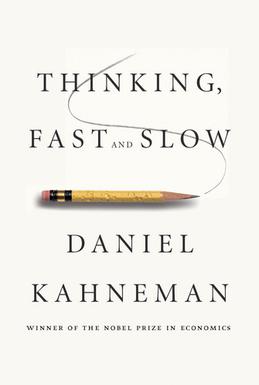
And then: Nobel laureate Daniel Kahneman. And I realized I have a book of his lying around somewhere unread that I received for Christmas a few years ago. Well, Thinking, Fast and Slow: no longer unread.
Kahneman summarizes the book in his conclusion:
I read the whole book word for word, cover to cover (is that how people read nonfiction?). The writing's a bit tedious at times; basically it's a retrospective of Kahneman's career, touching on all his research and the discoveries he made along the way. Anyone with an interest in cognitive processes will find examples and case studies to entertain or to puzzle over, some resonating more than others.
What Kahneman saves for the conclusion, though, caused a lightbulb moment. Individuals make intuitive but irrational decisions, and contradictory judgments, and "objective" assessments imbued with external influences — and these issues hold at the societal level of decision making as well. Kahneman makes a soft appeal for libertarian paternalism, where, given the known workings and weaknesses of systems of reasoning, policymakers should judiciously guide individuals using the principles of behavioral science (with experts to advise the policymakers, of course). Examples of applications of these principles include opt-out enrolment in social plans (like health care) and regulations regarding the labeling on food packaging and the framing of disclosures regarding fuel consumption. So, not just brain theory stuff.
Reviews and Insight
Two Brains Running — Jim Holt in the New York Times
How to Dispel Your Illusions — Freeman Dyson in the New York Review of Books
The King of Human Error — Michael Lewis in Vanity Fair
The course actually covered some fairly familiar concepts regarding intuitive thinking versus rational thinking, how responses are affected by whether a situation is framed positively or negatively, how those responses can be primed by unrelated factors in our environment, etc. And the material referenced the work of scientists with which I'm actually conversant, like Antonio Damasio and Steven Pinker.
And then: Nobel laureate Daniel Kahneman. And I realized I have a book of his lying around somewhere unread that I received for Christmas a few years ago. Well, Thinking, Fast and Slow: no longer unread.
Kahneman summarizes the book in his conclusion:
I began this book by introducing two fictitious characters, spent some time discussing two species, and ended with two selves. The two characters were the intuitive System 1, which does the fast thinking, and the effortful and slower System 2, which does the slow thinking, monitors System 1, and maintains control as best it can within its limited resources. The two species were the fictitious Econs, who live in the land of theory, and the Humans, who act in the real world. The two selves are the experiencing self, which does the living, and the remembering self, which keeps score and make the choices. In this final chapter I consider some applications of the three distinctions.
I read the whole book word for word, cover to cover (is that how people read nonfiction?). The writing's a bit tedious at times; basically it's a retrospective of Kahneman's career, touching on all his research and the discoveries he made along the way. Anyone with an interest in cognitive processes will find examples and case studies to entertain or to puzzle over, some resonating more than others.
What Kahneman saves for the conclusion, though, caused a lightbulb moment. Individuals make intuitive but irrational decisions, and contradictory judgments, and "objective" assessments imbued with external influences — and these issues hold at the societal level of decision making as well. Kahneman makes a soft appeal for libertarian paternalism, where, given the known workings and weaknesses of systems of reasoning, policymakers should judiciously guide individuals using the principles of behavioral science (with experts to advise the policymakers, of course). Examples of applications of these principles include opt-out enrolment in social plans (like health care) and regulations regarding the labeling on food packaging and the framing of disclosures regarding fuel consumption. So, not just brain theory stuff.
Reviews and Insight
Two Brains Running — Jim Holt in the New York Times
And frowning — as one learns on Page 152 of this book — activates the skeptic within us: what Kahneman calls "System 2." Just putting on a frown, experiments show, works to reduce overconfidence; it causes us to be more analytical, more vigilant in our thinking; to question stories that we would otherwise unreflectively accept as true because they are facile and coherent. And that is why I frowningly gave this extraordinarily interesting book the most skeptical reading I could.
How to Dispel Your Illusions — Freeman Dyson in the New York Review of Books
There are huge differences between Freud and Kahneman, as one would expect for thinkers separated by a century. The deepest difference is that Freud is literary while Kahneman is scientific. The great contribution of Kahneman was to make psychology an experimental science, with experimental results that could be repeated and verified. Freud, in my view, made psychology a branch of literature, with stories and myths that appeal to the heart rather than to the mind. The central dogma of Freudian psychology was the Oedipus complex, a story borrowed from Greek mythology and enacted in the tragedies of Sophocles. Freud claimed that he had identified from his clinical practice the emotions children feel toward their parents that he called the Oedipus complex. His critics have rejected that claim. So Freud became to his admirers a prophet of spiritual and psychological wisdom, and to his detractors a quack doctor pretending to cure imaginary diseases. Kahneman took psychology in a diametrically opposite direction, not pretending to cure ailments but only trying to dispel illusions.
The King of Human Error — Michael Lewis in Vanity Fair
There's a quality both impish and joyous to Kahneman's work, and it is most on display in his collaboration with Amos Tversky. They had a rule of thumb, he explains: they would study no specific example of human idiocy or irrationality unless they first detected it in themselves. "People thought we were studying stupidity," says Kahneman. "But we were not. We were studying ourselves." Kahneman has a phrase to describe what they did: "Ironic research."
Labels:
cognitive science,
Daniel Kahneman,
Jim Holt
Tuesday, September 02, 2014
Why is there something instead of nothing?
Why is there something instead of nothing? That's the question — along with some variations ("What banged? Why did it bang? And what was going on before it banged?") — Jim Holt asks, and sets out to answer (but, unsurprisingly, doesn't, entirely), in Why Does the World Exist: An Existential Detective Story.
Coincidentally I was about 20% of the way through this book (so maybe Holt does answer it, I dunno) when this TED Talk turned up. Why Does the World Exist? is Argo Bookshop's next book club title, set for discussion on September 25.
Labels:
Jim Holt,
philosophy
Saturday, August 30, 2014
Craving fiction
I've been a bit irritable this week. There was a bit of stress in getting the kid back to school — her supplies, our routine — but not enough, I don't think, to account for my crankiness. I think it's because I'm not reading enough fiction.
Working from home a couple days and getting a lift a couple other days meant not reading on my commute. My days are regularly grounded, or framed, or inspired, or escaped, by those twice-daily quarter-hour immersions in an imaginary world. Their absence is felt.
I'm still reading, though, but nonfiction. I'm actively reading two nonfiction books, one because it's related to a MOOC I've been following, another is for book club; there's a third languishing on my nightstand — I read a page now and then. They're all very interesting. But they're not exactly entertaining.
I deliberately decided that I needed to supplement my current nonfiction reading with some fiction. Short pieces by Robert Walser (which I've been meaning to get to for a couple years) seemed to fit the bill. But I was wrong. These Berlin "stories" are lovely prose poems, meditative essays, descriptive vignettes; but they're not stories.
[I've even found myself craving (gasp!) television this week.]
But I feel compelled to finish all these books before starting something new. So, here's to a couple more days of restlessness, here on a fact-based Earth, before escaping to a fictional universe.
Working from home a couple days and getting a lift a couple other days meant not reading on my commute. My days are regularly grounded, or framed, or inspired, or escaped, by those twice-daily quarter-hour immersions in an imaginary world. Their absence is felt.
I'm still reading, though, but nonfiction. I'm actively reading two nonfiction books, one because it's related to a MOOC I've been following, another is for book club; there's a third languishing on my nightstand — I read a page now and then. They're all very interesting. But they're not exactly entertaining.
I deliberately decided that I needed to supplement my current nonfiction reading with some fiction. Short pieces by Robert Walser (which I've been meaning to get to for a couple years) seemed to fit the bill. But I was wrong. These Berlin "stories" are lovely prose poems, meditative essays, descriptive vignettes; but they're not stories.
[I've even found myself craving (gasp!) television this week.]
But I feel compelled to finish all these books before starting something new. So, here's to a couple more days of restlessness, here on a fact-based Earth, before escaping to a fictional universe.
Labels:
nonfiction
Monday, August 25, 2014
Vampires!
Importance of names —
Most appellations appear to displease them; they would prefer not to be discussed at all, I believe. The expression "un-dead" is often considered distasteful. (I use it privately here, but would never utter it aloud in the club.) "Revenant" will do at a pinch, though the connotations of burial and return are a little indelicate. I asked Verner what name he preferred. He said that I was considering the question from the wrong angle. "We don't need words for ourselves," he said. "It's the living we're always watching out for."
"What do you call us, then?" I asked.
He said that there were few names he would care to repeat — the kindest being "bleaters." "Blood bag" is another. A buxom human female, in low circles, might be termed a "claret jug." He added that amongst those with better manners, the most widespread term for us is "the Quick."
Then he smiled — an effort made solely to discompose me. "Not always quick enough, of course."
Lauren Owen's The Quick is a vampire novel. Why this should be a secret is beyond me. But I'm betting that:
1. If you've heard at all about The Quick through the usual internetted ways, then you already know there are vampires.
2. Readers of this blog would be more inclined to pick up this novel knowing it's actually a vampire novel, not just a romance steeped in Victorian gothic atmosphere.
(Quite frankly, while the jacket copy about secret societies intrigued me, it wasn't enough to get me to read this book. It's the vampires that grabbed me; I agreed to a review copy only after I'd heard about this twist.)
It's a hefty book, but action-packed and with interesting characters, so it's quick to read.
It's positively dripping with Victorian gothic atmosphere. It reminds me of Susanna Clarke's Jonathan Strange (though I can't recall the details of that book, the mood stays with me) and Diane Setterfield's Bellman & Black (which I loved for how it let the reader hover in uncertainty). The most obvious reference would of course be Bram Stoker's Dracula, but at the time of the events told in The Quick it was not yet written.
Owen's creatures fit nicely into the vampire tradition, building on fundamental notions we have, primarily via Dracula, but with a few qualities invented or borrowed from elsewhere. These vampires have not been reinvented into something unrecognizable; they are updated classic, and they are scary.
And as in Dracula, those affected by the creatures take up a scientific exploration of their nature, so fact and myths are affirmed and dispelled for the reader as they are learned by the characters. In both books we see the investigators turning to medical and technological innovations (even if to establish a scientific basis in folkloric remedies) to aid them in defeating, or curing, the monster. Certainly typewriters will record their accumulated knowledge for posterity.
Owen discussed some the themes in her novel in an interview with The Bookseller:
"In modern representations of the vampire, the vampire is a metaphor for sex and romantic relationships, but in earlier depictions of the vampire there is more leeway into folklore," Owen says. "There's the idea of the vampire coming back to his family and sickening them and the rest of the village with his attacks, so that was part of the choice.
"I think family relationships are very interesting; the idea of what you tell the people who are closest to you and what you don't tell them — or what you're able to tell them, and whether or not being able to tell them everything about yourself means that your love for your family is not complete."
The vampire as metaphor for sex is already firmly established in Dracula, and it's nice to see this fiction stretch a little further back into the lore. Owen explores a lot of different family relationships in this novel, which puts some store in the saying that blood is thicker than water. Vampires would live by that too.
Labels:
fantasy,
historical fiction,
horror,
Lauren Owen
Sunday, August 24, 2014
Sunday only ever existed at home
Park air welcomes me; the many thousand green leaves of the lofty trees are lips that wish me good morning: So you're up already too? Indeed, yes, I'm surprised myself. A park like this resembles a large, silent, isolated room. In fact it's always Sunday in a park, by the way, for it's always a bit melancholy, and the melancholy stirs up vivid memories of home, and Sunday is something that only ever existed at home, where you were a child. Sundays have something parental and childish about them.— from "The Park" in Berlin Stories, by Robert Walser.
It's Sunday, and I find something heart-wrenchingly true in these words. Later, "Sundays only exist around the family table and on family walks." I can't reproduce my childhood Sundays. My parental Sundays waver; they are less grounded, still (still!) finding their way.
Labels:
Robert Walser
Wednesday, August 20, 2014
Never underestimate the determination of a kid who is time-rich and cash-poor
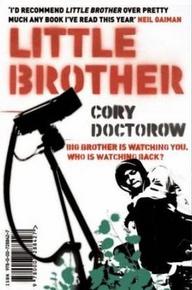
If you love freedom, if you think the human condition is dignified by privacy, by the right to be left alone, by the right to explore your weird ideas provided you don't hurt others, then you have common cause with the kids whose web-browsers and cell phones are being used to lock them up and follow them around.This is an excerpt from the introduction to Little Brother, by Cory Doctorow.
If you believe that the answer to bad speech is more speech — not censorship — then you have a dog in the fight.
If you believe in a society of laws, a land where our rulers have to tell us the rules, and have to follow them too, then you're part of the same struggle that kids fight when they argue for the right to live under the same Bill of Rights that adults have.
This book is meant to be part of the conversation about what an information society means: does it mean total control, or unheard-of liberty? It's not just a noun, it's a verb, it's something you do.
This is a very puzzling novel. Doctorow has a message he wants to spread, and he's not very subtle about it.
A terrorist attack in San Francisco gives rise to a state run by the Department of Homeland Security, by which 17-year-old Marcus is tortured, his right to privacy confiscated, his entire way of life threatened.
This novel was on the reading list for the MOOC Fantasy and Science Fiction: the Human Mind, Our Modern World. One of the issues to arise in the discussion forums was whether this novel should be considered science fiction. The professor posits that it's a thought experiment, a what-if novel. But some students observe that there's no what-if about it.
This is not a novel for readers. This is a novel for schoolchildren. It includes a history of civil rights movements and discussion of civil liberties, as well as a history of underground communications and Internet computing. I believe the tiresome explication is a desperate plea to be taken seriously.
Little Brother is a contradiction. It is free for download while being a marketing brochure for the bookstores of corporate America (every chapter is dedicated to a bookstore deemed significant by Doctorow, including Amazon and several large chainstore). It is didactic enough for inclusion on school curricula, while purporting to be a defense of autodidacticism. Its intent can only be to subvert from within. It is a how-to guide to hacking. It is a call to revolution.
This is not a novel. This is a manifesto. It is not about the future; it is about the now.
In many ways, I think this is not a very good novel. But I think it's a necessary book. It lacks subtlety, because the world of today lacks subtlety. It is attempting to equip the youth of today, who through our overprotection are sadly ill-prepared to face some social and political realities. What Doctorow has to say is more important than how he says it.
"Never underestimate the determination of a kid who is time-rich and cash-poor."
Labels:
Cory Doctorow,
dystopia,
science fiction
Tuesday, August 19, 2014
Some books might be better off as movies
There are some notable exceptions to the generally accepted truth that a book is better than its movie adaptation. Jaws comes to mind. Children of Men. Bladerunner. And there are other titles that stand as art in both mediums; arguably they are not adaptations, but interpretations. I'm thinking of films like Kubrick's 2001 and The Shining and Tarkovsky's Solaris and Stalker, that are equal to but different from the books they were inspired by (with credit to Clarke, King, Lem, Strugatsky).
But every know and then I encounter a book that should've bypassed its print incarnation entirely. Archetype and its sequel Prototype, by M.D. Waters, fall into this category. I enjoyed Archetype when I read it last winter. I started Prototype earlier this summer and was interrupted by life, but I've spent the last couple days complaining about this book that I couldn't stop reading.
The dialogue lacks prompts, which helps with immediacy, but for extended conversations leads to confusion. The action sequences are full of vivid description, but are somehow overly visual; the angle of the kick, the position of the gun, the bodies in motion — too many details and I lose my spatial orientation.
I'm not sure who the intended audience is. There's steamy romance (with cheesy, soap opera-like "lines") and there's a militia resistance enacting covert operations and raids. One chapter to the next didn't quite feel like the same book.
However, I would've gladly given over two hours of my life to watch this onscreen. A futuristic dystopian sci-fi action adventure romance. Something for everyone. A real blockbuster.
There are some great themes of identity and memory in these novels related to cloning, with an undercurrent of feminism. But to my liking, these are underdeveloped. And in fact, Prototype never delivers on one subplot that it is hinted at throughout (whether one of the main characters is himself a clone).
The books were really unputdownable, but with the sequel clocking in at 384 pages, I resented it.
Have you read any books that should've gone straight to film?
But every know and then I encounter a book that should've bypassed its print incarnation entirely. Archetype and its sequel Prototype, by M.D. Waters, fall into this category. I enjoyed Archetype when I read it last winter. I started Prototype earlier this summer and was interrupted by life, but I've spent the last couple days complaining about this book that I couldn't stop reading.
The dialogue lacks prompts, which helps with immediacy, but for extended conversations leads to confusion. The action sequences are full of vivid description, but are somehow overly visual; the angle of the kick, the position of the gun, the bodies in motion — too many details and I lose my spatial orientation.
I'm not sure who the intended audience is. There's steamy romance (with cheesy, soap opera-like "lines") and there's a militia resistance enacting covert operations and raids. One chapter to the next didn't quite feel like the same book.
However, I would've gladly given over two hours of my life to watch this onscreen. A futuristic dystopian sci-fi action adventure romance. Something for everyone. A real blockbuster.
There are some great themes of identity and memory in these novels related to cloning, with an undercurrent of feminism. But to my liking, these are underdeveloped. And in fact, Prototype never delivers on one subplot that it is hinted at throughout (whether one of the main characters is himself a clone).
The books were really unputdownable, but with the sequel clocking in at 384 pages, I resented it.
Have you read any books that should've gone straight to film?
Labels:
dystopia,
M.D. Waters,
science fiction
Monday, August 18, 2014
Saturday, August 16, 2014
Still life
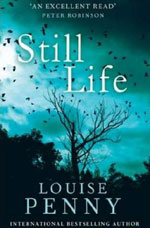
It happened far too often. Normally death came at night, taking a person in their sleep, stopping their heart or tickling them awake, leading them to the bathroom with a splitting headache before pouncing and flooding their brain with blood. It waits in alleys and metro stops. After the sun goes down plugs are pulled by white-clad guardians and death is invited into an antiseptic room.Still Life, by Louise Penny, is a wonderful palate cleanser of a book (a little too much SF for me lately). We've had cool, rainy days lately, and the leaves are starting to think about turning. The perfect backdrop for a perfect cosy mystery.
But in the country death comes, uninvited, during the day. It takes fishermen in the their longboats. It gabs children by the ankles as they swim. In winter it calls them down a slope too steep for their budding skills, and crosses their skis at the tips. It waits along the shore where snow met ice not long ago but now, unseen by sparkling eyes, a little water touched the shore, and the skater makes a circle slightly larger than intended. Death stands in the woods with a bow and arrow at dawn and dusk. And it tugs cars off the road in broad daylight, the tires spinning furiously on ice or snow, or bright autumn leaves.
Louis Penny brings death in the morning to Jane Neal, lovely, likeable old woman who'd just had a piece accepted to the community art show. And, like most of the villagers, there's a secret hidden in it.
I've read a few of Penny's novels before, but Still Life is the book that started the series of mysteries featuring Chief Inspector Gamache of the Sûreté du Québec. Her first book is every bit as assured in tone, plotting, character, and wit as the others I've read. There's only less Montreal (where Gamache's home and office are) and less departmental politics.
Excerpt.
"Life is change. If you aren't growing and evolving you're standing still, and the rest of the world is surging ahead. Most of these people are very immature. They lead 'still' lives, waiting."Perhaps the sentiment is a little anti-zen. More like stagnant stillness as opposed to being in stillness. But worth thinking about, no?
Labels:
Louise Penny,
mystery
Tuesday, August 12, 2014
Things my daughter texts me
The kid's been out at my mother-in-law's off and on for the last little while. I guess the subject of her upcoming flight to visit my sister came up.
I burst out laughing, because: who talks about plane brands? But she's right. It is funnier, while also true.
Labels:
Helena
Monday, August 11, 2014
Shifgrethor
Ursula K. Le Guin in The Left Hand of Darkness invents an alien world that has its own cultures, religions, mythologies, and languages. Her invented language includes some fairly nuanced concepts. The Karhidian language, for example, has several dozen terms for various type of snow. This may be out of a necessary response to the extreme environment, but this same environment, the flora and fauna, and how the land can be used, also shapes the culture philosophically.
Estraven is repeatedly described as a shadow when he comes to Genly's aid, serving as Genly's shadow (and therefore also his shifgrethor), as Genly has none of his own.
shif•gre•thor noun \ˈshif-grÉ™-thȯr\
1: prestige, face, place, pride-relationship; all-important principle of social authority in Karhide and among other civilizations of Gethen, of which native Karhidians have an innate sense but outsiders lack
2: code of social decorum
3: standard of individual behavior
4: recognition of the level of the manifestation of this quality and the status accorded it
Usage Notes 1. One may discard, forego, waive shifgrethor. 2. One may risk, stake shifgrethor; highly valued and must be given due regard. 3. One's shifgrethor may be degraded, diminished, impugned, insulted. 4. To play shifgrethor is to engage in political games, usually at an individual level, often petty and malicious, always intricate, but sometimes also internationally; can be played on the level of ethics.
Usage Examples
1. I waive shifgrethor; I discard it.
2. We must forego shifgrethor, forbid all acts of vengeance, and unite together.
3. He could lower all his standards of shifgrethor.
4. The shifgrethor of Karhide will be diminished.
Etymology Karhidish, from Old Gethenian "shadow"; possible derivation by analogy "shift" + "grey thore", which is widespread and fastidiously husbanded for maximal usage, minimal erosion, and full integration and balance, therefore "a shift in the balance". Discussion When Getheren of Shath, in the hearth-tale of The Place Inside the Blizzard, takes back his name and his shadow, he is owning his actions, making peace with both his internal conscience and the external society. In so doing he re-establishes the responsibility and dignity of which shifgrethor is borne. As every Karhidian casts his own shadow, shifgrethor is an internal shadow, functioning as a conscience, moral compass, social guide. Karhidian shifgrethor stems from Getheren's original sin and exile and bears the rightness of acknowledgement, necessity, atonement. Honorable men come to be outlawed, yet their shadow does not shrink. They live without shadows (shifgrethor) in Orgoreyn.
Related Words conscience, dignity, etiquette, high-mindedness, honour, integrity, irreproachability, manners, nobility, protocol, respectability, righteousness, right-mindedness, scrupulousness, self-sufficiency, tactfulness, virtuousness
Near Antonyms debasement, disgrace, disreputableness, looseness, pervertedness, reprehensibleness, shamelessness, unscrupulousness, weakness, wretchedness
(This is a revised version of the "essay" I submitted for the relevant unit in the MOOC Fantasy and Science Fiction: The Human Mind, Our Modern World. As the assignment limited me to 320 words, I have here added an introductory statement and expanded slightly on some points for the sake of clarity.)
Estraven is repeatedly described as a shadow when he comes to Genly's aid, serving as Genly's shadow (and therefore also his shifgrethor), as Genly has none of his own.
shif•gre•thor noun \ˈshif-grÉ™-thȯr\
1: prestige, face, place, pride-relationship; all-important principle of social authority in Karhide and among other civilizations of Gethen, of which native Karhidians have an innate sense but outsiders lack
2: code of social decorum
3: standard of individual behavior
4: recognition of the level of the manifestation of this quality and the status accorded it
Usage Notes 1. One may discard, forego, waive shifgrethor. 2. One may risk, stake shifgrethor; highly valued and must be given due regard. 3. One's shifgrethor may be degraded, diminished, impugned, insulted. 4. To play shifgrethor is to engage in political games, usually at an individual level, often petty and malicious, always intricate, but sometimes also internationally; can be played on the level of ethics.
Usage Examples
1. I waive shifgrethor; I discard it.
2. We must forego shifgrethor, forbid all acts of vengeance, and unite together.
3. He could lower all his standards of shifgrethor.
4. The shifgrethor of Karhide will be diminished.
Etymology Karhidish, from Old Gethenian "shadow"; possible derivation by analogy "shift" + "grey thore", which is widespread and fastidiously husbanded for maximal usage, minimal erosion, and full integration and balance, therefore "a shift in the balance". Discussion When Getheren of Shath, in the hearth-tale of The Place Inside the Blizzard, takes back his name and his shadow, he is owning his actions, making peace with both his internal conscience and the external society. In so doing he re-establishes the responsibility and dignity of which shifgrethor is borne. As every Karhidian casts his own shadow, shifgrethor is an internal shadow, functioning as a conscience, moral compass, social guide. Karhidian shifgrethor stems from Getheren's original sin and exile and bears the rightness of acknowledgement, necessity, atonement. Honorable men come to be outlawed, yet their shadow does not shrink. They live without shadows (shifgrethor) in Orgoreyn.
Related Words conscience, dignity, etiquette, high-mindedness, honour, integrity, irreproachability, manners, nobility, protocol, respectability, righteousness, right-mindedness, scrupulousness, self-sufficiency, tactfulness, virtuousness
Near Antonyms debasement, disgrace, disreputableness, looseness, pervertedness, reprehensibleness, shamelessness, unscrupulousness, weakness, wretchedness
(This is a revised version of the "essay" I submitted for the relevant unit in the MOOC Fantasy and Science Fiction: The Human Mind, Our Modern World. As the assignment limited me to 320 words, I have here added an introductory statement and expanded slightly on some points for the sake of clarity.)
Labels:
language,
linguistics,
mooc,
science fiction,
Ursula K. Le Guin
Saturday, August 09, 2014
Beethoven!
I love Beethoven!
There's a new book out, Beethoven: Anguish and Triumph, by Jan Swafford, which seems to be striking a chord with the public. I may need to check it out.
NPR's interview with the author covers how the Eroica symphony revealed his personality.
The New York Times also covers the book:
Music is hard to write about, and the Times includes an example of "silly": a sonata "begins with a couple of can't-get-started stutters followed by sort of a sneeze." But I think that sentence is rather evocative. And if the MOOC I took earlier this year (Exploring Beethoven's Piano Sonatas) is anything to go by, musicians actually talk that way. We can't all be poets. How else can you describe music if not by the noise it makes?
I include here for your entertainment the essay I wrote for that MOOC. Students ranged from serious experts in music theory and performance to music fans who wanted simply to explore a different genre (I fall somewhere in between). Truly, one got from the course what one put into it, and it's one of my favourite MOOCs to date.
The assignment was to choose one of nine stated sonatas, "imagine that you are hearing this sonata as a contemporary work or that you lived when it was a new work," and write a review, and to: 1. Refer to concepts covered in the lecture, including at least five historical and stylistic questions, and 2. Describe what you heard and how it made you feel, with two specific examples.
Without further ado...
Six Keys in Search of a Composer (with apologies to Pirandello)
A review of the Fantasia for piano in G minor, Op. 77, by Ludwig van Beethoven. Written 1809, published 1810. (Performed by Dino Ciano.)
Ah, phantasie. Some kind of cruel joke. A full ten minutes of unmusical noise mixed with show-offy flourishes.
"Fantasy" is the only appropriate categorization for something so unreal wrought of an unholy imagination. It is carnivalesque, bordering on grotesque.
It is a curious phenomenon that Beethoven should produce a fantasy at all. As of the publication of this phantasie, Beethoven has only once before dabbled with this "form" [issue 1], and given his propensity for structure it seems out of character to eschew it altogether.
It is striking in that it is a single-movement piece [issue 2], and it is the first time Beethoven embarks upon such a proposition [his only other single-movement composition, a polonaise, will be published in 1815].
It does not resemble, in its form or its content, anything else [issue 3] this reviewer has ever heard, in Beethoven's repertoire or that of anyone else. In its singularity, one may surmise that it was conceived as a companion piece for something that is yet to come, though what oddity that may be is difficult to imagine. The bulk of the piece is in B major (but more on this later) — so uncommon a choice my ears are barely attuned to it.
The whole of the approximately nine minutes it takes to perform this piece gives the impression of improvisation [issue 4]. It is highly involved, but with an adventurous spontaneity – Beethoven is intent on keeping us in the moment, with no glimpse of the future.
It seems not composed for human fingers, as if anticipating its performance on some autopiano. This phantasie must require inhuman preternatural skill to play, of which Beethoven has a full store, perhaps harboring in his soul a multiarmed creature both fanciful and monstrous. Beethoven's musical vision must be distorted by a blight he carries within. He must be seeing things, or hearing things. Or not hearing things.
There is an absurdity in naming this work as one in G minor – it starts in this key and stays there for all of twenty seconds. It wanders through several keys [issue 5] before settling on an organizing principle, strange though Beethoven's choice of B major may be.
Yet the atmosphere carries with it some ironic knowledge. Just past the two-minute mark, Beethoven plays allegro con brio [example 1], for almost a minute. I imagine this music accompanying some dastardly rogue villain as he ties a despairing damsel to the railroad tracks, her fate to be consummated by an oncoming steam locomotive, a hostage in his scheme; he twirls his moustaches and winks with a glint as if at an audience.
It is without a doubt a new kind of metamusical narrative. It conveys an awareness of itself, with self-deprecating wit, and an awareness that everyone (that is, everyone who matters) is aware of, and in on, the joke.
This has become music about music, lightly mocking musical tropes. The music is self-referential not just within a piece (as Bach so mathematically exemplified), but between works. Beethoven may be the father of metamusic.
The passages of villainy are followed by harp-like runs. They are disconnected form what comes before and what follows. At about three minutes, where again Beethoven slips into adagio, there is such a run in the fifth bar [example 2] that marks our entry into a different landscape – we have crossed the threshold from chaos to calm. And yet another series of runs in the opposite direction lead us back into presto.
The up and down, back and forth, disorients but also unifies: the runs are the connectors between the disparate, contrasting parts.
Although musically jarring, these runs serve a narrative function, to draw a curtain between the frenzy and calm, dream and nightmare – between fantasy and reality. But which is which? Despite the disorientation, they are in perfect balance, the yin and yang, wholly necessary to each other [issue 6].
With this phantasie, Beethoven has ventured into absurdity. It is illogical, yet logically so. Its search for structure has become its own structure. In a Hegelian manner, Beethoven’s musical dialectic becomes fundamental to its nature. It is in its becoming.
He anticipates an existentialist stance, while maintaining authenticity. One feels in his music the existential despair of the human condition, brought to the brink of the yawning void of meaninglessness. Beethoven heralds modernity, in an already postmodern way.
Certainly Beethoven has taken Kant's words into his head and his heart:
The fantasia is a bizarre composition, disturbing upon first hearing, but surefooted in the path it forges. Intended for ears strong enough to bear music's schizoid future.
There's a new book out, Beethoven: Anguish and Triumph, by Jan Swafford, which seems to be striking a chord with the public. I may need to check it out.
NPR's interview with the author covers how the Eroica symphony revealed his personality.
The New York Times also covers the book:
Swafford's voice is genial and conversational, that of a friend who loves to tell you about his fascinations: the foibles of court life, logistical problems of the musician. He supplies a generous chapter on the German Enlightenment, connecting threads of the 1770s and '80s, opposing currents of rationalism and expressive release: Schiller, Kant, Goethe, the American Revolution. He nods toward Beethoven's unhappy childhood, but emphasizes "the golden age of old Bonn's intellectual and artistic life" and "the town's endless talk of philosophy, science, music, politics, literature."An excerpt is available online.
Music is hard to write about, and the Times includes an example of "silly": a sonata "begins with a couple of can't-get-started stutters followed by sort of a sneeze." But I think that sentence is rather evocative. And if the MOOC I took earlier this year (Exploring Beethoven's Piano Sonatas) is anything to go by, musicians actually talk that way. We can't all be poets. How else can you describe music if not by the noise it makes?
I include here for your entertainment the essay I wrote for that MOOC. Students ranged from serious experts in music theory and performance to music fans who wanted simply to explore a different genre (I fall somewhere in between). Truly, one got from the course what one put into it, and it's one of my favourite MOOCs to date.
The assignment was to choose one of nine stated sonatas, "imagine that you are hearing this sonata as a contemporary work or that you lived when it was a new work," and write a review, and to: 1. Refer to concepts covered in the lecture, including at least five historical and stylistic questions, and 2. Describe what you heard and how it made you feel, with two specific examples.
Without further ado...
Six Keys in Search of a Composer (with apologies to Pirandello)
A review of the Fantasia for piano in G minor, Op. 77, by Ludwig van Beethoven. Written 1809, published 1810. (Performed by Dino Ciano.)
Ah, phantasie. Some kind of cruel joke. A full ten minutes of unmusical noise mixed with show-offy flourishes.
"Fantasy" is the only appropriate categorization for something so unreal wrought of an unholy imagination. It is carnivalesque, bordering on grotesque.
It is a curious phenomenon that Beethoven should produce a fantasy at all. As of the publication of this phantasie, Beethoven has only once before dabbled with this "form" [issue 1], and given his propensity for structure it seems out of character to eschew it altogether.
It is striking in that it is a single-movement piece [issue 2], and it is the first time Beethoven embarks upon such a proposition [his only other single-movement composition, a polonaise, will be published in 1815].
It does not resemble, in its form or its content, anything else [issue 3] this reviewer has ever heard, in Beethoven's repertoire or that of anyone else. In its singularity, one may surmise that it was conceived as a companion piece for something that is yet to come, though what oddity that may be is difficult to imagine. The bulk of the piece is in B major (but more on this later) — so uncommon a choice my ears are barely attuned to it.
The whole of the approximately nine minutes it takes to perform this piece gives the impression of improvisation [issue 4]. It is highly involved, but with an adventurous spontaneity – Beethoven is intent on keeping us in the moment, with no glimpse of the future.
It seems not composed for human fingers, as if anticipating its performance on some autopiano. This phantasie must require inhuman preternatural skill to play, of which Beethoven has a full store, perhaps harboring in his soul a multiarmed creature both fanciful and monstrous. Beethoven's musical vision must be distorted by a blight he carries within. He must be seeing things, or hearing things. Or not hearing things.
There is an absurdity in naming this work as one in G minor – it starts in this key and stays there for all of twenty seconds. It wanders through several keys [issue 5] before settling on an organizing principle, strange though Beethoven's choice of B major may be.
Yet the atmosphere carries with it some ironic knowledge. Just past the two-minute mark, Beethoven plays allegro con brio [example 1], for almost a minute. I imagine this music accompanying some dastardly rogue villain as he ties a despairing damsel to the railroad tracks, her fate to be consummated by an oncoming steam locomotive, a hostage in his scheme; he twirls his moustaches and winks with a glint as if at an audience.
It is without a doubt a new kind of metamusical narrative. It conveys an awareness of itself, with self-deprecating wit, and an awareness that everyone (that is, everyone who matters) is aware of, and in on, the joke.
This has become music about music, lightly mocking musical tropes. The music is self-referential not just within a piece (as Bach so mathematically exemplified), but between works. Beethoven may be the father of metamusic.
The passages of villainy are followed by harp-like runs. They are disconnected form what comes before and what follows. At about three minutes, where again Beethoven slips into adagio, there is such a run in the fifth bar [example 2] that marks our entry into a different landscape – we have crossed the threshold from chaos to calm. And yet another series of runs in the opposite direction lead us back into presto.
The up and down, back and forth, disorients but also unifies: the runs are the connectors between the disparate, contrasting parts.
Although musically jarring, these runs serve a narrative function, to draw a curtain between the frenzy and calm, dream and nightmare – between fantasy and reality. But which is which? Despite the disorientation, they are in perfect balance, the yin and yang, wholly necessary to each other [issue 6].
With this phantasie, Beethoven has ventured into absurdity. It is illogical, yet logically so. Its search for structure has become its own structure. In a Hegelian manner, Beethoven’s musical dialectic becomes fundamental to its nature. It is in its becoming.
He anticipates an existentialist stance, while maintaining authenticity. One feels in his music the existential despair of the human condition, brought to the brink of the yawning void of meaninglessness. Beethoven heralds modernity, in an already postmodern way.
Certainly Beethoven has taken Kant's words into his head and his heart:
Two things fill the mind with ever new and increasing admiration and awe, the more often and steadily reflection is occupied with them: the starry heaven above me and the moral law within me. Neither of them need I seek and merely suspect as if shrouded in obscurity or rapture beyond my own horizon; I see them before me and connect them immediately with my existence.Beethoven continues to connect our finite existence to the infinite.
The fantasia is a bizarre composition, disturbing upon first hearing, but surefooted in the path it forges. Intended for ears strong enough to bear music's schizoid future.
Thursday, August 07, 2014
The fitness of that city
Following the east bank of the great Rive Kunderer I came on my third morning in Orgoreyn to Mishnory, the largest city on that world.Big aimless bookshelves! The Left Hand of Darkness, by Ursula K. Le Guin, is a remarkable novel and already I look forward to rereading it someday.
In the weak sunlight between autumn showers it was a queer-looking city, all blank stonewalls with a few narrow windows set too high, wide streets that dwarfed the crowds, street-lamps perched on ridiculous tall posts, roofs pitched steep as praying hands, shed-roofs sticking out of housewalls eighteen feet above ground like big aimless bookshelves — an ill-proportioned, grotesque city, in the sunlight. It was not built for sunlight. It was built for winter. In winter, with those streets filled ten feet up with packed, hard-rolled snow, the steep roofs icicle-fringed, sleds parked under the shed-roofs, narrow window-slits shining yellow through driving sleet, you would see the fitness of that city, its economy, its beauty.
It is a beautifully written love story set amid a harsh environment against a backdrop of political intrigue. Which has to do with interplanetary contact. Also, there's a strong feminist message in the portrayal of a genderless society.
Aside: I think The Left Hand of Darkness bears a remarkable similarity to China Miéville's Embassytown, which is one of my favourite books, across all genres. The novels bring a studied anthropological perspective to alien contact, and the problem of communication across languages and cultures, which greatly appeals to my inner linguist. Both novels play with words, and the relationship between language and concepts.
Le Guin's Weaver — who weaves together the psychic energy of the foretellers — also reminded me of MiĂ©ville's Weaver in Perdido Street Station, though his is absolutely weirder and more poetical. It would not surprise me to learn that The Left Hand of Darkness was a tremendous influence on MiĂ©ville.
Le Guin builds her world on the Sapir-Whorf hypothesis, showing how language determines its speakers' worldview. This is particularly evident in the concept of shifgrethor, an untranslatable term for a kind of honour code or code of conduct, which governs the behaviour of the Karhidians and their resultant estimation of each other, while the Terran visitor fails to fully understand its mechanisms and implications. She also demonstrates how the Karhidian language reflects the environment on this planet the Terrans call Winter; borrowing from Whorf's examples, she presents a culture that has a multitude of terms for "snow."
The same concept is evident in the excerpt above — the style of architecture has evolved under the influence of the environment — and Le Guin extends it to all facets of life. The people have not developed flight, because there are no birds.
The sexual behaviour on this other world didn't make a particularly strong impression on me — to me this is not the main focus of the novel. Perhaps because I'm naturally openminded regarding people's sexual choices. Perhaps because since the novel was written our society really has changed and established some level of gender equality (at least in theory), and is coming to realize that biological sex need not determine social roles or even sexual roles. The novel is perhaps best known for its exploration of gender, which is fine, but I just want to go on record as saying that The Left Hand of Darkness is so much more than that.
[Oh! I just read Jo Walton's take, and it seems we agree.]
And really, the whole business of crossing the glacier, the blizzard, and no shadows — spectacular!
I read this novel as part of the coursework for a MOOC (Fantasy and Science Fiction: The Human Mind, Our Modern World). I can't tell you what exactly I'm learning from this course (in the professor's view, every rocketship is a penis, and some feminists are angry) apart from some trivial facts, like that Le Guin is American (I'd always assumed she was British). But I have been enjoying the reading and the discussion.
I suppose Le Guin is significant on the SF landscape for being among the first to bring real anthropological theory into the text (which is one the things I most love about the genre), shifting the genre away from straight-up action-adventure. (Although, many writers had already done that, no? Maybe it's the feminist angle that's supposed to be so groundbreaking. Frankly, I don't understand the logic behind the curriculum and I'm disappointed that it's so American-centric. )
I'm so relieved this novel lived up to the hype, and surpassed my expectations. You can bet I'll be reading more Le Guin over the months to come.
See also:
Sarah LeFanu, The Guardian: The king is pregnant
Jo Walton: Gender and glaciers: Ursula Le Guin’s The Left Hand of Darkness
The Paris Review: Ursula K. Le Guin, The Art of Fiction No. 221
And here's a list that may be (mostly) worth working through: 21 Books That Changed Science Fiction And Fantasy Forever.
Sunday, August 03, 2014
Good for the needy
I've been off-grid for a few days, which meant missing Jack White at Osheaga.
In recompense:
Literary connections:
In recompense:
Literary connections:
- Jack White, musician, now publisher, launches Third Man Books
- In That Black Bat Licorice, "Good for the needy, like Nietzsche, Freud and Horace."
Labels:
music,
Nietzsche,
Sigmund Freud
Wednesday, July 30, 2014
What did Time smell like?
There was a smell of Time in the air tonight. He smiled and turned the fancy in his mind. There was a thought. What did Time smell like? Like dust and clocks and people. And if you wondered what Time sounded like it sounded like water running in a dark cave and voices crying and dirt dropping down upon hollow box lids, and rain. And, going further, what did Time look like? Time looked like snow dropping silently into a black room or it looked like a silent film in an ancient theater, one hundred billion faces falling like those New Year balloons, down and down into nothing. That was how Time smelled and looked and sounded. And tonight — TomĂ¡s shoved a hand into the wind outside the truck mdash; tonight you could almost touch Time.In addition to rereading Ray Bradbury's The Martian Chronicles for this week's unit of the MOOC on fantasy and science fiction that I'm following, I decided to rewatch it as well.
It originally aired in January 1980, and I remember it as a big television event (this was, after all, the golden age of the miniseries). Apparently Bradbury thought it was boring. That may be true from the perspective of the mind from which the story was sprung. But it made a great impression on my 10-year-old self. Possibly more so than the book, which I didn't read till years later.
Low on special effects, and I don't particularly care for how the Martians are represented (they should be brown-skinned and small; I don't know about bald), it manages to convey the essence of Bradbury's novel, an ambiguity that hovers between poignancy and creepiness.
Scripted by Richard Matheson (no slouch as a writer of SF himself), it has an excellent new-agey soundtrack, and a vibe reminiscent of Fassbinder's World on a Wire (which is maybe just a general 1970s tv sfi-fi vibe, I dunno).But I think it's awesome.
You can watch The Martian Chronicles online (parts one, two, three).
Labels:
Ray Bradbury,
science fiction,
television
Tuesday, July 29, 2014
Cleaning up the language
"Everything You Always Wanted to Know About: Sects, Sets, Sex, prefix, frankforts, Waldorf, idle, American, peanuts, gin, Heritage, cabbage, Dictionary, Rasputin, bassoon, cohort, rum, putty, rotor, usage, coquette, alfalfa, zipper, Mississippi,…etc.: But Were Afraid to Axe!!"
(Via.)
(Via.)
Labels:
language
Monday, July 28, 2014
No matter how we touch Mars, we'll never touch it.
"I believe in the things that were done, and there are evidences of many things done on Mars. There are streets and houses, and there are books, I imagine, and big canals and clocks and places for stabling, if not horses, well, then some domestic animal, perhaps with twelve legs, who knows? Everywhere I look I see things that were used. They were touched and handled for centuries.— from "—And the Moon Be Still as Bright" in The Martian Chronicles, by Ray Bradbury.
"Ask me, then, if I believe in the spirit of the things as they were used, and I'll say yes. They're all here. All the things which had uses. All the mountains which had names. And we'll never be able to use them without feeling uncomfortable. And somehow the mountains will never sound right to us; we'll give them new names, but the old names are there, somewhere in time, and the mountains were shaped and seen under those names. The names we'll give to the canals and mountains and cities will fall like so much water on the back of a mallard. No matter how we touch Mars, we'll never touch it. And then we'll get mad at it, and you know what we'll do? We'll rip it up, rip the skin off, and change it to fit ourselves."
Labels:
Ray Bradbury,
science fiction
Thursday, July 24, 2014
Egg, bacon, thing
I'm at my mom's. Here's an old school assignment we dug up.
*************
Egg Man
- from aged, yellowed lava — when world created & volcanoes erupted
- yellow slime slithered, hardened with white foam covering on outside
- form of egg — were coloured white, yellow, beige, brown
- rolled about, wobbled
- few were cracked on rock — died
- most had 8-10 distinctly brow cuts used as mouths
- became very sacred — worshipped
- held ceremonies each night around fire
- first people ever created
Bacon Man
- third people to survive
- were created later than Egg Man
- live volcanic lava came together
- lava stuck and became Bacon Man
- sizzled, slithered around ground
- worshiped sun greatly — not fire, idol of Egg Man
- had not but 1 mouth
- communicate with bubbles
- were killed once all bubbles were scraped
Thing Man
- were created shortly after Egg Man far, far away — on a different planet out of our universe
- nobody knows of its background before they came to planet of Egg & Bacon
- head resembled bird, body of human, limbs & tail of pig
- worshiped dark — were blinded by any type of light except their own light
- light was of gloomy-oomy glow
- Thing Man was noisy — squawked & squealed at all times
- hated the quiet
LEGEND
Once a long time ago, Egg Man wandered the earth. He came upon Bacon Man and they travelled together. Their ways disagreed with each other — so they fought. The fighting was rough. Many peoples were killed. Strangely enough, no sound came of the fighting. Thing Man (which had come to "Planet of Bacon & Egg" by strange means) had roamed half way across the earth & dirt to the sight of the battle. The quiet of the fighting killed half of the tribe of Thing Men. The others decided to do something about this lack of noise. The Thing Men squawked & screamed and made the Egg & Bacon Men suffer, for they hated noise. But Egg & Bacon Men fought on. Thing Men decided that the only way to get rid of the quiet was to get rid of the other peoples. So the Thing Men pounced upon the others, ate them, and then there was noise. So the Thing Men travelled back to their own planet in their own universe.
This planet came to be known as "Earth." Thing Man evolved into 3 different things: the heads into chickens, the limbs & tail into pigs, and the body into a human (strange, isn't it). The humans still eat dead Bacon & Eggs. The Eggs come from the chickens. The Bacon comes from dead pigs. Few people know of Egg, Bacon & Thing Man and if you don't believe they ever lived, go ahead and think so. If you think they didn't 'live' in the sense that would most properly be understood today, you're right. Egg, Bacon & Thing Man live in imagination and mind.
Day of Egg Man
Once a year on every March 21st Egg Men would celebrate the beginning of life. That is why to this day the "egg" is thought of as the symbol of life. Well anyway, the Day of Egg Man was to them the most important day of the year. On this day they would paint each other with bright colours to show their happiness and thanks to their gods.
*************
Things I love about this essay:
*************
Egg Man
- from aged, yellowed lava — when world created & volcanoes erupted
- yellow slime slithered, hardened with white foam covering on outside
- form of egg — were coloured white, yellow, beige, brown
- rolled about, wobbled
- few were cracked on rock — died
- most had 8-10 distinctly brow cuts used as mouths
- became very sacred — worshipped
- held ceremonies each night around fire
- first people ever created
Bacon Man
- third people to survive
- were created later than Egg Man
- live volcanic lava came together
- lava stuck and became Bacon Man
- sizzled, slithered around ground
- worshiped sun greatly — not fire, idol of Egg Man
- had not but 1 mouth
- communicate with bubbles
- were killed once all bubbles were scraped
Thing Man
- were created shortly after Egg Man far, far away — on a different planet out of our universe
- nobody knows of its background before they came to planet of Egg & Bacon
- head resembled bird, body of human, limbs & tail of pig
- worshiped dark — were blinded by any type of light except their own light
- light was of gloomy-oomy glow
- Thing Man was noisy — squawked & squealed at all times
- hated the quiet
LEGEND
Once a long time ago, Egg Man wandered the earth. He came upon Bacon Man and they travelled together. Their ways disagreed with each other — so they fought. The fighting was rough. Many peoples were killed. Strangely enough, no sound came of the fighting. Thing Man (which had come to "Planet of Bacon & Egg" by strange means) had roamed half way across the earth & dirt to the sight of the battle. The quiet of the fighting killed half of the tribe of Thing Men. The others decided to do something about this lack of noise. The Thing Men squawked & screamed and made the Egg & Bacon Men suffer, for they hated noise. But Egg & Bacon Men fought on. Thing Men decided that the only way to get rid of the quiet was to get rid of the other peoples. So the Thing Men pounced upon the others, ate them, and then there was noise. So the Thing Men travelled back to their own planet in their own universe.
This planet came to be known as "Earth." Thing Man evolved into 3 different things: the heads into chickens, the limbs & tail into pigs, and the body into a human (strange, isn't it). The humans still eat dead Bacon & Eggs. The Eggs come from the chickens. The Bacon comes from dead pigs. Few people know of Egg, Bacon & Thing Man and if you don't believe they ever lived, go ahead and think so. If you think they didn't 'live' in the sense that would most properly be understood today, you're right. Egg, Bacon & Thing Man live in imagination and mind.
Day of Egg Man
Once a year on every March 21st Egg Men would celebrate the beginning of life. That is why to this day the "egg" is thought of as the symbol of life. Well anyway, the Day of Egg Man was to them the most important day of the year. On this day they would paint each other with bright colours to show their happiness and thanks to their gods.
I.A.K.
*************
Things I love about this essay:
- It goes from the first people to the third people. But who were the second? Why not present them chronologically? Suspense!
- "had not but 1 mouth" — Who writes like that? (Yeah, I know, I do.)
- So Bacon Man dies once he loses the ability to communicate...
- "gloomy-oomy"
- The noise. Oh, the noise, noise, noise, noise. I feel somewhat Grinch-like in my aversion to noise. I'm surprised to see it manifested so early. Or maybe the legend's message is anti-quiet, I dunno.
- How the narrator is suddenly inserted into the text (strange, isn't it).
- The Twilight Zone-y ending. I can just hear Rod Serling narrating the last few sentences of the Legend over the fade-out.
Labels:
children,
mythology,
science fiction
Wednesday, July 23, 2014
The whole thing is nonsense
I've never read Ursula K. Le Guin. Not really. The Dispossessed was on the syllabus of a course I took in university, but we ended up skimming that unit, and the book. So: major gap in my SF education.
The Left Hand of Darkness has been on my radar for several years. I'm reading it now as part of MOOC (Fantasy and Science Fiction: The Human Mind, Our Modern World); in fact, I enrolled in the MOOC precisely because I wanted to read this novel, else it would languish in my stack of unread books for a long time to come.
Le Guin's 1976 introduction to her novel is worth reading in its own right. In it she describes science fiction as something more than extrapolation; she considers it a thought-experiment, describing reality at a quantum level.
The Left Hand of Darkness has been on my radar for several years. I'm reading it now as part of MOOC (Fantasy and Science Fiction: The Human Mind, Our Modern World); in fact, I enrolled in the MOOC precisely because I wanted to read this novel, else it would languish in my stack of unread books for a long time to come.
Le Guin's 1976 introduction to her novel is worth reading in its own right. In it she describes science fiction as something more than extrapolation; she considers it a thought-experiment, describing reality at a quantum level.
Science fiction is not predictive; it is descriptive.The entire essay is worth reading in its entirety, if you can track it down. LeGuin's tone is very matter of fact; her style reminds me very much of Doris Lessing's (which is a good thing). It bodes well for this classic of science fiction.
Predictions are uttered by prophets (free of charge); by clairvoyants (who usually charge a fee, and are therefore more honored in their day than prophets); and by futurologists (salaried). Prediction is the business of prophets, clairvoyants, and futurologists. It is not the business of novelists. A novelist's business is lying.
[...]
Fiction writers, at least in their braver moments, do desire the truth: to know it, speak it, serve it. But they go about it in a peculiar and devious way, which consists in inventing persons, places, and events which never did and never will exist or occur, and telling about these fictions in detail and at length and with a great deal of emotion, and then when they are done writing down this pack of lies, they say, There! That's the truth.
They may use all kinds of facts to support their tissue of lies. They may describe the Marshalsea Prison, which was a real place, or the battle of Borodino, which really was fought, or the process of cloning, which really takes place in laboratories, or the deterioration of a personality, which is described in real textbooks of psychology; and so on. This weight of verifiable place-event-phenomenon-behavior makes the reader forget that he is reading a pure invention, a history that never took place anywhere but in that unlocalisable region, the author's mind. In fact, while we read a noel, we are insane — bonkers. We believe in the existence of people who aren't there, we hear their voices, we watch the battle of Borodino with them, we may even become Napoleon. Sanity returns (in most cases) when the book is closed.
Is it any wonder that no truly respectable society has ever trusted its artists?
In reading a novel, any novel, we have to know perfectly well that the whole thing is nonsense, and then, while reading, believe every word of it.
Labels:
science fiction,
Ursula K. Le Guin
Sunday, July 20, 2014
Sardines and oranges
I'm not sure why this poem speaks to me so, nor do I recall the precise circumstance of my encountering it (via) and it speaking to me, but isn't that the way with poetry.
Perhaps the sentiment here — the present absence, or subtraction — might also explain why it is that I'm not a poet, even a writer. Or a mathematician.
Why I Am Not a Painter
I am not a painter, I am a poet.
Why? I think I would rather be
a painter, but I am not. Well,
for instance, Mike Goldberg
is starting a painting. I drop in.
"Sit down and have a drink" he
says. I drink; we drink. I look
up. "You have SARDINES in it."
"Yes, it needed something there."
"Oh." I go and the days go by
and I drop in again. The painting
is going on, and I go, and the days
go by. I drop in. The painting is
finished. "Where's SARDINES?"
All that's left is just
letters, "It was too much," Mike says.
But me? One day I am thinking of
a color: orange. I write a line
about orange. Pretty soon it is a
whole page of words, not lines.
Then another page. There should be
so much more, not of orange, of
words, of how terrible orange is
and life. Days go by. It is even in
prose, I am a real poet. My poem
is finished and I haven't mentioned
orange yet. It's twelve poems, I call
it ORANGES. And one day in a gallery
I see Mike's painting, called SARDINES.
— Frank O'Hara
Perhaps the sentiment here — the present absence, or subtraction — might also explain why it is that I'm not a poet, even a writer. Or a mathematician.
Labels:
Frank O'Hara,
poetry
Wednesday, July 16, 2014
The movements of men are not analogous to the stars
Aimee (not her real name) is a grifter. She's killed several times, for money and for justice. She is "the avenging angel of her own nihilism." She rides into town, settles in with the ruling class, and proceeds to dig up the dirt to drag them down.
Similarly, it's difficult to discern if Manchette is espousing feminist sympathies. There must be more to his characterization of this female James Bond–type protagonist than simple male fantasy. What message is Manchette trying to communicate when he ends the novel with the line, "SENSUAL WOMEN, PHILOSPHICALLY MINDED WOMEN, IT IS TO YOU THAT I ADDRESS MYSELF"?
These oddities, other weird narrative insertions, and occasional seeming contradictions in character made this slim book a goldmine for bookclub discussion.
My sense of time and space were a little disoriented in reading Fatale. Written in the seventies, the noir tone may take you back a few decades earlier. It's set in a remote coastal village in the north of France, but "whichever way you go, there is a big hill to climb before you get out of Bléville" (I believe the hill is metaphorical).
The book reminds me of Simenon's romans durs in the moral ugliness of its characters, with a hint of existentialism underlying it all. It also brought to my mind Claude Chabrol's film La Cérémonie (based on a Ruth Rendell novel) in the violence and senselessness, the dark side of French provincial life. (Interestingly, Chabrol had adapted another Manchette work for film, so I may have sensed a common vibe.)
I really enjoyed this novella. It may ultimately prove to be forgettable, but it succeeded in lifting me out of my everyday in spectacular fashion. There are worse ways to spend a couple hours.
New York Review Books has just released Manchette's The Mad and the Bad. I need to get my hands on a copy.
See
Manchette: Into the Muck, by James Sallis, in The New York Review of Books.
Also
Analepsis
NoirWhale
"When I break this decanter of mine," he said, "I'll replace it with one with advertising on it." He held out one of the glasses to AimĂ©e, who reached for it with one hand as she continued towelling her hair with the other. "I am very interested in promotional items and free gifts," continued the baron. "Also in trash. I have no income, you see, and a man with no income is bound to take a great interest in free gifts and trash." He took a sip of brandy and clicked his tongue appreciatively. "Given the present state of the world, don't you know, with the increase of constant capital as compared with variable capital, a whole stratum of the poor is bound to be unemployed and live off free gifts and trash, and occasionally off various government subsidies. Do you know what I am saying?"Nor am I entirely sure what to make of Fatale, by Jean-Patrick Manchette. Every now and then it veers into something like social commentary, something like the above, which is just a little bit weird. Some passages are clearly anticapitalist, while AimĂ©e herself operates on capitalist principals — she is the ultimate self-made woman. Is she being held up as a model or as an object of ridicule?
"I am not sure," said Aimée.
"Nor am I," said the baron.
Similarly, it's difficult to discern if Manchette is espousing feminist sympathies. There must be more to his characterization of this female James Bond–type protagonist than simple male fantasy. What message is Manchette trying to communicate when he ends the novel with the line, "SENSUAL WOMEN, PHILOSPHICALLY MINDED WOMEN, IT IS TO YOU THAT I ADDRESS MYSELF"?
These oddities, other weird narrative insertions, and occasional seeming contradictions in character made this slim book a goldmine for bookclub discussion.
A little later, a little calmer now, as the pair went back down into the hall (on a wall of which hung a Weatherby Regency under-and-over double-barrel shotgun), Baron Jules further informed Aimée that, although the movements of men are not analogous to the stars, it sometimes seemed to him that they were, this on account of the posture that he had adopted, or rather that he had been obliged to adopt. These strange remarks made Aimée a little nervous, and she wanted to get away from this place. It was not long before the baron drove her back to Bléville. Yet when he left in his banged-up old 4CV, Aimée was sorry.Fatale has a definite noir feel, but perhaps it's a little too clipped. It'd be nice to see Aimée a little closer up, insinuating herself into society, stalking her prey, to know her modus operandi better.
My sense of time and space were a little disoriented in reading Fatale. Written in the seventies, the noir tone may take you back a few decades earlier. It's set in a remote coastal village in the north of France, but "whichever way you go, there is a big hill to climb before you get out of Bléville" (I believe the hill is metaphorical).
The book reminds me of Simenon's romans durs in the moral ugliness of its characters, with a hint of existentialism underlying it all. It also brought to my mind Claude Chabrol's film La Cérémonie (based on a Ruth Rendell novel) in the violence and senselessness, the dark side of French provincial life. (Interestingly, Chabrol had adapted another Manchette work for film, so I may have sensed a common vibe.)
I really enjoyed this novella. It may ultimately prove to be forgettable, but it succeeded in lifting me out of my everyday in spectacular fashion. There are worse ways to spend a couple hours.
New York Review Books has just released Manchette's The Mad and the Bad. I need to get my hands on a copy.
See
Manchette: Into the Muck, by James Sallis, in The New York Review of Books.
Also
Analepsis
NoirWhale
Labels:
French literature,
Jean-Patrick Manchette,
noir,
NYRB
Friday, July 11, 2014
On the shoulders of giants
One of the MOOCs I recently completed was On Strategy: What Managers Can Learn from Great Philosophers. While it is to date the most disorganized and worst prepared online course I've taken, the content and exercises were in fact very valuable.
One module focused on how all genius is built on the shoulders of giants. The assignment was take one or two "giants" of Luc de Brabandere's lecture (featuring Plato, Aristotle, Descartes, Leibniz, Newton, Russell) and connect them with at least two others, not included in his model. We were to include at least one philosopher and one scientist. I further challenged myself to select women.
*************************
Hypatia of Alexandria was a fourth-century philosopher. As a Neoplatonist, she was heavily influenced by Plato and the Platonic tradition. As such, she valued and used logic and mathematical thinking. She taught the works of Plato and Aristotle in public lectures. 1
Although considered a pagan, she is significant for bridging classical antiquity to Christianity. Her murder heralded the coming dark ages. I think of her as a philosopher because she promoted a mode of logical thinking (based on Plato), but she contributed to the advancement of various geometrical concepts (also founded in Plato) and developed instruments for use in physics and astronomy. She assisted her father in the writing of his mathematical commentary, Euclid's Elements, which in turn influenced Newton.2
Descartes, Newton, and Leibniz later expanded on Hypatia's work.3
Ada Lovelace was a 19th-century computer programmer (i.e., mathematician and scientist) who worked with Charles Babbage in developing the Analytical Engine. Her study of mathematical and scientific concepts, in particular differential calculus (developed independently by Newton and Leibniz), framed by her poetical and metaphysical attitude, drove the conceptual leap to consider the possibilities of computing machines and their applications, far beyond the arithmetic of Leibniz's calculator.
"Whilst describing the revolutionary implications of Babbage's ideas, Lovelace wrote out the first computer programme […] and she made the sensational suggestion that such a device should be able to compose music if a suitable set of rules could be devised. She thus anticipated the development of both modern computing and artificial intelligence by more than a hundred years."4 Among the innovations she imagined (that would be realized only several generations later) were the subroutine (a set of reusable instructions), looping (running a useful set of instructions over and over) and the conditional jump (branching to specified instructions if a particular condition is satisfied).5 Certainly her own shoulders are broad enough for subsequent giants to stand on (such as Alan Turing). She desired also "to create a mathematical model for how the brain gives rise to thoughts and nerves to feelings ("a calculus of the nervous system"),"6 foreshadowing the entire field of cognitive neuroscience. [See also.]
*************************
I repost this assignment because Ada Lovelace seems to be in the air these days: she's been referenced on Halt and Catch Fire, which I've been watching; Melville House is publishing a book; and I get email from the Be Like Ada program the publisher mentions.
Someone outside of the course asked me, not why did I choose these women, but how I do even know about these women to be able to connect them with the other giants of history. The answer is, they're in the fiction I read. (I'll name, for example, All Men of Genius, by Lev AC Rosen, and Azazeel, by Youssef Ziedan, as obvious references, but there are others.)
Because everything is connected.
One module focused on how all genius is built on the shoulders of giants. The assignment was take one or two "giants" of Luc de Brabandere's lecture (featuring Plato, Aristotle, Descartes, Leibniz, Newton, Russell) and connect them with at least two others, not included in his model. We were to include at least one philosopher and one scientist. I further challenged myself to select women.
*************************
Hypatia of Alexandria was a fourth-century philosopher. As a Neoplatonist, she was heavily influenced by Plato and the Platonic tradition. As such, she valued and used logic and mathematical thinking. She taught the works of Plato and Aristotle in public lectures. 1
Although considered a pagan, she is significant for bridging classical antiquity to Christianity. Her murder heralded the coming dark ages. I think of her as a philosopher because she promoted a mode of logical thinking (based on Plato), but she contributed to the advancement of various geometrical concepts (also founded in Plato) and developed instruments for use in physics and astronomy. She assisted her father in the writing of his mathematical commentary, Euclid's Elements, which in turn influenced Newton.2
Descartes, Newton, and Leibniz later expanded on Hypatia's work.3
Ada Lovelace was a 19th-century computer programmer (i.e., mathematician and scientist) who worked with Charles Babbage in developing the Analytical Engine. Her study of mathematical and scientific concepts, in particular differential calculus (developed independently by Newton and Leibniz), framed by her poetical and metaphysical attitude, drove the conceptual leap to consider the possibilities of computing machines and their applications, far beyond the arithmetic of Leibniz's calculator.
"Whilst describing the revolutionary implications of Babbage's ideas, Lovelace wrote out the first computer programme […] and she made the sensational suggestion that such a device should be able to compose music if a suitable set of rules could be devised. She thus anticipated the development of both modern computing and artificial intelligence by more than a hundred years."4 Among the innovations she imagined (that would be realized only several generations later) were the subroutine (a set of reusable instructions), looping (running a useful set of instructions over and over) and the conditional jump (branching to specified instructions if a particular condition is satisfied).5 Certainly her own shoulders are broad enough for subsequent giants to stand on (such as Alan Turing). She desired also "to create a mathematical model for how the brain gives rise to thoughts and nerves to feelings ("a calculus of the nervous system"),"6 foreshadowing the entire field of cognitive neuroscience. [See also.]
*************************
I repost this assignment because Ada Lovelace seems to be in the air these days: she's been referenced on Halt and Catch Fire, which I've been watching; Melville House is publishing a book; and I get email from the Be Like Ada program the publisher mentions.
Someone outside of the course asked me, not why did I choose these women, but how I do even know about these women to be able to connect them with the other giants of history. The answer is, they're in the fiction I read. (I'll name, for example, All Men of Genius, by Lev AC Rosen, and Azazeel, by Youssef Ziedan, as obvious references, but there are others.)
Because everything is connected.
Labels:
mathematics,
mooc,
philosophy,
science
Monday, July 07, 2014
Tell-tale
I'm writing an essay, for a MOOC, on Edgar Allan Poe's "The Oval Portrait," because in this unit on Poe and Hawthorne (SF? really?), of the required reading it is the story I've never read before (it turns out I'm that kind of student), and also it's the shortest (it turns out I'm also that kind of student), and in the spirit of procrastination (I need to write 300 words in the next 12 hours, of which about 11 are already accounted for with work, sleep, and personal hygiene), I've fallen down the rabbit hole of Edgar Allan Poe theatrical adaptations, animations, and inspirations on YouTube.
So here's James Mason, with a voice, and a tell-tale heart:
Labels:
Edgar Allan Poe,
mooc
Saturday, July 05, 2014
A vitamin in society's organism
"Does a god have the right to feel anything but pity?"Hard to Be a God, by Arkady and Boris Strugatsky is in some ways more traditional genre fiction, at least in a North American sense, than the other two novels I've read by the brothers. Definitely, Maybe is very philosophical, static (in the sense that nothing much happens), internal (a lot of the little that happens is inside the characters' heads). Roadside Picnic, although kind of post-apocalyptic and with a noir edge, also had a deeply philosophical bent.
Hard to Be a God, on the other hand, at first glance appears to be pure genre fantasy. Or science fiction. I couldn't tell which at first.
[I asked a Russian coworker about this, and he replied, as he does regarding just about anything Russian I've mentioned in the past few years, "No, eez not science feection [or domestik drama or comedy or...]. Ees allegory ov Sovyet Rasha."]
The early chapters are all about world-building and have a medieval stench to them. The science is subtle, certainly too innocuous to be noticed by most of the resident "barbarians." But it turns out that 250 citizens of an advanced Earth have been placed on this planet to monitor and guide this "civilization" into a more enlightened era. Without "interfering." Much harder than it sounds. Don Rumata certainly has a very hard time of it indeed, and much of the book is concerned with his internal reflections.
Two hundred thousand men and women. Two hundred thousand blacksmiths, gunsmiths, butchers, haberdashers, jewelers, housewives, prostitutes, monks, money changers, soldiers, tramps, and surviving bookworms were currently tossing in bedbug-ridden, stuffy beds; sleeping, making love, recalculating profits in their heads, crying, grinding their teeth in anger or resentment. Two hundred thousand people! To a visitor from Earth, they all had something common. It was probably the fact that almost without exceptions, they were not yet humans in the modern sense of the world [sic], but blank, unfinished pieces, which only the bloody centuries of history could one day fashion into true men, proud and free. They were passive, greedy, and incredibly, fantastically selfish. Almost all of them had the psychology of slaves — slaves of religions, slaves of their own kind, slaves of their pathetic passions, slaves of avarice. And if the fates decreed for one of them to be born or become a master, he didn't know what to do with his freedom. He would again hurry to become a slave — a slave of wealth, a slave of outlandish excesses, a slave of his slaves. The vast majority of them weren't guilty of anything. They were too passive and too ignorant. Their slavery was the result of passivity and ignorance, and passivity and ignorance again and again breeds slavery.And that's really the heart of the concept behind this novel.
If they were all identical, there would be reason to throw up your hands and lose hope. But they were still people, the bearers of the spark of reason. And here and there in their midst, the fires of the incredibly distant and inevitable future would kindle and blaze up. They would kindle despite it all. Despite all their seeming unworthiness. Despite the oppression. Despite the fact that they were being trampled with boots. Despite the fact that no one in the world needed them, and the everyone in the world was against them. Despite the fact that at best, they could expect contemptuous, puzzled pity.
The didn't know that the future was on their side, that the future was impossible without them. They didn't know that in a world belonging to the terrible ghosts of the past, they were the only manifestation of the future — that they were an enzyme, a vitamin in society's organism. If you destroy this vitamin, society will rot, and social scurvy will begin: the muscles will go weak, the eyes will lose their sharpness, the teeth will fall out. No country can develop without science — it will be destroyed by its neighbors. Without arts and general culture, the country loses its capacity for self-criticism, begins to encourage faulty tendencies, starts to constantly spawn hypocrites and scum, develops consumerism and conceit in its citizens, and eventually again becomes a victim of its more sensible neighbors. Persecute bookworms all you like, prohibit science, and destroy art, but sooner or later you'll be forced to think better of it, and with much gnashing of teeth open the way for everything that is so hated by the power-hungry dullards and blockheads.
The Strugatsky brothers had originally conceived this novel as a kind of Three Musketeers, just on another planet. Indeed there is swashbuckling and intrigue and dank taverns, but its tone took a much darker, more serious turn. The only real point in common with Dumas's creation is the sense of honour and justice.
Arkady outlined some of the initial plans for this novel in a letter: "And there would be the implicit idea that a communist who found himself in such an environment would slowly but surely become a petty bourgeois [...]." So it seems my coworker was right. Although the book is also terrific science fiction.
Here's hoping that more English translations of the Strugatsky's corpus get published, but in the meantime it's my mission to track down out-of-print editions.
Labels:
fantasy,
science fiction,
Strugatsky
Thursday, July 03, 2014
M is for meme
It's a meme and it goes like this:
Favorite Book: Middlemarch, by George Eliot, which I read with a wonderful group of people during March through May of 2006. It's vast and rich and life-affirming and complicated, a lot like real life. Jo Walton loves it, and Eliot is revered by genre aficionados everywhere for her skilled world-building. Quite apart from just being wonderful and romantic and having great insight into human nature, reading it taught me not to be afraid of big books and that I could read carefully while still having fun.
Favorite Author: China Miéville. I've read most of what he's written, and he never ceases to astound me with his inventiveness, weirdness, learnedness. His stories can be frightening, trippy, and truly alien. To date, my favourite remains Embassytown.
Polynia, his latest short story, is available at Tor.com. I haven't read it yet; I'm saving it up for a lazy Saturday morning in bed.
Favorite Song: It being jazz festival, I'll go with The Man with the Golden Arm, which was written as the theme song for the movie of the same name starring Frank Sinatra, which was based on the novel by Nelson Algren. I picked up this album in 1988, before I ever became acquainted with the excellent movie.
Favorite Film: Moonrise Kingdom, because it's so naĂ¯ve and absolutely not naĂ¯ve at the same time. It's not funny the way some of Wes Anderson's other films are, but it is whimsical, and I find it heartbreakingly beautiful.
This clip does not appear in the movie. But it explores a main character's book collection. Which is something essential. (Sadly, these books don't actually exist.) I'd like to know more about the book collections of characters in other movies I see.
See also Bill Murray's tour of the set. Oh, and the official trailer, or any of the other featurettes.
Favorite Object: My mattress. Mmmm.
[Let me know if you'd like a letter of your own.]
"Here's something that should be fun — and do get involved in the comment section! — I'm going to kick off a meme where we say our favourite book, author, song, film, and object beginning with a particular letter. And that letter will be randomly assigned to you "by me, via random.org. If you'd like to join in, comment in the comment section and I'll tell you your letter! (And then, of course, the chain can keep going on your blog.)"Via Bookpuddle I've been assigned the letter M (because X just wouldn't've been fair). (Although, M is almost too easy.)
Favorite Book: Middlemarch, by George Eliot, which I read with a wonderful group of people during March through May of 2006. It's vast and rich and life-affirming and complicated, a lot like real life. Jo Walton loves it, and Eliot is revered by genre aficionados everywhere for her skilled world-building. Quite apart from just being wonderful and romantic and having great insight into human nature, reading it taught me not to be afraid of big books and that I could read carefully while still having fun.
Favorite Author: China Miéville. I've read most of what he's written, and he never ceases to astound me with his inventiveness, weirdness, learnedness. His stories can be frightening, trippy, and truly alien. To date, my favourite remains Embassytown.
Polynia, his latest short story, is available at Tor.com. I haven't read it yet; I'm saving it up for a lazy Saturday morning in bed.
Favorite Song: It being jazz festival, I'll go with The Man with the Golden Arm, which was written as the theme song for the movie of the same name starring Frank Sinatra, which was based on the novel by Nelson Algren. I picked up this album in 1988, before I ever became acquainted with the excellent movie.
Favorite Film: Moonrise Kingdom, because it's so naĂ¯ve and absolutely not naĂ¯ve at the same time. It's not funny the way some of Wes Anderson's other films are, but it is whimsical, and I find it heartbreakingly beautiful.
This clip does not appear in the movie. But it explores a main character's book collection. Which is something essential. (Sadly, these books don't actually exist.) I'd like to know more about the book collections of characters in other movies I see.
See also Bill Murray's tour of the set. Oh, and the official trailer, or any of the other featurettes.
Favorite Object: My mattress. Mmmm.
[Let me know if you'd like a letter of your own.]
Labels:
China Miéville,
George Eliot
Tuesday, July 01, 2014
Colour
I love colouring.
I've known it for some time — maybe it wasn't evident when Helena was in her scribbling phase, but certainly later, when we embarked on colouring projects together and I was still at it an hour after she'd left the table, it was obvious that I was finding some peace in it.
Over the last year or so, I've fully assumed it. I find it's the perfect accompaniment to Netflix-bingeing. I find so much joy in it that I insisted on giving the gift of colouring books (and felt tips or coloured pencils as appropriate) to several grown-up loved ones at Christmas (although, it only really caught on with my sister).
So I feel somewhat vindicated to learn that colouring books are now outselling cookbooks in France. Although also, I'm a little sorry that my little hobby has become so mainstream.
The best place to buy colouring books: art supply stores and museum gift shops.
I've known it for some time — maybe it wasn't evident when Helena was in her scribbling phase, but certainly later, when we embarked on colouring projects together and I was still at it an hour after she'd left the table, it was obvious that I was finding some peace in it.
Over the last year or so, I've fully assumed it. I find it's the perfect accompaniment to Netflix-bingeing. I find so much joy in it that I insisted on giving the gift of colouring books (and felt tips or coloured pencils as appropriate) to several grown-up loved ones at Christmas (although, it only really caught on with my sister).
So I feel somewhat vindicated to learn that colouring books are now outselling cookbooks in France. Although also, I'm a little sorry that my little hobby has become so mainstream.
The best place to buy colouring books: art supply stores and museum gift shops.
Labels:
motherhood
Subscribe to:
Posts (Atom)