Wednesday, May 28, 2014

An education in love

Maria Popova presents a lovely overview of Leo Buscaglia's ideas — she focuses primarily on the topics of education and labeling — as presented in Love: What Life Is All About.

She notes:
Buscaglia ends with a reminder of how our disembodied illusion of separateness contributes to our inability to inhabit our own selves and how the pathologically overlooked gift of human touch reconnects us not only with each other, but with our own deepest humanity.

(I think Buscaglia might be horrified by today's socially mediafied culture.)

The excerpts Popova chooses bring a nostalgic tear to my eye. Believe it or not, I've been thinking a lot about Leo lately. I think because Helena is about the age I was when my mother and I would spend hours watching Leo Buscaglia's lectures together. Every few months, the PBS pledge drive ensured a marathon of Leo love.

I can't say I enjoyed it exactly. My mother had control of the television (one television, and just the two of us). I'd sit pyjamaed with a Shirley Temple. I wouldn't've done it if it were just to make my mother happy. Part of me must've found it interesting. But it's not anything I told my friends about.

But my mom and I. We'd laugh. And cry. And hug.

I'm not the sort of person to dole out Iloveyous unthinkingly; I won't say it, or anything, if I don't mean it. Sometimes I think of Leo, even these days. Like he's wormed his way into my conscience, or is sitting on my shoulder, entreating me to tell people how much I love them.

I see a lot of myself in Helena; when she turns a certain way, her demeanour, it's like I'm watching myself. Only she's prettier, and kinder, and more loving. I can't believe she loves me so much.

Monday, May 26, 2014

Dirty words

There are a number of difficulties with dirty words, the first of which is that there aren't nearly enough of them; the second is that the people who use them are normally numskulls and prudes; the third is that in general they’re not at all sexy, and the main reason for this is that no one loves them enough.
— from On Being Blue: A Philosophical Inquiry, William H. Gass.

Sunday, May 25, 2014

"Even the murders move more slowly down here."

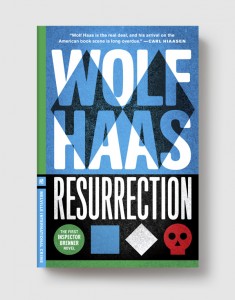
Resurrection, by Wolf Haas, is a charming little crime novel. That is, there's very little crime in it, it just zips along from taxicab to curling strip to castle to restaurant, and before you know it, you're halfway through when you realize, oh, right, it started with a couple of dead bodies, presumably foul play, now what's that all about?

The setting is Zell, an Austrian ski resort, but with very much a small town vibe. Inspector Simon Brenner, recently resigned from the police force, is now "investigating" (that is, writing occasional reports), this time on behalf of an insurance company.

It's been three-quarters of a year since the bodies on the ski lift, so it's not exactly an "active" investigation. Brenner's just muddling into situations.
The German had this bad habit. Purely insofar as, let's say, cars and drivers go. She always looked you right in the eye when she was talking to you. Now, normally, that's not necessarily uncomfortable. But in this case. She was hissing down the Autobahn at 130. And on top of that, well, no hands after all, even if she was a good driver, unbelievable, but still, just her two arm-stumps on the steering wheel. And when she was talking, she always took her eyes off the road and looked right at Brenner with those enormous eyes of hers. Because they were magnified so big by her farsighted glasses.

"It's quite lovely here," she says.

"Here in the tunnel?" Brenner says.

He was thinking, I'll make a joke, and if I make a joke, maybe I'll get her to look back at the road again, at least in the tunnel, because this here's a place with oncoming traffic. But, nothing doing, she didn't understand it was joke, and Brenner, of course, ready with a stereotype: Germans, no sense of humor. She looked at him with her polyp eyes and said:

"No, here in Zell."

"You don't like it in Hamburg?"

"I do. Quite lovely. Quite lovely indeed. But everything moves very fast there. Whereas here, everything's allowed to move a tiny bit — just a bisserl — more slowly."

Needless to say, we're all the same down here. We don't like it when a German imitates our dialect. And it wasn't any different for Brenner, a bisserl. And then that bit about the "slowly," practically — well, it's true, of course, but we don't like hearing it. But Handless didn't mean it quite so generally, because now she says:

"Even the murders move more slowly down here. In Hamburg, shot on the spot. And here, deep frozen."

And then, she even laughed. Brenner thought: This I don't understand, either, what's so funny about that.
This is the very first Inspector Brenner novel, but the third to be available in English. I really enjoyed Brenner and God for its wit and philosophical musing; The Bone Man was a bit madcap, and the crime seemed to bog down the story. But Resurrection is simply delightful. What little story there is moves with more agility than Brenner's migraine-addled thought processes. That may sound like a back-handed compliment, but without all those pesky crime details getting in the way, it's simple, swift, and funny.

And there's more by Wolf Haas — Come, Sweet Death — coming from Melville House soon.

(See also my recap of Wolf Haas at the Blue Met a few weeks ago.)

Tuesday, May 20, 2014

Entangled in Poland

He tried smiling roguishly into the side mirror. What a tragedy. Like a German pretending to find Polish humour funny.
Entanglement, by Zygmunt Miłoszewski, has a lot going for it, starting with a wealthy corpse with a skewer through his eye in a repurposed monastery, journeying through quack psychiatry and marital infidelity, and ending in the archives of Poland's secret service.

Prosecutor Teodor Szacki is a solid protagonist. There's nothing spectacular about him — and I mean this as a compliment. No quirks, no special methods, no esoteric hobbies (not poetry or opera), no drinking problem; he's not a fuck-up, at least not in anything but a very average way. He dresses well, perhaps above his station ("a suit the colour of diluted silver").

His intuition occasionally comes into play — a niggling feeling that something's not right, not complete — but it never overshadows the real work, the research, exhausting all avenues. His problem: he's bored. Personally and professionally. So when he actually finds something interesting, it can drive him pretty far.
He reached his block and glanced up at the illuminated kitchen window on the second floor. He didn't feel like going home, so he sat on a bench in the courtyard to enjoy the June evening. It was already after nine, but it was still warm and light, and there was a smell of the city cooling down. At moments like these he felt like the nightingale in Julian Tuwim's poem, who upsets his wife coming home late for supper.
It's references like this that make me feel connected to my Polishness.

Warsaw is the backdrop. We visit its parks and cafes, and tour through its various districts. Contemporary Poland really comes alive in the chapter openings, where Miłoszewski runs down the day's headlines — it's 2005 — touching on local politics and including the weather report.

The story digs back into the days of Communism and the rule of General Jaruzelski, and the unpleasantness of those times follows Szacki into the present day.

I suppose most readers will view all these elements as "colour" to round out a good crime story. For me, the murder is an entry point to contemporary Polish culture and recent history.

See also the following reviews:
Petrona
Swiftly Tilting Planet

Saturday, May 17, 2014

What would it be like to read Bulgakov for the first time now?

"I don't know if you have ever been in love. Really and truly. If you have, you're a lucky man, If not, I envy you like the devil, because you have the greatest adventure of your life ahead of you — perhaps. Do you know what I'm talking about? It's like with books. It was great to read The Master and Margarita at grammar school, but I'm green with envy to think there are adults who still have that ahead of them. I sometimes wonder: what would it be like to read Bulgakov for the first time now? Never mind. Anyway, if you want to reply: 'I don't know,' it means you haven't loved yet."
— from Entanglement, by Zygmunt Miłoszewski.

These are not new sentiments being expressed here, but I find this little monologue from a minor character in the final pages of this contemporary Polish crime novel odd for two reasons.

Odd thing number one: I love books. Sure, there are times I prefer the company of books to people. But I my love for books is not on the same scale as my love for my loved ones. These are entirely different orders of love; it would not occur to me to juxtapose them.

Odd thing number two: To read a beloved book again for the first time is a common enough wish. I've heard people wish this of Jane Eyre. Childhood classics, coming of age classics. Mind-bending SF classics. Simply it surprises me that the sentiment should be expressed regarding Bulgakov.

I read The Master and Margarita more than twenty years ago, loved it, but remember next to nothing about it. I've been planning to reread it — perhaps this year is the year — and in a different translation, it'll be as if I'm reading it for the first time. Won't it?

What would you like to read again for the first time?

Sunday, May 11, 2014

The future of reading

Today's episode of Spark on CBC Radio focused on the future of reading in the internet age. How, generally, the rhythm of our lives and the rhythm of deep reading no longer intersect.

Listen online:

Robotics in work and life: Margaret Atwood on robots and AI.

Bite-sized reading: Rooster, an app that breaks down novels into easily digestible bite-sized chunks.

Scanning and skimming: It turns out we do read differently whether text is on screen or on paper. A conversation with Maryanne Wolf, neuroscientist and author of Proust and the Squid. One of the points made is that reading is not a natural thing — it's totally learned. So internet reading feeds our predatory/preservationist instincts for watching, searching, jumping, quick processing. "The quality of our attention is a mirror of the quality of our thought."

Social reading: The idea of "social reading" is not for me — I read alone, I don't want to be intruded upon. But this segment is about a story-sharing app, Wattpad. Of course stories are a social phenomenon, and this app seems to be about engaging with people who want to tell them.

With commentary by bookfuturist Tim Carmody.

The 53-minute podcast is worth a listen. . . or you may wish to spend that time reading instead.

Friday, May 09, 2014

The magnificent octopus

Although this blog was not named for the cephalopod, I have a certain fascination with these creatures. I would be remiss not to share this review of Octopus!. (And how is that not a fantastic name for a book?!)

One argument is that extreme self-reliance requires extreme engagement with the environment. We associate intelligence with dependence in childhood, longevity, and civilization; but in the case of the octopus, it seems that the opposite conditions promote curiosity, problem-solving, speedy learning, and sensitivity.

Wednesday, May 07, 2014

If I had a completely different life

Łazienki Park
I wonder what it would be like, thought Szacki, if I were to park in the courtyard and go up to the flat on the second floor, and find that girl waiting for me? If I had a completely different life, different CDs, different books on the shelves, if I smelled a different body lying next net to me. We could go for a walk in Łazienki Park, I'd tell her why I had to be at work today — let's say at an architectural studio; she'd say I was brave and that she'd buy me an ice cream near the Theatre on the Island. Everything would be different.

How unfair it is that we only have one life, mused Szacki, and that it so quickly bores us.
— from Entanglement, by Zygmunt Miłoszewski.

This book is interesting to me on two main counts: 1. The victim (this being a crime novel) was engaged in Family Constellation Therapy, which is a real thing and a terrifically weird thing. 2. It's very rich from a cultural perspective — life in contemporary Poland — with mentions of everything from the Green Day concert in Katowice to the commemorative stamp issued to honour ski jumper Adam Małysz ("the Polish Batman").


Sunday, May 04, 2014

Does a constraint force a compromise?

Matthew Carter on designing typefaces that compensate for technology, from the phenomenon of inkspread to screen resolution.

Friday, May 02, 2014

"It's not real German, it's more like the nightmare of German."

Wolf Haas is the author of a series of comic crime novels featuring private investigator Simon Brenner, a former cop. Three of them are now available in English, and a fourth is on its way. (The English publications are not in the order of their original release.) I saw Haas yesterday evening at the Blue Metropolis Literary Festival.

Haas is Austrian, and so is his German. "If it sounds weird, sounds wrong, it's a good translation." He apologizes for his English, but explains that when he reads in German, he also has to apologize for his German: "It's not real German, it's more like the nightmare of German." There is not only one kind of German.

His writing style is unique. It's very much like spoken language, lively, verbal tics and all. He writes the way he does because he likes the sound of it. (And it makes for very compelling reading.)

He likes reading in English because it's as if he's reading a book someone else wrote. He is distanced from the words; the words come as a surprise and he's not as judgemental of them as if he were reading them in his own language.

On top of which, in English they sound more like a real whodunit. He seems to romanticize the American crime thriller. As I riffle through scads of Scandinavian bestsellers in my head, I realize he means the hard-boiled, noir tradition.

In his view (and mine) it's the narrator of these books who's the main character, not the detective.

There's an attempt to explain the detective Simon Brenner to those who have not read any of the books. The interviewer likes the Columbo analogy; I don't. Brenner may have a common-man appeal about him, but he's not that clever. A bit oafish; not exactly clumsy, but intellectually sloppy. He never controls a situation; things happen to him.

Haas describes Brenner as a dinosaur of a man, an old-fashioned stereotype, only he tried to make him more likeable. Like his uncles. The kind of man who has to appear strong, tough; says little, but drinks a lot. Remember, Brenner's an ex-cop, and all-round fuck-up. "He tries to think, but he's too tired."

So how does he solve anything then (or does he)? "I don't want to be rude in a foreign language, but that's when the narrator kicks his ass."

While some of his writing has a basis in reality, Haas admits that much of it is pure fantasy; for example, Brenner's hometown is a real village, but Haas has never been there. Haas travels to promote his books, of course, and he discusses how those experiences are creeping into his books. But he's wary of opening his mind too far; his books are, after all, about small villages with narrow-minded people.

When did Wolf Haas realize he needed to write? He sets the interviewer straight: "I do not need to write. I want to write." Being a writer was a more attractive alternative to having a proper job, though not so viable in the beginning. What he learned from his days writing advertising copy: when you have an idea, you have to stick with it, run with it past the point of no return. He confesses that it's somewhat embarrassing to write crime stories — it's ridiculous.

I picked up a copy of Resurrection and he signed it for me. We even managed some (very) small talk. I asked him whether he reads a lot of crime novels, does he have a favourite crime writer, but it turns out, no, he reads maybe 2 or 3 a year, he likes reading all kind of things, "even poetry" (and it sounded to me a little like a line). Lovely man, shy, a bit nervous and awkward — real, with things to say.

Read Wolf Haas.

Monday, April 28, 2014

Reading made me feel as if I were the center of the universe

I had always liked reading, but lately I had started reading in a different kind of way. When I opened a book now, I was seized with desperation. I felt as if I was madly in love. It was as if I were in a confession booth and the characters in the book were on the other side telling me their most intimate secrets. When I read, I was a philosopher and it was up to me figure out the meaning of things. Reading made me feel as if I were the center of the universe.
— from Lullabies for Little Criminals, by Heather O'Neill.

Sunday, April 27, 2014

It is impossible to divine a story while you are living it

A book is a collaboration between the one who reads and what is read, and at its best, that coming together is a love story like any other.
The Summer without Men, by Siri Hustvedt, was not at all what I expected it to be; it pales against my memory of her What I Loved (which I consider to be one of the best books I've ever read), as well as against my personal expectation of the liberation that an actual summer without men might entail.

It definitely leans toward angry feminist rather than ditzy chick lit. The narrator seems to hold that you have to act like a man — in work, love, whatever — to make it in a man's world. But perhaps by the end of the summer she learns that women can assert themselves in much more effective, subversive ways.

This is the summer of Mia, whose husband of 30 years is taking a Pause from their marriage, in the form of a bright young French thing.

At this news, Mia suffered a breakdown:
Insanity is a state of profound self-absorption. An extreme effort is required just to keep track of one's self, and the turn toward wellness happens the moment a bit of the world is allowed back in, when a person or thing passes through the gate.
She spends time with her mother and her cohort at the seniors' residence.
The Five lived in a ferocious present because unlike the young, who entertain their finality in a remote, philosophical way, these women knew that death was not abstract.
She teaches a summer poetry workshop to a gang of 13-year-olds. It doesn't go easily.
Perception is laden with visible differences, with light and shadow and object masses and moving bodies, but also always there are invisible differences and similarities, ideas that draw the lines, separate, isolate, identify. I was, am kinda different. Not one of the gang. Outside, always outside.
Mia has plenty of time to reflect on her marriage.
This is not the voluntary blindness of new attraction; it is the blindness of an intimacy wrought from years of parallel living, both from its bruises and its balms.
There's a shoutout to Hustvedt's real-life husband:
Correlation is not cause. It is just "the music of chance," as one prominent American novelist has phrased it.
It's a very thoughtful and thought-provoking novel.
What do we know about people really? What the hell do we know about anyone?
There are several philosophical asides, with reference to Kant and Hegel, Socrates and Kierkegaard, and Meister Eckhart.
We are not only receivers of the world; we also actively produce it.
The poetry classes are pretty terrific, rich with how the young experience their worlds, how their worlds are transformed into poetry.
It is impossible to divine a story while you are living it; it is shapeless; an inchoate procession of words and things, and let us be frank: We never recover what was. Most of it vanishes.
It's a well-crafted novel, but for all its interesting bits, as a whole it's a little clinical. Told by Mia, the academic poet, it's fairly emotionless; the tone could be read as being consistent with Mia's character. Mia's poetry, scattered throughout, is pretty awful.

I read on, but more to see what else there might be on Rilke, what more of one old lady's secret embroideries, or what else the adolescent poets might devise, rather than out of any feeling for Mia and how her marriage might turn out.
I didn't move for a few minutes. I stood there with my bare feet in the warm grass and felt immeasurably sad. All at once, I felt sad for the whole lot of us human beings, as if I had suddenly been transported skyward and, like some omniscient narrator in a nineteenth-century novel, were looking down on the spectacle of flawed humanity and wishing things could be different, not wholly different, but different enough to spare some of us a little pain here and there. This was a modest wish, surely, not some utopian fantasy, but the wish of a same narrator who shakes her red head with its slices of gray and mourns deeply, mourns because it is right to mourn the endless repetitions of meanness and violence and pettiness and hurt. And so I mourned until the door opened, and my three neighbors emerged from the house and came across the lawn, and I took them in.
Read an excerpt.

Friday, April 25, 2014

Death will not correct a single line of verse

Proofs

Death will not correct
a single line of verse
she is no proof-reader
she is no sympathetic
lady editor

a bad metaphor is immortal

a shoddy poet who has died
is a shoddy dead poet

a bore bores after death
a fool keeps up his foolish chatter
from beyond the grave

— Tadeusz Różewicz
(translated by Adam Czerniawski)

Tadeusz Różewicz, Polish poet and playwright, died April 24, 2014.

Thursday, April 24, 2014

Lullabies for white trash

I'm reading Heather O'Neill's Lullabies for Little Criminals, in anticipation of seeing the author next week. I'm only halfway, but I highly recommend it. It is absolutely heartbreaking.

The worst is, she names streets that I know, and I picture myself walking along them with my daughter, who's just about the age of the novel's narrator, and, well, I well up, and I think how lucky I am.

A selection of Heather O'Neill's writing is available online:

Fiction
The End of Pinky
Johnny really was a gorgeous thief. Tonight he was wearing a black fedora over his dirty blond hair, and his blue eyes peeked out from underneath. He had a tattoo of a swan on his fist. He had survived his father trying to kill him three times. Once he had held him under the water in his bubble bath for a whole minute. Another time he had thrown Johnny off the balcony, and he landed in a pile of snow in just his underwear. Once his father sent him to talk to a stranger wearing a trench coat with nothing on underneath. As a result, Johnny didn’t fear death at all and he had no morals, which gave him the wickedest smile on the strip. It was as though each homicide attempt had only made him more beautiful.
And They Danced by the Light of the Moon (a prequel to the events of Lullabies)
Manon liked how the word "fuck" sounded when it came out of Jules’s mouth. It was like something shiny and wondrous that lit up her whole being. It was like a little piece of dirt in the oyster’s mouth that would turn into a pearl.
Riff-raff
Because I was from Canada, they seemed to think that I had never been exposed to riff-raff. I was like the dodo birds that lacked natural predators and so stood meekly as Europeans clubbed them to death. Listening to too much Anne Murray had made me soft.
Nonfiction
On Deadbeat Dads
Deadbeat Dad typically wears sunglasses and leather jackets. He has long hair, even though he’s balding on top. He rides a skateboard at age thirty-five. He’s fit, and is often spotted in the playground doing chin-ups on the monkey bars. When children are with Deadbeat Dad, they always feel in the flush of a new relationship. Everything Deadbeat Dad says is a riot. He does the most exciting things. He wrestles snakes! He eats shark! He runs into Ozzy Osbourne in bars!
On Growing Up White Trash
I wrote about how the basement walls of my building were covered in licence plates and hubcaps. I thought it was beautiful, like Aladdin's cave. I wrote about eating pork chops while sitting on the sidewalk and watching a television plugged into an extension cord that ran through a window.
Poetic License: A letter from Heather O'Neill, on liberating the sixth grade.
One had compared feeling good to disco balls, one had written about a raving stepbrother who drank all the orange juice in the house, one had written about his dad letting him sleep out on the balcony in the summer.
Radio
Various stories on This American Life.

"The Little Wolfboy of Northern Quebec" on Wiretap. (There are several other stories on Wiretap, but they are not easily searchable, or findable; this one's a favourite of mine.)

Blue Met
Heather O'Neill is at the Blue Metropolis Montreal International Literary Festival, interviewed by Shelagh Rogers, on May 2. Heather O'Neill's new book is The Girl Who Was Saturday Night.

Monday, April 21, 2014

If we were his sentences

If any of us were as well taken care of as the sentences of Henry James, we'd never long for another, never wander away: where else would we receive such constant attention, our thoughts anticipated, our feelings understood? Who else would robe us so richly, take us to the best places, or guard our virtue as his own and defend our character in every situation? If we were his sentences, we'd sing ourselves though we were dying and about to be extinguished, since the silence which would follow our passing would not be like the pause left behind by a noisy train. It would be a memorial, well-remarked, grave, just as the Master has assured us death itself is: the distinguished thing.
— from On Being Blue: A Philosophical Inquiry, William H. Gass.

Gass writes a mean sentence himself.

[On Being Blue is the Argo Bookshop bookclub selection to be discussed at the end of May.]

Saturday, April 19, 2014

Mind modelling

As you may have noticed, in general members of book clubs regard the characters inside books exactly the way they regard the characters outside books. The facts that the former are made of the alphabet and the latter of muscle, tissue, and bone are of little relevance.
— from The Summer without Men, by Siri Hustvedt.

Science backs this up. It's the same brain centres lighting up in response to a stimulus, whether in the world or in our minds.

This is the essence of a short online course I recently completed, and it's a curious serendipity that I was concurrently reading a novel that addressed the same concept within it.

By the age of 3 or 4, we develop a theory of mind, applying the sense of our own personness, to others, real or fictional, in order to understand them, to fill in the gaps.

Real life is good experience for understanding and appreciating literature; and fiction can be good practice for real life.

Certainly the girls attending the narrator's summer poetry workshop learn this lesson.

The Summer without Men was not the book I expected it to be. Having read Hustvedt before, I knew it wouldn't be chick lit. There's some angry feminism about it, not all of which I agree with.

The narrator's a poet, an academic. As much as she references Kierkegaard, I never fully warmed to her.

Friday, April 18, 2014

Reading Gabo online

The Handsomest Drowned Man In The World
"even though they were looking at him there was no room for him in their imagination"

Light Is Like Water
"Household objects, in the fullness of their poetry, were flying through the kitchen sky on their own wings."

Tuesday Siesta
"She bore the conscientious serenity of someone accustomed to poverty."

A Very Old Man with Enormous Wings
"a Portuguese man who couldn't sleep because the noise of the stars disturbed him"

Tuesday, April 15, 2014

Transcendence of form

Beethoven's music is Hegelian philosophy: it is at the same time truer than this; i.e., it contains the conviction that the self replication of society as something identical is not enough, indeed, that it is false. Logical identity as the esthetic and produced domination of forms is at once practiced and criticized by Beethoven. The seal of its truth in Beethoven's music is its suspension: the transcendence of form, through with form for the first time achieves its inner meaning. The transcendence of form is for Beethoven the portrayal — not the expression — of hope.
— T.W. Adorno, as quoted in Hegel — Purpose, Results and the Philosophical Essence, by Scott Hornton, in Harper's Magazine.

I've just finished another online course, this one exploring Beethoven's piano sonatas. I've learned quite a bit about the structure of Beethoven's music, and about the historical context for all the rules he was stretching to breaking point. And I've come to some understanding about some of the elements that attract me, about why I love Beethoven so much (even though I wasn't especially familiar with his sonatas before taking up this course).

I got to realizing just how modern Beethoven is, and it got me thinking about Kierkegaard and the crisis of modernity, and I started drawing connections, and recognized an ironic stance in Beethoven's work, how self-reference can only come from self-awareness, how he could be said to be composing metamusic. Beethoven of course precedes Kierkegaard, but Hegel would've been all the rage, and Kant: "The moral law within us and the starry heaven above us!" — which Beethoven had scrawled in a notebook. The music is becoming. And Beethoven is infinite.

And in writing my final assignment, I found scattered across the internet evidence that others have thought as I have. A reassuring thing.

And I am reminded to pick up Thomas Mann again. I must read Doctor Faustus.

Friday, April 11, 2014

Life has taught me to understand books

Learning to Read

If I had to look up every fifth or sixth word
so what. I looked them up.
I had nowhere important to be.

My father was unavailable, and my mother
looked like she was about to break,
and not into blossom, each time I spoke.

My favorite was The Iliad. True,
I had trouble pronouncing the names;
but when was I going to pronounce them, and

to whom?
My stepfather maybe?
Number one, he could barely speak English –

two, he had sufficient cause
to smirk or attack
without prompting from me.

Loneliness boredom and fear
my motivation
fiercely fueled.

I get down on my knees and thank God for them.

Du Fu, the Psalms, Whitman, Rilke.
Life has taught me
to understand books.

— Franz Wright

Tuesday, April 08, 2014

I am resplendent in divergence


The end is the best part. After the stop. I love the end. Sometimes I start chanting that bit spontaneously. "I am resplendent in divergence." It's a holy thing.

I've been looking for this song forever, because upon a time I owned it, on vinyl, and I think of it often, every time I encounter a new ism. Surely my vast knowledge of isms can be traced back to this song. I learned more isms than any 12-year-old ought to know. I developed a weird interest in the Great Schism, and also the teachings of Nestorius. I think solipsism may still be my favourite, though, because it was my first.

Sometimes when I hear bells, I say, out loud, "Bells! I can hear bells!"

Nobody ever gets the reference, though, with my chanting, or the bells, or the diction of various isms.

Having seen Divergent this weekend with my daughter, I am now, of course, resplendent in it.

Thank you, Internet, for restoring this divergence to me.