Monday, June 02, 2014

Blue

This has been a most puzzling book. Sentence by sentence it's absolutely gorgeous, but I have trouble making sense of it.

On Being Blue: A Philosophical Inquiry, by William H. Gass, is about the colour blue, and about blueness, but mostly it's about sex. Kind of.

The thing is: it's breathtakingly beautiful. Just loll-your-tongue-around-it gorgeous. But it didn't make any sense. I get how blue refers to sex, but really? Random sex passages throughout all literature are blue? Random passages throughout all literature are really about sex? Everything is blue? Really?
So a random set of meanings has softly gathered around the word the way lint collects. The mind does that.
Then I read a couple of reviews, was reassured that I wasn't alone in being somewhat mystified, and gave myself over to it.
Then there are the blues we'd love to have loom large and linger long around us like deep sofas, accommodating women, and rich friends.
It's a great book for skimming, and there are sentences and long breathless passages that beg to be read aloud.
"For our blues," Hoogstraten says, "we have English, German, and Haarlem ashes, smalts, blue lakes, indigo, and the invaluable ultramarine." It is of course the skiy. It is the sky's pale deep endlessness, sometimes so intense at noon the brightness flakes like a fresco. Then at dusk, it is the way the color sinks among us, not like dew but settling dust or poisonous exhaust from all the life burned up while we were busy being other than ourselves. For our blues we have those named for nations, cities, regions: French blue, which is an artificial ultramarine, Italian, Prussian, Swiss and Brunswick blues, Chinese blue, a pigment which has a peculiar reddish-bronze cast when in lump-form and dry, in contrast to China blue which is a simple soluble dye; we have Indian blue, an indigo, Hungarian, a cobalt, the blues of Parma and Saxony, Paris, Berlin, and Dresden, those of Bremen and Antwerp, the ancient blues of Armenia and Alexandria, the latter made of copper and lime and sometimes called Egyptian, the blue of the Nile, the blue of the blue sand potters use. Are there so many states of mind and shades of feeling?
Reviews
The Guardian:
One difference is that much, or most, of Gass's self-conscious experiment is going on at the level of the sentence, its style and especially its sound, rather than look-at-me games with plot or character. This is partly a matter of poetic influence – Stevens and Rilke have been constant references – but the presiding example is probably Gertrude Stein, about whom he has written several essays. Stein is nowhere to be seen in On Being Blue, but the book is surely in thrall to her Tender Buttons and its incantatory way with the rhythms and phonics of everyday American speech.
Although, I wonder if that review merely skimmed the book, as Gass does directly reference Stein, including specifically Tender Buttons. And the review contains other factual errors.

NPR:
In many ways, On Being Blue is less a book to read than an experience to be had. It's essentially a rant, a riff, poetry, music, art, all of that. But it isn't apologetics. There's no scientific argument, no clear-cut hypothesis to be found. It's not a treatise on the nature of man and his place in the universe. Gass is more interested in getting across a passion for language, and the way the words look and sound on the page.
*************

On Being Blue was the subject of a book club I attended last week, and it turned out to be less inspiring of discussion than had been hoped. Without a clear thesis, it's difficult to argue against anything Gass brings to the table. While it's mostly internal to Gass — the connections he makes between colour, science, philosophy, sex, language — it's also weirdly impersonal. The thing to do is just read it, let it wash over you, accept it, and think about blue.
(curses without a curse, they contain only archery and cleverness like a purse full of chocolates and needles)
Excerpt.

Wednesday, May 28, 2014

An education in love

Maria Popova presents a lovely overview of Leo Buscaglia's ideas — she focuses primarily on the topics of education and labeling — as presented in Love: What Life Is All About.

She notes:
Buscaglia ends with a reminder of how our disembodied illusion of separateness contributes to our inability to inhabit our own selves and how the pathologically overlooked gift of human touch reconnects us not only with each other, but with our own deepest humanity.

(I think Buscaglia might be horrified by today's socially mediafied culture.)

The excerpts Popova chooses bring a nostalgic tear to my eye. Believe it or not, I've been thinking a lot about Leo lately. I think because Helena is about the age I was when my mother and I would spend hours watching Leo Buscaglia's lectures together. Every few months, the PBS pledge drive ensured a marathon of Leo love.

I can't say I enjoyed it exactly. My mother had control of the television (one television, and just the two of us). I'd sit pyjamaed with a Shirley Temple. I wouldn't've done it if it were just to make my mother happy. Part of me must've found it interesting. But it's not anything I told my friends about.

But my mom and I. We'd laugh. And cry. And hug.

I'm not the sort of person to dole out Iloveyous unthinkingly; I won't say it, or anything, if I don't mean it. Sometimes I think of Leo, even these days. Like he's wormed his way into my conscience, or is sitting on my shoulder, entreating me to tell people how much I love them.

I see a lot of myself in Helena; when she turns a certain way, her demeanour, it's like I'm watching myself. Only she's prettier, and kinder, and more loving. I can't believe she loves me so much.

Monday, May 26, 2014

Dirty words

There are a number of difficulties with dirty words, the first of which is that there aren't nearly enough of them; the second is that the people who use them are normally numskulls and prudes; the third is that in general they’re not at all sexy, and the main reason for this is that no one loves them enough.
— from On Being Blue: A Philosophical Inquiry, William H. Gass.

Sunday, May 25, 2014

"Even the murders move more slowly down here."

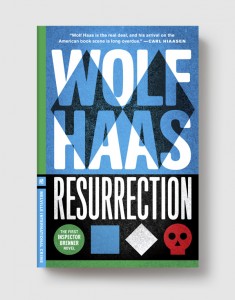
Resurrection, by Wolf Haas, is a charming little crime novel. That is, there's very little crime in it, it just zips along from taxicab to curling strip to castle to restaurant, and before you know it, you're halfway through when you realize, oh, right, it started with a couple of dead bodies, presumably foul play, now what's that all about?

The setting is Zell, an Austrian ski resort, but with very much a small town vibe. Inspector Simon Brenner, recently resigned from the police force, is now "investigating" (that is, writing occasional reports), this time on behalf of an insurance company.

It's been three-quarters of a year since the bodies on the ski lift, so it's not exactly an "active" investigation. Brenner's just muddling into situations.
The German had this bad habit. Purely insofar as, let's say, cars and drivers go. She always looked you right in the eye when she was talking to you. Now, normally, that's not necessarily uncomfortable. But in this case. She was hissing down the Autobahn at 130. And on top of that, well, no hands after all, even if she was a good driver, unbelievable, but still, just her two arm-stumps on the steering wheel. And when she was talking, she always took her eyes off the road and looked right at Brenner with those enormous eyes of hers. Because they were magnified so big by her farsighted glasses.

"It's quite lovely here," she says.

"Here in the tunnel?" Brenner says.

He was thinking, I'll make a joke, and if I make a joke, maybe I'll get her to look back at the road again, at least in the tunnel, because this here's a place with oncoming traffic. But, nothing doing, she didn't understand it was joke, and Brenner, of course, ready with a stereotype: Germans, no sense of humor. She looked at him with her polyp eyes and said:

"No, here in Zell."

"You don't like it in Hamburg?"

"I do. Quite lovely. Quite lovely indeed. But everything moves very fast there. Whereas here, everything's allowed to move a tiny bit — just a bisserl — more slowly."

Needless to say, we're all the same down here. We don't like it when a German imitates our dialect. And it wasn't any different for Brenner, a bisserl. And then that bit about the "slowly," practically — well, it's true, of course, but we don't like hearing it. But Handless didn't mean it quite so generally, because now she says:

"Even the murders move more slowly down here. In Hamburg, shot on the spot. And here, deep frozen."

And then, she even laughed. Brenner thought: This I don't understand, either, what's so funny about that.
This is the very first Inspector Brenner novel, but the third to be available in English. I really enjoyed Brenner and God for its wit and philosophical musing; The Bone Man was a bit madcap, and the crime seemed to bog down the story. But Resurrection is simply delightful. What little story there is moves with more agility than Brenner's migraine-addled thought processes. That may sound like a back-handed compliment, but without all those pesky crime details getting in the way, it's simple, swift, and funny.

And there's more by Wolf Haas — Come, Sweet Death — coming from Melville House soon.

(See also my recap of Wolf Haas at the Blue Met a few weeks ago.)

Tuesday, May 20, 2014

Entangled in Poland

He tried smiling roguishly into the side mirror. What a tragedy. Like a German pretending to find Polish humour funny.
Entanglement, by Zygmunt Miłoszewski, has a lot going for it, starting with a wealthy corpse with a skewer through his eye in a repurposed monastery, journeying through quack psychiatry and marital infidelity, and ending in the archives of Poland's secret service.

Prosecutor Teodor Szacki is a solid protagonist. There's nothing spectacular about him — and I mean this as a compliment. No quirks, no special methods, no esoteric hobbies (not poetry or opera), no drinking problem; he's not a fuck-up, at least not in anything but a very average way. He dresses well, perhaps above his station ("a suit the colour of diluted silver").

His intuition occasionally comes into play — a niggling feeling that something's not right, not complete — but it never overshadows the real work, the research, exhausting all avenues. His problem: he's bored. Personally and professionally. So when he actually finds something interesting, it can drive him pretty far.
He reached his block and glanced up at the illuminated kitchen window on the second floor. He didn't feel like going home, so he sat on a bench in the courtyard to enjoy the June evening. It was already after nine, but it was still warm and light, and there was a smell of the city cooling down. At moments like these he felt like the nightingale in Julian Tuwim's poem, who upsets his wife coming home late for supper.
It's references like this that make me feel connected to my Polishness.

Warsaw is the backdrop. We visit its parks and cafes, and tour through its various districts. Contemporary Poland really comes alive in the chapter openings, where Miłoszewski runs down the day's headlines — it's 2005 — touching on local politics and including the weather report.

The story digs back into the days of Communism and the rule of General Jaruzelski, and the unpleasantness of those times follows Szacki into the present day.

I suppose most readers will view all these elements as "colour" to round out a good crime story. For me, the murder is an entry point to contemporary Polish culture and recent history.

See also the following reviews:
Petrona
Swiftly Tilting Planet

Saturday, May 17, 2014

What would it be like to read Bulgakov for the first time now?

"I don't know if you have ever been in love. Really and truly. If you have, you're a lucky man, If not, I envy you like the devil, because you have the greatest adventure of your life ahead of you — perhaps. Do you know what I'm talking about? It's like with books. It was great to read The Master and Margarita at grammar school, but I'm green with envy to think there are adults who still have that ahead of them. I sometimes wonder: what would it be like to read Bulgakov for the first time now? Never mind. Anyway, if you want to reply: 'I don't know,' it means you haven't loved yet."
— from Entanglement, by Zygmunt Miłoszewski.

These are not new sentiments being expressed here, but I find this little monologue from a minor character in the final pages of this contemporary Polish crime novel odd for two reasons.

Odd thing number one: I love books. Sure, there are times I prefer the company of books to people. But I my love for books is not on the same scale as my love for my loved ones. These are entirely different orders of love; it would not occur to me to juxtapose them.

Odd thing number two: To read a beloved book again for the first time is a common enough wish. I've heard people wish this of Jane Eyre. Childhood classics, coming of age classics. Mind-bending SF classics. Simply it surprises me that the sentiment should be expressed regarding Bulgakov.

I read The Master and Margarita more than twenty years ago, loved it, but remember next to nothing about it. I've been planning to reread it — perhaps this year is the year — and in a different translation, it'll be as if I'm reading it for the first time. Won't it?

What would you like to read again for the first time?

Sunday, May 11, 2014

The future of reading

Today's episode of Spark on CBC Radio focused on the future of reading in the internet age. How, generally, the rhythm of our lives and the rhythm of deep reading no longer intersect.

Listen online:

Robotics in work and life: Margaret Atwood on robots and AI.

Bite-sized reading: Rooster, an app that breaks down novels into easily digestible bite-sized chunks.

Scanning and skimming: It turns out we do read differently whether text is on screen or on paper. A conversation with Maryanne Wolf, neuroscientist and author of Proust and the Squid. One of the points made is that reading is not a natural thing — it's totally learned. So internet reading feeds our predatory/preservationist instincts for watching, searching, jumping, quick processing. "The quality of our attention is a mirror of the quality of our thought."

Social reading: The idea of "social reading" is not for me — I read alone, I don't want to be intruded upon. But this segment is about a story-sharing app, Wattpad. Of course stories are a social phenomenon, and this app seems to be about engaging with people who want to tell them.

With commentary by bookfuturist Tim Carmody.

The 53-minute podcast is worth a listen. . . or you may wish to spend that time reading instead.

Friday, May 09, 2014

The magnificent octopus

Although this blog was not named for the cephalopod, I have a certain fascination with these creatures. I would be remiss not to share this review of Octopus!. (And how is that not a fantastic name for a book?!)

One argument is that extreme self-reliance requires extreme engagement with the environment. We associate intelligence with dependence in childhood, longevity, and civilization; but in the case of the octopus, it seems that the opposite conditions promote curiosity, problem-solving, speedy learning, and sensitivity.

Wednesday, May 07, 2014

If I had a completely different life

Łazienki Park
I wonder what it would be like, thought Szacki, if I were to park in the courtyard and go up to the flat on the second floor, and find that girl waiting for me? If I had a completely different life, different CDs, different books on the shelves, if I smelled a different body lying next net to me. We could go for a walk in Łazienki Park, I'd tell her why I had to be at work today — let's say at an architectural studio; she'd say I was brave and that she'd buy me an ice cream near the Theatre on the Island. Everything would be different.

How unfair it is that we only have one life, mused Szacki, and that it so quickly bores us.
— from Entanglement, by Zygmunt Miłoszewski.

This book is interesting to me on two main counts: 1. The victim (this being a crime novel) was engaged in Family Constellation Therapy, which is a real thing and a terrifically weird thing. 2. It's very rich from a cultural perspective — life in contemporary Poland — with mentions of everything from the Green Day concert in Katowice to the commemorative stamp issued to honour ski jumper Adam Małysz ("the Polish Batman").


Sunday, May 04, 2014

Does a constraint force a compromise?

Matthew Carter on designing typefaces that compensate for technology, from the phenomenon of inkspread to screen resolution.

Friday, May 02, 2014

"It's not real German, it's more like the nightmare of German."

Wolf Haas is the author of a series of comic crime novels featuring private investigator Simon Brenner, a former cop. Three of them are now available in English, and a fourth is on its way. (The English publications are not in the order of their original release.) I saw Haas yesterday evening at the Blue Metropolis Literary Festival.

Haas is Austrian, and so is his German. "If it sounds weird, sounds wrong, it's a good translation." He apologizes for his English, but explains that when he reads in German, he also has to apologize for his German: "It's not real German, it's more like the nightmare of German." There is not only one kind of German.

His writing style is unique. It's very much like spoken language, lively, verbal tics and all. He writes the way he does because he likes the sound of it. (And it makes for very compelling reading.)

He likes reading in English because it's as if he's reading a book someone else wrote. He is distanced from the words; the words come as a surprise and he's not as judgemental of them as if he were reading them in his own language.

On top of which, in English they sound more like a real whodunit. He seems to romanticize the American crime thriller. As I riffle through scads of Scandinavian bestsellers in my head, I realize he means the hard-boiled, noir tradition.

In his view (and mine) it's the narrator of these books who's the main character, not the detective.

There's an attempt to explain the detective Simon Brenner to those who have not read any of the books. The interviewer likes the Columbo analogy; I don't. Brenner may have a common-man appeal about him, but he's not that clever. A bit oafish; not exactly clumsy, but intellectually sloppy. He never controls a situation; things happen to him.

Haas describes Brenner as a dinosaur of a man, an old-fashioned stereotype, only he tried to make him more likeable. Like his uncles. The kind of man who has to appear strong, tough; says little, but drinks a lot. Remember, Brenner's an ex-cop, and all-round fuck-up. "He tries to think, but he's too tired."

So how does he solve anything then (or does he)? "I don't want to be rude in a foreign language, but that's when the narrator kicks his ass."

While some of his writing has a basis in reality, Haas admits that much of it is pure fantasy; for example, Brenner's hometown is a real village, but Haas has never been there. Haas travels to promote his books, of course, and he discusses how those experiences are creeping into his books. But he's wary of opening his mind too far; his books are, after all, about small villages with narrow-minded people.

When did Wolf Haas realize he needed to write? He sets the interviewer straight: "I do not need to write. I want to write." Being a writer was a more attractive alternative to having a proper job, though not so viable in the beginning. What he learned from his days writing advertising copy: when you have an idea, you have to stick with it, run with it past the point of no return. He confesses that it's somewhat embarrassing to write crime stories — it's ridiculous.

I picked up a copy of Resurrection and he signed it for me. We even managed some (very) small talk. I asked him whether he reads a lot of crime novels, does he have a favourite crime writer, but it turns out, no, he reads maybe 2 or 3 a year, he likes reading all kind of things, "even poetry" (and it sounded to me a little like a line). Lovely man, shy, a bit nervous and awkward — real, with things to say.

Read Wolf Haas.

Monday, April 28, 2014

Reading made me feel as if I were the center of the universe

I had always liked reading, but lately I had started reading in a different kind of way. When I opened a book now, I was seized with desperation. I felt as if I was madly in love. It was as if I were in a confession booth and the characters in the book were on the other side telling me their most intimate secrets. When I read, I was a philosopher and it was up to me figure out the meaning of things. Reading made me feel as if I were the center of the universe.
— from Lullabies for Little Criminals, by Heather O'Neill.

Sunday, April 27, 2014

It is impossible to divine a story while you are living it

A book is a collaboration between the one who reads and what is read, and at its best, that coming together is a love story like any other.
The Summer without Men, by Siri Hustvedt, was not at all what I expected it to be; it pales against my memory of her What I Loved (which I consider to be one of the best books I've ever read), as well as against my personal expectation of the liberation that an actual summer without men might entail.

It definitely leans toward angry feminist rather than ditzy chick lit. The narrator seems to hold that you have to act like a man — in work, love, whatever — to make it in a man's world. But perhaps by the end of the summer she learns that women can assert themselves in much more effective, subversive ways.

This is the summer of Mia, whose husband of 30 years is taking a Pause from their marriage, in the form of a bright young French thing.

At this news, Mia suffered a breakdown:
Insanity is a state of profound self-absorption. An extreme effort is required just to keep track of one's self, and the turn toward wellness happens the moment a bit of the world is allowed back in, when a person or thing passes through the gate.
She spends time with her mother and her cohort at the seniors' residence.
The Five lived in a ferocious present because unlike the young, who entertain their finality in a remote, philosophical way, these women knew that death was not abstract.
She teaches a summer poetry workshop to a gang of 13-year-olds. It doesn't go easily.
Perception is laden with visible differences, with light and shadow and object masses and moving bodies, but also always there are invisible differences and similarities, ideas that draw the lines, separate, isolate, identify. I was, am kinda different. Not one of the gang. Outside, always outside.
Mia has plenty of time to reflect on her marriage.
This is not the voluntary blindness of new attraction; it is the blindness of an intimacy wrought from years of parallel living, both from its bruises and its balms.
There's a shoutout to Hustvedt's real-life husband:
Correlation is not cause. It is just "the music of chance," as one prominent American novelist has phrased it.
It's a very thoughtful and thought-provoking novel.
What do we know about people really? What the hell do we know about anyone?
There are several philosophical asides, with reference to Kant and Hegel, Socrates and Kierkegaard, and Meister Eckhart.
We are not only receivers of the world; we also actively produce it.
The poetry classes are pretty terrific, rich with how the young experience their worlds, how their worlds are transformed into poetry.
It is impossible to divine a story while you are living it; it is shapeless; an inchoate procession of words and things, and let us be frank: We never recover what was. Most of it vanishes.
It's a well-crafted novel, but for all its interesting bits, as a whole it's a little clinical. Told by Mia, the academic poet, it's fairly emotionless; the tone could be read as being consistent with Mia's character. Mia's poetry, scattered throughout, is pretty awful.

I read on, but more to see what else there might be on Rilke, what more of one old lady's secret embroideries, or what else the adolescent poets might devise, rather than out of any feeling for Mia and how her marriage might turn out.
I didn't move for a few minutes. I stood there with my bare feet in the warm grass and felt immeasurably sad. All at once, I felt sad for the whole lot of us human beings, as if I had suddenly been transported skyward and, like some omniscient narrator in a nineteenth-century novel, were looking down on the spectacle of flawed humanity and wishing things could be different, not wholly different, but different enough to spare some of us a little pain here and there. This was a modest wish, surely, not some utopian fantasy, but the wish of a same narrator who shakes her red head with its slices of gray and mourns deeply, mourns because it is right to mourn the endless repetitions of meanness and violence and pettiness and hurt. And so I mourned until the door opened, and my three neighbors emerged from the house and came across the lawn, and I took them in.
Read an excerpt.

Friday, April 25, 2014

Death will not correct a single line of verse

Proofs

Death will not correct
a single line of verse
she is no proof-reader
she is no sympathetic
lady editor

a bad metaphor is immortal

a shoddy poet who has died
is a shoddy dead poet

a bore bores after death
a fool keeps up his foolish chatter
from beyond the grave

— Tadeusz Różewicz
(translated by Adam Czerniawski)

Tadeusz Różewicz, Polish poet and playwright, died April 24, 2014.

Thursday, April 24, 2014

Lullabies for white trash

I'm reading Heather O'Neill's Lullabies for Little Criminals, in anticipation of seeing the author next week. I'm only halfway, but I highly recommend it. It is absolutely heartbreaking.

The worst is, she names streets that I know, and I picture myself walking along them with my daughter, who's just about the age of the novel's narrator, and, well, I well up, and I think how lucky I am.

A selection of Heather O'Neill's writing is available online:

Fiction
The End of Pinky
Johnny really was a gorgeous thief. Tonight he was wearing a black fedora over his dirty blond hair, and his blue eyes peeked out from underneath. He had a tattoo of a swan on his fist. He had survived his father trying to kill him three times. Once he had held him under the water in his bubble bath for a whole minute. Another time he had thrown Johnny off the balcony, and he landed in a pile of snow in just his underwear. Once his father sent him to talk to a stranger wearing a trench coat with nothing on underneath. As a result, Johnny didn’t fear death at all and he had no morals, which gave him the wickedest smile on the strip. It was as though each homicide attempt had only made him more beautiful.
And They Danced by the Light of the Moon (a prequel to the events of Lullabies)
Manon liked how the word "fuck" sounded when it came out of Jules’s mouth. It was like something shiny and wondrous that lit up her whole being. It was like a little piece of dirt in the oyster’s mouth that would turn into a pearl.
Riff-raff
Because I was from Canada, they seemed to think that I had never been exposed to riff-raff. I was like the dodo birds that lacked natural predators and so stood meekly as Europeans clubbed them to death. Listening to too much Anne Murray had made me soft.
Nonfiction
On Deadbeat Dads
Deadbeat Dad typically wears sunglasses and leather jackets. He has long hair, even though he’s balding on top. He rides a skateboard at age thirty-five. He’s fit, and is often spotted in the playground doing chin-ups on the monkey bars. When children are with Deadbeat Dad, they always feel in the flush of a new relationship. Everything Deadbeat Dad says is a riot. He does the most exciting things. He wrestles snakes! He eats shark! He runs into Ozzy Osbourne in bars!
On Growing Up White Trash
I wrote about how the basement walls of my building were covered in licence plates and hubcaps. I thought it was beautiful, like Aladdin's cave. I wrote about eating pork chops while sitting on the sidewalk and watching a television plugged into an extension cord that ran through a window.
Poetic License: A letter from Heather O'Neill, on liberating the sixth grade.
One had compared feeling good to disco balls, one had written about a raving stepbrother who drank all the orange juice in the house, one had written about his dad letting him sleep out on the balcony in the summer.
Radio
Various stories on This American Life.

"The Little Wolfboy of Northern Quebec" on Wiretap. (There are several other stories on Wiretap, but they are not easily searchable, or findable; this one's a favourite of mine.)

Blue Met
Heather O'Neill is at the Blue Metropolis Montreal International Literary Festival, interviewed by Shelagh Rogers, on May 2. Heather O'Neill's new book is The Girl Who Was Saturday Night.

Monday, April 21, 2014

If we were his sentences

If any of us were as well taken care of as the sentences of Henry James, we'd never long for another, never wander away: where else would we receive such constant attention, our thoughts anticipated, our feelings understood? Who else would robe us so richly, take us to the best places, or guard our virtue as his own and defend our character in every situation? If we were his sentences, we'd sing ourselves though we were dying and about to be extinguished, since the silence which would follow our passing would not be like the pause left behind by a noisy train. It would be a memorial, well-remarked, grave, just as the Master has assured us death itself is: the distinguished thing.
— from On Being Blue: A Philosophical Inquiry, William H. Gass.

Gass writes a mean sentence himself.

[On Being Blue is the Argo Bookshop bookclub selection to be discussed at the end of May.]

Saturday, April 19, 2014

Mind modelling

As you may have noticed, in general members of book clubs regard the characters inside books exactly the way they regard the characters outside books. The facts that the former are made of the alphabet and the latter of muscle, tissue, and bone are of little relevance.
— from The Summer without Men, by Siri Hustvedt.

Science backs this up. It's the same brain centres lighting up in response to a stimulus, whether in the world or in our minds.

This is the essence of a short online course I recently completed, and it's a curious serendipity that I was concurrently reading a novel that addressed the same concept within it.

By the age of 3 or 4, we develop a theory of mind, applying the sense of our own personness, to others, real or fictional, in order to understand them, to fill in the gaps.

Real life is good experience for understanding and appreciating literature; and fiction can be good practice for real life.

Certainly the girls attending the narrator's summer poetry workshop learn this lesson.

The Summer without Men was not the book I expected it to be. Having read Hustvedt before, I knew it wouldn't be chick lit. There's some angry feminism about it, not all of which I agree with.

The narrator's a poet, an academic. As much as she references Kierkegaard, I never fully warmed to her.

Friday, April 18, 2014

Reading Gabo online

The Handsomest Drowned Man In The World
"even though they were looking at him there was no room for him in their imagination"

Light Is Like Water
"Household objects, in the fullness of their poetry, were flying through the kitchen sky on their own wings."

Tuesday Siesta
"She bore the conscientious serenity of someone accustomed to poverty."

A Very Old Man with Enormous Wings
"a Portuguese man who couldn't sleep because the noise of the stars disturbed him"

Tuesday, April 15, 2014

Transcendence of form

Beethoven's music is Hegelian philosophy: it is at the same time truer than this; i.e., it contains the conviction that the self replication of society as something identical is not enough, indeed, that it is false. Logical identity as the esthetic and produced domination of forms is at once practiced and criticized by Beethoven. The seal of its truth in Beethoven's music is its suspension: the transcendence of form, through with form for the first time achieves its inner meaning. The transcendence of form is for Beethoven the portrayal — not the expression — of hope.
— T.W. Adorno, as quoted in Hegel — Purpose, Results and the Philosophical Essence, by Scott Hornton, in Harper's Magazine.

I've just finished another online course, this one exploring Beethoven's piano sonatas. I've learned quite a bit about the structure of Beethoven's music, and about the historical context for all the rules he was stretching to breaking point. And I've come to some understanding about some of the elements that attract me, about why I love Beethoven so much (even though I wasn't especially familiar with his sonatas before taking up this course).

I got to realizing just how modern Beethoven is, and it got me thinking about Kierkegaard and the crisis of modernity, and I started drawing connections, and recognized an ironic stance in Beethoven's work, how self-reference can only come from self-awareness, how he could be said to be composing metamusic. Beethoven of course precedes Kierkegaard, but Hegel would've been all the rage, and Kant: "The moral law within us and the starry heaven above us!" — which Beethoven had scrawled in a notebook. The music is becoming. And Beethoven is infinite.

And in writing my final assignment, I found scattered across the internet evidence that others have thought as I have. A reassuring thing.

And I am reminded to pick up Thomas Mann again. I must read Doctor Faustus.

Friday, April 11, 2014

Life has taught me to understand books

Learning to Read

If I had to look up every fifth or sixth word
so what. I looked them up.
I had nowhere important to be.

My father was unavailable, and my mother
looked like she was about to break,
and not into blossom, each time I spoke.

My favorite was The Iliad. True,
I had trouble pronouncing the names;
but when was I going to pronounce them, and

to whom?
My stepfather maybe?
Number one, he could barely speak English –

two, he had sufficient cause
to smirk or attack
without prompting from me.

Loneliness boredom and fear
my motivation
fiercely fueled.

I get down on my knees and thank God for them.

Du Fu, the Psalms, Whitman, Rilke.
Life has taught me
to understand books.

Franz Wright

Tuesday, April 08, 2014

I am resplendent in divergence


The end is the best part. After the stop. I love the end. Sometimes I start chanting that bit spontaneously. "I am resplendent in divergence." It's a holy thing.

I've been looking for this song forever, because upon a time I owned it, on vinyl, and I think of it often, every time I encounter a new ism. Surely my vast knowledge of isms can be traced back to this song. I learned more isms than any 12-year-old ought to know. I developed a weird interest in the Great Schism, and also the teachings of Nestorius. I think solipsism may still be my favourite, though, because it was my first.

Sometimes when I hear bells, I say, out loud, "Bells! I can hear bells!"

Nobody ever gets the reference, though, with my chanting, or the bells, or the diction of various isms.

Having seen Divergent this weekend with my daughter, I am now, of course, resplendent in it.

Thank you, Internet, for restoring this divergence to me.

Sunday, April 06, 2014

We are all comic characters

Lola's eyes gleamed with pleasure and interest as she listened to my tales of the cosmopolitans, all of them true but all fictions nevertheless. Shorn of intimacy and seen from a considerable distance, we are all comic characters, farcical buffoons who bumble through our lives, making fine messes as we go, but when you get close, the ridiculous quickly fades into the sordid or the tragic of the merely sad. It doesn't matter whether you are stuck in the provincial backwater of Bonden or wandering down the Champs-Élysées. The merely sad business about me was that I wanted to be admired, wanted to see myself as a shining reflection in Lola's eyes.
— from The Summer without Men, by Siri Hustvedt.

Saturday, April 05, 2014

Closing the circle

The Circle, by Dave Eggers.
I mean, all this stuff you're involved in, it's all gossip. It's people talking about each other behind their backs. That's the vast majority of this social media, all these reviews, all these comments. Your tools have elevated gossip, hearsay and conjecture to the level of valid, mainstream communication. And besides that, it's fucking dorky.

Like, smile, favorite, zing, tweet, thumbs up, vote up, recommend, pin, forward, plus, doubleplusgood.

Recommended for anyone who has ever tweeted, messaged, sent an email, answered a customer survey, reviewed, commented, posted a status update, joined a community.

Reviews

Bookpuddle:
Society buys into the idea that ever increasing levels of "transparency" are of ultimate benefit to all. The Circle implements what sounds like great ideas at first — politicians that wear cameras on them at all times, criminals that are easily identifiable in a crowd, children that can never be abducted because they are instantly trackable via GPS, etc., — but along the way, all personal freedoms are one by one jettisoned, and the reader is faced with seeing (literally) what it would really be like to be at all times monitored, and "known" by anyone else who wanted to observe what you were up to.

So Many Books:
The Circle was a page-turner, the horror of watching Mae get sucked into the hivemind is delicious.

Betsy Morais: Sharing Is Caring Is Sharing, The New Yorker
But even without the searing wit of "1984," the book is capable of landing on point—when it's at its most irksome. Where "1984" has the vigilant Police Patrol and Thought Police, "The Circle" has SeeChange and Clarification. Surveillance isn't a bad word; it's a gift, even a human right.

Margaret Atwood: When Privacy Is Theft, The New York Review of Books
The nineteenth-century art critic John Ruskin—who famously said, "Tell me what you like and I’ll tell you who you are"—viewed bad taste as a moral offense, and the young Circlers subscribe to this dogma: nothing gets you the brushoff more quickly than a pair of uncool jeans. Utopia, it seems, is an awful lot like high school, but with even more homework.

Ellen Ullman: Ring of Power, The New York Times
She is more a high school mean girl than an evil opponent. Perhaps this is what Eggers wants to say: that evil in the future will look more like the trivial Mae than it will the hovering dark eye of Big Brother.

Wednesday, April 02, 2014

Looking forward to Blue Met

The launch of the festival program is like Christmas for me. I look forward to it every year. Then I sit with my various coloured pens, marking the must-sees and the maybe-interestings, mapping and scheduling.

The 16th Blue Metropolis Montreal International Literary Festival, themed "The Power of Words," runs April 28 to May 4, with some pre- and post-festival events.

This year's recipient of the Blue Metropolis International Literary Grand Prix is Richard Ford. (But I'm not yet convinced I need to read him.)

At my first go over the program, I've identified two standout events:
  • Thursday, May 1, an interview with Austrian crime writer Wolf Haas, author of the darkly humorous Simon Brenner books and for whom I've developed a fondness. I'm giddy with anticipation.
  • Friday, May 2, Shelagh Rogers interviews Heather O'Neill, author of the amazing Lullabies for Little Criminals. No, I haven't actually read it, but I own a copy and I know all sorts of things about it and I expect it to be thoroughly amazing. She has a new book out.
I'll be poring over the event listings in more detail in the coming days — I'll let you know what else I find. The full program is available on the Blue Metropolis website.

Monday, March 31, 2014

Before the law

Orson Welles reads Kafka.


"Every man strives to attain the law."

Saturday, March 29, 2014

Unnaturally extreme social needs

"It's not that I'm not social. I'm social enough. But the tools you guys create actually manufacture unnaturally extreme social needs. No one needs the level of contact you're purveying. It improves nothing. It's not nourishing. It's like snack food. You know how they engineer this food? They scientifically determine precisely how much salt and fat they need to include to keep you eating. You're not hungry, you don't need the food, it does nothing for you, but you keep eating these emptying calories. This is what you're pushing. Same thing. Endless empty calories, but the digital-social equivalent. And you calibrate it so it's equally addictive."
— from The Circle, by Dave Eggers.

Yes! That's the world exactly.

(As the novel progresses, there's a creeping sense of unease. Clearly something bad is going to happen to sweet Mae, new employee of the Circle, modelled after real-life Google.)

My reading is enhanced this week by watching Google and the World Brain, in which Kevin Kelly relates how Larry Page said, "It's not to make a search engine, it's to make an AI."

Also, "Google's Earth" by William Gibson: "We are its unpaid content-providers [...]. Google is made of us."

Friday, March 28, 2014

Everyone always mistakes everyone for someone else

The Letter Killers Club, by Sigizmund Krzhizhanovsky, is a strange little excuse for a novel.

I want to love it, but I don't quite. For such a short novel, it took an amazingly long time to read. It's full of interesting ideas that aren't completely developed, aren't resolved, don't completely gel. The novel is a fantastic cerebral exercise, but it leaves me cold.
A conception without a line of text, I argued, is like a needle without thread: it pricks, but does not sew.
That's how I feel about this book.

The club is a secret society of men known only by nonsense syllables. They are "conceivers" — in the interest of purity, nothing is committed to paper. They meet weekly and tell stories that span genres, subjects, and formats.

But it's the framing story that captivates me — who are these men, why do they meet, what is so subversive in it, why must it be so secret? where is the political element? for it feels like there must be one.

Here are some of the themes strewn across these pages.
I walked quickly — from crossroad to crossroad — trying to untangle my feelings. The evening seemed like a black wedge driven into my life. I had to unwedge it. But how?

**********

I think this is all fairly simple: every three-dimensional being doubles himself twice — reflecting himself outwardly and inwardly. Both reflections are untrue: the cold, flat likeness returned by the looking glass is untrue because it is less than three-dimensional; the face's other reflection, cast inward, flowing along nerves to the brain and composed of a complex set of sensations, is also untrue because it is more than three-dimensional.

**********

And if the hectic youth who mistook our passer for someone else — racing up, then away — had been able to see through eyes to what is behind them, he would have understood once and for all: everyone always mistakes everyone for someone else.

**********

The fewer the managers, the greater the manageability.

**********

[...] you enter facts from the outside, not the inside, you're worse than your bacteria: they eat the facts, you eat the facts' meanings.

**********

Plotlines throw out disputes the way a plant throws out spores: into space, where they germinate.

See also
The Millions: Storytelling is a Deadly Business: Krzhizhanovsky's The Letter Killers Club
The Rumpus: Against an Ethical Machine

Wednesday, March 26, 2014

Inspiration is for amateurs

Last week I went to see Man Booker International Prize-nominated author and creative writing professor Josip Novakovich and two-time Booker Prize-winning author Peter Carey in conversation on stage.

I like Peter Carey, and I'm so relieved that the real-life Peter Carey does not taint my impression of his books, but confirms and enhances my suspicion of the sort of person he is. Wry and unassuming. Observant, clever. Genuine.

On the other hand, I've never read Josip Novakovich. Being a "local" boy (he's called Montreal home for some time), he has flirted with one of my friends. He completely won me over; a little obsessed with death, but in a good way, smart and funny.

The audio file linked to here is a little over an hour, but well worth it. The conversation is moderated; they cover topics including the writing process, inspiration, motivation, editors, how you view "home" when you no longer live there, outsiderness.

Highlights
Josip described in great detail a story he's working on, about a dying man who plans in great detail his own death, funeral, etc. but he — Josip — played it down as something he hasn't fully worked out yet. And Peter cried out, why bother? he's already plotted it out to the point that he — Peter — would lose interest with the project. (Peter himself may plot the skeleton of a journey, but the writing remains a journey of discovery.) And all of this has seeped heavily into my current reading (Krzhizhanovsky's Letter Killers Club) and studying (a MOOC on cognitive poetics) and stained it beyond repair.

Novakovich also said the best advice he ever received from an editor was to cut the first nine pages (and bear in mind that he writes short stories). As an editor, I love hearing anecdotes like this, about finding the real story in a glut of words, finding where the story really starts.

The big takeaway for me was in the discussion of "inspiration is for amateurs," driving home the point that writing is not a romantic notion; it's something they work hard at.


Learn more about the Thinking Out Loud conversation series on the creative process, sponsored by Concordia University and The Globe and Mail.

Peter Carey's latest novel, Amnesia, about a hacker, is due out in November. Why, yes, I do have a birthday around then.

Tuesday, March 25, 2014

No one should end his learning while he lives

We are living in 1937 and our universities, I suggest, are not half-way out of the fifteenth century. We have made hardly any changes in our conception of university organisation, education, graduation, for a century — for several centuries. The three- or four-years' course of lectures, the bachelor who knows some, the master who knows most, the doctor who knows all, are ideas that have come down unimpaired from the Middle Ages. Nowadays no one should end his learning while he lives and these university degrees are preposterous. It is true that we have multiplied universities greatly in the past hundred years, but we seem to have multiplied them altogether too much upon the old pattern. A new battleship, a new aeroplane, a new radio receiver is always an improvement upon its predecessor. But a new university is just another imitation of all the old universities that have ever been. Educationally we are still for all practical purposes in the coach and horse and galley stage.
— from World Brain, by H.G. Wells.

In this collection of essays, Wells envisions a massive, digitized, permanent World Encyclopedia, accessible to everyone. In 2004, Google announced that it had the same idea. Sort of.


Google and the World Brain is being screened tonight in Montreal.

I'm not able to attend, so I poked around a little and it turns out the film is readily available for viewing online. (But don't tell anyone. Pretty sure it's an infringement of copyright.)

Thursday, March 20, 2014

Lettered excesses must be destroyed

"You know, Goethe once described Shakespeare (to Eckermann) as a wildly overgrown tree that — for two hundred years straight — had stifled the growth of all English literature; thirty years later, Börne called Goethe: 'A monstrous cancer spreading through the body of German literature.' Both men were right: if our letterizations stifle one another, if writers prevent each other from writing, they don't allow readers even to form an idea. The reader hasn't the chance to have ideas, the right to them has been usurped by word professionals who are stronger and more experienced in this matter: libraries have crushed the reader's imagination, the professional writings of a small coterie of scribblers have crammed shelves and heads to bursting. Lettered excesses must be destroyed: on shelves and in heads. One must clear at least a little space of other people's conceptions to make room for one's own: everyone has the right to conception — both the professional and the dilettante."
— from The Letter Killers Club, by Sigizmund Krzhizhanovsky.

The Argo Bookshop book club meets March 27 to discuss this book over drinks.

Monday, March 17, 2014

Three novels about art, plus

I love art. As the saying goes, I don't know much about art, but I know what I like. Often I feel that I don't have the vocabulary to talk about art. But some writers do.

While nonfiction texts about art might teach me something about technique, form, history, context, I think fiction excels at teaching me to respond to and feel something about art.

Here are three novels that have dealt with art, artists, the art world superbly. (And it's telling that I was unable have yet to get around to review a couple of them.)

Art as business
An Object of Beauty, by Steve Martin.

The story follows young and ambitious Lacey Yeager as she climbs through the New York art world, starting in the bins at Sotheby's and finally owning her own gallery. This world is full of art history majors, and generally not people who actually make art.

It doesn't entirely succeed as a novel — I never cared what happened to Lacey. But it's a fascinating glimpse of a world few are wealthy, privileged, or determined enough to see. Steve Martin is a collector of fine art, and this novel is not about art so much as its value, whether to an individual or according to the market.
Art as an aesthetic principle was supported by thousands of years of discernment and psychic rewards, but art as a commodity was held up by air.
Read an excerpt.

Note, also, that gorgeous artwork is reproduced within.

Art as an intensely personal expression
The Woman Upstairs, by Claire Messud.
There's a lot of hate in this novel's narrator. Nora, gradeschool art teacher, rediscovers her artistic drive when she befriends the immigrant family of a new student, in particular his mother, an artist looking to share a studio.

Messud explores Nora's art-making and its concept, which in turn relies on Nora's interpretation of the art and biographies of Emily Dickinson, Alice Neel, and Edie Sedgwick.

It's said of Edie Sedgwick, but it may as well be about Nora, perhaps Messud herself:
When, as a woman, you make yourself the work of art, and when you are then what everyone looks at, then whatever else, you aren't alone.
I can't think of another recent novel that's been so divisive in its reception, so many voices whom I respect decrying that this novel is not worth the hype or critical praise, and it seems to me the lines are clearly drawn along gender and age. For me, that reinforces the point, that art, the creative process, is deeply individual.

Hate it for yourself.

Art for art's sake
What I Loved, by Siri Hustvedt.

I loved this novel. It brought me to tears, wonder, astonishment, despair. It's one of the finest novels I've read, ever.

Written from the point of view of an art historian with some artists as characters, it describes the (near?) contemporary art scene and facets like installation art such that I almost think I understand them.

In equal parts family saga, thriller, meditation, I'd say its primarily about love and loss. But its imbued with art, peopled with artists, who do art, who live and breathe art. It makes not just the characters' artistic visions come alive, but the very idea that there exists such a thing as artistic vision becomes crystal clear, and it makes me wonder how anyone could live without art.
"That's the problem with seeing things. Nothing is clear. Feelings, ideas shape what's in front of you. Cezanne wanted the naked world, but the world is never naked. In my work, I want to create doubt." He stopped and smiled at me. "Because that's what we're sure of."
Sample it here.

Coincidentally, I finally downloaded some of Hustvedt's back catalogue last week. And I was thrilled to discover that she has another novel freshly released, The Blazing World, about a woman painter negotiating New York's art establishment.

Plus
Mark Rothko on the Transcendent Power of Art and How (Not) To Experience His Paintings

Saturday, March 15, 2014

Les Objets crépusculaires

The work of André Dubois is being featured as part of Art Souterrain 2014, showcasing art in the public spaces of Montreal's underground city.

André Dubois cuts fantastically detailed silhouette-like panoramas into things like coffee cups, shoeboxes, maps, and packaging and shines a light on them to cast a shadow image. The series Les Objets crépusculaires blew me away.

The cut-outs constitute a thing of beauty in themselves and are obviously the product of remarkable craftsmanship. Dubois's artistry lies not so much in the final image he creates but in the perspective he has mastered, his ability to understand how an angle of light will translate a flat surface of cuts and gashes into an evocative scene.

Art Souterrain is on for only two weeks (ending tomorrow), but having been on vacation the first week, and playing post-vacation catch-up the second week, I managed to see just a mere fraction of the art on show, at those venues closest to my office.

Happily, Les Objets crépusculaires is on display in the passage between Place Ville-Marie and La Gare Centrale until October 2014, so there's still time for me (for you) to drag friends and family out to see it.

And now I must go slash all my lampshades.

Friday, March 14, 2014

Reasons to read Stefan Zweig

I've only ever read Stefan Zweig's Chess Story, but there is so much more.

Wes Anderson

"It’s more like me trying to do a Zweig-esque thing" (via A Different Stripe).

That Zweig-esque film is The Grand Budapest Hotel.

Zweig biographer George Prochnik interviews Wes Anderson: How a Viennese author inspired The Grand Budapest Hotel.

Beware of Pity
The Sheila Variations: Beware of Pity, by Stefan Zweig
Although it is, essentially, a domestic tale, a kind of effed-up twisted drawing-room romance of horror (Jane Austen on crystal meth), surrounding it is the world at large, the military maneuvers and gleaming by-rote ritual that seems to give an order and continuity to a crazy world. Zweig knows what is coming, and so do we, which is what gives the book such a creepy pallor.

The Outlet: Beware of Memory: On Reading Stefan Zweig's "Beware of Pity"
Beware is a novel about the complexity of human emotions: about how people hurt one another without meaning to, about how love is as much borne of the happiness one can give as the happiness one can get, and how its absence is inextricably tied up with embarrassment, with shame, with the fear of proclaiming one's love before one's fellow soldiers, fellow men. It is about how Hofmiller grows up, with brutal abruptness, and realizes that he lives in a world far more complex, with boundaries between emotions far more easily blurred, than he expected.

Letter from an Unknown Woman
The Mookse and the Gripes: Stefan Zweig: Letter from an Unknown Woman
This is signature Zweig: highly emotional, almost ridiculously dramatic, yet it works. It works marvelously.

Les derniers jours de Stefan Zweig
Le Figaro: Stefan Zweig au cœur de la tempête
Plongée profonde au cœur de la tempête intérieure qui secoua l'un des grands écrivains du XXe siècle...

Wednesday, March 12, 2014

Homeostatic universe

A riddle, wrapped in a mystery, inside an enigma. I've heard this phrase thousands of times, often with a hint of humour, referring to various things. I didn't know that it was Winston Churchill who said it, and I didn't know that the statement was in reference to Russia.

In a radio broadcast in October 1939, Churchill said:
I cannot forecast to you the action of Russia. It is a riddle, wrapped in a mystery, inside an enigma; but perhaps there is a key. That key is Russian national interest.
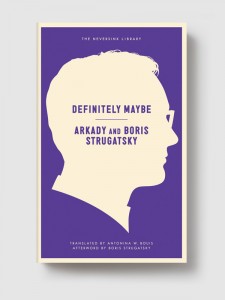
Definitely Maybe, by Arkady and Boris Strugatsky, is a riddle wrapped in a mystery inside an enigma.

I hesitate to call it science fiction, although that's the label commonly applied to the work of the Strugatsky brothers. It's deeply psychological, with several ambiguities and loose ends. It could also be read as a political satire or social commentary.
I was realizing that just yesterday I was man, a member of society. I had my own concerns and worries, yes, but as long as I obeyed the laws created by the system — and that had become a habit — as long as I obeyed those laws, I was protected from all imaginable dangers by the police, the army, the unions, public opinion, and my friends and family. Now, something in the world around me had gone haywire. Suddenly I became a catfish holed up in a crack, surrounded by monstrous vague shadows that didn't even need huge looming jaws — a slight movement of their fins would grind me into a powder, squash me, turn me into zilch. And it was made clear to me that as long a I hid in that crack I would not be touched. Yet it was even more terrifying than that. I was separated from humanity the way a lamb is cut off from the herd and dragged off somewhere for some unknown reason, while the herd, unsuspecting, goes on about its business, moving farther away into the distance. I would have felt much better if only they had been warlike aliens, some bloodthirsty, destructive aggressors from outer space, from the ocean depths, from the fourth dimension. I would have been one among many; there would have been a place for me, work for me; I would be in the ranks! But I was doomed to perish in front of everyone's eyes. No one would see a thing, and when I was destroyed, ground to dust, everyone would be surprised and then shrug it off.
Does that sound more like the threat of an alien intelligence or of government?

Dmitri Alekseevich Malianov, astrophysicist, is on the brink of a great discovery.
In the yellow, slightly curved space, the axially symmetric cavities turned slowly like gigantic bubbles. Matter flowed around them, trying to seep through, but it couldn't. The compressed itself on the boundaries to such incredible densities that the bubbles began to glow.
His wife and son have gone to Odessa, leaving him alone with the cat to work. But one interruption (a beautiful woman) follows another (a delivery of vodka and caviar), and soon a full cast is parading through the apartment: Arnold Pavlovich Snegovoi, highly mysterious neighbour, colonel, supposed by Malianov to be a physicist, in rocketry. Valentin Andreevich Weingarten, biologist and womanizer. Zakhar Gubar, master craftsman techie, patent holder of several inventions, lady-killer of the highest degree. Vladlen Semenovich Glukhov, orientalist.

And Philip Pavlovich Vecherovsky, state prize laureate.
Vecherovsky lapsed into muffled guffaws that passed for satisfied laughter. That's probably the sound H.G. Wells's Martians made when they drank human blood; Vecherovsky guffawed like that because he liked the poem he had just read. One would think that the pleasure he derived from poetry was purely physical.
All these men are connected, their life's work has been waylaid, the universe is conspiring against them. I find it curious, and commendable, that while the supposed cosmic intelligence is unknowable, there is no hypothesizing about anything like God; for these are men of science (or at least, academic rigour), living under a godless Soviet regime.

When they are forced to consider that the orientalist is among their ranks, they realize that it is not merely scientific advances and technological innovation that are being stifled but rather the whole of knowledge of humankind.

Continued reference to Vecherovsky's Martian guffaws lends to the impression that there is something alien among them, even while Vecherovsky is firmest his conviction that he knows what's going on and how best to combat it.

The story is presented in the form of excerpts, all starting with ellipses, sometimes midsentence, but they are presented in order, with no obvious gaps between them. Excerpts of what?

There are so many unresolved situations in this book. It's impossible to state with any certainty which occurrences are purely coincidental or imagined or planned as a joke or part of a grand conspiracy, whether governmental or cosmic in nature.

Roadside Picnic by the Strugatsky brothers, which I read a couple years ago, conveys suspense and horror so palpably; I count it as one of my favourite books ever. Definitely Maybe takes place in a more familiar environment, yet is more mysterious — the enigma it is wrapped in is subtler. It is less about an obvious external threat than a creeping paranoia that's generated from within.

I finished reading Definitely Maybe a couple weeks ago, but I find myself thinking of it often. It is in fact more potent now than when I turned the final page. I continue to consider, with a shudder:

Work toward what end? What price my family, my peace of mind? At what cost knowledge?

See also Kaggsy's Bookish Ramblings.

Tuesday, March 04, 2014

Body mind change

A while ago I attended an exhibit exploring the work of David Cronenberg. That visit included a tour of BMC Labs, after which I engaged in the experience of personalizing my own pod (a biotech enhancement) for brainstem implantation.

At its core a series of psychological profiling questions, the customization process was dressed up with audiovisual clips and social media interactions for an unsettling, emotional, but also weirdly satisfying narrative exercise.

Once calibrated according to my personality, the pod was brought to maturity in optimal lab conditions.

The implantation ceremony was held a few weeks ago. I was unable to attend, but it's been reported on at Fangoria.


My own pod is being delivered to me by mail.

Saturday, March 01, 2014

Mind reading: cognitive poetics

How to read... a mind is a two-week online course starting March 17, offered by the University of Nottingham.

The journey from new student to advanced study is really very short. Over two weeks, you will become fairly expert in cognitive poetics. You will understand in quite a profound way what it is to read and model the minds of other people, both real and fictional. You don't need any preparation other than your curiosity and your own experience of reading literary fiction or viewing film and television drama.

Although I haven't figured out how to read the title of this course, it sounds fascinating, and far too short. I'm going to be an expert in cognitive poetics!

I am positively addicted to MOOCs. (And I love saying "MOOC.") I just finished my fourth MOOC last week, and I start another next week. Only one of them has been purely for personal interest — the rest were for, as they say, professional development. "How to read" (MOOC number six) is a return to feeding my non-working life.

Monday, February 24, 2014

Sustain them

My assistant's favourite poem remains a secret, but I maintain that it's not an inappropriate discussion to have. To the contrary, I think it's essential, and my assistant has dropped in my esteem as a result. (My assistant also favours American spelling and is lax about punctuation.)

There are days I'd rather have a poem than an assistant.

Today's poem (courtesy of the Poetry Foundation app):
The Metaphysical Countrygirl

You, functional space
variants in voltage, the only light
Transitory effect of Love
several different lights
Sustain
Sustain them
you sustain them.

— Omar Pérez (tr. Kristin Dykstra)

Thursday, February 20, 2014

An octopus that doesn't even exist

"Or take our situation, for instance, why do you say it isn't a manifestation of a supercivilization?"

"Hmm, too human. They've discovered that earthlings are on the threshold of the universe. Afraid of the competition, they decide to stop it. Is that it?"

"Why not?"

"Because that's fiction. Dime-store fiction in bright, cheap covers. It's like trying to fit an octopus into a pair of tuxedo pants. And not a plain octopus at that, but an octopus that doesn't even exist."

— from Definitely Maybe, by Arkady and Boris Strugatsky.

Despite the awesomeness of the interwebs, there is an appalling dearth of images of octopuses in tuxedo pants, let alone any that approach what this passage conjures in my head. The occasional jacket-wearing octopus, yes. Also, people wearing tuxedoes while eating octopus. But no pants-wearing octopus.

There you have it. Proof that such an octopus doesn't even exist.

Note: It should not be construed that this novel is in any way about octopus — tuxedo pants-wearing octopus, space alien octopus, or octopus of any kind. There is some caviar, though. And to this point, there is some conjecture as to the existence of (non-octopus-like) space aliens. The quoted passage is a simple — and delightful — metaphor.

Sunday, February 16, 2014

A romance in lower mathematics

The Dot and the Line: A Romance in Lower Mathematics — book by Norton Juster, adapted into animated short by Chuck Jones.


(Via Brain Pickings.)

Moral of the story: "To the vector belong the spoils."

Friday, February 14, 2014

Yes, no, maybe, perhaps

Malianov's wife is away, and a friend of hers comes to stay:
...then he poured her another glass of wine. The decision to toast the use of the informal Russian personal pronoun for "you" came up. Without the kissing. Why should there be kissing between two intelligent people? The important thing was spiritual rapport. They drank to using the informal "you" and spoke of spiritual closeness, new methods of birth deliveries, and about the differences among courage, bravery, and valor. The Riesling was finished, and Malianov put the empty bottle out on the balcony and went over the bar for some cabernet. They decided to drink the cabernet out of Irina's favorite smoked crystal glasses, which they chilled first. The conversation on femininity, which came up after the one on manliness and bravery, went very well with the icy red wine. They wondered what asses had decreed that red wine should never be chilled. They discussed the question. Isn't it true that iced red win is particularly good? Yes, absolutely. By the way, women who drink icy red wine become particularly beautiful. They resemble witches somewhere. Where precisely? Somewhere. A marvelous word — somewhere. "You are a pig somewhere." I love that expression. By the way, speaking of witches — what do you think marriage is? A real marriage. An intelligent marriage. Marriage is a contract. Malianov refilled the glasses and developed the thought. In the aspect that a man and wife are first of all friends, for whom friendship is the most important think. Honesty and friendship. Marriage is a friendship. A contract on friendship, understand? He had his hand on Lidochka's bare knee and was shaking it for emphasis.

I am thus far loving Definitely Maybe, by Arkady and Boris Strugatsky. I love the drunken trajectory of this particular passage.

(I'm slightly puzzled by the pig expression, though, and the use of "somewhere." Perhaps the translation is too literal here. I'll have to ask around. In Polish you can use "somewhere" as an exclamatory expression signifying something between indifference and disbelief. Perhaps something similar is going on here.)

It was originally published in English under the title A Billion Years Before the End of the World. I don't know the rationale for the title change to Definitely Maybe, but I can't help but be reminded of Kraftwerk's 1986 classic, Sex Objekt. (That album is now my reading soundtrack.)

NPR review.
Excerpt.

Tuesday, February 11, 2014

The devil in a bottle

The experience of Mikhail Bulgakov's short story Morphine is exquisite and hallucinatory, but its meaning is a little elusive.

On the surface it's the story of a young country doctor who turns to morphine to quell his stomach pains, perhaps the manifestation of a deeper suffering. Polyakov had been in love with an opera singer, but she left him. "I was a man full of joie de vivre until my domestic drama."

Add a layer of biographical context. Bulgakov himself was addicted to morphine. During the First World War he served as a doctor on the front, where he suffered serious injuries and developed a habit.

Polyakov tries to wean himself from morphine by taking cocaine. "The Devil in a bottle. Cocaine is the Devil in a bottle":
There's no pain. On, on the contrary: I'm anticipating the euphoria that will soon be coming. And then it does come. I know of it because the sounds of the accordion which Vlas the watchman, rejoicing at spring, is playing on the porch, the ragged, hoarse sounds of the accordion, which come flying to me, muffled, through the window pane, become angelic voices, and the rough basses in billowing furs hum like a heavenly choir. But then, after an instant, obeying some mysterious law which isn't described in a single one of the pharmacology books, the cocaine in the blood is transformed into something new. I know: it's a mixture of the Devil and my blood. And on the porch Vlas flags, and I hate him, while the sunset, with an uneasy rumbling, scorches my innards. And that's how it is several times running in the course of an evening until I realize that I'm poisoned. My heart starts thumping such that I can feel it in my arms, in my temples... and then it sinks into an abyss, and there are sometimes moments when I think that Dr Polyakov won't come back to life again...

But a Bulgakov-loving Russian I know tells me this is a story about the revolution, how morphine (or vodka, or whatever) is the only means of coping with the insanity, horror, devastation, absurdity of sovietism.

Indeed, Polyakov's diary runs from January 1917 till his death in February 1918. "There's a revolution going on there." "Far, far away is dishevelled, turbulent Moscow." Perhaps the woman he pines for, unreasonably, is Mother Russia.

Medical professionals will view Morphine as a document with educational value, for example: "Bulgakov's short story Morphine documents the decline of Dr Polyakov and illustrates a number of salient professional issues such as self-medication, abuse of authority and risks to patients."

So many stories in this one story. And if we go back to the beginning, it's still not clear where happiness lies.

Morphine was originally published in 1926 and is generally collected in A Country Doctor's Notebook. Morphine is also published on its own as a New Directions Pearl.

Has anybody seen the adaptation of A Young Doctor's Notebook with Jon Hamm and Daniel Radcliffe?

Sunday, February 09, 2014

Typical archetypical

It's a futuristic mystery dystopian sci-fi action-adventure romance. More or less.

Archetype, by M.D. Waters, is a terrifically engrossing read, perfect for a day spent sick in bed, or a weekend trapped inside your home, or very long bus rides. You get the idea. It's the kind of book that's more unputdownable than others.

The reviews and promo copy consistently reference Margaret Atwood's Handmaid's Tale. There's some of that.

Emma wakes up in a medical facility with no memory of her life before "the accident" and little knowledge of how the world works outside of the hospital. Clearly she is expected, by her husband as well as by her doctor, to conform to a specific model of wife. There's an intense Stepford Wives vibe (and a direct reference to that classic) to Emma's education regarding her expected behaviour.

Meanwhile, Emma deals with nightmares, which early on we suspect may be memories, and an inner voice that expresses constant resistance to the world outside. Emma thinks of the voice as a third party, but it's more likely a voice of conscience, or consciousness, her true self struggling to emerge through the haze of medication and neuroelectrical treatments.

It's only gradually that we become aware of the sociopolitical circumstances beyond the four walls to which Emma is confined, and indeed from which it seems she's being "protected." Women are commoditized and fertility is highly prized.
"That seems to be the big enigma for us all. Nobody can seem to pinpoint the exact reason, so they blame it on Mother Nature. Her way of compensating for the overpopulation of our species.

"Unfortunately, we'd already begun taking the steps to take are of this ourselves. Globally limiting families to one child, and at that time — oh, I'd say this started roughly two hundred years ago — couples could change the sex of their child to whatever they wanted. Men wanted their family line to continue, you see, so they chose male children more often than not."

[...]

But if you have the ability to change a child's sex, why not make more girls?" I say when I am sure his long explanation has ended.

He finds the book he was looking for and pulls it free, then heads back to his chair. "It has been outlawed after what happened last time. We do not want to risk a shortage of boys. Forcing nature to do our bidding is a risky business."

Gradually we learn about the Women's Training Centers, where women are prepared for marriage.
"Roughly a hundred years ago, a civil war broke out and split the United States right down the middle. Women in the west live free, while the east forces women at a young age into society as they see fit. It's slavery masked as a training center."

So that's the dystopian backdrop. The rest is spoiler territory.

Archetype is more entertaining than thought-provoking, but it does raise some interesting issues about identity. It's not Atwood-caliber prose or imaginings. And perhaps it tries to pack in a plot — or genre — or two more than it ought. But it's suspenseful, and there are a few twists that caught me off guard. And I will be reading the sequel, Prototype, due out in July.

(Note that this book is in some places billed as YA, but it's a little too steamy, in my view, to fit comfortably in this category.)

Excerpt.
Profile: Shelf Awareness (in which the book sounds smarter than its author).
Review: A.V. Club.

Friday, February 07, 2014

How you do remember happiness

Clever people have been pointing out for a long time that happiness is like good health: when it's there, you don't notice it. But when the years have passed, how you do remember happiness, oh, how you do remember it!
— from Morphine, by Mikhail Bulgakov.

Some books I'd ordered arrived yesterday. Coincidentally they're all Russian, setting off an olympic marathon of Russian literature.

I've yet to read past the first paragraph of Bulgakov's short story Morphine, but I love the design of this slim volume, the feel of it, it's whiteness, it's lightness, like a sheet of ice. Happiness.

Monday, February 03, 2014

What is tango?

"Tango?" said Mrs Rupa Mehra in alarm. "What is tango?"

"Bye, Ma," said Meenakshi. "Tango. A dance. We're going the Golden Slipper. Nothing to worry about. There's just a large crowd and a band and dancing."

"Abandoned dancing!" Mrs Rupa Mehra could hardly believe her ears.

— from A Suitable Boy, by Vikram Seth.

(I'm only about a third of the way through the book, but the number of pages is alarmingly high — easily the equivalent of two average novels.)

Part seven with all its parties and socializing has been particularly delightful. Lots of clever repartee, and throwaway lines like, "He's just a writer, he knows nothing at all about literature."