5.7 His most famous riff, perhaps, was about knowledge. Not knowledge of anything in particular; just knowledge in and of itself. Who was the last person, he would ask, to enjoy a full command of the intellectual activity of their day? The last individual, I mean? It was, he'd answer, Leibniz. He was on top of it all: physics and chemistry, geology, philosophy, maths, engineering, medicine, theology, aesthetics. Politics too. I mean, the guy was on it. Like some universal joint in the giant Rubik's Cube of culture, he could bring it all together, make the arts and sciences dance to the same tune. He died three hundred years ago. Since Leibniz's time (Peyman would go on), the discipline have separated out again. They're now on totally different pages: each in its own stall, shut off from all the others. Our own era, perhaps more than any other, seems to call out for a single intellect, a universal joint to bring them all together once again — seems to demand, in other words, a Leibniz. Yet there will be no Leibniz 2.0. What there will be is an endless set of migrations: the process. No one individual will conduct this operation; it will be performed collectively, with input from practitioners of a range of crafts, possessors of a range of expertise. Migration, mutation and what I (Peyman affirmed) call "supercession": the ability of each and every practice to surpass itself, break its own boundaries, even to the point of sacrificing its own terms and tenets in the breaching; and, in the no-man's-land between its territory and the next, the blank stretches of the map, those interstitial zones where light, bending and kinking round impossible topographies, produces mirages, fata morganas, apparitions, spectres, to combine in new, fantastic and explosive ways. That, he'd say is the future of knowledge.I'm reading slowly, fully considering every paragraph, smiling over how these ideas dance. It's meditative, but in a cerebral way, not emotionally. It makes me feel smart.
Saturday, April 18, 2015
The future of knowledge
I'm only on page 51 of Tom McCarthy's Satin Island, and I think it's extraordinary.
Labels:
Tom McCarthy
Tuesday, April 14, 2015
The devastation of abandoment
The Days of Abandonment, by Elena Ferrante, was an absolutely devastating book. It made me thoroughly miserable and I wallowed in it.
I recommend it for its honesty and its anguish. There is nothing beautiful about it, but it describes in unflinching detail the workings of the mind of an abandoned woman. I know because I am one.
The absurdity of his uttering, "Don't think it's easy for me"!
For thirty-eight-year-old Olga, her fifteen-year marriage dissolved one April afternoon, right after lunch. She spends the summer disintegrating, withering under the imagined gaze of others — the sense that everybody knows, and they judge you for it. She's turned the magnifying glass on herself, searing into her soul, as if to etch the pain there, to feel it more deeply, to make it mean something more than it is.
[On Christmas evening, our eighteenth together, I told him, "I love you," and was greeted with silence. I've spent these three months reading about all manner of marriage gone wrong. In this way I think I've stopped myself from being completely consumed by rage and from committing countless desperate and petty acts of spite.]
Olga has two small children to care for, and a dog. And she totally loses it.
It is an exhausting, unpleasant read.
I was an unpleasant person for days while reading it, full of rage and frustration and confusion and despair. Yet I needed to read it. It was wholly cathartic. I think I'm done now, reading this kind of book, at least for a little while.
Jean Hanff Korelitz in the New York Times:
"Olga's close self-scrutiny and utter lack of resulting self-awareness is particularly striking."
James Woods in The New Yorker:
"It assails bourgeois niceties and domestic proprieties; it rips the skin off the habitual."
I have more Ferrante on deck, but I need to pause first. Readers will be discussing Ferrante's work over brunch at the 17th Blue Metropolis Montreal International Literary Festival.
I recommend it for its honesty and its anguish. There is nothing beautiful about it, but it describes in unflinching detail the workings of the mind of an abandoned woman. I know because I am one.
The absurdity of his uttering, "Don't think it's easy for me"!
For thirty-eight-year-old Olga, her fifteen-year marriage dissolved one April afternoon, right after lunch. She spends the summer disintegrating, withering under the imagined gaze of others — the sense that everybody knows, and they judge you for it. She's turned the magnifying glass on herself, searing into her soul, as if to etch the pain there, to feel it more deeply, to make it mean something more than it is.
[On Christmas evening, our eighteenth together, I told him, "I love you," and was greeted with silence. I've spent these three months reading about all manner of marriage gone wrong. In this way I think I've stopped myself from being completely consumed by rage and from committing countless desperate and petty acts of spite.]
Olga has two small children to care for, and a dog. And she totally loses it.
It is an exhausting, unpleasant read.
I was an unpleasant person for days while reading it, full of rage and frustration and confusion and despair. Yet I needed to read it. It was wholly cathartic. I think I'm done now, reading this kind of book, at least for a little while.
Jean Hanff Korelitz in the New York Times:
"Olga's close self-scrutiny and utter lack of resulting self-awareness is particularly striking."
James Woods in The New Yorker:
"It assails bourgeois niceties and domestic proprieties; it rips the skin off the habitual."
I have more Ferrante on deck, but I need to pause first. Readers will be discussing Ferrante's work over brunch at the 17th Blue Metropolis Montreal International Literary Festival.
Labels:
Elena Ferrante,
love
Monday, April 13, 2015
Photography has no language
I was chatting with some colleagues about god knows what, when one fellow said, it's like those people who shop around for a doctor to amputate a perfectly good body part — people do that, you know; it's a condition. And I said, someone should write a novel about that, that would make for some great doctor and patient characters; maybe I should write that novel. And I proceeded to look it up and find that it's called "body integrity identity disorder." Several months later I would discover that David Cronenberg had in fact written that novel; it's called Consumed.
I should've recognized the Cronenbergian appeal of this theme straight away, and he does touch on the issue in Crash and in the short film The Nest, both of which I'd seen. While Consumed is not consumed by this theme, it does flesh it out.
Just how many senses of the word does the title capture?
transitive verb
1 : to do away with completely : destroy
2 a : to spend wastefully : squander ; b : use up
3 a : to eat or drink especially in great quantity ; b : to enjoy avidly : devour
4 : to engage fully : engross
5 : to utilize as a customer
intransitive verb
1 : to waste or burn away : perish
2 : to utilize economic goods
It starts off as an investigation into a murder. Photojournalist Naomi flies off to Paris to delve into the lives of the Arosteguys, famed philosopher couple. But Aristide appears to have fled the country, while Celestine's remains are scattered around their apartment. It appears that parts of her had been prepared, cooked, and eaten.
Naomi's partner Nathan meanwhile is in Eastern Europe photographing the work of a shady doctor who performs operations for the truly desperate. Nathan's dream is to be published in The New Yorker's Annals of Medicine section.
There's a lot of technogeekery in this novel, mostly cameras and lenses, but also hearing aids, 3D printers, and some run-of-the-mill gadgetry.
There's also a peculiarly warped penis. And the sense that everybody is sleeping with everybody else, although they don't; but I guess, you know, the French and the medically perverse, they cast that aura.
Nathan contracts a rare STD and heads to Toronto to talk to the elusive has-been of a doctor after whom the disease was named. Naomi meanwhile follows Aristide's trail to Japan.
Believe it or not, Naomi's and Nathan's stories do intersect, quite satisfactorily. These characters' narratives are wholly intertwined, even though they barely share any screen time.
Oh, and there's also a North Korean conspiracy, that's involved even in the politicking at Cannes.
I hope Cronenberg writes another book.
I should've recognized the Cronenbergian appeal of this theme straight away, and he does touch on the issue in Crash and in the short film The Nest, both of which I'd seen. While Consumed is not consumed by this theme, it does flesh it out.
Just how many senses of the word does the title capture?
transitive verb
1 : to do away with completely : destroy
2 a : to spend wastefully : squander ; b : use up
3 a : to eat or drink especially in great quantity
4 : to engage fully : engross
5 : to utilize as a customer
intransitive verb
1 : to waste or burn away : perish
2 : to utilize economic goods
It starts off as an investigation into a murder. Photojournalist Naomi flies off to Paris to delve into the lives of the Arosteguys, famed philosopher couple. But Aristide appears to have fled the country, while Celestine's remains are scattered around their apartment. It appears that parts of her had been prepared, cooked, and eaten.
Naomi's partner Nathan meanwhile is in Eastern Europe photographing the work of a shady doctor who performs operations for the truly desperate. Nathan's dream is to be published in The New Yorker's Annals of Medicine section.
There's a lot of technogeekery in this novel, mostly cameras and lenses, but also hearing aids, 3D printers, and some run-of-the-mill gadgetry.
There's also a peculiarly warped penis. And the sense that everybody is sleeping with everybody else, although they don't; but I guess, you know, the French and the medically perverse, they cast that aura.
Nathan contracts a rare STD and heads to Toronto to talk to the elusive has-been of a doctor after whom the disease was named. Naomi meanwhile follows Aristide's trail to Japan.
"I only smoke Japanese now. I want to become Japanese. I'll never speak French again. Never. They say that Tolstoy learned classical Greek very quickly once he put his mind to it. I'm learning Japanese very quickly. Until then, I speak English or German. For philosophy, at least, you have to speak German. Perhaps I will make Japanese essential for contemporary Western philosophy. If I live long enough."Cronenberg's expression of journalism puzzles me. Here are these photojournalists following these really complex stories — stories that, in my view, demand more (much more) than pictures to tell them — but for them, the words are an afterthought, easily dashed off, filled in later. It's the picture that makes the story. I can't tell if Cronenberg is saying this is how it is, or how it ought to be. Of all the perversities in this novel, this is the one I can't get past, the one that feels wrong. I guess it's natural for a filmmaker to fetishize the view through the lens; but why then is he writing a novel?
Naomi was groping. "Photography has no language. Is that why you're so interested in it?"
Believe it or not, Naomi's and Nathan's stories do intersect, quite satisfactorily. These characters' narratives are wholly intertwined, even though they barely share any screen time.
Oh, and there's also a North Korean conspiracy, that's involved even in the politicking at Cannes.
I hope Cronenberg writes another book.
Labels:
David Cronenberg
Sunday, April 12, 2015
Revisiting Ravenscrag
The other week I attended the launch of Alain Farah's Ravenscrag at Drawn & Quarterly (although the term "launch" seems to be used rather loosely by the store, as the book has been available since January).
The conversation with author Alain Farah (left) and his translator, Lazer Lederhendler (right), was moderated by Catherine Leclerc. Interestingly, it's Lederhendler who held the floor for most of the evening, probably because 1. his command of English is superior to that of the other parties, and 2. as translator, he's had to read and interpret the text particularly closely. He could've carried the evening on his own with his insight into the problems of translation.
Lededhendler notes that the novel may seem crazy — or better, "madcap" — but it's not insane. It holds to an internal logic.
The novel in French is titled Pourquoi Bologne, which I would think makes the thing as a whole something other than Montreal-centric, whereas the English takes for its title the name of a city landmark, grounding it very firmly. I can't help but think the title, and the impression it creates, affects the reception of the novel. Is it a different novel in English than it is in French? In fact, Farah occasionally refers to the translation as "Lazer's novel."
What I hadn't considered is how much the schizoid experience of the book is meant to reflect a francophone's experience in English Montreal — I can't tell if I didn't recognize this because I'm still so much an outsider to this city that I can't see some of its essential paradoxes, or that I'm so much of here already that the issues appear commonplace and don't strike me the way they would if I were reading about some foreign place.
The underground geography of the McTavish reservoir, its pipes and tubes, Farah says was inspired by Terry Gilliam.
This novel is not a linear narrative because that's not Farah's experience of the world.
[I had several issues with the event: it started late (about 30 minutes or so, though I'd stopped checking the time); the way chairs were set up severely restricted movement, particularly access to the author (for a subsequent event I attended, someone had the sense to stack chairs to clear floorspace once the formal portion of the event was through); in fact, the author appeared to be at a cocktail party rather than a book-signing (I had every intention of buying a copy of the book for a friend, but I didn't, because it was difficult to interrupt his small talk and more awkward to ask that he bestow the favour of his signature (at the subsequent event, the author sat at a table and there was a clear lineup for signings). Keeping it casual can be cool, but I'd bet it's detrimental to book sales.]
Things I would've liked to ask the author (but didn't, because the question period was cut short because it was weirdly silent and I'd already asked a question, and because I failed to schmooze my way into conversation with him):
The conversation with author Alain Farah (left) and his translator, Lazer Lederhendler (right), was moderated by Catherine Leclerc. Interestingly, it's Lederhendler who held the floor for most of the evening, probably because 1. his command of English is superior to that of the other parties, and 2. as translator, he's had to read and interpret the text particularly closely. He could've carried the evening on his own with his insight into the problems of translation.
Lededhendler notes that the novel may seem crazy — or better, "madcap" — but it's not insane. It holds to an internal logic.
The novel in French is titled Pourquoi Bologne, which I would think makes the thing as a whole something other than Montreal-centric, whereas the English takes for its title the name of a city landmark, grounding it very firmly. I can't help but think the title, and the impression it creates, affects the reception of the novel. Is it a different novel in English than it is in French? In fact, Farah occasionally refers to the translation as "Lazer's novel."
What I hadn't considered is how much the schizoid experience of the book is meant to reflect a francophone's experience in English Montreal — I can't tell if I didn't recognize this because I'm still so much an outsider to this city that I can't see some of its essential paradoxes, or that I'm so much of here already that the issues appear commonplace and don't strike me the way they would if I were reading about some foreign place.
The underground geography of the McTavish reservoir, its pipes and tubes, Farah says was inspired by Terry Gilliam.
This novel is not a linear narrative because that's not Farah's experience of the world.
[I had several issues with the event: it started late (about 30 minutes or so, though I'd stopped checking the time); the way chairs were set up severely restricted movement, particularly access to the author (for a subsequent event I attended, someone had the sense to stack chairs to clear floorspace once the formal portion of the event was through); in fact, the author appeared to be at a cocktail party rather than a book-signing (I had every intention of buying a copy of the book for a friend, but I didn't, because it was difficult to interrupt his small talk and more awkward to ask that he bestow the favour of his signature (at the subsequent event, the author sat at a table and there was a clear lineup for signings). Keeping it casual can be cool, but I'd bet it's detrimental to book sales.]
Things I would've liked to ask the author (but didn't, because the question period was cut short because it was weirdly silent and I'd already asked a question, and because I failed to schmooze my way into conversation with him):
- What exactly is retro scifi? Is it a thing your marketing department came up with, just because you mention Philip K. Dick?
- What is the relationship between insanity and time travel? You seem to be deeply influenced by Philip K. Dick; to what extent is the relationship between insanity and time travel in your novel inspired by or modeled after Dick's depictions?
- Although he has a cult following, Dick has never really been accepted by the literary establishment (to the extent even that none of the reviews of your novel I've read appear to recognize his influence): Does that hold true among French readers? (To what extent is genre an English problem?) How do you feel about the genre-ification of literature, that Dick should be ghetto-ized? How would you feel if your book were shelved in SF?
Monday, April 06, 2015
Disillusionment
Mad Men has returned, and it got literary again.
While only one novel was clearly in view, and shown to be actively read — The 42nd Parallel, by John Dos Passos — there's another literary reference straining through Peggy Lee's rendition of "Is That All There Is?" which opens and closes last night's episode. The song's lyrics were inspired by Thomas Mann's short story "Disillusionment."
It's not hard to imagine that the story was written with Don Draper in mind. Ennui in extremis.
While only one novel was clearly in view, and shown to be actively read — The 42nd Parallel, by John Dos Passos — there's another literary reference straining through Peggy Lee's rendition of "Is That All There Is?" which opens and closes last night's episode. The song's lyrics were inspired by Thomas Mann's short story "Disillusionment."
I zealously fed my magnificent expectations of life with the matter of a thousand books and the works of all the poets. Ah, how I have learned to hate them, those poets who chalked up their large words on all the walls of life — because they had no power to write them on the sky with pencils dipped in Vesuvius! I came to think of every large word as a lie or a mockery.You can read it in its entirety, or listen to it here.
Ecstatic poets have said that speech is poor: "Ah, how poor are words," so they sing. But no, sir. Speech, it seems to me, is rich, is extravagantly rich compared with the poverty and limitations of life. Pain has its limits: physical pain in unconsciousness and mental in torpor; it is not different with joy. Our human need for communication has found itself a way to create sounds which lie beyond these limits.
Is the fault mine? Is it down my spine alone that certain words can run so as to awaken in me intuitions of sensations which do not exist?
It's not hard to imagine that the story was written with Don Draper in mind. Ennui in extremis.
Labels:
Mad Men,
television,
Thomas Mann
Sunday, April 05, 2015
Nest
David Cronenberg's short film The Nest documents a medical consultation with a woman who wants her left breast removed because she believes it to be full of insects.
I love how it's set in a garage.
I was lucky enough to see The Nest during the Christmas holidays of 2013 at a TIFF exhibition exploring Cronenberg's work.
Cronenberg's novel, Consumed, explores the same subject matter further. It's just one of several weird and typically Cronenbegian narrative threads in the book, but having watched this film gave the novel another dimension — it's become a kind of multimedia experience.
I love how it's set in a garage.
I was lucky enough to see The Nest during the Christmas holidays of 2013 at a TIFF exhibition exploring Cronenberg's work.
Cronenberg's novel, Consumed, explores the same subject matter further. It's just one of several weird and typically Cronenbegian narrative threads in the book, but having watched this film gave the novel another dimension — it's become a kind of multimedia experience.
Labels:
David Cronenberg,
horror,
movie
Monday, March 30, 2015
To study myself with precision and cruelty
I spent the warm months of early autmumn sitting on a bench in the rocky garden, writing. In appearance they were notes for a possible book, at least that's what I called them. I wanted to cut myself to pieces — I said to myself — I wanted to study myself with precision and cruelty, recount the evil of these terrible months completely. In reality the thoughts revolved around the question that Carrano had suggested to me: was I like Mario? But what did that mean? That we had chose each other because of affinities and that those affinities had ramified over the years? In what ways did I feel similar to him when I was in love with him? What had I recognized of him in myself, at the beginning of our relationship? How many thoughts, gestures, tones, tastes, sexual habits had he transmitted to me over the years?— from The Days of Abandonment, by Elena Ferrante.
In that period I filled pages and pages with questions of this type. Now that Mario had left me, if he no longer loved me, if I in fact no longer loved him, why should I continue to carry in my flesh so many of his attributes? What I had deposited in him had surely been eliminated now by Carla in the secret years of their relationship. But as for me, if all the features that I had assimilated from him had once seemed to be lovable, how, now that they no longer seemed lovable, was I going to tear them out of me? How could I scrape them definitively off of my body, my mind, without finding that I had in the process scraped away myself?
The hard part is telling us apart. And what of the ossified bits? How do I scrape him off without marring any bit of my real self? What is my real self, anyway?
Labels:
Elena Ferrante,
love
Sunday, March 29, 2015
Skin deep
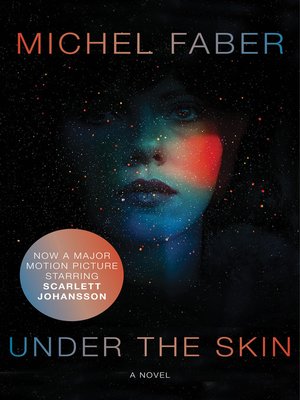
"You know," he said, almost dreamily, "I sometimes think that the only things really worth talking about are the things people absolutely refuse to discuss."I read Michel Faber's Under the Skin over a month ago, but I put off writing about it, wanting to see the film adaptation. Now I'm at a loss — they are so completely different, yet also compelling and weird. They're both also nigh impossible to talk about without giving anything away.
"Yes," snapped Isserley, "like why some people are born into a life of lazing around and philosophizing, and others are shoved into a hole and told to fucking get busy."
The weight, weightiness, of them comes out of the title. We're immediately invited to question: What's under Isserley's skin? What's under Scarlet Johansson's skin? The character in both the novel and the film is somehow off, out of place, other.
The only thing seemingly clear from the outset is that we're dealing with a female predator. In the film this is highly sexualized, because ScarJo; in the novel, Isserley is weird-looking, but men are distracted by her massive breasts, because men. But she's a very good predator; she studies her prey, their habits, and their environment intensely.
The film does a great job of focusing on the predation. The novel goes far beyond female-male relations (not that the film does just that) to cover a lot more territory, a whole other culture, in fact.
Under the Skin is also very much about the relationship between hunter and hunted. What's under the skin of her victims, anyway? What constitutes our humanity?
The thing about vodsels was, people who knew nothing whatsoever about them were apt to misunderstand them terribly. There was always the tendency to anthropomorphize. A vodsel might do something which resembled a human action; it might make a sound analogous with human distress, or make a gesture analogous with human supplication, and that made the ignorant observer jump to conclusions.It's the sort of talk that could turn you vegetarian. The novel might also be read as a warning about the dangers of disturbing an ecosystem ("A few drops of chemical soap into such a vast reservoir of natural purity wouldn't have much effect, surely?"). The problems of overhunting. How economics factors into our moral choices.
In the end, though, vodsels couldn't do any of the things that really defined a human being. They couldn't siuwil, they couldn't mesnishtil, they had no concept of slan. In their brutishness, they'd never evolved to use hunshur; their communities were so rudimentary that hississins did not exist; nor did these creatures seem to see any need for chail, or even chailsinn.
And, when you looked into their glazed little eyes, you could understand why.
If you were looking clearly, that is.
So, that's why it was better that Amlis Vess didn't know that the vodsels had a language.
Most reviews of the novel give away the story, and that's okay in the sense that that's not really what the book is about. However, I really loved the discovery of the story as the novel unfolded. It changed tack several times; it started off as a thriller, turned scifi, took a romantic twist, and mused on socioeconomic structures, before finally settling into an existential introspection — the problem of otherness and the impossibility of genuine communication.
That's what lying had done to the world. All the lying that people had been doing since the dawn of time, all the lying they were doing still. The price everyone paid for it was the death of trust. It meant that no two humans, however innocent they might be, could ever approach one another like two animals. Civilization!Reviews (with spoilers)
LitMed
New York Times
Excerpt.
Labels:
Michel Faber,
science fiction
Thursday, March 26, 2015
Bookclub, anyone?
If you're in the Montreal area and interested in meeting downtown (in person) every 2 months or so (starting at the end of May) to discuss a book of note (probably fiction), please contact me for more details.
The bookclub I'd been attending quasiregularly for about a year and a half recently had to disband (it was associated with a bookstore, and there weren't the resources to maintain it any longer).
A couple of the readers, along with myself, are interested in continuing the club, but we're looking for fresh reader blood.
The previous club had focused on books published under the NYRB Classics imprint, but had begun to branch out. Selections spanned centuries and cultures.
Future bookclub choices will very much depend on the dynamics of the group, but if your reading tastes at all jive with mine, consider joining us. Email me at ikratynski@gmail.com.
The bookclub I'd been attending quasiregularly for about a year and a half recently had to disband (it was associated with a bookstore, and there weren't the resources to maintain it any longer).
A couple of the readers, along with myself, are interested in continuing the club, but we're looking for fresh reader blood.
The previous club had focused on books published under the NYRB Classics imprint, but had begun to branch out. Selections spanned centuries and cultures.
Future bookclub choices will very much depend on the dynamics of the group, but if your reading tastes at all jive with mine, consider joining us. Email me at ikratynski@gmail.com.
Monday, March 23, 2015
Bug music
With dusk begins to cry— from Kokinshu, by Tsurayuki (~900 AD)
the male of the Waiting-insect; —
I, too, await my beloved,
and, hearing, my longing grows.
Graeme Revell (once best known for fronting industrial band SPK, now probably more readily recognized for his soundtracks) produced The Insect Musicians in 1987. (I listened to a lot of experimental music in the mid 80s.)
This orchestral wall of sound consists entirely of modulated insect sounds.
I owned and loved that album, and shared it and it was lost. (All praise the Internet, restorer of lost treasures!)
The liner notes summarize Revell's concept and describe the techniques used in transforming insect "noise" into "music."
To me this album signified a world of (alien) beauty at our feet, if only we cared to look, listen.
Insects feature in Consumed, by David Cronenberg, inhabiting the left breast of the woman who as the novel opens is found apparently to have been murdered and cannibalized. The book embraces entomologists and state-of-the-art hearing technology. So this music formed the soundtrack for my weekend reading.
Labels:
David Cronenberg,
music
Wednesday, March 18, 2015
Word neutrality is destabilizing
We were enclosed in Audio Booth 4, basically an audio recording cabinet floating on foam and designed to be sound-neutral. Words spoken in Booth 4 sounded unnaturally deadened, like inanimate objects. The walls of the booth, the floor, the ceiling, none of it added any energy or shape by reflectance or geometry to the sounds that came out of our mouths, and this had a mysterious effect on the meaning and the impact of the words themselves that was hard to calculate. It made me realize that word neutrality in human communication is destabilizing; there is a paper to be written there.— from Consumed, by David Cronenberg.
Labels:
David Cronenberg,
language
Tuesday, March 17, 2015
Things my 12-year-old says
"Can it be storytime? I'll read you the story. Only, I warn you: it's more descriptive than narrative."
Apparently also she's scouring the Internet for tips on doing homework.
Labels:
Helena
Monday, March 16, 2015
Two kinds of readers
Sometimes I think there are two kinds of readers: readers for whom books are bread and coffee, and readers for whom books are magic mushrooms. The bread-and-coffee people prefer to read about real life (marriage and parenthood, vocations and vacations, adultery and war), while the magic mushroom readers live for the shadow in the corner, the mysterious figure on the train, and the eerie music floating over the darkened lake.This comes from a review of The Uncanny Reader: Stories from the Shadows, an anthology edited by Marjorie Sandor. The book sounds wonderful — thirty-one stories that cover two centuries and sample the world, including a couple authors I particularly admire, China Miéville and Bruno Schulz. (You can read Sandor's introduction to her anthology here.) I'm very likely to pick up a copy to have on hand in the event of a dark and stormy night.
But it's the dichotomy of book readers that my mind keeps wandering back to. Hands down I'm a magic mushroom kind of reader. But I've noticed a disturbing trend in my reading choices of late — easily half of the year's reading to date is books directly about love gone wrong, marriages gone bad, and almost all of them tangentially so.
It was purely coincidental at first, reading I'd lined up before Christmas, before everything soured. Then it was a subconscious draw. And now I'm realizing the full value of bibliotherapy, of living lives other than mine, of living variations of my life, of examining marriage (all marriages, not just mine) from all angles. Now I'm seeking these books out. It's been somewhat cathartic, it's kept me remarkably steady, but it's becoming obsessive, like picking at a scab.
As much as I love the magic mushrooms, I think sometimes my body and mind are telling me I need bread and coffee, just for a little while, for grounding. (But not too much; I'll have to fly again sometime.)
What kind of reader are you? Are your books bread and coffee, or magic mushrooms?
Labels:
bibliotherapy,
coffee,
love
Wednesday, March 11, 2015
Like versions of truth, like versions of love
"Is that not always the case? Given any two people in a relationship, one will always love more, the other less. Right?"I haven't yet figured out how I feel about Hausfrau, by Jill Alexander Essbaum. It's complicated. I don't like Anna. I don't like her at all. I don't feel a bit of sympathy for her. I'm also slightly troubled by the fact that I don't feel for her. I don't thinks she's sad; I think she's stupid. I want to slap her. Yet. There's something compelling about the inner drama Anna creates (and she does create it, all by herself).
The titular housewife is Anna, an American ex-pat married to a Swiss banker, living just outside of Zurich with their three children. Anna is bored or possibly depressed — although to me she seems affectless — so she goes to therapy and has affairs.
A little of this, a little of that
According to some booksellers, Hausfrau is for readers of Claire Messud and Mary Gaitskill. I've never read Gaitskill, but I can see the comparisons to Messud's Woman Upstairs, though I don't quite agree with them. Messud's novel was famously about an unlikeable character, though I liked her quite a bit, certainly more that I like Anna (whom I don't like at all). Messud's character also had my respect, for trying, for engaging, for being an interesting, deep, thoughtful, and honest person. Essbaum's Anna has none of that; she's just boring, and I can't decide if that's a novelistic flaw or if that's the bloody point.
It's "Madame Bovary meets Fifty Shades of Grey." I can't speak to Fifty Shades per se, but I can say Hausfrau offers some steamy scenes. Part of me thinks they're entirely gratuitous, but hell, sex is part of life, why shouldn't those scenes be included? Do these scenes contribute to the development of Anna's character? No, they don't let me know her any better. But again, maybe that's the point. The influence of Madame Bovary, however, is obvious. But Emma has gained my sympathy over the years; Anna, to whom I should be able to relate on some level (marriage, child, mother-in-law, transplanted residence, living in a second language), leaves me cold.
It "recalls Marguerite Duras's The Lover and Anita Brookner's Hotel du Lac." I haven't read either, but it seems like a bit of a stretch, particularly as Duras experimented with form. Hausfrau gives us scenes from psychotherapy. Anna is completely inside herself; other people barely register on her.
"For readers of Gone Girl and The Girl on the Train." Maybe. I dunno.
And don't forget Anna Karenina. Hausfrau Anna arguably shares more similarities with Tolstoy's Anna than with Flaubert's Emma.
According to Book Riot, "the novel itself feels more like the heir apparent to Dept. of Speculation by Jenny Offill." But Offill's character is highly sympathetic and observant; the novel is meditative. Anna on the other hand is merely flat.
The rest of it
The language is lovely.
That morning's German lesson left Anna pensive. The German language, like a woman, has moods. On occasion they are conditional, imperative, indicative, subjunctive. Hypothetical, demanding, factual, wishful. Wistful, bossy, of blunted affect, solicitous. Longing, officious, anhedonic, pleading. Anna tried to make a list of every mood she's ever been in but ran out of words before even half of her feelings were named.
The ending is inevitable. There's no other way for it to end. It's easy to see it coming. In principal, it is the perfect ending. In practice, the lead-up is a little over-wrought, and even in all Anna's emotionlessness it's too emotional, somehow out of step with the rest of the novel.
Reviews
The Frisky:
"What I enjoyed the most about the first two-thirds of the novel was that Anna was a fairly ordinary woman with some serious emotional complications, but who wasn’t a mustachioed supervillain or an anti-hero – just a woman with lower-than-average ethics in a life situation that would be genuinely difficult for almost anyone."
The Guardian:
"I liked the fact that Essbaum gives us no sweeteners in the matter of Anna’s character. She is difficult. She is boring. She is narcissistic. She is so very sad."
The Independent:
"That, in the end, is the subversive thing about Anna: not her libido or her secret affairs, but her refusal to feel quite as copiously as women are expected to, her refusal to make herself likeable."
Excerpt.
Make no mistake: everything has a variant. Like versions of truth, like versions of love, there are versions of sleep. The deepest sleep is meant only for children and perfect fools. Everyone else must pay each night her restless due.
Labels:
Claire Messud,
Gustave Flaubert,
Jill Alexander Essbaum,
love
Monday, March 09, 2015
Space opera
Solaris, the opera, has just premiered in Paris, music by Dai Fujikura (sung in English), based on the classic science fiction novel by Stanisław Lem.
However, it seems to have been not particularly well received (verdict: boring).
Interestingly, it seems this isn't the first time the story has been set to music. Detlev Glanert's version was staged in Germany in 2012 (and I'd go see that, given the chance).
However, it seems to have been not particularly well received (verdict: boring).
Interestingly, it seems this isn't the first time the story has been set to music. Detlev Glanert's version was staged in Germany in 2012 (and I'd go see that, given the chance).
Labels:
music,
Polish literature,
Stanisław Lem
Sunday, March 08, 2015
Being your whole self
The Upside of Your Dark Side: Why Being Your Whole Self — Not Just Your "Good Self — Drives Success and Fulfillment, by Todd Kashdan and Robert Biswas-Diener, is not the sort of book I usually read. I'd call it pop psychology. Its tone was such that I was ever afraid of it veering toward self-help territory, but I think that's more an artefact of how it's marketed than the intent of the actual text.
It was given to me as a gift, because I've had a lot of dark looming up in my life lately, in both my home and work lives.
Its starting point is the American obsession with positive thinking: the right to the pursuit of happiness has been confused with an obligation to be happy, all the time.
I've been obsessed with the notion of happiness since I was in grade 7. Not that I wanted a direct path to it. I just wanted the idea of it defined. (Were we reading Brave New World?) I wanted to establish the difference between thinking you're happy and really being happy. Cuz goddamit I know there's a difference. And real happiness is an elusive, if not altogether imaginary, beast. I've known all my life that it is not possible to live in a state of constant joy. Contentment is another matter. Which is where the problem of definition comes in. In fact, for some 30+ years, I've been a proponent of happiness being just one aspect of living a full life. Which is what this book is about. (Gosh, I was a smart kid.)
So the fact is: people get angry, or sad, or bored, or frustrated, all the time. When we experience physical pain, we tend to take it seriously. But we're generally pretty dismissive of emotional pain and view it simply as wrong, without ever listening to what that pain is telling us about ourselves or our environment.
The upshot: it's OK to feel angry, sad, mean, selfish, whatever, in certain contexts, and it's better for us to acknowledge those feelings, even indulge them, than to mask them because we're supposed to be happy all the time. These "negative" feelings are shown to fuel creativity, heighten awareness, and enhance performance.
But you already knew that, right?
Regarding one study conducted in a workplace setting:
In addition, the book is full of little insights on sprawling topics, like:
Reviews
Huffington Post
Positive Psychology
Presentation.
It was given to me as a gift, because I've had a lot of dark looming up in my life lately, in both my home and work lives.
Its starting point is the American obsession with positive thinking: the right to the pursuit of happiness has been confused with an obligation to be happy, all the time.
I've been obsessed with the notion of happiness since I was in grade 7. Not that I wanted a direct path to it. I just wanted the idea of it defined. (Were we reading Brave New World?) I wanted to establish the difference between thinking you're happy and really being happy. Cuz goddamit I know there's a difference. And real happiness is an elusive, if not altogether imaginary, beast. I've known all my life that it is not possible to live in a state of constant joy. Contentment is another matter. Which is where the problem of definition comes in. In fact, for some 30+ years, I've been a proponent of happiness being just one aspect of living a full life. Which is what this book is about. (Gosh, I was a smart kid.)
So the fact is: people get angry, or sad, or bored, or frustrated, all the time. When we experience physical pain, we tend to take it seriously. But we're generally pretty dismissive of emotional pain and view it simply as wrong, without ever listening to what that pain is telling us about ourselves or our environment.
The upshot: it's OK to feel angry, sad, mean, selfish, whatever, in certain contexts, and it's better for us to acknowledge those feelings, even indulge them, than to mask them because we're supposed to be happy all the time. These "negative" feelings are shown to fuel creativity, heighten awareness, and enhance performance.
But you already knew that, right?
Regarding one study conducted in a workplace setting:
The take-home lesson is simple: do not create a culture based on the assumption that positivity must reign supreme. Instead, create a culture where everyone knows that it's safe to be real, and that depending on the situation it's sometimes better to feel something other than happiness.I worked for a company some years ago where the gung-ho, go-get-'em, go-go-go all-American attitude just didn't fly with us Canadian counterparts. So I can see how HR departments could learn from this book, to build the right corporate culture for the right skills to flourish.
In addition, the book is full of little insights on sprawling topics, like:
Love is about adopting another person's perspective of the world, and when overvaluing your happiness gets in the way, it leads to unfortunate by-products such as loneliness.And:
Research suggests that you, like everyone else, think that you are better than other human beings. This so-called better-than-average effect shows that most people believe that they are above average, which, of course, is a mathematical impossibility.[...] The average person lives inside a narcissistic bubble, a self-serving bias that gives most of us the confidence we need to face a complex and uncertain day.So I don't think I learned anything, but the book is full of interesting research studies, and it's nice to have my intuitive thinking validated. A pleasant-enough way to while away a train ride on a wintry afternoon.
Reviews
Huffington Post
Positive Psychology
Presentation.
Labels:
cognitive science,
happiness
Saturday, March 07, 2015
Words will change nothing
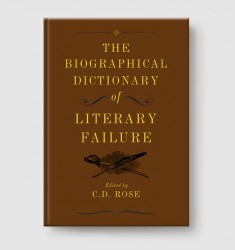
Those who claim to know her, or know of her, have talked of poems whose syntax and diction twist language into new shapes, forming tiny bright daggers sharp enough to pierce the heart. Others have spoken of a novel so compendious and yet so precise it would change our thinking about the form, the last true revolutionary work, a thing that would turn lives inside out after only its first page. Some have claimed she wrote short stories, brief tales that twist and turn, things that would checkmate Chekhov, carve Carver into pieces. Stories that need but a few brief pages to reconfigure our soul.— from "Sara Zeelen-Levallois" in The Biographical Dictionary of Literary Failure, edited by C.D. Rose.
The ephemeral, evanescent, scarcely believable career of Sara Zeelen-Levallois shows us, if nothing else, one important, terrible thing: words will change nothing. Write how we may, the arrogant and corrupt will still run the world, people will starve needlessly, your lover will still leave you.
And yet.
The power of writing is one of the greatest things we have, whether it is read or not.
Labels:
C.D. Rose,
dictionary,
Melville House
Wednesday, March 04, 2015
The hotel library
Yes, my hotel has a library. And there's a fireplace in the library, but not pictured here because there are strangers sitting beside it, and I didn't want to make them uncomfortable.
Weirdly, most of the books are German, with some French and English, but nothing that grabbed me. Still, a great place to sit, read, rest.
Monday, March 02, 2015
We are going to another disco
I'm in New York City for a few days...
Sunday, March 01, 2015
So finely ground it appears homogenous
Duras, in Écrire, deplores that too may books are lacking in freedom. She admonishes writers for acting like cops, whereas writing is a breeding ground for delinquents. By being content with conformist little books, scribblers take pleasure in their own neutralization, they make books with no night, pastime books, books for travelling, not books that sink into the mind, not books that speak the dark grief of all life.Ravenscrag, by Alain Farah, is a perfectly bizarre novel. Duras would approve.
I have a hard time summarizing its plot. And I'm not sure whom I would recommend it to, except as a literary curiosity. Only now that I've finished reading it, I like it more. This novel gave me a hard time, but that's a good thing.
I love that the narrator is reading Emmanuel Carrère's I Am Alive and You Are Dead. That he admires Jean-Patrick Manchette. That he plagiarizes William Burroughs's Blade Runner. I love that Umberto Eco is a character in this novel. I love the references to Edgar Poe and Lady Gaga.
I love that Rilke is quoted. (Why is it that everyone I read these days is quoting Rilke?)
Then there's the Bologna enigma, Aelia Laelia Crispis. That this is a mysterious inscription famously translated by Jung reinforces the oneiric quality of the novel.
[In] the novel I was then writing, I peppered the narrative, without knowing why, with references to the city of Bologna, whose name designates a mortadella so finely ground it appears homogenous, with no visible trace of the assorted bits from which it's made: pork snouts, rooster fee, beef anuses.It leads one to think that the whole novel is bologna. Very finely ground. Admirably so.
Ravenscrag is weirdly reminiscent of Philip K. Dick's Time Out of Joint and Marge Piercy's Woman on the Edge of Time. It's also a direct descendent of La Dolce Vita and Last Year at Marienbad.
Mind-wiping, the CIA, and some oddly anachronistic scenes that conflate 2012 with 1962 and 1912.
Ravenscrag is the name of the mansion that sits just up the mountain, atop of McGill. Today it's known as the Allan Memorial Institute. The novelized version has only half the rooms of the real-life prototype.
With some difficulty, I manage to leave Ravenscrag, with its architecture of thirty-six doors arrayed on either side of a long central corridor, none of which leads out of the building, as if one had to agree to invent a thirty-seventh in order to exit.I feel on exiting this book that I am bound by a similar contract.
I want to read it again.
Wednesday, February 25, 2015
Fresh as a daisy
Ah, love.
This is how the story ends:
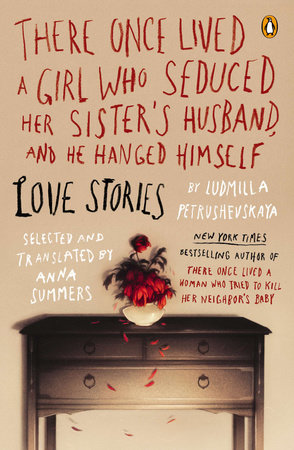
That's how one of the stories ends. But all the stories end like this, just life continuing without end. Ludmilla Petrushevskaya's slim volume of love stories, There Once Lived a Girl Who Seduced Her Sister's Husband, and He Hanged Himself, is brutal and true.
In the introduction, translator Anna Summers writes:
I read these stories last month, even though my husband had just left me for a younger woman. And they made me feel better. Because other people's lives are so much more tragic than mine. Although, I was drunk for much of the time I was reading.
Life, love — all of it is so inconsequential.
Reviews
A.V. Club
Bookslut
New York Times
This is how the story ends:
To the accompaniment of Victor's snoring, Ali-Baba reviewed her life and swallowed the pills. The next morning Victor found her lying facedown on the desk. He read her note and called an ambulance. Paramedics pumped Ali-Baba's stomach, then took her to a mental hospital. Shaking with a hangover, Victor pulled on some clothes and trotted off to work to wait for the liquor store to open.
Ali-Baba was lying in a clean bed in a ward for the insane. She would stay there at least a month. Soon there would be a hot breakfast and conversation with a family doctor. Later, as she knew, her neighbors would swap life stories. Ali-Baba also had a story or two to share. She wanted to tell them, for example, about the first time she took pills, when she went blind for twenty-four hours. The second time put her to sleep for two days, but the sixth time she woke up in the morning fresh as a daisy.
That's how one of the stories ends. But all the stories end like this, just life continuing without end. Ludmilla Petrushevskaya's slim volume of love stories, There Once Lived a Girl Who Seduced Her Sister's Husband, and He Hanged Himself, is brutal and true.
In the introduction, translator Anna Summers writes:
Petrushevskaya's genius as a literary artist lies in her ability to make the strangeness of her mothers, her would-be mothers, her once-were mothers, and her other characters worthy of our sympathy in the partial absence of our understanding. The changes she introduces in vocabulary, perspective, rhythm, and intonation sneak up on us, and before we know it we have implicitly forgive bizarre, bewildering, and often vulgar behaviors and qualities.These stories are small, as small as the lives they depict. Very many of them are forgettable lives. They are also surprisingly light; they waft away.
I read these stories last month, even though my husband had just left me for a younger woman. And they made me feel better. Because other people's lives are so much more tragic than mine. Although, I was drunk for much of the time I was reading.
Life, love — all of it is so inconsequential.
Reviews
A.V. Club
Bookslut
New York Times
Labels:
love,
Ludmilla Petrushevskaya,
short stories
Tuesday, February 24, 2015
Screen test
I've been watching some of Andy Warhol's screen tests on Youtube.
Some of them are very boring. Indeed, I lose interest in most of them by about the 30-second mark. This surprises me, because I'm generally a patient person who gives my undivided attention to things (like very long books and arthouse movies).
But a few of them really intrigue me — those with particularly interesting faces, or whom I know something about (like Edie Sedgwick, and everything I know about her I learned from Claire Messud's novel The Woman Upstairs).
As part of a course on Andy Warhol, we were invited to use the Vine app to create our own screen tests.
So I "screen-tested" my daughter for a full 6 seconds. And what I got out of the exercise is something I've always known in theory, but here I felt it firsthand: that the picture or video is more about the relationship between the watcher and the watched than it is about the image itself being captured. A kind of still portrait but over time.
The Vine exercise was part of the MOOC's opening unit, on celebrity. And the ensuing discussions continue to be quite provocative, on the nature of celebrity, on cultivating persona, on the phenomenon of social media. Has our promised 15 minutes in fact shrunken to mere seconds? And I wonder how interested I would be in Warhol's art if it weren't for the fact of his own celebrity.
**********
Warhol Mania is on at the Montreal Museum of Fine Arts until March 15. It's a small exhibit (2 rooms) but tightly focused on Warhol's posters (including for Perrier) and magazine work.
Because it consists entirely of "printed" work, there's no real "aha" moment such as I've experienced in seeing some other artworks (say, in terms of the colour and texture of a painting). However, it's interesting to see Warhol's works grouped: e.g., his illustrations of shoes and accessories for ladies magazines. And I learned, sadly, that much of Warhol's original work would've been destroyed — typically, the magazine itself is seen as the finished product, and working files aren't retained.
Some of them are very boring. Indeed, I lose interest in most of them by about the 30-second mark. This surprises me, because I'm generally a patient person who gives my undivided attention to things (like very long books and arthouse movies).
But a few of them really intrigue me — those with particularly interesting faces, or whom I know something about (like Edie Sedgwick, and everything I know about her I learned from Claire Messud's novel The Woman Upstairs).
As part of a course on Andy Warhol, we were invited to use the Vine app to create our own screen tests.
So I "screen-tested" my daughter for a full 6 seconds. And what I got out of the exercise is something I've always known in theory, but here I felt it firsthand: that the picture or video is more about the relationship between the watcher and the watched than it is about the image itself being captured. A kind of still portrait but over time.
The Vine exercise was part of the MOOC's opening unit, on celebrity. And the ensuing discussions continue to be quite provocative, on the nature of celebrity, on cultivating persona, on the phenomenon of social media. Has our promised 15 minutes in fact shrunken to mere seconds? And I wonder how interested I would be in Warhol's art if it weren't for the fact of his own celebrity.
**********
Warhol Mania is on at the Montreal Museum of Fine Arts until March 15. It's a small exhibit (2 rooms) but tightly focused on Warhol's posters (including for Perrier) and magazine work.
Because it consists entirely of "printed" work, there's no real "aha" moment such as I've experienced in seeing some other artworks (say, in terms of the colour and texture of a painting). However, it's interesting to see Warhol's works grouped: e.g., his illustrations of shoes and accessories for ladies magazines. And I learned, sadly, that much of Warhol's original work would've been destroyed — typically, the magazine itself is seen as the finished product, and working files aren't retained.
Labels:
Andy Warhol,
art,
Montreal,
mooc
Wednesday, February 18, 2015
Understanding how to live the experience of a garment
I can recognize a disciple of La Sape from miles away. This watchman is a master at applying the foundational principles of the society, including the sacrosanct rule of the Trilogy. Three colours for an ensemble, not one more, not one less. Dressing in accordance with principles of La Sape means knowing how to display flamboyant arrangements: a three-piece Dior suit with Weston crocodile shoes, why not. It's showing off your white merino wool tailcoat, your McQueen tie, your mahogany pipe, your cane with a "system" that includes, in the handle of the shaft, a compartment for storing cutlery, sometimes a weapon. Being a good sapologist involves exploring fabrics, patterns, accessories; it's about understanding how to live the experience of a garment.— from Ravenscrag, by Alain Farah.
La Sape: la Société des Ambianceurs et des Personnes Élégantes.
Labels:
Alain Farah
Tuesday, February 17, 2015
Serious sociological reflection
Georges Simenon was born on Friday, February 13 — 102 years ago. Last Friday, A Different Stripe posted a great quote about it:
As if to chide me, there's also an excellent essay by Elliott Colla on "Maigret's Jurisdiction" in the LA Review of Books:
"It's a boy," she stammered. As for him, with a complete lack of self-restraint, he said, crying all the while:That's from Pedigree, Simenon's novelization of his own life, which I have not yet read.
"I shall never, never forget that you have just given me the greatest joy a woman can give a man..."
"Désiré... Listen... What time is it?"
The child had been born at ten past twelve. Élise whispered:
"Listen, Désiré... He's come into the world on a Friday the thirteenth... Nobody must know... You must beg that woman..."
And that was why, the next morning, when Désiré, accompanied by his brother Arthur as a witness, went to register the child's birth at the Town Hall, he told the clerk, with an innocent expression:
"Roger Mamelin, born at Liége, at No. 18, Rue Léopold, on Thursday 12 February 1903."
As if to chide me, there's also an excellent essay by Elliott Colla on "Maigret's Jurisdiction" in the LA Review of Books:
By mapping out the emergent networks of French modernity as a sprawling social geography, Simenon turned crime writing toward serious sociological reflection. Take, for instance, the enigmatic opening lines of Pietr the Latvian: "ICPC to PJ Paris Xvzust Krakow vimontra m ghks triv psot uv Pietr-le-Letton Bremen vs tyz btolem." Maigret translates the phrase, which, we learn, is composed in the language of a continental network of police agencies. Rendered legible, the words read: "International Criminal Police Commission to Police Judiciaire in Paris: Krakow police report sighting Pietr the Latvian en route to Bremen." The next memo reads: "Polizei-Präsidium Bremen to PJ Paris: Pietr the Latvian reported en route Amsterdam and Brussels." These memos and others sketch a colorful map of overlapping networks: a rail that could take a Latvian national through Poland and Germany, then Holland and Belgium and on to France; a police network linking the national polices of these various countries in a single system of knowledge and surveillance; and, of course, a communication network linking these two systems — rail and policing — to one another in real-time.All those Maigret reissues to explore. And I still have a few old Simenon paperbacks that I dug up in second-hand shops lying around, unread. And there are several untranslated works also available to me to practice my French. I have a feeling I'll be getting back to basic, serious sociological reflection with Simenon very soon.
The rest of the novel fills out this geography, and indicates just how exhilarating and terrifying it was for Simenon to witness the emergence of this interwar landscape where polyglot nations intersected and interpenetrated each other by way of crime and interdiction. Bodies, goods, and information travel back and forth across borders with near infinite possibilities. This movement is what makes crime possible, by allowing men to leave their pasts behind or to inhabit more than one identity at a time.
Labels:
French literature,
Georges Simenon
Tuesday, February 10, 2015
And what does our purportedly decluttered mind now allow us to do?
Do you use an online dictionary? Have you ever "liked" a word, or shared it on social media? Have you ever commented on a dictionary entry? I mean, by leaving a comment that satisfies the prompt (What made you want to look up ___? Please tell us where you read or heard it.). I've often wondered why anyone would be motivated to do that, apart from students of English as a second language, who seem quite genuine in their queries regarding usage. But what if you could vote a word up or down? What if its definition were crowdsourced? What if its shape, meaning, sound, morphed as data was received?
What if it all happened with the aid of the technology of our very near future, with a kind of Google Glass or a chip integrated directly into our neural network? Among its other functions for day-to-day living (hailing cabs, making payments, checking contact details, researching background info — with less than a blink of the eye), it would fulfill linguistic services, not only looking up unknown words and supplying their meanings but suggesting entire conversational tacks. What if you could devise a business model that earned you money for every look-up, while dumbing down the culture and creating a dependence on your service? You might need a monopoly on the dictionary industry first, of course.
Also, secret libraries and pneumatic tubes!
What if the Word Exchange were hacked, and everyone who used the device were infected with Word Flu, effectively losing language?
Interview
Bustle: Q&A: Alena Graedon on 'The Word Exchange': The Influence and Influenza of Words
Reviews
New York Times: World Wide Web
Slate: When Smartphones Attack
Tor.com: Science Fiction Saves the Dictionary: The Word Exchange by Alena Graedon
Toronto Star: The Word Exchange by Alena Graedon: review
What if it all happened with the aid of the technology of our very near future, with a kind of Google Glass or a chip integrated directly into our neural network? Among its other functions for day-to-day living (hailing cabs, making payments, checking contact details, researching background info — with less than a blink of the eye), it would fulfill linguistic services, not only looking up unknown words and supplying their meanings but suggesting entire conversational tacks. What if you could devise a business model that earned you money for every look-up, while dumbing down the culture and creating a dependence on your service? You might need a monopoly on the dictionary industry first, of course.
It is comforting to believe that consigning small decisions to a device frees up our brains for more important things. But that begs the question, which things have been deemed more important? And what does our purportedly decluttered mind now allow us to do? Express ourselves? Concentrate? Think? Or have we simply carved out more time for entertainment? Anxiety? Dread?The Word Exchange, by Alena Graedon, is on its surface a mystery story — a search for a missing person. But soon enough it takes on thriller-like aspects, with corporate intrigue on an international stage. But it's also a linguistic nerd's dream. It covers synchronic versus diachronic approaches to language study, the basics of lexicography, Hegel's philosophy of language (Graedon acknowledges guidance from Jim Vernon), the theory of universal grammar, book burnings, Jabberwocky-type nonsense and countless references to Lewis Carroll's wonderland ("When I use a word, [...] it means just what I choose it to mean.").
We fear that Memes may have a paradoxical effect — that indeed, contrary to Synchronic's claims, they tend to narrow rather than expand consciousness, to the point where our most basic sense of self — our interior I — has started to be eclipsed. Our facility for reflection has dimmed, taking with it our skill for deep and unfettered thinking. And another change is taking place: our capacity for communication is fading.
In the most extreme cases, Meme users have been losing language. Not esoteric bits of linguistic debris but everyday words: ambivalence, paradox, naïve. The more they forget, the more dependent on the device they become, a frightening cycle that only amplifies and that has grown to engulf another of Synchronic's innovations, the Word Exchange.
Also, secret libraries and pneumatic tubes!
What if the Word Exchange were hacked, and everyone who used the device were infected with Word Flu, effectively losing language?
Maybe Hegel had it wrong: laber there's no mystical link between the speaker of a word and the recipient of its sound. Maybe language isn't unity but domination. Unilateral. Unkind.Fantastic premise, wonderful vocabulary usage. Mostly interesting characters. Somewhat uneven pacing, but it's Graedon's first novel.
Interview
Bustle: Q&A: Alena Graedon on 'The Word Exchange': The Influence and Influenza of Words
Reviews
New York Times: World Wide Web
Slate: When Smartphones Attack
Tor.com: Science Fiction Saves the Dictionary: The Word Exchange by Alena Graedon
Toronto Star: The Word Exchange by Alena Graedon: review
Labels:
cognitive science,
dictionary,
dystopia,
language,
linguistics,
science fiction
Sunday, February 08, 2015
New books from Anansi
The kind people at House of Anansi Press, have been sending me some lovely books over the last couple of months that I haven't had a chance to read yet. I'm still playing catch-up with reading books received at Christmas, and otherwise generally drowning in life.
(One of the best things about Anansi books? French flaps! I love French flaps!)
The Gallery of Lost Species, by Nina Berkhout, is about Edith, who believes she saw a unicorn. She takes a job cataloguing art where she meets a cryptozoologist searching for "Gauguin's mystery bird."
Ravenscrag, by Alain Farah, takes place in Montreal but spans two time periods separated by 50 years. Nefarious psychiatric experiments and a gothic manor. It's billed as a blend of retro science fiction and autobiography.
The Other Joseph, by Skip Horack, is a journey across America in search of redemption.
When the Doves Disappeared, by Sofi Oksanen, explores the occupation, resistance, and collaboration in Estonia during and after World War II. Passion and betrayal!
So, which one do I read first?
(One of the best things about Anansi books? French flaps! I love French flaps!)
The Gallery of Lost Species, by Nina Berkhout, is about Edith, who believes she saw a unicorn. She takes a job cataloguing art where she meets a cryptozoologist searching for "Gauguin's mystery bird."
Ravenscrag, by Alain Farah, takes place in Montreal but spans two time periods separated by 50 years. Nefarious psychiatric experiments and a gothic manor. It's billed as a blend of retro science fiction and autobiography.
The Other Joseph, by Skip Horack, is a journey across America in search of redemption.
When the Doves Disappeared, by Sofi Oksanen, explores the occupation, resistance, and collaboration in Estonia during and after World War II. Passion and betrayal!
So, which one do I read first?
Friday, February 06, 2015
Pop
"I think the artists who aren't very good should become like everybody else so that people would like things that aren't very good. It's already happening."
— Andy Warhol
This week I got back into the MOOC swing, after a couple months' hiatus, with a course on Andy Warhol. The course is structured around the major themes that framed his life and art. After providing a brief introduction to pop art, the focus of week one is celebrity, and touched on topics such as the star system and the appropriation of images in the media. (I'll have more to say about this course in the weeks to come; as well, I'm set to see a Warhol exhibit at the museum this weekend.)
So it's an interesting coincidence that every morning on my way to work I pass through what is currently a portrait gallery of artists as children, and one of those children is Andy Warhol. The exhibit is Voix d'ailleurs, by Quebec artist Louis Boudreault. Already the course material has given me a new perspective on this collection.
Taken individually, the paintings are fairly nondescript, in a neutral palette, and subjects that are almost expressionless. As a collection, however, they fare somewhat better — to stand amid child-Picasso, child-Pollock, child-Kandinsky, child-Disney does in fact give pause for thought about the seeds of greatness.
These portraits recently replaced another set of Quebec icons as children, among them such greats as Maurice Richard and Emile Nelligan. Frankly, the Quebec set was more interesting, with a hairstyle or the turn of a collar readily evoking a different time and place. The collection of artists, on the other hand, has a bland uniformity, as if all art springs from the same place. To me this indicates that Boudreault is closer to his Quebec roots than to the artist community, perhaps a better Quebecker than he is an artist.
I think a lot my current self was present in my childhood self. What do you think: can you look at a child and see what they will become?
Labels:
Andy Warhol,
art,
children,
Montreal,
mooc
Tuesday, February 03, 2015
The book cover that judges you
The cover that judges you.
More.
Via.
I'm not convinced that a book should demand neutrality from its reader.
Labels:
book design
Wednesday, January 28, 2015
Neither present nor past
From the entry for Otha Orkkut (1890-1943), poet, translator, and historian, in The Biographical Dictionary of Literary Failure, edited by C.D. Rose:
I treated myself to this lovely volume at Christmas, to add to my shelf of weird dictionaries. This collection of 52 lives, by turns tragic and comic, easily lends itself to browsing; I reach for it for inspiration, for reminders, for warnings.
The introduction alone is worth the price of admission, exploring the concepts of erasure, "faith in the ineffable," linguistic negation, "literature of the unword," "stories that would prefer not to."
Reviews
Biographile: "The simple fact is this: books are real; writers aren't."
PopMatters: "It's questionable whether insanity is a prerequisite for the arts."
Excerpt.
Cimbrian, it is said, was a unique language in that it contained a tense which was used to describe a person or object which had gone missing or been lost: neither present nor past, still existing in a space or time which no non-Cimbrian can ever properly comprehend.Identified as a Bothno-Ugaric language, "Cimbrian" may be referencing the same language known in Italo Calvino's quarters as "Cimmerian," described by Professor Uzzi-Tuzzi as "a modern language and a dead language at the same time."
A number of critics and translators are currently at work on Orkkut's books, her manuscripts now inhabiting the realm of that unique Cimbrian tense.
I treated myself to this lovely volume at Christmas, to add to my shelf of weird dictionaries. This collection of 52 lives, by turns tragic and comic, easily lends itself to browsing; I reach for it for inspiration, for reminders, for warnings.
The introduction alone is worth the price of admission, exploring the concepts of erasure, "faith in the ineffable," linguistic negation, "literature of the unword," "stories that would prefer not to."
Reviews
Biographile: "The simple fact is this: books are real; writers aren't."
PopMatters: "It's questionable whether insanity is a prerequisite for the arts."
Excerpt.
Labels:
C.D. Rose,
dictionary,
Italo Calvino,
language,
Melville House
Saturday, January 24, 2015
Reading can transport you
Montreal metro stations this week have been filled with bookshelves, stocked with virtual books.
In a campaign cosponsored by various transit commissions and library associations, the commuting public is being encouraged to read.
First chapters of 60 books that span genres are available for free for instant download, just by scanning a smart code or entering a URL (or they can be accessed from the campaign website). The books are available in French only (I believe Louise Penny bears the distinction of being the only English-language author on the list, in French translation).
So far it's inspired fun waiting times when I'm with my daughter (and therefore not actually reading): "Oh, I read that," "That book looks interesting," and infinite I Spy possibilities. But I may yet download a chapter of two to practice my French.
Transit-goers may or may not be getting the point — it's really heard to tell what they're doing on their phones. I'd love to see the download and usage stats at campaign's end.
Lire vous transporte. (Video.)
In a campaign cosponsored by various transit commissions and library associations, the commuting public is being encouraged to read.
First chapters of 60 books that span genres are available for free for instant download, just by scanning a smart code or entering a URL (or they can be accessed from the campaign website). The books are available in French only (I believe Louise Penny bears the distinction of being the only English-language author on the list, in French translation).
So far it's inspired fun waiting times when I'm with my daughter (and therefore not actually reading): "Oh, I read that," "That book looks interesting," and infinite I Spy possibilities. But I may yet download a chapter of two to practice my French.
Transit-goers may or may not be getting the point — it's really heard to tell what they're doing on their phones. I'd love to see the download and usage stats at campaign's end.
Lire vous transporte. (Video.)
Wednesday, January 21, 2015
Unperturbed by that appalling fact
— from By Night in Chile, by Roberto Bolaño.The following days were strange. It was as is until then we had all been dreaming and had suddenly woken to real life, although occasionally it seemed to be the other way round, as if we had all been plunged into a dream. And we went on living day by day in accordance with the abnormal conventions of the dream-world: anything can happen and whatever happens the dreamer accepts it. Movement works differently. We move like gazelles or the way gazelles move in a tiger's dream. We move like a painting by Vassarely. We move as if we had no shadows and were unperturbed by that appalling fact. We speak. We eat. But underneath we are trying not to realize that we are speaking and eating.
Zebra, by Victor Vasarely
[Who'd've thought that Bolaño's description upon the toppling of Allende's government would be so apt in conveying how it feels for an 18-year relationship to end.]
I reread this book for book club; in fact, I'd suggested it. What strikes me now is that for a book whose jacket copy touts the "clandestine view of the strange bedfellows of Church and State in Chile," there's remarkably little church in this novel, and not very much politics either. The politics that are there are presented nonjudgmentally; it'd be impossible to peg the narrator, or the author, as a leftist or otherwise on the basis of this text.
It strikes me also that this novella is in many way 2666 in miniature, with its lit critics and German writers, spaceships (yes) and labyrinthine torture basements. "An assortment of fruits and vegetables worthy of Archimboldo." The cultivation of art alongside some horror.
What the narrator expresses in the excerpt above, as well as in some of the anecdotes throughout the book — in particular, that of the Guatemalan painter in Paris, and the shoemaker whose dream of Heroes' Hill became his own crypt — where lassitude meets boredom, and a glimpse of immortality catalyzes it into some form of existential ennui, is some infernal detachment haunted by a secret knowledge. "That's how literature is made."
"It's good to love. It's bad to be impressionable."
Labels:
love,
poetry,
Roberto Bolaño
Wednesday, January 14, 2015
He is a bridge
Man is a rope stretched between the animal and the Superman — a rope over an abyss.— from Thus Spake Zarathustra, by Friedrich Nietzsche.
A dangerous crossing, a dangerous wayfaring, a dangerous looking-back, a dangerous trembling and halting.
What is great in man is that he is a bridge and not a goal.
Labels:
Nietzsche
Thursday, January 08, 2015
Speculation
The Buddhists say there are 121 states of consciousness. Of these, only three involve misery or suffering. Most of us spend our time moving back and forth between these three.I've had trouble reading lately. Doing much of anything really. I can't focus, yet I need to distract myself.
Enter Jenny Offill's Dept. of Speculation. It's damn near the most perfect book I could've hope for, for my here and now. "The wife is praying a little. To Rilke, she thinks."
It mirrors my reality, so that I may reflect upon it. I want to read it again immediately.
It's the story of love and marriage and a lovely daughter, and betrayal.
Taller?I also was not a good wife. I also go to yoga to cry.
Thinner?
Quieter?
Easier, he says.
The wife has never not wanted to be married to him. This sounds false but it is true.It's so hard to be kind.
She has wanted to sleep with other people, of course. One or two in particular. But the truth is she has good impulse control. That is why she isn't dead. Also why she became a writer instead of a heroin addict. She thinks before she acts. Or more properly, she thinks instead of acts. A character flaw, not a virtue.
Reviews
"The Smallest Possible Disaster," by Elaine Blair in The New York Review of Books:
In the history of the novel, female adulterous desire has been a major force, female jealousy a minor one.
"Bridled Vows" by Roxane Gay in The New York Times:
The wife's pain and sorrow are rendered through a wryer brand of observation as she becomes the betrayed. It is easy to feel for her because she is a desperately interesting character. Each newly disclosed flaw only makes her more compelling. In fact, we know everything about the wife and how she thinks and feels and moves through the world. It is much more difficult to feel anything about the marriage because the husband is so secondary a character. He is an accessory and a bit player in the wife's meditations.(My husband was always a secondary character.)
"Mother Courage," by James Woods, in The New Yorker:
If it is a distressed account of a marriage in distress, it is also a poem in praise of the married state. If it brutally tears apart the boredom and frustrations of parenthood, it also solidly inhabits the joys and consolations of having a child. If it laments the work not done, the books not written, the aspirations unfulfilled, it also represents work well done, a book written, the fruit of aspiration. [...] It is often extremely funny, and often painful; earnestly direct but glancingly ironic, even whimsical.
Labels:
Jenny Offill,
love,
Rainer Maria Rilke
The anatomy of jealousy
Jealousy everywhere. I'm living and breathing it.
I read Alain Robbe-Grillet's Jealousy several years ago. I never got around to reviewing it here, but I recall noting that I might've interpreted it rather differently if it weren't for its title, if I hadn't known what it was supposed to be about. It couldn't be read cold. A weirdly dispassionate telling was suddenly imbued with a passionate external interpretation.
In The New York Review of Books, Diane Johnson considers the theme of jealousy in the light of a couple of books that I'm not sure I would ever have thought to group together, including Jealousy, by Peter Toohey:
Johnson also references Happy Are the Happy, a book of short stories by Yasmina Reza, which has just sky-rocketed to the top of my wishlist.
See also An Ode to Envy, a TED Talk by Parul Sehgal, an editor for The New York Times Book Review:
I read Alain Robbe-Grillet's Jealousy several years ago. I never got around to reviewing it here, but I recall noting that I might've interpreted it rather differently if it weren't for its title, if I hadn't known what it was supposed to be about. It couldn't be read cold. A weirdly dispassionate telling was suddenly imbued with a passionate external interpretation.
In The New York Review of Books, Diane Johnson considers the theme of jealousy in the light of a couple of books that I'm not sure I would ever have thought to group together, including Jealousy, by Peter Toohey:
One of Toohey's more interesting findings is that a morbidly jealous person (as opposed to "normally" jealous) is especially zealous in seeking "visual evidence to confirm the truth of the way they are feeling"; Othello must see Desdemona's handkerchief. This visual element makes film a particularly suitable medium for expressing jealousy. He suggests that stalking also arises from the visual need.Toohey uses Robbe-Grillet's novel to illustrate a couple other points. I'm a little hung up on this novel at the moment and want to revisit it, having just watched Last Year at Marienbad (for which Robbe-Grillet wrote the screenplay) the other week.
Johnson also references Happy Are the Happy, a book of short stories by Yasmina Reza, which has just sky-rocketed to the top of my wishlist.
See also An Ode to Envy, a TED Talk by Parul Sehgal, an editor for The New York Times Book Review:
Jealousy is exhausting. It's a hungry emotion. It must be fed. [...] Jealousy is a hungry emotion. Jealousy like information. Jealousy likes detail. That's why Instagram is such a hit. Proust actually links the language of scholarship and jealousy. When Swann is in his jealous throes, and suddenly he's listening at doorways and bribing his mistress' servants, he defends these behaviors. He says, "You know, look, I know you think this is repugnant, but it is no different from interpreting an ancient text or looking at a monument." He says, "They are scientific investigations with real intellectual value." Proust is trying to show us that jealousy feels intolerable and makes us look absurd, but it is, at its crux, a quest for knowledge, a quest for truth, painful truth, and actually, where Proust is concerned, the more painful the truth, the better. Grief, humiliation, loss: These were the avenues to wisdom for Proust. He says, "A woman whom we need, who makes us suffer, elicits from us a gamut of feelings far more profound and vital than a man of genius who interests us." Is he telling us to just go and find cruel women? No. I think he's trying to say that jealousy reveals us to ourselves. And does any other emotion crack us open in this particular way? Does any other emotion reveal to us our aggression and our hideous ambition and our entitlement? Does any other emotion teach us to look with such peculiar intensity?
Labels:
Alain Robbe-Grillet,
love,
Marcel Proust
Tuesday, January 06, 2015
If you had a crooked heart
It is important if someone asks you to remember one of your happiest times to consider not only the question but also the questioner. If the question is asked by someone you love, it is fair to assume that this person hopes to feature in this recollection he has called forth. But you could, if you were wrong and if you had a crooked heart, forget this most obvious and endearing thing and instead speak of a time you were all alone, in the country, with no one wanting a thing from you, not even love. You could say that was your happiest time. And if you did this then telling about this happiest of times would cause the person you want to be happy to be unhappy.— from Dept. of Speculation, by Jenny Offill.
I sometimes think I have a crooked heart.
Labels:
Jenny Offill,
love
Friday, January 02, 2015
She cried that night
StanisÅ‚aw BaraÅ„czak — poet, dissident, and translator — died last week. Here's a poem I found, translated by the poet himself with Clare Cavanagh.
But here's the poem in Polish.
More literally, it'd be something like this...
I've always enjoyed comparing poems in translation, and I marvel at the translators' feat. It demands emotional precision more than technical exactitude.
But to my ear, this English translation is a very different poem.
Where is the damp pillow? A person's right to sleep at night?
She Cried That Night, but Not for Him to HearI quite love this poem already. It resonates with me because... it resonates.
She cried that night, but not for him to hear.
In fact her crying wasn't why he woke.
It was some other sound; that much was clear.
And this half-waking shame. No trace of tears
all day, and still at night she works to choke
the sobs; she cries, but not for him to hear.
And all those other nights: she lay so near
but he had only caught the breeze's joke,
the branch that tapped the roof. That much was clear.
The outside dark revolved in its own sphere:
no wind, no window pane, no creaking oak
had said: "She's crying, not for you to hear."
Untouchable are those tangibly dear,
so close, they're closed, too far to reach and stroke
a quaking shoulder-blade. This much is clear.
And he did not reach out — for shame, for fear
of spoiling the tears' tenderness that spoke:
"Go back to sleep. What woke you isn't here.
It was the wind outside, indifferent, clear."
But here's the poem in Polish.
Płakała w nocy, ale nie jej płacz go zbudziłThe first stanza of the translation is, to me, strikingly different from the original. While everything else essentially matches up, the opening sets a very different tone.
Płakała w nocy, ale nie jej płacz go zbudził.
Nie był płaczem dla niego, chociaż mógł być o nim.
To był wiatr, dygot szyby, obce sprawom ludzi.
I półprzytomny wstyd: że ona tak się trudzi,
to, co tłumione, czyniąc podwójnie tłumionym
przez to, że w nocy płacze. Nie jej płacz go zbudził:
ile więc było wcześniej nocy, gdy nie zwrócił
uwagi — gdy skrzyp drewna, trzepiÄ…ca o komin
gałąź, wiatr, dygot szyby związek z prawdą ludzi
negowały staranniej: ich szmer gasł, nim wrzucił
do skrzynki bezsenności rzeczowy anonim:
"Płakała w nocy, chociaż nie jej płacz cię zbudził"?
Na wyciÄ…gniÄ™cie rÄ™ki — ci dotkliwie drudzy,
niedotykalnie drodzy ze swoim "Śpij, pomiń
snem tę wilgoć poduszki, nocne prawo ludzi".
I nie wyciągnął ręki. Zakłóciłby, zbrudził
toporniejszą tkliwością jej tkliwość: "Zapomnij.
Płakałam w nocy, ale nie mój płacz cię zbudził.
To był wiatr, dygot szyby, obce sprawom ludzi".
More literally, it'd be something like this...
She cried that night, but it's not her crying that woke him.So while the official translation maintains the rhyme, rhythm, matter-of-factness of the original, it turns on generality. There is something altogether more pointed and tragic about the original. She might be crying about him.
She wasn't crying for him, but it might've been about him.
It was the wind, a rattling window pane, other people's odd business.
I've always enjoyed comparing poems in translation, and I marvel at the translators' feat. It demands emotional precision more than technical exactitude.
But to my ear, this English translation is a very different poem.
Where is the damp pillow? A person's right to sleep at night?
Labels:
poetry,
Polish literature,
Stanisław Barańczak
Thursday, January 01, 2015
Full of things that have never been
And now let us believe in a long year that is given to us, new, untouched, full of things that have never been, full of work that has never been done, full of tasks, claims, and demands; and let us see that we learn to take it without letting fall too much of what it has to bestow upon those who demand of it necessary, serious and great things.— from Rainer Maria Rilke, in a letter to Clara Rilke, January 1, 1907.
Hear me, world. I demand necessary, serious, and great things.
Labels:
poetry,
Rainer Maria Rilke
Tuesday, December 30, 2014
Holding the universe together
The most beautiful sentences...
That used to be me, I was that girl. But my universe has crumbled apart. Someone else holds his universe together now.
She wasn't doing a thing that I could see, except standing there leaning on the balcony railing, holding the universe together.— from "A Girl I Knew," by J.D. Salinger.
That used to be me, I was that girl. But my universe has crumbled apart. Someone else holds his universe together now.
Labels:
J.D. Salinger
Monday, December 29, 2014
That showy dark crack running down the middle of a life
I spent some hours at the bookstore this afternoon, wanting something but not finding anything that satisfied. I picked up Donna Tartt's The Secret History, but then I put I put it back down again. It starts this way:
The narrator believes his flaw to be "a morbid longing for the picturesque." I think that's fairly benign.
I'm not convinced how showy the crack is, but sadly, I have little trouble identifying flaws — gaping voids — in others. I have much less insight into my own shortcomings.
Does such a thing as "the fatal flaw," that showy dark crack running down the middle of a life, exist outside literature? I used to think it didn't. Now I think it does.Me too. I didn't think it existed. But now I do.
The narrator believes his flaw to be "a morbid longing for the picturesque." I think that's fairly benign.
I'm not convinced how showy the crack is, but sadly, I have little trouble identifying flaws — gaping voids — in others. I have much less insight into my own shortcomings.
Labels:
Donna Tartt
Monday, December 22, 2014
Stillness
Much-needed stillness these days...
"Finding what feels like real life, that changeless and inarguable something behind all our shifting thoughts, is less a discovery than a recollection."
The amount of data humanity will collect while you're reading this book is five times greater than the amount that exists in the Library of Congress. Anyone reading this book will take in as much information today as Shakespeare took in over a lifetime. Researchers in the new field of interruption science have found that it takes an average of twenty-five minutes to recover from a phone call. Yet such interruptions come every eleven minutes — which means we're never caught up with our lives.— from The Art of Stillness: Adventures in Going Nowhere, by Pico Iyer.
"Finding what feels like real life, that changeless and inarguable something behind all our shifting thoughts, is less a discovery than a recollection."
Labels:
happiness,
philosophy,
Pico Iyer
Friday, December 19, 2014
Where are they going?
Back in November I read Satantango, by László Krasznahorkai, and I'll even write about it someday. My challenge these days is to find an 8-hour block of time so that I can watch Bela Tarr's film adaptation of it, uninterrupted.
While trying to find my way into novel, I found some clips of the film. Nothing much happens, in any of them. Yet the clips are oddly compelling. I need to see how the nothingness resolves. I need to watch the full movie.
Where are they going? They look like they're going somewhere. That's quite the wind. Do they have far to go? They look like they're in a hurry. They must be in a hurry to get to wherever they're going. But the street's not passing fast enough beneath their feet. Where is everybody anyway? Maybe they're just leaving this place. But, no, they're going somewhere. Will they get there? Is that where everybody is?
So where is she going? And why is she carrying a dead cat? (Is it a real dead cat?) Will the rain ever let up? Oh, thank gawd, the rain is letting up. And it's daylight too. That's a lot of walking. The landscape has changed; she's making progress. But what's wrong with her? Why is the cat dead? Does she even know where she's going? Will she ever get there? She must be tired. Doesn't anybody care that she's been out all night? Where is everybody? Is she going someplace, or just leaving someplace behind? Where?
It's so much nothing. But something's going to happen, isn't it?
Where are they going?
While trying to find my way into novel, I found some clips of the film. Nothing much happens, in any of them. Yet the clips are oddly compelling. I need to see how the nothingness resolves. I need to watch the full movie.
Where are they going? They look like they're going somewhere. That's quite the wind. Do they have far to go? They look like they're in a hurry. They must be in a hurry to get to wherever they're going. But the street's not passing fast enough beneath their feet. Where is everybody anyway? Maybe they're just leaving this place. But, no, they're going somewhere. Will they get there? Is that where everybody is?
So where is she going? And why is she carrying a dead cat? (Is it a real dead cat?) Will the rain ever let up? Oh, thank gawd, the rain is letting up. And it's daylight too. That's a lot of walking. The landscape has changed; she's making progress. But what's wrong with her? Why is the cat dead? Does she even know where she's going? Will she ever get there? She must be tired. Doesn't anybody care that she's been out all night? Where is everybody? Is she going someplace, or just leaving someplace behind? Where?
It's so much nothing. But something's going to happen, isn't it?
Where are they going?
Labels:
László Krasznahorkai,
movie
Tuesday, December 16, 2014
A presentiment of indistinct terrors
"Yesterday their childhood came to an end." Yesterday, their mother dismissed their governess, pregnant with their cousin's child. The governess was so happy in love, but lately she's been sad. The girls overheard that there was a baby; they think that's why she's sad — the governess in another life somewhere had to leave behind her baby to come work for them. Well, not quite. And then the governess is gone, and the circumstances of her departure are a little ambiguous even, but this is not her story.
Do you remember crying yourself to sleep? Was it like that, puberty? Some inkling of the mysteries of love, a sexual awakening of a sort. The dark and menacing forest of fairy tales.
I rather think it must be like that. In a phenomenon like childbirth, the memory of the pain of it disintegrates over time as it yields to a greater thing. But Zweig and the intensity of my daughter's emotions these days (she is 12; the girls in the story, 12 and 13) convince me of its reality.
Zweig writes love well — the blooming of it, the tragedy of it, the awareness and secrecy of it. In one story ("A Summer Novella"), one character suggests to another that he is telling "a story like your German novelists, that's to say with lyrical fancies, broad, sentimental, tedious," and it is taken as a criticism. Indeed, I am seeing Zweig falter when he paints broader landscapes, whole villages in historical context. But when Zweig writes of the personal and intimate, I think he is "German" (without the tedium), and he is magnificent.
About the stories.
That afternoon they grow many years older. And only when they are alone in the darkness of their room in the evening do childish fears surface in them, the fear of loneliness, of images of dead people, as well as a presentiment of indistinct terrors. [...] They still dare not talk feely. But now the younger girl at last burst into tears, and her elder sister joins her, sobbing wildly. They weep, closely entwined, warm tears rolling down their faces hesitantly at first, then falling faster, hugging one another breast to breast, shaking as they share their sobs. They are united in pain, a single weeping body in the darkness. They are not crying for the governess now, or for the parents who are lost to them; they are shaken by a sudden horror and fear of the unknown world lying ahead of them, after the first terrifying glimpse that they had of it today. They are afraid of the life ahead of them into which they will now pass, dark and menacing like a gloomy forest though which they must go. Their confused fears become dimmer, almost dreamlike, their sobbing is softer and softer. Their breath mingles gently now, as their tears mingled before. And so at last they fall asleep.— from "The Governess," in The Collected Stories of Stefan Zweig, by Stefan Zweig.
Do you remember crying yourself to sleep? Was it like that, puberty? Some inkling of the mysteries of love, a sexual awakening of a sort. The dark and menacing forest of fairy tales.
I rather think it must be like that. In a phenomenon like childbirth, the memory of the pain of it disintegrates over time as it yields to a greater thing. But Zweig and the intensity of my daughter's emotions these days (she is 12; the girls in the story, 12 and 13) convince me of its reality.
Zweig writes love well — the blooming of it, the tragedy of it, the awareness and secrecy of it. In one story ("A Summer Novella"), one character suggests to another that he is telling "a story like your German novelists, that's to say with lyrical fancies, broad, sentimental, tedious," and it is taken as a criticism. Indeed, I am seeing Zweig falter when he paints broader landscapes, whole villages in historical context. But when Zweig writes of the personal and intimate, I think he is "German" (without the tedium), and he is magnificent.
About the stories.
Labels:
short stories,
Stefan Zweig
Subscribe to:
Posts (Atom)